


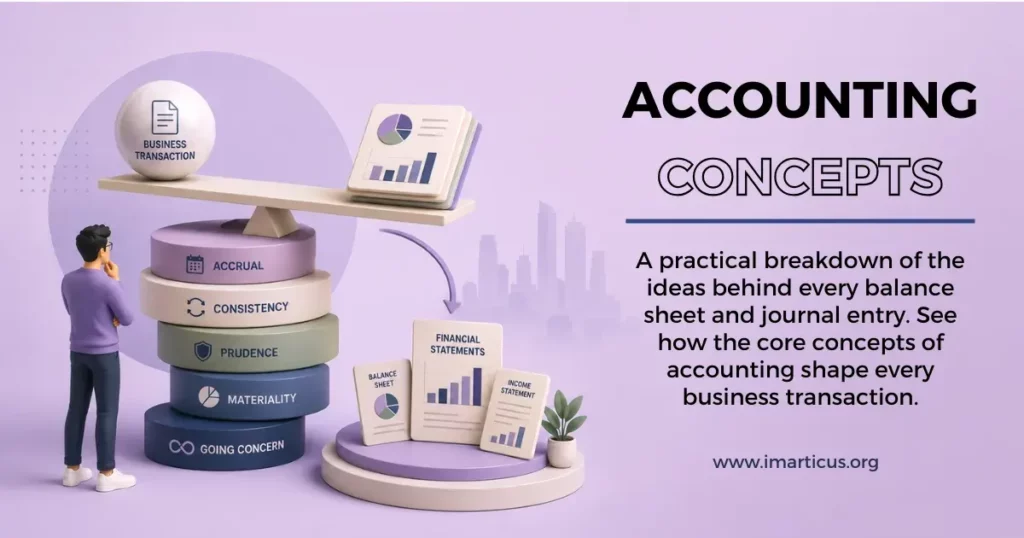
Every balance sheet you look at tells a secret story about where a company came from, where its cash is hiding, and whether its leaders are playing fair. When you pull back the curtain, the entire trillion-dollar global economy runs on a simple set of shared ground rules. Master those rules and accounting concepts, and you can spot a failing firm months before the stock crashes, or value a booming startup with razor-sharp accuracy. Miss them, and you are just staring at a wall of meaningless numbers.
Ever wondered why a tech giant can report billions in profit yet still run completely out of cash? Or why a founder cannot simply pull money from the business account to buy a personal car without the ledger throwing an alarm? That is where basic accounting concepts step in to separate actual economic reality from clever financial fiction. They build a uniform, universal language that allows an investor in London, an auditor in Mumbai, and a founder in New York to read the exact same statement and reach the same conclusion.
If you are aiming to build a high-impact career in corporate valuation, investment banking, or global reporting, memorising definitions won’t get you far on a real trading desk. You have to understand the deeper logic behind these frameworks. Enrolling in industry-designed finance courses helps you bridge that gap, turning simple textbook rules into high-value analytical skills. Let us strip away the academic jargon and break down the core concepts of accounting that turn raw ledger entries into powerful business strategy.
Did You Know?
Double-entry bookkeeping was first written down in 1494 by an Italian math teacher named Luca Pacioli. The core logic he published over 500 years ago powers modern accounting software today.
Don’t Let Our Best Advice Get Buried
Add Imarticus as a Preferred Source — see more of what we publish, every time you search.

What Are Accounting Concepts? Meaning And Core Purpose
An accounting concepts meaning boils down to a set of core assumptions that dictate how you record money matters. Think of them as the ground rules for bookkeeping. They make sure every business measures profit and loss using the exact same playbook. Without these basic ideas, every firm would invent its own method to calculate income. That would make it impossible to compare two businesses side by side.
Financial accounting concepts keep reports honest and objective. When a business presents its end-of-year numbers, investors rely on these concepts of accounting to judge performance. They know the figures reflect cold facts rather than creative guesses by the owner. These simple assumptions make sure that financial statements show actual performance instead of personal opinions.
In a nutshell→
Core Postulates → Operational Guidelines → Customary Practices
(Accounting Concepts) → (Accounting Principles) → (Accounting Conventions)
Example: Business Entity → Example: Revenue Recognition → Example: Conservatism (Prudence)
Differences Between Accounting Concepts vs. Principles vs. Conventions
People often mix up accounting principles and concepts with accounting conventions. They treat them like the same thing. But in reality, each term performs a totally different job when you balance a ledger.
An accounting concept is an absolute assumption you must make before you write down a single number. An accounting principle is a clear operational rule built on top of that assumption. An accounting convention is a traditional practical habit that accountants use to solve tricky reporting dilemmas.
| Reporting Element | Underlying Definition | Primary Purpose | Degree of Compliance | Real-World Application Example |
| Accounting Concepts | Basic assumptions and theoretical postulates forming the core foundation of bookkeeping. | Provides a uniform theoretical base for measuring transactions across all industries. | Mandatory across all standardised accounting frameworks. | Treating the business owner as a separate creditor for capital invested. |
| Accounting Principles | General rules derived from concepts to guide practical transaction recording. | Standardises ledger entries and financial statement presentation under GAAP/IFRS. | Strictly enforced by auditing bodies and corporate regulators. | Recording assets strictly at their historical acquisition cost. |
| Accounting Conventions | Established traditions or customs applied during financial statement compilation. | Resolves practical ambiguities during complex financial reporting tasks. | Followed by industry consensus and professional judgment. | Anticipating all potential future losses while ignoring unearned gains. |
Knowing the difference between these three terms stops you from making major reporting mistakes. It keeps your books aligned with strict legal guidelines.
Key Types of Accounting Concepts Every Business Needs
To really grasp how bookkeeping works, you should look closely at the primary rules that govern daily work. These rules decide how you measure, time, and write down every single penny that enters a firm.
Business Entity Concept
The business entity concept states that a firm is completely separate from the person who owns it. You cannot mix personal bank accounts with company money. Personal bills, family trips, and household goods must never touch the business ledgers.
If an owner takes cash out of the company till to pay personal house rent, you log that transaction as a capital reduction. You do not list it as a normal business expense. Keeping money streams separate ensures that your profit and loss account calculation reflects actual commercial activity.
In a nutshell→
Business Entity Concept In Practice
Owner Personal Funds ── (Capital Injection) → Business Bank Account
Business Operating Cash ── (Drawing Account) → Owner Personal Rent
Money Measurement Concept
The money measurement concept means you only record events that you can calculate in money terms. Qualitative assets like team spirit, brand loyalty, or smart leadership do not show up on a balance sheet because you cannot put a price tag on them.
When a company hires a brilliant top executive, the firm gains immense value. But you log zero value on the ledger until you actually pay out salary checks. This rule keeps financial reports objective, even if it ignores intangible assets that do not carry a clear purchase tag.
Going Concern Concept
The going concern concept assumes that a firm will stay in business for a very long time. You act as if the firm will not close down or sell off its assets tomorrow. Because of this basic rule, you record long-term gear at purchase cost minus annual wear and tear. You do not list it at panic sale prices.
GOING CONCERN VS. LIQUIDATION ASSUMPTION
- Going Concern Status: Machinery is recorded at its Net Book Value (NBV) and depreciated over its estimated 10-year useful life.
- Liquidation Status: Machinery is immediately written down to its current distress sale value, reflecting the amount expected from a quick sale.
Without this assumption, every firm would have to recalculate its worth at liquidation prices every month.
Accounting Period Concept
The accounting period concept breaks the long life of a firm into short, equal time spans like months or years. No one wants to wait twenty years until a firm closes to find out if it made money. Breaking time into chunks helps owners review progress, pay taxes, and compare seasonal performance. Set time spans force you to close your books regularly and figure out true net earnings.
A BCom alone no longer guarantees premium corporate roles. Adding recognised global credentials equips you with the practical skills needed to command high-paying international opportunities.
Expanding Key Types of Accounting Concepts
Moving forward with types of accounting concepts, we need to cover valuation rules and entry mechanics. These ideas provide clear accounting concepts with examples that pop up in daily office work.
Cost Concept / Historical Cost
The cost concept states that you must record an asset at its original purchase price. You keep that initial cost on the books rather than changing the value whenever market prices move.
If your firm buys a small plot of land for 500,000 pounds in 2015, you keep it logged at 500,000 pounds. You leave it at that number even if local property values double over the next ten years. Sticking to original purchase costs stops companies from inflating asset numbers based on wild market guesses.
Dual Aspect Concept
The dual aspect concept is the core rule behind double-entry accounting and bookkeeping. It states that every single transaction affects two different accounts at the exact same time. This rule gives us the fundamental accounting formula:
Assets = Liabilities + Owner’s Equity
If your firm takes out a bank loan for 100,000 pounds, your bank cash asset goes up by 100,000 pounds. At the exact same time, your loan debt liability goes up by 100,000 pounds.
DUAL ASPECT TRANSACTION MECHANICS
- Transaction: £100,000 Bank Loan Received
- Debit: Cash Account (+£100,000 Asset) ↔ Credit: Bank Loan (+£100,000 Liability)
Every financial move keeps this balance intact, which stops ledgers from falling out of alignment.
Revenue Recognition Concept (Realisation)
The revenue recognition concept says you record sales income when you complete the job, not when cash arrives in your hand. You earn income the moment you hand over products or complete a service for a customer. If your team completes a software job in December, you write down the revenue in December. You record it then even if the buyer pays the bill in February.
| Transaction Stage | Operational Event | Revenue Status | Financial Ledger Impact |
| Order Placement | Client signs contract for custom equipment. | Unearned Revenue | No income statement entry; contract logged. |
| Production Phase | Equipment is manufactured in the factory. | Work-In-Progress | Costs recorded in inventory asset accounts. |
| Delivery & Handover | Equipment delivered and accepted by client. | Revenue Recognized | Sales income credited; Accounts Receivable debited. |
| Cash Settlement | Client settles invoice via bank transfer. | Cash Realized | Accounts Receivable credited; Cash debited. |
This timing rule stops business owners from shifting sales records into different months to make earnings look better.
Matching Concept
The matching concept demands that you record all production costs in the exact same period as the income those costs created. If you pay a worker a cash commission for a sale made in March, you must record that commission cost in March. You log it then even if you print the commission check in April. Matching sales directly with production costs gives everyone a clear view of real monthly profit.
Accrual Basis Concept
The accrual basis concept combines sales timing and expense matching into one simple system. You record economic moves when they happen instead of waiting for cash to move. Unlike simple cash methods, accrual accounting tracks unpaid bills and money owed to you. That gives you a full view of your financial health.
ACCRUAL VS. CASH BASIS TIMING FLOW
Accrual Basis
Transaction occurs
↓
Record immediately in the current period ledger
Cash Basis
Transaction occurs
↓
Wait for cash transfer
↓
Record in the ledger
Most corporate laws require accrual accounting because simple cash logs can hide unpaid bills very easily.
Full Disclosure Concept
The full disclosure concept requires you to print all important facts in your reports so readers can make smart choices. If a firm faces a major legal suit that could cost thousands of pounds, you must list that threat in the report notes. Full transparency builds trust with investors and keeps executives from hiding operational problems.
Consistency Concept
The consistency concept forces a business to stick with the exact same accounting methods year after year. If you choose a specific method to calculate tool wear, you must use that method next year too. You cannot jump around without a valid legal reason. Changing your setup every year ruins historical records and makes it impossible to track true growth over time.
Conservatism / Prudence Concept
The conservatism concept tells you to play it safe by planning for potential future losses while ignoring unearned gains. When inventory stock values drop below purchase cost, you write down that inventory loss right away.
CONSERVATISM CONCEPT RULE ENGINE
Potential Loss Identified
↓
Record expense immediately
Potential Gain Identified
↓
Recognise only when realised (or sufficiently certain under the applicable accounting framework).
This cautious approach keeps your overall asset values realistic, protecting lenders from surprise losses later on.
Materiality & Objectivity Concepts
The materiality concept allows you to skip complex asset tracking for cheap items if those items do not impact major choices. Meanwhile, the objectivity concept demands that every ledger entry have solid physical proof like a paper receipt or bank record.
Buying a 15-pound stapler gets logged as an immediate office cost rather than a long-term asset depreciated over ten years. That small amount does not impact big choices. Having real proof for every line item keeps your accounting records clean and audit-ready.
DOCUMENTATION AND AUDIT TRAIL WORKFLOW
Source Document (Invoice/Receipt) → Ledger Entry → Independent Audit Verification
Paper receipts and digital invoices give external auditors a clear paper trail to double-check your claims.
Special Application: Accounting for Partnership Basic Concepts
When you transition from a single-owner store to a partnership firm, applying accounting for partnership basic concepts requires specialised ledger tools to track shared capital. Partnership setups require special entries to distribute annual net profits, charge interest on personal cash draws, and handle firm goodwill when partners join or leave.
| Partnership Element | Accounting Treatment | Primary Concept Applied | Impact on Partner Equity |
| Capital Contributions | Credited to individual partner capital accounts upon deposit. | Business Entity Concept | Increases overall partner equity balance directly. |
| Profit & Loss Distribution | Allocated strictly according to agreed partnership deed ratios. | Dual Aspect Concept | Adjusts current partner equity accounts annually. |
| Interest on Drawings | Debited from partner accounts to prevent excessive personal withdrawals. | Business Entity Concept | Reduces partner capital while boosting firm income. |
| Goodwill Revaluation | Adjusted across existing capital accounts when partners change. | Cost & Valuation Concepts | Realigns partner equity to reflect true firm value. |
Applying basic accounting concepts to shared businesses stops arguments between co-owners and keeps ownership records clear.
PARTNERSHIP CAPITAL FLOW ARCHITECTURE
Firm Net Income → Profit Sharing Ratio Engine → Credit Partner A Capital Account / Credit Partner B Capital Account
Setting up clear partner accounts early helps growing firms avoid messy legal fights down the road.
Also Read: The Step-by-Step Process to Balance a Bank Reconciliation Statement
Connecting Accounting Concepts and Principles to Global Standards
Modern firms do not operate on isolated islands, making it crucial to align local rules with global frameworks like US GAAP and IFRS. Global standards adapt these core ideas into strict rules so multinational firms can publish comparable financial reports in any country. Knowing these fundamental building blocks gives you the confidence to manage books across international borders.
Even after earning traditional credentials like Chartered Accountancy, top financial professionals look for global qualifications to build high-level careers. Practical training like the Investment Banking, ACCA, or CFA programs prepares you to lead corporate strategy anywhere in the world.
Compensation & Career Progression by Qualification Trajectory
| Qualification / Credential | Primary Job Roles | Entry-Level Salary Range (0-2 Yrs) | Senior Leadership Salary Range (8+ Yrs) |
| ACCA (Association of Chartered Certified Accountants) | Audit Associate, Financial Analyst, IFRS Reporting Lead, Controller | ₹4.5 LPA – ₹8.0 LPA | ₹25.0 LPA – ₹50.0+ LPA |
| US CPA (Certified Public Accountant) | US Tax Consultant, Corporate Accountant, SOX Auditor, FP&A Manager | ₹6.0 LPA – ₹10.0 LPA | ₹22.0 LPA – ₹45.0+ LPA |
| CFA (Chartered Financial Analyst) | Investment Banking Analyst, Portfolio Manager, Equity Research Lead | ₹6.5 LPA – ₹12.0 LPA | ₹28.0 LPA – ₹60.0+ LPA |
| US CMA (Certified Management Accountant) | Management Accountant, Cost Controller, Finance Manager, FP&A Lead | ₹5.5 LPA – ₹9.0 LPA | ₹20.0 LPA – ₹38.0+ LPA |
| CIBOP / IB Ops (Investment Banking Operations) | Trade Settlement Analyst, Risk Analyst, IB Operations Lead | ₹4.0 LPA – ₹7.5 LPA | ₹18.0 LPA – ₹32.0+ LPA |
Knowing how to apply basic concepts across corporate setups elevates simple record-keeping into high-level business strategy.
Choosing between ACCA, CFA, FRM, or CMA determines your 2025 earning ceiling. Aligning the right global qualification with your career goals turns a basic B.Com into high-paying corporate roles.
Why Choose Imarticus Learning For Finance Courses?
Textbooks teach you the formulas, but they rarely show you what it actually feels like to handle a trade settlement, build a dynamic valuation model under deadline, or field tough questions in a corporate boardroom. That gap between theoretical passing marks and real-world desk readiness is precisely where the finance courses offered by Imarticus Learning step in, transforming complex financial concepts into practical job execution.
- 1,500+ Corporate Hiring Partners: You get direct access to an expansive network of hiring managers across global investment banks, Big 4 accounting firms, and financial institutions looking for desk-ready talent.
- Guaranteed Interview Program: For job-focused tracks, the platform backs its curriculum with up to 7 guaranteed interview opportunities upon completion, taking the guesswork out of job hunting.
- Training by Industry Practitioners: You learn directly from veteran investment bankers, chartered accountants, and finance leaders who bring live deal structures and daily operational scenarios into the classroom.
- Official Global Partner Status: Recognised as an approved prep provider for gold-standard credentials like ACCA, CFA, and US CMA, ensuring your study plan mirrors official, updated exam frameworks.
- Practical Tool Mastery: Coursework embeds hands-on practice with the exact tools modern finance teams rely on daily, including Advanced Excel, Financial Modelling, Power BI, and SQL.
- End-to-End Placement Support: Dedicated career managers work with you individually to overhaul your resume, polish your LinkedIn presence, and run rigorous technical mock interviews until you are ready to impress hiring panels.
FAQs About Accounting Concepts
Got quick doubts about how these financial rules work in real life? Below are straightforward answers to the most frequently asked questions about core accounting concepts, helping you clear up any confusion and see how these guidelines apply to everyday business setups.
What are accounting concepts?
The accounting concepts meaning refers to the core rules and assumptions that guide how you log financial moves. These concepts keep financial statements consistent, objective, and easy to read across different reporting years and global markets.
What are the five basic accounting concepts?
The five basic accounting concepts are the Business Entity concept, Money Measurement concept, Going Concern concept, Accounting Period concept, and Dual Aspect concept. These core assumptions build the foundational base for double-entry bookkeeping.
What are the 12 concepts of accounting?
The primary accounting concepts include Business Entity, Money Measurement, Going Concern, Accounting Period, Historical Cost, Dual Aspect, Revenue Recognition, Matching, Accrual, Full Disclosure, Consistency, and Conservatism. Using them keeps your balance sheets accurate and compliant.
What is the difference between accounting concepts and accounting principles?
The main difference between accounting concepts and conventions comes down to their purpose. Concepts are theoretical assumptions that form the foundation of bookkeeping. Principles are practical rules derived from those assumptions under GAAP and IFRS guidelines.
What is the basic concept of accounting?
The core concept of accounting is the Dual Aspect concept. It states that every transaction impacts two distinct accounts equally. This fundamental rule gives us the balance sheet formula where assets always equal liabilities plus equity.
How many accounting concepts are there?
Most financial textbooks cover 12 to 13 core accounting concepts in detail. Specialised career courses at Imarticus Learning show you how to apply these basic concepts across real corporate scenarios and modern software tools.
What are the four concepts crucial to accounting?
The four critical concepts in bookkeeping are Going Concern, Accrual, Business Entity, and Matching concepts. Together, these four rules govern how you track asset values, record debts, and measure real profit.
What are the most important skills an accountant should have?
Key accounting skills include financial analysis, deep knowledge of accounting concepts, ERP software skills, and regulatory compliance know-how. Industry training programs at Imarticus Learning help you master these technical skills quickly.
Taking Your Accounting Concepts From Paper to Practice
Knowing the definition of matching principles or going concerns is a great starting point, but book knowledge alone won’t run a trading desk or balance a multinational ledger. The real magic happens when you move past memorising rules and start seeing how these foundational ideas shape actual business decisions, valuation models, and financial reports.
Grasping these core rules is essential if you want to analyse business numbers, run a company, or plan corporate budgets. These rules convert raw bank moves into a clear financial story that managers, bankers, and investors can rely on.
Mastering these basic building blocks is your first real step toward a strong financial career. Whether you manage company books, review corporate mergers, or lead global finance teams, knowing these core concepts sets you up for long-term success.
If you are ready to take these core principles off the textbook page and build a career in investment banking, financial analysis, or global accounting, having the right guidance makes all the difference. Exploring the practical, career-focused finance courses at Imarticus Learning can help you bridge that gap between theory and execution, giving you the real-world toolset, hands-on practice, and hiring network you need to step confidently into your next role.
Liked This? Follow Us Where You Already Search.
Preferred Sources is Google’s built-in follow button — no app, no login, just more Imarticus in your results.