



Last Updated on 2 weeks ago by Imarticus Learning
You’ve put in the work. Maybe you’ve cleared a few ACCA papers, maybe you’ve just crossed the finish line on the full qualification. Either way, you’re now sitting with something real – a skill set that travels, and possibly a plan that involves Germany. When finance professionals start thinking seriously about working in Germany, the salary question comes up fast. And it should. They want to know if the numbers add up.
Germany is a serious country for finance careers. It has the largest economy in Europe, a corporate sector that genuinely respects professional qualifications, and a job market that spans everything from global investment banks in Frankfurt to precision-engineering multinationals in Munich. But it also has its own rules, its own qualification hierarchy, and its own way of deciding who gets paid what.
Considering ACCA?
Get personalized guidance on your ACCA journey—eligibility, exam roadmap, and career outcomes in a 15-minute call with our expert counsellor.
No commitment required • 200+ students counselled this month
Senior ACCA professionals in Germany can earn €100,000+ annually, making it one of the most attractive finance careers in Europe.
The ACCA salary in Germany is competitive, but it doesn’t land the same way for everyone with an ACCA certification, and the gap between a well-prepared move and an underprepared one is wider here than in most markets.
I’ll walk you through the ACCA salary in Germany at every career stage, break down which sectors and cities pay the most, explain the qualification dynamics that every ACCA professional should understand before relocating, and the things that will quietly cap your salary if you don’t plan around them and give you an honest picture of what drives salaries upward once you’re inside the market.
Did you know?
Germany is currently facing a shortage of skilled finance and accounting professionals, with over one-third of companies reporting difficulty finding qualified workers, particularly those with accounting expertise. (Source: ACCA Global’s Accounting and Business magazine)
The Finance Market in Germany
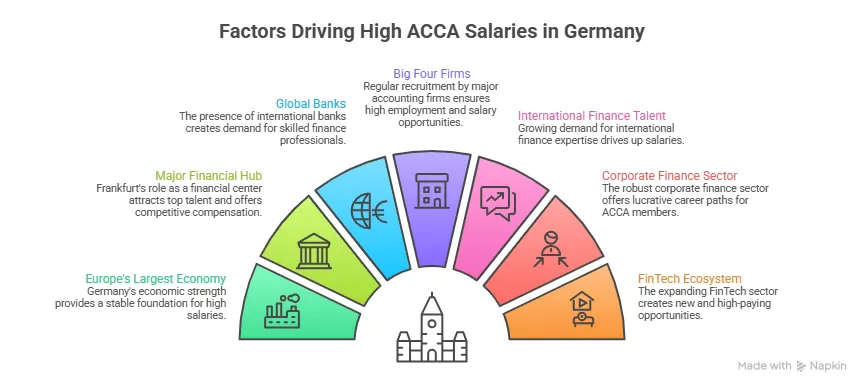
Before we get into numbers and see the ACCA salary in Germany, here’s the thing about Germany that most salary guides skip over: the country has a dual employment economy when it comes to finance.
Most salary guides treat Germany as one job market. It isn’t. There are two quite different employment worlds running alongside each other, and which one you’re targeting will shape your salary more than almost anything else.
- The first is the multinational layer – DAX corporations, Big Four firms, international banks, global consultancies, and the fintech companies that have made Frankfurt, Berlin, and Munich increasingly competitive with London and Amsterdam. These employers benchmark salaries internationally. They hire globally. ACCA is part of their vocabulary, and they factor it into their offers.
- The second is the Mittelstand / SMEs – Germany’s dense network of mid-sized, often family-owned businesses that produce everything from industrial machinery to speciality chemicals. These companies are genuinely excellent employers in many respects. ACCA isn’t always on their radar, not because it’s weak, but because they’ve never needed to think about it.
Understanding which side of this divide you’re targeting is one of the most practically important decisions you’ll make when planning your ACCA salary in Germany. It shapes everything from which roles to apply for to how you position the credential in an interview. Once you are clear with that and understand, what is ACCA? We can start seeing the salaries to get a deeper understanding.
Also Read: Understand ACCA Eligibility and plan your exemptions smartly.
ACCA Salary in Germany by Career Stage
Let me give you the figures that reflect what the market is currently paying, along with the context that makes the ACCA salary in Germany figures useful.
| Experience Level | Years of Experience | Gross Annual Salary | Monthly Salary Before Tax |
| Entry Level | 0 to 2 Years | €35,000 to €48,000 | €2,900 to €4,000 |
| Mid Level | 3 to 5 Years | €50,000 to €70,000 | €4,100 to €5,800 |
| Senior Level | 6 to 9 Years | €70,000 to €95,000 | €5,800 to €7,900 |
| Leadership Roles | 10 Years and Above | €100,000 to €160,000+ | €8,300 to €13,300+ |
If you want a clear breakdown of how to plan your ACCA exams step by step, watch the quick video below.
City-by-City: Where the ACCA Salary in Germany Is Highest
Germany is not one salary market. There are several running in parallel. Where you work inside the country has a significant impact on compensation, and getting this right matters.
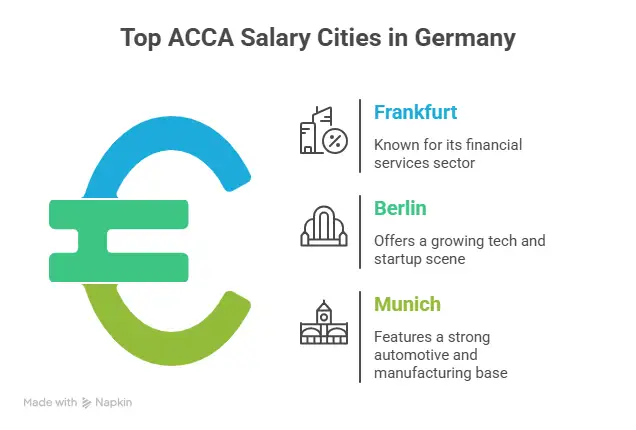
Frankfurt
Frankfurt is Germany’s financial capital. The European Central Bank is headquartered here. Deutsche Bank, Commerzbank, and the German offices of most global investment banks operate here. The ACCA salary in Germany reaches its highest consistent levels in Frankfurt, particularly for professionals working in banking, treasury, asset management, and financial risk.
Salaries in Frankfurt typically run 15 to 20% above the national average for equivalent finance roles. If you are ACCA-qualified and targeting a finance career in Germany, Frankfurt gives you the largest addressable employer pool and the most internationally benchmarked compensation structures.
Munich
Munich is the headquarters city for Germany’s insurance giants – Allianz and Munich Re – as well as major industrial corporations including BMW, Siemens, and MAN. The ACCA salary in Germany’s Munich market is strong, particularly in corporate finance, controllership, and internal audit roles at these large employers.
Munich also has a growing private equity and venture capital scene that values professionals with strong analytical and planning skills. What I’ve observed is that ACCA professionals who combine their qualification with the German language find Munich particularly more acceptable. The city’s corporate culture is slightly more traditional and places greater emphasis on local professional fluency.
Berlin
Berlin has transformed over the past decade into Germany’s technology and startup capital. N26, Zalando, Delivery Hero, and dozens of well-funded fintech and e-commerce companies are headquartered here. The ACCA salary in Germany’s Berlin market sits slightly below Frankfurt in absolute terms, but often includes equity components, options and RSUs, that can add substantial value in high-growth companies.
Here’s the thing about Berlin for ACCA professionals: the city is more internationally oriented than almost anywhere else in Germany. English is far more commonly used as a working language. This makes Berlin more accessible for internationally qualified professionals who are still building German language proficiency.
Hamburg and Düsseldorf
Both cities offer solid finance employment markets, particularly in trading, logistics, retail, and FMCG. The ACCA salary in Germany’s Hamburg market is competitive in international trade finance and shipping sector roles. Düsseldorf has a large Japanese and Asian business community and a strong consultancy presence.
Salaries in these cities are typically 5 to 10% below Frankfurt and Munich for comparable roles, but the cost of living is also slightly lower.
Also Read: Understand how ACCA subjects shape your accounting career.
Which Industry And Sectors Pay ACCA Professionals the Most?
Banking and financial services consistently sit at the top of the ACCA salary in Germany, and the reasoning tracks directly with what ACCA trains for. Germany’s banking sector – particularly in Frankfurt – demands professionals who can handle multi-currency reporting, regulatory capital calculations, IFRS-compliant financial statements, and risk management frameworks. The ACCA syllabus maps onto all of these. That alignment is why employers in this sector consistently offer above-average compensation to ACCA-qualified professionals.
| Industry | Annual Gross Salary Range | Trajectory |
| Banking and Financial Services | €70,000 – €120,000 | High |
| Consulting and Advisory | €65,000 – €110,000 | High |
| Technology and Fintech | €60,000 – €100,000 | Fast Growing |
| Automotive and Manufacturing | €55,000 – €90,000 | Stable to High |
| Pharmaceutical and Healthcare | €55,000 – €85,000 | Growing |
| Energy and Utilities | €58,000 – €92,000 | Stable |
| Retail and FMCG | €50,000 – €80,000 | Moderate |
(Sources: LinkedIn Salary Insights Germany)
Consulting is the other strong performer. McKinsey, BCG, Deloitte, PwC, EY, and KPMG all have significant German presences, and finance advisory roles within these firms benchmark against global compensation structures rather than purely domestic German norms. From what I’ve seen, ACCA professionals who enter consulting in Germany often find that their salary trajectory accelerates faster than peers in industry roles, largely because consulting firms have structured promotion cycles with corresponding pay steps.
The video below explains some of the best free ACCA resources and how students can use them effectively while preparing for the exams.
How The ACCA Qualification Fits in Germany Landscape
I’ll be direct about ACCA after graduation, which doesn’t always get addressed in salary guides aimed at ACCA professionals: Germany has its own well-regarded accounting qualification ecosystem, and understanding how ACCA sits within it will save you a lot of uncertainty.
The primary German-specific qualifications are:
- Steuerberater – a tax advisor certification that requires passing a notoriously difficult state exam. This is the dominant qualification for tax-focused roles in Germany.
- Wirtschaftsprüfer – the German statutory auditor designation. This is required to sign off on German company audits.
- Bilanzbuchhalter – a balance sheet accountant certification, widely valued in Mittelstand and mid-market employer contexts.
ACCA does not replace these credentials for roles that specifically require them. If you want to sign German statutory audit opinions or practice as a German tax advisor, you will need the relevant German qualification.
However, this matters significantly for where the ACCA salary in Germany is most competitive – the majority of corporate finance roles inside multinational companies, Big Four firms, and financial services do not require these German-specific credentials. They require strong financial reporting knowledge, IFRS competency, analytical capability, and business judgment. That is precisely what ACCA provides.
The professionals I’ve seen struggle in Germany are those who assumed ACCA would be universally understood and valued without doing the groundwork on employer type. The ones who thrive are those who target their job search toward environments where international qualifications are part of the normal hiring vocabulary and then build from there.
Also Read: How every aspirant should plan ACCA course fees smartly.
Role-by-Role Salary Guide for ACCA Professionals in Germany
When looking at the ACCA salary in Germany by roles. What I often see is that ACCA professionals who gravitate toward FP&A early in their careers reach senior compensation levels faster than those who stay in pure financial accounting or audit. The reason is structural: FP&A roles are inherently cross-functional, they require communication with business unit leadership, and they have a direct line to strategy. Employers value that positioning and pay for it.
| Role | Monthly Gross (€) | Annual Gross (€) |
| Junior Financial Analyst | €2,900 – €3,800 | €34,800 – €45,600 |
| Cost Accountant | €3,000 – €4,000 | €36,000 – €48,000 |
| Senior Financial Analyst | €4,200 – €5,800 | €50,400 – €69,600 |
| FP&A Manager | €5,500 – €7,500 | €66,000 €90,000 |
| Finance Manager | €6,000 – €8,500 | €72,000 – €102,000 |
| Financial Controller | €7,000 – €10,000 | €84,000 – €120,000 |
| Head of Finance / CFO | €10,000 – €16,000+ | €120,000 – €192,000+ |
(Sources: StepStone Finance Salary Report Germany, Glassdoor Germany)
The FP&A and Financial Controller tracks consistently show the strongest salary trajectories for ACCA professionals. Both roles place the professional at the intersection of financial data and business decision-making, which is exactly what the ACCA qualification is designed for.
Also Read: How to strategically study challenging ACCA course subjects.
The German Language Factor
If there is one practical factor that most internationally qualified professionals underestimate when planning their career in Germany, it is language. And I say this not to discourage anyone, but because the impact on salary and opportunity is too significant to gloss over.
Germany is not the Netherlands or Scandinavia, where English has become functionally equivalent to the local language in many business environments. German remains the primary working language in most corporate settings outside of specifically international-facing roles or explicitly English-first companies like Berlin-based tech startups.
Here’s the thing: even in multinational companies where English is the official working language, fluency in German creates a material advantage. Being able to read a German commercial contract, participate in a management meeting conducted in German, or build credibility with a German-speaking client team is not a soft bonus – it directly affects how quickly you advance and, therefore, how quickly your ACCA salary in Germany grows.
From what I’ve seen, ACCA professionals with B2 to C1 German proficiency consistently receive offers 10 to 15% above comparable candidates without that skill in employer environments where German is the predominant language. That premium compounds significantly across a five to ten-year ACCA career.
One practical approach: if you’re planning a move to Germany within the next two years, begin German language study immediately. Reaching B2 level takes 600 to 750 hours of study. Starting now means arriving in the market with a genuine advantage.
The quick video below explains practical strategies to prepare for Big Four interviews and how ACCA students can improve their chances of getting selected.
ACCA Salary in Germany in Rupees
For Indian finance professionals evaluating the German option, here is the comparison of ACCA salary in Germany in rupee terms, so they can compare it with the ACCA salary in India.
| Career Stage | Monthly Gross (€) | Annual Gross (€) | ~Annual Gross (INR) |
| Entry Level (0-2 years) | €2,900 – €4,000 | €34,800 – €48,000 | ₹31 – 43 LPA |
| Mid-Level (3-5 years) | €4,200 – €5,800 | €50,400 – €69,600 | ₹45 – 63 LPA |
| Senior (6-9 years) | €5,800 – €8,000 | €69,600 – €96,000 | ₹63 – 86 LPA |
| Leadership (10+ years) | €10,000 – €16,000+ | €120,000 – €192,000+ | ₹1.08 Cr – 1.73 Cr+ |
I’ll be direct: the INR conversion looks compelling, but Germany’s income tax structure means the net take-home is around 60 to 65% of gross. That said, Germany also provides universal healthcare, strong pension contributions, and a social infrastructure that has genuine financial value over a long career horizon. The effective compensation picture, when you factor in the value of those benefits, is stronger than the raw net salary figure suggests.
Also Read: How the right ACCA books can help you prepare effectively.
Skills To Boost Your ACCA Salary in Germany
The ACCA salary in Germany has enough range at every experience level that the skills you bring beyond the credential make a meaningful difference in where you land within it.
- SAP Proficiency: SAP was founded in Germany and remains deeply embedded in German corporate systems. SAP FI (Financial Accounting) and CO (Controlling) modules are used across DAX companies, major Mittelstand employers, and multinational subsidiaries. An ACCA professional who is SAP-competent shortens their onboarding curve significantly. Employers recognise this and price it accordingly.
- IFRS Application Depth: Germany adopted IFRS for consolidated reporting of listed companies in 2005, and many large employers expect finance professionals to apply it with confidence. CMAs who combine management accounting skills with a strong working knowledge of IFRS 15 (revenue recognition), IFRS 16 (leases), and IFRS 9 (financial instruments) are particularly valued in controller and reporting roles.
- Financial Modelling and Scenario Analysis: Germany’s manufacturing and energy sectors require detailed long-range financial planning that goes well beyond standard budgeting. Professionals who can build integrated financial models – connecting P&L, balance sheet, and cash flow projections under multiple scenarios are valued across automotive, chemical, and industrial employers.
- Power BI and Data Visualisation: FP&A and finance business partner roles in Germany increasingly expect candidates to communicate financial insights visually. The ability to build executive-ready dashboards in Power BI, translate month-end close data into a clear leadership narrative, and present financial complexity without losing clarity is a skill that visibly accelerates promotion timelines.
- German Language (B2 and Above): As discussed, this is not just a differentiator – it is progressively becoming a baseline expectation in many German corporate environments outside the tech sector.
Also Read: Everything you should know before enrolling in ACCA online courses.
What the Early Years in Germany Actually Look Like
I want to give you an honest picture of what the first two to three years of an ACCA career in Germany typically involve, because the entry-level salary figures don’t tell the full story.
Germany’s corporate culture is structured and methodical. Hierarchies are respected. Finance teams tend to have clearly defined functional boundaries – the person doing the on-the-end close is not typically the person presenting to the CFO. This is different from more flat-structured environments in the UK or parts of Southeast Asia, and it affects how quickly junior professionals gain visibility.
What I often see is ACCA professionals who arrive with strong technical skills but underestimate the importance of demonstrating patience and thoroughness in the German work context. Showing up and immediately trying to redesign processes, skip steps, or move at a pace that outstrips the team culture rarely lands well. Earning trust through consistent, accurate work first – and then demonstrating strategic capability once that trust is established – is the sequence that works.
The professionals who move from the €38,000 entry-level band to the €60,000 mid-level band in three to four years rather than five to six are typically those who read the work culture correctly and invested early in relationships, not just output.
Also Read: What the ACCA fresher’s salary in India looks like.
Germany vs Other International Markets for ACCA Professionals
The UAE Dubai market wins on net take-home income at every career stage due to zero income tax. The UK remains the most natural market for ACCA professionals, given that the ACCA course is a British qualification with its deepest recognition there. Canada offers strong long-term prospects, particularly for professionals seeking permanent residency.
Germany’s specific advantage is long-term stability, the quality of its social infrastructure, and the strength of its manufacturing and industrial finance sector, which creates a type of finance career depth that is harder to find in more services-dominated economies.
| Factor | Germany | UAE (Dubai) | UK | Canada |
| Average Mid-Level Salary | €55,000 – €75,000 | AED 168,000 – 264,000 | £45,000 – £60,000 | CAD 75,000 – 95,000 |
| Tax Rate (Approx.) | 30 – 42% | 0% | 20 – 40% | 20 – 33% |
| ACCA Recognition | Strong in MNCs & Big 4 | Very Strong | Very Strong | Growing |
| Language Barrier | Significant | Low | None | None |
| Social Benefits | Excellent | Limited | Good | Good |
| Long-term Stability | Very High | High | High | High |
| Career Growth Speed | Structured | Fast | Structured | Structured |
Also Read: How ACCA salary in the USA compares with ACCA salary in Germany.
What Can You Expect in 10 Years?
Let me map this out practically, of how the ACCA salary in Germany grows. An ACCA-qualified professional entering Germany at age 26 or 27, starting at €38,000 gross:
- Years 1 to 3: Building technical competence, establishing credibility, and learning the corporate culture. Salary moves from €38,000 to €48,000 as experience deepens and language improves.
- Years 4 to 6: First significant role upgrade – from analyst to manager track. Salary moves into the €55,000 to €70,000 range. This is where employer type has its biggest impact on trajectory.
- Years 7 to 9: Senior manager or controller level. Salary reaches €75,000 to €95,000 with performance bonuses. At this point, the financial life in Germany – including pension contributions, property purchase potential, and career stability starts to look very different from where it began.
- Year 10 and beyond: Finance Director or CFO-track roles. €120,000 and above becomes realistic for professionals who have stayed on a planning-and-control-oriented career path.
This trajectory of ACCA salary in Germany is not automatic, but it is entirely achievable for someone who arrives well-prepared, targets the right employer segment, invests in German language, and builds their career deliberately.
Why Imarticus Learning for Your ACCA Preparation
Preparing for the ACCA program is one decision. Choosing where to prepare is another, and it has a direct bearing on how quickly you clear the exams and how well-positioned you are when you enter the job market.
Imarticus Learning offers an industry-led ACCA preparation program built in collaboration with KPMG in India, and all students earn a joint certification on program completion. They combine structured exam coaching with real-world finance exposure in a way that most standalone coaching programs simply don’t.
- Imarticus is an ACCA Gold Status Learning Partner.
- The course material is powered by Kaplan, the largest ACCA-approved content provider globally.
- The top performers gain access to internship opportunities at KPMG in India.
- The program also includes a pre-placement bootcamp, soft skills training, resume support, and assured interview opportunities.
Imarticus is built to get you through the exams and into the job market with more than just a certificate.
FAQs About ACCA Salary in Germany
The decision to pursue an ACCA career in Germany comes with a lot of specific questions. The frequently asked questions below address what finance professionals most commonly ask when evaluating ACCA salary in Germany, to help you understand how the market actually works.
What is the average ACCA salary in Germany at the entry level?
The entry-level ACCA professionals in Germany typically earn between €35,000 and €48,000 gross annually. After income tax, social security, and health insurance deductions, the net take-home is typically 60 to 65% of the gross figure. In rupee terms, the gross entry-level band converts to approximately ₹31 to 44 LPA.
Is ACCA recognised by German employers?
ACCA is recognised and valued in Germany. Multinational companies, Big Four firms, international banks, and global consultancies operating in Germany are familiar with ACCA and factor it into their hiring decisions. Targeting your job search toward multinational employers is the most reliable path to having ACCA recognised at its full value.
Does ACCA allow you to practice as a statutory auditor or tax advisor in Germany?
No. Signing German statutory audit opinions requires the WP designation(German Public Auditor), and practising as a German tax advisor requires the StB qualification. ACCA does not substitute for either of these credentials. However, the large majority of corporate finance roles – financial reporting, FP&A, controlling, treasury, and advisory – do not require these German-specific credentials, and this is where ACCA professionals are most competitive.
How important is German language proficiency for ACCA professionals?
It is far more important than most salary guides acknowledge. Outside of specifically international roles and Berlin-based tech companies, German remains the primary working language in most corporate environments. ACCA Professionals with B2 to C1 proficiency consistently receive offers 10 to 15% above comparable candidates without that skill in German-speaking employer environments. More significantly, language fluency accelerates your ability to build relationships, gain visibility, and progress into senior roles – which is where the real salary compounding happens.
How does the ACCA salary in Germany compare to the UAE?
The UAE wins clearly on net take-home income at every career stage, because Dubai has no income tax. A comparable mid-level salary in Dubai results in significantly higher monthly take-home than the same gross figure in Germany. Germany’s advantage lies in long-term career depth, particularly in manufacturing, industrial finance, and corporate controllership, combined with universal healthcare, strong pension contributions, and exceptional career stability.
What skills lift ACCA salaries above the median in Germany?
SAP proficiency (particularly FI and CO modules), strong working knowledge of IFRS 16, IFRS 15, and IFRS 9, financial modelling capability, Power BI for data visualisation, and German language proficiency at B2 level or above. These skills don’t just increase your starting salary, but they also determine how quickly you move from analyst to manager level. Candidates who arrive with two or three of these already developed consistently land in the upper half of salary bands at every career stage.
Can Indian finance professionals with ACCA realistically build a career in Germany?
Yes, and many have done so successfully. The professionals who struggle are generally those who assume ACCA will be universally understood without doing this groundwork. The ones who thrive treat the German move as a strategic decision and prepare for it as such. You can get certified from Institutes like Imarticus Learning, target Big 4 employers, and work actively on German language development before arriving in the German market.
Is the ACCA Salary in Germany Worth Pursuing?
Germany is not the easiest international market for ACCA professionals to break into. The language requirement is real. The qualification hierarchy is different. The corporate culture has specific expectations that take time to understand. Anyone who tells you otherwise is oversimplifying.
But the ACCA salary in Germany – particularly in Frankfurt, Munich, and Berlin, within multinational employers and Big Four firms – is genuinely competitive. The social infrastructure adds value that doesn’t show up in salary tables. The career stability is exceptional. And for ACCA professionals who invest in the groundwork – German language, SAP proficiency, and deliberate employer targeting, the medium and long-term financial outcomes are strong.
From what I’ve seen, the professionals who do best in Germany are those who treat it as a strategic decision rather than a reactive one. They research the market properly, they prepare the supporting skills, and they arrive with a clear sense of which part of the German economy they’re targeting and why. If you’re willing to do that work to earn a high ACCA salary in Germany, the ACCA course rewards it in a way that is genuinely sustainable in the German market.
