


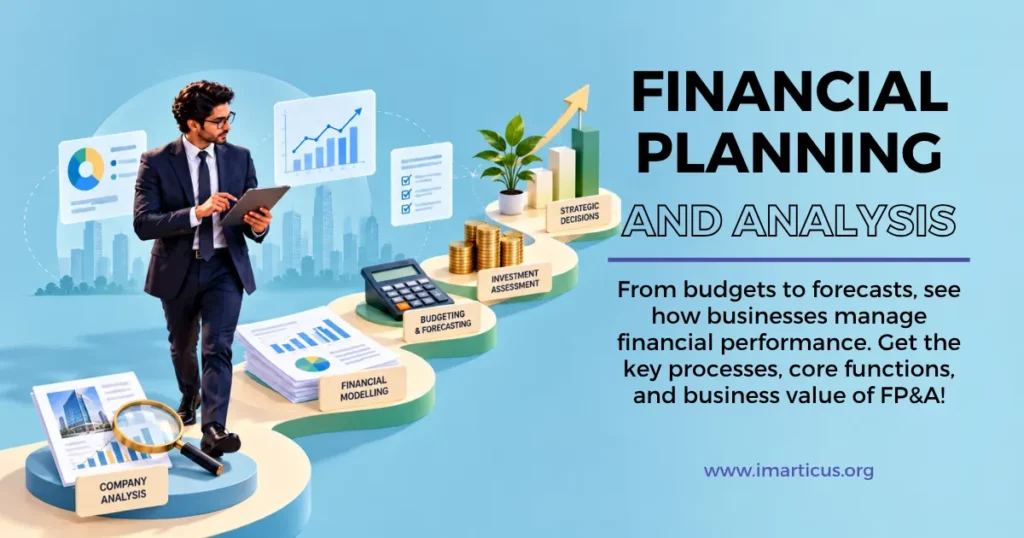
Financial planning and analysis (FP&A) is the process of using financial data to build budgets, forecast future performance, analyse variances and guide business decisions. FP&A teams examine revenue, operating costs, profit margins and cash flow to explain why results differ from expectations and what management should do next. Core activities include financial modelling, scenario planning, management reporting and resource allocation.
FP&A professionals need accounting knowledge, Excel skills, analytical thinking and clear communication. Career opportunities range from FP&A analyst to finance manager and finance director.
Most people meet financial planning and analysis through a question. Why did we miss the quarter? Can we afford twelve more hires? What happens to cash if our biggest customer starts paying sixty days late?
None of those answers sits in the books. The books only record what already happened. Somebody has to look forward, put numbers on the possibilities and tell leadership which one to bet on. In most companies, that somebody is the FP&A team.
I wrote this guide to explain financial planning and analysis properly. I cover how the work is organised, what it looks like in practice, which tools people use, what the jobs pay in India, which certifications carry weight and how to learn it from zero. I’ve also worked through one small budget-versus-actual example, because in my experience the arithmetic explains more than any definition ever does.
Don’t Let Our Best Advice Get Buried
Add Imarticus as a Preferred Source — see more of what we publish, every time you search.

If you’re thinking about a credential to go with the career, the CMA Course is the one whose syllabus overlaps most with this work. Imarticus offers a US CMA course built around it, and I’ll come back to where it fits once the basics are clear.
What Is Financial Planning and Analysis?
Financial planning and analysis (FP&A) is the finance function that turns a company’s past and present numbers into forecasts, budgets and recommendations. An FP&A team builds the plan, tracks results against it, explains the gaps and helps leaders decide where money should go next.
That’s the tidy version. The messier truth is that it all comes down to time. Financial accounting asks what happened. FP&A asks what is likely to happen and what we should do about it. Both use the same data. They just point it in opposite directions.
| Accounting | FP&A | Investment-side financial analyst | |
| Core question | What happened? | What will happen, and what should we do? | Is this company or security worth buying? |
| Time focus | Past | Future, plus the gap to the plan | Future, from an investor’s view |
| Main output | Financial statements, compliance filings | Budgets, forecasts, variance reports, models | Valuation and research reports |
| Works for | The company and its regulators | The company’s leadership | Investors, funds, banks |
Two clarifications, because search results love to blur these.
- First, personal financial planning is a different job altogether. A personal financial planner advises individuals on savings, insurance and retirement. FP&A sits inside a company, or serves one, and works on the company’s money.
- Second, “financial analyst” is a loose title. Some financial analysts value stocks for an investment firm. Plenty of others are FP&A analysts with a plainer name on their card. Read the job description, not the title.
There is one more thing most definitions skip, and it’s the part I care about most. Financial analysis and planning is as much conversation as calculation. A forecast nobody trusts is just a spreadsheet. The people who do this well can explain one number to a sales head and a CFO in the same afternoon, in different words, without changing the number.
Is the US CMA worth pursuing for a career in financial planning and analysis? Its value depends on your career goals, the skills you want to build, the investment involved and the opportunities the qualification can open up in management accounting and corporate finance.
The Financial Planning and Analysis Function: Where It Sits and What It Owns
In most organisations, the financial planning and analysis function sits inside the finance department and reports to the CFO, or to a director or VP of FP&A. IBM’s overview of the field describes the same arrangement. Smaller companies often have no separate team at all. The founder, the CFO or the controller does the work, usually in a spreadsheet, usually the night before a board meeting.
As a company grows, the work splits out. A common set-up is a few analysts, each covering a part of the business (a product line, a region, a cost centre), under a manager who owns the budget cycle and the forecast. Bigger firms add business partners who sit with sales or operations and become, in effect, that team’s finance person.
So what does the team actually own? I’d group it into four things: the annual budget, the rolling forecast, the monthly review of plan against actual, and ad-hoc decision support, which is the catch-all for whatever leadership asks for in a hurry. Notice what’s missing. The ledger, tax filings and statutory audit belong to accounting and compliance.
The financial planning and analysis function also leans on other teams more than it likes to admit.
- Sales supplies pipeline assumptions.
- HR supplies hiring plans.
- Procurement supplies cost changes.
If any of them hands over optimistic inputs, the forecast inherits the optimism. A good FP&A lead spends a surprising amount of time chasing and challenging other people’s assumptions.
If I had to name the single most useful thing financial planning and analysis delivers, it wouldn’t be accuracy. Forecasts are wrong; that’s what makes them forecasts. It would be making assumptions visible, so that when reality differs, the team knows which assumption broke.
Did You Know?
An AFP survey on extended planning and analysis found that 90% of surveyed companies could reforecast, but only 8% said they could do so easily. The survey highlighted the gap between having the capability and being able to use it efficiently. (Source)
The Five Elements of Financial Planning and Analysis
There’s no official list, and companies draw the lines differently, but most describe the same five working parts of financial planning and analysis. Here they are, in the order the work usually flows.
1. Data collection and clean-up
Everything starts with pulling numbers from the Enterprise Resource Planning (ERP), the CRM, payroll and HR systems, and from outside sources such as market data and exchange rates. It’s the least glamorous step and the one that does the most damage when it goes wrong. A forecast built on mismatched data doesn’t fail loudly. It’s just quietly wrong.
2. Planning and forecasting
A plan is the path you intend to take. A forecast is your current best estimate of where you’ll end up. Eisenhower is often quoted as saying that plans are useless, but planning is indispensable, and I think of that whenever someone treats a forecast like a promise. The value is in having thought it through, not in the number.
3. Budgeting
Budgeting turns the plan into money allocated to each team, plus a view on capital spending. The distinction I find most useful is this: a budget is a commitment, a forecast is a belief. Mixing them up is where a lot of planning meetings go sideways. Some companies build the budget from last year’s numbers. Others use business budgeting methods like zero-based budgeting, where every line has to be justified again. Neither is free of politics.
4. Variance analysis and reporting
This is where actual results are compared with the plan and, more importantly, explained. It’s also where financial analysis and planning stop being separate jobs, because the analysis of last month feeds straight into next month’s plan. The worked example below shows why the explanation matters more than the gap.
5. Scenario analysis and decision support
What if demand drops 10%? What if a key input costs 15% more? What if we delay a launch by a quarter? Scenario work gives leadership a range instead of a single point, which is closer to how the world behaves. Three scenarios (base, upside, downside) usually beat fifteen.
A Worked Example: Why a “Favourable” Variance Can Mislead
This is a made-up company with deliberately simple numbers. It sells a single product.
Budget: 10 lakh units at ₹500 each, so ₹50 crore revenue.Variable cost is ₹300 per unit, so ₹30 crore. Marketing: ₹5 crore. Other overheads: ₹8 crore.
Actual: 9.2 lakh units at ₹500 each, so ₹46 crore revenue. Cost of goods sold ₹28.5 crore. Marketing ₹5.8 crore. Other overheads ₹7.9 crore.
| Line (₹ crore) | Budget | Actual | Variance |
| Revenue | 50.0 | 46.0 | −4.0 |
| Cost of goods sold | 30.0 | 28.5 | +1.5 (favourable) |
| Gross profit | 20.0 | 17.5 | −2.5 |
| Marketing | 5.0 | 5.8 | −0.8 |
| Other overheads | 8.0 | 7.9 | +0.1 |
| Operating profit | 7.0 | 3.8 | −3.2 |
Look at the cost line first. It’s ₹1.5 crore under budget, which reads like good cost control. But sales volume was 8% lower than planned, so of course costs came in lower. The fairer comparison is a budget flexed to the actual volume: 9.2 lakh units at ₹300 should have cost ₹27.6 crore.
The company spent ₹28.5 crore. Against the flexed budget, cost control actually slipped by ₹0.9 crore, and the low volume was hiding it. Now split the ₹3.2 crore profit shortfall into its causes.
| Profit bridge (₹ crore) | Amount |
| Budgeted operating profit | 7.0 |
| Fewer units sold (0.8 lakh units × ₹200 contribution) | −1.6 |
| Higher cost per unit than planned | −0.9 |
| Marketing overspend | −0.8 |
| Overheads slightly under | +0.1 |
| Actual operating profit | 3.8 |
One gap, three very different conversations. Why did volume miss? That belongs to sales and pricing. Why did unit cost rise? Procurement or production. Why did marketing spend go up while units went down? That’s the question I’d ask first, and it doesn’t assume anyone is at fault. Gross margin also slid from 40% to about 38%, which a headline of “costs under budget” would never have shown.
That’s the difference between financial reporting and analysis. Reporting says what the numbers are. Analysis says what they mean, and who needs to hear it.
Pro Tip: Investigate the variance before recommending a fix. A cost increase does not automatically justify a budget cut. Separate changes caused by price, volume, timing and one-off events. The cause determines the appropriate response.
Key Financial Planning and Analysis Techniques and Metrics
You’ll hear the same handful of methods in almost every FP&A team.
| Technique | What it answers | The catch |
| Rolling forecast | Where are we heading over the next 12 months, updated every month or quarter? | Easy to over-tweak; needs discipline about what triggers a change |
| Driver-based planning | How do outcomes move when a real driver (headcount, price, volume) moves? | Only works if the drivers are genuinely the ones that matter |
| Scenario analysis | What happens under a few different futures? | Too many scenarios and nobody reads them |
| Flexed budgets | What should this have cost at the actual volume? | Needs a clean split between fixed and variable costs |
| Zero-based budgeting | Does every line still earn its place? | Time-consuming; best used selectively |
The metrics depend on the business, but a few turn up almost everywhere: revenue growth, gross margin, operating margin, cash conversion and, for younger companies, burn rate and runway. For investment decisions, the return on the project matters more than the department’s budget.
A caution from me. A model is a set of assumptions with arithmetic attached, and the arithmetic is the easy part. Good financial analysis and planning live or die on those assumptions. If your churn assumption is wrong, a beautifully built model will give you a beautifully wrong answer, and it will look more convincing than a rough one.
Financial Planning and Analysis Software and Tools
Most financial planning and analysis work still happens in Excel or Google Sheets. IBM, citing the 2024 FP&A Trends Survey, notes that more than half of teams use spreadsheets as their primary planning tool. That survey is a couple of years old, so I’d read it as direction, not gospel, but it matches what hiring managers keep asking for.
| Layer | Examples | Good for | Watch out for |
| Spreadsheets | Excel, Google Sheets | Everything, at every size | Version chaos, hidden formula errors |
| BI and reporting | Power BI, Tableau | Dashboards on top of clean data | They visualise; they don’t forecast by themselves |
| Dedicated planning platforms | Anaplan, Workday Adaptive Planning, Oracle, Planful, Vena, IBM Planning Analytics | Many contributors, multiple entities, rolling forecasts | Cost and long implementations |
Whichever financial planning and analysis software you pick, the source data usually lives in an ERP (SAP, Oracle, NetSuite and similar), which feeds the layer you’ve chosen.
When people ask me which financial planning and analysis software to choose, my honest answer is to fix the process first. Software laid over a confused process just makes the confusion faster. The best financial planning and analysis software for a team of five analysts isn’t the one a 500-person finance department needs, and the reverse is also true.
AI is changing the routine parts of financial planning and analysis: data gathering, first-draft variance commentary, early forecasting runs. That frees financial analysts for judgement, which was always the point. Adoption numbers vary a lot by survey and year, so if you’re quoting one, check that it’s recent.
Did You Know?
In the 2025 AFP survey, 71% of respondents said their organisations used enterprise performance management (EPM) tools. Yet spreadsheets remained widely used alongside those systems: 85% reported using spreadsheets in conjunction with EPM tools. (Source)
Financial Planning and Analysis Services and Consulting
Not every company can or should build the team in-house. That’s where financial planning and analysis services come in. They typically cover budgeting support, forecasting, board and investor reporting, KPI dashboards, and what’s sometimes called fractional or outsourced FP&A, where an external team or part-time finance lead runs the cycle. Startups without a full-time CFO and fast-growing firms mid-transition are the usual buyers.
Financial planning and analysis consulting
Financial planning and analysis consulting is more project-shaped. Think of building a budgeting model from scratch, redesigning a planning process that takes six weeks when it should take two, choosing and implementing a planning platform, or cleaning up management reporting. Large technology firms sell this alongside their software. For companies trying to improve their own financial planning and analysis without outside help, these are the changes I’d expect to matter most:
- Tie the plan to the actual strategy, so it isn’t a spreadsheet exercise
- Fix data quality before building anything new
- Shift from one annual budget to rolling forecasts
- Bring budget owners into the process so assumptions have a name next to them
- Report in plain language, with the “so what” first
Also Read: What Are the Main Functions of Cost Accounting?
Financial Planning and Analysis Jobs, Roles and Salary in India
Financial planning and analysis jobs are usually organised as a ladder.
| Role | What you own | Typical shape of the work |
| FP&A analyst | Data, models, monthly reports for one area | Build and maintain; do the variance work |
| Senior analyst | A bigger scope, plus forecasts and scenario work | Own the model; start advising business leaders |
| FP&A manager | The budget cycle and the team’s output | Review, challenge, present to senior management |
| Director / VP of FP&A | Planning strategy across the company | Work directly with the CFO and executive team |
A typical job description reads like this. One Bengaluru FP&A analyst posting I came across asks for five or more years of experience, a CA or an MBA in finance, and the ability to prepare annual budgets, quarterly forecasts and long-range plans, build financial models, perform monthly variance analysis against budget, produce management reporting packs and partner with department heads on spend and headcount. It lists ₹25 to ₹30 lakh. That’s one posting, not a market average, but the duties are representative of what most postings ask for.
The skills that show up repeatedly are solid accounting fundamentals (the three statements and how they link), Excel modelling, enough business curiosity to ask why a number moved, and the ability to explain it simply. SQL and Power BI are increasingly listed as nice-to-haves.
What do financial planning and analysis jobs pay?
FP&A salaries in India vary by job level, experience, company, location and the scope of financial responsibility. An analyst who supports forecasts and reports will typically earn less than a manager who leads budgeting and business planning. The figures below come from original salary-data sources, rather than estimates created for this article. Treat them as market benchmarks, not guaranteed offers, and note that each source may use a different sample and reporting method.
| FP&A Job Role | Average Aalary in India |
| Financial Planning Analyst | ₹7 – 18 LPA |
| FP&A Analyst | ₹13 – 24 LPA |
| Senior Financial Analyst | ₹8 – 16 LPA |
| FP&A Manager | ₹15 – 26 LPA |
| Director of FP&A | ₹35 – 45 LPA |
So is FP&A high paying? Compared with general accounting roles, it tends to pull ahead at manager level and above. Compared with investment banking, it usually doesn’t match the bonus upside. On demand, the US Bureau of Labor Statistics projects financial analyst employment to grow 7% from 2025 to 2035, with about 29,500 openings a year.
Is Financial Planning and Analysis a Good Career?
For the right person, yes. Financial planning and analysis jobs give you early visibility to senior leaders, a view of how the whole business works, and a path toward finance business partner, controller or CFO-track roles. The trade-offs are real, though. Month-end, quarter-end and budget season can be heavy, and you often depend on data from people who don’t report to you. If you like questions more than closing the books, you’ll probably enjoy it. If certainty is what you want from work, the forecasting part may frustrate you.
Also Read: What Are the Steps Involved in the Capital Budgeting Process?
How to Learn Financial Planning and Analysis: A 90-Day Plan
If you want to learn financial planning and analysis from scratch, resist the urge to collect every PDF and set of notes you can find. Notes help with revision. You pick this work up by building things. Here’s the plan I’d follow.
Days 1 to 30: Foundations.
- Learn the three financial statements and how they connect.
- Get comfortable with Excel: lookups, pivot tables, conditional logic.
- Build a one-page budget for a small business, even an imaginary one.
Days 31 to 60: Modelling and forecasting.
- Build a simple model where the income statement, balance sheet and cash flow talk to each other.
- Make a driver-based revenue forecast.
- Take a listed company’s reported quarter, forecast it yourself beforehand if you can, and write down why you were off.
Days 61 to 90: Reporting and judgement.
- Build a dashboard in Power BI or Excel. Write a one-page commentary explaining a variance to a non-finance reader.
- Practise explaining your model aloud. That last part is harder than it sounds.
Financial Planning And Analysis Course: What To Look For
A good financial planning and analysis course makes you build, not just watch. When comparing options, I’d check for:
- Modelling in Excel with real or realistic data, not screenshots
- Variance analysis worked through on a case, not just defined
- Forecasting methods (rolling, driver-based, scenarios) taught with their limits
- Practice in communicating results, not only calculating them
- Instructors who have done the job, and assessments that mark your work
If a financial planning and analysis course is mostly a software demo, it’s teaching a tool, not the work. Tools change every few years. The thinking doesn’t.
Also Read: How Is DCF Valuation Used to Calculate a Company’s Value?
Qualifications and Financial Planning and Analysis Certification
You don’t need a licence to work in financial planning and analysis. Most employers want a bachelor’s degree in commerce, finance, accounting, economics or business. For senior roles, an MBA in finance, CA, CMA or CFA often appears in the listing. The Bengaluru posting I mentioned wouldn’t consider a degree alone, though that’s one employer’s rule.
- On financial planning and analysis certification, the dedicated option is the Certified Corporate FP&A Professional (FPAC), run by the Association for Financial Professionals (AFP).
- Earning FPAC means meeting an education and experience requirement and passing two exam parts, and AFP says candidates can sit the exams before they’ve met the requirements.
- AFP lists the CMA among the approved credentials for one of its eligibility categories, and it has announced that CMA, CPA and CTP holders can waive Part I of the exam.
Other routes people take include CFI’s FPAP, financial modelling credentials such as the FMVA, and the CFA for those leaning toward investment analysis.
Where The US CMA Fits
The one I’d look at most closely for an FP&A path is the CMA. The CMA full form is Certified Management Accountant, awarded by the Institute of Management Accountants (IMA) in the US. Part 1 of the exam is called Financial Planning, Performance and Analytics. That’s close to a word-for-word match with the field itself, and it’s why the overlap is real rather than marketing.
| US CMA at a glance | Detail |
| CMA exam format | Two parts, taken in any order. Imarticus’s course page lists 100 multiple-choice questions and two essays per part, four hours each. IMA has been offering case-based questions in some windows, so confirm the current format on imanet.org |
| Exam windows | January to February, May to June, September to October |
| CMA registration | Join IMA, enrol as a CMA candidate, then register for each part; exams are taken at Prometric centres |
| CMA course duration | Imarticus lists 6 to 8 months of training for both parts |
| Experience rule | Two years in management accounting or financial management; IMA lets you sit the exams before completing it |
Look at the Part 1 list again. Planning, budgeting and forecasting, performance management, cost management and analytics are the working parts of the FP&A function. The CMA syllabus then widens into corporate finance, risk management and ethics, which is why it suits people heading toward finance leadership rather than only analyst work.
Clearing both parts of the US CMA requires a focused study plan, consistent practice and a clear grasp of the exam structure. A well-planned preparation strategy can help you manage revision, practise exam-style questions and approach each part with greater confidence.
How Imarticus Learning Can Support Your US CMA Journey
A career in management consulting often involves working with budgets, weighing business options and explaining what the numbers mean. The CMA Course prep offered by Imarticus Learning can help you build a stronger foundation in these areas. Here’s what the US CMA programme at Imarticus Learning offers:
- KPMG in India collaboration: Work through practical business case studies and practitioner-led sessions designed to connect CMA concepts with business situations.
- 23 business case studies: Apply your knowledge to practical scenarios, with evaluations by KPMG in India practitioners.
- Surgent-powered preparation: Practise with AI-powered question banks, adaptive mock exams and an AI tutor available around the clock.
- IMA Gold Learning Partner: Prepare with a provider recognised by the Institute of Management Accountants at Gold Learning Partner level.
- 50% money-back guarantee: The programme offers a partial fee refund subject to its stated terms and conditions.
- Pre-placement bootcamp: Strengthen your CV, interview preparation and workplace communication skills.
- Flexible learning: Choose online or offline classes, with a stated preparation timeline of approximately 6–8 months for both exam parts.
For aspiring management consultants, the value lies in building financial and decision-making skills that complement broader business knowledge.
FAQs About Financial Planning And Analysis
From how FP&A teams build forecasts and investigate budget gaps to the skills, qualifications and career paths the role demands, these answers address the most frequently asked questions around financial planning and analysis.
What Is Financial Planning And Analysis?
Financial planning and analysis is the finance function that builds budgets and forecasts, compares results with the plan, and explains the gaps. Where accounting records what happened, FP&A looks ahead and helps leaders decide how to spend, hire and invest.
Is Financial Planning And Analysis A High-Paying Job?
Financial planning and analysis can pay well, especially at manager level and above. Indian salary sources disagree widely, from roughly ₹4 to ₹10 lakh for freshers to ₹18 to ₹40 lakh for managers. Employer type, city and qualifications such as CA, MBA or CMA move pay more than the title does.
Is FP&A A Good Career?
Yes, financial planning and analysis is a good career for people who like numbers and explaining them. It gives early visibility to senior leaders and leads to business partner, controller and CFO-track roles. The trade-off is heavy month-end, quarter-end and budget-season workloads.
How Can I Learn Financial Planning And Analysis?
To learn financial planning and analysis, start with the three financial statements and Excel, then build a budget, a driver-based forecast and a variance report yourself. Add a recognised qualification for credibility; Imarticus’s US CMA course covers the planning side. The work is best learned by building real models.
What Qualifications Do You Need For FP&A?
Among the qualifications required for FP&A, most employers want a bachelor’s degree in commerce, finance, accounting or economics. Senior roles often prefer a CA, MBA (Finance), CMA or CFA. The dedicated financial planning and analysis certification is AFP’s FPAC, but none of these is legally required.
Can Accountants Do FP&A?
Yes, and many accountants do FP&A. Accountants already know the data and the three statements. What changes is the question: financial planning and analysis asks what will happen next, so forecasting, modelling and business communication skills need building.
How Can Businesses Improve Their Financial Planning And Analysis?
Businesses can improve their financial planning and analysis by tying the plan to strategy, cleaning the data first, moving from annual budgets to rolling forecasts, involving the budget owners and reporting in plain language. Improvement usually comes from fixing process before buying software.
What Are The Elements Of Financial Planning And Analysis?
The elements of financial planning and analysis include five working parts: data collection and clean-up, planning and forecasting, budgeting, variance analysis and reporting, and scenario analysis for decisions. Together they form a loop, where last month’s results feed next month’s plan.
Build Your Financial Planning and Analysis Skill Set
Financial planning and analysis is valuable because it connects financial results with business decisions. Budgets set targets, forecasts reflect changing conditions, and variance analysis explains where performance has shifted. The real skill lies in understanding why those changes happened and deciding what to do next.
For anyone considering an FP&A career, start with accounting fundamentals, Excel, financial modelling and forecasting. Build the habit of questioning assumptions rather than accepting every figure at face value. These skills matter when you need to explain a cost increase, assess a growth plan or help management allocate resources.
The US CMA can strengthen this foundation through its focus on budgeting, forecasting, performance management and strategic financial decisions. Imarticus Learning’s CMA Course offers structured exam preparation alongside practical case studies. Review the syllabus and programme details to see whether it fits your career goals.
Liked This? Follow Us Where You Already Search.
Preferred Sources is Google’s built-in follow button — no app, no login, just more Imarticus in your results.
