


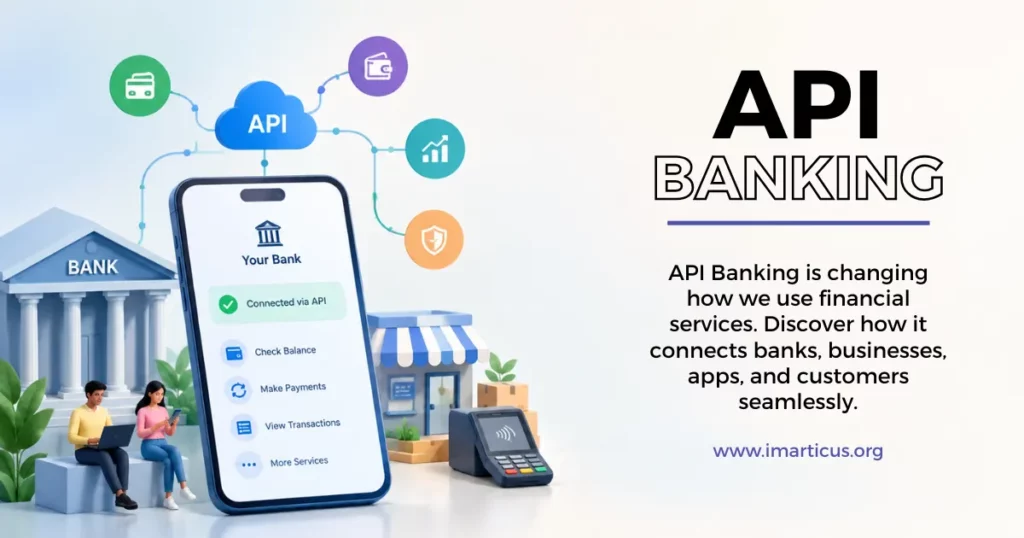
API banking, or connecting your bank’s systems to other apps through a secure Application Programming Interface (API), is what lets you check a balance, pay someone, or finish KYC without opening net banking every time. API banking is what lets your bank “talk” to other apps, like Google Pay, Zomato, or the accounting software your company uses, through a secure connection called an API. That’s how you can check your balance, pay someone, or get your KYC done without opening net banking every time. Let’s see: what API banking actually does, what the letters API stand for, what it might cost you, and where things can go wrong.
Ever noticed you can check your account balance on Paytm or PhonePe without ever opening your bank’s app? API stands for Application Programming Interface. An API is just how two apps or systems talk to each other. It’s a bit like ordering food at a restaurant. You don’t walk into the kitchen yourself, you tell the waiter what you want, they take it to the kitchen, and bring it back. That’s basically the job an API does between an app and your bank.
I’ll walk you through what API banking really means, how banks like HDFC, ICICI, and SBI are using it, roughly what it costs, and the risks worth knowing about. If you’re thinking about a career in this space, Imarticus Learning’s fintech course is the best choice to get into these exact shifts: open banking, fintech operations, all of it.
What API Banking Means in Everyday Terms
API stands for Application Programming Interface. An API is just how two apps or systems talk to each other. It’s a bit like ordering food at a restaurant. You don’t walk into the kitchen yourself. You tell the waiter what you want, they take it to the kitchen, and they bring it back to you. That’s basically the job an API does between an app and your bank.
Don’t Let Our Best Advice Get Buried
Add Imarticus as a Preferred Source — see more of what we publish, every time you search.

So what is API banking, in plain terms? It’s when a bank opens a safe, secure “door” into its own system so other apps can request information or make a transaction on your behalf, only with your permission.
- Not a new account: it doesn’t replace or add a bank account; it just connects your existing one to other apps.
- Not a new product: it’s the technology layer working quietly behind apps you already use.
- Always consent-based: nothing happens without you approving it first.
- Same idea as “open banking”: you’ll often see the two terms used together, since API banking is how Indian banks have put open banking into practice.
It also helps to know who usually searches this term:
- Everyday customers who saw the phrase somewhere and just want a clear answer.
- Students or professionals trying to understand it for a job or exam.
This guide is written for both. If you’re in the second group, our fintech trends have more reads on digital payments and banking worth checking out.
Did You Know?
India’s account aggregator framework, backed by the RBI, runs almost entirely on bank-to-bank APIs, letting you share your financial data with a lender in seconds instead of submitting paper statements.
How API Banking Works Step by Step
I find it easier to picture API banking as a short chain of handshakes rather than one big black box. Here is roughly what happens when, say, a food delivery app lets you pay directly from your bank account:
- You give consent. You approve the app to access a specific banking function, such as reading your balance or initiating a payment.
- The app calls the bank’s API. A small, encrypted request goes from the app’s server to the bank’s API gateway, asking for exactly what it needs and nothing more.
- The bank authenticates the request. Using tools like OTP verification or OAuth, the bank checks that the request is genuine and that you actually authorised it.
- The bank’s core system processes it. Your balance is checked, or the payment is debited, inside the bank’s own secure environment.
- A response comes back. The result, whether that is a “payment successful” message or an account balance, is sent back to the app in real time.
What I like about this chain is that the bank never actually hands over your login credentials to the app. It only shares the specific piece of information the API was built to share, which is a big part of why API banking is considered more secure than older methods, such as screen scraping.
Banks typically group their APIs into a few broad categories, based on what they let you do. Before diving into the risks and costs, it helps to see this table laying out the common categories you will come across.
| API Category | What It Does | Typical Use Case |
| Payment APIs | Initiate transfers, collections and payouts | UPI collections on an e-commerce checkout |
| Account and Balance APIs | Fetch balance, statements and transaction history | A budgeting app showing your live balance |
| KYC and Onboarding APIs | Verify identity documents and open accounts digitally | Opening a savings account from a fintech app |
| Authentication APIs | OTP and OAuth-based verification | Two-factor login on a banking portal |
| Trade and Corporate APIs | Bank guarantees, letters of credit, bulk reconciliation | An ERP system reconciling payments automatically |
Once you can place any banking API into one of these five buckets, most bank developer portals start to feel a lot less overwhelming.
On the technical side, a developer usually starts in a sandbox with dummy data, moves to UAT once an NDA is signed, and only then gets production access. If this part of the process sounds interesting rather than intimidating, it is worth knowing that fintech operations is now a genuine career track, with our fintech leadership programme covering exactly this kind of bank-to-developer workflow.
API Full Form and Common Terms You Will See in Banking Apps
If you have landed here searching for “api full form in banking”, the answer is straightforward: API stands for Application Programming Interface. In banking specifically, it refers to the secure digital interface a bank builds so that authorised third-party software can request data or services from its core banking system.
A handful of terms you’ll see in a bank’s developer docs: once you start reading a bank’s developer documentation, a few words keep popping up. Worth knowing them before you dive in:
- Sandbox – basically a practice area. You test the bank’s APIs here with fake data before anything goes live.
- UAT (User Acceptance Testing) – comes after the sandbox stage. This is where things get tested under near-real conditions, right before launch.
- OAuth 2.0 – lets an app access limited parts of your account without ever seeing your actual password.
- NDA – most banks won’t hand you production access until you’ve signed one of these.
- API Gateway – think of it as the security guard standing between outside apps and the bank’s core system, checking everything that tries to pass through.
None of this is unique to banking, by the way. These terms come straight out of general software development. And if the financial side interests you more than the tech side, our fundamentals of financial markets programme is worth a look once these terms stop feeling foreign.
Benefits of API Banking for Customers and Businesses
API banking took off in India for a fairly simple reason: it just makes life easier, on both sides of a transaction. Here’s what that looks like in practice.
- Payments move faster. Balance checks and reconciliations happen right away instead of sitting overnight.
- Less time at the branch. Businesses can make payments or pull statements without ever walking in.
- Reconciliation gets less painful. Finance teams can match payments to invoices automatically, inside the accounting software they already use.
- Onboarding speeds up. A new customer can open an account or get a small loan approved in minutes, not days, through digital KYC.
- Customers get more options. Your bank account isn’t locked into your bank’s own app anymore; it can plug into whatever you actually use.
- Banks find a new revenue line. They earn from letting fintechs build on their infrastructure, rather than building every app in-house.
- Lending gets a bit smarter. Through account aggregator APIs, lenders can look at real transaction history instead of leaning on a credit score alone.
All of this is exactly why banking, financial analysis and fintech have become so closely linked as career paths.
Also Read: A Closer Look at Careers in Fintech Operations
API Banking Charges and Costs to Expect
Costs are one of the murkiest parts of this topic, mainly because most Indian banks do not publish a public price list; pricing is usually negotiated once a business signs up. That said, a general pattern holds across most large banks.
| Who Is Using It | Typical Cost Pattern |
| Individual customer using a UPI or payment app | Free, since the fee is usually absorbed by the merchant or the app |
| Small business testing APIs in a sandbox | Free during development and testing |
| Business going live with a bank’s APIs | Per-transaction or slab-based fees, agreed with the bank’s relationship manager |
| Large corporate with an existing banking relationship | Often bundled into the existing current account or cash management pricing |
If you are a business owner rather than a developer, the honest answer is that you will need to speak to your bank’s relationship manager to get an exact quote, because it depends on your transaction volume and the specific APIs you plan to use.
Challenges and Risks of API Banking
It would not be a balanced guide if I only listed the upsides, so let me walk through the genuine risks worth knowing about. This is also the section I would point a risk or compliance professional toward first, since managing these exact trade-offs is a growing part of their job.
Challenges of API Banking
- Integration errors – A rushed or badly built integration on a business’s end can cause failed payments, or worse, duplicate ones.
- Regulatory complexity – Banks have to keep tweaking their APIs to stay in line with RBI rules, and that sometimes means downtime or sudden version changes for developers.
- Over-permissioning – Some apps ask for way more access than they actually need, so it’s worth pausing to check exactly what you’re agreeing to before you tap “allow.”
Risks of API Banking
- Data privacy exposure – The more apps and systems touching your money data, the more places something could slip up, even if each one is locked down tight on its own.
- Third-party dependency – If the app you’re using has sloppy security, that becomes the weak link, even if your bank’s side is airtight.
- Concentration risk – If a bank’s API gateway goes down, every single app relying on it goes down with it. That’s exactly why banks pour so much money into uptime and monitoring.
Pro Tip!
Before linking any app to your bank account, check whether it uses RBI-regulated APIs or an account aggregator, rather than asking for your raw net banking password.
API Banking Versus UPI and Other Digital Rails
This is one of the most common points of confusion, so it is worth untangling properly. UPI, or Unified Payments Interface, is a specific payment rail built by NPCI that moves money between bank accounts using a virtual payment address. API banking is the broader technology that banks use to expose many kinds of services, including UPI itself, along with balance checks, KYC, loans, and much more.
In other words, UPI is one particular application built using API banking, not a competitor to it. Here is a quick side-by-side to make the distinction clearer.
| Aspect | API Banking | UPI |
| What it is | A broad technology layer for bank connectivity | A specific instant payment system |
| Scope | Payments, KYC, statements, loans, trade finance and more | Peer-to-peer and merchant payments only |
| Who governs it | Individual banks, within RBI guidelines | NPCI, on behalf of participating banks |
| Everyday example | A fintech app pulling your account statement | Sending money using a UPI ID or QR code |
Once you see UPI as one small, well-known slice of the much larger API banking picture, the rest of the ecosystem, including account aggregators and embedded finance, becomes a lot easier to place.
API Banking EB and What the EB Tag Usually Means
If you’ve typed “API banking EB” into a search bar and landed here, fair warning: it’s not a term with one fixed meaning. Most of the time, “EB” is bank-speak for:
- Enterprise Banking or Electronic Banking – the corporate side of online banking, separate from the retail net banking app you’d use personally.
- Used for – large-value transactions, bulk payments, and treasury operations.
- “API banking EB” usually means – the API layer running behind a bank’s enterprise or corporate portal, letting a finance team pull statements, send bulk payments, or automate reconciliation without logging in manually.
If you landed here chasing a specific product name, check that bank’s own developer or corporate banking page directly; naming conventions vary bank to bank.
How Leading Indian Banks Offer API Banking
Most of the big Indian banks have their own API or developer portal these days. They’re not identical, but the general idea is pretty much the same everywhere. Here’s a quick look at a few of the well-known ones.
| Bank | What They Offer |
| HDFC Bank | A developer portal with a large catalogue of payment, collection and enterprise banking APIs, available to businesses after registration |
| ICICI Bank | An extensive API banking portal covering accounts, deposits, payments, collections, cards and trade finance APIs |
| SBI | API banking services aimed largely at corporate and institutional clients for collections, payments and account information |
| Kotak Mahindra Bank and Axis Bank | Dedicated API banking pages for cash management, collections and payouts aimed at business banking clients |
| Regional players like J&K Bank | Smaller but growing API catalogues, often covering collection notifications and authentication services |
| Other private and public banks | Growing developer programmes, often built around the RBI’s broader open banking and account aggregator push |
A quick note on two commonly searched questions: whether HDFC’s API access is free depends entirely on your existing relationship with the bank and the specific APIs involved, and there is no single universally “cheapest” API across banks, since pricing is typically negotiated per business. The right move is always to compare quotes directly with a relationship manager rather than relying on a generic number online.
Also Read: What a Career in Modern Banking and Finance Actually Looks Like
Future of API Banking in India
Looking ahead, I expect three things to shape where API banking goes next. First, the account aggregator framework will keep expanding into new areas like insurance and pensions, not just loans. Second, embedded finance, where a non-bank app quietly offers a banking feature like a savings pocket or an instant loan, will become far more common, all powered by the same underlying API banking rails. Third, regulatory sandboxes run by the RBI will keep giving smaller fintechs a safer route to build and test on top of bank APIs before going fully live.
None of this changes the core idea, though. Whatever new product name comes along, it will almost certainly be built on the same principle: banks opening secure, consent-based digital doorways into their systems. For finance and technology professionals, that means the demand for people who understand both sides of this equation, the banking rules and the technology, is only going to grow.
Also Read: How Investment Banking Operations Actually Work
Learn API Banking and Fintech with Imarticus Learning
If reading this has made you curious about working in this space rather than just using it, it helps to train somewhere that treats fintech as a core subject, not an afterthought. Here is specifically what sets our programmes apart for someone aiming at a career built around digital and API-driven banking.
- Industry-endorsed curriculum: Our fintech course is built around how banks and fintechs actually operate today, including open banking and API-driven products.
- Hands-on operations training: Our programmes use real case studies and simulations, not just theory.
- Placement support: Dedicated placement teams and 1500+ hiring partners help translate coursework into an actual job offer.
- Experienced faculty: Trainers with real banking and fintech backgrounds, not just academic experience, walk you through live workflows.
You can also read genuine learner outcomes, or find out more about our journey on the about Imarticus page. Curious where this could take your career? Explore our best fintech course to see the programmes built around exactly this shift toward digital, API-driven banking.
FAQs About API Banking
Here are quick, straight answers to the questions people most often ask about API banking, covering safety, costs, and how it compares with other digital payment tools.
What is API in Banks?
API in banks is a secure digital connector that lets outside apps talk to your bank’s system, checking balances, moving money, or verifying KYC. It only shares what’s needed, and only with your go-ahead.
Is API banking safe for customers?
Yes, mostly, as long as the app runs through RBI-regulated channels like UPI or an account aggregator. Just avoid anything asking for your actual net banking password.
What is the difference between an API and UPI?
An API is the broader technology that lets systems talk to each other. UPI is just one thing built on top of it, specifically for instant payments.
What is API full form of API?
API stands for Application Programming Interface. In banking, it’s the secure doorway that lets approved apps pull data or trigger transactions safely.
Which bank API is best?
No single “best” one; it depends on your needs. HDFC and ICICI have wide public developer portals, while SBI leans more corporate-focused.
What are the risks of using APIs?
Mainly data exposure, integration errors causing failed or duplicate payments, and apps asking for more access than they need. Sticking to regulated apps handles most of this.
Is HDFC API free?
Depends on your existing relationship with the bank and which APIs you want. Best to check directly with your relationship manager for pricing.
What is API banking in SBI?
SBI’s API banking is built mainly for corporate and institutional clients, covering payments, collection, and account info wired into their own systems.
What are API charges?
Free for everyday users on things like UPI. For businesses going live, it’s usually per-transaction or slab-based fees, negotiated with the bank.
Which API is the cheapest?
No fixed cheapest option; it depends on your volume and which APIs you use. Comparing quotes from two or three banks is the smarter move.
What This Means for You Next
Remember that food delivery payment from the start? That “instant” tap wasn’t instant at all; it was a quick handshake between apps, banks, and security checks, all running quietly on API banking. Once you notice it, you’ll start spotting it everywhere: loan apps, budgeting tools, even your own company’s accounting software.
Maybe you came here just wanting a straight answer, or maybe you’re seriously weighing a move into this side of banking. Either way, understanding how banks, tech, and regulation fit together is only going to matter more, not less. Banks aren’t slowing down on this, and neither are the fintechs building on top of it, so people who get both sides of that equation will stay in demand for a good while yet. If that sounds like the direction you’re leaning, take a look at our fintech course and see if it’s the right next step for you.
Liked This? Follow Us Where You Already Search.
Preferred Sources is Google’s built-in follow button — no app, no login, just more Imarticus in your results.