


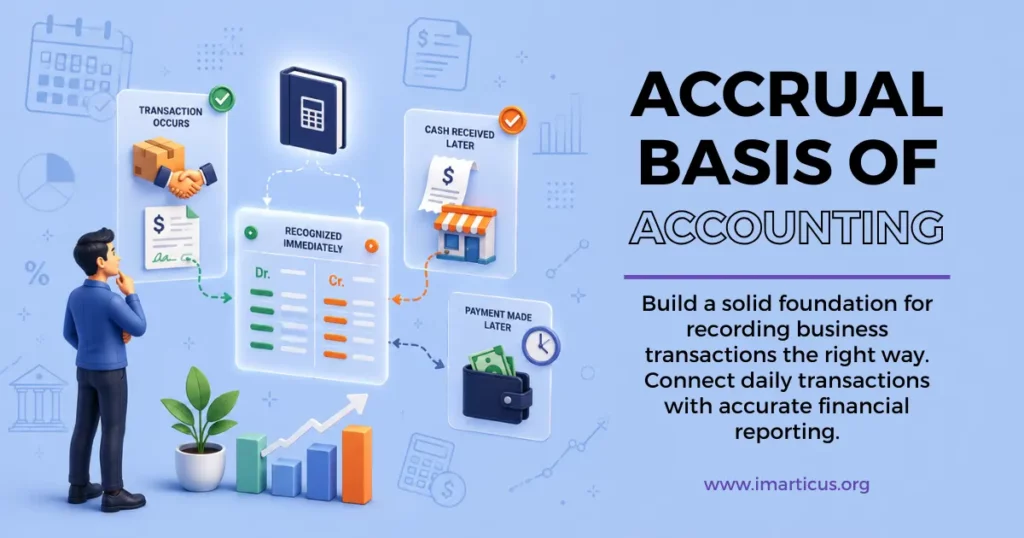
Look at your company bank account balance at the end of the month. Does that single figure truly reflect how your business performed over the last thirty days? If you cleared a fifty-thousand-pound consulting project in December, handed over the final deliverables, but granted the client thirty-day payment terms, your bank balance on New Year’s Eve will show zero pounds from that massive effort. If you rely solely on cash movements to judge your operational health, you are effectively running a business while looking through a frosted window. This scenario can be understood with the accrual basis of accounting.
The disconnect between physical cash movement and real economic value is one of the most dangerous traps in financial management. Profitability is not merely a measure of liquidity; it is a measure of earned value matched directly against consumed resources. When you invoice a corporate client on net 30 terms or consume electricity for an office that you will not pay for until next month, you are engaging in economic transactions that standard cash tracking completely misses. This is precisely why institutional investors, commercial lenders, and global regulatory bodies demand a more rigorous framework to evaluate corporate performance.
Understanding how these financial mechanics operate in the real world is what separates basic bookkeeping from strategic financial leadership. If you are aiming to navigate complex corporate balance sheets, evaluate global trade lifecycles, or transition into high-stakes investment banking roles, mastering these foundational frameworks is non-negotiable. Building this deep technical expertise through specialised finance courses allows you to look past superficial bank balances and interpret the true financial story behind any business.
Have you ever wondered why a business that appears highly profitable on paper suddenly struggles to clear its monthly payroll? Or why a company with millions in the bank might actually be running at a severe operational loss? The answers lie entirely within the rules governing revenue recognition, expense matching, and balance sheet placeholders. In this comprehensive guide, we will break down the accrual basis of accounting, examine real-world journal entry scenarios, compare it directly against cash-basis frameworks, and explore how mastering these principles sets the foundation for an elite career in modern finance.
Don’t Let Our Best Advice Get Buried
Add Imarticus as a Preferred Source — see more of what we publish, every time you search.

What Is Accrual Basis Of Accounting
The answer to this question is surprisingly simple when you understand ‘what is accounting’ and how it works. You record your income the moment you earn it. You record your expenses the moment you owe them. You completely ignore the actual movement of physical cash.
You deliver a product to a customer on a Tuesday. The customer takes the product home. They promise to pay you in thirty days. Under this specific bookkeeping method, you made money on that Tuesday. You log the sale immediately. Your profit increases on that exact day.
The same logic applies to your costs. You hire a contractor to fix your office roof in November. The contractor finishes the job. They send you an invoice in December. You pay the invoice in January. You must record that repair expense in November. The work happened in November. The cost belongs to November.
This creates a very clear picture of your operations. You know exactly what you earned during a specific month. You know exactly what it cost you to earn that money. This is the entire foundation of the accrual basis of accounting. It stops your financial reports from jumping around wildly just because a client paid a bill late.
Define Accrual Basis Of Accounting In Simple Terms
People often struggle to define accrual basis of accounting without using heavy academic words. I prefer a much more direct definition. It is a system that matches your business activities to a calendar.
You perform an action that creates value. You record that value immediately. You consume a resource that costs money. You record that cost immediately. The timing of the actual cash transfer does not matter at all.
The accrual basis of accounting provides transparency. You cannot manipulate your profit by simply delaying your bill payments. Your obligations show up on your reports the moment you incur them.
Accrual Basis Of Accounting Meaning In Daily Operations And Types
Understanding the accrual basis of accounting meaning changes how you run your daily operations. It changes how you view a successful month.
You might have a month where your bank account drops by five thousand pounds. A cash-focused person would panic. An accrual-focused person investigates the underlying activities. You might have bought ten thousand pounds of inventory on credit. You might have delivered fifteen thousand pounds of services. Your actual operations were highly profitable. Your cash simply has not caught up yet.
This method requires you to use special placeholder accounts. These accounts live on your balance sheet. They keep track of the promises people make to you. They keep track of the promises you make to others.
You will use accounts receivable to track money owed to you. You will use accounts payable to track money you owe to vendors. These accounts are the beating heart of the accrual basis of accounting. They act as temporary holding pens for your money.
The Revenue Recognition Principle
You cannot fully grasp the accrual basis of accounting without understanding revenue recognition. This is a strict rule governing when you can claim income.
You cannot claim income just because someone signed a contract. You cannot claim income just because someone gave you a cash deposit. You only claim income when you fulfil your specific promise to the customer.
Imagine you run a software company. A customer pays you twelve hundred pounds in January for a one-year subscription. You have the cash in your bank. But you have not earned all of it yet.
You only earn one hundred pounds each month as you provide the software access. You must spread that revenue out over the entire year. The accrual basis of accounting demands this precision. It prevents you from looking artificially wealthy in January and completely broke in December.
You record the initial payment as a liability. You owe the customer a service. You slowly move that money from a liability to actual revenue month by month. This is how you maintain a completely accurate income statement.
The Matching Principle
The second major rule is the matching principle. This rule dictates how you handle your business costs.
You must match your expenses to the specific revenue they helped create. This is non-negotiable under the accrual basis of accounting. It provides a true picture of your profit margins.
You own a shop selling expensive watches. You buy a watch from a supplier in March for two thousand pounds. You place the watch in a glass display case. You do not sell the watch until August.
You do not record a two thousand pound expense in March. The watch is an asset sitting in your shop. You only record the expense in August when you actually sell the watch. You match the cost of the watch directly against the revenue from the sale.
This principle prevents your financial statements from showing a massive loss in March. It shows the true cost of goods sold in August. The accrual basis of accounting relies entirely on this matching process to calculate genuine profitability.
Also Read: Understanding the Types of Accounting: Real Examples and Core Functions.
Key Balance Sheet Accounts Used
Your balance sheet becomes much more detailed when you switch away from simple cash tracking. You need new categories to hold your pending transactions. These categories are essential for the accrual basis of accounting to function properly.
They provide a map of your future cash flows. You can look at these accounts and predict exactly how much money will enter your bank soon. You can predict exactly how much money will leave your bank soon.
We must examine the specific accounts you will use every single week. Understanding these accounts makes the daily bookkeeping process much easier to manage.
Accounts Receivable In Practice
This account acts as a promise from your customers. You finished the work. You sent the invoice. You are now simply waiting for the physical money.
This account is classified as a current asset. It holds genuine economic value. You can actually use your accounts receivable balance to secure a business loan. Banks view this account as future cash.
The accrual basis of accounting relies heavily on this specific asset. If your receivables grow too large, you might face a cash crisis. You have high profits on paper but no money to pay your staff. You must monitor this account constantly.
Accounts Payable Operations
This account represents your promises to other businesses. You received supplies. You used a service. You have the invoice sitting on your desk. You just have not transferred the funds yet.
This account is classified as a current liability. It shows exactly how much cash you will lose in the near future.
Properly managing your accounts payable is a core part of the accrual basis of accounting. You want to delay paying these bills for as long as your vendors allow. This keeps cash in your bank account longer. But you must record the liability immediately to keep your profit reports perfectly accurate.
Relying solely on a BCom degree often limits entry-level growth in today’s competitive job market. Pairing your degree with global certifications expands your expertise, opening doors to strategic investment, valuation, and risk management roles worldwide.
Accrual Basis Of Accounting Example Scenarios
We need to look at specific daily situations to truly understand the mechanics. A theoretical explanation is never enough. We must walk through the exact journal entries you will make.
→ Let us look at a very common accrual basis of accounting example involving a marketing agency. You run an agency and sign a contract to build a website for four thousand pounds. You complete the entire website in September. The client is thrilled with the work. You send the final invoice on 30 September.
You must record this event in September. You make a journal entry. You debit your accounts receivable for four thousand pounds. You credit your service revenue for four thousand pounds. Your September profit goes up.
→ The client pays you on 15 October. You make a second journal entry. You debit your cash account for four thousand pounds. You credit your accounts receivable for four thousand pounds. Your October profit remains completely unaffected by this cash movement.
→ Let us explore another accrual basis of accounting example involving expenses. You run a busy restaurant. Your staff works long hours during the final week of December. You owe them three thousand pounds in wages for that specific week. You process payroll and physically pay them on 5 January.
You must record the expense in December. You debit your wage expense for three thousand pounds. You credit your accrued payroll liability for three thousand pounds. Your December profit correctly absorbs the cost of that labour.
On 5 January, you hand over the cash. You debit your accrued payroll liability. You credit your cash account. January takes no profit hit from December’s hard work. This is the exact workflow demanded by the accrual basis of accounting.
Cash And Accrual Basis Of Accounting Overview
Business owners often struggle to choose a bookkeeping system. They look at cash and accrual basis of accounting and wonder which one makes sense.
The cash method is incredibly simple. You only record transactions when physical money moves. It works exactly like your personal checking account. You check your pocket. If the money is there, you made a profit.
The accrual method requires more effort. You track invoices. You track pending bills. You make adjusting journal entries at the end of every month. It takes more time and usually requires professional software.
But you cannot compare cash and accrual basis of accounting solely on effort. You must compare them on the quality of information they provide. The cash method gives you a fast snapshot of your liquidity. The accrual method gives you a deep understanding of your actual business performance over time.
Difference Between Cash Basis And Accrual Basis Of Accounting
We must break down the exact operational differences. Understanding the difference between cash basis and accrual basis of accounting helps you make better management decisions.
The primary difference always comes down to timing. One method tracks the economic event. The other method tracks the bank transfer. This timing difference drastically alters how your income statement looks at the end of the year. Here is a clear breakdown showing how these two systems treat daily business operations differently.
| Feature Being Evaluated | Cash Method Approach | Accrual Method Approach |
| Recording Customer Sales | When the client actually pays you | When you finish delivering the work |
| Recording Vendor Bills | When you write the physical check | When you incur the specific cost |
| Taxation Trigger Point | You pay taxes on collected cash | You pay taxes on billed invoices |
| Balance Sheet Depth | Shows only your current bank balance | Shows all pending debts and assets |
| Regulatory Compliance | Not accepted for corporate audits | Mandatory for all official reporting |
| Overall Complexity | Very simple and easy to maintain | Requires double-entry journal updates |
You can clearly see the difference between cash basis and accrual basis of accounting in this table. The cash method hides your future problems. The accrual method puts your future problems right on your balance sheet for you to manage.
The cash basis and accrual basis of accounting serve different masters. Cash serves the small sole trader. Accrual serves the growing corporate enterprise.
Also Read: Key Accounting Concepts Explained: Simple Rules and Real Examples.
Advantages Of Accrual Basis Of Accounting
You might wonder why anyone would choose a more complicated system. The advantages of accrual basis of accounting far outweigh the extra bookkeeping hours.
The biggest advantage is forecasting accuracy. You can look at your historical accrual reports and spot genuine seasonal trends. You know exactly when your sales peak. You know exactly when your utility costs rise. Cash accounting distorts these trends based on random payment delays.
Another massive advantage is investor confidence. Try asking a bank for a fifty thousand pound commercial loan using cash basis statements. The bank will likely reject your application immediately. They need to see your accounts receivable. They need to see your hidden liabilities. The accrual basis of accounting provides the transparency institutional lenders require.
We must also look at performance evaluation as one of the key advantages of accrual basis of accounting. You can accurately judge your management team. If a sales manager hits their targets in Q3, they deserve their bonus. Accrual accounting proves they earned the revenue in Q3, even if the clients pay in Q4.
Cash Basis And Accrual Basis Of Accounting In Tax
Taxation introduces a very complicated angle to this discussion. The government has very specific rules regarding cash basis and accrual basis of accounting.
If you use the cash method, your tax life is simple. You only pay income tax on the cash you physically collected during the tax year. If a client owes you ten thousand pounds on 31 December, you do not pay tax on it until the next year.
The accrual basis of accounting forces a different reality. You must pay tax on the money you earned, even if you have not collected it yet. This can create a severe cash crunch. You might owe the government five thousand pounds in taxes based on your accrued profits. But if your clients are paying late, you might not have the physical cash to pay the tax bill.
This is why tax planning is crucial when operating under the accrual basis of accounting. You must aggressively collect your receivables before tax deadlines approach.
Transitioning Between Methods
Many businesses start with the cash method. It makes sense for a brand new startup. But growth forces change.
Transitioning requires a massive overhaul of your books. You must identify every single unpaid customer invoice. You must identify every single unpaid vendor bill. You have to record all these pending items onto a brand new balance sheet.
You cannot do this transition on your own. It requires a professional accountant to ensure your opening balances are perfectly accurate. The accrual basis of accounting demands mathematical perfection from day one.
Also Read: Beyond the Balance Sheet: Why the Accounting Equation Drives Every Business Decision
Building A Career Beyond CA With Global Credentials
Understanding these accounting frameworks is just the beginning of a finance career. Mastering the accrual basis of accounting gives you a solid foundation. But modern finance requires much more than basic reporting skills.
Many professionals earn their CA and stop learning. This is a mistake. The global financial market demands advanced strategic knowledge. You must understand investment operations, corporate valuation, and international capital flows.
You should look into specialised credentials to push your career forward. Consider programmes like ACCA or the CFA charter. These globally recognised qualifications prove you can handle complex financial engineering.
If you want to break into investment banking operations, you need highly specific training. The Certified Investment Banking Operations Program (CIBOP) provides exactly this level of expertise. It teaches you how massive trade settlements work across global markets.
These advanced courses position you as a financial leader. You stop being the person who just records the journal entries. You become the person who makes the strategic decisions based on those entries.
A BCom degree provides foundational knowledge, but high-paying corporate roles require elite global credentials. Exploring pathways like ACCA, CFA, CMA, and FRM unlocks specialised, high-growth finance careers. Learn more about career trajectories and salary potential in high-paying jobs after BCom.
Why Choose Imarticus Learning For Your Finance Career
Moving from foundational accounting concepts into specialised roles in corporate finance, investment banking, or financial analysis often requires practical exposure to real-world workflows. The finance courses offered by Imarticus Learning have industry-aligned training programs designed to help finance professionals build technical expertise, prepare for global credentials, and access career opportunities across the financial sector.
- India’s First Approved Prep Provider for 4 Global Credentials: Official prep partner status for four major international accounting and finance qualifications, ensuring course content directly follows global exam frameworks.
- Curriculum Built with Industry Leaders: Select programs are co-developed in a knowledge partnership with global firms like PwC India and KPMG, exposing learners to real-world financial modelling tools and industry practices.
- Established Career Track Record: Over 40,000 placements facilitated, with an average salary hike of 60% and salary packages reaching up to 22 LPA for program graduates.
- Network of 1,500+ Hiring Partners: Direct access to a recruitment network spanning investment banks, Big 4 firms, financial consultancies, and corporate finance departments.
- Specialised Role-Focused Programs: Industry-tailored certifications such as the Certified Investment Banking Operations Professional (CIBOP™), alongside specialised tracks in FinTech, Financial Analysis, and Risk Management.
- Recognised Category Leadership: Named the Best Education Provider in Finance at the Elets World Education Summit, supported by a portfolio of over 15 specialised finance programs.
FAQs About Accrual Basis Of Accounting
Mastering the accrual basis of accounting requires understanding how timing impacts your bottom line. Here are quick, definitive answers to the most frequently asked questions around the topic.
What is the accrual basis of accounting?
The accrual basis of accounting is a system that records revenue when you earn it and expenses when you incur them. You do not wait for actual bank transfers. Imarticus Learning covers these foundational rules comprehensively in their professional training modules.
What’s the difference between accrual and cash basis?
Cash accounting only tracks physical money movement in your bank. The accrual basis of accounting tracks the actual economic activity as it happens. You record the transaction upon delivery of goods or services. Imarticus Learning explains this contrast in detail.
What are examples of accrual basis?
An excellent accrual basis of accounting example is billing a client for web design work today but receiving the actual payment next month. You recognise the revenue today. Imarticus Learning uses many such practical scenarios in their advanced finance curriculum.
What are the four types of accruals?
The four main categories include accrued revenues, accrued expenses, unearned revenues, and prepaid expenses. You manage all these temporary accounts constantly under the accrual basis of accounting to maintain accurate financial health records throughout the entire corporate reporting year.
Is accrual a liability or asset?
It entirely depends on the specific transaction type under the accrual basis of accounting. Earned but unbilled income becomes a current asset on your balance sheet. Incurred but unpaid bills become current liabilities. Imarticus Learning clarifies these balance sheet placements.
How to calculate accrual basis?
You calculate net profit under the accrual basis of accounting by taking all your earned revenues and subtracting all your incurred expenses for that exact same time period. The physical cash you hold does not change this specific mathematical calculation.
What is the journal entry for accruals?
A standard journal entry for the accrual basis of accounting involves two steps. You debit an asset or expense account, and you credit a revenue or liability account. Imarticus Learning provides detailed walk-throughs for recording these exact double entries correctly.
Why use accrual basis of accounting?
You use the accrual basis of accounting because it provides the most accurate picture of long-term financial profitability. It matches your costs directly with your sales. It also ensures you remain fully compliant with strict global corporate reporting standards.
Where Accrual Basis Of Accounting Meets Real-World Financial Strategy
If there is one lesson to take away from working inside corporate finance, it is that cash in the bank only tells you where a business stands today; it tells you almost nothing about where it is heading tomorrow. Relying strictly on cash movements leaves management blind to pending liabilities, unearned revenues, and the true cost of generating sales. The accrual basis of accounting solves this by forcing financial reports to reflect economic reality rather than bank transfer schedules.
Once you learn to look at a business through the lens of revenue recognition and expense matching, reading financial statements becomes intuitive. You stop looking at accounts receivable or accrued expenses as simple line items and start seeing them for what they really are: the operational pipeline of the company. Whether you are valuing a business, managing trade operations, or preparing for an audit, this depth of understanding is what separates basic record-keeping from genuine financial analysis.
Building a successful career in corporate finance, investment banking, or financial control starts with this exact foundation. But knowing the theory is only step one; knowing how these entries flow through complex global trading desks or corporate balance sheets is what actually gets you noticed. If you are looking to turn these fundamental principles into practical, job-ready skills, expanding your technical toolset through professional finance courses with Imarticus Learning gives you the practical edge, industry insights, and structured guidance needed to navigate modern financial markets with confidence.
Liked This? Follow Us Where You Already Search.
Preferred Sources is Google’s built-in follow button — no app, no login, just more Imarticus in your results.