


Every business decision I have seen go wrong has had one thing in common: someone was working without a clear picture of their numbers. A founder who thought the business was profitable because cash was coming in, but had not accounted for deferred payments. Every time I’ve seen a company run into trouble, it started with a founder misreading the numbers. Knowing what is accounting essential to seeing the full financial picture.
I believe understanding what is accounting not just useful for finance professionals – it is essential knowledge for anyone who wants to make informed decisions about money, business, or their own career. Whether you want to manage a business or enrol in Finance Courses, accounting knowledge creates a strong foundation.
This guide changes that. From what accounting is to what career paths this knowledge opens up – everything is covered in plain terms. By the end, you’ll not only understand the numbers but also know how to use them to grow your business, career, or personal wealth.
Did You Know?
Don’t Let Our Best Advice Get Buried
Add Imarticus as a Preferred Source — see more of what we publish, every time you search.

71% of small business owners use accounting software – But 42% admit they had limited or no financial literacy before starting their business. (Source: QuickBooks)
What Is Accounting?
When people ask me what is accounting in simple terms, I say this: accounting is the organised process of recording, classifying, summarising, and communicating the financial transactions of a business. It is the financial storytelling of an organisation – it tells you where money came from, where it went, and how much value remains.
Every investor, every analyst, every business leader eventually has to learn to read the numbers – and accounting is the grammar behind those numbers.
Why Is Accounting Important?
From my experience working across finance education, I have found that people underestimate how many critical functions accounting actually serves in a business. It is not just about keeping books tidy or filing taxes. Let me show you the full picture:
| Function | Why It Matters | Who Depends on It |
| Business Decision-Making | Every real decision I’ve seen a manager make – hiring, expanding, cutting costs, setting budgets – had accounting data sitting behind it. | Leadership, department managers, founders |
| Tax Compliance | Accurate financial records ensure correct tax computation and protect against legal penalties | Business owners, CFOs, tax consultants |
| Profit Tracking | Accounting reveals whether a business is genuinely profitable after all expenses are accounted for | Owners, investors, lenders |
| Investor Confidence | Audited financial statements are the foundation of trust between a company and its investors | Shareholders, PE firms, banks |
| Regulatory Compliance | Listed companies must file structured financial reports as required by law | SEBI, ROC, tax authorities, and auditors |
| Performance Analysis | Accounting ratios and trends help identify strengths and weaknesses in business operations | Analysts, board members, consultants |
The more I’ve worked in accounting, the more I’ve realised – it’s never just been about the numbers. It’s about understanding where a business stands. Good accounting helps you make smarter decisions, stay on the right side of compliance, and build something that actually lasts. The records are just the beginning. The real value is in what they tell you.
Also Read: Financial Analysis with Accounting Programs
Types of Accounting Explained
Accounting is one word that carries many meanings. Understanding which type you’re dealing with changes everything.
What Is Financial Accounting?
Financial accounting is the type most people are familiar with. It focuses on recording historical financial data and preparing standardised financial statements for external audiences – investors, regulators, banks, and the public.
When a company publishes its annual report, that is financial accounting at work. When SEBI requires listed companies to report quarterly earnings, financial accounting is what produces those numbers.
| Aspect | Details |
| Primary Audience | Shareholders, banks, tax authorities, regulators, and the general public |
| Key Output | Balance Sheet, Income Statement (P&L), Cash Flow Statement |
| Governing Standards | GAAP (India/US), IFRS (global standard), Ind AS (listed Indian companies) |
| Time Orientation | Historical – reports what has already happened |
| Mandatory? | Yes, for all registered companies under the Companies Act and SEBI regulations |
The defining characteristic of financial accounting is that it must follow external standards. I cannot decide, as a financial accountant, to record revenue my own way. The rules are set – because external users need to compare my company’s numbers with others.
What Is Management Accounting?
Management accounting – also called managerial accounting – is the type of accounting that I find most intellectually exciting, because it is entirely forward-looking and internally focused. Its goal is to help managers make better decisions, not to report history to external parties.
Management accounting has no mandatory external standards. It is flexible, customised to the organisation’s needs, and deeply strategic.
| Feature | Management Accounting |
| Primary Audience | Internal – managers, executives, boards |
| Purpose | Plan, budget, and support future decisions |
| External Standards | No mandatory standards – full flexibility |
| Time Horizon | Future-focused – forecasts and projections |
| Report Format | Customised to what each manager needs |
| Examples of Output | Budget reports, cost analysis, variance reports |
Management accounting helps businesses move beyond numbers and make smarter decisions. It supports planning, budgeting, cost control, and future business growth.
What Is Cost Accounting?
Cost accounting is a discipline I consider essential for anyone in manufacturing, production, or any business where margins are tight. Its entire focus is on understanding, tracking, and controlling the costs involved in producing a product or delivering a service.
| Cost Accounting Concept | What It Means | How I Use It |
| Fixed Costs | Costs that do not change with production volume | Factory rent, management salaries – fixed regardless of output |
| Variable Costs | Costs that rise and fall with output | Raw materials, direct labour – increase as production increases |
| Break-Even Analysis | The output level at which total revenue equals total cost | Tells me the minimum sales needed to avoid a loss |
| Standard Costing | Pre-set expected costs compared against actual costs | Helps me identify where costs are running over budget |
| Marginal Costing | The extra cost of producing one additional unit | Guides pricing decisions and production volume choices |
| Overhead Absorption | Spreading indirect costs across production units | Ensures all costs are captured in the product’s true cost |
Cost accounting helps businesses understand where money is being spent and where costs can be controlled. It supports better pricing, improved profitability, and smarter operational decisions.
What Is Corporate Accounting?
Corporate accounting refers to the accounting practices of large organisations – particularly publicly listed companies, where the stakes involve thousands of shareholders and strict regulatory oversight. I see corporate accounting as financial accounting at scale, with added complexity. In corporate accounting, I have to think about:
| Area | Purpose |
| Financial Statements | Combine parent and subsidiary reports |
| Compliance | Follow legal and tax regulations |
| Shareholder Reporting | Prepare reports and disclosures |
| Transactions | Manage mergers and investments |
| Internal Controls | Prevent fraud and errors |
Corporate accounting demands both technical expertise and business acumen. It is where accounting and strategy truly intersect.
What Is Computerised Accounting?
If you picture accountants working with physical ledgers and manual calculations, I want to update that image entirely. Modern accounting is technology-driven, and the pace of change has been dramatic.
Computerised accounting uses software to record, process, and report financial transactions automatically. What used to take days now takes hours. What used to require a room of accountants can now be handled by one person with the right software and the right skills.
| Technology | What It Does | Tools I Have Seen Used |
| Accounting Software | Records transactions, generates invoices, and produces reports automatically | Tally Prime, QuickBooks, Zoho Books |
| ERP Systems | Integrates accounting with HR, inventory, supply chain, and operations in one platform | SAP, Oracle Financials, Microsoft Dynamics 365 |
| Cloud Accounting | Enables real-time financial access from any device, anywhere | Xero, FreshBooks, Zoho Books cloud edition |
| AI and Automation | Auto-categorises transactions, flags anomalies, and generates forecasts | Sage AI, Botkeeper, Vic.ai |
| Data Analytics Tools | Analyses large financial datasets to surface insights and trends | Power BI, Tableau are integrated with accounting data |
Technology has transformed accounting from a manual process into a faster and more efficient system. Modern tools help businesses reduce errors, save time, improve accuracy, and make smarter financial decisions through real-time insights.
How Accounting Actually Works
Accounting is not random number-crunching. It is a structured, sequential process where each step builds on the last.
Step 1 – Recording Transactions
Every financial event in a business – a sale made, a supplier paid, a loan taken, a salary disbursed – is called a transaction. The very first job of accounting is to identify these events and record them in a structured format. This is where the journal comes in.
What Is Journal in Accounting?
Before any transaction gets classified or reported, it gets written down. That’s the journal – the first place everything lands. I think of it as my rough draft. Every entry has a date, the accounts affected, the amounts, and a quick note explaining what happened. Simple, chronological, honest. Nothing moves forward in accounting until it starts here:
| Account | Debit (Dr) | Credit (Cr) | Narration |
| Cash Account | Rs 1,00,000 | – | Capital invested by the owner to start a business |
| Capital Account | – | Rs 1,00,000 | Capital invested by the owner to start a business |
| Purchases Account | Rs 18,000 | – | Raw materials purchased for cash |
| Cash Account | – | Rs 18,000 | Raw materials purchased for cash |
| Cash Account | Rs 60,000 | – | Sales collected from customers |
| Sales Account | – | Rs 60,000 | Sales collected from customers |
| Salary Expense | Rs 15,000 | – | Staff salaries paid for June |
| Cash Account | – | Rs 15,000 | Staff salaries paid for June |
Notice how every single entry has two sides – a debit and a credit. They always balance. This is the double-entry system of accounting, and it has been the global standard. Every transaction in a business, no matter how large or complex, follows this same logic.
What Is Debit And Credit In Accounting?
If there is one concept that I have seen trip up every beginner – and even some working professionals – it is debit and credit. The bank’s use of these terms is the opposite of accounting’s use, which is where the confusion starts.
In your bank statement, a credit means money came in, and a debit means money went out. In accounting, that logic does not apply. Here is what debit and credit actually mean in accounting:
| Account Type | Debit (Dr) Means | Credit (Cr) Means | Practical Example |
| Asset Account | Increase in asset | Decrease in asset | Cash received – Debit Cash Account |
| Liability Account | Decrease in liability | Increase in liability | Loan taken – Credit Loan Account |
| Capital / Equity | Decrease in equity | Increase in equity | Owner invests – Credit Capital Account |
| Revenue / Income | Decrease in income | Increase in income | Sales made – Credit Sales Account |
| Expense Account | Increase in expense | Decrease in expense | Rent paid – Debit Rent Expense Account |
A mnemonic I find genuinely useful is DEAD CLIC – Debits increase Expenses, Assets, and Drawings; Credits increase Liabilities, Income, and Capital. Once this is locked in, journal entries start to feel logical rather than arbitrary.
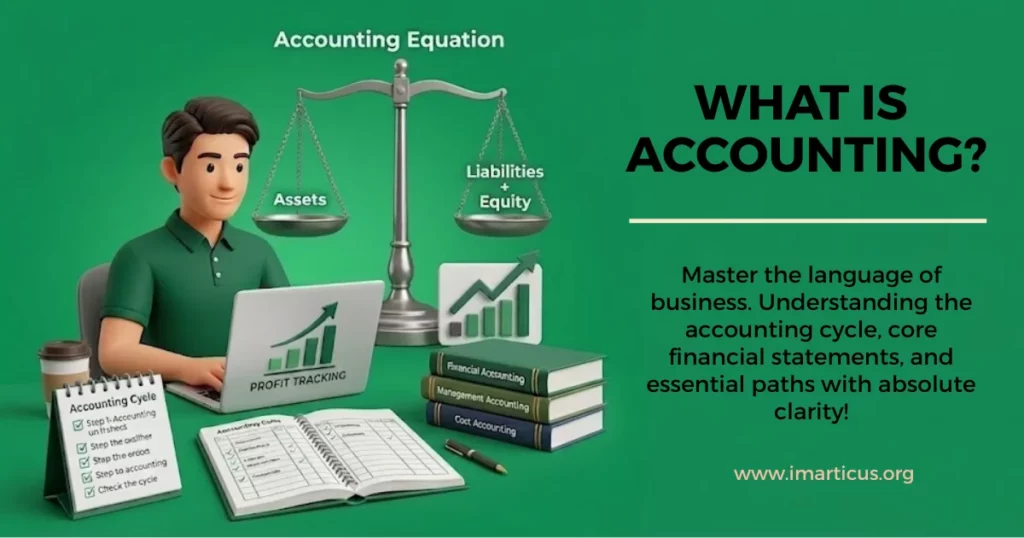
What Is The Accounting Equation?
Everything in accounting flows from one fundamental truth. I call it the golden rule of accounting – and it is expressed as the accounting equation:
Assets = Liabilities + Owner’s Equity
This equation is the backbone of every balance sheet ever prepared. Here is what each term means and why it matters:
| Component | Definition | Examples |
| Assets | Everything the business owns or controls that has economic value | Cash, inventory, machinery, buildings, receivables, investments |
| Liabilities | Every obligation the business owes to outsiders | Bank loans, supplier invoices unpaid, salaries payable, tax due |
| Owner’s Equity | The residual interest – what belongs to the owner after all debts are settled | Capital invested + retained profits accumulated over time |
What I find remarkable about this equation is that it can never be broken. Every single financial transaction in a business changes the numbers – but the equation always stays balanced. If assets increase, either liabilities increase or equity increases. Always. That is by design, and it is what makes double-entry accounting so powerful.
Step 2 – Classifying Transactions
Once everything is recorded, I move it to the ledger. This is where each account gets its own space – cash in one place, sales in another, salaries in their own section. It turns a long list of transactions into something I can actually use. At any point, I can open any account and see exactly what happened and when.
Step 3 – Preparing Financial Statements
With everything recorded and classified, the real picture starts to form. Financial statements are where it all comes together. The three I work with most are the Profit and Loss Account, the Balance Sheet, and the Cash Flow Statement. Each one tells a different part of the same story.
What Is Profit and Loss Account?
The Profit and Loss account is the financial report I always look at first when evaluating a business. It shows revenues earned and expenses incurred over a specific period, and the resulting net profit or net loss.
| P&L Component | What It Captures |
| Revenue / Net Sales | Total income from core business activities |
| Cost of Goods Sold (COGS) | Direct costs of producing the goods or services sold |
| Gross Profit | Revenue minus COGS – the profit before operating costs |
| Operating Expenses | Indirect day-to-day costs – rent, salaries, utilities, marketing |
| Operating Profit (EBIT) | Gross profit minus operating expenses |
| Interest and Tax | Finance costs and tax obligations |
| Net Profit / Net Loss | What remains after ALL expenses – the bottom line |
A positive net profit means the business is making money. A net loss means expenses are outrunning revenue. I recommend every business owner review their P&L every single month – not just at year-end. The patterns it reveals are often surprising.
Step 4 – Analysing Financial Performance
The final step in the accounting process is analysis – using the financial data to ask and answer meaningful questions. Are margins improving or compressing? Is the business taking on too much debt? Are customers paying on time? This is where accounting ratios become indispensable.
What Is Accounting Ratio?
Accounting ratios are mathematical relationships between two financial figures that reveal meaningful insights about a business’s health, efficiency, and profitability. I think of them as the vital signs of a business – the way a doctor reads a patient’s blood pressure and heart rate, an analyst reads a company’s current ratio and return on equity.
| Ratio | Formula | What I Use It to Assess | Healthy Benchmark |
| Current Ratio | Current Assets ÷ Current Liabilities | Short-term liquidity – can the business pay its near-term bills? | 2:1 is generally comfortable |
| Gross Profit Margin | Gross Profit ÷ Net Sales × 100 | Profitability of the core product or service | Varies by industry |
| Net Profit Margin | Net Profit ÷ Revenue × 100 | Overall profitability after every cost is accounted for | Higher is better, compared to industry peers |
| Debt-Equity Ratio | Total Debt ÷ Shareholders’ Equity | Financial risk – how much debt vs owner funding? | Below 2:1 is generally preferred |
| Return on Equity | Net Profit ÷ Shareholders’ Equity × 100 | Returns generated for the owners’ investment | Above 15% is considered strong |
| Inventory Turnover | Cost of Goods Sold ÷ Average Inventory | Efficiency of stock management | Higher is better in most industries |
When I see financial news comparing company performance, accounting ratios are almost always behind the headline numbers. Learning to read these ratios is one of the most practical skills anyone in business or finance can develop.
What Are Accounting Principles and Standards?
Accounting without rules is just guesswork. The principles and standards I am about to walk you through are what make financial information trustworthy, comparable, and legally defensible – whether you are a small business in Mumbai or a listed company filing with SEBI.
What Is Accounting Principles?
Accounting principles are the foundational rules that guide how financial information is recorded and reported. They are not laws in the legal sense, but they are the professional standards that every serious accountant follows. Here are the most important ones I work with:
| Principle | What It Means | Why I Consider It Important |
| Revenue Recognition | Revenue is recorded when it is earned, not when cash is received | Prevents inflating current period income by collecting advance payments |
| Matching Principle | Expenses must be recorded in the same period as the revenue they help generate | Ensures the P&L reflects true period-wise profitability |
| Consistency Principle | The same accounting methods must be used from one period to the next | Makes year-on-year comparisons meaningful and reliable |
| Materiality Principle | Only financially significant information needs to be disclosed in detail | Avoids cluttering statements with immaterial transactions |
| Prudence / Conservatism | Recognise anticipated losses immediately; recognise gains only when certain | Prevents overstating profits and misleading stakeholders |
| Full Disclosure | All material information that could influence decisions must be disclosed | Ensures investors have everything they need to make informed choices |
Accounting principles and the golden rules of accounting create a structured framework for financial reporting. They help maintain accuracy, consistency, transparency, and reliability, ensuring that financial information can be trusted for decision-making.
What Is Accounting Standards?
Accounting standards are the formal, authoritative rules issued by recognised bodies that specify exactly how different financial transactions should be recorded, measured, and disclosed. They are what ensure a company’s financial statements are comparable to another company’s – even across different industries and geographies.
| Standard | Where It Is Used | Governing Body |
| IFRS (International Financial Reporting Standards) | 140+ countries across the world | IASB – International Accounting Standards Board |
| Ind AS (Indian Accounting Standards (converged with IFRS)) | Listed companies and large Indian corporates | Ministry of Corporate Affairs, India |
| US GAAP (Generally Accepted Accounting Principles) | United States companies | FASB – Financial Accounting Standards Board |
| AS (Old Indian) (Accounting Standards (older set)) | Unlisted SMEs and smaller Indian entities | ICAI – Institute of Chartered Accountants of India |
Accounting standards act like a common language for financial reporting. They make sure businesses follow the same rules, helping investors, regulators, and decision-makers understand and compare financial information with confidence.
Difference Between Accounting Principles and Standards
While both guide accounting practices, principles and standards play different but complementary roles, shaping the way financial information is recorded, reported, and interpreted across businesses.
| Aspect | Accounting Principles | Accounting Standards |
| Definition | Basic guidelines or assumptions that form the foundation of accounting (e.g., consistency, prudence, accrual). | Detailed rules issued by regulatory bodies to standardize accounting practices (e.g., GAAP, IFRS). |
| Purpose | To provide general guidance for recording and reporting financial transactions. | To ensure uniformity, accuracy, and comparability of financial statements across businesses. |
| Nature | Broad, conceptual, and theoretical. | Specific, formal, and enforceable. |
| Examples | Consistency Principle, Matching Principle, Prudence Principle. | IFRS 15 (Revenue from Contracts), IAS 1 (Presentation of Financial Statements). |
| Who Issues | Developed from accounting concepts and practices over time. | Issued by standard-setting authorities (e.g., ICAI, FASB, IASB). |
Principles are the foundation and philosophy behind accounting, while Standards are the formal rules to apply those principles consistently.
What Is the Accounting Cycle?
The accounting cycle is one of my favourite topics to explain because it brings everything together. It is the complete, repeating sequence of steps that a business goes through to record, process, and report financial transactions over an accounting period – typically a month, quarter, or financial year.
I use the word ‘cycle’ deliberately. This process does not end – it repeats, period after period, keeping the financial records current and meaningful.
- Identify Transactions: Identify financial events and collect supporting documents.
- Record Journal Entries: Record transactions using debit and credit rules.
- Post to the Ledger: Transfer and classify transactions into accounts.
- Prepare Trial Balance: Verify that total debits equal total credits.
- Make Adjusting Entries: Record accruals, depreciation, and pending adjustments.
- Prepare Financial Statements: Create the Profit & Loss Statement, Balance Sheet, and Cash Flow Statement.
- Record Closing Entries: Close temporary accounts and transfer balances.
- Prepare Post-Closing Trial Balance: Confirm account balances and prepare for the next cycle.
Interesting Insight: Over 140 countries use IFRS accounting standards for financial reporting. (Source: IFRS Foundation)
Career Opportunities In Accounting
One of the things I genuinely love about a foundation in accounting is how broadly it translates into career opportunities. Accounting knowledge is not confined to one job title. It opens doors across industries, geographies, and seniority levels – from a fresh graduate starting in a Big 4 firm to a CFO leading financial strategy at a global corporation.
Top Careers In Accounting
Let me walk you through the specific roles I see accounting professionals move into – and what each career path actually involves day to day.
| Career Role | What They Do Day to Day | Average Salary in India | Key Qualification |
| Chartered Accountant (CA) | Audit financial statements, advise on tax, handle corporate compliance and financial reporting | ₹ 7-20 LPA (rises sharply with experience and specialisation) | ICAI CA qualification |
| Auditor | Examine and verify financial records for accuracy, compliance, and fraud detection | ₹ 4-12 LPA | CA, CPA, ACCA |
| Financial Analyst | Analyse financial data to guide investment and business strategy decisions | ₹ 5-15 LPA | CFA, MBA Finance, BCom + experience |
| Tax Consultant | Advise businesses and individuals on tax planning, GST, and income tax compliance | ₹ 4-10 LPA | CA, LLB (tax), specialised tax certifications |
| Management Accountant | Internal reporting, budgeting, cost control, and performance management | ₹ 6-14 LPA | CMA, CIMA, MBA Finance |
| Investment Banker | Execute M&A deals, raise capital, and perform company valuations | ₹ 10-30+ LPA (plus significant bonuses) | CFA, MBA from top institutes |
| Finance Manager | Oversee the financial operations and reporting of a business or division | ₹ 8-18 LPA | CA, MBA Finance, CMA |
Accounting can lead to a wide range of careers, from corporate finance and auditing to investment and tax consulting.
(Source: AmbitionBox)
Skills Required For Accounting Professionals
Beyond qualifications, I have noticed that the accounting professionals who advance fastest share a specific set of skills. Here is what I believe matters most:
- Analytical thinking – the ability to look at numbers and derive decisions, not just describe what the spreadsheet says
- Accounting software proficiency – Tally, SAP, QuickBooks, Xero, or whichever platform the employer uses
- Deep understanding of applicable standards – GAAP, Ind AS, IFRS, depending on the role and geography
- Financial modelling and Excel skills – essential for analyst and senior roles across all accounting functions
- Communication skills – being able to explain complex financial data to non-finance colleagues and leadership
- Professional ethics and integrity – accounting is a trust-based profession, and reputation is everything
- Attention to detail combined with the ability to see the big picture – both matter in equal measure
Also Read: Key Reasons to Use Accounting Software
Why Choose Imarticus Learning For An Accounting Career
Building a successful accounting career requires more than theoretical knowledge. From my experience, choosing the right Finance Courses can help bridge the gap between classroom learning and real-world industry requirements. Imarticus Learning focuses on developing practical skills that prepare learners for modern finance and accounting roles.
- Industry-focused course aligned with current market demands
- Practical learning through real-world case studies and business scenarios
- Training on accounting and finance tools used by professionals
- Guidance from experienced mentors and industry experts
- Career support with interview preparation and placement assistance
- Skill development in financial analysis, reporting, and business decision-making
FAQ About What Is Accounting
Understanding accounting becomes easier when common doubts are addressed, which is why the following frequently asked questions may be helpful.
What Is GAAP In Accounting?
GAAP stands for Generally Accepted Accounting Principles – the standardised rules companies must follow when preparing financial statements. In India, GAAP broadly refers to Ind AS and the older AS standards; in the US, it refers to FASB standards. GAAP ensures financial statements are consistent and comparable across companies.
What Is Accounts Payable?
Accounts payable is the money a business owes to its suppliers for goods or services already received but not yet paid for. It is recorded as a current liability on the balance sheet, representing a future cash outflow the business is committed to making.
What is Chartered Accountant?
A Chartered Accountant (CA) is a qualified accounting professional certified by the Institute of Chartered Accountants of India (ICAI). CAs are authorised to conduct statutory audits, advise on taxation, provide financial consulting, and sign off on regulated financial documents. The CA qualification is one of the most respected and demanding professional certifications in India.
What Qualifications Are Required To Start A Career In Accounting?
You can begin with qualifications such as B.Com, CA, CPA, ACCA, CMA, or a specialised course depending on your career goals.
What Is The Difference Between Accounting And Bookkeeping?
Bookkeeping is the day-to-day task of recording financial transactions accurately and completely. Accounting takes those records and transforms them – classifying, analysing, preparing statements, and drawing insights that inform business decisions. Bookkeeping is an input to accounting; accounting is the broader discipline that uses bookkeeping as its foundation.
Is Accounting A Good Career Option In India?
Yes, accounting remains a strong career choice in India with opportunities across industries and long-term growth potential. Imarticus Learning help students build practical skills through industry-focused courses.
What Is The Future Scope Of Accounting?
The demand for accounting professionals continues to grow with increasing business expansion, digital transformation, and financial compliance requirements.
Is Accounting Difficult For Beginners?
No, accounting becomes easier when you understand the basic concepts, such as transactions, debit and credit, journals, and financial statements, step by step. Imarticus Learning helps beginners build strong accounting fundamentals through industry-oriented training, practical case studies, and expert-led finance programs.
Learn What Is Accounting and Grow Your Skills
Accounting plays a much larger role than simply recording transactions and preparing financial reports. It helps businesses understand their financial position, track performance, manage costs, and make informed decisions that support growth and long-term stability. Understanding what is accounting creates a foundation that helps individuals and organisations make better financial choices.
As businesses continue to evolve with technology and changing market demands, accounting remains a highly valuable skill across industries. Whether your goal is to pursue a career in finance or strengthen your understanding of business fundamentals, accounting continues to offer practical knowledge, professional opportunities, and long-term value.
The Finance Courses by Imarticus Learning help learners build practical finance and accounting skills through industry-focused training, real-world projects, and career-oriented learning designed for aspiring finance professionals.
Liked This? Follow Us Where You Already Search.
Preferred Sources is Google’s built-in follow button — no app, no login, just more Imarticus in your results.