


Every time a company’s annual report lands on an investor’s desk, the first place most experienced finance professionals flip to is not the CEO’s letter. It is the balance sheet. But honestly, when someone first asks you what is balance sheet and why it matters so much, the textbook answer rarely does justice to how powerful this document actually is.
When I first encountered a balance sheet, I did not find it fascinating. I found it confusing. Three sections. Dozens of line items. Two sides that somehow always added up to the same number. And a formula that felt more like a rule I had to accept on faith than something I actually understood. And that is exactly why so many working professionals today are turning to structured Finance Courses – not to start from scratch, but to fill the gaps, sharpen their understanding of documents like this one, and make faster, smarter decisions in their careers.
This guide covers everything – meaning, formula, types, reconciliation, and real career applications. No jargon, just clarity. A balance sheet tells you, at a specific point in time, what a company owns, what it owes, and what belongs to its owners. Three things that reveal more about a business than almost anything else.
What is Balance Sheet?
Don’t Let Our Best Advice Get Buried
Add Imarticus as a Preferred Source — see more of what we publish, every time you search.

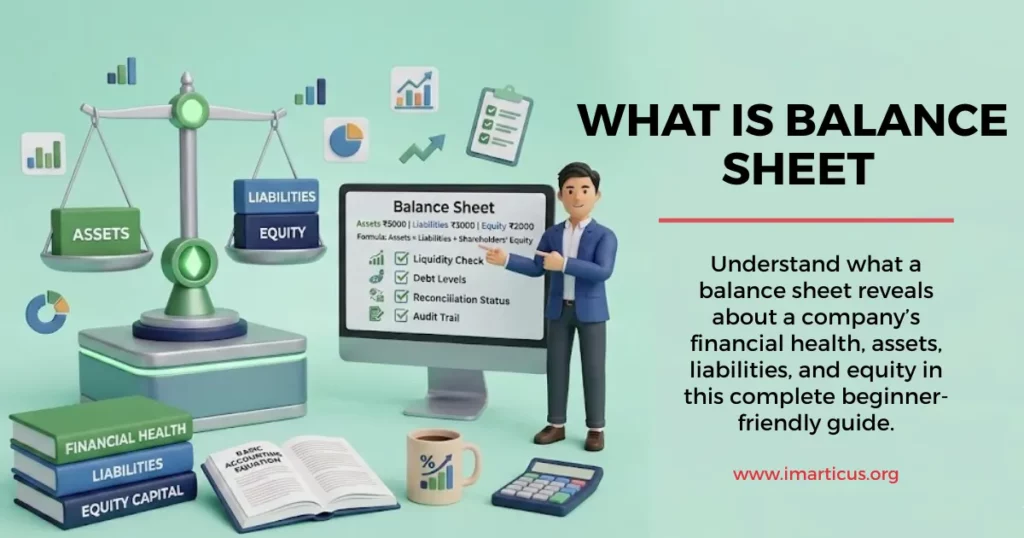
A balance sheet is a financial statement that tells you, at a specific point in time, exactly what a company owns, what it owes, and what belongs to its owners.
Think about it this way. If someone asked you right now, “how are you doing financially?”- you would probably say something like: “I have some savings, maybe a house. I have a home loan and a credit card bill I need to clear.” That is it. What you own, what you owe. A balance sheet does the same thing for a company – just in a more structured, regulated, and publicly disclosed way.
- Assets – what the company owns or controls
- Liabilities – what the company owes to others
- Shareholders’ Equity – what belongs to the company’s owners after liabilities are settled
Why Is It Called A “Balance” Sheet?
The term “balance” exists because of the accounting equation that governs every single transaction a business records. No matter how many transactions happen, the sheet must always balance – assets must always equal the combined total of liabilities and equity.
If a company borrows money (a liability increases), it also receives cash (an asset increases). Both sides move together. This self-balancing nature is what gives the statement its name.
The Basic Balance Sheet Formula
The foundation of every balance sheet rests on one equation:
Assets = Liabilities + Shareholders’ Equity
This is the accounting equation. Every entry in a balance sheet, no matter how complex, traces back to this formula. If a company has ₹50 crore in assets and ₹30 crore in liabilities, shareholders’ equity stands at ₹20 crore.
| Component | What It Represents | Example |
| Assets | What the company owns or controls | Cash, land, inventory, receivables |
| Liabilities | What the company owes to outsiders | Bank loans, accounts payable, bonds |
| Shareholders’ Equity | Owners’ residual claim after liabilities | Share capital, retained earnings, reserves |
What strikes me most is that every rupee of assets had to come from somewhere – either a creditor or an owner. There’s no third option.
Shareholders’ equity tells me what would be left for owners after selling everything and clearing every debt. And the equation must always balance – not approximately, but perfectly, to the last paisa. That’s what makes this formula so powerful.”
What Is The Purpose Of a Balance Sheet?
If we already have a profit and loss, why do we even need a balance sheet? Simple. The P&L tells you how the company performed. The balance sheet tells you where it actually stands. One shows the journey, the other shows where you ended up.
| Purpose | Who Uses It | What They Look For |
| Financial health assessment | Investors, analysts | Liquidity, solvency, asset quality |
| Creditworthiness evaluation | Banks and lenders | Debt levels, collateral, and equity base |
| Business decisions | Management and board | Working capital, leverage, growth capacity |
| Regulatory compliance | Auditors, regulators | Accuracy, completeness, standards compliance |
| Performance tracking | CFOs, controllers | Year-on-year changes in financial position |
What I find compelling is that no single stakeholder reads a balance sheet the same way. A banker’s eye goes straight to debt levels, while an investor scans for asset quality. Same document, entirely different lens.
That’s what makes the balance sheet truly versatile – it doesn’t speak just one language. It speaks to everyone who has a stake in the company’s future.
Also Read: Learn the Most Important Balance Sheet Items
Main Components of a Balance Sheet
A balance sheet has three main sections. Understanding each one is essential before you attempt to read or analyse a real company’s financials. Think of these three sections as three different lenses – each one telling you something the other two cannot.
Assets
Assets are everything a company owns or controls that holds economic value. Simply put, if it can generate money or support operations, it is an asset. A strong, diversified asset base is what keeps a business stable when things get tough. Assets are split into two categories based on how quickly they can be turned into cash.
- Current Assets
These are assets expected to convert into cash within one year. They reflect how comfortably a company can handle its day-to-day financial obligations – without needing to panic or borrow at the last minute.
| Current Asset | Description | Example |
| Cash and Cash Equivalents | Most liquid form of assets | Bank balance, treasury bills |
| Accounts Receivable | Money owed by customers | Unpaid invoices |
| Inventory | Goods held for sale | Raw materials, finished goods |
| Prepaid Expenses | Payments made in advance | Insurance premiums paid upfront |
| Short-term Investments | Securities maturing within a year | Fixed deposits, money market instruments |
Here is something worth keeping in mind – not all current assets are created equal. Cash sitting in a bank account is ready to use right now. Receivables? That depends on whether your customers actually pay on time. And the inventory still needs to find a buyer before it becomes cash. This is why a smart analyst never just looks at the current assets total – they always ask what is actually inside it.
- Non-Current Assets
Also called fixed or long-term assets, these are held by the business for longer than one year and are not intended for quick sale. They represent the backbone of a company’s operational capacity – the resources it relies on to generate revenue year after year.
| Non-Current Asset | Description | Example |
| Property, Plant & Equipment (PP&E) | Tangible long-term assets | Land, buildings, machinery |
| Intangible Assets | Non-physical value-generating assets | Patents, trademarks, goodwill |
| Long-term Investments | Equity or debt held long-term | Stakes in subsidiaries |
| Deferred Tax Assets | Future tax benefits | Carry-forward losses |
One important thing to remember – non-current assets are recorded at historical cost, not current market value. A property bought decades ago could be worth far more today than what the balance sheet shows.
Liabilities
Liabilities are obligations the company owes to outside parties – money it must repay or services it must deliver in the future. How a company manages its liabilities is often just as telling as the assets it holds – too much of the wrong kind of debt can unravel even an otherwise healthy business.
- Current Liabilities
These are due within one year and directly affect a company’s short-term cash flow. Keeping current liabilities in check is critical – when they start outpacing current assets, it is usually the first sign that a company is heading into liquidity trouble.
| Current Liability | Description |
| Accounts Payable | Amounts owed to suppliers |
| Short-term Borrowings | Loans maturing within a year |
| Accrued Expenses | Expenses incurred but not yet paid |
| Deferred Revenue | Payment received before service delivery |
| Current Portion of Long-term Debt | Part of a long-term loan due this year |
A rising current liabilities figure is not always a bad sign – but when it grows faster than current assets, that is when it demands attention. Smart analysts always read current liabilities alongside the current ratio to get the full picture.
- Long-Term Liabilities
These are obligations due beyond one year and relate to the long-term financial strategy for business leaders. While they do not pressure the company’s immediate cash flow, a bloated long-term liability section can quietly signal over-leveraging that catches up with the business down the road.
| Long-Term Liability | Description |
| Long-term Debt | Bonds, debentures, term loans |
| Deferred Tax Liabilities | Taxes payable in future periods |
| Pension Obligations | Future employee retirement benefits |
| Lease Liabilities | Long-term operating/finance leases |
Long-term liabilities are not inherently bad – borrowing to fund growth is a legitimate strategy. What matters is whether the business generates enough cash flow to service that debt comfortably over time.
Shareholders’ Equity
Shareholders’ equity is the residual interest in the company’s assets after all liabilities have been deducted. It represents the owners’ claim on the business. It typically includes:
- Share Capital – the face value of shares issued to investors
- Reserves and Surplus – accumulated profits retained in the business
- Securities Premium – amount received above the face value of shares during issuance
- Other Comprehensive Income – gains and losses not reflected in the P&L
What is Equity Capital in Balance Sheet?
Equity capital in a balance sheet is simply the money that the owners or shareholders put into the company in exchange for their stake in it. It shows up under shareholders’ equity and includes the paid-up share capital – the actual amount the company received when it issued shares to investors. Think of it as the foundation the business is built on. Without equity capital, there is no company.
What makes equity different from debt is that there is no fixed obligation to repay it. It is permanent capital – it stays in the business for as long as the company exists. But there is a trade-off. In the event of liquidation, equity holders are the last in line to get paid, after every creditor and lender has been settled. That is the risk they carry – and higher potential returns are the compensation for accepting it.
Interesting Insight: Equity is also called “book value” and represents the residual interest of owners after subtracting total liabilities from total assets. (Source: United States Securities and Exchange Commission)
Balance Sheet Format Explained
The format in which a balance sheet is presented matters for readability and analysis. Different organisations, industries, and regulatory environments prefer different formats.
Vertical Balance Sheet Format
In the vertical format, all items – assets first, then liabilities and equity – are listed top to bottom in a single column. This is the most commonly used format in India, as prescribed under Schedule III of the Companies Act, 2013.
This format is clean, easy to compare across periods, and ideal for annual reports.
Horizontal or T-Form Balance Sheet
The T-form balance sheet splits into two sides – assets on the left, liabilities and equity on the right; and both sides must always add up to the same number. That equality isn’t a coincidence; it’s just how double-entry bookkeeping works.
This format makes the balancing of both sides immediately visible, which is why it remains popular in academic and teaching contexts.
Classified Balance Sheet
A classified balance sheet organises assets and liabilities into meaningful subcategories – current and non-current – making it easier for readers to assess liquidity and long-term solvency at a glance. Most publicly listed company balance sheets follow this classified structure.
What is Common Size Balance Sheet
A common size balance sheet expresses each line item as a percentage of total assets, rather than as an absolute monetary figure. This makes it easy to compare companies of different sizes or the same company across different time periods.
| Line Item | Amount (₹ Cr) | % of Total Assets |
| Cash & Equivalents | 500 | 10% |
| Accounts Receivable | 1,000 | 20% |
| Fixed Assets | 2,500 | 50% |
| Total Assets | 5,000 | 100% |
| Total Liabilities | 2,000 | 40% |
| Shareholders’ Equity | 3,000 | 60% |
Common size analysis is especially useful for cross-company benchmarking and identifying structural shifts in a company’s financial composition over time. For instance, if a company’s fixed assets as a percentage of total assets have been steadily declining over three years, that is a story worth investigating – and common size analysis is what surfaces it.
What is Comparative Balance Sheet
A comparative balance sheet places two or more periods side by side – typically the current year and the previous year – allowing readers to identify trends, growth, and directional shifts in the company’s financial position.
| Item | FY 2024 (₹ Cr) | FY 2025 (₹ Cr) | Change (₹ Cr) | % Change |
| Total Assets | 4,200 | 5,000 | +800 | +19% |
| Total Liabilities | 1,800 | 2,000 | +200 | +11% |
| Shareholders’ Equity | 2,400 | 3,000 | +600 | +25% |
Comparative balance sheets are the backbone of trend analysis and year-on-year financial performance reviews. If equity is growing steadily while debt is shrinking, that is a company building financial strength – and a comparative balance sheet is what makes that pattern visible at a glance.
Types of Balance Sheets
Not every balance sheet serves the same purpose. The type of balance sheet depends on the nature of the entity, the purpose of the report, and the stage of business operations.
What Is Standalone Balance Sheet
A standalone balance sheet presents the financial position of a single legal entity without including the performance or financials of its subsidiaries or associated companies. It reflects only the parent company’s own assets, liabilities, and equity – nothing more, nothing less. If you want to evaluate how the parent company itself is performing, stripped of everything else, this is the document you turn to. Key characteristics:
- Covers only one legal entity
- Does not eliminate intercompany transactions
- Best used for evaluating the parent company in isolation
- Mandatory for all registered companies under the Companies Act, 2013
What is Consolidated Balance Sheet
A consolidated balance sheet combines the financial positions of a parent company and all its subsidiaries into a single, unified statement. It eliminates intercompany transactions and presents the entire group as one economic entity. A parent company may look modest on a standalone basis, but its consolidated balance sheet can reveal a much larger financial reality. Key characteristics:
- Covers the parent company and all subsidiaries as one unit
- Intercompany transactions are eliminated to avoid double-counting
- Preferred by investors and analysts for group-level assessment
- Mandatory for listed companies with subsidiaries under SEBI regulations
What is Standalone and Consolidated Balance Sheet?
If you have ever looked at two different balance sheets for the same company and wondered why the numbers do not match, chances are one was standalone, and the other was consolidated. They are not contradictory. They are simply answering two different questions. Here is how the two compare:
| Feature | Standalone Balance Sheet | Consolidated Balance Sheet |
| Scope | Single legal entity only | Parent + all subsidiaries as one unit |
| Intercompany Transactions | Included | Eliminated on consolidation |
| Best Used For | Evaluating the parent company | Evaluating the entire corporate group |
| Regulatory Requirement | Mandatory for all companies | Mandatory for listed companies with subsidiaries |
| Investor Usefulness | Limited for group analysis | Preferred for full group picture |
In India, the Securities and Exchange Board of India (SEBI) and the Companies Act, 2013 require listed companies with subsidiaries to publish both standalone and consolidated financial statements.
What Is Projected Balance Sheet
A projected balance sheet is a forward-looking, estimated financial statement prepared for a future date based on business forecasts, growth assumptions, and financial planning models. It is not an actual record of transactions but a financial projection. Projected balance sheets are widely used in:
- Business plan preparation and startup funding pitches
- Loan applications and bank credit appraisals
- Strategic financial planning by CFOs and finance teams
- Mergers, acquisitions, and due diligence processes
What is Provisional Balance Sheet
A provisional balance sheet is a temporary financial statement prepared before the books of accounts are finalised for the period. It uses unaudited, estimated figures to give a preliminary picture of the company’s financial position. It is typically prepared when:
- A final audited balance sheet is not yet available
- A company needs to present its financials quickly for compliance or banking purposes
- An interim financial position is needed for internal decision-making
What is Valuation Balance Sheet
A valuation balance sheet is prepared specifically to determine the fair value or economic worth of a company’s assets and liabilities, often for mergers, acquisitions, partnership dissolution, or insolvency proceedings. Unlike a historical cost balance sheet, assets here are revalued at market or fair value rather than their original purchase price – because in an M&A transaction, what something was bought for years ago rarely reflects what it is actually worth today. Key characteristics:
- Assets and liabilities are recorded at fair or market value, not historical cost
- Commonly used in M&A due diligence and business valuations
- Critical in partnership dissolution and insolvency proceedings
- Book value and market value can differ significantly, making this document essential
What is Bank Balance Sheet
A bank balance sheet follows the same fundamental structure as any corporate balance sheet but differs significantly in the nature of its assets and liabilities, given the unique business model of banks. What makes it distinctly different is that for a bank, loans given out are assets while customer deposits are liabilities – the exact reverse of a typical manufacturing company. Key characteristics:
- Advances and loans to customers appear as assets, not liabilities
- Customer deposits are recorded as liabilities since the bank owes that money back
- Governed by RBI’s Master Directions with specific NPA and capital adequacy disclosures
- Requires separate provisioning norms not seen in regular corporate balance sheets
What is Balance Sheet Reconciliation?
Balance sheet reconciliation is the process of verifying that the balances in the general ledger match the amounts reported in the balance sheet by tracing each line item back to source documents, subsidiary ledgers, and supporting schedules.
Think of it as a check and balance on the numbers themselves. Before a company presents its balance sheet to auditors, shareholders, or regulatory bodies, the finance team must reconcile every account to ensure accuracy.
Why Reconciliation Matters
Without reconciliation, even a well-run finance team can end up presenting numbers that look clean on the surface but are quietly hiding errors underneath. And in finance, a small undetected error today has a habit of becoming a much bigger problem by the time auditors find it. Specifically:
- Errors in individual accounts can roll up into misstated financial statements
- Regulatory penalties become likely if discrepancies are found during audits
- Management decisions made on inaccurate data carry compounded risk
- Investors and lenders lose confidence in the reliability of the company’s financials
Common Reconciliation Errors
Reconciliation errors rarely happen because someone was careless. They happen because finance teams are working across multiple systems, tight deadlines, and large volumes of data. Here are the most common ones to watch for:
| Error Type | Description |
| Timing differences | Transactions recorded in different periods than expected |
| Missing entries | Transactions recorded in one ledger but not another |
| Incorrect classification | Assets recorded as expenses or vice versa |
| Bank reconciliation gaps | Differences between bank statements and book balance |
| Foreign currency mismatches | Incorrect exchange rate application in multi-currency accounts |
The good news is that most of these errors are preventable with a structured reconciliation process and clear ownership of each account. Which brings us to exactly that.
Balance Sheet Reconciliation Process
Reconciliation is not a one-time activity – it is a discipline. Companies that treat it as a regular, structured process tend to catch errors early, close their books faster, and walk into audits with far more confidence. The reconciliation process typically follows these steps:
- Extract ledger balances for each balance sheet account
- Gather supporting documents – bank statements, invoices, contracts, payroll records
- Compare ledger balances against source documents line by line
- Identify discrepancies and investigate their cause
- Pass correcting journal entries for genuine errors
- Document and sign off the reconciled balances
- Maintain a reconciliation schedule for audit trail purposes
What is Balance Sheet Audit?
A balance sheet audit – also called a financial position audit or year-end audit – is the process through which an independent external auditor examines and verifies the accuracy, completeness, and fairness of the information presented in a company’s balance sheet.
It is not just a number-check. Auditors assess whether the balance sheet presents a “true and fair view” of the company’s financial position, in accordance with applicable accounting standards.
Objectives of a Balance Sheet Audit
An audit is not just about ticking boxes – it is about independently verifying that the numbers in the balance sheet actually reflect reality. Auditors approach this with a specific set of objectives in mind, each targeting a different dimension of accuracy and reliability:
- Verify that assets exist and are owned by the company (existence and rights)
- Confirm that all liabilities on the balance sheet are recorded and not understated (completeness)
- Check that assets and liabilities are valued appropriately (valuation)
- Ensure proper classification and disclosure of items (presentation)
- Detect material misstatements arising from error or fraud
Steps in Balance Sheet Auditing
Every audit follows a structured path – auditors do not simply walk in and start checking numbers. There is a deliberate sequence to how they work, designed to ensure nothing material is missed:
| Step | Activity |
| Planning | Understand the business, assess risk areas, and define scope |
| Internal controls review | Evaluate the reliability of the company’s own financial controls |
| Substantive testing | Verify individual balances through confirmation letters, physical verification |
| Analytical procedures | Ratio analysis, trend comparison, reasonableness checks |
| Finalisation | Issue audit opinion, review management responses |
Each step builds on the previous one. By the time auditors reach finalisation, they have worked through the business top to bottom – which is why a clean audit opinion carries as much weight as it does.
Importance of Audits for Businesses
A clean audit opinion – an “unqualified” or “unmodified” audit report – significantly enhances a company’s credibility with investors, lenders, regulators, and the public. It signals that the balance sheet can be trusted. An adverse opinion or qualified report, on the other hand, raises serious red flags about financial integrity.
In India, companies above a certain threshold are required to undergo a statutory audit under the Companies Act, 2013. Additionally, listed companies are subject to review by SEBI-registered auditors.
Difference Between Trial Balance and Balance Sheet
This is one of the most commonly confused pairs in accounting – and honestly, the confusion is understandable. They both involve the same numbers, they are both prepared by the accounts team, and they both sound like they are describing the company’s financial position. But they are not the same thing, and mixing them up in a professional setting can cost you credibility fast. Let us clear this up once and for all.
| Feature | Trial Balance | Balance Sheet |
| What it is | An internal accounting document | A formal financial statement |
| Purpose | Check the mathematical accuracy of the ledger | Reflect the financial position of the company |
| Includes | All ledger accounts (revenue, expense, assets, liabilities) | Only assets, liabilities, and equity |
| Prepared by | Accounting department internally | Prepared for external reporting |
| Format | List of debit and credit balances | Structured statement (vertical or horizontal) |
| Frequency | Can be prepared at any time | Typically prepared quarterly or annually |
| Audited? | Not audited | Subject to statutory audit |
| Published? | Not published externally | Included in annual reports, SEBI filings |
The trial balance is the accountant’s internal tool – it confirms that for every debit there is a corresponding credit in the books. It catches mathematical errors. It does not, however, tell you anything meaningful about financial health.
The balance sheet, on the other hand, is a communication document. It is prepared for the outside world – shareholders, lenders, regulators, analysts – and tells a structured story about where the company stands financially at a given moment.
How to Read and Analyse a Balance Sheet
Analysing balance sheets is a skill – and like most skills, it gets sharper with practice. The first time you look at one, it can feel like a wall of numbers. But once you know what to look for and where to look, it starts telling you a very clear story about the business. Here is how finance professionals approach it systematically, without getting lost in the details.
Check Liquidity
Liquidity refers to the company’s ability to meet short-term obligations. The first thing to check is whether current assets comfortably exceed current liabilities. A company that cannot meet its short-term obligations is in distress regardless of how profitable it appears on paper.
Understand Debt Levels
Look at the proportion of liabilities to total assets. High debt relative to equity increases financial risk, especially in rising interest rate environments. Always check the nature of the debt – is it short-term or long-term? Are there any debt covenants mentioned in the notes?
Evaluate Working Capital
Working Capital = Current Assets − Current Liabilities
Positive working capital means the company can fund its day-to-day operations comfortably. Negative working capital is a serious warning sign in most industries (with exceptions in businesses like supermarkets, where suppliers are paid later than customers pay).
Analyse Shareholders’ Equity
A growing equity base – particularly through increasing retained earnings – suggests the company is consistently profitable and is reinvesting those profits back into the business. Declining equity, especially due to accumulated losses, signals trouble.
How Balance Sheets Are Used in Real Finance Careers
Understanding what is balance sheet is not just an academic exercise. Every major finance role – whether you are sitting in an investment bank, an audit firm, or a corporate treasury team – requires you to read, interpret, and act on balance sheet data. Here is how it plays out across different careers:
Role in Investment Banking
Bankers in investment banking spend a lot of time analysing balance sheets during deal season. When a company is being acquired, the entire conversation starts with the target’s balance sheet – what it owns, what it owes, and what surprises might be hiding in the footnotes. Key applications:
- M&A due diligence and asset quality assessment
- Identifying hidden liabilities and off-balance sheet risks
- Valuation modelling using book value and net assets
- Analysing goodwill and intangible assets in deal structuring
Role in Financial Analysis
Equity research analysts and buy-side analysts build financial models that project a company’s future balance sheets alongside its income statement and cash flow statement. The three statements are deeply interlinked – and the balance sheet is the thread that connects them. Key applications:
- Three-statement financial modelling
- Working capital analysis and cash flow forecasting
- Year-on-year trend analysis and ratio benchmarking
- Stock valuation using book value and return on equity
Role in Accounting and Auditing
For CA (chartered accountants) and auditors, the balance sheet is the central document. It is not just about checking numbers – it is about verifying that every line item reflects economic reality. Key applications:
- Balance sheet audit and substantive testing
- Reconciliation of ledger balances to financial statements
- Compliance checking against Ind AS and Companies Act requirements
- Issuing audit opinions based on balance sheet accuracy
Role in Corporate Finance
CFOs and corporate finance teams use balance sheets to make some of the most consequential decisions a business faces – how to fund growth, how much debt to carry, and when to return capital to shareholders. Key applications:
- Capital structure decisions – equity vs debt trade-offs
- Dividend policy and retained earnings management
- Treasury and liquidity management
- Monitoring debt covenants and financial ratios analysis for lenders
Many B.Com students assume investment banking salaries are only for top-tier finance professionals. But understanding the actual salary structure, career growth, required skills, and hiring reality can help students plan their finance careers with far more clarity and confidence.
Why Choose Imarticus Learning for a Finance Career
Understanding balance sheets becomes much easier when finance is taught through practical business scenarios instead of just theory. Structured learning, expert guidance, and real-world applications often help learners build stronger financial analysis skills over time. Here are some notable aspects of Finance Courses offered by Imarticus Learning:
- Industry-focused programs in finance, accounting, investment banking, and financial analysis
- Practical learning through case studies, projects, and financial modelling exercises
- Guidance from industry professionals and expert mentors
- Flexible online learning formats for students and working professionals
- Career-oriented support, including interview preparation and resume guidance
- Curriculum aligned with real industry applications and financial decision-making
For learners looking to build practical finance skills beyond textbooks, Imarticus Learning offers a more industry-connected learning experience.
FAQs About What Is Balance Sheet
Before we wrap up, let me address some of the most frequently asked questions I come across – from students just starting to working professionals who want to sharpen their understanding. If you have been reading through this guide and something did not fully click, chances are the answer is right here.
Is a Balance Sheet Mandatory For Companies?
Yes. Under the Companies Act, 2013, all registered companies in India are required to prepare and present a balance sheet as part of their annual financial statements. It helps ensure financial transparency and regulatory compliance.
How Often Is A Balance Sheet Prepared?
Publicly listed companies typically prepare balance sheets quarterly and annually as part of their financial reporting. Many businesses also prepare monthly balance sheets for internal financial monitoring and decision-making.
Can Small Businesses Prepare Balance Sheets?
Absolutely. Any business – regardless of size – can and should prepare a balance sheet. For sole proprietors and small businesses, even a simple balance sheet provides clarity on financial health and is required when applying for bank loans.
What Is Reserve And Surplus In Balance Sheet?
Reserve and surplus represent accumulated profits retained by the company after paying dividends and meeting obligations. These funds are usually reinvested into business growth, expansion, or future contingencies and form an important part of shareholders’ equity.
What Is Balance Sheet Also Called?
A balance sheet is also called a statement of financial position because it reflects the financial standing of a business at a specific point in time. It provides a snapshot of what a company owns and owes.
What Is The Role Of Balance Sheets In Financial Analysis?
Balance sheets help analysts evaluate liquidity, leverage, operational efficiency, solvency, and capital structure through ratio analysis and trend comparison. They also support investment, lending, and strategic business decisions.
What Is The Meaning Of Balance Sheet?
The meaning of a balance sheet lies in its ability to present a company’s financial position clearly by balancing assets with liabilities and equity. It is one of the most important financial statements used in accounting.
What Are The 3 Parts Of A Balance Sheet?
The three main parts of a balance sheet are assets, liabilities, and shareholders’ equity. Together, they show how a company finances its operations and manages its resources. These components help businesses, investors, and analysts evaluate the company’s financial strength and stability.
Learn Finance the Way Industry Actually Works
There is a reason the balance sheet has been the cornerstone of financial reporting for centuries. It is not just a statutory requirement. It is a truth-telling document – a structured, honest representation of where a company stands financially at a given moment in time.
From understanding what is balance sheet in simple words to analysing equity capital, reading reserve and surplus figures, distinguishing between standalone and consolidated statements, and interpreting bank balance sheets – the more fluent you become in balance sheets, the sharper your financial thinking becomes.
Whether your goal is to crack a CFA exam, build financial models in investment banking, audit listed companies, or simply make smarter decisions about your own business, the balance sheet is where every serious finance journey begins. If you are ready to take that journey further, Finance Courses by Imarticus Learning are built to give you exactly that – practical, career-ready skills in financial analysis, accounting, and investment banking.
Liked This? Follow Us Where You Already Search.
Preferred Sources is Google’s built-in follow button — no app, no login, just more Imarticus in your results.