A Guide to Markets: Monopoly, Duopoly, Oligopoly & Perfect Competition

Market structure refers to the level of competition present in the market for goods and services, influenced by several key factors, including:

Number and nature of sellers: Varying from perfect competition with numerous sellers to pure monopoly with a single seller and duopoly or oligopoly with a few dominant sellers.

Nature of product: Differentiated products lead to monopolistic competition, undifferentiated products to perfect match, and unique products to pure monopoly.
Entry and exit conditions: Market entry and exit depend on profitability, with perfect competition allowing freedom, monopoly and oligopoly having barriers, and monopolistic competition having minimal restrictions.

Market Structure Forms

Based on competition, we can classify a market in the following ways:

1. Monopoly

A monopoly is a type of business distinguished by its dominance in a market with minimal or no competition and a lack of alternative products.

Within a monopoly, the company wields the authority to influence pricing and constructs obstacles that hinder potential rivals from entering the market.

Monopolies achieve their status through the consolidation of the entire supply chain, which includes everything from production to sales. This can be realised through vertical integration, where they oversee every aspect, or horizontal integration, where they acquire competing companies to establish sole control over production.
One notable advantage monopolies typically enjoy is the concept of economies of scale, enabling them to manufacture large quantities at reduced costs per unit.

Features

  • Single seller: Monopoly features a single dominant seller or firm in the market.
  • Unique product: The monopolist offers a unique product with no close substitutes.
  • Price maker: The monopoly has significant control over setting prices.
  • Barriers to entry: High barriers to entry prevent other firms from entering the market.
  • Market power: The monopolist has substantial market power, often resulting in higher prices.

Pros and cons

Pros Cons
Profit Generation: Generates substantial profits, benefiting shareholders and local communities. Price Control: Curtails competition, leading to higher prices.
Economies of Scale: Achieves cost savings through increased production. Innovation Constraints: Limited competitive innovation due to resource constraints.
Global Competitive Advantage: Excels in foreign markets with strong brand recognition. Quality Neglect: Quality maintenance may need to be noticed in local monopolies.

2. Duopoly

A duopoly is a subset of an oligopoly where only two independent sellers exist. These sellers can act independently or consider the influence of their actions on each other.
When sellers recognise this interdependence, they factor in direct and indirect effects on pricing.

Duopolies can also involve a rival seller maintaining a consistent offering in quantity or price, offering two approaches: acknowledging or disregarding mutual interdependence.

Features

  • Two dominant firms: A Duopoly consists of only two major firms dominating the market.
  • Limited competition: Restricted competition due to the small number of firms.
  • Strategic interactions: Firms engage in strategic actions that affect each other’s decisions.
  • Price interdependence: Pricing decisions by one firm influence the other.
  • Product variation: Products can be homogeneous or differentiated, depending on the industry.

Pros and cons

Pros Cons
Promotion of Competition and Innovation: Fosters innovation and technological advancement through fierce competition. Competition Constraint: Limited competition can lead to higher prices, reduced product diversity, and compromised quality.
Enhanced Consumer Choice: Offers broader consumer options compared to a monopoly. Entry Barriers: New entrants face challenges due to established dominant firms with resources and brand recognition.
Market Stability: Provides a more stable business environment appealing to investors. Price Dynamics: Duopolistic firms may engage in price fluctuations or rigidity, potentially impacting consumers.

3. Oligopoly

In an oligopoly market structure, companies team up to reduce competition and dominate a specific industry. These companies, whether large or small, often hold significant power due to patents, financial strength, and control over resources. This knock creates barriers that discourage new competitors from entering the scene.

In this market setup, real competition is limited, allowing producers to set prices. However, the market is highly responsive to price changes, as consumers can easily switch to alternative products if prices become too high.

Features

  • Few dominant firms: Oligopoly involves a small number of dominant firms.
  • Limited competition: Competition is limited, leading to strategic interactions.
  • Price setting: Firms may be able to set prices, impacting the market.
  • Barriers to entry: Significant barriers deter new entrants.
  • Product variation: Oligopolistic products can be homogeneous or differentiated.

Pros and Cons

Pros Cons
Enhanced Consumer Convenience: Simplifies the decision-making process for consumers. Limited Choices: Few options may cater to only some consumer needs, forcing compromises.
Profitability Boost: Higher pricing can increase profits, potentially benefiting employees and GDP growth. Innovation Deterrence: Entry barriers can discourage innovation, limiting market evolution.
Potential for Competitive Pricing: Market dynamics can influence pricing, fostering competitive options. Prevalence of Price Fixing: Collusion for price fixing may occur, limiting consumer influence.

4. Perfect Competition

Supply and demand intricately determine production levels and prices in a perfectly competitive market.
The perfect competition represents a theoretical ideal. It allows unrestricted entry and exit, with companies flowing in and out based on profitability. With numerous players, no single company significantly influences the market.

Here, participants are price takers, not influencers.

Products are nearly identical, and information about quality and price is openly available. Firms are assumed to operate at peak efficiency, maximising output.

Features

  • Many small firms: Many small firms operate in the market.
  • Homogeneous products: Products are identical among different firms.
  • Price taker: Firms are price-takers with no influence over prices.
  • Free entry and exit: Firms can quickly enter or exit the market.

Pros and Cons

Pros Cons
Optimal Resource Allocation: Efficiently allocates resources, maximising societal well-being. Lack of Innovation Incentive: Constant profit margins may discourage innovation.
Enhanced Consumer Choices: Provides a wide range of options for consumers. Minimal Entry Barriers: Easy market entry may require established firms to remain proactive.
Competitive Pricing: Promotes cost-effective pricing for consumers. Short-Term Profit Volatility: Constant competition can lead to fluctuating profits.

Conclusion

Understanding the various market structures, from the solitary dominance of a monopoly to the strategic interactions of an oligopoly or the vibrant competition in perfect competition, is essential for businesses and professionals alike.

As working professionals, gaining insights into these market dynamics can be a pivotal part of your career growth. That’s where programs like Imarticus Learning’s IIM Lucknow’s Global Senior Leadership Programme come into play.

In today’s dynamic business landscape, being part of a senior leadership programme, especially one offered by a prestigious institution like the Indian Institute of Management (IIM) Lucknow, can be a game-changer.

This IIM course for working professionals equips you with the knowledge and skills to navigate diverse market structures effectively. It’s a unique opportunity to enhance your leadership capabilities and advance your career.

Visit Imarticus Learning today for more information.

Financial Forecasting for Managers and Leadership

The domain of financial forecasting constantly strives to help companies navigate through the constantly changing business landscape without financial hurdles. Financial forecasting delves into the art and science of projecting fiscal patterns and provides managers with critical insights to make educated decisions that drive organisational success.

The blog demystifies the complexity of financial forecasting with a pragmatic approach, helping managers embrace its potential as a strategic tool. Each aspect of this critical discipline is explained in specifics, from predicting revenues and costs to detecting market trends and identifying risks.

If you are interested in leadership and general management courses, keep reading to learn more about financial forecasting.

What is Financial Forecasting?

Financial forecasting is a crucial method of predicting future financial patterns and encompassing economic prediction tools. It entails rigorous examination of historical data, identifying trends and variations, and eventually assisting individuals and organisations in making decisions.

This proactive practice allows for the wise allocation of resources, the strategisation of investment avenues, and the evaluation of risk mitigation techniques.

Financial forecasting offers insights into future outcomes by utilising mathematical models and statistical methods, providing stakeholders with foresight to optimise financial strategy. This predictive strategy improves flexibility and competitiveness by assisting in planning, budgeting, and forecasting market fluctuations.

Importance and Benefits of Financial Forecasting

Financial forecasting is a cornerstone of efficient financial management, providing multiple advantages critical to the performance and resilience of organisations in a variety of industries. They are:

Strategic Decision-Making: Financial forecasting enables organisations to make educated, forward-thinking judgements that guide resource allocation, investment decisions, and expansion strategies.

Resource Optimisation: It supports effective resource management by anticipating future cash flows, allowing for improved budgeting and cost control.

Risk Mitigation: Forecasting helps detect possible risks by predicting financial issues and market volatility, allowing for proactive risk mitigation actions.

Investor Trust: Accurate financial predictions boost investor and stakeholder trust by providing openness and predictability about the company’s financial performance.

Capital Planning: It aids in assessing the requirement for external finance or capital investments, ensuring that capital is accessible when needed for growth or operating demands.

Financial Forecasting vs. Financial Modelling

Financial forecasting and financial modelling are two separate but complimentary financial management and decision-making techniques. While forecasting is concerned with projecting future financial outcomes based on historical and current data, modelling entails developing mathematical representations to examine various scenarios and their implications. Let’s see what they are:

Aspect Financial Forecasting Financial Modelling
Purpose Financial forecasting draws insights into future fiscal performances, aiding seamless decision-making. Financial modelling simulates different financial scenarios and analyses potential decision impacts.
Flexibility Adept with flexibility for changing circumstances and updating forecasts once new information comes to light. Flexible to test various assumptions emerging as a versatile tool for decision making.
Data Leans primarily on historical fiscal data, economic indicators and changing market trends. Likewise utilises historical data to make assumptions for building complex financial structures.
Time Short to medium-term depending upon the next few months to next few years. Flexible with short, medium and long term depending on specific financial modelling objectives.
Scope Focuses on predicting financial metrics like expenses, revenues and cash flow. Encompasses a wide range of financial aspects starting from simple budgets to complex risk analysis valuations.

Methods of Financial Forecasting for Managers and Leaders

Financial forecasting encompasses various methods suitable for the organisation. They are:

1. Bottom-up Forecasting

Bottom-up is a method of detailed financial forecasting in which different components or units within an organisation make projections that are then aggregated to form the overall financial estimate. This strategy promotes a fine-grained awareness of numerous operational factors, which improves accuracy and accountability. It enables managers and departments to directly participate in the forecasting process, resulting in a complete and thorough view that supports informed decision-making and resource allocation.

2. Top-down Forecasting

Top-down forecasting begins with overarching, high-level financial estimates for an organisation. This method starts with macroeconomic considerations, industry trends, and market circumstances, which are then used to generate financial predictions for specific company units or departments. It gives broad insight into financial performance and allows for alignment with external factors, making it useful for organisational strategic planning and budgeting.

3. Correlation Forecasting

Correlation forecasting determines and measures the correlations between variables like asset values, interest rates, and economic indicators. This strategy analyses past correlations and assists forecasters in making more accurate predictions about how changes in one variable may affect others, improving the precision of financial projections.

4. Statistical Forecasting

In financial forecasting, statistical forecasting analyses historical data using mathematical and statistical models. It predicts financial data by quantifying patterns, trends, and linkages. It assists decision-makers in projecting future financial outcomes by objectively assessing historical performance and improving the precision of financial planning, budgeting, and risk assessment inside organisations.

5. Delphi Forecasting

Delphi forecasting employs experts to systematically assess and amend projections. These professionals share their views and perspectives, gradually agreeing. Delphi forecasting is a powerful technique for complicated financial projections and decision-making in uncertain circumstances because of the iterative process that improves forecast accuracy and decreases biases.

6. Asset and Liability Management Forecasting

Asset and Liability Management (ALM) forecasting uses quantitative analysis to forecast an institution’s financial status by analysing the interaction of assets and liabilities. It forecasts cash flows, interest rate fluctuations, and market risk, allowing for smart risk management and balance-sheet optimisation. Forecasting ALM is critical for ensuring financial stability and matching strategy with market dynamics.

Conclusion
Financial forecasting is a critical tool for organisations because it allows them to negotiate uncertainty, make educated decisions, and prepare for a financially secure future. Organisations may improve their strategic agility and assure long-term development and stability in a volatile economic landscape by leveraging data-driven insights.

If you are interested in a general management program, check out Imarticus Learning’s 22nd Management programme in Dubai. This general management program is one of the best leadership and management courses that would help you to land a job in an eminent leadership role. It incorporates a practical in-hand approach to teaching the students.

To know more, check out the website right away: https://imarticus.org/

Key points to consider before enrolling in an institute to learn full-stack development

Joining a course is not as easy as attending a lecture. It demands two commitments from your end. The first is the commitment of time.

For the duration of the course, you are expected to attend lectures, seminars and workshops as required. Second, you will be committing your hard-earned money. When two of the most vital aspects of your life are being committed, you must make an informed choice.

Are you a fresher or experienced professional aiming to learn full-stack development? The following sections of this article will support your decision-making process.

Points to consider before enrolling in a full-stack development course

You might already know this, but it’s good to recap before moving forward. A full-stack developer is responsible for taking care of the complete user journey.

This includes frontend, backend and data structures. If you’re looking for the best institute, your search must be for one that offers all three of these in its curriculum.

The following subsections talk about the offerings of the best institute. Look for this before subscribing to their course.

Does it cover Backend, Frontend and Database Technologies?: Curriculum is the core of any course. This is the first thing you must evaluate while looking for an institute. Ensure that the course covers the following.

  • Programming languages
  • Frameworks
  • Databases

If the institute offers these, it’s time to move on to the next step. In this step, check if they teach the latest technologies like the ones listed below. All of these are important to know when you learn full-stack development.

  • JavaScript
  • React
  • Node.js
  • Python
  • Ruby on Rails
  • SQL and NoSQL

Hands-on project experience: Theoretical knowledge must always be complemented by practical learning. It reinforces your concepts by showing you their practical implementation. Look for an institute that provides you with the experience of dealing with real-world scenarios. This develops your problem-solving skills and critical-thinking capabilities. It also builds your portfolio to impress potential employers around the world.

Course content alignment with employer demands: If you wish to secure job opportunities in the modern digital market, you must stay tuned with the latest updates in the technological world. Employers demand skills that are the latest in the industry.

This is why you must carefully assess the alignment of the course content with the expectation of the employers. Start by researching the skills demanded by employers. Look at the tools and technologies listed in the job postings. Base your decision on the research.

Integration of industry trends: Now that you know the importance of learning the latest technology, this point becomes obvious.

Check the latest trends in the industry from social media platforms like X (formerly Twitter) or LinkedIn. Make a note of all the technologies, tools and services in demand. While you learn full-stack development, you must at least know all of the topics listed below. It’s a bonus if the institute teaches concepts in addition to these.

  • Cloud computing
  • DevOps practice
  • Microservices architecture
  • Responsive design

Institute reputation: Every potential employer looks for the reputation of the institute of your certification. If your institute has a strong reputation, it is believed to produce job-ready and skilled graduates. Consider the following points to gauge an institution’s reputation.

  • History
  • Affiliations
  • Partnerships
  • Awards or recognitions

Placement records: Isn’t your ultimate goal being placed in a good company? Gain insights into the percentage of students placed by an institute before enrolling. Look at the roles they have been placed at, the companies they are working for and their average starting salaries.

Navigating the path to full-stack success

Your career prospects in the IT industry heavily rely on your choice of course. You must meticulously evaluate the following factors before zeroing down on an option.

  • The comprehensiveness of the curriculum
  • Hands-on project opportunities
  • Alignment with employer demands
  • Integration of the latest technologies
  • Institute reputation
  • Placement records

If you join a course keeping these factors in mind, by its completion, you will become one of the most sought-after developers. Always remember that your choice of institute isn’t just a block in your journey.

But it is a solid foundation that you lay for the success of your career. So, learn full-stack development from a reputed institute that establishes the first steps of your promising career in IT.

Imarticus Learning offers an extensive catalogue of courses to search from. Visit the website to explore the offerings of hundreds of industry experts from diverse backgrounds. Start your journey today!

Mastering the role of a supply and operations planner: Key responsibilities and skills

In the fast-changing field of supply chain management, the job of a supply and operations planner is really important. As a supply and operations planner, you will have to make sure things go smoothly, from production to delivery. This article talks about what this job involves and the important skills you need for it.

What do supply and operations planners do?

Being a supply and operations planner is all about careful coordination. Your main goal is to make sure there’s a good match between what people want and what’s available.

This means working closely with different groups, like suppliers and distributors, to keep enough products in the right places at the right times. This helps prevent any problems or delays.

Key responsibilities of a supply and operations planner

1. Demand forecasting

Your keen analytical skills become important as you study old data and current market trends. This helps you guess how many products will be needed in the future. This information is useful for effective planning and resource allocation.

2. Inventory management

Acting as the key player between production and distribution, you have to judiciously manage inventory levels. This involves making decisions about reorder points, safety stock and economic order quantities.

3. Production scheduling

As a supply and operations planner, your role extends to crafting production schedules that align with demand expectations. You need to balance capacity, lead times, and resource availability. This ensures that production processes run like a well-oiled machine.

4. Collaborative coordination

Effective communication is your department, as you coordinate with various teams to ensure a seamless flow of information. You will have to coordinate with procurement, logistics and sales departments to maintain an integrated approach.

5. Risk management

The supply chain is vulnerable to disruptions. Your knowledge about finding and reducing these problems is important. You’ll need to spot possible issues and make backup plans to keep things going smoothly.

6. Continuous improvement

Striving for operational excellence, you will have to engage in ongoing process enhancements as a supply and operations planner. You will need to identify inefficiencies and implement solutions to achieve streamlined operations.

7. Cost optimisation

You will have to use smart ways to spend money wisely. You will have to look at costs, talk about good deals and find efficient sourcing options. This makes sure you make a profit while meeting the customer demand.

8. Supplier relationship management

Creating strong connections with suppliers is a big deal for you as a supply and operations planner. You’ll need to team up with them to ensure things arrive on schedule and are of good quality. Also, the deals are to be favourable. This teamwork helps in a well-functioning supply chain.

Skill requirements of supply and operations planner

Following are the various skills you must excel to start a career as a supply and operations planner:

1. Analytical expertise: A sharp eye for data interpretation and trend analysis is crucial. It is necessary for accurate demand forecasting and effective decision-making.

2. Communication skillfulness: Explaining complex information clearly is crucial. It helps different teams work well together, which is key to reaching the organisation’s goals.

3. Organisational agility: Dealing with the complexities of the supply chain needs you to be flexible and able to change with evolving scenarios. This is why having the skills to adapt to changes is important for becoming a supply and operations planner.

4. Problem-solving skills: A supply and operations planner is the go-to person for solving problems. You will need to fix things that go wrong and make processes work better, so everything keeps going smoothly.

5. Attention to detail: The understanding of managing inventory, schedules and resources is essential for streamlined operations. This also helps in effective supply chain management.

6. Negotiation skill: You should be able to negotiate agreements and terms with various stakeholders helps in securing favourable terms. This skill also helps to manage costs and maintain strong relationships.

7. Technology proficiency: Staying updated with supply chain management software and tools allows you to leverage technology. These tools are crucial for data analysis, process optimisation and real-time tracking. This helps in enhancing overall operational efficiency.

Final thoughts

As a supply and operations planner, you are the key player that keeps the wheels of the supply chain turning. Your strategic foresight, communication skills and analytical knowledge ensures that goods reach their destinations efficiently. Even in the face of challenges, you should effectively manage the inventory.

If you aspire to excel in this dynamic role, consider exploring the comprehensive supply chain management courses offered by Imarticus Learning. We have expertise in nurturing professionals across various industries. We empower you with the skills needed to thrive in the world of supply chain management.

The role of a supply and operations planner is a mix of coordination, analysis and strategic insight. Embracing this role means embracing the heartbeat of the supply chain.

Each decision as a supply and operations planner affects the entire network. As you embark on this journey, remember that Imarticus Learning stands ready to equip you. We provide you with the knowledge and expertise to excel in this rewarding field.

CFOs and Risk Management: Safeguarding Financial Health in Uncertain Times

In the present-day scenario, a company can face unanticipated threats without any prior warning. These threats may consist of pandemics, inflation, etc. Therefore, companies must take robust steps to create a management system to safeguard themselves against these unexpected future risks efficiently.

A company’s CFO or the Chief Financial Officer plays a crucial role in planning an efficient risk management plan that would effectively save an organization. A risk management plan is mainly comprised of business continuity management (BCM) as well as enterprise risk management (ERM) that must be well grasped by a CFO. However, one can easily learn these skills with the aid of a CFO certification.

To learn more about CFOs and their role in mitigating risk management let’s dive into this article!

Strategies CFOs Can Take to Mitigate Risk Management

Here are a few strategies that a Chief Financial Officer can incorporate while creating a risk management plan. These strategies have been well elucidated below:

1. Creation of a Strategy

A Chief Financial Officer (CFO) of a company must create a strong risk management strategy that is comprehensible to the other employees, stakeholders, directors, etc. This allows a company to continue with its productivity smoothly even during the time of any unforeseen risk or crisis. These unpredictable problems or crises can be easily resolved with the assistance of enterprise risk management (ERM).

Unpredictable risks have increased in the past five years. Companies whose risk management strategy already included enterprise risk management (ERM) had easily overcome various crises. Therefore, a CFO must note that it is very important to include enterprise risk management (ERM) while creating a risk management strategy.

An enterprise risk management (ERM) plan should be updated periodically for better efficiency. Apart from this, a strong risk management strategy can also display insights that are helpful for making future decisions.

2. Incorporation of a Planning That Includes a Wide Viewpoint

While planning for an efficient risk management plan, a CFO of a company must conduct procedures that will help to gather the various viewpoints of different employees, stakeholders, directors, suppliers, as well as consumers. A planning process assists in identifying the current demand of the consumers and prevents a company from landing into any type of financial trouble. When such a wide point of view is incorporated while making a risk management plan, it eliminates all the blind spots that might hamper the growth of a company.

3. Investment of More Resources for Risk Management

While making the budget a company must invest more of its resources in risk management plans. This will assist the CFOs to work easily without any restrictions and difficulties. If a company does not invest in enterprise risk management (ERM) then they have to face adverse consequences and will not have enough time to enforce a risk management plan.

The absence of a good enterprise risk management (ERM) plan may also create an adverse relationship with the stakeholders during the time of any unpredictable crisis. Subsequently, a company will be required to submit a well-defined risk management plan to the stakeholders.

4. Constant Supervision Against Risks

One of the most important tasks of a CFO is to constantly supervise various risks so that they can be easily avoided. Such risks are detected and eliminated by various artificial intelligence (AI) and machine learning tools. These tools can easily detect risks from accounts that a company might use to pay bills, a common bank ledger, or any account through which a company receives payments or money.

All the machine-learning tools play an important role in scrutinizing all the frauds or risks that are present in the mentioned accounts in a span of a few seconds. On the other hand, AI tools eliminate these frauds and safeguard a company against any risk. These modern-day tools can rapidly detect threats and hence assist the CFOs of various companies by saving their real-time.

5. Hire External Auditor

The CFO of a company must ensure that the company hires an external auditor so that they get an efficient and error-free audit report. This also allows a company to set an efficient risk management plan. Conducting an audit by an external auditor also prevents the possibility of various failures that may take place because of various changes like policies, regulations, operations, as well as employees.

External auditors also assist in finding and deleting all duplicate actions. Therefore, it can spontaneously eliminate the need for requesting as well as clarifying information. By hiring an external auditor a company can rapidly enhance the quality of its audits in no time.

7. Installation of Cybersecurity

The CFOs of various companies should immediately install strong cybersecurity software to protect their companies against various risks. Cybersecurity is a part of vulnerability risk management (VRM) which is essential to defect and eliminate external threats. This also allows the company to monitor all external threats that are present in the assets and assist in eliminating any potential attack against the business or company.

Cybersecurity can also fix exploits by releasing patches. These exploits occur when any new weak devices are added to the network to enhance the quality of the internet. Therefore, CFOs must add cybersecurity software for a strong risk management strategy.

Conclusion

If an individual is planning to become a Chief Financial Officer (CFO) therefore they must know how to plan efficient risk management for a company. This would assist them in acing their career s a Chief Financial Officer (CFO). An online CFO certification would help an individual incorporate all the necessary skills of a Chief Financial Officer.

Imarticus Learning has brought a postgraduate certificate programme in collaboration with IIM Indore for someone who is willing to commence their career as a CFO. This is a course of 151 hours that will take place in hybrid mode only on weekends. Hence, without any further delay get yourself enrolled in this CFO certification programme.

The Importance of Cloud Computing in Today’s World

The cloud consists of online software and services without physical hardware like local computers or on-site servers. In cloud adoption, organisations shift to save money, reduce risk, and scale their databases.

Different organisations adopt the cloud to different extents based on their needs.

How Does Cloud Computing Function?

Cloud computing is similar to leasing IT resources and data centres via the Internet. Rather than constructing and overseeing their IT systems, businesses can tap into storage and software offered by a cloud service provider. They are charged solely for their actual usage.

To better understand this concept, think of cloud computing in two parts: the front and backend. The front end permits users to access data and software stored in the cloud via web browsers or dedicated apps. The back end houses all the data on servers and computers.

For anyone interested in data science training, knowing about cloud computing is essential in today’s world.

How Did Things Work Before the Cloud?

Before cloud computing, you had to install every program and manage all your files on your device. It could quickly eat up your device’s storage and disrupt your work.

Cloud computing moved the core data infrastructure from your device to the internet. Instead of storing everything on your device, you store it online. Cloud computing isn’t just about storage; it also handles essential tasks like processing, streaming, and data management.

What Are Examples of Cloud Computing?

Some cloud computing examples are:

  • Education: Institutions of higher learning, such as universities and colleges, benefit from free services like Google Apps for Education (GAE), enhancing efficiency and reducing costs. This is particularly valuable for students pursuing a data science course.
  • Government: Governments use cloud-based IT services to provide e-governance services to citizens, improving transaction handling and reducing congestion bottlenecks.
  • Health care: Medical professionals use cloud computing for remote hosting of information, diagnostics, and global data sharing. This helps faster prescriptions and updates.
  • Big data analytics: Cloud computing supports data scientists in analysing large datasets, deriving insights, and making informed decisions. Tools like Hadoop and Cassandra  for big data are essential if you’re enrolled in a data analytics course.
  • Business process: Cloud-based solutions like ERP, document management, and CRM streamline business processes. Services like Salesforce and HubSpot enhance reliability by offering data redundancy.
  • Communication: Cloud-based communication tools, including email, calendars, and WhatsApp, rely on cloud infrastructure, ensuring seamless data storage and access for users.
  • Banking and financial services: Cloud storage is used for financial data and tax record backups, offering security and accessibility to customers.
  • Social networking and file storage: Cloud services like Facebook, Gmail, and Dropbox offer easy storage, backup, and synchronisation.

What Are the Typical Applications of Cloud Computing?

Cloud technology has numerous practical uses across different domains, including:

Collaboration: Cloud-based tools like Microsoft 365 and Google Workspace offer seamless cooperation internally and with clients, enhancing productivity and benefiting those aiming to become data analysts.

Storage: Cloud storage services like Amazon S3 and DropBox provide secure data access from anywhere, supporting businesses and individuals in their data analytics careers.

Database: Cloud databases offer flexibility, cost savings, and expertise, serving as a vital resource for data analysts as they manage and analyse data.

Web applications: Businesses rely on cloud-powered web apps to access and share information remotely, aiding professionals in their careers in data analytics by facilitating on-the-go communication and collaboration.

SaaS applications: Software-as-a-Service (SaaS) applications like Salesforce help businesses efficiently store, organise, and automate data, easing data management for aspiring data analysts.

Cloud technology is important for individuals pursuing a career in data analytics. It provides a toolkit and resources that boost communication, foster collaboration, and streamline data management.

What Are the Various Kinds of Cloud Computing?

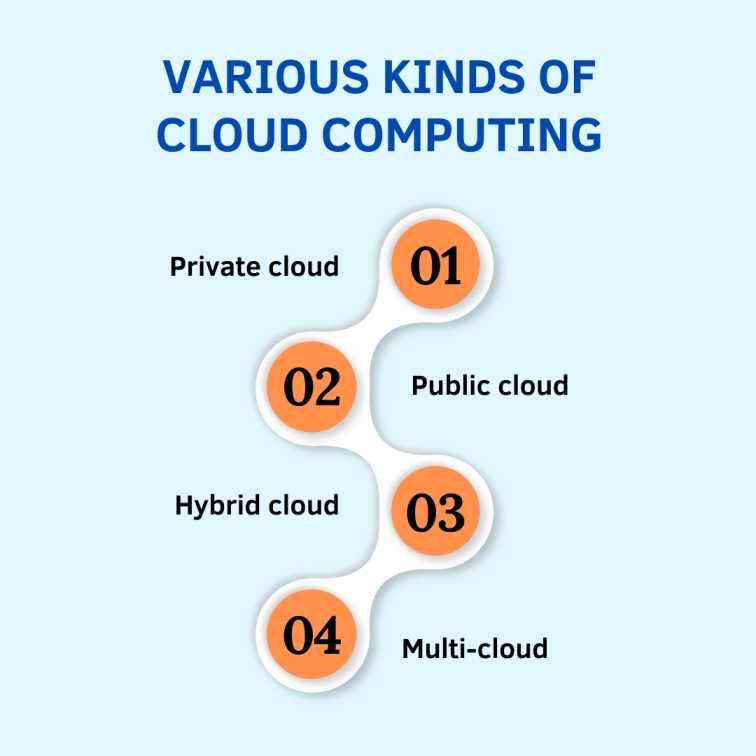
Various Kinds of Cloud Computing

Cloud Computing doesn’t follow a uniform model. Instead, it can be classified into four distinct categories depending on specific needs:

Private cloud

The IT infrastructure is dedicated to a single organisation in a private cloud. It prioritises security and control, often hosted in-house or managed by a third-party provider. Ideal for organisations with strict regulatory needs, it’s a key consideration for data science certification seekers.

Public cloud

Operated by external providers and shared by numerous internet users, the public cloud delivers services like IaaS, PaaS, and SaaS, catering to businesses and individuals.

Key players like AWS, Azure, Google Cloud, Alibaba Cloud, and IBM Cloud are pivotal for individuals seeking data analytics certification.

Hybrid cloud

Combining elements of both public and private clouds, the hybrid model allows businesses to scale their computing capacity by seamlessly integrating public and private resources.

It’s a cost-effective solution, sparing companies from the hassle of buying and maintaining new servers.

Multi-cloud

Multi-Cloud involves using multiple clouds, be they public or private, from various providers. This versatile approach enables organisations to pick the best-fit services based on their unique requirements, from data analytics to software development.

Benefits of Cloud Computing

Cloud technology presents a multitude of advantages, appealing to businesses of all sizes. These advantages include:

Enhanced collaboration: Cloud applications facilitate seamless communication and secure access to shared information, enabling effortless collaboration among team members. Multiple users can work on documents simultaneously.

Cost efficiency: Businesses can significantly reduce capital expenses as they don’t need to build their IT infrastructure or invest in hardware.

Data security: Cloud vendors prioritise data security by implementing advanced features such as authentication, access management, and data encryption to safeguard sensitive information.

Flexibility and scalability: Cloud computing provides the flexibility to scale up or down computing resources per the organisation’s needs and budget, making it adaptable for businesses of all sizes.

Mobility: Users can access corporate data from any device, anytime, and anywhere via the internet, ensuring productivity even on the go.

Disaster recovery: Cloud providers can handle unforeseen disruptions like hardware failures, natural disasters, and power outages, ensuring high application availability and business continuity.

Automatic updates: Service providers regularly update systems with the latest technology, relieving businesses of manual organisation-wide software updates and ensuring they have access to up-to-date software versions, improved servers, and enhanced processing power.

Conclusion
Cloud Computing has already left a significant mark on the tech landscape, but its growth potential is beyond measure.

It opens up a world of exciting possibilities in various areas, such as Processing Capability, Quantum Computing, and Artificial Intelligence, all aimed at enhancing the power of Cloud Computing.

Imarticus Learning’s Postgraduate Program in Data Science and Analytics not only equips you with a strong foundation in cloud computing and distributed computing while opening doors to a dynamic career in data analytics or data science.

By joining this course, you’ll acquire the knowledge and skills to navigate a career in data science and analytics, helping you to become a data analyst and thrive in this data-driven world.

Visit Imarticus Learning today to learn more about a career in data science with our data analytics certification course.

How to choose an effective cybersecurity training course for your employees

Unlock the power of cybersecurity training courses

In today’s digital world, keeping your business safe from online threats is really important. Your employees’ ability to protect against these threats is like a key piece of a puzzle. To make your defences strong, investing in a cybersecurity training course for your employees is not just an option; it’s a necessity.

This article will help you pick a training programme that works well to improve your business’s cybersecurity skills.

Why does your team need cybersecurity training?


corporate training

Before getting into the details of choosing the correct course, it’s important to know why your employees need cybersecurity training. Online threats are always changing and getting more advanced all the time. Your employees are usually the first ones who can protect against these dangers. If they don’t have the right training, they could accidentally put your company at risk.

Effective workforce cybersecurity training courses equip your team with the knowledge and skills to identify and respond to potential threats. These courses empower your employees to make informed decisions and maintain a vigilant eye on cybersecurity. This reduces the likelihood of security breaches.

How do you choose an effective cybersecurity training course for your employees?

  • Assess your team’s skill level

The first step in choosing the right training course is to assess your team’s current cybersecurity skill level. Start by evaluating their understanding of basic concepts like password management, phishing awareness and data protection. Knowing your team’s strengths and weaknesses will help you select a course that matches their needs.

  • Research course providers

Not all cybersecurity training courses are created equal. To find the best fit for your company, research different course providers thoroughly. Look for providers with a strong track record in business cybersecurity skill development.

Looking at reviews, checking if they’re accredited and asking people in your field for suggestions can help you find training providers that have a good reputation.

  • Course content and delivery

The core of any effective training course lies in its content and delivery methods. Ensure that the course covers a wide range of cybersecurity topics, including threat detection, incident response and compliance.

Find courses that offer practical, hands-on exercises to reinforce learning. Cybersecurity is a dynamic field, so the course should also provide updates on the latest threats and technologies.

  • Flexibility and accessibility

Consider your team’s schedule and learning preferences. Look for courses that offer flexibility in terms of timing and delivery format.

Some employees may prefer in-person training, while others may thrive in online environments. A blend of both might also work well for your company.

  • Certification and recognition

Investing in a cybersecurity training course should not only enhance your team’s knowledge but also boost their credentials.

Check if the course provides industry-recognised certifications upon completion. These certifications demonstrate your commitment to cybersecurity to clients and stakeholders.

  • Budget considerations

While cybersecurity is invaluable, budget constraints are a reality for most businesses. Set a reasonable budget for training and seek courses that offer the best value for your investment.

Remember that the cost of a breach can be far greater than the expense of training.

  • Continuous learning and support

Cybersecurity is an ever-evolving field, and threats never rest. Choose a course that encourages continuous learning and offers post-training support. This might include access to updated materials, forums for discussing emerging threats or opportunities for advanced training.

Boost your defences

Choosing an effective cybersecurity training course for your employees is a critical step in fortifying your company’s defences against cyber threats. Assess your team’s skills and research providers. Evaluate course content and delivery. And consider flexibility, certification and ongoing support.

Investing in business cybersecurity skill development is an investment in your company’s security and future. Equip your team with the knowledge and tools they need to protect your business from cyber threats.

Imarticus Learning offers a range of industry-recognised cybersecurity courses designed to empower your workforce. Visit our website today to explore our offerings and take the first step in safeguarding your business.

Content Repurposing: Extending the Lifespan of Content Assets for Multiple Platforms

In the ever-changing digital communication landscape, content repurposing emerged as an effective strategy for maximising the utility of information assets across several platforms.

This method entails adapting and transforming old content into new media, extending its significance and impact. Businesses can efficiently reach a broader demographic and adapt to different learning styles by repurposing knowledge into multiple forms as articles, videos, infographics, and podcasts.

Content repurposing is a strategic pillar of modern content management. Organisations can increase visibility, optimise resource allocation, and strengthen their digital presence across platforms by repurposing current content. Mastering the art of content repurposing remains critical for keeping a competitive edge in multi-platform communication as the digital environment evolves.

In this blog, let’s delve into various aspects of content repurposing and learn in detail about digital marketing course, courses for marketing professionals, and many more.

What is Content Repurposing?

Content repurposing is a strategic process of changing current content into various formats and platforms to extend its lifespan and increase its reach and influence.

This strategy entails transforming original data, such as articles, blog entries, or films, into various mediums like infographics, podcasts, social media postings, and more.

The goal is to adapt to a wide range of audience tastes and consumption habits while efficiently presenting the same essential information in new ways.

Content repurposing provides multiple advantages optimising resources by utilising existing content assets, increasing search engine exposure through improved content density, and maintaining a consistent brand message across numerous media. Furthermore, it allows organisations to connect with new consumers who prefer specialised media or platforms. However, successful content repurposing fosters a thorough understanding of the target audience, cautious platform selection, and competent content adaption to ensure relevance and consistency.

Content Repurposing: Its Necessity and Significance

Content repurposing is a strategic method providing several advantages, such as cost savings, increased content value, and better audience engagement. Organisations can improve online visibility and communication efficacy by creatively adjusting information to different platforms and preferences.

  • Enhanced Content Utility: Content repurposing involves recycling old material into new formats and platforms enhancing its usage across multiple audiences and channels.
  • Increased Lifespan: Content repurposing helps content be relevant and valuable for a more prolonged time period, minimising the need for creating new content.
  • Catering to Audience Needs: Different audiences like different types of material. Repurposing content allows it to evolve to other learning methods and consumer preferences.
  • Efficient Resources: Repackaging existing content saves resources since it reuses developed materials, eliminating the need to start from scratch.
  • Enhanced SEO: Repurposing expands the number of information on specific topics, improving search engine visibility and boosting organic traffic to the content.
  • Multi-Platform Reach: Updating content to numerous platforms, such as blogs, social media, videos, and podcasts, boosts brand reach and engagement across several platforms.
  • Consistent Brand Messaging: Repurposing conveys brand messages and values across multiple mediums, reinforcing the brand’s identity.
  • Trend Adaptation: Content can be modified according to current trends and discussions, allowing the brand to remain relevant and participate in ongoing topics.
  • Innovation and Flexibility: Repurposing requires content developers to think creatively and innovate to find new methods to show and share knowledge.
  • Sustainability: Repurposing aligns with sustainability goals since it reduces content waste and mitigates the detrimental effect of continual content generation.

How Do You Extend the Lifespan of a Content?

Content repurposing comes with various methods to extend its lifespan. Here are some ways that would extend its lifespan. They are:

1. Transforming blog posts

Converting well-researched blog posts into engaging videos, podcasts, infographics and social media posts is one of the best ways to repurpose content. These visual and auditory formats of content repurposing foster an interactive experience with the target audience that facilitates engagement.

2. Creating an e-book

One can compile a series of blogs on a particular subject and post it in an e-book format. It offers the audience a comprehensive guide to the topic but is a lead magnet to establish thought leadership ideals throughout the platform.

3. Repackaging the social media content

If one has shared valuable infographics on social media platforms on a subject, repurpose them into small pieces of content into longer blog posts. One can also expand them in a podcast format and repurpose them in an auditory form. It helps businesses to learn about the topic in detail and enhances audience engagement.

4. Updating content

Over time, pieces of content become obsolete and lose relevance. Instead of letting them fade away, businesses can update and refresh the content by embedding recent statistics, case studies and examples. Republishing the updated content will breathe new life into it and gain fresh attention from the targeted audience.

Challenges in Content Repurposing

Even though content repurposing comes with its perks, it however poses a plethora of challenges. They are:

– Tedious text-only content

The text-only content poses a significant challenge in content repurposing. It fails to take advantage of multimedia video and audio content exercises and adopt e-learning. If the original learning material is text-heavy, the company has to propose a new content strategy for marketing.

– Lack of interaction

Another significant challenge during content repurposing is interaction deficiency. Although in PowerPoint presentations, the instructor-led classroom acts as a visual aide, the content delivery is verbal. Additionally, these presentations serve as a fraction of the repurposed content while it does not promote e-learning. It lacks the necessary interaction for student engagement and thus leads the students to migrate to an online platform to gain the required knowledge.

– Transformation of original learning objects

While repurposing, it is vital to follow a method that ensures the retrieval of original content. Most of the reusable content is graphic elements like videos, illustrations and animations. Hence, the transformation becomes difficult for the content developer.

– Variety of learning objects

Repurposing content with various learning objects while keeping a formal tone requires rigorous preparation, analysis, and modification. One may successfully repurpose information to meet the needs of myriad learners and circumstances by analysing the target audience, creating rules, and assuring consistency.

Conclusion

Even though content repurposing comes with myriad disadvantages, it is a powerful strategy enabling organisations to extend the lifespan of their content. Through various transformations of existing content into different formats, organisations engage new audiences to improve their SEO visibility and save lots of time and resources.

If you are looking for a scope to study digital marketing and other courses for marketing professionals, check out Imarticus Learning’s Strategic Chief Marketing Officers programme with IIM Raipur. It is not a mere digital marketing course but is an executive certificate programme for you to study digital marketing and other crucial aspects of marketing. It is an empowering course for future CMOs.

To know more, check out the website right away: https://imarticus.org/

Analysis and Segmentation with AI: Market Basket Analysis and Customer Behaviour Analysis

Artificial Intelligence (AI) has transformed how organisations assess and segment their clients. With the power of AI, organisations can now analyse customer behaviour and preferences, shopping history, and many more. AI technologies can help business analysts harness all this knowledge to make data-driven decisions.

Enrolling in an AI ML training and AI learning course is a great way to enhance your skills in artificial intelligence. This blog will explore two essential techniques of AI in business analysis: Market Basket Analysis and Customer Behavior Analysis.

Market Basket Analysis

Market basket analysis (MBA) is a data mining approach retailers use to find purchase patterns in any retail context. It involves evaluating huge data sets, such as purchase history, to uncover product groups and products likely to be purchased together. MBA is a series of statistical affinity calculations that assist business owners in better understanding – and ultimately serving – their customers by identifying purchase trends. In basic terms, MBA looks for what combinations of products most commonly occur together in transactions.

Leveraging AI for market basket analysis

Market basket analysis is a data mining technique that identifies co-occurrence patterns and analyses the strength of the link between purchased products. Machine learning experts utilise this unsupervised learning technique to generate data-driven strategies for merchants, enhancing sales. It requires minimum feature engineering and minimal data cleaning.

By applying AI Association Rule Mining, merchants can boost market basket analysis and cross-selling techniques, increasing assortment efficiency. This analysis can identify which things buyers purchase together, assist companies in locating products together, and propose items customers commonly add to their shopping carts. This strategy also allows firms to deliver customised suggestions to clients.

Customer Behavior Analysis

Customer behaviour analysis is a technique of acquiring and analysing data about how customers engage with a firm. It provides insight into customer behaviour, including social trends, frequency patterns, and background variables influencing their decision to buy anything. The study helps organisations identify their target demographic and generate more compelling products and service offers.

A customer behaviour analysis entails segmenting customers into buyer personas based on their similar interests and analysing each group at their appropriate stage in the customer journey to see how the different personas interact with the organisation. This research delivers insight into the elements that impact audiences and the motives, priorities, and decision-making procedures clients consider during their trips. The results of a customer behaviour study help organisations gain insight into how customers engage with a business and enable them to modify its products or services or marketing to create greater sales.

Leveraging AI for customer behavior analysis

Here are some ways businesses are leveraging AI for customer behaviour analysis:

  • Analysing enormous quantities of client data such as buying behaviour, preferences, and spending habits.
  • Forecasting up-sells, cross-sells, website abandonment, and providing data to improve customer experience.
  • Investigating how customers engage with their companies and delivering insights at every step in the customer experience.
  • Using AI-powered sentiment analysis to understand consumer feedback and enhance customer happiness.
  • Targeted marketing to develop consumer relationships that survive the test of time.
  • Pinpointing customer preferences and giving customised recommendations.
  • Identifying disgruntled clients and addressing their complaints in real time.
  • Analysing customers’ in-store behaviours utilising volumetric tracking and AI spatial analysis.

Segmentation in Market Basket Analysis and Customer Behavior Analysis

Segmentation is a marketing approach that involves breaking a bigger market into smaller groups of consumers with comparable demands or characteristics. This helps firms focus their marketing efforts on certain groups, leading to greater sales and consumer satisfaction. Market segmentation can be done in numerous methods, including demographic, geographic, psychographic, and firmographic segmentation.

MBA and CBA are graduate-level business degrees covering various business disciplines, including marketing. Therefore, it is likely that both MBA and CBA schools teach the issue of segmentation in their marketing curricula. However, the specific strategy for teaching segmentation may differ based on the program and the instructor.
Implementing Market Basket Analysis and Customer Behavior Analysis in Your Business

To implement MBA and CBA in your business, one can follow these steps:

1. Establish clear objectives and goals:

Define the specific objectives and goals of the proposal.
Determine success criteria to measure project effectiveness.
Create a structured framework for assessing costs and benefits aligned with project objectives.

2. Form a competent team and acquire resources:

Assemble a team of skilled professionals with relevant expertise.
Ensure access to crucial resources, such as financial data and market research.
Assign clear roles and responsibilities within the team to streamline project execution.

3. Conduct a thorough Cost-Benefit Analysis (CBA):

Undertake a rigorous cost-benefit analysis (CBA) to evaluate project viability.

Include the following factors in your CBA:

Cost Assessment: Identify all pertinent project expenses, encompassing initial investments, ongoing operational costs, and maintenance expenditures.

Benefit Analysis: Evaluate expected benefits, encompassing tangible gains (e.g., increased revenue, cost reductions) and intangible advantages (e.g., enhanced reputation, employee morale).
Timeframe Definition: Establish a timeframe for evaluating costs and benefits, accounting for long-term implications.

Discount Rate Application: Apply an appropriate discount rate to consider the time value of money in your analysis.

Risk Evaluation: Assess potential project risks and uncertainties impacting costs and benefits.
Sensitivity Analysis: Examine how variations in key parameters (e.g., market growth rate, inflation rate) affect project outcomes.

4. Informed decision-making and ongoing review:

Utilise CBA results to make informed decisions regarding project feasibility.
Regularly review project progress against established objectives and goals.
Adapt the project plan to maintain alignment with objectives and achieve successful outcomes.

This structured framework enables systematic project evaluation and planning, ensuring comprehensive consideration of all relevant factors. It facilitates data-driven decision-making and provides a roadmap for managing costs and benefits throughout the project lifecycle.

Conclusion

AI is transforming the way firms approach customer segmentation and behaviour analysis. It gives powerful tools to identify and target the correct clients, which is considerably more challenging to achieve manually or with standard analytical methods. AI-powered consumer segmentation is a fundamental notion in marketing that allows organisations to reach their target demographic effectively. AI may reduce marketing expenditures by 30%, optimise marketing spend, and boost efficiency in marketing activities, saving firms time and money. AI also offers scale and efficiency to client segmentation, automating the process and allowing adaptive targeting.

Imarticus Learning offers an Executive Programme in AI for Business in collaboration with IIM Lucknow. The AI ML training programme is designed for professionals in Artificial Intelligence who desire to become AI and Machine Learning leaders. The AI for executives course delivers competence in vital disciplines connected to Machine Learning and Artificial Intelligence through practical learning.

The AI learning course is a 6-month live online and campus immersion course that seeks to empower graduates with at least five years of work experience in the relevant sector with the necessary knowledge and skill sets in AI and Machine Learning.