10 Data Analytics Myths that Can Hamper Your Business Data!

Myths are a waste of time; they prevent progression – Barbara Streisand

In addition to making conclusions about the data, the science of evaluating raw data is what we call data analytics. Many techniques of data analytics and procedures have been converted via automation into mechanical operations and algorithms that operate over raw information for use by humans.

It is a booming field and many young and ambitious professionals are opting for data analytics courses. Many universities are offering data analytics courses online.

Due to its complexity and distinctive language, many amateurs don’t understand it and are hence oblivious of its activities in the backend. Its insignificance has led to the emergence of good and bad myths that have forayed into people’s minds. It can discourage any organization from effectively capitalizing on data analytics since they treat the myths as reality.

Here are the 10 data analytics myths debunked.

  1. It contributes to new findings: Theoretically, data analytics helps in finding significant data, and practically it helps in making some important decisions. Reaching new findings with AI via data analytics is untrue.An accurate understanding comes from the gathered and modeled data, and evidence is collected that proves to refute the theories. Data analytics should be used as a valuable platform for learning.
  2. It is time exhaustive: Some market leaders are of the view that using data analytics in a sensible manner is too time-consuming. One should check for answers which will align with the existing networks and then provide a complete view of the revenue-driving activities and provide execution services. In less time, the right software tools will help extract data insights
  3. It needs an exorbitant amount: The misconception that data analytics is a costly affair prevents many companies from effectively leveraging it. In fact, a solution for data analytics can be very functional and cost-effective, it is all based on the type of solution needed.
  4. Value can only be derived if an individual is an analyst: Another misconception is the above. All the credit goes to the pathbreaking development in the fields of automation along with AI for enabling the process through which anyone can avail an insight into the data information and quickly transform this knowledge into effective business decisions.
  5. Data is the force behind every business: Not all companies have data as their driving force. When the business offering makes sense, only then data is important. It is necessary to concentrate on the information, whether it is important to the company, and then join the battle, if not, keep concentrating on important progress.
  6. Bounce rates – useless to keep track of it: It is the perception of some company heads that keeping a record of bounce rates serves no purpose. The logic behind it is, these figures are usually inaccurate, and the real value is not given by the data.In reality, the bounce rate is important in increasing the SEO value and gives an indication of the consumer’s understanding of the said business, aiding them in identifying the faults responsible for people making an early exit from their site.
  7. Decisions made by machines are impartial: It confirms the already existing social biases, transforming into a “black box,” without any means of describing the logic behind choices. When the organizations are asked to explain decisions, they aren’t in charge of the manner in which models are designed, rendering them insecure and accountable.
  8. The loss of jobs is directly related to data analytics: This is a common misconception that data analytics connects to AI and that further transpires into job loss. Data analytics is akin to a business tool that produces jobs and productivity and reduces waste.
  9. More data is key: Another prevalent myth is that the more the data, the better it always is. The most important thing is that data has been well-sourced, is reliable, and also meaningful. As they always say, quality is better than quantity.
  10. Analytics runs your business: An organization cannot expect their business to grow and flourish only with the help of data analytics. It’s also about building a rapport with their customers and understanding their needs. It also depends on their processes and their products. When an organization incorporates better insights into its business processes, it can add more value.


What Are Career Opportunities in Operation Management?

Operation management is a promising career option, as it is one of the most important components of a business establishment. Business process, customers, and supply chain are three major pillars of business.

So, operation professionals can find opportunities across industries. This unlocks great potential for career development.

To have a successful operation management career, one needs to have holistic skills to ensure that the different departments of the company work together seamlessly.

This demands in-depth knowledge of various departments and functions. These can be obtained through different courses offering operation management training. The business landscape is evolving fast, the COVID-19 pandemic has changed the way business is done today.

This is essentially an adaptation to the current situation, but it could bring a substantial change in the way businesses are done in the future. This underlines the need for good leaders with subject knowledge and core management skills who can make complex business decisions. That is indeed good news for those who are aspiring for a career in operation management.

What is Operation Management?

Operation management focuses on the operational part of a business, which is essentially a collection of many key business functions. This includes:

  • Logistics management and supply chain management
  • Production management and product quality assurance
  • Relationship management with clients and vendors
  • Material flow management, warehousing, and ordering

In other words, operation management is handling the day-to-day business operations and ensuring a smooth workflow to steer the company towards achieving its business goals.

Career Opportunities:

Depending upon your interests and expertise, you can select from a range of different specialties in operation management. The important ones are:

Production Management

  • Managing the operational processes and identifying inputs and outputs. Listening to the feedbacks and transform the processes, operational systems, and policies to accelerate the organization’s growth to achieves its goals and mission.
  • Ensure that all processes are perfect and in place to get the work done by the employees.

Financial Management

  • This role caters to the planning, control, and management of the company’s overall finances and fiscal documents. The finance manager works closely with the Chief Operational Officer (COO).
  • The finance manager also oversees the budgeting and cost-cutting to ensure that the working capital is used wisely. The role also involves managing financial statements and cash flow.

Resource Management

  • This involves effective management and coordination of finance, IT, and HR departments, and implementing process improvements to smoothen the communication between business functions and business support division.
  • To ensure a conducive environment for the company’s human resources – the employees – to empower them and to align the efforts of the workforce with productivity.

How to Become an Operational Manager

Being a core business-related role, a business development role requires you to have good experience in business administration, coupled with at least a bachelor’s degree in a relevant field. Being an operational manager is like becoming a jack of all trades.

You need to be comfortable and confident in your management skills. Enrolling in an operational management training course will help you gain some knowledge in this area. However, you need to have a comprehensive idea of the workflow and processes related to different departments. Imarticus offers operational management courses. Securing a job will not be a concern as Imarticus has a dedicated team that works for the placement of its students. It has partnered with many leading business organizations which offer placement once you complete the course.

What’s Next in Your Career?

As mentioned earlier, operation management roles are relevant for businesses across all industries. So, there are diverse roles and good growth opportunities. Some possible roles you can explore are:

  • Customer service manager
  • Facilities coordinator
  • Logistics analyst
  • Operations analyst
  • Process engineer
  • Purchasing manager
  • Transportation manager
  • COO

The career growth potential in operation management is massive. You could see that it offers to arrange of roles from analyst to COO. Your career growth depends upon your skills, experience, and performance.

Why Does Data Ops For Data Science Project Matter?

What is Data Science?

Data plays a major role in every organization as it helps in making decisions based on facts, statistics, and trends. Data science helps to trace insights from the raw data generated, which in turn is used to make major business decisions. Implementing Data Science in business has several advantages.

  • It helps in reducing risks and identifying fraud models. Data scientists are trained to identify data that stands out in some way and they use methodologies to predict fraud models along with creating alerts every time unusual data is identified.
  • It helps organizations in identifying when and where the products best sell. This helps the organization to deliver the right products at the right time as per the customers’ needs.
  • It helps the sales and marketing teams to understand their audience well and helps with providing personalized customer experiences.

Why Data Science Needs DataOps?

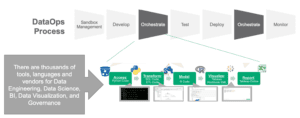
Data scientists deal with searching for data, labeling, cleaning, and performing other tasks that consume a lot of time. Especially if the business has to maintain a backlog legacy, then the amount of data keeps multiplying every year. This is where the need for DataOps rises.

DataOps involves collaboration, automation, and continuous innovation to data within a data-driven environment. Just like software can not be expected to provide exact results outside its live environment, data projects may also tend to behave similarly and may have to be reworked completely to make it work in a production environment. It also has to be continuously monitored even after deployment. Which makes it even more necessary to implement DataOps in a Data Science project.

Data Ops for Data ScienceDataOps plays a major role in building best practices throughout a function. Through continuous production, DataOps helps organizations to deliver value to a range of stakeholders.

Another significance of using DataOps in Data Science is Automation. Data moves through a particular process within an organization. While Data is entered in one form, it does not exist in the same form. Data scientists have to build data pipelines, test, and change them before data is deployed.

Making use of DataOps best practices, you can get a constant stream of data flowing through the pipelines. Which in turn, helps to attain real-time insights from the data. This ensures to reduce the time taken in converting raw data into Valuable information.

Combining Machine Learning with DataOps helps in maintaining a continuous workflow through internal communication. With this, the data quality can be controlled through version control, constant development, and integration. Combining ML also improves the insights and has a great potential for extracting value from DataOps.

Introducing DataOps in the organization also means changes in the work process. It builds a new ecosystem with consistent communication between the departments. Employees of each department work together, in real-time, sharing a common goal.

Therefore, using DataOps in Data Science ensures to develop projects keeping in mind the business impact along with delivering it in a way that the management can understand.

Why Data Science Course?

The Data Science course covers a mix of topics like mathematics, Tools, Machine Learning techniques, Business Acumen, and several algorithms. The main principle behind Data Science is finding patterns from gigabytes of raw data collected.

In today’s competitive world, more and more organizations are opening up to big data, and the need for data scientists is also on the rise. They get exciting opportunities to work on and also get to come up with solutions for businesses.