Can I Switch to Investment Banking From Another Career?

Here’s what Shawn Almeda has to say about his jump into investment banking and a job at BNP Paribas through Imarticus Learning.

After engineering, I was struggling to get a good job. Sure, I did odd jobs, but I was not happy or convinced on the path I was taking. It was then that I decided to pursue my long-term second passion, which was Investment Banking.

I heard about Imarticus through a friend who also happened to be doing a course here. After doing a lot more research on Google, reading Imarticus Learning reviews, collecting information about Imarticus through other people and talking to the course counselors, I was convinced that this course is for me.

I would rate the Imarticus Learning’s faculty a 5 on 5.

I would like to thank Lourdes Ma’am, Rajesh Sir and Sharon Ma’am, in particular. The faculty explained even the most difficult concepts really well. During the course, if we had any doubts, we could approach them anytime.

The soft skills class, which was very interesting, helped me to boost my confidence. In all, learning with Imarticus was a really good experience.

I got placed through Imarticus Learning, and I’m excited about my training in the UK.

Currently, I’m working at BNP Paribas – I got placed through the Imarticus Learning placement process. Just five days after joining the company, I got to know that I would be flying to the UK for training. I was not expecting this, but I’m pretty excited because I will be meeting senior professionals in the industry and trying my hand at new things.

After doing the CIBOP course, I would rate Imarticus a solid 5 on 5. This is because moving from engineering to Investment Banking with nothing else in between would have otherwise been difficult for me. CIBOP gave me a great launching pad to get myself into the deep end of Investment Banking.

This brief period of two and a half months doing certified industry-endorsed Investment Banking training gave me a lifetime’s worth of experience. And for that, I would like to thank Imarticus Learning a lot.

Are you ready to jump into the deep end of Investment Banking? Click here to chat with a course counselor today.

How Machine Learning is a Boon For License Plate Recognition?

Machine Learning has weathered some tough days, pulling through to become a powerful technological force capable of leading and creating real-world change.

A prime example of this is the use of Machine Learning in automated surveillance systems on roads in busy metropolises. License plate recognition, for example, has transformed from a pipe dream to current reality, thanks to image processing and recognition capabilities of AI and ML systems.

Out of all the solutions posited towards vehicle movement and management, machine learning solutions are the most accurate because:

  • They derive crucial information from vehicles on the move
  • They are real-time and efficient
  • They are self-taught and don’t need human resource support

What is license plate recognition?

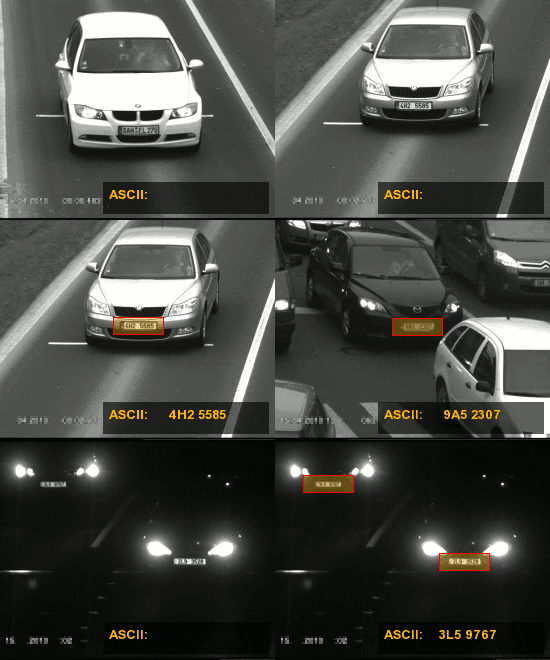
It is the process of detecting and identifying license plates, through Optical Character Recognition, to be run against an existing database. The most basic recognition system consists of three steps:

  • Detecting the actual license plate
  • Segmenting characters into individual images
  • ML algorithms recognize each character

License plate recognition is a boon for many government and private entities, especially when used in tandem with an existing robust database.

Where is license plate recognition thought to be useful?

As the number of vehicles increases across metros and crime also shoots up, many law enforcement bodies find it increasingly difficult to track offensive vehicles and levy fines, book drivers or conduct searches in good time.

Identification of traffic defaulters: ML-based license plate recognition systems allow bodies like the police and traffic control to identify vehicles that break rules like driving over the speed limit, not wearing seatbelts or having broken headlights. Depending on the business of the junction or road, the technology can be used in tandem with human traffic police to ensure accuracy and efficiency.

Recognition of abandoned wanted or stolen vehicles: By integrating ML-based systems on mobile devices, police or other law enforcement bodies can recognize and identify vehicles whether wanted, stolen or abandoned. This reduces a lot of time wasted on identifying vehicles or organizing paperwork. It also allows the enforcers to contact the person in question or make arrests were necessary.

Automating of toll collection: By adding LP systems to toll booths, law enforcement authorities can conveniently collect tolls without the need for actual service personnel manning the station.

A good LPR system is set apart from the rest by the following salient features–

Functions in all environments: Using humans to identify license plates in extreme weather leaves plenty of room for errors. Good LPR systems work regardless of the environment– stormy, cloudy, foggy or dusty– thereby heightening the accuracy and increasing real-time problem solving or escalation. They also function on low-resolution images, when the image is at an angle or where the image is blurry and of a fast-moving vehicle.

Identifies plates on all vehicles: Depending on the vehicle, indeed even the country it’s in, the license plate can differ in color, font, and sequence. It could also be placed on different parts of the vehicle body, which means a good LPR tool needs to be able to identify the right markings in the right spot and identify the sequence correctly.

The final word

Detecting and recognizing license plates is a task that grows increasingly cumbersome as the number of vehicles and registration requirements increase. To get a head start on this emerging field, students, freshers, and industry professionals must engage in a Machine Learning Course and open up new avenues for themselves. Using a license plate recognition system that is dynamic, ML-based and scalable is a positive step towards managing the chaos and getting real-time, positive results.