What Kind of Jobs Should Young Business People Look For Blockchain Startups?

Blockchain technology is the emerging darling of 2018 with hopeful industries incorporating it willingly. It has the potential to transform disruptively and every industry. However, the cryptocurrency markets shed almost 79 percent of their capital and the field is dogged by regulations and legal hurdles as of now.

The present fintech job market:

For terrible market and economic conditions, youngsters still love the fintech career in the blockchain field because of its potential and the emerging thrust for fintech industries. The crypto market from where it originated seemingly has had no impact on the hiring process and scope for the blockchain segment.

According to Glassdoor reports, the annual jump in recruitments for this field for August 17-18 was 300% and median salaries paid in India were above the national average salary by a considerable amount! Upwork states that for employers the most sought-after skill was blockchain technology.

Even venture capitalists in 2018 have boosted their investments 280% in blockchain industries. All these statistics are excellent for those who are interested in making their fintech career. Of course, finding the right stable job involves doing a course to develop your skills, researching jobs and the job market, training for interviews and much, much more. It is still worth it at the moment.

So, let us quickly look at what jobs are being the leaders for recruitments.

The required skills:

The trending tools, languages and technological suites required for a fintech career today are: 

  • C Suite languages like C and C#
  • Python suite languages
  • Java Suite languages including Java, JavaScript ES6, JSON, js and Javascript.
  • Simplicity, Serpent, Solidity, Go, Rust and such languages.
  • SQL and NoSQL
  • HyperLedger Fabric

Among the soft attributes required you must include

  • Innovation and creative thinking: These attributes are important in every evolving field where standard practices and technologies may not always be available. Remember to simplify attitudes and think afresh.
  • Intent, dedication, and passion: Understanding the intent of technology helps achieve the results for a better experience for clients who have a passion for new technologies. These attributes are a must with dollops of dedication thrown in.
  • The will to learn and humility: Emerging technologies and companies may be unstable. The will to learn helps build humility and the ability to take things in your stride in spite of hurdles.
  • Team spirit and communication skills: These attributes are non-negotiable for lean teams who are cross-functional and use Agile practices.

Basically, one must believe in the job and contribute to the company’s growth using the jumble-box of attributes and all skill sets mentioned above.

The top draws:

According to Glassdoor reports, youngsters will find the top US Fintech career jobs in Blockchain firms are:

1. Software Engineer: The payouts are in the range of 90,000-145,000 USD and in the US Blockstack, Chronicled and Axuall is recruiting.

2. Technology Architect: Companies like Bank of America, Amazon/AWS and the State of Colorado are hiring with payouts ranging from 100,000-160,000 USD

3. Product Manager: The salaries can run from 85,000-130,000 USD at companies like JP Morgan Chase, Cynet Corp, and Mediaocean.

4. Risk Analyst: These can get paid salaries from 85,000-105,000 USD and can find recruitments in Bank of America, Electric Power Research Institute, Veem, and such companies.

5. Analyst Relations Manager: The job fetches a median salary of 50,000-125,000 USD at companies like IBM, R3 or Accenture.

6. Front End Engineer: These can get paid between 70,000-125,000USD at companies like Binance, Gem, and Ford Motor Co.

7. Legal Counsel: These jobs pay 100,000-190,000 USD at recruiting companies like Consensys, Figure, and BitGo.

8. Business Analyst: The payouts here are 80,000-105,000 USD at hiring firms like NuArca, Bittrex, and IBM.

9. Cryptocurrency Community Manager: The job has a median payout of 35,000-95,000 USD at companies like Zeus Protocol, Dolare and Crowdcreate.

Parting notes:

In spite of a bad start, the blockchain industries are hiring and investing in the capital of human nature. Training in blockchain technology and certifications are popular with reputed institutes like Imarticus Learning.

Whether you love coding or are just looking for jobs in the next big sector try doing a Fintech course on Blockchain technology to launch your fintech career. Put your best foot forward with them for a successful career. All the best!

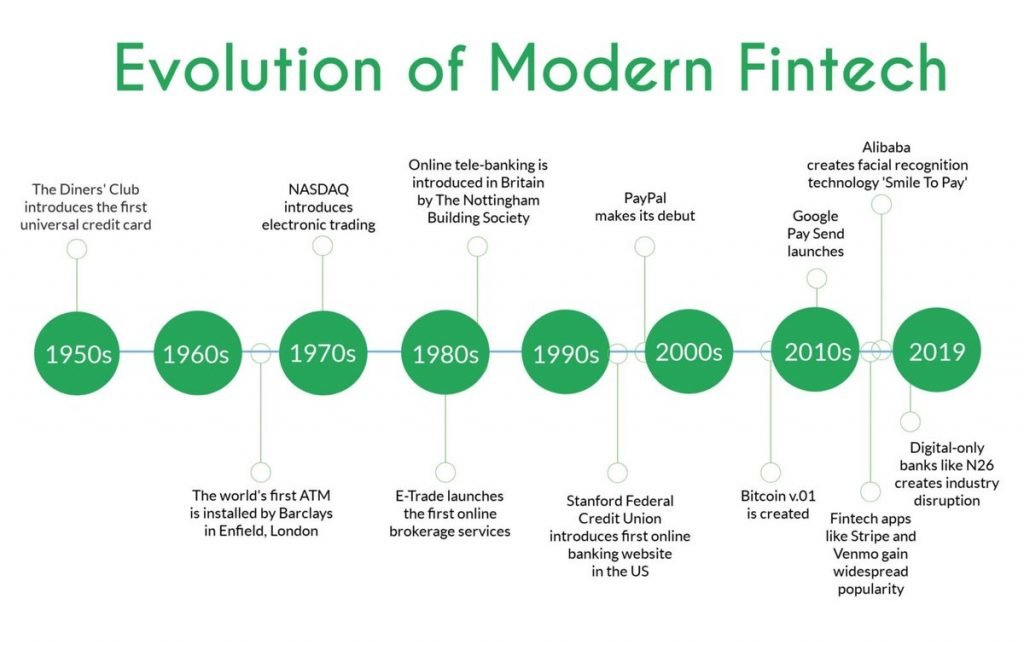
What Are Evolution of Fintech or Financial Technology?


Technology and Finance have gone together for time immemorial. Initially, it was about making and maintaining records of financial transactions and later the introduction of coins, paper currency and promissory notes in the early 19th century. In modern times and about a decade ago Fin and Tech have got amalgamated into the era of fintech.

The early internet age:

Did you know that Fintech Courses teach you that the past 5 years cable under the seas far exceeds the cable network over the last 150 years since data and volumes of traffic have increased immensely? The first under-sea trans-Atlantic telegraphic cable fondly called Victorian internet-connected North America to West Europe and was in use since 1867. Financial markets at New York could connect to London, Asian markets, Europe, etc with its expansion. Forex references to GBPUSD also call this the cable-pair as most transactions were between the USD and GBP.

The laying of cabling infrastructure helped globalization and financial interactions between the period from inception in 1867 to 1914. The outbreak of WWI, the 1929 stock market crash and the Great Depression led to the slowing of the markets for over 25 years. During WWII codes and code-breakers were developed by the Germans and Britishers respectively. Communications in those days were through codes and set the initial foundation stone for coding. Just look at the German encoder shown below! It was the ability to build the decoders that leaked the German communications that led to an inversion of fates and an early end to WWII.

The ATM and calculator era:

The second phase of fintech began in 1967 with the digitization of analog to digital systems. It was also the beginning of RegTEch and early use of Fintech in development. The first ATM machine placed in the UK in Barclay’s Bank was the introduction and initiation of fintech. With more machines being made available the way people transacted and their relations with technology and finance changes irreversibly. Soon we saw the introduction of computing power in the TT 2500 DataMath hand-held calculator from Texas Instruments. This slowly evolved into today’s smartphones.

The electronic age:

The period between1970-80 saw the introduction of banking SWIFT codes and payment systems both international and domestic in 1973. SWIFT-(Society For Worldwide Interbank Financial Telecommunications) with its HQ in Belgium covered over 15 major countries and 239 banks. Today it is a portal for financial communication with 11,000 institutions and is the global payment system portal for financial communications. Between the ’70s and ’80s emerged NASDAQ the stock exchange with almost no human interference. The launch of the internet in the late ’80s saw internet banking and brought smart mobile phones into the hands of the common man.

Stock markets and payment systems: 

1999 saw .coms start and soon end. The 2008 financial crash brought into the limelight the distrust of customers and the start of the blockchain technology and cryptocurrencies. It also saw Siri, Google, Amazon, etc enter the digital assistant and payments platforms to revolutionize the financial scenario. Alongside e-commerce platforms emerged like TenCents, Alibaba and many others who all cashed in on the immense benefits of being early fintech players who have nearly replaced the way we shop, transact and buy things.

The present scenario: 

With the advent of smartphones, data analytics and the startup revolution Fintech post the 2008 financial meltdown emerged with blockchain technology being touted as the next big technological breakthrough. Blockchains have the potential to transform and disrupt the industrial scenario with cryptos, eCommerce platforms and digital currencies taking over. P2P lending, crowd-funding, angel investors and a complete transparent digital financial world is where we definitely are headed to.

Conclusion:

The evolution of fintech has been gradual and over the last decade, fintech is set to transform and disrupt many an industry. This makes the demand for personnel high and scope for jobs huge. Payments are also good and it makes a wise choice as a career. The fintech industry needs a large number of qualified personnel and is set to grow rapidly with even governmental policies promoting its growth. Incubators, startup hubs and integration of technology into all streams of life is the new mantra.

Do your Fintech courses at Imarticus Learning to get the ideal launch with assured placements. For more details, you can also contact us through the Live Chat Support system or can even visit one of our training centers based in – Mumbai, Thane, Pune, Chennai, Hyderabad, Delhi, Banglore, Gurgaon, and Ahmedabad.

Statistics For Data science

Data Science is the effective extraction of insights and data information. It is the science of going beyond numbers to find real-world applications and meanings in the data. To extract the information embedded in complex datasets, Data Scientists use myriad techniques and tools in modelling, data exploration, and visualization.

The most important mathematical tool of statistics brings in a variety of validated tools for such data exploration. Statistics is an application of mathematics that provides for mathematical concrete data summarization. Rather than use one or all data points, it renders a data point that can be effectively used to describe the properties of the point regarding its make-up, structure and so on.

Here are the most basic techniques of statistics most popularly used and very effective in Data Science and its practical applications.

(1) Central Tendency

This feature is the typical variable value of the dataset. When a normal distribution is x-y centered at (110, 110) it means the distribution contains the typical central tendency (110, 110) and that this value is chosen as the typical summarizing value of the data set. This also provides us with the biasing information of the set.

There are 2 methods commonly used to select central tendency.

Mean:

The average value is the mid-point around which data is distributed. Given 5 numbers here is how you calculate the Mean. Ex: There are five numbers

Mean= (188 2 63 13 52) / 5 = 65.6 aka mathematical average value used in Numpy and other Python libraries.

Median:

Median is the true middle value of the dataset when it is sorted and may not be equal to the mean value. The Median for the sample set requires sorting and is:

[2, 13, 52, 63, 188] → 52

The median and mean can be calculated using simple numpy Python one-liners:

numpy.median(array)

numpy.mean(array)

(2) Spread

The spread of data shows whether the data is around a single value or spread out across a range. If we treat the distributions as a Gaussian probability figure of a real-world dataset, the blue curve has a small spread with data points close to a narrow range. The red line curve has the largest spread. The figure also shows the curves SD-standard deviation values.

Standard Deviation:

This quantifies the spread of data and involves these 5 steps:

1. Calculate mean.

2. For each value calculate the square of its distance from the mean value.

3. Add all the values from Step 2.

4. Divide by the number of data points.

5. Calculate the square root.

Made with https://www.mathcha.io/editor

Bigger values indicate greater spread. Smaller values mean the data is concentrated around mean value.

In Numpy SD is calculated as

numpy.std(array)

(3) Percentiles

The percentile shows the exact data point position in the range of values and if it is low or high.

By saying the pth percentile one means there is p% of data in the lower part and the remaining in the upper part of the range.

Take the set of 11 numbers below and arrange them in ascending values.

3, 1, 5, 9, 7, 11, 15,13, 19, 17, 21. Here 15 is at the 70th percentile dividing the set at this number. 70% lies below 15 and the rest above it.

The 50th percentile in Numpy is calculated as

numpy.percentile(array, 50)

(4) Skewness

The Skewness or data asymmetry with a positive value means the values are to the left and concentrated while negative means a right concentration of the data points.

Skewness is calculated as

Skewness informs us about data distribution is Gaussian. The higher the skewness, the further away from being a Gaussian distribution the dataset is.

Here’s how we can compute the Skewness in Scipy code:

scipy.stats.skew(array)

(5) Covariance and Correlation

Covariance

The covariance indicates if the two variables are “related” or not. The positive covariance means if one value increases so do the other and a negative covariance means when one increases the other decreases.

Correlation

Correlation values lie between -1 and 1 and are calculated as the covariance divided by the product of SD of the two variables. When 1 it has perfect values and one increase leads to the other moving in the same direction. When less than one and negative the increase in one leads to a decline in the other.

Conclusion: 

When doing PCA-Principal Component Analysis knowing the above 5 concepts is useful and can explain data effectively and helps summarize the dataset in terms like correlation in techniques like Dimensionality Reduction. Thus when more data can be defined by a median or mean values the remaining data can be ignored. If you want to learn data science, try the Imarticus Learning Academy where careers in data science are made.

How Criminals Are Using AI And Exploiting It To Further Crime?

AI can use the swarm technology of clusters of malware taking down multiple devices and victims. AI applications have been used in robotic devices and drone technology too. Even Google’s reCAPTCHA according to the reports of “I am Robot” can be successfully hacked 98% of the time.

It is everyone’s fear that the AI tutorials, sources, and tools which are freely available in the public domain will be more prevalent in creating hack ware than for any gainful purpose.

Here are the broad areas where hackers operate which are briefly discussed.

1. Affecting the data sources of the AI System:

ML poisoning uses studying the ML process and exploiting the spotted vulnerabilities by poisoning the data pool used for MLS algorithmic learning by. Former Deputy CIO for the White House and Xerox’s CISO Dr. Alissa Johnson talking to SecurityWeek commented that the AI output is only as good as its data source.

Autonomous vehicles and image recognition using CNNs and the working of these require resources to train them through third-parties or on cloud platforms where cyberattacks evade validation testing and are hard to detect. Another technique called “perturbation” uses a misplaced pattern of white pixel noises that can lead the bot to identify objects wrongly.

2. Chatbot Cybercrimes:

Kaspersky reports on Twitter confirm that 65 percent of the people prefer to text rather than use the phone.  The bots used for nearly every app serve as perfect conduits for hackers and cyber attacks.

Ex: The 2016 attack on Facebook tricked 10,000 users where a bot presented as a friend to get them to install malware.

Chatbots used commercially do not support the https protocol or TLA. Assistants from Amazon and Google are in constant listen-mode endangering private conversations. These are just the tip of the iceberg of malpractices on the IoT.

3. Ransomware:

AI-based chatbots can be used through ML tweaking to automate ransomware. They communicate with the targets for paying ransom easily and use the encrypted data to ensure the ransom amount is based on the bills generated.

4. Malware:

The very process of creating malware is simplified from manual to automatic by AI. Now the Cybercriminals can use rootkits, write Trojan codes, use password scrapers, etc with ease.

5. Identity Theft and Fraud:

The generation of synthetic text, images, audio, etc of AI can easily be exploited by the hackers. Ex: “Deepfake” pornographic videos that have surfaced online.

6. Intelligence garnering vulnerabilities:

Revealing new developments in AI causes the hackers to scale up the time and efforts involved in hacking by providing them almost simultaneously to cyber malware that can easily identify targets, vulnerability intelligence, and spear such attacks through phishing.

7. Whaling and Phishing:

ML and AI together can increase the bulk phishing attacks as also the targeted whaling attacks on individuals within a company specifically. McAfee Labs’ 2017 predictions state ML can be used to harness stolen records to create specific phishing emails. ZeroFOX in 2016 established that when compared to the manual process if one uses AI a 30 to 60 percent increase can be got in phishing tweets.

8. Repeated Attacks:

The ‘noise floor’ levels are used by malware to force the targeted ML to recalibrate due to repeated false positives. Then the malware in it attacks the system using the AI of the ML algorithm with the new calibrations.

9. The exploitation of Cyberspace:

Automated AI tools can lie incubating inside the software and weaken the immunity systems keeping the cyberspace environment ready for attacks at will.

10. Distributed Denial-of-Service (DDoS) Attacks

Successful strains of malware like the Mirai malware are copycat versions of successful software using AI that can affect the ARC-based processors used by IoT devices. Ex: The Dyn Systems DNS servers were hacked into on 21st October 2016, and the DDoS attack affected several big websites like Spotify, Reddit, Twitter, Netflix, etc.

CEO and founder of Space X and Tesla Elon Musk commented that AI was susceptible to finding complex optimal solutions like the Mirai DDoS malware. Read with the Deloitte’s warning that DDoS attacks are expected to reach one Tbit/sec and Fortinet predictions that “hivenets” capable of acting and self-learning without the botnet herder’s instructions would peak in 2018 means that AI’s capabilities have an urgent need for being restricted to gainful applications and not for attacks by cyberhackers.

Concluding notes:

AI has the potential to be used by hackers and cybercriminals using evolved AI techniques. The field of Cybersecurity is dynamic and uses the very same AI developments providing the ill-intentioned knowledge on how to hack into it. Is AI defense the best solution then for defense against the AIs growth and popularity?

To learn all about AI, ML and cybersecurity try the courses at Imarticus Learning where they enable you to be career-ready in these fields.