


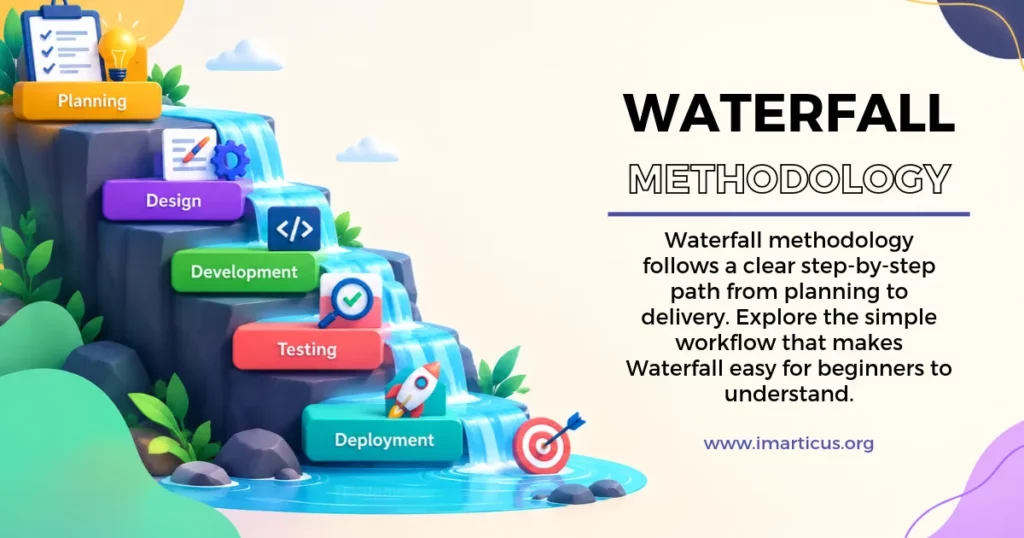
Waterfall methodology is a linear, step-by-step approach to project management where a project moves through fixed phases, usually requirements, design, implementation, testing and maintenance, and each phase must be completed and approved before the next one begins. It works best when requirements are clear, budgets are fixed and deadlines are strict, as in construction, manufacturing and regulated IT work. Compared with agile, which delivers work in short cycles and welcomes change, waterfall offers more predictability, stronger documentation and tighter control, but less flexibility once work is underway. Many modern teams combine both, using waterfall for planning-heavy work and agile for fast-changing work.
Ask any project manager how a big project should begin, and most will give you the same answer: with a plan. Not a rough idea on a sticky note, but a proper plan with scope, dates, costs and sign-offs. That one belief sits at the heart of the waterfall methodology, one of the oldest and most trusted ways of running a project.
If you are new to project work, the name itself can feel confusing. You might also have heard people say that waterfall is old and agile is new, so waterfall must be dead. It is not. Construction companies, banks, hospitals, manufacturers and government bodies still run large parts of their work on it every single day. In this blog, I will walk you through what it is, how its stages work, where it helps, where it struggles, and how it compares in the waterfall methodology vs agile debate.
If you want to go beyond reading and learn waterfall, agile and hybrid ways of working through real case studies and live classes, have a look at the Project Management Prodegree Course from Imarticus Learning, offered in knowledge partnership with PwC India.
Don’t Let Our Best Advice Get Buried
Add Imarticus as a Preferred Source — see more of what we publish, every time you search.

What Is Waterfall Methodology
Waterfall methodology is a project management approach where work flows in one direction, like water falling down a series of steps. You finish one phase, get it approved, and only then move to the next. You do not go back up unless something goes seriously wrong.
Think about building a house. You cannot lay the roof before the walls are up, and you cannot build walls before the foundation is ready. Each step depends on the one before it. Waterfall treats a project in exactly the same way. Everything is planned upfront, documented in detail, and then executed in order.
So if someone asks you what waterfall methodology is in one line, you can say this: it is a sequential way of managing projects where planning is done fully at the start, and the work then moves phase by phase until delivery.
A few things make it different from other approaches:
- Fixed scope: What the project will deliver is decided at the start.
- Fixed order: Phases follow a set sequence and do not overlap much.
- Heavy documentation: Every decision, requirement and change is written down.
- Formal approvals: A phase closes only after the client or sponsor signs off.
- Clear milestones: Everyone knows what is due and when.
This is why waterfall is also called a predictive or traditional approach. You try to predict the whole project upfront and then follow the plan.
Where Did Waterfall Methodology Come From
The idea of working in sequential stages came from manufacturing and construction, where you simply cannot change the foundation after the building is finished. In 1970, a computer scientist named Winston Royce wrote a paper on managing large software systems that showed a step-by-step flow, and that diagram became the basis for what people later called waterfall.
Interestingly, Royce himself pointed out the risks of a strictly one-way flow. Still, the structure was easy to understand and easy to manage, so it spread quickly across software, defence, engineering and government projects. For decades, it was the default way to run a serious project.
Explore the Waterfall Methodology
Move through the five stages, see what each stage produces, and check whether Waterfall, Agile or a hybrid approach fits your project.
1. Explore the five stages
Select a stage to understand its purpose and main output.
1. Requirements
The team gathers the client’s needs, project goals, budget and deadline. These details are documented before the work moves forward.
2. Choose an approach
Answer three quick questions to get a suggested project approach.
3. Quick comparison
Use this summary to remember how the two approaches differ.
| Waterfall | Agile |
|---|---|
| Plans in detail upfront | Plans in short cycles |
| Fixed scope and sequence | Scope can adapt |
| Usually delivers at the end | Delivers in increments |
| Best for stable requirements | Best for changing needs |
Also Read: A Beginner’s Handbook Agile Project Management
Stages of Waterfall Methodology
Most sources describe waterfall in five stages. Names differ a little from one company to another, but the flow stays the same.
1. Requirements
This is where everything begins. The team sits down with the client and stakeholders to understand exactly what needs to be built. What is the goal? Who will use it? What is the budget? What is the deadline? All of this goes into a requirements document.
This stage matters the most in waterfall, because the rest of the project is built on it. A missing requirement found late can be expensive to fix.
2. Design
Once requirements are signed off, the team plans how to meet them. In a software project, this could mean system architecture, database design and screen layouts. In a construction project, it means drawings, material lists and structural plans.
Design usually happens in two layers: a high-level design that shows the big picture and a detailed design that explains each part.
3. Implementation
Now the actual building starts. Developers write code, engineers build structures, and teams produce the deliverables as per the design. Because the planning is already done, people mostly follow the plan and focus on doing their part well.
4. Testing
After the build is complete, the work is checked against the original requirements. Bugs are found and fixed, quality is measured, and the client confirms that what was delivered is what was promised. In waterfall, testing generally begins only after implementation ends, which is both its strength and its weakness.
5. Deployment and Maintenance
The finished product is handed over or launched. After that, the team handles support, updates and small fixes. Many sources split this into two stages, deployment and maintenance, but they are often counted together as the fifth stage. Here is a quick view of all five stages:
| Stage | What Happens | Main Output |
| Requirements | Needs are gathered and documented | Requirements document |
| Design | Solution is planned in detail | Design documents and blueprints |
| Implementation | The product or deliverable is built | Working build |
| Testing | Work is checked against requirements | Test reports and approvals |
| Deployment and Maintenance | Product is delivered and supported | Live product and support plan |
In simple words, each stage ends with a clear output, and that output becomes the input for the next stage.
Also Read: What is Scrum Methodology?
Waterfall Methodology in Project Management
In day-to-day work, waterfall methodology in project management is used for projects where the end result is clear, and change is expensive. Let me explain with a simple example.
Imagine a builder who is constructing a 10-storey apartment complex. The scope is known: number of floors, flats per floor, parking, lifts. The budget is approved. The government permits are in place. The delivery date is promised to buyers. Here, it makes sense to prepare a Work Breakdown Structure, schedule every task, estimate costs, and then track progress against the baseline. If the buyers ask to move a wall after the slab is cast, the cost goes up sharply. So, change is controlled through a formal process. That is waterfall in real life. A project manager using it will usually work with:
- Scope statement: To define what is included and what is not.
- Work Breakdown Structure (WBS): To break the project into smaller tasks.
- Schedule baseline: To compare planned dates against actual progress.
- Critical Path Method (CPM): To find the tasks that decide the project end date.
- Earned Value Management (EVM): To track cost and schedule performance together.
- Risk register and issue log: To record risks and how they will be handled.
- Change control process: To approve or reject changes in a formal way.
These are standard project management tools, and a strong grip on them is what separates a confident project manager from a nervous one.
Key Features of Waterfall Methodology
Once you understand the stages, the features are easy to spot. These are the traits that make waterfall what it is:
- Linear flow: Work moves forward in a straight line.
- Upfront planning: Scope, cost and schedule are decided before the work starts.
- Defined roles: Everyone knows who owns what.
- Phase gates: A phase ends only after review and approval.
- Strong documentation: New team members can pick up the project by reading the records.
- Limited client involvement during the build: Clients are mostly involved at the start and at the end.
These features give waterfall its biggest strength, which is control. They also create its biggest weakness, which is rigidity. We will look at both in a moment.
Also Read: Impact of Agile Methodology on Businesses
Advantages of Waterfall Methodology
Waterfall has stayed popular for decades because it solves real problems. Here are the main benefits:
- Easy to understand: The stages are simple, so even people new to project work can follow along.
- Clear structure: Every phase has a start, an end and a deliverable.
- Predictable cost and time: Since planning is detailed, budgets and dates are easier to estimate.
- Strong documentation: Records make handovers, audits and future reference much easier.
- Better control: Formal approvals reduce confusion about who decided what.
- Works well with fixed contracts: Vendors and clients can agree on scope and price from day one.
- Good for large teams: When many people or vendors are involved, a clear plan keeps everyone aligned.
In simple words, waterfall gives you a map. When the road is known, a map is exactly what you need.
Disadvantages of Waterfall Methodology
Waterfall is not perfect, and it is better to know its limits before choosing it.
- Hard to change: If requirements shift midway, going back is costly and slow.
- Late testing: Problems may only appear after most of the work is done.
- Late delivery of value: The client may see nothing usable until the end.
- Risk of wrong assumptions: If the early requirements are wrong, the whole project can go in the wrong direction.
- Less client feedback: The client is not involved enough during the build.
- Poor fit for uncertain work: Products where users and markets keep changing do not suit a fixed plan.
A good way to remember it: waterfall is excellent when you know what you want, and risky when you are still figuring it out.
What Is Agile Methodology
To understand waterfall properly, you should know what sits on the other side. Agile is an approach where work is done in short cycles, often called sprints, that usually last one to four weeks. After every sprint, the team shows a working piece of the product, collects feedback and adjusts the plan.
Instead of planning everything upfront, agile plans a little, builds a little, learns a little and repeats. Popular agile frameworks include Scrum, Kanban and SAFe. The focus is on people, working output, customer collaboration and quick response to change. Agile became famous in software development, but today marketing teams, product teams, banks and even HR departments use it.
Agile vs Waterfall Methodology: Key Differences
This is the question most people search for, so let me answer it clearly. Here is the difference between agile and waterfall methodology in one table:
| Point | Waterfall | Agile |
| Approach | Linear and sequential | Iterative and flexible |
| Planning | Detailed plan made upfront | Planning done in small cycles |
| Scope | Fixed at the start | Can change during the project |
| Delivery | One final delivery | Frequent small deliveries |
| Customer involvement | Mostly at start and end | Continuous throughout |
| Testing | After the build phase | Along with development |
| Documentation | Heavy and detailed | Light and just enough |
| Change handling | Formal and costly | Welcomed and easy |
| Best for | Clear, stable requirements | Changing, uncertain requirements |
| Risk | Found late | Found early |
The short takeaway: waterfall asks you to decide first and build later, while agile lets you build and decide as you go. So when people compare agile methodology vs waterfall, they are really comparing two different attitudes towards change. Waterfall tries to prevent change. Agile expects it.
Waterfall Methodology vs Agile: Which One Should You Choose?
There is no winner in the waterfall vs agile methodology debate. The right choice depends on your project. Use this table as a quick guide:
| Situation | Better Fit |
| Requirements are clear and unlikely to change | Waterfall |
| Fixed budget, fixed deadline, fixed contract | Waterfall |
| Strict rules, audits or safety standards apply | Waterfall |
| Construction, manufacturing, infrastructure | Waterfall |
| Product is new, and users need to test it early | Agile |
| Requirements will keep changing | Agile |
| Fast releases and regular feedback matter | Agile |
| Software products, apps and digital services | Agile |
Ask yourself three questions before choosing. How clear are my requirements? How costly is a change? How soon do I need user feedback? The answers will usually point you in the right direction.
Agile and Waterfall Methodology Together
In real companies, it is rarely a strict either-or choice. Many teams use a hybrid approach, which mixes agile and waterfall methodology in one project.
Take a smartphone launch. The hardware, such as the chip, body and battery, needs fixed specifications and fixed timelines, so the team follows waterfall. The software and apps change with user feedback, so the team follows agile with sprints. Both streams meet at integration checkpoints and then go through testing and launch together.
This is why modern project managers are expected to know both. Someone who understands only one method will struggle the moment a project needs the other.
Also Read: What Is Agile Methodology?
Tools Used in Waterfall Methodology Projects
Tools do not make the method, but they make it easier to run. Some tools commonly used in waterfall and hybrid projects are:
- Microsoft Project: For Gantt charts, schedules and resource planning.
- Jira: Popular for agile teams, but also used to track tasks and issues in hybrid setups.
- Confluence: For documentation and shared project records.
- Trello and Asana: For task tracking and team coordination.
- ClickUp and Notion: For dashboards, workflows and collaboration.
- Excel and Power BI: For cost tracking, reports and performance dashboards.
Today, many of these tools also come with AI features that help forecast timelines, flag delays, and write status reports, so learning them early gives you an edge.
Skills and Career Scope in Project Management
Understanding waterfall is not just an exam topic. It is a skill that employers expect in anyone who plans to lead projects. Companies want people who can build a schedule, manage risks, control costs and keep stakeholders on the same page. If you learn waterfall, agile and hybrid ways of working, you can look at roles such as:
- Project Manager
- Program Manager
- Agile Project Manager
- Scrum Master
- Project Coordinator
- PMO Analyst
- Business Analyst
- Risk Manager
- Operations Manager
If you want structured, mentor-led learning for this, Imarticus Learning covers waterfall, agile, hybrid and Lean Six Sigma with practical projects, so you are ready to handle real work and not just theory.
Why Choose Imarticus Learning for Project Management
There are many project management courses out there, so here is what makes this one worth a look:
- Knowledge partnership with PwC India: Learn through masterclasses led by industry experts from PwC Academy.
- Joint certificate: Earn a certificate in project management awarded by Imarticus Learning and PwC Academy.
- Complete methodology coverage: The curriculum covers Waterfall, Agile, Hybrid and Lean Six Sigma in one programme.
- Real case studies: Work on cases such as the AstraZeneca PMO, a township construction project by SLA Group, the digital transformation of a bank, a smartphone development project and Toyota Kirloskar’s lean implementation.
- Your project, our mentorship: Bring a project from your own personal or professional life and build it from start to finish with expert guidance.
- AI-powered project management: Learn to forecast timelines, predict risks and automate reports using AI tools.
- Hands-on tools: Practise on Jira, Confluence, Trello, Asana, Microsoft Project and ClickUp.
- PMP certification preparation: Prepare for the PMP exam and earn 35 PDUs along with expert-led sessions and end-to-end certification guidance.
- Live online learning: A 4-month programme with 100 hours of live online classes, suitable for working professionals.
- Career-friendly extras: A 6-month Pro membership to iimjobs for access to premium job openings and recruiter visibility.
The programme is designed for aspiring project managers, senior professionals, career switchers and recent graduates. The Project Management Prodegree Course is designed for them.
FAQs of Waterfall Methodology
Still have questions about the waterfall methodology? You’re not alone. These are the frequently asked questions people ask most when they start learning how waterfall works, how it differs from agile, and where each one is used.
What is Waterfall vs Agile?
Waterfall is a linear approach where a project moves through fixed phases in order, and each phase is finished before the next begins. Agile is an iterative approach where work is delivered in short cycles with regular feedback and changes. Waterfall suits projects with clear, stable requirements, while agile suits projects where requirements are likely to change. Many teams use a hybrid of both.
What are the 5 Stages of the Waterfall Methodology?
The five stages of the Waterfall methodology are requirements, design, implementation, testing, and deployment and maintenance. The team first gathers and documents needs, then designs the solution, builds it, tests it against the requirements, and finally delivers and supports it. Each stage must be completed and approved before the next one starts.
What is the Waterfall Methodology?
The waterfall methodology is a sequential project management approach in which work flows step by step through planned phases, such as requirements, design, build, testing and delivery. All planning is done upfront, and changes are handled through formal approval. It is widely used in construction, manufacturing, engineering and regulated industries where scope and deadlines are fixed.
Is Jira Agile or Waterfall?
Jira is mainly built as an agile tool and is known for Scrum boards, Kanban boards, sprints and backlogs. However, it is a tool and not a methodology, so teams can also configure it with workflows and issue types to track work in a waterfall or hybrid way. Programmes like the Project Management Prodegree from Imarticus include hands-on practice with Jira.
Why is Scrum better than Waterfall?
Scrum is often seen as better when requirements keep changing, because it delivers working output in short sprints and takes feedback often. Problems are found early, and the team can change direction quickly. Waterfall can still be the better choice for fixed-scope projects, so Scrum is better only where flexibility and speed matter more than upfront certainty.
What are the Four Pillars of Agile?
The four pillars of Agile come from the Agile Manifesto and are four value statements. They are individuals and interactions over processes and tools, working software over comprehensive documentation, customer collaboration over contract negotiation, and responding to change over following a plan. The items on the right still matter, but the items on the left matter more.
Is Waterfall used for Large Projects?
Yes, waterfall is widely used for large projects, especially those with fixed scope, fixed budgets and strict regulations. Examples include construction, infrastructure, manufacturing, defence and government programmes. Detailed upfront planning, clear milestones and formal approvals help coordinate many teams and vendors. For large projects with uncertain requirements, many organisations prefer a hybrid approach.
Waterfall Methodology: Final Takeaway
Waterfall methodology is still one of the most useful tools in a project manager’s kit. It gives structure, clarity and control, and it works beautifully when you know exactly what you want to build. Its weakness is flexibility, which is exactly where agile steps in. The smartest project managers do not pick sides. They learn both, understand the difference between agile and waterfall methodology, and choose what fits the project in front of them.
If you want to build this skill properly, with live classes, real case studies, modern AI tools and PMP exam preparation, enrol in the Project Management Prodegree Course and take the first step towards leading projects with confidence.
Liked This? Follow Us Where You Already Search.
Preferred Sources is Google’s built-in follow button — no app, no login, just more Imarticus in your results.