Who Earns More CA or Investment Banker?

A Chartered Accountant (CA) is responsible for auditing accounts, giving advice, financial reporting, taxation, etc., whereas an Investment Banker is responsible for raising capital for their clients.

An Investment banker assists their clients in debts, equity selling, Mergers & Acquisitions (M&As). They both are professions in the finance field but differ a lot. This article lets us see who earns more and which job type (CA vs Investment banker) has a good working environment.

CA vs Investment Banker Salary Comparisons

The average salary of a CA in the United States is 90,400 USD per year. The salaries range from 48,800 USD to 136,000 USD. The average salary of an Investment banker in the US is 96,000 USD per year, with the highest salary going up to 140,000 USD per year.

According to LinkedIn, the average base salary of a CA in India is 6 lakhs per annum, with the total average compensation going up to 6.25 lakhs per annum, whereas the average salary of an Investment banker in India has an average base salary of 11.9 lakhs per annum. The total average compensation of an Investment banker in India can go up to 12.2 lakhs per year.

As one can see from the aforementioned stats on CA vs investment banker salary, an investment banker earns a little more when compared to CA’s. However, personal performances also matter, and it is likely that you may encounter a hard-working CA earning a lot. There is a lot to earn in life besides money, like having a social life. Let us compare the working cultures of both these professionals.

Work Environment of CA vs Investment Banker

We have to compare the equivalent job types in both fields, like analyst vs accountant, Multinational Corporation (MNC) vs domestic, etc. A CA has to study a lot and has to pass exams before stepping into the field. He is later paid well if he qualifies for the recruiting parameters.

An Investment banker could be anybody, an individual with an MBA degree can be a good Investment banker. However, there are certification programs and online Investment banking courses after 12th available, which can boost the skills of an Investment banker.

A CA has to audit the bank statements, and it is a tedious job, whereas an Investment banker is concerned with raising capital and assisting their clients, and they can deal with their clients with a phone call, too. A CA can have crazy work hours, but one can wrap up the work remotely if he/she is an Investment banker.

However, success in every field depends on the personal performance of any individual. If you can adapt to changes quickly and keep gaining experience, you will grow in any field.

CA vs Investment Banker – Which field is good to choose?

Both fields have their own unique pros and cons. One should instead focus on his/her own skills and qualifications to choose between a CA vs Investment banker role. If you are good at numbers and analytics and are ready to work and study hard, you can start your CA course.

If any individiual has completed his/her bachelor’s degree, is interested in deal structuring and management, has strong networking skills, he/she can opt for an Investment banking course. One must try to find a job role according to his/her skills to grow faster in that particular field. One must also try to analyze the working culture and environment of any job before doing it.

Conclusion

In the context of earnings, there is not much of a difference between CA vs Investment banker but depending on the complexity of the job and the pay according to that, an Investment banking role may be preferred. This article was all about the comparison of a CA and an Investment banker on various parameters.

FAQ’s

  1. What is the average salary for a CA in India?

The average salary for a CA in India varies greatly by experience, location, and type of company. However, they typically fall between INR 8 and 13 LPA (AmbitionBox).

  1. How much is the average salary for an investment banker in India?

Investment bankers are generally well paid as compared to CAs. Their average annual salary falls between INR 8 and 25 LPA and above (WallStreeSchoolIndia).

  1. What decides the salary of a CA or investment banker?

Experience, qualification, company size, industry, and location of both CAs and investment bankers decide their salary.

  1. Are investment bankers always paid more than CAs?

Although investment bankers earn high salaries as compared to a CA, it may not always be so. Here again, it largely depends upon individual performance, the size of the company, and the type of role of an investment banker.

  1. What are the chances of career development for CAs and investment bankers?

Both CA and investment banking offer scope for career advancement, though the paths might be different. While CAs can specialize in fields such as auditing, taxation, or finance, investment bankers can advance to become managing director or partner.

  1. Which profession has a better work-life balance?

Both careers are demanding, though investment banking appears to have longer hours than the rest, mostly during peak seasons. Balancing work and life can be more flexible for CAs, especially when compared with most non-audit roles, although tax season peak times mean a lot of overtime hours.

  1. Do Investment Bankers earn more over the long run?

Investment bankers do tend to earn much better in the long run because of performance-based bonuses, equity stakes, and a more humongous salary scale at senior levels such as Managing Director or Partner in investment firms.

  1. What are the reasons that bring in higher income for a CA?

For a CA, income can be multiplied by a few factors –  specialization in some field, say taxation, auditing, or forensic accounting, experience acquired through the years,  working in high-demand sectors, like consultancy or corporate finance and extra certification, like CFA or CPA.

  1. Can a CA transition to Investment Banking, and would it pay better?

Yes, some CAs do make this transition to Investment Banking, especially in mergers and acquisitions or corporate finance. Sometimes, it can improve your earning potential, especially after gaining relevant experience or further qualifications like an MBA or a CFA.

What is the Starting Salary Of An Investment Banker In India[2023-24]?

Investment Banking is a high-profile job and investment banker salary is one of the highest in the finance industry. This lucrative job is challenging for a fresher due to the limited number of domains.

A course in investment banking can help you earn an attractive starting investment banker salary in India, though more is needed to compete with other high-profile jobs in the market. Yet, it is easier to climb the salary ladder once you have developed the required skills and proven competence in this demanding job.

Investment banking in India

Foreign banks dominated investment banking in India until the 1970s when an Indian bank entered the picture. Investment banking is a complex segment of the finance mechanism worldwide that provides various kinds of financial services.

Why is Investment Banker Salary in India High?

Because of this complexity and its crucial role in business success and corporate profits, handling such services requires specialized skills.

Not only does it need skills, but extreme knowledge of the field to understand the changes and the ability to make rapid decisions as well.

Such demands in the banking and finance sectors opened up the way for a list of job roles such as investment banker or financial analyst. As the job has a complex nature, it’s clear why is investment banker salary so high.

The starting salary

Investment banking jobs offer not just a salary but also bonuses and other incentives according to performance. Effectively, the starting investment Banker salary in India could be anywhere between 2.5-4L per annum.

This salary can grow faster if an MBA degree or other additional degrees or certification courses are added to upgrade the skills. Moreover, experience also matters and holds a higher value in determining the onward investment Banker salary. It is also an opportunity for more leadership roles and quicker promotions.

At the same time, the job has its share of cons, such as being stressed with longer working hours, being vulnerable to market trends, and having fewer opportunities for a quality life away from work. But in the long run, all of these are easily rectified with a better investment Banker salary.

Investment Banking Course

How to make a career in investment banking?

The bare minimum qualification to be a banker is a degree in commerce, finance, or economics. An MBA in finance, degrees such as CA, programs such as Chartered Finance Analyst, or anyone who has undergone an investment banking course in India is also eligible for this job. The more degrees or certifications, the more attractive the profile would be.

In addition, more expertise in mathematical and analytical skills, along with knowledge of Excel and PowerPoint, will help. Having an idea about the Financial Model is also needed, as that gives extra points to the resume. As mentioned, these added skills lead to a better investment Banker salary, even if it is entry-level. There is no single investment banking course to prepare for the list of job roles; instead, there are several certifications and programs to train candidates on the right path and beyond in their careers.

Conclusion

Completing an investment banking course is the beginning of the road to this career. It will provide eligibility for the first step, which is an internship to get hands-on experience. Post that, getting into a leading company as an analyst will open up the door to a lucrative career. Though the courses and certifications would only add to the prospects, the key to a successful career is a natural aptitude for finance and mathematics with an analytical mind can be a banker. One may just need a slight push in the right direction.

Equity Market: Definition, How It Works, Types and Examples

An equity market offers investors quick access to stocks of publicly traded companies. It offers a convenient way for investors to increase their capital and generate more profits. A range of equity markets cater to diverse categories of investors and companies.

So, understanding the intricacies of the equity market is important for every investor. Navigating its market needs extensive knowledge, analysis, and intuition. In this guide, we will discuss what is equity market, how it works, its types, and examples.

What is the equity market?

Before trading, it is important to know the equity market meaning. Well, the equity market is the meeting point of the sellers and buyers of stocks. Within the equity market, investors trade securities into two main categories: privately traded stocks and public stocks.

Investors exchange private stocks through intermediaries. It mainly represents the ownership interests in companies. This allows investors to participate in the success and growth of the business. The equity stock market offers a platform for all investors to grow their capital.

With it, the investors purchase and sell the shares based on profitability and future performance. So, it will be fair to say that equity can bring high returns to investors.

How does the equity market work?

Different mechanisms streamline the buying and selling of shares. It influenced investor behavior and stock prices.

So, after knowing what is equity in share market, understanding how it works is important. At the core, the equity market operates via several channels:

  • IPO or initial public offering

Private companies conduct an IPO when they first decide to go public and offer their shares. This process helps the companies to raise capital by selling shares to investors. When they complete the IPO, their shares get on the stock exchange list.

  • Secondary market

Once the IPO issues the equity shares, they enter the secondary market. This is where the investors buy and sell assets. The prices of the secondary equity stock market vary on the supply and demand dynamics.

  • Stock exchanges

The equity in the share market occurs on stock exchanges. These exchanges offer regulations and infrastructure important for orderly trading.

  • Market participants

After knowing what is equity trading, it is important to know the market participants. The participants are institutional investors, individual investors, brokers, traders, and market makers. Every participant plays a crucial role in shaping the market liquidity and dynamics.

  • Price discovery

An important thing in the equity market is the price discovery. Here, the interaction of the sellers and buyers determines the stock’s fair market value. For instance, when the demand for a stock increases, the price of it will rise automatically.

  • Regulation

Any investor will never know the whole equity market meaning without understanding its regulations. Different regulatory bodies strictly regulate the equity market to maintain transparency and fairness. It protects investors and prevents market manipulation.


Investors wanting to learn about the equity trade life cycle can opt for Investment Banking course.


Different types of equity market

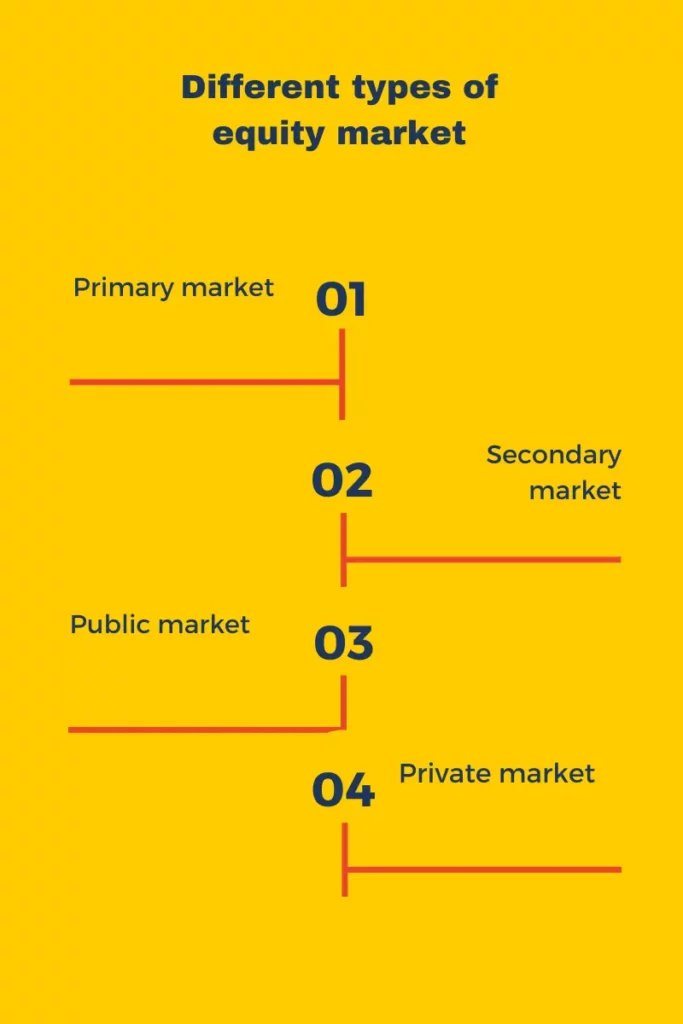
Many novice investors ask, what is equity market? What are the types? There are four types of equity markets. The types depend on many factors, like company size, geography, and trading methods.

  • Primary market

It is one of the types of equity market that investors use to issue new shares via IPO. This type helps investors raise their capital by selling ownership stakes for the first time.

  • Secondary market

The secondary market is mainly the stock market. Here, the investors buy and sell the issued shares.

  • Public market

One of the most important types of equity market is the public market. It is for the general public. So, anyone can purchase and sell shares on stock exchanges.

  • Private market

When investors are involved in the trading of shares in private companies, it refers to the private market.

So, these are the types of equity market. Every market comes with its own characteristics and investment opportunities. Anyone looking to expand their knowledge in the equity market can enroll in the Investment Banking course. Through this extensive program, one could become an equity expert. 

Different types of equity market

Trading in the equity market

After understanding the concept of what is equity in share market, learning how to trade is important. In the stock market, investors make offers to buy stocks at a specific price. But, the sellers ask for a certain price. After a proper negotiation, a sale happens.

  • Often, several investors want the same stocks. In that case, the first bidder always gets the stock. When a buyer wants to pay any price to buy the stock, they purchase it at market value. Likewise, whenever a seller accepts any stock price, they sell at the market value.
  • When companies sell their stocks on the market, they become publicly traded. Here, every stock represents ownership, and it attracts investors. So, when the companies perform well, the stock value increases, and investors get rewards.
  • To get a clear understanding of what is equity trading, investors must know the potential risks. Whenever the companies struggle, the stock price value always drops. But, investors can buy and sell stocks quickly.

Examples of equity market

It is important to know the examples of the equity market to understand the equity market meaning properly. So some examples are: 

  • National stock exchange (NSE) and Bombay stock exchange (BSE)

These two stock exchanges are the most popular and largest stock exchanges. It lists a wide range of companies in India.

  • New York stock exchange (NYSE)

Another significant stock exchange is the New York Stock Exchange or NYSE. It features companies from the US and other International companies.

  • NASDAQ

This equity stock market exchange is famous for its growth and technology-oriented companies. It is a leading stock exchange that streamlines the trading of shares for several innovative companies.

  • London stock exchange

It is one of the most established and oldest stock exchanges. This stock exchange features companies from different sectors.

In conclusion

The equity market has become a significant platform of the global economic system. It allows investors to improve their growth potential. But, anyone who wants to trade in the equity market must have an understanding of what is equity market.

With the basic idea, they can target specific stocks and invest in the most suitable stocks. To learn the fundamentals of the financial market and equity in-depth, enroll in the Certified Investment Banking Operations Professional course.

This Imarticus program is suitable for every type of learner. Through this, learning crucial skills is possible. Investors can also get a clear view of what is equity in share market, which helps in future trading.

FAQ’s

Is the stock a kind of equity?

Yes, the stock represents the ownership equity in a company. It entitles the shareholders to a proportional share of the earnings and assets.

What is the difference between shares and equity?

To know the equity market meaning, it is important to understand the difference between shares and equity. Shares refer to the individual units of ownership in a company. However, equity is the total ownership interest of the shareholder.

What is the formula of equity?

Investors can calculate the equity based on the difference between liabilities and a company’s assets. It means the formula is: Equity= Assets – Liabilities.

Can anyone do online equity trading?

Yes, investors can do online equity trading using online broker platforms. For that, they have to open a trading account to invest in the live equity market.

Stages Involved in Mergers And Best Practices

Mergers and acquisitions have become one of the most popular ways of expanding a business. Knowing where to invest and to merge with which company is a crucial aspect of mergers, which requires a lot of planning, preparation and strategic evaluation. The major objective behind mergers is that businesses share the same strategy of cost optimisation, business expansion, market growth and earning a larger market share.

The process of consolidating the assets of two or more business houses or the coming of two or more companies together is known as merger and acquisition. It is a business strategy that results in forming one single entity by acquiring or merging more than one company. It is a form of investment decision that the company’s shareholders take to increase their market share. 

Merger and acquisition is an integral aspect of investment banking. One can gain a deeper understanding of mergers and acquisitions by enrolling on an insightful investment banking course. Read on to imbibe a profound understanding of planning and preparing for mergers, the various stages involved in a merger and best practices.

Stages of a Merger and Acquisition Transaction

Merger and acquisition transactions can be different due to their dynamic nature. Some transactions can be simple and open-ended, whereas some can involve certain complicated turns of events. Merger transactions vary depending on their nature, size, number of employees, regulatory implications, international commitments, fiscal considerations and so on.

However, all merger and acquisition transactions follow a basic process involving 5 major steps. The degree of complexity in these stages may differ depending on a particular merger or acquisition. 

Assessment and preliminary review

The first and foremost step to begin a merger and acquisition transaction is to prepare a memorandum of information. This has to be done even before a purchaser is found for the entity or company that is up for merger. Generally, the vendor draws the information memo and broadcast set to evaluate market interest. This helps the vendor to ascertain suitable buyers willing to buy a portion of a business or the entire business at the highest possible price.

The information memorandum contains all the relevant information necessary for the purchaser to decide whether to buy the company or not. However, it does not reveal any sensitive or confidential information related to the business. To gain access to confidential company data, parties have to indulge in a non-disclosure agreement (NDA) to protect sensitive information concerning the business.

Negotiation and letter of intent

The next step is negotiation, followed by due diligence when there exists more than one suitable purchaser. However, in an event where there is only one buyer in the running, it is routine for the parties to start discussing certain matters prior to the merger’s contractual phase. This can be done either before or at the time of commencement of the due diligence process.

The important matters of concern in this phase can be listed as follows:

  • Competition law implications and findings, and if any of it requires pre-clearance from the office.
  • Matters related to employment law considerations.
  • Important matters related to various licenses.
  • Aspects of fiscal implications.
  • Tracking of market conditions.

Additionally, both the purchaser and vendor must put out certain terms and conditions for the merger to be reviewed by both parties. Such terms are contained in a letter of intent, and the parties have to agree to continue with the merger. 

To gain greater insight into the same, one may consider taking a certification in investment banking.

Due diligence

Carrying out a due diligence exercise on the target company is common in an M&A. Generally, where there is only one buyer, the advisors chosen by the purchaser carry out the due diligence exercise. The seller also conducts a due diligence exercise for multiple reasons, such as for facilitating the sale of the company shares, finding any potential problems that may act as a barrier to the sale, searching for any warranties, etc.

The purpose of due diligence is to cover legal, financial and fiscal areas, ensure fair pricing and spot any potential risks that may arise out of a particular merger and acquisition transaction. It takes into account a variety of legal aspects and determines whether this merger will result in any legal ramifications or not.

Negotiations and closing

Following the final phase of the due diligence process, the potential purchaser analyses and reviews the advisors’ reports to take the final call about the merger. It also establishes the significance of the deal. The parties then finally negotiate and decide the terms and conditions of the merger, its pricing, transfer of rights and all other important aspects of the deal.

After finalising the merger, both parties discuss the pricing of the assets, liabilities and indemnities of the business that shall be included in the Share Purchase Agreement (SPA) or the Assets Purchase Agreement (APA).

Post-closer implementation/ integration

The final stage is signing the share purchase agreement that includes detailed clauses relating to the rights regarding acids and liabilities of the business, issuing notifications, obtaining consent and so on. Additionally, both parties can arrange for a post-closing integration that will allow them to acknowledge their common business intent. 

Merger is a part of the capital market, which is a crucial concept of investment banking. One can build a career in investment banking by learning the fundamentals of mergers and acquisitions.

Mergers and Acquisitions Best Practices

Companies can improve the chances of a successful merger by implementing the following strategic best practices:

  • Aligning the organisational objectives and market positioning of the acquiring and target company.
  • Conduct strategic planning and proper integration.
  • Indulge in cultural integration by eliminating cultural differences.
  • Engage and communicate with the stakeholders seamlessly.
  • Perform risk management analysis while considering a merger.
  • Keep track of the post-merger performance.

Conclusion

Merger and acquisition is a delicate process that requires extensive research, knowledge, planning and expertise in investment banking activities. This domain contains multiple components for which a strong hold on investment banking operations is important. 

If you want to become an investment banker, consider signing up for the Certified Investment Banking Operations Professional course by Imarticus. This course will assist you in inculcating specialised skills and knowledge essential for building a successful career in investment banking.

How can an investment banking course advance your banking career?

Despite donning a rather plain appearance in its name, investment banking is a complex field. As a professional, you must know in detail about stocks and other instruments. Every instrument carries its set of unique features and complexities. And that’s not enough. You must also be aware of the regulatory landscape and much more. An investment banking course familiarises you with the concepts required to build a successful banking career.

By understanding complicated topics, you get an edge over your peers. The following sections give the information needed to take the right call. Check out how the course can give a boost to your resume.

Let’s get started!

Why is investment banking the foundation of a banking career?

investment banking courses

The most important quality of a successful investment banker is inquisitiveness. You must be curious to keep abreast of the latest market trends.

Investment banking develops this skill by compelling you to generate market insights. For this, you will have to closely monitor market trends, industry developments and market indicators.

Keep reading to know the reasons that make the study of investment banking important for your career.

  • Increases financial acumen: As an investment banker, you ought to deal with complex financial structures. This is why an investment banking course teaches intricate valuation methods and provides a detailed understanding of marketing dynamics. You can apply these concepts to other roles like credit analysis.
  • Teaches pressure management: Investment bankers operate under tight deadlines. By understanding the working environment, you learn the following skills. These skills prepare you for roles dealing with client service or project management.
    – Stress management
    – Multitasking
    – Time management
  • Exposes to regulatory standards: Investment banking demands adherence to strict financial regulations. By learning about these standards, you are prepared to take up roles that deal with the following aspects.
    – Regulatory compliance
    – Legal
    – Risk management
  • Teaches deal structuring: An investment banker is expected to design elaborate financial solutions. These include arranging the terms, financial components and conditions of transactions. You must perform these tasks according to the expectations of the client. This ability to craft tailored solutions with optimal outcomes for both parties helps in corporate banking.

How does an investment banking course unlock opportunities?

Now that you know the importance of this topic, let’s uncover more about it. In the following list, you will know how an investment banking course opens up the doors of many opportunities for you.

  • Familiarity with jargon: An investment banking course helps you become fluent in industry-specific lingo. As a fresher, terms like IPO, leverage and due diligence may scare you. By the end of the course, your fluency with such jargon will increase, thereby unlocking more recruitment opportunities.
  • Mastering data crunching: As an investment banker, you will be crunching data all day long. Through the course, you will learn the skills that make you a pro in handling financial transactions. These skills include the following:
    –  Analysing financial statements
    –  Building models
    –  Interpreting data
  • Networking: An investment banker builds connections with hundreds of people. By joining a course, you will connect with industry experts, insiders and alumni. This will expand your network to allow the best opportunities to come your way.
  • Improving presentation skills: One of the main roles of an investment banker is to sell ideas to clients. This involves making effective presentations and delivering them by demonstrating impeccable communication skills. Thus, a course will help you persuasively explain complex financial terms.

Get a competitive advantage in the industry by enhancing your skillset

Investment banking is rightly the foundation of several banking roles.

It builds your financial acumen, teaches pressure management and exposes you to regulatory standards.

You get opportunities to network with industry leaders while improving your persuasion skills. Imarticus Learning takes your journey forward in the right direction through its Investment Banking Course.

You can also explore other topics of your interest by visiting the official website of Imarticus Learning, the leading educational platform for professionals.

The rise of Quantum computing in Investment Banking

The rise of Quantum computing in Investment Banking

Investment banking is one of the most complicated financial mechanisms, serving numerous purposes and businesses. It is a special branch of banking operations providing financial consultancies and services. Hence, there is a great emphasis by students and professionals to learn investment banking. With such a demand, there are many popular investment banking courses to cater to such rising needs.

Such financial services require the capacity to weigh and measure a range of potential outcomes, which requires the usage of complex models and algorithms based on calculating probabilities. However, the current scenario involves dealing with a massive amount of data for enhanced accuracy of probabilities. This helps in maximizing profitability and improved the quality of financial services, hence the need for better technology.

What is Quantum Computing?

Quantum computing is simply a new technology based on quantum theory principles. It relies on the quantum mechanics law to perform complicated data operations. Traditional computers make use of bits as their basic unit and binary system for representing information, however, quantum computers will store this information in qubits. 

According to quantum physics, certain properties of particles can exist in two states or a combination of two states simultaneously. This is in contrast to traditional binary constraints, where the operating system operates on 1s and 0s. A Quantum system can be 1 and 0 or a mixture of 1 and 0, all at the same time. 

Thus, quantum computing has the capabilities of extending the capacity limits of traditional high-performance systems. It will improve the algorithm efficiency substantially. 

Quantum Computing for Investment Banking

Quantum computing is an emerging technology and has immense potential that has not been harnessed completely. However, it has started sparking interest in many businesses, including investment banking. With major players already making their way in developing and experimenting with this technology, it will soon become an important component of long-term strategies of investment banking. It is being incorporated as an important topic in Investment Banking Courses online in order to learn Investment Banking.

It has the potential to increase the speed of transactions, trades, and data processing. Some of quantum computing’s biggest contributions would include improving the quality of simulations, resulting in better risk management. All of this would also have a positive outcome in reducing the processing cost and time with respect to classical computer systems. Optimization capabilities would see an improvement.

Even though full-fledged, end-to-end commercial applications are years away, it is expected that quantum computing would be a game-changer. It is important for learners to gain knowledge about quantum computing as an integral part of Investment Banking courses.

How can Quantum Computing be Utilized in Investment Banking?

Following are some use cases where quantum computing would positively affect investment banking:

Prediction and Targeting

Customers of financial services demand products and services that are personalized according to their ever-evolving behavior and needs. Similarly, fraud detection systems have to cope with the current dynamic situations. Quantum computers offer superior data modeling capabilities that will discover patterns and make predictions with enhanced accuracy.

Optimization of Trading

Quantum technology would enable the trading division to include a response to real-life market movements and investor aspirations. This will make portfolio optimization cost-effective and more precise.

Risk Profiling

Improved data-processing capabilities of quantum systems will help in managing complex risk-profiling demands along with increasing regulatory processes with increased efficiency.

Improved Operational Processes

Investment Banking organizations can re-align their operational processes including asset management, treasury management, compliance, onboarding customers, decisions regarding KYC norms, and others

Way Forward

There are associated risks as well including the absence of quantum-safe public-key cryptography exposing the financial systems to systemic failures. However, challenges will continue to exist, but the enormous benefits have to be balanced along with it. It places an important highlight on interested learners to learn Investment Banking along with the new emerging technologies. 

Taking a proactive approach, certification for Investment Banking Operations is available, which is an industry-oriented Investment Banking Course. This will provide a detailed understanding of job-relevant skills along with an opportunity to launch a career in investment banking. The industry certification, practical learning, and a curriculum aligned with the industry will provide a boost to the learners’ resumes and skill sets. 

Interested learners can contact us through chat support, or drive to our training centres in Mumbai, Thane, Pune, Chennai, Bengaluru, Delhi, and Gurgaon

Can a diploma in investment banking get you your dream job?

In these times, an investment banking course with placement is a golden cow you need to milk. Investment banking is the most preferred job for people passing out of IIMs. If you want to know the statistics of job openings, a top banking firm in Mumbai has around 2000-3000 front desk jobs for investment bankers. 

Not only that, JP Morgan, one of the premier banking firms in the world, receives around 50000 applications for 400 internship openings. The salaries are pretty good too. The biggest benefit of this job is that you could rise through the ranks to the top of the hierarchy within a decade. No wonder this is one of the best jobs you could ever dream of.

Career as an investment banker

Investment bankers are one of the most important professionals in the banking industry. They provide financial consultancy services to both high net worth individuals (HNWI) and organisations. Your primary responsibility as an investment banker is to raise capital for the individual/organisation after assessing their financial position in the market. This assessment serves two important purposes. Let us know more about it.

When working for an investment bank, you will have to report on the various opportunities available in the market. One of the core responsibilities of an investment banker is to tell his/her client what to buy or where to invest. You will have to make several reports regarding the performance of this specific investment opportunity. This is what the buying side of investment banking is all about.

There is also the selling side of the investment banking role. Say you are working with a company that wishes to sell some of its assets or a product or service in the market. That is also one area where you have to chip in regularly as an investment banker. In this area also, you will have to contact the prospective buyers or clients and convince them to make the purchase.

But still, why should you be interested in the investment banking field?

Investment banking has been becoming big in the last two decades. The nature of the job has become more important and immersive. Earlier, any financial professional could handle this job, be it a CA, CMA, CFA or MBA. But slowly, the top brands and business owners realised that knowledge about finance only wasn’t going to break the ice. Something extra is required to grow to gigantic proportions, especially globally.

To serve the bigger cause, professionals with specialised knowledge were required. Here comes the demand for investment banking courses after graduation. They caught individuals interested in banking at an earlier stage and moulded them as per the requirement of the field. As a result, many high-quality investment bankers were created indigenously, and Indian banks also started growing in their stature in the global market.

Over time, India has become a big and unique force in the global banking system. Not only that, you get many opportunities to develop a high-profile career right from scratch. Who would let go of such an opportunity?

What is the career pathway for becoming an investment banker?

We will be discussing how you can become an investment banker:

First combination: Class 10th + class 12th in non-medical stream + UG in any engineering discipline + diploma in investment banking

In this combination, we shall refer to the students from the non-medical stream. These are those students who would initially be opting for engineering studies. In this stream, you should have strong mathematics knowledge and number-crunching capabilities. You will be trained for your role as an investment banker after you complete your engineering studies. At a later stage, ensure you also get an MBA in investment banking for better prospects. 

Second combination: Class 10th + class 12th in commerce stream + UG/PG in any commerce course (B.Com/BBA/M.Com) + diploma in investment banking

Since you are from the core commerce stream, you will have a fair idea of investment banking. Your syllabus will cover most of the topics of investment banking. After completing your diploma, you can immediately opt for placement.  

But, which investment banking diploma should you opt for? 

Imarticus Learning has this wonderful investment banking course with placement. You can learn from the best faculty in India and get to know about the investment banking field in detail. Also, after completing the course, you can get placed at the top companies in India. 

So yes, a diploma in investment banking can help you get your dream job. What are you waiting for? Enrol now!

The different types of investment banking jobs: Junior and Senior levels

The different types of investment banking jobs: Junior and Senior levels

No doubt, Investment banking is one of the most sought-after and prestigious careers in the market. It is well known for providing lucrative opportunities, and the career growth potentials are quite promising. Every year, thousands of individuals apply for investment banking jobs, but only a few are lucky to get selected. The competition is fierce, and one must possess the right skill set and knowledge to compete in this industry.

corporate leadership

So, if you are aiming to become an investment banker, then you should know that there are two different levels of investment banking jobs – junior and senior level. 

Junior investment bankers usually perform research, analyze financial data, and help prepare reports. They are also required to conduct market research and provide project management support. Meanwhile, senior investment bankers focus on high-level activities such as mergers and acquisitions and corporate finance transactions.

This post will discuss the rise of investment banking as well as different types of investment banking jobs in more detail.

Rise of Investment banking

The investment banking sector has seen unprecedented growth over the past years, thanks to the global economy’s shift towards a more digital and automated approach. This industry is now taking advantage of technology and automation more than ever before, helping banks to stay competitive in this highly volatile market.

You will not even realize that the investment banking industry has grown like never before. Most of the big financial institutions have already started to make use of digital channels to provide better services and also improve their overall efficiency. These technological developments have made it easier for investment bankers to stay ahead in the game and attract more customers.

Different Types of Investment Banking Jobs

As we discussed earlier, there are two different levels of investment banking jobs – junior and senior. 

Let’s discuss each level in more detail.

  • Junior Investment Banker: This is the most common entry-level position from which you can become an investment banking associate. Associates are responsible for conducting research and analysis to support senior investment bankers. They also provide project management assistance and help in determining the best opportunities for their clients. Furthermore, they may be required to provide support in the preparation of presentations, financial modeling, and the capital raising process. 
  • Senior Investment Banker: This is the more advanced level of investment banking job, which requires a great deal of experience and expertise in this field. Senior bankers are responsible for managing high-level activities such as mergers and acquisitions, restructuring, syndication, capital markets transactions, and private placements. They are also responsible for making strategic decisions and leading the team of junior investment bankers.

In addition, a lot of people are now opting to do an Investment Banking course with a placement option. This is one of the ideal go-about to get into this industry, as the courses provide in-depth knowledge about all areas of banking, such as finance, economics, and corporate strategy. With this, you can get the necessary skills and knowledge to become an investment banking professional in no time. So, don’t miss out on this great chance and make investment banking your career.

Discover Investment banking courses with Imarticus Learning

Imarticus Learning provides investment banking courses after graduation with placement options for those willing to pursue an investment banking career. They offer a comprehensive and interactive program that covers the extensive field of investment banking, giving you the right skills and knowledge necessary to succeed in this industry.

Course Benefits for Learners:

  • Students will gain in-depth knowledge about financial instruments, capital markets, corporate finance, and risk management.
  • Students who are looking to begin their investment banking career may get the help to succeed in the competitive job market.
  • After completing the investment banking course with placement, students can get on-ground placements in well-known financial institutions.

Contact us through chat support, or drive to our training centers in Mumbai, Thane, Pune, Chennai, Bengaluru, Delhi, Gurgaon, or Ahmedabad.

Trends to look out for in investment banking

Are you interested in investment banking and want to know what current trends are taking place? Have you ever wondered how some top banks stay ahead of their competition or if there’s anything new that could help your career within this field? 

Postgraduate Program In Machine Learning And Artificial Intelligence

As a student looking to get a job in investment banking, staying abreast of relevant industry news can provide insight into the latest strategies. 

Understanding these significant trends will make it easier for students to find work in this dynamic sector. From streaming technology advances to novel financing arrangements, we’ll be exploring some hot topics and cutting-edge developments that aspiring bankers should recognize when seeking jobs. 

So brace yourself – buckle up – and let’s jump into today’s blog post about Trends to Look Out for In Investment Banking!

The increasing demand for fintech services

One trend that is certain to influence the direction of investment banking in 2023 is this one. Financial technology services have expanded rapidly in the past few years, covering everything from automated portfolio management to cryptocurrency trading. As these services continue to grow and provide more options for investors, traditional financial institutions must keep up with the latest developments to stay competitive.

The constantly-growing popularity of digital currencies and blockchain technology

Blockchain technology promises the potential for faster, safer, and more efficient transactions, which is attractive to large-scale investors and businesses alike. In addition, digital currencies like Bitcoin are becoming increasingly popular among small and individual investors as they look for alternative ways of trading assets and making payments.

With more people in emerging markets accessing previously-inaccessible financial services, the demand for innovative solutions and products can skyrocket. Investment banks offer solutions that meet the needs of these new customers and take advantage of this growing market to remain competitive.

The impact of AI and ML on investment banking

 AI and machine learning are already used in many areas of finance, from automated portfolio management to trading algorithms that can identify opportunities faster than any human trader. 

AI innovations could “potentially unlock $1 trillion of incremental value for banks.” AI would unlock this value by accelerating human decision-making and raising the likelihood that humans will make the choices that will promote growth.

As these technologies become more sophisticated and widely available, they will revolutionize the investment banking industry by speeding up processes, optimizing decision-making, and providing more accurate predictions of market movements.

The growth of mobile banking

 As more people use their phones and tablets to access financial services, banks must invest in developing secure and user-friendly mobile apps that enable customers to manage their finances.

Instantaneous fund transfers are made possible by real-time payment networks, which establish a direct connection between banks and their clients. This is especially helpful for those who work as independent contractors because they can get paid immediately for their work instead of waiting for conventional bank processing times. Businesses are also becoming increasingly enamored with real-time payments because they offer a quicker way to pay invoices and bills.

These are just a few significant trends shaping investment banking in 2023. As the industry continues to evolve, banks must stay up-to-date and invest in solutions that meet their customers’ needs. With the right strategies, investment banks can remain competitive and benefit from new opportunities presented by these emerging trends.

Discover an investment banker career With Imarticus Learning

With the help of the Certified Investment Banking Operations Professional program, students can begin a career in the financial markets. Students who complete this investment banking course with placement assistance will have the skills and knowledge needed to succeed in banking and clearing services at all stages of production.

Course Benefits for Learners:

  • The management of complex derivative products and securities throughout their trade-life cycles is one of the financial services and investment banking lessons that students will learn.
  • Additionally, the student will get the help they need to start a career in investment banking.
  • The investment banking courses after graduation include lessons on finance, strategic planning, financial management, and the assessment of investment prospects.

How can an investment banking course in India streamline your career in the derivatives market?

Have you ever wondered how an investment banking course in India can help streamline your career in the derivatives market? It is no secret that the Indian economy is on the rise, and the demand for qualified investment bankers is increasing. With the proper training and education, you can position yourself at the forefront of this industry and enjoy a successful career in the field. This blog post explores how an investment banking course in India benefit a career in derivatives market. 

What is making a career in Investment banking in 2022 like?

The future looks bright regarding making a career in investment banking. In 2022, the industry is expected to grow at a rapid pace and offer opportunities for those with the right skill set.

There are a few factors that are driving this growth. Firstly, the global economy is expected to rebound strongly from the pandemic-induced recession. This will lead to an increase in demand for investment banking services.

Secondly, the Indian government has recently liberalized the country’s financial sector, opening up new opportunities for foreign banks and investors. Finally, as developing economies continue to grow, they will increasingly need investment banking services to develop their infrastructure and fund their growth.

Thus, if you’re looking to make a career in investment banking, 2022 will be a great year. To increase your chances of success, consider enrolling in an investment banking course in India. Such courses will help you develop the necessary skillset and network to thrive in this rapidly growing industry. 

How does an investment banking course streamline a career in the derivative market?

An investment banking course in India can help streamline your career in the derivatives market by providing you with the necessary skills and knowledge to succeed. The course will cover financial analysis, investment banking operations, and derivative instruments. By taking this course, you will better understand the workings of the derivatives market and how to make money from it.

What are the benefits of enrolling in an investment banking course in India?

financial analyst course

If you want to make a career in investment banking, enrolling in a course is the best way to start. There are many benefits of registering for an investment banking course in India, some of which are mentioned below:

  1. The first and foremost benefit is that you will be imparted the required skills and knowledge to succeed in this field.
  2. The investment banking courses in India are designed and delivered by experienced professionals who have worked in the industry. Therefore, you will get first-hand insights and real-world experience which will be highly beneficial for your career.
  3. These courses offer good placement opportunities with top investment banks and financial institutions.
  4. Enrolling in an investment banking course will help you network with other like-minded individuals who can be extremely helpful for your career growth.

An investment banking course in India can provide an excellent platform for those looking to make a career in the derivatives market. It will help you gain the necessary skills and knowledge to succeed, offer valuable placement opportunities and allow you to network with industry professionals.

Transitioning Investment Banker Career with Imarticus Learning:

Imarticus Learning provides recent graduates in commerce & finance with 0–3 years of experience with industry-specific training.

The 180-hour long, power-packed Certified Investment Banking Operations Professional course equips students with the skillset needed to begin a career in investment banking operations, treasury & clearing services. Your only responsibility is to learn; we do the rest.

Course USPs:

Understanding complex securities and derivative products, their trade lifecycles, and the functions within investment banking operations.

8000+ placements completed with 60% salary hikes, get extensive career support.

Gain Industry Certifications with the valuable and globally recognized CIBOP certificate.

Live facilitated instruction to provide the best student outcomes.

For further details, contact the Live Chat Support system or visit our training centers in Mumbai, Thane, Pune, Chennai, Bengaluru, Hyderabad, Delhi, Gurgaon, and Ahmedabad.