What Are Evolution of Fintech or Financial Technology?


Technology and Finance have gone together for time immemorial. Initially, it was about making and maintaining records of financial transactions and later the introduction of coins, paper currency and promissory notes in the early 19th century. In modern times and about a decade ago Fin and Tech have got amalgamated into the era of fintech.

The early internet age:

Did you know that Fintech Courses teach you that the past 5 years cable under the seas far exceeds the cable network over the last 150 years since data and volumes of traffic have increased immensely? The first under-sea trans-Atlantic telegraphic cable fondly called Victorian internet-connected North America to West Europe and was in use since 1867. Financial markets at New York could connect to London, Asian markets, Europe, etc with its expansion. Forex references to GBPUSD also call this the cable-pair as most transactions were between the USD and GBP.

The laying of cabling infrastructure helped globalization and financial interactions between the period from inception in 1867 to 1914. The outbreak of WWI, the 1929 stock market crash and the Great Depression led to the slowing of the markets for over 25 years. During WWII codes and code-breakers were developed by the Germans and Britishers respectively. Communications in those days were through codes and set the initial foundation stone for coding. Just look at the German encoder shown below! It was the ability to build the decoders that leaked the German communications that led to an inversion of fates and an early end to WWII.

The ATM and calculator era:

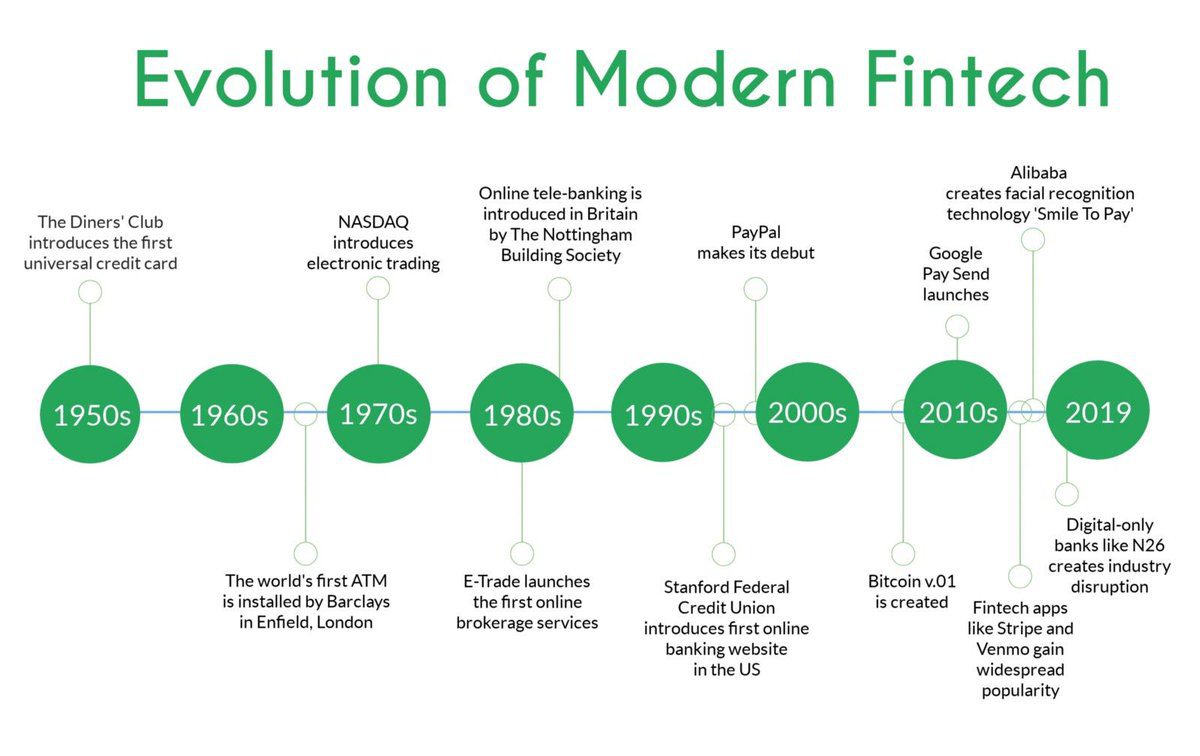
The second phase of fintech began in 1967 with the digitization of analog to digital systems. It was also the beginning of RegTEch and early use of Fintech in development. The first ATM machine placed in the UK in Barclay’s Bank was the introduction and initiation of fintech. With more machines being made available the way people transacted and their relations with technology and finance changes irreversibly. Soon we saw the introduction of computing power in the TT 2500 DataMath hand-held calculator from Texas Instruments. This slowly evolved into today’s smartphones.

The electronic age:

The period between1970-80 saw the introduction of banking SWIFT codes and payment systems both international and domestic in 1973. SWIFT-(Society For Worldwide Interbank Financial Telecommunications) with its HQ in Belgium covered over 15 major countries and 239 banks. Today it is a portal for financial communication with 11,000 institutions and is the global payment system portal for financial communications. Between the ’70s and ’80s emerged NASDAQ the stock exchange with almost no human interference. The launch of the internet in the late ’80s saw internet banking and brought smart mobile phones into the hands of the common man.

Stock markets and payment systems: 

1999 saw .coms start and soon end. The 2008 financial crash brought into the limelight the distrust of customers and the start of the blockchain technology and cryptocurrencies. It also saw Siri, Google, Amazon, etc enter the digital assistant and payments platforms to revolutionize the financial scenario. Alongside e-commerce platforms emerged like TenCents, Alibaba and many others who all cashed in on the immense benefits of being early fintech players who have nearly replaced the way we shop, transact and buy things.

The present scenario: 

With the advent of smartphones, data analytics and the startup revolution Fintech post the 2008 financial meltdown emerged with blockchain technology being touted as the next big technological breakthrough. Blockchains have the potential to transform and disrupt the industrial scenario with cryptos, eCommerce platforms and digital currencies taking over. P2P lending, crowd-funding, angel investors and a complete transparent digital financial world is where we definitely are headed to.

Conclusion:

The evolution of fintech has been gradual and over the last decade, fintech is set to transform and disrupt many an industry. This makes the demand for personnel high and scope for jobs huge. Payments are also good and it makes a wise choice as a career. The fintech industry needs a large number of qualified personnel and is set to grow rapidly with even governmental policies promoting its growth. Incubators, startup hubs and integration of technology into all streams of life is the new mantra.

Do your Fintech courses at Imarticus Learning to get the ideal launch with assured placements. For more details, you can also contact us through the Live Chat Support system or can even visit one of our training centers based in – Mumbai, Thane, Pune, Chennai, Hyderabad, Delhi, Banglore, Gurgaon, and Ahmedabad.


How is The Ethereum Blockchain Different From The Bitcoin Blockchain?


The Ethereum and Bitcoin blockchains are superficially the same, in that, both cryptocurrencies use blockchain technology and are the most popularly known cryptos of the 20th century. A bit of learning at any reputed institute for Fintech Training will be able to explain the differences in the blockchains. That’s what we will explore in the next few paragraphs.

The basics of blockchains:

Blockchains are today popular across verticals and industries like banking, agriculture, healthcare, e-commerce, education, mining, property recording, retail, entertainment, media, automobiles, logistics, transport and many more. Blockchain technology brings in the important four attributes of immutability, decentralization, transparency, and security. The benefits offered by Blockchain technology are

  • The data ledgers are cryptography protected and contain hashtag functions from the previous block. This information is verified to complete the cryptography transactional process.
  • The blockchain data structure is contained in the app-end and causes the data to be immutable, and impossible to delete or alter.
  • The peer network has all transactions on the blockchain over all the interconnected computers thus decentralizing the system.
  • User-authentication and verification, use blockchain technology sans third-party interference.
  • Ledger consensus and record-keeping are enhanced as all data of transactions are contained in the block and are duly verified for maximum trust by the peer network users.
  • The ledger is distributed over all Blockchain nodes in real-time.
  • Data is always retrievable and never lost.
  • Transparent transactions ensure the viewing parties are verified users and reduce transactional ambiguities.
  • Blockchain time-stamping ensures a recorded chronological order.
  • The source of the ledger can be tracked at every block of the chain.
  • Consensus between the parties ensures duplicity and fraud are removed.
  • Smart contracts enable presetting criteria and conditions for automatic recording of transactions.

How the blockchains differ:

2009 saw Satoshi Nakamoto invent the Bitcoin as a peer-to-peer cash system which works electronically and replaces the older inefficient banking system. The protocol or Bitcoin’s blockchain was a perfectly transparent financial transaction where data was stored in blocks and interlocked together by hashtags and cryptography.

Since each block carries the signature of hashtags of the previous block, the resultant blockchain is immutable, needs verification across all nodes and works only on authentication. All this, at literally zero fees! The record of transactions can be traced back to the source and all along the chain. The distributed and decentralized system is peer-to-peer, secure and sans any intermediary.

Use of Bitcoins became the way to avoid those bank fees and lengthy authorization processes when transacting. One could avail Fintech Training and use the Bitcoin instead of paper-money and send money across to remote places in completely secure transactions with the click of a mouse. Bitcoins don’t care who is transacting and how much. It could even be used by AI-enabled machines or robots! Bitcoin is uncensored digital money worth its weight in gold!

In contrast, Ethereum blockchains go beyond just being a peer-to-peer blockchain payment transacting platform. Ethereum’s blockchain can do more and uses its platform to create smart contracts and DApps which execute and store the logic coded for creating them. The fintech training partner the Ethereum platform can transfer and supports the digital currency and DApps. Ethereum can also execute the smart contract using the “if-this-then-that” coded logic and condition coded in its blockchain.

In its functioning, one can use the Ethereum crypto, digital wallets, the native programming language, smart contracts enabled by Solidify and more. Thus bank fees, escrows, and intermediary agencies can be totally avoided. Some of the examples are Airbnb, eBay, OYO, Upwork, and Uber. Hence Ethereum is programmable money!

Parting notes:

Bitcoin platform and the Ethereum Blockchain are not in competition and are designed for different purposes. It is rumored that Bitcoin will shortly be powered with the lightning network which when launched could bring in competition between the Bitcoin and Ethereum Blockchains and apps dependant on them. Till then both technologies work well for resolving modern complexities.

There are very many jobs on offer in the blockchain segment and these are well-paid too! It is a step in the right direction to make a career of Blockchains and fintech since they are growing and demand outstrips personnel supply. At Imarticus Learning the fintech training has an excellent course curriculum, assured placement, soft-skill and resume building module and an industrially well-accepted certification. Rush, since admissions are limited!

For more details, you can also contact us through the Live Chat Support system or can even visit one of our training centers based in – Mumbai, Thane, Pune, Chennai, Banglore, Hyderabad, Delhi, Gurgaon, and Ahmedabad.

How Can Business Benefit From Blockchain Tech?


Bitcoin is the best example of blockchains succeeding and the beginning of the use of blockchains in all technologies to improve efficiency, accountability, transparency, and productivity at reduced costs for a wide variety of businesses.

Technology today is part and parcel of every business and industry where data is used. Without exceptions and across financial services, global supply chains, healthcare, government, insurance, real estate and banking sectors among many others have benefitted from blockchains. Ways and means to use the Blockchain Certification to transform and disrupt industrial growth and businesses are the subject matter of every innovator on the web.

Let us explore how the blockchain can transform your industry or business model.

1. Transactional transparency:

Record keeping and maintaining transactional histories use blockchain distributed ledgers where all network users can verify the recording of the shared documentation. The altering, deleting or tampering of records is near impossible as every block transaction carries a copy of the previous block in unique hashtags and needs verification before being added to the block.

This means duplicity, frauds, altering documents becomes impossible as the sequence has to be changed across millions of network users and needs the consensus of all users on the network to timestamp and record the transaction. The result is a precise, accurate and immutable record shared to permission-enabled users in a transparent and sans intermediary transaction.

2. Verification and top-end security:

Consensual transactions ensure transparent recording. Every transaction is verified, approved, encrypted and linked through cryptographic means to the previous transaction. Publishing for verification in real-time ensures information is stored across every node of the network to make the hacking, data-loss and privacy of the network a 100% fail-proof system.

3. Better record keeping and traceability:

Tracing the source of products in a chain is difficult enough. By recording them on blockchains the logistics, marketing, record-keeping, product lists are all stored on blockchains to ensure finding the source or origin easily in real-time. Imagine how the product deliveries in a food-chain can be tracked to even account for spoilage and refrigeration details!

4. Speed, efficiency, and ease-of-use:

Paper transactions can be completely avoided by recording on blockchains. This also reduces human errors, third-party mediation, ledger keeping, and many such benefits. Sales are quicker and settlements hastened as proven by e-commerce platforms when blockchains are used since the records are stored on blocks shared in real-time across authorized users requiring a single distributed ledger for the entire network of users.

5. Cost reduction:

No intermediaries need be present meaning lesser costs on the recording, verification, and record-keeping. Where cost reduction is a priority blockchain can be relied upon for the trust, accuracy and transparency factors to help with improved efficiency and increased productivity.

A bit on blockchains:

Blockchain technology brings in the important four attributes of immutability, decentralization, transparency, and security.

  1. User authentication and verification using blockchain technology sans third-party interference.
  2. The blockchain data structure is contained in the append and causes the data to be immutable, and impossible to delete or alter.
  3. The data ledgers are cryptography protected and contain hashtag functions from the previous block. This information is verified to complete the cryptography transactional process.
  4. Ledger consensus and record keeping are enhanced as all data of transactions are contained in the block and are duly verified for maximum trust by the peer network users.
  5. Blockchain time-stamping ensures a recorded chronological order.
  6. The ledger is distributed over all blockchain nodes in real-time.
  7. The peer network has all transactions on the blockchain overall interconnected computers thus decentralizing the system.
  8. Data is always retrievable and never lost.
  9. Transparent transactions ensure the viewing parties are verified users and reduce transactional ambiguities.
  10. The source of the ledger can be tracked at every block of the chain.
  11. Consensus between the parties ensures duplicity and fraud are removed.
  12. Smart contracts enable presetting criteria and conditions for automatic recording of transactions.

Blockchains are today popular across verticals and industries like banking, agriculture, healthcare, e-commerce, education, mining, property recording, retail, entertainment, media, automobiles, logistics, transport and many more.

Conclusions:

The blockchain technology is being popularly lapped up by governmental agencies, insurance firms, banks, real-estate sectors, for medical record keeping and much more where unauthorized access is limited and verification of users critical. Yes! Blockchains can be applied to all businesses without any problem to reap the very many benefits in improving accountability and efficiency of transactions.

However, to know what and when to do with this technology is an important area best tackled by doing a Blockchain Course at Imarticus Learning. Go ahead and learn it all starting at Imarticus’ course today! For more details,  you can even visit one of our training centers based in – Mumbai, Thane, Pune, Chennai, Hyderabad, Banglore, Delhi, Gurgaon, and Ahmedabad.

Why Does Fintech Business Increasingly Prefer Python As a Primary Programming Language?

The last decade has been all about FinTech which has played a crucial role in many areas of financial transactions through smart use of technology. And Python definitely scores as the most popular language to use.

Here is why.
As taught in most fintech course financial services need the most-apt application to optimize costs, planning and the amalgamation of financial services. A HackerRank investigative report suggests that Python is the most popular language in use for FinTech firms in the US.

The report by e-Financial Careers ranks Python among the top 6 machine codes for the banking sector. Thus, doing a Fintech Course at a reputed institute like Imarticus can help you with certification and giving you the ideal launch into the technological world of fintech where well-paying jobs abound and demand for personnel is fast becoming a rage.

The fintech data science advantages of Python:

The fintech startups work with financial transactions that need records to be unchangeable, immutable and hard to tamper with. Decisions cost money and setbacks when they go wrong. The industry thus needs a ready-to-use programming language with ample libraries, components and high-performance maturity such as Python.

The Hacker Rank  2016 Study across the famous six of health care, media, and gaming, social media, security, fintech, and finance industries searched for the best popular programming knowledge.

Python, especially for fintech industries and as taught in Fintech courses, outstripped the rest by a huge margin in the performance testing on coding challenges. It also proved to be very popular in the financial sector.

The Python benefits:

Some outstanding features that set Python apart are

  • Simplicity and accuracy: Python has low bug-rates and error rates than the other programming languages.
  • Speed: Though not the fastest it scored in the time-to-market optimization tests.
  • Syntax: The collaborative syntax is straightforward in Python and is easy for interconnecting the C-suite, developer and technical-expert languages.
  • Libraries: The huge repository of free open-source libraries can be used for ready-made solutions in the financial and fintech sectors and are popular for training purposes in fintech courses. 

Use of python in industries:

Python is being widely used today in banking and is widespread among the hedge, investment and corporate finance bankers. This is because of Python scores in handling quantitative challenges in trade management, risk management, and pricing. It also makes use of its large number of libraries to handle issues related to analytics, compliance, data, and regulation.

Bootstrapped fintech startups may use various back-end programming languages. But from the point of view of time, efficiency and effort spent, Python outdoes the rest for fintech use. It is growing very quickly and has the potential to be supportive in almost any industry it is used in. No wonder Python is so popular, reliable and accurate!

Python can hence be effectively used in software for the following sectors and is great at multitasking especially as a back-end server.

  • Financial analysis
  • Insurance
  • Fintech
  • Banking
  • Stock markets
  • Data analytics
  • Cryptocurrency transactions.

Python Projects in Fintech:

Success and Python implementation are synonymous when blended with FinTech ideas.  Look at the P2P lending platform Zopa which uses a mix of Java, C#, and Python. Zopa helps the borrowers and creditors transact free of intermediaries. And Python has helped the algorithmic models of Zopa execute complex transactions on blockchain enabled platforms.

Even the payments system like Stripe, Braintree, Paypal, and other receiving and processing systems use Python-based applications for the authentication of users and transactions mainly due to its wide array of ready-to-use libraries.

Conclusion:

Many fintech startups use C, R, Java, etc. But, Python is ideal for the challenges of the fintech industry. It has scored over many languages in its popularity over Java, C, R, SQL and others in the HackerRank challenges over the top 6 industries. Python emerged the ideal language for programming in the financial and fintech sectors. Obviously one would do well to learn Python because the top 6 industrial sectors are recruiting.

The jobs in the top industries prefer expertise in Python and are high-paying and have well-defined scope for progress and grow your career. If you want to learn the latest applications of Python in the fintech sector just check out the Fintech Training at Imarticus. Hurry as opportunities may be limited!

For more details, in brief, you can also contact us through the Live Chat Support and can even visit one of our training centers based in – Mumbai, Thane, Pune, Chennai, Hyderabad, Bangalore, Delhi, Gurgaon.

How Fintech Companies Are Impacting Millions of Lives In Tier II and III India


Fintech companies are pushing the boundaries of what’s possible in Tier II and Tier III markets in India. This is a huge opportunity that comes with financial inclusion to touch the lives of the unbanked rural customers, who with fintech’s technological innovation are personalizing and expanding their businesses to serve and impact millions of lives. Rural areas are yet to see better accessibility and proper social and financial inclusion.

But the scenario has improved because of three events that have allowed fintech to actually impact rural cash-driven customers in India. These are: 

  • The 2016 demonetization movement.
  • The wave promoting e-commerce.
  • Penetration of smartphones.

This promoted the proliferation of fintech industries catering to the rural sector by bringing new payments processing platforms, online transactions, and smartphone internet banking to the rural customers who far outnumber the urban clients. Let us quickly explore how the fintech industry has actually touched the lives of these people.

The watershed moment:

Rural customers in Tier II and III cities are dropping their mistrust of the online movement. The demonetization drive of 2016 meant to root out black-money saw India as whole embrace digitization of financial transactions. Coupled with the thrust of the government to boost the fintech sector and the push for financial inclusion, the watershed moment came with better penetration of the rural segment where banking transactions were yet to make a mark.

And yes, the smartphones were also instrumental in rural people trying and finding digitized transactions more transparent, safe and easy. Banking will never revert to the same again after this wave of digitization and technology impacting the rural customers.

According to NASSCOM reports the 2020 forecast of the fintech software market in India is expected to be USD 2.4 billion.No wonder then the figures reflect the changes in the pulse of digitizing the fintech way the tier 2 and 3 cities of rural India.

Reading the rural pulse of India:

Rural India contributes in big ways to the GDP and industrial development, as it is an untapped market and home to many businesses of the small-scale variety, which when cumulatively looked at, do contribute substantial millions to those GDP figures. Empowering the rural people with financial inclusion can not only improve these figures but provides a huge exploration area for entrepreneurs with a rural background.

The internet and online payment platforms are today making everyday life simpler and easier for the rural client who has to travel to far-off locations just for bill payments and banking. The unbanked rural segment is also seeing an improvement in billing and supply of water, electricity, gas, daily commodities procurement, etc.

Many e-commerce platforms, online banking, financial services like insurance, recharge for phones, small loans, shopping online has changed the face of rural India and the way they access and spend their money. This is the right ambiance for fintech industries to take their business up a notch and cash in on the largely untapped rural markets and thus improve the lives of millions living in those areas. Just stop for a moment and imagine the micro-enterprises getting instant loans and contributing collaboratively to the fintech sector.

Role of education:

Education is the key factor that can bring about financial inclusion. To change and impact more lives raising awareness and education is the only way to go. And the fintech industries are doing a good job through training camps and awareness sessions of their products and services in the rural markets.

To take it up a notch, regional language-based apps are being introduced to ease the rural customer onto the online platforms. These two measures are not only profitable for the enterprises undertaking them, but also impact the millions of rural persons living in the unbanked locations and geographies across India. Bringing the rural people into seamlessly using the fintech platforms, has been and continues to be, an area of prime interest to the fintech sector in its thrust aimed at taking the benefits of technology to these locations.

Conclusion:

Over the next decade, we can expect to see the fintech contributing to improving a lot of the unbanked rural sectors. This move will improve the industrial growth, the GDP and also impact positively the rural millions who are yet to see the major benefits of financial and social inclusion on all fronts. Fintech industries need to stay ahead of the curve and focus on products and services meant for rural clients. Do you want to learn how you can be a part of this revolution?

Do a Fintech course from Imarticus Learning and emerge career-ready with assured placements. Go ahead and impact the lives of your rural brethren.

How is Fintech Changing Business Models Across the World?

How is Fintech Changing Business Models Across the World?

Meet the darling of the 20th century. Fintech! Using technology innovatively in the financial sector to increase efficiency embodies the definition of the two worlds of technology and finance married forever by Blockchain technology!
Apparently, the term has been around for long. However, since 2015 it has emerged the thrust area affecting banking and any industry which is financial transaction based. Most early startups in the sector will be mature by 2020 and the trend is worth watching out for. We are going to view how the business models have changed and in what areas we can expect newer startups to emerge.
Importantly, fintech training is also an area that has seen much growth and even certification of skills. Any emerging sector brings with it the well-paid jobs due to the demand for personnel. And this will continue to grow over the next decade making it a wonderful career to start off with. Of the many institutes and academies available, Imarticus Learning has been the forerunner with a reputation for reputed and certified practical training that has been consistently providing personnel for the fintech areas.

Banking business model changes:

Banking has been the one industry that guardingly embraced blockchain technology, Fintech Courses, etc and has emerged the better for it. Let us study the impact of fintech on this business area. What impacts this area will also touch the way we deal with money and is good for a host of industries like

In the processing of payments:

Payfirma – The early runner started in 2011 introduced mobile-phone card readers to Canada and has since expanded into merchant accounts processing.
Stripe – The partnership with the famous Apple Pay mobile payments on the Apple Pay app the firm innovated mobile and app-based check-outs using tech that is biometric thumbprint triggered and secure and works through the iOS digital wallets.
Square – introduced the card-swipe technology for mobile-payments and has emerged the most popular blue-eyed startup in the sector.

Alternatives to lending:

Rather than lengthy loan applications and processing today fast, insta-loans are available online alternatives today for the traditional banking sector.
Lending Club – the 2006 peer-to-peer marketplace for lending marketplace had a rough time but is immensely popular even today.
Prosper – The earliest innovator this fintech startup of 2005 is also similar to Lending Club and had to wade through industry regulations and changes b, Prosper is the first FinTech company of this generation as well as the first peer-to-peer growing up to its present stature.
UpStart – really changed the unsecured personal loan segment. Started by Googlers it makes your credit history, educational background, and work experience into creating loan opportunities with better rates of interest and repayment.

Wealth and investment management advisories:

Chatbots and robot-advisors revolutionized the accurate and timely customer service and advisory areas using ML to match and sift through large data volumes while advising or serving customers.
Wealthfront – targeting the novice and first-time investors do have an investment amount of 500 USD and do not charge any fee for managing investments up to 10,000 USD.
Betterment – the path-breaker for automated investments has an easy-to-invest process for beginners and investors guided through a transparent and full-automated online process. The fee is a bare minimum and it does not have any minimum investment limits.

Other areas:

In the beginning, IT meant the server-room and Fintech Training today has become anything to do with financial transactions and technological innovations for it. Cybersecurity, Regtech, risk, and compliance management have all been touched with fintech innovations making the processes involved data accountable and accurate. Storage has shifted to cloud-based servers and online banking the norm of digital payments. Mobile phones and the common man popularly use UPI, Paypal, QR scanners like Paytm today.

Pay packages:

The fintech sector is similar to the banking sector we can take IB salaries as the benchmark for scope and payouts. In the US the financial analyst in fintech and IB had an average salary of 84,300 USD as reported in 2017 by the BLS. The BLS predicts 11 percent growth in FA positions between the decade starting 2016.
Payscale reports the IB and fintech FA salary is an average salary of 508, 855 Rs for a fresher. The salary components can vary between 177,560 to 1,545, 630 Rs while the bonuses can vary with contract negotiation from 2,517 to 524, 023 Rs depending on your skills and performance.

Conclusions:

Fintech offers many opportunities such as advisors, accountants, account managers, treasurers, analysts, business analysts, etc. If you wish to take on fintech training, consider Imarticus Learning for their super certification and assured placements when starting your career. Hurry! The early birds to find the worms. For more details regarding this, you can contact us through the Live Chat Support system or can even visit one of our training centers based in – Mumbai, Thane, Pune, Chennai, Hyderabad, Delhi, Gurgaon, Delhi, Gurgaon, and Ahmedabad.

The Advantages of Taking Up Fintech Courses

Financial technology is not completely new. The industry has been around for enough time to witness its ups and downs. Everyone can see how technology is changing finance. But still, there are a lot of gaps in information. Still, there are hundreds of people who ask Why Fintech? Even today. There seem to be thousands of blogs and posts on the internet, but they confuse people even more. Too much information is often like no information.
In such a case, if you belong to the interested but confused group of people, then your only savior is FinTech courses. Financial technology has only one way to go, and that is up, as believed by the experts. The industry will grow even more strong, and it will be advantageous to have certification for FinTech courses on your side.

Here are a few advantages of learning FinTech courses:

  1. Financial Technology

One of the biggest reasons why FinTech learning is essential right now is technology. The finance industry is no longer in the initial stage. The industry has adopted technology and is changing really fast. The pace at which banks are going digital is alarming. So if you don’t adopt financial technology or keep believing in traditional transactions, then you will be obsolete in a year or two. Being in the finance field, you cannot afford that. You have to get trained in the latest market situation and nothing better than FinTech courses to do that.

  • For the masses

Financial technology has brought each and every aspect of finance to the everyday man. There are no middlemen or economic bifurcations anymore. From investment advice to the rate of interest, every data and risk assessment reaches the layman by just one click. Intermediaries have gone down and so have the rates of interest. Now personal and business capital is available to anyone who needs it. Everything is computer-based, and that is why FinTech is essential. If you go for FinTech courses at the right time, you can make sense of it all for your clientele at the right time.

  • Competitive advantage

Entering any industry without proper knowledge can be dangerous. Being able to understand what’s going around you and using the proper jargon can be advantageous all the time. When a client asks you why Fintech, you will know the answer. Understanding financial technology better will help you outsmart the competition. FinTech courses are needed to do your job properly in these times of fast-paced technological changes.

  • Become a pro

Being in the field of finance, you know that mastering any discipline of finance takes time and efforts. Financial technology is no different. It takes the effort to become a Fintech pro. Online courses and free materials are all good, but they are more like shortcuts. If you want to become successful, then a detailed knowledge of the industry is necessary, and that can be learned through proper certification FinTech courses only. There is something for everyone – from beginners to professionals. Your success in the finance industry is why Fintech learning is essential for you.
Conclusion
We live in an age where there is no shortage of resources. There are a plethora of FinTech courses online and offline. According to your requirement, you need to make a choice. Whether you are a traditional financer, a beginner, own a start-up or have your own established business in the financial technology industry, you have to be updated about Fintech. These advantages listed about should tell you why Fintech is essential for your career. In fact, now you should be asking why not Fintech?

Is Lisk the best Blockchain?

Lisk is a platform, out of many platform coins seeking to serve the broader applications of blockchain technology. Lisk is opposed to Bitcoin which is a digital currency. It is in its earlier stages of development and Lisk is being tested by multiple companies testing multiple methods in a race towards mass adoption.
The History of Lisk
Lisk was initially called Crypti and was created in September 2014. According to their Crunchbase profile, it was created as a fully stacked solution to deploy truly decentralized applications onto the blockchain. Founders Max Kordek and Oliver Beddows created the open source dapp platform to inspire more blockchain developers to participate in the cryptocurrency space. The team released their ICO in Q1 2016 and sold 100 million of their native tokens, LSK, in return for 14,000 BTC which was worth $5.8 million at that time. Since its inception and ICO, the team has made steady progress on the project – from the implementation of their road-map to the Q1 2018 rebranding.
Why is Lisk different?
Lisk is different than its competitors due to two major reasons – JavaScript and Dapp Sidechains.
JavaScript
According to a survey by the 2018 LinkedIn Emerging Jobs Report, the job market for blockchain has seen a 33 percent growth in the last year. Lisk is trying to help the blockchain job marketplace by letting dapp developers use JavaScript, which has continuously been the most popular language for programming for the past 6 to 8 years. A large number of websites use Javascript, which gives allows Lisk apps to easily mesh and connect with most of the internet. Lisk might turn out to be the topmost option when developers are looking for a platform to build apps with if the demand for developers continues to expand and JavaScript is still as popular.
fintech certification
Lisk Software Development Kit (SDK)
Lisk also offers the Lisk App SDK in order to make dapp development easy for blockchain developers. The Lisk Too SDK is a framework to deploy sidechains and develop blockchain applications. JavaScript is used to write everything – which means that one can develop platform-independent social networks, contract execution platforms, games, messengers, exchanges, prediction markets, online shops, loT applications, online shops and much more on one’s own blockchain, fully decentralized and without the trouble of complex consensus protocols pr P2P
This points to another part of Lisk that differentiates it from its competitors: Sidechains.
Dapp Sidechains
One of the central reasons why blockchain training is built is to increase the scalability of blockchain technology. This needs a platform to manage large amounts of activity and transactions happening constantly on their blockchain which has to be thoroughly planned, as seen with Ethereum. Lisk is applying the use of sidechains to allow apps to be built on their blockchain, without the risk of a congested network. This allows, theoretically for infinite scalability and increased security.
To conclude the Lisk team comes off as one of the most professional projects in the current space and it is also backed by prominent advisors. They entered the market with a unique solution to a major problem and have proven their ability to make partnerships in the industry. Lisk is definitely worth taking the time to research and given a chance, it might outlast the current market and see significant gains in the next market.

Why Blockchain Engineers are in Demand?

There is a massive demand for blockchain training and talent and there is plenty of capital waiting to back it up. More than $3.7 billion has already been gathered through Initial Currency Offering (ICO) in the United States alone. Jobs in the blockchain sector are growing rapidly and according to the survey, there are now about 14 to 15 job openings for every one blockchain developer.

According to Nick Szabo, the developer of “Smart Contracts” there is a massive dollar to knowledge ratio in the blockchain space where capital outpaces talent.

Total – a marketplace for tech talent, is publicly releasing their blockchain engineering talent out of private beta. The total represents about 50 percent of engineering labor by revenue in today’s software development landscape. The demand for blockchain engineers has grown more than 700 percent since January 2017.

According to their records, almost 50 percent of the completely managed software development projects require blockchain skills. According to Toptal, if the requests are properly divided, it is possible to improvise on the blockchain development languages and knowledge areas that are increasing in demand.

fintech certification
Toptal’s founder and CEO, Tase Du Val is of the opinion that this paves way for some predictions on the blockchain development at large. Different types of contracts, according to him are going to be disrupted first and this disruption will mostly happen in the deals made that require complex contracting or even asset management.

Payments are complicated and to work at scale, asks for the Central Banks and Governments to sign-off. According to him, payments won’t come first and contracts can do without a sign-off, as they are a lower barrier to entry. The contracted space gets disrupted first as they are less regulatory hurdles.

The need for on-demand blockchain talent today is super high. Just the previous year, Upwork, which is a freelance talent market place, saw a massive rise in the blockchain which was registered as the fastest growing skill out of more than 5 – 6000 skills in terms of freelance work. These were spread over ICO advisory services, various engineering projects, and overall blockchain consultancy.

Toptal’s release of blockchain engineering talent in its freelance market might also pave the way for other great things. It can assist with the blockchain ecosystem, development overall by cross-pollinating projects as on-demand engineers share knowledge from one project to the other.

Moreover, it can also help for the overall growth of the blockchain talent pool through Toptal’s engineering skill development program that will in-turn help their existing pool of engineers to be up-to-date on the blockchain.
The blockchain engineers of Toptal are working on projects like the Hashgraph which looks into scalability issues on blockchain integrations alongside big public companies like SinglePoint.

In turn, all the clients who use Total for their projects and their remote workforce that span over 100 countries, gestures the further development of blockchain engineers with actual applied experience, allowing their clients to even hire them for a contract-to-hire fee.

Why Fintech Needs to Start Counting for The Unimaginable 2020?

Fintech is a young achiever in India. Just a half-decade into its foray it has completely transformed the behavior of consumers. From cash to cards and now smartphone digital payments the concept of money stands redefined. The young Turk of Fintech can hope to see much development and should gear itself for 2020. The Government has placed its bet on the Fintech industry and has gone all out to promote the revolution with large incubators, sand-boxes, and promotion of the Digital India movement. So what does 2020 hold for this nascent industry? Let us explore the main contributory factors that are sure to dominate the next decade and usher in the digital revolution.
Digital Payments:
While blockchain technology and the digital mobile app solutions for payments like the interface for unified payments UPI the QR scan Bharat, initiatives of large online payment solutions like Amazon and Google Pay and many more the Indian markets will see much user-experience improvements. As of today, and according to NPCI the Indian payments corporation digital payments on UPI recorded a growth of 20 percent and 2018 saw over six-figure Crore worth money being transacted in nearly 621 million digital or mobile transactions. Truly messaging money is as simple as it gets!
Scanning of QR codes:
India uses the slightly outdated version of QR codes that are static while countries like China have moved to dynamic codes already. Even street vendors use the QR scan options to accept even the least payments and have made a huge impact on the behavior of the customers pan India. Alipay, Wechat, Tencent, Paypal, and a host of other big players see India as an emerging market for QR code scanning applications and evolving technologies in payment solutions. With sanctions and trade-wars hanging over the global industrial scenario 2020 will be a decisive year as far as Indian markets go.
Banking for MSME/ SME:
2020 will definitely be the year when the Fintech players fill the gaps in traditional retailer banking with innovative solutions and better customer experience. With fintech based aggressive companies competing for a place in the lending sector, the impetus for MSME/SME lending and credit is set to grow and will probably overtake retail-banking. Rightly so, since they are vital drivers for an economy that needs a boost and niche to grow into. Fintech also is a great step towards inclusion financially and a step in the right direction for the growth of industries according to the survey data from FICCIIBA.
Credit and lending apps:
Over and above the lofty goals of financial inclusion and growing the economy, the Indian market is where credit has been consistently withheld and is a cumbersome process. A plethora of changes is expected with online loan facilities and a population that is largely credit-starved. The over 15 crore market, the POS credit facilities being offered by giants like Amazon, Flipkart and others, and the rapid development of credit apps for digital lending are set to dominate the development of the Fintech sector especially with the credit card circulation rate is less than 3.9 crore. This is a win-win situation for the young digital-age consumers with instant facilities to pay in installments and for the business enterprises to cash in on the burgeoning customer market for credit facilities completely doing away with the unnecessary issue of credit cards.
Fintech training:
The growth in this sector has also seen the promotion of Fintech learning in a big way. The essentials of finance, technology and practical development of learning have seen unprecedented boom-time. Are you interested in what the Fintech industry could mean to your career and how you could be a part of this growth? Try the courses at Imarticus Learning which not only gear you for a career in Fintech but also offer assured placements in this next-gen technology.
In parting, 2020 looks promising for disrupting in the Fintech segment and the emergence of young startups as the unicorns of tomorrow for all the above reasons. Beat the helm of a fintech career and experience the seamless career transitions at Imarticus. Besides, where futuristic technology is expected to spur growth, one cannot but place a bet on the reputed favorites, right? Enroll at Imarticus today and ensure you are part of Fintech’s success.