In the world of finance, things can get a bit tricky when you move beyond the basics. That’s where technical accounting comes in.
If you’ve ever found yourself staring at complex financial reports, dealing with regulatory headaches, or just wondering how big companies keep everything straight, you’re not alone. Technical accounting is the toolset that helps professionals like you navigate those choppy financial waters.
But what exactly is it? Why is it so crucial in today’s world of finance? In this guide, we’ll break down the fundamentals of technical accounting, explain its growing importance in modern finance, and give you the inside scoop on how a CPA course can level up your skills and career.
Ready to dive in? Let’s go!
Understanding Technical Accounting
As a discipline, technical accounting can be seen as the application of specific accounting principles, rules and standards. These rules often pertain to complex financial reporting and regulatory requirements. Needless to say, this is an advanced area of accounting and involves the preparation and analysis of financial statements in line with international financial reporting standards (IFRS), US GAAP (Generally Accepted Accounting Principles), and other local regulations.
Distinct from general accounting, which concerns itself with routine business operations, technical accounting pursues deeper probing of transactions such as mergers and acquisitions, financial derivatives, revenues and other operating income, and leases. It ensures that a firm’s accounting records are accurate, complete and presented in accordance with respective legal requirements.
The Fundamentals of Technical Accounting
Before diving into more specialised topics, it’s crucial to grasp the fundamentals of technical accounting, which include:
Adhering to the set regulatory standards – Technical accountants guarantee that all the financial records and reports compiled are in compliance with the current set regulatory agencies such as SEC, FASB or IASB.
Financial Reporting – They specialise in the production and presentation of general financial reports so that any business entity can give the owners, creditors, investors, and other stakeholders accurate financial reports to act on.
Revenue Recognition – Another important aspect of technical accounting is the recognition of revenues, which map income statements with packages of standards such as IFRs 15.
Taxation & Audit Preparation – Technical accountants analyse and work on the technical aspects of taxation preparations and audit processes among other key aspects under international taxation laws.
Now, let’s try to understand the importance of technical accounting in modern finance.
The Importance of Technical Accounting in Modern Finance
For the present day’s increasingly complex and unpredictable financial environment, technical accounting plays a most crucial part. Here are some reasons why it holds importance in modern finance:
Regulatory Complexity: Given that there are changes to financial reporting standards from time to time, companies need technical professional accountants to guide them in compliance with the rules to avoid problems related to accountability.
Transparency for Stakeholders: Sophisticated investors, as well as regulatory authorities, call for increased transparency. The technical accountant has a critical responsibility of ensuring that the reported figures are credible, and are in compliance with the provisions of the law.
Strategic Decision-making: Accounting according to standard technical accounting procedures helps create financial statements that are of great use to management in making decisions such as acquiring new outlets, expanding or restructuring.
Mitigating Financial Risks: Technical accountants also assist in recognising and avoiding exposure to financial statement risks or failure to meet regulatory standards so as to avoid incurring penalties or damaging the business image.
As the finance industry continues to evolve with the integration of new technologies and regulations, technical accounting professionals are at the forefront of ensuring accuracy and compliance in all financial dealings.
How a CPA Course Can Boost Your Technical Accounting Skills?
For anyone who wants to pursue a career in technical accounting, it may be necessary to attend a Certified Public Accountant (CPA) course. The CPA certification is recognised internationally and teaches its candidates sophisticated aspects of accounting, audit, taxation and financial reporting.
The CPA course targets the particular knowledge required for dealing with intricate regulations, allowing professionals to provide an edge when handling disclosures, audits and compliance functions. Therefore, it is important for any finance professional to have a CPA course when offering their services to any organisation to show how proficient they are in technical accounting.
Conclusion: Taking Your Technical Accounting Career to the Next Level
It’s crucial to have some technical accounting skills if you want to move forward in your finance career. This remains important, especially in the current complex regulatory financial environment. Whether you are working with a complicated financial process, need to stay with regulatory requirements, or need to analyse a strategic decision, technical accounting knowledge will provide numerous opportunities.
Among the most useful strategies for deepening your knowledge in the field of technical accounting, the best choice is to complete the Certified Public Accountant (CPA) course offered by Imarticus Learning.
This globally recognised program covers more than the principles of accounting. It also goes further to include areas such as the regulatory environment and aspects of auditing and taxation as they apply in the international context. By enrolling under Imarticus Learning, you will learn all that is necessary to succeed in today’s complex business environment and become an expert in technical accounting.
If you want to build your career as an accountant, then there are certain technical accounting skills that you need to excel. Apart from perfecting these technical accounting skills, you will also need to stay on top of deadlines, keep up with the changing regulations, as well as manage clients. In the modern world of today, accountants need to think and go beyond number crunching and become strategic business advisors.Keep on reading to learn about the crucial technical skills for accountants that can help you build a successful career.
Top Technical Accounting Skills
Expertise in Accounting Software
In the tech savvy business world of today, it is crucial to know all the ins and outs of accounting and office software such as Excel, QuickBooks, and Google Workspace. This is one technical accounting skill that you need to master as technology keeps bringing new changes in the field of accounting.
Being Deft at Preparing and Reporting Financial Statements
This is amongst the most crucial technical accounting skills as financial statements are the bread and butter of accounting firms and business operations. You need to have in-depth knowledge on how to report and prepare financial statements if you want to be successful at your job as it will include tracking and reporting on balance sheets, creating income as well as cash flow statements.
Knowledge of Spreadsheet Software
Excel is one of the most important tools for an accountant even today. This is why, before you pursue a career in accounting, ensure that you understand how to use Excel to organise and manipulate data. In case you don’t have a deft hand at an Excel spreadsheet, take out time and practice. You can even take up an online course before you apply for accounting jobs.
Essential Soft Skills for an Accountant
Apart from technical skills for accountant, you also need to be an expert at certain soft skills. This is important because building strong professional relationships with clients, peers and colleagues is just as important as your ability to perform complex financial analyses. Moreover, these soft skills also give you an edge over other applicants in the accounting job market. These soft skills include:
Communication
Effective communication is very important in almost all business roles and accounting is no different. Apart from being sound with your numbers you are also required to meet clients, stakeholders and fellow employees and you will be required to communicate financial updates.
Time Management and Organization
You need to organise and also manage your time effectively if you want to become an accountant. During the tax season in the early part of the year, the volume of work usually increases and you will be required to juggle a lot of work including handling clients, making spreadsheets and reports. All this requires keeping a track of your time and staying aware of strict deadlines to file taxes and reports.
Critical Thinking
It is true that technical accountingskills will make you successful but this job goes way beyond numbers. You will be required to have strong critical thinking skills so that you can deal with ethical dilemmas. Moreover, you will require to report errors and take care of unbalanced spreadsheets after careful thoughts and investigations so that you can come up with the best solutions.
Problem-Solving
No matter how technologically advanced we become, an accountant needs to predict trends and make financial forecasts through his/her problem solving skills. This is why it remains as one of the most sort-after skills in accountants. You need to remember that employers do not need a robot, they are seeking creative problem solvers who can help with accounting as well as identify innovative solutions to help take their organisation forward.
Conclusion
A career in accounting can be very fulfilling for you, provided you have the right set of technical accounting skills as well as soft skills. Kickstart your journey in the field of accounting and become a CPA with AICPA at Imarticus. This CPA course can propel your career to new heights, and will also provide you access to the exclusive AICPA community.
If you’re reading this, you’re probably asking one of two questions: “Is CPA worth it?” or “How soon will my CPA salary make this whole effort pay off?”
Think about it – what makes certain professionals stand out in finance? How do they gain the credibility to advise on multi-crore budgets, manage risks, or guide companies through complex audits?
This is exactly where specialised training and a CPA certification come into play. It’s what separates someone who simply crunches numbers from a professional who can lead financial strategy, influence major decisions, and command top-tier salaries.
In this blog, we’ll walk through the full map – what is the full form of CPA, real salary ranges in India according to roles and experience, city and industry premiums, how to strategically approach the fresher to leadership pay, and more.
Did you know? Median salary for a new CPA graduate with a bachelor’s degree in the US is $60,834 in 2025, marking an 11% increase over the previous AICPA survey period.
Overview of CPA
You’ve probably heard people talk about accountants, auditors, or finance managers, but not all of them have the same influence or earning potential. Some handle routine bookkeeping, while others are trusted to make strategic decisions that can shape the future of a company. And now, you might wonder who is behind these roles. Well, usually a professional with a CPA is trusted for these kinds of responsibilities.
Sounds like a buzzword, but you are not really sure what is CPA or even what is the full form of CPA. Let me break it down. The full form of CPA is Certified Public Accountant – a US professional accounting license that shows you passed the Uniform CPA Examination and met education & experience requirements.
It’s not a job title but a professional credential that opens roles in audit, tax, finance, risk, and corporate leadership. The AICPA (American Institute of CPAs) is the primary body behind the exam and resources.
What matters for salary is that employers pay for transferable skills (US GAAP/IFRS, tax, audit procedures, financial reporting), and CPAs often command higher pay in cross-border or MNC setups because they can speak both the technical accounting language and global regulatory dialects.
CPA Salary in India
Having a CPA in India can genuinely change the course of your career and open doors to higher earning potential. But it’s important to stay grounded – clearing the CPA exam doesn’t instantly make you a six-figure professional. The salaries you see are tied to the level of responsibility, expertise, and trust that companies place in a CPA. It’s a qualification that allows you to take charge of audits, taxation, financial planning, and strategic decisions that shape a business’s direction.
When you’re just starting, the pay is good – it’s enough to live comfortably and start building some savings. The real growth happens as you gain experience, choose a niche, and step into roles where your work influences major business decisions. That’s when your compensation begins to truly match the value you deliver as a finance professional.
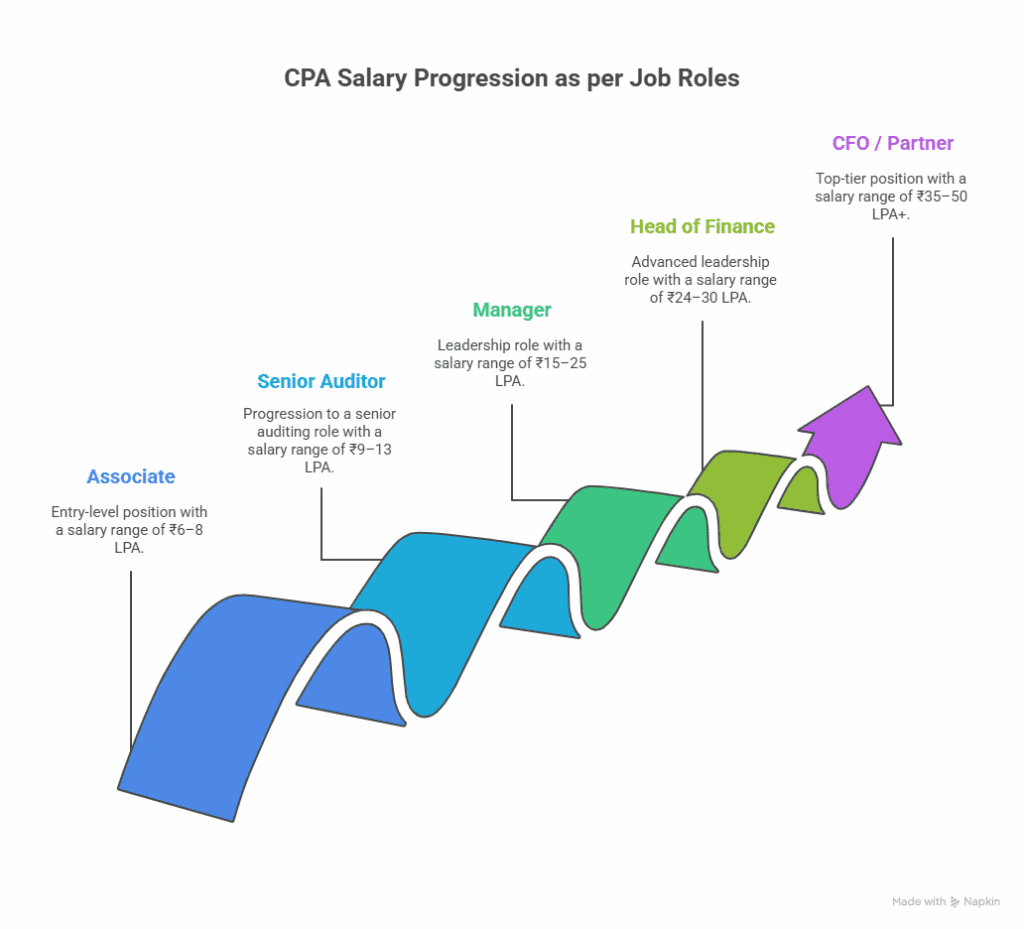
Senior / leadership: ₹20–30 LPA+ – CFOs/Partners in Big firms can go much higher
CPA Salary in India by Experience
If you’re looking at a CPA purely through the lens of salary, here’s the truth: it grows steadily, not suddenly. The good part? It’s a growth you can count on. The market in India rewards CPAs who stay curious, take on complex projects, and continuously adapt to changing global standards.
If you’re worried about whether the CPA pays off – it does, but in the most sustainable way possible. Not overnight, but over time, your salary becomes a reflection of the trust your qualification commands.
Experience Level
Average Annual Salary (INR)
Fresher/Entry-Level (0-1 year)
₹6-9 LPA
Early-Career (2-4 years)
₹6–10 LPA (Total Compensation)
Mid-Career (5-10 years)
₹15–25 LPA
Senior/Experienced (10+ years)
₹24–30 LPA or more (Leadership roles often higher)
The jump between mid and senior – when you take on managerial ownership, client responsibility, or cross-border reporting – can multiply pay by 2x or more. That’s where most CPAs go from “comfortable” to “six-figure in INR” territory.
Salary growth over a CPA’s career
New hires with master’s degrees saw starting salaries increase roughly 17% to a median $67,750 from the previous survey.
You can make a Management jump (within 5→10 yrs): the biggest multiplier when the role expands beyond technical work.
CPA Salary by Industry
Not every CPA earns the same, and that’s because industries value accounting expertise differently. A CPA working in financial consulting or investment management often handles high-stakes decisions – so the compensation reflects that. On the other hand, those in manufacturing or public sector roles might enjoy more stability but at a steadier pay scale.
In India, the industry you choose often decides how fast your CPA qualification starts paying off. Technology, BFSI (Banking, Financial Services & Insurance), and consulting firms tend to offer the most aggressive salary growth, especially if you’re handling cross-border compliance or US GAAP reporting.
But ultimately, each sector brings something different to the table – some offer learning, some offer lifestyle, and a few offer both. The table below breaks down how CPA salaries vary across industries, so you can plan your career not just around your skills, but around where those skills are valued most.
Industry
Average Range
Big-4 / Audit firms
₹6–20 LPA (entry → manager)
MNC Finance / Corporate FP&A
₹8–25 LPA
Consulting / Advisory
₹10–30+ LPA
Tech (product firms)
₹8–22 LPA
Banking / BFSI
₹9–28 LPA
Public sector / NGOs
₹4–10 LPA
CPA Salary by Cities
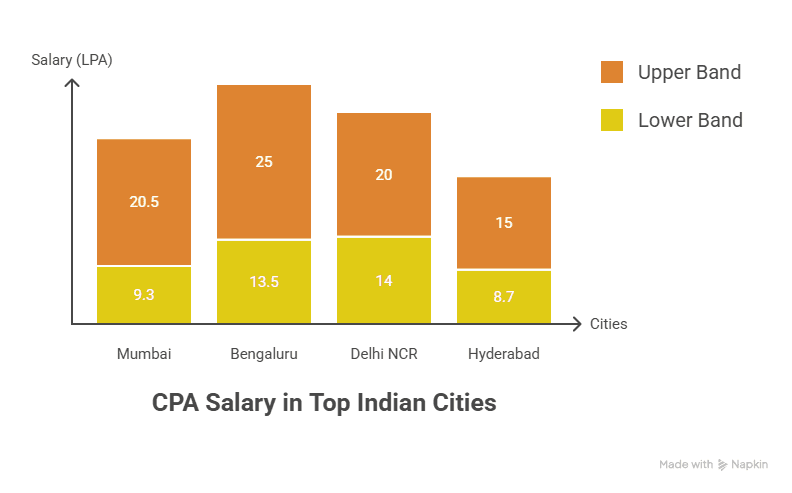
Understanding how CPA salaries vary by city can help you make informed decisions about career opportunities and relocation. Here’s a snapshot of average salaries for Certified Public Accountants (CPAs) in key Indian cities:
Consulting and MNC corporate roles generally pay more because the work requires both technical and commercial acumen; Big-4 gives a strong early-career pay and learning curve, while senior Big-4 partners and ex-partners move to CFO/Controller roles with very high pay.
Key Takeaway→ Metro cities like Mumbai and Bengaluru top the charts due to the concentration of MNCs and finance centres.
Factors Impacting CPA Salary
A CPA’s paycheck doesn’t just depend on clearing the exam; it’s shaped by where you work, what you specialise in, how much experience you’ve gathered, and even how you position yourself in the market.
Two people with the same qualifications can have completely different salary stories. One might be working at a Big 4 firm in Mumbai handling multinational audits, while another could be consulting for startups remotely from Pune – both valid, both valuable, but with very different pay scales.
Understanding these factors early helps you make smarter career choices – from the industry you enter to the city you move to, to the niche you build expertise in.
Top factors:
Experience & Role Scope – early promotion to manager or specialist roles (tax/transfer pricing/forensic) multiplies pay faster than years alone. Mentor tip: Seek role expansions that add client-facing responsibility or people management within 3–5 years.
Industry – consulting/big-4/MNCs pay premiums. Tech companies with finance teams also pay well for US GAAP know-how. Mentor tip:Move laterally to BFSI or tech if you want steep salary growth.
City / Cost-of-doing-business – Mumbai, Bangalore, Delhi & Hyderabad command premiums (10–20%). Mentor tip: If you’re remote and earning from US firms, location is secondary – skill is king.
Skill Specialisation – IFRS conversions, US GAAP, international tax, and forensic accounting attract better pay. Mentor tip:Add a niche certificate (forensic, valuation) to your stack.
Employer Reputation (Big-4 / MNC vs domestic) – Big-4 lifts brand & learning; MNCs may pay more for control roles. Mentor Tip: If you want global mobility or cross-border exposure, Big 4 experience makes you a plug-and-play fit for multinational teams.
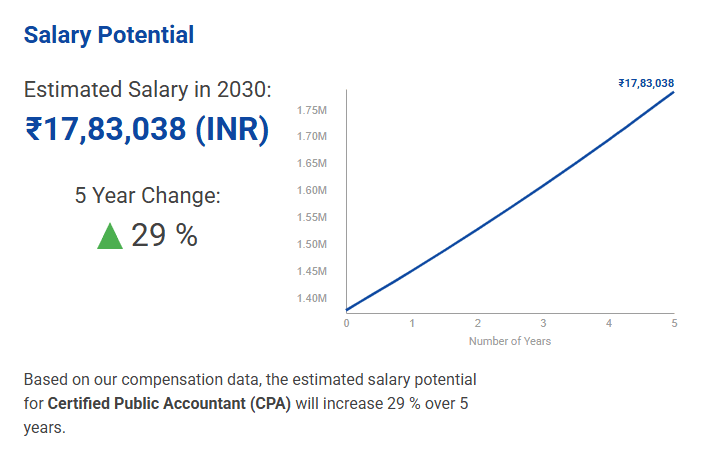
Once you understand what impacts a CPA’s earning power: experience, specialisation, and the trust you build in the market, the growth curve starts to make perfect sense. Below is a projection for the CPA Salary by 2030.
What impacts CPA salary the most?
Specialisation (tax, IFRS, transfer pricing): +20–40% pay uplift.
City: Mumbai/Bengaluru/Delhi pays ~10–20% more.
Scope of Responsibilities: client-facing + managerial = faster increases.
CPA vs CMA vs CA – The Salary and ROI comparison
If you’re trying to decide between the CPA, CMA, and CA certifications, you’re not alone. A lot of people reach this stage and wonder which one will actually help them grow their careers meaningfully.
The CPA is your ticket to global opportunities. It’s respected everywhere and can get you into roles in audit, taxation, or corporate finance that pay really well.
The CMA is more about understanding the business side of numbers, like planning, budgeting, and helping companies make smart financial moves. It’s a great choice if you enjoy strategy and want to grow in corporate roles.
The CA has deep roots in India and still carries huge respect here, especially if you’re interested in audit, tax, or compliance. This comparison highlights the earning potential for each qualification, helping you make an informed career choice.
Differentiator / Feature
CPA
CMA
CA
Global Recognition
✅
✅
❌
Average Global Starting Salary
✅
✅
❌
Mid-Career Salary Growth
✅
✅
✅
Top-Tier Salary Potential (10+ years)
✅
✅
✅
ROI (Cost-to-Earning Ratio)
✅
✅
❌
Duration to Qualify (Shorter)
✅
✅
❌
Recognition by MNCs & Global Firms
✅
✅
❌
Ease of Global Mobility
✅
✅
❌
Alignment with US/IFRS Standards
✅
✅
❌
Demand in Big 4 Firms
✅
✅
✅
CPA Salary Comparison with CA
The comparison below breaks down how salaries differ between CPAs and CAs across experience levels and roles, helping you see where each qualification truly shines – whether your goal is stability at home or a global finance career.
Level
CPA average
CA average
Notes
Entry(0–2 yrs)
6–8
5–6
CPA often edges CA at entry where US-focused roles exist.
Mid(5–10 yrs)
11–14
9–12
CPA shows a premium in MNC roles.
Senior(10+ yrs)
20–35+
15–25
CPA senior managers/CFOs often command global packages.
The “better” path depends on your desired market: if you want early domestic accounting roles in India only, CA is excellent. If you’re targeting MNCs, US reporting, or the US job market, a CPA increases global mobility and may improve salary upside.
Key Takeaway→ CPA offers global portability and often higher pay in MNC roles; CA is excellent for India-specific tax/audit depth. Choose based on target geography & role.
CPA Salaries In India vs the USA
If you benchmark against the US, the nominal numbers differ hugely due to currency and living costs.
Headline numbers:
US average CPA salary: ~$80k–120k+ depending on source and role.
What that means for India-based CPAs working for US firms: If you secure a remote role paid in USD, your INR salary (after conversion) can look dramatically higher – but remember taxation and benefits differ.
This video walks you through pay scales shift between India, the US, and other major markets – and what really drives those differences beyond just currency. It’s a quick, insightful watch that brings the numbers to life.
Executive CPA Salary in India and the US
When CPAs step into top executive roles, the pay gap between India and the US really starts to show – and it’s not just about the currency difference. It’s about the scale of work, the level of responsibility, and how each market values senior finance professionals.
In India, executive-level CPAs earn well above the average mid- or senior-level salary, especially if they’re working with multinational companies or global consulting firms. In the US, those same roles come with even higher compensation – not only because of the cost of living, but because these positions often shape major business and financial strategies.
The table below gives you a clearer picture of what executive CPAs typically earn in both countries. It’s not just about comparing numbers – it’s about understanding what drives those differences: experience, industry, and the size of the company you work for all play a big part in how far your CPA can take you.
Starting as a CPA, your salary reflects not just your qualification, but also the market you’re stepping into. In India, fresh CPAs earn a good starting pay that grows as they gain experience and take on bigger responsibilities. In the US, starting salaries are generally higher, thanks to the larger scale and cost of living differences.
The table below gives a quick snapshot of what is the CPA salary typically in India and the US. It’s a handy way to get a sense of what to expect as you begin your career and start planning your next steps.
Country
Experience Level
Average Annual Salary
India
Fresher/Entry-Level
₹6–8.5 LPA
India
Fresher/Entry-Level (Metro Cities)
Up to ₹13.8 LPA
US
Fresher/Entry-Level
$55,000–75,000
Average CPA Salary by Country
CPA salaries can be very different depending on where you are in the world. A lot of that comes down to the economy, industry demand, and the cost of living. In India, CPAs get a strong start and plenty of room to grow. But in places like the US, Canada, or Australia, salaries are usually higher, and the work often comes with more international exposure.
The table below gives you an easy snapshot of average CPA salaries by country. It’s a good way to see not just the numbers, but also the kinds of opportunities your qualification could open up for you.
Country
Average Annual Salary
United States of America (USA)
$90,000–99,000
Australia
$113,035
Canada
$100,291
India
₹9,12,663
Japan
¥7,755,349
United Arab Emirates (UAE)
AED 180,000
Ireland
€50,000
Understanding How CPA Salary Increases Over Time
Your CPA license is the key, but how fast you unlock its full earning potential depends on the moves you make. From choosing the right industry and city to specialising in high-demand niches, small tactical decisions can multiply your pay faster than just waiting for yearly increments.
In this section, we’ll share some approaches that can help you understand how can your CPA salaries grow over time, with smarter choices that translate directly into higher compensation and career growth.
Build a niche: Master one high-demand niche (transfer pricing, international tax, forensic). Market it on LinkedIn and include niche keywords.
Ask for higher-responsibility projects: Volunteer for cross-border reporting or client-facing tasks – responsibility beats tenure.
Get secondment experience: Temporary placements in MNC finance teams or overseas secondments boost pay and resume.
Consider lateral moves: Moving companies often yield higher jumps than annual increments.
Upskill with tech: SQL, Power BI, or automation tools increase bargaining power.
FAQs about CPA Salary
If you’ve made it this far, you probably still have a few questions buzzing in your head about CPA salary – how it grows, what affects it, and whether it’s really worth the effort. This section clears up the most common questions students and professionals ask about CPA salaries.
Who earns more, CA or CPA?
Both credentials are valuable. Generally, a CPA working in MNCs or roles requiring US GAAP/IFRS knowledge can earn a higher CPA salary in global-facing roles, whereas a CA may have stronger domestic opportunities in Indian tax and statutory audit. By seniority (10+ yrs), many CPAs who move into leadership roles or global finance positions will often see higher compensation than their CA counterparts, but individual outcomes depend on role, industry, and negotiation.
What is the highest CPA salary?
The top CPA salary varies widely. In India, senior CPAs who reach the C-suite (CFO, Finance Head, etc.) or become partners in large firms can earn ₹40–50 LPA and beyond, while global packages for senior finance executives can be higher. In the US, senior CPAs in finance leadership roles often average well into six figures (USD), and specialised roles or Big-4 partners report significantly higher pay.
Is CPA better than an MBA?
Better” depends on goals. A CPA is specialised, technical, and highly valued for accounting/audit/tax work; an MBA is generalist, leadership- and strategy-focused. If you want deep finance & reporting expertise and technical credibility, a CPA can be a higher ROI. If you want broad business leadership and a strong management network, an MBA might be the way to go. Some professionals do both to maximise skills and pay.
Am I eligible for CPA?
Your eligibility depends on the various state boards and the specific requirements (e.g. education credits, residency). Most candidates require 120–150 credit hours with accounting and business subjects. Check the AICPA/state board guidance for your exact pathway.
Is CPA a good career option?
Yes. CPAs are in global demand as the designation signals competence and opens doors in audit, tax, corporate finance, and advisory. In India, as businesses find their global footing, the demand for CPAs with international reporting skills will continue to grow.
Is CPA in demand in India?
Yes, CPA is very much in demand in India, particularly among MNCs, US-facing finance teams, consulting firms, and companies doing cross-border reporting. The demand is strongest in major finance hubs like Mumbai and Bengaluru.
Is CPA more difficult than CA?
Both are challenging but different. CA tests India-specific tax, law and audit frameworks extensively. CPA focuses on US exam content and state credentialing rules; difficulty depends on background, study approach, and exam readiness. Many Indian candidates find the CPA exam manageable with structured prep because it’s modular and exam-focused.
What is the fees of CPA course in India?
Fees usually vary: application stages like exam registration, board fees, and coaching combined fall in the range of ₹2–4 lakhs, depending on the coaching provider and your selected state board. Always check the latest fee schedules from the state board and coaching providers.
Which companies hire CPA in India?
Common employers include Big-4 firms, MNCs (Amazon, IBM, JP Morgan), tech product companies, consultancies, and banks, essentially any firm with international reporting or US filing requirements.
Your Next Steps
The true value of the CPA isn’t just in the paychecks – it’s in the kind of professional you become along the way. Salary is a milestone, not the destination. What the CPA does is refine how you think about money, business, and trust. It turns you from someone who records numbers into someone who interprets them – who helps companies make decisions that ripple through balance sheets, markets, and lives.
It’s a credential that demands discipline, but it also builds perspective. A CPA learns early that growth doesn’t come from chasing higher salaries alone, but from earning influence – the ability to walk into a boardroom and be trusted with financial truths. Some CPAs climb fast in multinational firms; others carve their niche in startups or consulting. But across every path, the thread remains the same: the ones who keep learning, keep rising.
Think of it like compounding interest – small, consistent efforts in learning, networking, and specialisation quietly multiply into exponential career returns. Your CPA license is the principal; how you invest it defines your yield.
If you’re ready to take that step – to not just earn more, but become more – the CPA Program in collaboration with KPMG in India offers the structure, mentorship, and global credibility to help you get there. With a money-back guarantee if you don’t clear your exams, live and on-demand sessions that adapt to your schedule, and projects that make you apply what you learn, it’s built for professionals who are serious about building a global finance career.
Because careers don’t just happen; they’re built with intention, skill, and the right guidance.
Chasing the CPA certification? You’re not just adding letters after your name – you’re stepping into a world where your financial expertise drives smarter decisions and defines leadership.
But before you dive in, one question probably stands out – What is the CPA eligibility, and am I qualified to apply? If that’s what you’re wondering, you’re not alone – every CPA journey begins exactly there.
Becoming a Certified Public Accountant (CPA) means positioning yourself as a trusted global finance leader – someone who doesn’t just crunch numbers but shapes business strategy and advises top organisations. For anyone serious about rising in the finance world, ready to go global, the CPA is a badge of credibility and mastery. It sets you apart, opens global opportunities, and changes not just where you work but how you work.
This guide simplifies everything you need to know:
What education do you need? How does your work experience count? The step-by-step application process And how Indian students and professionals can meet the CPA eligibility requirements smoothly.
🎫Think of CPA eligibility as your boarding pass. It tells that you’re qualified to take the CPA exam without unexpected hurdles.
What is CPA?
If you’ve ever wondered what is CPA and what it truly means to be a Certified Public Accountant. You can think of it as an elite designation of global finance professionals trusted to keep businesses financially sound and strategically sharp.
The CPA certification is awarded and governed by the American Institute of Certified Public Accountants (AICPA). It is considered the gold standard in accounting and finance. It’s not just another certification – it’s proof that you understand the language of business at the highest level.
As a CPA, you’re not limited to audit and tax roles. You’re a strategic advisor, helping organisations make smarter financial decisions, ensure compliance, and plan for long-term growth. From global firms like Deloitte and EY to Fortune 500 companies, CPAs are at the heart of every major financial conversation.
In simple terms, if you’re someone who loves numbers but wants to go beyond them – to influence business outcomes, shape financial policies, and lead teams across borders – the CPA course is your passport to a global accounting career.
CPA Eligibility Requirements: Your Golden Ticket to Certification
Before you begin with your CPA journey, it’s important to know what CPA eligibility really means. Simply put, it’s the set of educational and professional requirements you need to meet before you can sit for the CPA exam or earn your license.
Think of it as your starting checklist – ensuring you have the right academic foundation, relevant work experience, and necessary documentation before you leap.
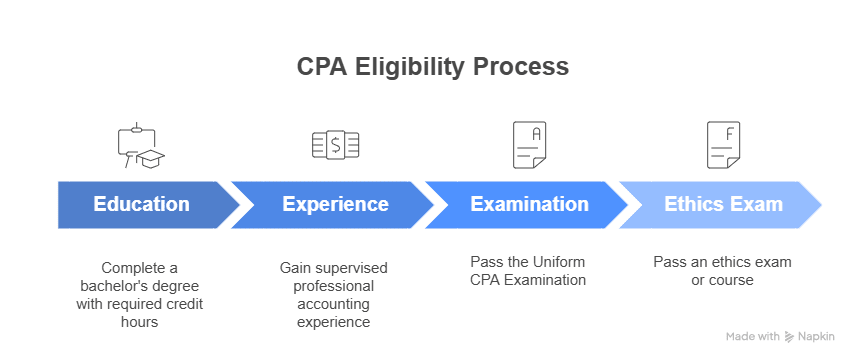
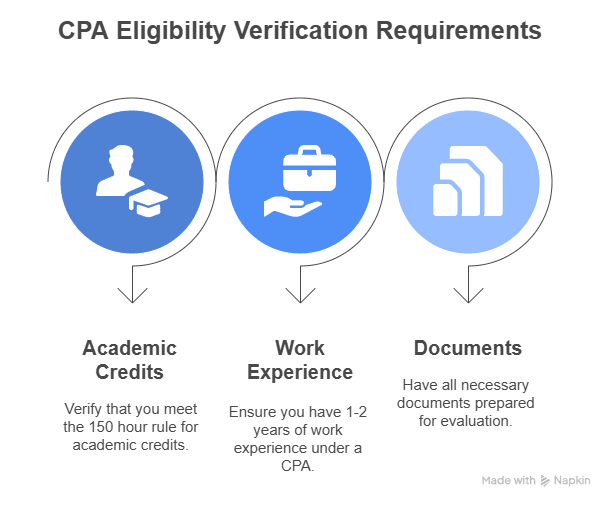
While the exact CPA eligibility criteria can vary depending on the state board you apply through, the essentials remain the same everywhere:
Education: A recognised bachelor’s degree in accounting, finance, or a related field
Credit Hours: A certain number of credit hours (usually 150) in accounting and business subjects
Experience: And in some cases, a few years of verified professional experience under a licensed CPA.
Meeting these CPA qualifications is your first step toward unlocking worldwide opportunities in finance.
Why Work Experience Matters?
Think of it like learning to drive. You can read the traffic rules and watch “how to drive” videos all day – that’s your theory. The instructor is right there beside you – guiding your hands on the wheel, helping you understand what to do in real situations, pointing out where you can improve, and building your confidence one drive at a time. Only after that real practice can you go and take the driving test to earn your license.
The CPA works the same way. You don’t just study and pass exams – you need real, hands-on work experience under a licensed CPA. This ensures you’re not just good at theory, but confident in handling real financial decisions in the workplace.
A Quick Analogy for Credit Hours
Think of the CPA credit hour requirement like training for a marathon. Your bachelor’s degree has already given you that solid foundation – just like being reasonably fit before you start serious training. But to be fully race-ready, you need some focused preparation. In this case, it means taking a few extra accounting and business courses.
Just like those last training runs help you cross the finish line, those additional credits make sure you’re fully prepared and eligible to take the CPA exam.
Core CPA Eligibility Criteria: A Detailed Look
Here’s a quick look at the core eligibility requirements most CPA candidates must meet:
Education
You’ll typically need 150 semester hours of education. This is usually around a bachelor’s degree plus additional coursework.
Most candidates meet this through a B.Com + M.Com, B.Com + MBA, or a CA/CMA qualification from India.
Your degree should include 24-30 semester hours of accounting and business-related subjects.
Experience
Some U.S. states also require 1-2 years of supervised professional experience under a licensed CPA.
This ensures you have real-world accounting exposure alongside academic knowledge in areas like public accounting, government, or industry, involving financial analysis, auditing, tax, or management accounting.
Examination All candidates must clear the Uniform CPA Examination, which consists of four sections:
Auditing and Attestation (AUD)
Financial Accounting and Reporting (FAR)
Regulation (REG)
Discipline Section: This is a choice-based specialisation, allowing you to focus on your career path – Business Analysis and Reporting (BAR), Information Systems and Controls (ISC), or Tax Compliance and Planning (TCP).
Ethics Exam (in select states)
A few jurisdictions also require an ethics exam or course to confirm your understanding of professional integrity and ethical practice.
US CPA Eligibility for Indian Students: What You Need to Know
Coming from India, you have some unique considerations, but rest assured, thousands of Indian candidates are in the same boat – and they’re sailing through just fine.
Here’s what usually happens for Indian students pursuing CPA:
Degree Equivalence: Your Indian degree – be it B.Com, MBA, CA, or CMA – can meet the educational requirements. However, depending on the U.S. state, you might need to add extra credit hours through coursework or certifications to reach the 150-semester-hour mark. Many Indian students pursue a Master of Commerce (M.Com) or a Chartered Accountancy (CA) qualification to fulfil this.
Credential Evaluation: You’ll need to get your academic credentials evaluated by an authorised agency (e.g., NASBA International Evaluation Services, WES) to verify their equivalence to U.S. standards. This step is routine and supported by most states to which Indian candidates apply.
Examination Centres in India: Great news: you can take the CPA exams right here in India at approved testing centres (such as Prometric Centres). No need for an expensive trip abroad, unless you want to!
Experience for Licensure: For licensing, you’ll need relevant experience – usually one to two years – under the supervision of a licensed CPA. This experience can be tracked alongside your studies or even after passing your exams, often from India.
📍Flexible Exam Centres:
Picture booking a movie ticket at your local theatre instead of having to travel to another city. CPA exams can be taken at approved centres in India, so you don’t have to fly halfway across the world – making the whole eligibility and exam process much more convenient.
Step-by-Step CPA Application Explained
Getting started is often the hardest part, so here’s a simple checklist you can follow for your CPA application process:
Verify Your Eligibility – Check if your education background and experience align with your target state’s requirements.
Submit Your Application – Apply through the state board and submit your academic transcripts and credential evaluations.
Get your Authorisation to Test – Once approved, you’ll receive an Authorisation to Test (ATT) so you can schedule exams.
Prepare for and pass the Exams – Pass all four exam parts within 18 months with the use of study guides, coaching, and practice tests.
Complete Required Experience – Fulfil your supervised work experience as per state requirements.
Apply for the CPA License – After exams and experience, apply for licensure and start your global career as a CPA.
This process looks daunting on paper, but breaking it down like this reveals it’s totally doable.
Note– Missing or misinterpreting even one requirement can delay your progress significantly – something no one wants after putting in hours of hard work and exam preparation.
CPA Exam Pattern & Modules 2025: What to Expect
Let’s talk about the CPA exam- and no, it’s not a daunting test. It is a well-designed challenge that really puts your skills to work in scenarios you’ll face in the real world. After all, the CPA isn’t about memorising endless rules; it’s about proving you know how to apply them when the stakes are high.
CPA 2025 Exam Structure
The CPA 2025 exam structure tests how well you can apply accounting and business concepts in real-world scenarios – not just how much you can memorise.
Category
Details
Exam Format (2025)
3 Core sections (mandatory for all) + 1 Discipline section (choose based on your career path).
Exam Duration
Each section lasts 4 hours, giving you enough time to showcase your knowledge and judgment.
Passing Score
You need a minimum score of 75 on each section.
Exam Window
You must pass all four sections within an 18-month rolling period.
Question Types
Multiple-Choice Questions (MCQs) and Task-Based Simulations (TBSs) that mimic real-world scenarios.
For a comprehensive guide on the most challenging CPA exam section and strategies to conquer it, explore this detailed blog post on the hardest CPA exam section.
The CPA Exam modules are listed below:
Section
Focus Area
What It Covers
Auditing and Attestation (AUD)
Auditing, Risk & Ethics
Audit procedures, Reviewing Financial Records, Assessing Risks, Ensuring Internal Controls are strong, and Professional Ethics.
Financial Accounting and Reporting (FAR)
Financial Reporting
Preparing and Interpreting Financial Statements under frameworks like US GAAP and IFRS.
Regulation (REG)
Taxation & Compliance
Tax Laws, Business Regulations, and Professional Ethics.
Discipline Section
Specialisation
Business Analysis and Reporting (BAR): Financial reporting, analysis, and technical accounting. Information Systems and Controls (ISC): IT governance, security, and internal controls. Tax Compliance and Planning (TCP): Advanced tax planning and compliance.
What’s interesting is that the exam blends traditional multiple-choice questions with task-based simulations. These simulations throw real-life scenarios your way – you’ll be analysing data, making calls, and writing up communications just like you would on the job.
If you’re serious about laying a strong foundation for your accounting career, this blog can help you ace your CPA exam preparation and achieve career readiness in just 12-18 months.
Why Getting CPA Eligibility Right Matters
When you earn your CPA license, it isn’t just a career milestone; it is a transformation. You won’t be seen as someone who knows only accounting; you will be a trusted financial advisor whose insights drive growth and shape strategy.
If you’re serious about making the CPA certification your next big career milestone, understanding your eligibility isn’t just a formality – it’s absolutely critical. Getting this step right up front sets the entire stage for your success and ensures your CPA journey is smooth and focused.
So take a moment. Verify your academic credits. Check your work experience records. Get those documents in order. Because this isn’t just preparation – it’s your first smart move toward a career where you’re recognised not just for what you know, but for the impact you create.
Discover the earning potential of a US CPA in India and abroad, as this video reveals the top career paths, salaries, and global opportunities available to CPA-qualified professionals.
CPA Eligibility vs CA, ACCA & CFA – Quick Comparison
Choosing the right professional qualification starts with understanding who can apply. Here’s a quick eligibility comparison for top global certifications:
Criteria
CPA (US)
CA (India)
ACCA
CFA
Minimum Qualification
✅ Bachelor’s Degree
✅ 10+2
✅ 10+2
✅ Bachelor’s / Final Year
Commerce Background Needed
❌
✅ Useful
❌
❌
Extra Credit Requirement
✅ 150 Credits (Bridge Possible)
❌
❌
❌
Work Experience Before Exam
❌
❌
❌
✅ Required for Charter
Global Recognition
✅ Very High
❌ Limited
✅ Good
✅ High
CPA stands out because its eligibility is straightforward, globally recognised, and flexible for both students and working professionals.
Is CPA worth it?
Absolutely – and not just on paper. But beyond the numbers and requirements, what truly matters is how the CPA can change your career journey in real life.
As a B.Com graduate in India, who always dreamed of working in a global finance environment but felt unsure where to begin. Once you have learned all that was needed with a few additional accounting credits, a credential evaluation, and the right guidance, the path suddenly becomes much clearer.
You can work as an Audit Associate at a leading Big Four firm. The CPA doesn’t just upgrade your qualification – it expands your opportunities, confidence, and career direction.
Why Choose Imarticus for Your CPA Journey
I’ve seen how daunting this whole process can be, and that’s where Imarticus Learning steps in. They don’t just teach CPA content; they guide you through eligibility, application, and exam preparation with care and expertise. Join Imarticus Learning’s CPA program to fast-track your journey with:
Expert instructors who know the CPA rules inside and out.
Flexible study options that suit your pace.
Tailored support for Indian students navigating the US CPA system.
High-quality study materials with premium access and mock exams to build confidence.
If you’re unsure where to start, guided coaching can make the process clearer.
Imarticus Learning helps learners understand eligibility, complete evaluations, prepare for exams, and build confidence with mentor-led support.
Key Takeaways
✅CPA eligibility means meeting education (bachelor’s + credits), experience (1-2 years supervised), and exam requirements specific to your jurisdiction.
✅Indian degrees such as B.Com, M.Com, MBA Finance, CA, or CMA can fulfil educational criteria, but be ready for variations state-by-state.
✅CPA is accessible with the right guidance and preparation, even if you’re not a CA or don’t have an accounting background.
✅With focused effort, clearing the CPA in 1 year is achievable.
Discover how you can transition from CPA to CFO with expert guidance, real-world learning, and the essential leadership skills to excel at the top of your finance career.
FAQs on CPA Eligibility
If you’re thinking about the CPA eligibility, you probably might have a few more questions buzzing in your head. Here are a few frequently asked questions to clear things up about CPA eligibility.
Who is eligible for CPA?
Anyone with a recognised bachelor’s degree (or equivalent) with around 120-150 semester credit hours in accounting and business-related subjects is eligible for CPA. Most US states also expect 1-2 years of professional experience under a licensed CPA before granting your license.
If you’ve done a B.Com, M.Com, MBA (Finance), or hold professional qualifications like CA or CMA, you’re already on the right track – though the exact requirements vary by state.
Can I do CPA directly after 12th?
Not yet – you can’t jump into the CPA right after Class 12. You’ll first need to complete your bachelor’s degree with the required accounting credits.
Some states may allow you to sit for the exam in your final year, but you must finish your degree before applying for the license.
Is CPA harder than CA?
CPA and CA have different focuses and difficulty levels; CA is intensive in Indian tax laws, audit, and accounting, renowned for its low pass rates. CPA is rigorous with a global outlook, emphasising U.S. GAAP, auditing, and regulations, but is often seen as more accessible with structured preparation. Which is “harder” depends on your background and exam preparation approach.
Can I become a CPA without being a CA?
Absolutely! You don’t need to be a CA to become a CPA. As long as you meet the education, exam, and experience criteria set by your state board, you’re eligible – no prior certification required. Imarticus Learning guides students through the evaluation and state selection process so you can choose the right state board based on your educational background.
What is the minimum educational requirement to be eligible for the CPA exam in the US?
Most U.S. states require candidates to have 150 semester hours of education. This typically means a bachelor’s degree (around 120 hours) plus an additional 30 semester hours of coursework in accounting and business-related subjects.
Can Indian students take the CPA exam?
Yes, Indian students are eligible to take the CPA exam. They must meet the educational requirements – usually 150 semester hours, which is often achieved through a combination of Indian degrees like B.Com + M.Com, B.Com + CA, or B.Com + MBA and have their academic credentials evaluated by an authorised agency for U.S. equivalency.
Is an M.Com or CA qualification sufficient for CPA eligibility?
Yes, B.Com + M.Com, B.Com + CA, or B.Com + MBA typically help meet the 150-hour requirement.
However, it’s smart to get your credits pre-checked. Imarticus Learning helps you assess whether your degree combination meets the credit hour and subject-specific criteria for your target CPA state board.
Your CPA Eligibility: The First Step Toward Global Success
Getting your CPA eligibility sorted is more than just a requirement – it’s your entry pass to a global finance career. The CPA isn’t just about knowing numbers. It’s the ability to think like a leader, making strategic decisions, and becoming the professional companies trust at the highest level.
And the best part?
With the right guidance, the journey is absolutely achievable. You don’t require a commerce background or years of experience to begin your CPA certification journey. Take that first small step with clarity, a simple plan, and confidence.
So take a moment – check where you stand, see what’s required, and start at your own pace.
You’re closer than you think. Your future as a globally recognised CPA is waiting.
You’ve completed your commerce degree. You’ve spent late nights balancing ledgers, deciphering financial statements and trying to imagine what your career could really become. Now you’re asking the big question: What comes next?
For many ambitious finance professionals in India, the answer lies in taking the leap from good to global, and that’s precisely where the Certified Public Accountant (CPA) credential shows its edge. Before diving into the CPA course details, let’s answer the question every aspirant asks – how long does it actually take? But one thing stands between you and that global career: What’s the realistic CPA course duration?
Here’s the truth: the CPA journey can be completed in 12 to 18 months for most motivated candidates – yes, you can go from working in Indian finance to holding a globally recognised qualification within a year to a year and a half. But “12 to 18 months” only scratches the surface. What it doesn’t capture is the preparation time, the exam windows, the eligibility steps, the state board filings and the strategy involved.
In this guide, we’ll walk you through every part of that timeline: what the CPA course duration really means in India, how you should plan your months and milestones, how the exam structure is designed, and how you can integrate the process with your current job or studies. At Imarticus Learning, we’ve helped countless candidates accelerate this path – we’re here to help you too.
So let’s unpack your roadmap to global accounting recognition – starting now.
The Certified Public Accountant, or CPA, isn’t just another accounting credential you add to your resume – it’s a genuine passport to the world of global finance. Recognised not only in the US but across more than 130 countries, the CPA opens up doors to exciting international roles, leadership positions, and a level of professional trust that really makes employers notice you.
But what exactly does the CPA course prepare you for? Well, it’s designed for people who want to go beyond just crunching numbers. It helps you build the skills to interpret complex financial data, analyse reports, and lead in areas like auditing, taxation, and strategic financial management – all the critical elements businesses rely on to grow and stay compliant.
Put simply, being a CPA means you’re not just someone who deals with accounts. You’re a trusted financial advisor whom companies look to for ethical judgment, clear insights, and expertise that spans across borders.
The course itself is governed by the American Institute of Certified Public Accountants (AICPA), and to earn the CPA title, you’ll need to tick three important boxes: meet educational and eligibility requirements, pass four challenging exam sections, and complete experience requirements set by a U.S. state board.
For Indian students and working professionals, this means gaining a qualification that’s respected worldwide, especially by multinational corporations, the Big 4 firms, and top consulting companies.
And here’s the best part – you can get your CPA certification in as little as 12 to 18 months. That’s a lot faster than many other international finance qualifications. No wonder more and more finance grads and professionals in India are choosing CPA as their fast-track ticket to exciting, global finance careers.
Did you know? The US CPA course duration is one of the shortest among global accounting qualifications, making it an ideal next step for ambitious finance professionals.
Why Pursue the CPA in 2025?
The world of finance isn’t what it used to be. Technology is transforming how things get done – automation is taking over routine accounting tasks, and companies are spreading their wings far beyond borders. In this fast-changing landscape, financial leaders aren’t just number crunchers anymore; they’re expected to think big, strategise, and guide businesses through complexity.
That’s exactly why 2025 feels like the perfect moment to consider the CPA course.
Because the CPA is more than just a certificate. It’s a signal to employers that you’ve got the smarts, the ethics, and the sharp analytical skills to tackle the toughest global finance challenges.
As Indian companies and multinationals race to find talent who know both local rules and international standards, CPA professionals are stepping into the spotlight – taking on roles where they’re not just needed, but actively sought after.
Already a CPA and wondering what’s next? Watch this video to learn how to chart your path from CPA to CFO – mastering the leadership, strategy, and executive skills that define top finance leaders.
What Makes the CPA Unique in 2025?
First off, global recognition. The CPA isn’t just respected in the US – it’s accepted across Canada, Australia, the Middle East, and much of Asia too. In other words, it gives you the freedom to move and work almost anywhere on the planet.
Then there’s the career boost. CPAs are among the top picks for roles in auditing, financial analysis, consulting, taxation, and leadership. Whether it’s with the Big 4 accounting giants or Fortune 500 companies, a CPA credential puts you right in the running.
Now, let’s talk about money. CPA professionals typically earn 30-40% more than their non-certified peers, and it’s easy to see why. In roles like Finance Controller, Audit Manager, or those on the fast track to becoming CFOs, their expertise and global credibility make all the difference.
How about time? Unlike other international accounting courses that can drag on for 3 to 4 years, you can finish your CPA in just 12 to 18 months. That makes it one of the fastest and smartest routes to a globally respected qualification.
And don’t forget job security. With constantly evolving regulations and the rising focus on ESG and cross-border taxation, companies are eager to hire professionals who really know their stuff – like CPAs with US GAAP and IFRS expertise.
Simply put, the CPA is your ticket to moving beyond just balancing the books. It puts you in a position to influence the business, make strategic decisions, and lead with confidence.
Wondering how long it really takes to complete the CPA course in India? On average, most candidates wrap it up in about 12 to 18 months, depending on their pace, work commitments, and study strategy.
CPA Course Duration – A Realistic Breakdown
Let’s be real – one of the very first questions on every CPA aspirant’s mind is, “How long is this going to take?” After all, it’s a big commitment, and you want to plan your life accordingly.
The answer? For most people, it takes somewhere between 12 to 18 months to go from being an accounting graduate in India to holding that globally recognised CPA credential. That’s right – in about a year, you could be certified and ready to take on the world.
But here’s the real thing – the timeline can look different for everyone. It’s not just about passing the exams; there’s a whole process behind the scenes. You have to tick off eligibility checks, meet licensing requirements, and balance studying with life and work.
But the timeline can look a little different for everyone. Let’s unpack what really goes into it.
How Long Does It Take to Become a CPA
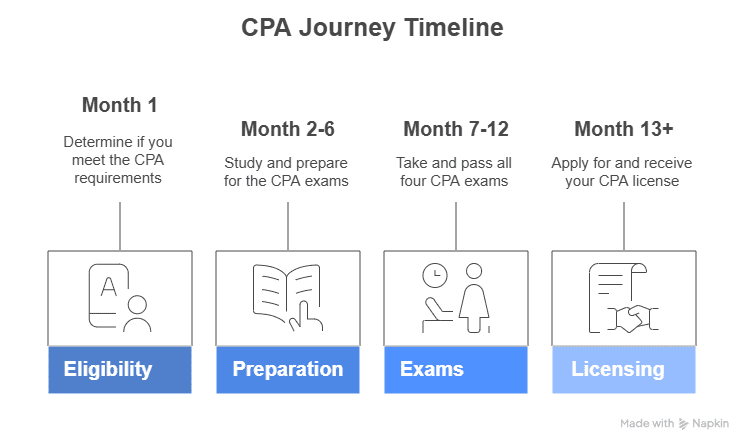
Completing the CPA isn’t just about passing exams – it’s about ticking every box, from eligibility to licensing. This breakdown gives a practical overview of the CPA course duration in months, helping you plan your preparation realistically.
Stage
Duration
What Happens Here
Eligibility Evaluation
1-2 months
Your academic transcripts are verified, and your state board is selected.
Exam Preparation
6-9 months
You study for all four sections – one at a time or back-to-back, depending on your schedule.
Exam Completion
3-6 months
You appear for each of the four CPA exams.
Result & Licensing
1-2 months
Results, work-experience validation, and the final licensing step.
If you’re planning your CPA course timeline in India, most candidates finish all four sections within 6 to 18 months – depending on work schedules and study pace.
Interesting Fact – Many learners complete the entire process in under a year with structured study plans and mentorship, proof that efficiency is all about the right guidance.
CPA Exam Duration: The Hours That Matter
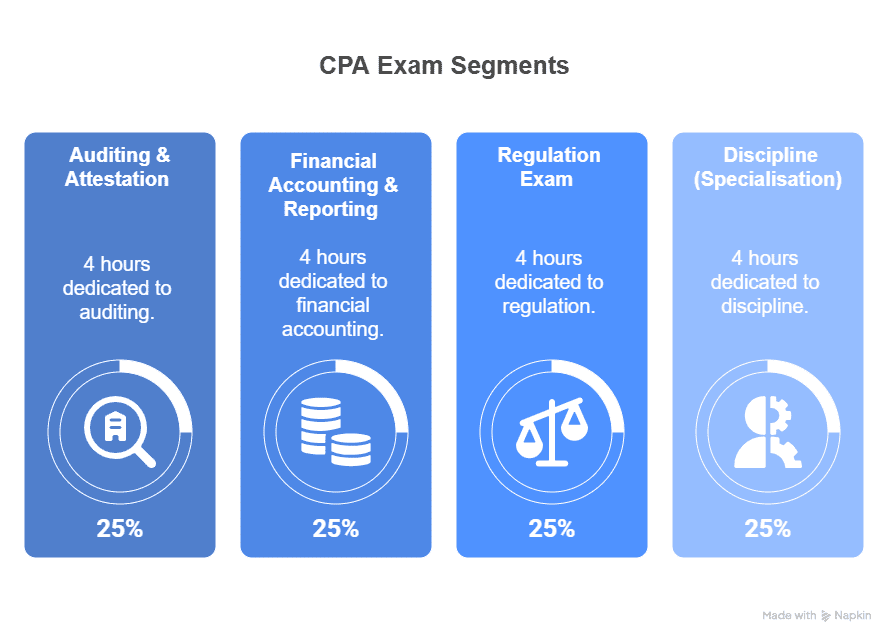
Each CPA exam section runs for 4 hours, covering the four core pillars of global accounting.
Section
Type
Duration
What You’ll Learn
Auditing & Attestation (AUD)
Core
4 hours
Learn auditing standards, internal controls, ethics, and professional responsibilities – the backbone of every CPA’s credibility.
Financial Accounting & Reporting (FAR)
Core
4 hours
Master U.S. GAAP, financial statements, and reporting frameworks that form the foundation of global accounting practices.
Regulation (REG)
Core
4 hours
Build a solid understanding of U.S. taxation, business law, and professional ethics – essential for compliance and advisory roles.
Discipline Section (BAR / ISC / TCP)
Specialisation
4 hours
Choose your area of expertise – Business Analysis & Reporting (BAR), Information Systems & Controls (ISC), or Tax Compliance & Planning (TCP) – introduced in 2025 to reflect evolving industry needs.
Total exam time: 16 hours – but it’s the preparation that counts.
You can find a detailed breakdown of each exam module in the ‘Uniform CPA Examination Blueprints’ published and approved by the AICPA Board of Examiners.
The good news?
There’s no fixed exam window anymore, so you can schedule each test when you’re ready – no waiting around for months.
CPA Study Duration: How Much Time You’ll Need
Your study timeline depends entirely on your lifestyle. A full-time student might breeze through faster than a working professional juggling deadlines and weekend study sessions.
Study Style
Weekly Hours
Typical Duration
Full-time focus
25-30 hrs/week
8-10 months
Working professional
12-15 hrs/week
10-12 months
Weekend learners
8-10 hrs/week
12-14 months
Depending on your pace, you can wrap up all four sections in 6 to 12 months – that’s the typical CPA course duration in months for most candidates aiming to complete their exams efficiently.
Looking for trusted study materials? Explore our curated list of must-read CPA books to enhance your exam preparation.
If you are wondering whether you can pursue a CPA while working? The answer is absolutely yes. In fact, many professionals do.
Since exams are offered throughout the year, you can easily pace your preparation alongside your job. With the right strategy and guidance, most working professionals complete their CPA within 12-18 months, balancing learning with experience.
Fact: For working professionals, the CPA course duration typically extends to 14-18 months with part-time study.
Career Transformation Through CPA
If you’ve ever wondered how a professional qualification can truly change the course of your life, the CPA journey offers some inspiring examples across different backgrounds.
BCom Graduate Pathway
If you are fresh out of a commerce degree, wide-eyed and eager to make your mark, the path ahead can feel vast and a bit overwhelming. You hear about the CPA – a global credential that could turn local dreams into worldwide opportunities. With a little guidance, you can dive into the eligibility process, sorting through transcripts and choosing a state board.
The initial months usually go between preparation and paperwork, but steady effort pays off.
By dedicating just 12-15 hours a week, you can confidently tackle each CPA exam section – one step at a time.
And before you know it, within a year, that distant goal will become your reality: you’ll be a globally certified accountant, ready to take on roles at Big 4 firms or leading multinational companies.
The CPA isn’t just a qualification – it’s proof of your dedication, resilience, and the journey you took to get there.
CA Pathway
Now picture yourself as a mid-career professional, already qualified as a CA, with years clocked in Indian finance firms but craving that global edge. The eligibility check is a breeze – your background aligns perfectly. Juggling a demanding job, you carve out time over weekends and evenings, pacing your study smartly.
With a mentor’s encouragement and a clear plan, you clear the exams section by section over the next 10 months.
When that CPA license lands in your hands around month 14, it unlocks new doors – international assignments, cross-border taxation roles, and leadership tracks.
The CPA becomes the smart boost that complements your existing expertise and propels you onto the global stage.
Working Professional Pathway
Imagine a working professional, managing a full-time job and family commitments, who wonders if a CPA is even possible. With determination, they craft a part-time study schedule stretching across 15 months. Progress is steady – no rush, no burnout. They lean on structured courses and mentorship, celebrating small wins with each passed section.
In the end, this balance between persistence and planning pays off.
The CPA credential boosts their profile at work, leading to promotions and new responsibilities.
The journey proves that even with a busy life, ambition backed by a smart strategy can transform careers.
Before you plan your study calendar or look into the CPA course duration, it’s crucial to check your CPA course eligibility.
Thinking about becoming a US CPA? Watch this video to explore real US CPA salary insights and top career roles across India and abroad, and see why it’s one of the most rewarding finance qualifications worldwide.
CPA Eligibility Criteria – Who Can Apply?
Before you plan your study calendar or look into the CPA course duration, there’s one important question to answer: Are you eligible for the CPA exam? Here’s your guide to CPA eligibility.
The Certified Public Accountant (CPA) credential is regulated by the U.S. state boards, each with its own eligibility requirements. While that may sound complicated, it really comes down to one thing – having the right educational background in accounting and business.
If you’re based in India, here’s how it works:
BCom + MCom holders meet the 150-credit rule.
CA, CMA, or CS professionals are also eligible in most states.
BCom graduates may need to complete a postgraduate program or additional coursework.
Each US state board has its own criteria, so the team at Imarticus Learning helps you choose the one that best fits your academic profile. That way, you can focus on studying – not on paperwork.
Want to see the CPA journey in action? Watch this short video where our mentors walk through the realistic steps you’ll take in becoming a CPA.
How Imarticus Learning Helps You Ace It
At Imarticus Learning, we don’t just help you prepare for the CPA exam; we help you build a career. Our CPA program, powered by Becker, is designed to fit around your schedule and goals, whether you’re a working professional or a student aiming to fast-track your success.
You get end-to-end mentorship from eligibility evaluation to license guidance, and globally trusted and exam-aligned materials. So while the CPA course might seem challenging, with the right mentorship and structure, you’re never doing it alone.
We’ve designed our CPA program around the latest 2025 syllabus and structure. You’ll get:
Expert-led sessions that simplify even the toughest US GAAP and tax concepts.
Real-time simulations and mock tests to track your readiness.
A clear, personalised study plan aligned with your CPA course duration goals.
Because the CPA isn’t just another certification – it’s your stepping stone to becoming a trusted finance leader, equipped to make a global impact.
Ready to start your CPA journey? Explore the Imarticus Learning CPA program powered by Becker – structured to fit your schedule and designed for real results.
Still debating between CPA and CA? Watch this quick breakdown to discover which qualification can accelerate your rise to global finance leadership faster.
Why Should You Choose CPA Over Other Courses?
If you’re looking for a globally recognised, fast-paced qualification that delivers real returns, the CPA course stands out as a smart investment in both time and money. This table gives a short overview of how CPA is better than other finance certifications.
Course
Global Reach
Fast Duration
High Salary (India)
CPA (USA)
✔️
✔️
✔️
CA (India)
❌
❌
❌
CMA (USA)
✔️
✔️
✔️
ACCA (UK)
✔️
❌
❌
When it comes to CPA duration in India, most learners complete the course in about a year, making it one of the fastest pathways to becoming a globally recognised accounting professional.
Key Takeaway– When you compare the CPA course duration and fees to other global programs like CMA or ACCA, CPA offers faster ROI.
Planning to build your finance career in Canada? Watch this video to uncover whether CPA US or CMA US is the smarter route for your global goals, career growth, and salary potential.
FAQs About CPA Course Duration
You’ve now got a clear picture of how the CPA course works – from eligibility and structure to fees and scope. But if you still have some questions in your mind. Here are a few frequently asked questions about CPA Course Duration.
How long does it take to complete the CPA Course?
On average, for Indian aspirants, the CPA course duration ranges between 12 to 24 months, depending on your background, preparation strategy. And study pace. Many candidates finish all four exam sections within a year when following a consistent preparation schedule.
Is CPA harder than CA?
Not necessarily. The CPA course is different, not harder. CA focuses deeply on Indian accounting and taxation, while CPA tests your understanding of U.S. GAAP and global accounting principles. The CA exam has three levels after 12th grade and 2 levels if you start after graduation. Whereas CPA has no levels and just four sections, which makes the passing rates quite higher compared to CA. With structured preparation and the right study plan, most candidates find the CPA exam more straightforward and quicker to complete.
Can I complete CPA in 1 year?
Yes, if you stay consistent, plan smartly, and focus on one section at a time, you can easily complete the CPA course in 12 months or even less. Many working professionals do it while managing full-time jobs with guided mentorship.
Can I pass the CPA in 3 months?
Yes, it’s ambitious and challenging, but not impossible. If you can dedicate full-time hours to preparation, you could complete one or even two sections within 3 months. However, finishing all four in that time requires an intensive study plan and complete focus.
How many attempts are required to pass the CPA?
With the right strategy and coaching, most candidates clear each section in one attempt. The CPA exam allows multiple retakes, but consistent practice, mock tests, and time management can go a long way in ensuring you pass on the first attempt.
Take the Smartest Route to a Global Accounting Career
At its core, the CPA course isn’t just a certification – it’s a career catalyst. In a world where finance professionals are expected to go beyond spreadsheets and actually drive strategy, becoming a CPA gives you that global edge. It tells employers you understand not just accounting principles, but the business impact behind every number.
And the best part? The CPA course duration makes it one of the most time-efficient ways to earn a globally respected credential. In as little as 12-18 months, you can move from being a local finance graduate to a global accounting professional – trusted by Big 4 firms, multinational corporations, and financial consultancies worldwide.
If you’ve been waiting for a sign to take your accounting career global – this is it.
The CPA certification is your pathway to international opportunities, faster promotions, and the kind of professional credibility that makes people listen when you speak.