CFA Course Fees in India: Smart Investment for Your Career

Thinking about the CFA? You’re aiming for one of the most respected qualifications in finance – and that’s a big move. But let’s be real for a second – the first question on your mind is probably, “How much are the CFA course fees? How much is this actually going to cost me?” Fair question. The CFA isn’t just an exam; it’s a serious investment in your future. Knowing the CFA course fees, and who doesn’t like to plan and avoid surprises, right?

Imagine the CFA as your golden ticket to a finance career where doors open faster, salaries grow quicker, and opportunities stretch worldwide. But this ticket does come with a price tag. The good news is, with the right info and a smart approach, you won’t just invest – you’ll invest wisely. By understanding exactly how the CFA course fees work, you can plan better, save smart, and make your investment count.

So, in this blog, we’re breaking down exactly what goes into the CFA course fees, especially if you’re studying in India, and throwing in tips on how to manage costs without cutting corners. Ready for a transparent, friendly financial breakdown? Let’s dive in.


🏆Charlie Munger once said, “Spend each day trying to be a little wiser than you were when you woke up.” – That’s exactly what the CFA journey is about.


What is CFA?

Wondering what is CFA and what CFA stands for? It’s the Chartered Financial Analyst designation, a fancy-sounding title but one that really means you’ve taken serious investment management, financial analysis, and ethical decision-making. 

  • The CFA Program, awarded by the CFA Institute (USA), is a globally recognised credential for professionals looking to build a career in finance and investment management. It is like the VIP badge of the finance world.
  • You see, the CFA program is no walk in the park. It stretches across three levels, each tougher than the last, designed to turn you from a finance aspirant into a skilled professional who can navigate the complexities of modern markets with confidence and integrity.
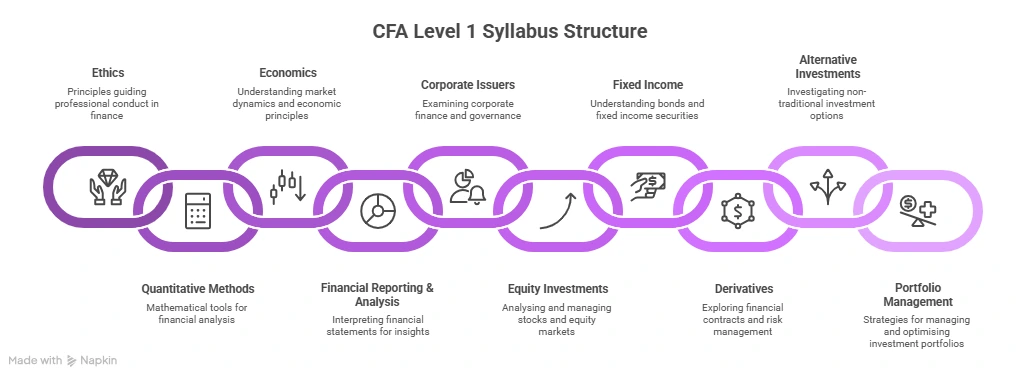
  • The curriculum covers everything from Financial Reporting and Analysis to Equity Investments, Corporate Finance, Economics, and Portfolio Management– giving you both technical depth and a strategic overview of global markets.
  • In short, becoming a CFA Charterholder means joining an elite group of over 190,000 professionals across the world (CFA Institute, 2024).

Whether you want to analyse stock trends, manage portfolios, or guide big financial decisions, CFA is your launchpad. Many candidates also explore the CFA course fees structure early to plan their preparation and budget efficiently.

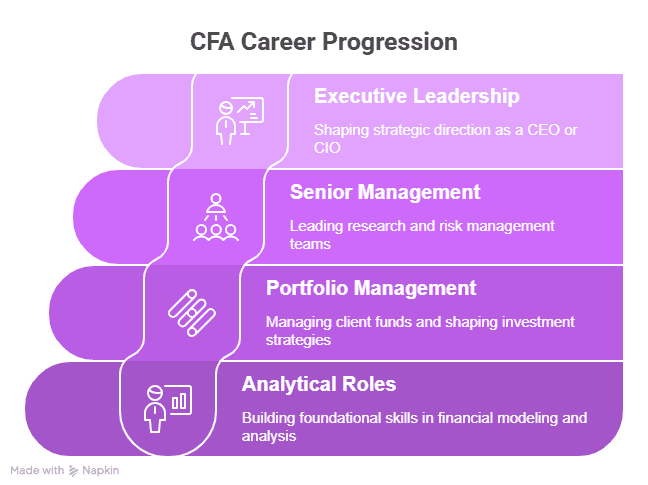
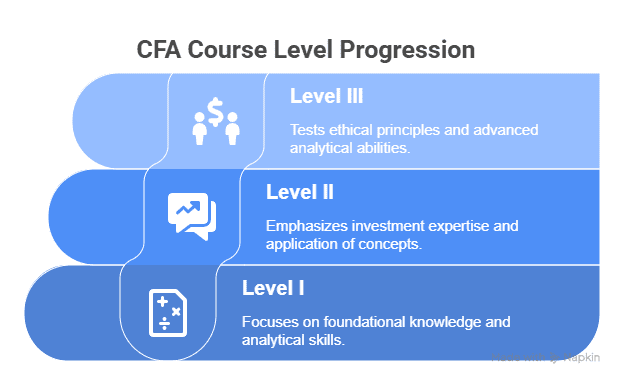
CFA Course Level Progression

💲As Warren Buffett says, “The more you learn, the more you earn” – and the CFA is proof of that.


Why Does It Matter for Your Career?

Let’s be real: in today’s competitive world, just knowing finance isn’t enough. Employers want the full package – technical skill, ethical judgement, and the ability to think on your feet. That’s exactly what CFA equips you with. The CFA isn’t just a certification; it’s your ticket to a career with real impact.

CFA charterholders often see big perks, like faster career growth and higher salaries. Whether you’re a commerce graduate, an engineer exploring finance, or a working professional, the CFA program helps you:

  • Gain global credibility across 170+ countries
  • Access premium finance roles in firms like Goldman Sachs, JP Morgan, Deloitte, and KPMG
  • Build real-world financial expertise that employers value

When you weigh these benefits against the CFA course fees, it’s clear that the return on investment is strong for committed finance professionals – and that’s exactly why CFA is the gold standard for finance professionals.

For example, a 2024 CFA Institute survey showed charterholders earn about 25-40% more than their peers without the certification. 

In India, fresh CFAs start around ₹8-12 lakhs per year, and as they gain experience, their salaries can soar past ₹30 lakhs! Plus, companies like JPMorgan, BlackRock, and Goldman Sachs actively look for CFAs because they know these pros bring serious value to the table.​


If you are wondering how much a CFA charterholder earns, this video will give you a detailed insight.


CFA Course Fees Breakdown

Okay, now let’s talk about the part that makes many pause – the CFA course fees. It’s not exactly pocket change, but knowing what you’re paying for can help you see it as an investment, not a setback.

  • First up, there’s a one-time enrollment fee of around ₹30,000 (or $350) you pay when signing up for Level 1. 
  • This gets you access to official CFA materials straight from the institute. Then there’s the exam registration fee for each level. 
  • If you register early, it’s around ₹84,000, but if you wait too long, that number climbs to about ₹1,10,000 or even more.
  • Don’t forget, many candidates spend extra on prep courses, mock exams, and books – usually another ₹15,000 to ₹50,000 per level, depending on how fancy you want your study setup to be. 
  • And if the exam centre isn’t in your city? Add travel and maybe hotel costs to your budget.

Sounds like a lot? It really adds up, but we’ll talk about how to manage it all smartly in a bit.

Registration TypeFee (USD)Approx. INR (₹)
Early Registration$940₹78,000
Standard Registration$1,250₹1,04,000

Understanding the complete CFA course fees breakdown helps you plan each level without financial surprises.


💲Every rupee you spend here builds a foundation for returns that compound – just like good investments do.


CFA Course Fees in India

The CFA is a global qualification, so while the prestige is international, the costs can feel a bit different when you’re paying in rupees. Before you dive in, it’s important to get a clear picture of what kind of financial commitment you’re signing up for.

  • Living in India? Then yes, you’re likely wondering how the international fees translate here, and what extra costs pop up locally. 
  • The good news: the CFA fees in India are basically the same as global fees, but converted into INR. While the CFA Institute charges fees in USD, when converted, your total CFA course fees in India can range roughly between ₹2.5-4.5 lakhs, depending on exchange rates and when you register.
  • For the full CFA journey – clearing all three levels – you’re probably looking at anywhere between ₹3,00,000 to ₹4,50,000 when you add up exam fees, study materials, and even coaching if you decide to go that route. Speaking of coaching, cities like Mumbai and Bangalore have a thriving CFA prep scene, where prices vary from ₹35,000 to ₹1,00,000 per level, depending on the course and provider.
  • Oh, and don’t forget those smaller but important extras, like passport and visa costs if you have to travel abroad for exams – ₹1,500 to ₹5,000 typically for a passport, plus any travel expenses if the test centre’s not close by. Planning saves you from surprises.

It’s an investment, but one that pays off with global career opportunities and higher earning potential.


💲The price tag might look steep, but so is the climb to the top of the finance ladder.


CFA Course Fees: Enrolment, Registration and Exam Fees for Levels 1, 2, & 3

Each CFA level represents a step forward in both complexity and professional readiness. Let’s put the numbers side by side so you get a clear picture of what’s expected at each CFA exam level:

LevelKey Focus AreaApprox. Fee (INR)Exam Frequency
Level IBasic investment tools & ethics₹1.1 lakh4 times/year (Feb, May, Aug, Nov)
Level IIAsset valuation & financial analysis₹1 lakh3 times/year (May, Aug, Nov)
Level IIIPortfolio management & decision-making₹1 lakh2 times/year (May, Nov)

Tip: If you plan your registrations strategically (early bird + consistent prep), you can save up to ₹40,000-₹50,000 across all levels.


🏆 An MBA is an investment in leadership. A CFA is an investment in mastering the language of finance, and the returns speak for themselves.


Are the CFA Course Fees Worth It? ROI and Benefits for Your Finance Career

Let’s be honest – spending upwards of ₹3,00,000 on CFA exams and prep might make you pause. But here’s the thing: a CFA charterholder’s earning potential and career trajectory often multiply that investment many times over.

Globally, CFA charterholders earn nearly 25-40% more than their peers without the certification, according to a 2025 CFA Institute Salary Survey. In India, fresh CFA charterholders can expect salaries starting around ₹8-12 lakhs per year, and experienced pros in fund management or equity research often touch ₹30 lakhs or more.​

Take the story of Arun from Bangalore – he was sceptical about the fees, but after clearing Level 3, his salary jumped from ₹6 lakhs to ₹18 lakhs in just three years. That rapid growth couldn’t have happened without the CFA. More than just money, the CFA opens doors globally and gives you a skillset that’s highly in demand in today’s tech-driven finance world.

If you compare the CFA course fees to the salary jump after certification, the ROI is exceptional. Most candidates recover their CFA course fees within a few years of entering the finance industry.

CFA Charterholders work in diverse fields such as:

A 2024 CFA Institute report showed that 70% of CFA Charterholders switch to more strategic or leadership roles within two years of earning the credential.


💲Like Buffett says, “Price is what you pay, value is what you get.” – The CFA delivers on value.


This video dives into why the CFA continues to stand out as one of the best career choices for finance professionals in 2025 – offering global recognition, career growth, and the skills to thrive in an evolving financial world.


Smart Tips to Manage and Reduce Your CFA Course Fees

If the total cost seems high, don’t worry – smart planning can help you save significantly. So, how can you keep your CFA costs in check without sacrificing quality? Here are some simple yet effective tips and smart strategies that can help you reduce your CFA course fees without compromising on preparation quality.:

  • Register Early: This one’s easy and makes a big difference. Early registration can slice your exam fees by up to 30%. Mark your calendar and don’t miss the window!
  • Employer Support: Don’t hesitate to ask your company if they sponsor CFA fees or offer study leave. Many recognise the CFA’s value and support employees pursuing it.
  • Apply for Scholarships: The CFA Institute offers scholarships like the Access Scholarship to reduce financial burdens. It’s worth applying early – cutting costs by 50% or more is real and possible.
  • Mix Free and Paid Resources: Utilise free online lessons and forum discussions alongside official CFA materials. Join study groups to keep motivated and learn smart.
  • Flexible Payment Plans: Institutes like Imarticus offer EMI options, spreading the cost over months instead of paying upfront.
  • Choose Digital Curriculum: Opt for the digital version of CFA materials (included in the fee). Buying printed books can add ₹10,000-₹15,000 unnecessarily.
  • Use Prep Providers Wisely: Institutions like Imarticus Learning offer structured CFA training with mock exams, case studies, and mentor guidance – ensuring you clear each level on the first attempt, reducing retake costs.
  • Build a Study Calendar: Avoid last-minute rescheduling or missed exam windows, which can cost an additional ₹20,000+.

Small moves like these add up big over your CFA journey.

CFA Scholarships and Employer Funding: Save on CFA Course Fees

If your budget is tight and CFA course fees feel like a burden, don’t worry – there are real ways to ease the financial burden. The CFA Institute offers scholarships designed to help candidates worldwide, including the popular Access Scholarship, which can cut your exam fees by up to 70%. It’s aimed at those who might otherwise struggle to afford the program, so it’s definitely worth applying for if you qualify.

On top of that, many Indian employers in the finance sector actively support CFA candidates. Banks, asset management firms, and financial consultancies often cover exam fees and provide study leave because they know a CFA charterholder brings serious value to their teams. So, have a chat with your HR – their support can be a game-changer.

Scholarship TypeEligibilityBenefit
Access ScholarshipFinancial need-basedReduces fees to $300 (₹25,000)
Women’s ScholarshipFor women in financeUp to 70% fee waiver
Student ScholarshipEnrolled university studentsLower exam fee
Regulator/Faculty ScholarshipFor finance educators or regulatorsDiscounted exam fee

Note – In addition, many top employers, including KPMG, EY, and JP Morgan, often sponsor or reimburse CFA course fees for high-performing employees. Check your company’s learning & development policy to see if this applies to you.


💲The best investors use leverage – in your CFA journey, that leverage could be funding or scholarships.


CFA Course Fees Payment Plans: Making Your Investment Easier

We get it – dropping a big chunk of money in one go isn’t easy. That’s why several CFA prep providers, including Imarticus Learning, offer flexible payment plans. Instead of paying everything up front, you can break the fee into convenient monthly instalments that fit your budget.

This way, you keep your cash flow healthy, avoid unnecessary stress, and focus more on studying, because that’s what really matters. It’s a win-win, making professional-level CFA preparation accessible without financial strain.

Many Indian banks offer education-focused credit plans for CFA exam fees, like Credit Card EMI or Education Loans. Think of it as turning one big investment into manageable, strategic steps.


Why Choose Imarticus Learning for the CFA Course in India?

It’s not just about passing exams; it’s about building a career story that lasts.

When it comes to CFA preparation, Imarticus Learning stands out for good reason. They’ve partnered with KPMG to design a course that’s tightly aligned with what the finance industry actually needs today – not just theory.

Their instructors are seasoned professionals and CFA charterholders who break down complex topics into easy-to-grasp lessons. Whether you prefer face-to-face classroom learning or the flexibility of live online sessions, Imarticus has you covered.

Beyond just teaching, they offer lots of extras like mock exams, revision kits, and mentorship, including job placement support once you clear Level 1. Thousands have trusted Imarticus Learning to navigate their CFA journey, and they keep seeing success stories from their students.

You don’t just study here, but you prepare to stand out. Because smart preparation deserves smarter mentorship.


FAQs on CFA Course Fees

Before diving into the details, it’s natural to have some common questions that pop up time and again when considering the CFA journey. Here are a few frequently asked questions to help you make informed decisions.

What are the total fees of CFA?

The total CFA course fees in India for completing all three levels, including enrollment, exam registration, study materials, and optional coaching, typically range between ₹3,00,000 and ₹4,50,000 in India. This will vary a bit based on when you register and how you choose to prepare. At Imarticus Learning, students also benefit from flexible EMI options, helping them manage their CFA investment smartly and confidently.

Is CFA tougher than CA?

Comparing CFA to CA (Chartered Accountant) is like comparing apples and oranges – they’re both tough but focus on different areas. CA dives deep into accounting, tax, and audit, while CFA is more about investment analysis, portfolio management, and ethics. Your background and career goals usually determine which is a better fit. If your goal is a global career in investment or finance, the CFA course with Imarticus Learning is often the better fit.

Who is eligible for the CFA course?

Almost anyone with a bachelor’s degree or in the final year of their degree can register for Level 1 of the CFA program. No specific finance background is required, so engineers, IT pros, and many others can join. You do need four years of relevant work experience to earn the charter at Level 3.

How much does CFA cost?

CFA course fees vary based on registration timing, but expect to pay around ₹75,000 per level if you register early, with possible increases to ₹1,10,000 or more if registering late. Don’t forget to budget for books or prep courses on top of that. 

How much does the CFA registration cost per level?

The CFA registration fees for each level can vary depending on when you register. At Imarticus Learning, the registration costs are aligned with the official CFA Institute fees. The early registration fee for each level of the CFA exam is approximately ₹75,000, while the standard registration fee can go up to ₹1,10,000.

Can I reduce the CFA course fees through scholarships?

Yes, the CFA Institute offers scholarships that can significantly reduce your exam fees. The Access Scholarship can lower your exam fees to around ₹25,000. There are also Women’s Scholarships, Student Scholarships, and Regulator/Faculty Scholarships, which provide varying levels of fee reductions. 

Are there any flexible payment options for CFA course fees?

Yes, Institutes like Imarticus Learning make it easier with affordable payment plans and expert-led CFA training designed to help you clear every level on your first attempt. Instead of paying the entire fees upfront, you can opt for easy EMI options to spread the payment over months.

How much can I save by registering early for the CFA exams?

By registering early for the CFA exams, you can save a significant amount on your registration fees. Imarticus Learning encourages early registration, as the CFA Institute offers a discount for early bird registrations, typically saving you ₹30,000 – ₹40,000 across all three levels. 


Final Thoughts: Planning and Budgeting for CFA Course Fees

In Munger’s words, “Take a simple idea and take it seriously.” – investing in your CFA is exactly that. With the right mindset and planning, your CFA course fees become more than an expense – they become your first investment in a global finance career.

Taking on the CFA program is a journey – it demands time, effort, and yes, money. But with smart planning, this investment becomes manageable and totally worth it. Early registration, scholarships, employer support, and flexible payment plans like those offered by Imarticus Learning can really lighten the financial load.

Remember, the CFA Certification is more than just a certificate; it’s a symbol of your dedication and expertise recognised globally. It can fast-track your career and open doors you only dreamed of before.

Why choose Imarticus Learning? Because they go beyond just teaching. With an industry-aligned curriculum developed alongside KPMG, expert faculty who are CFA charterholders themselves, flexible online or classroom classes, and dedicated career mentorship and placement support after you clear Level 1, Imarticus sets you up for success from day one.

Ready to take the smart step in your finance career? Join thousands of successful CFA candidates with Imarticus Learning and make your journey smoother and more rewarding!

CFA Course: The Gateway to Global Finance

Thinking about stepping into the world of finance,  whether you’re a fresh grad, a working professional itching for the next leap, or someone simply curious about the inner workings of money and markets? Then the CFA Course might be your ticket.

Let’s be honest: pulling off a serious credential like the CFA isn’t just about collecting letters after your name. It’s about rewiring how you think: not only what the numbers show, but why they matter, how they drive decisions, and what they reveal about the financial world around you. The journey is more than exams and textbooks – it’s about cultivating a mindset that speaks the language of global finance, one that hiring managers and investment teams recognise and value.

I’ll give you a look at what the journey actually involves, the skills you’ll pick up, the doors it can open for your career, and some tips to tackle it without feeling burned out. By the end of this guide, you’ll have a clear roadmap for your CFA course journey – so you can step in confident, focused, and ready to take your place in the world of finance. Let’s dive in and explore what makes this credential a game-changer.


Interesting Fact: The CFA Program is recognised in 160+ markets around the world.


What is the CFA Course?

So you might be wondering – what is CFA, really?

What does a CFA charterholder actually do?

To me, the CFA course isn’t just another finance qualification – it’s a shift in the way you see the world of investing. It’s what happens when you stop just reacting to market changes and start anticipating them with insight.

The Chartered Financial Analyst (CFA) program, offered by the CFA Institute, is one of the most respected credentials in global finance. It’s not a quick shortcut or a simple course to boost your career – think of it more like a marathon one that builds lasting expertise and prepares you for the long game in investment and financial management. Each level challenges you to dig deeper into how money flows – through markets, portfolios, and entire economies, and trains you to make smarter, more informed decisions along the way.

Think of it as your complete financial toolkit. You don’t just learn how to analyse a balance sheet; you learn how to connect numbers to narratives – to understand why a company’s valuation changes, how macroeconomic shifts affect portfolios, and what ethical choices define great investors.

When someone earns the CFA charter, it signals more than knowledge. It shows discipline, judgment, and a long-term view – the exact traits that employers and clients look for in investment professionals from Mumbai to London to New York.

In short: the CFA course isn’t just about mastering finance – it’s about learning to think like the people who shape it.

If you’re still exploring whether the CFA course is right for you, our CFA course details section breaks down everything from how the program works to what skills you’ll build and how to prepare for success.


The fundamental purpose of finance is to contribute to society through increases in societal wealth and well‑being. We need more people in our professional ranks who have clear ethics and a sense of commitment. – Paul Smith, CEO of CFA Institute


Why Choose the CFA Course for Your Finance Career?

Why would anyone willingly invest hundreds of hours in this demanding course? For me, it’s simple: it prepares you to be the professional people turn to when markets move, when portfolios need insight, or when critical financial decisions are on the line.

Imagine being the go-to professional when your company needs insight into market trends, portfolio risks, or asset valuations. The CFA charter doesn’t just open doors; it unlocks them widely across investment management firms, hedge funds, and corporate finance departments worldwide. 

When employers seek trusted experts, having a CFA course credential on your resume sets you distinctly apart. And more importantly, it gives you the confidence to make decisions that others might hesitate to take.

The CFA program is experiencing significant growth in India, with candidate numbers increasing by almost 25% annually since 2019, highlighting its growing importance in emerging markets.

Benefits of CFA Course

Curious why the CFA is hailed as the gold standard in finance? This video breaks down what makes the CFA so valuable for your career – from global recognition to high-paying roles.


CFA Course Levels and Curriculum

The CFA course is similar to climbing a mountain – each level builds on the last; it is structured in three progressive levels:

Level 1 – Building Fundamentals: It’s like learning to read the language of the financial world. This level assesses your understanding of the basics, such as ethics, quantitative methods, economics, and financial reporting, with multiple-choice questions. It’s the foundation every apprentice investor needs.

Level 2 – Application of Concepts: Now, envision stepping into the shoes of a financial analyst who must apply knowledge to real-world cases. Level 2 examines your ability to analyse complex equity valuations, fixed income, corporate finance, and risk. At this level, the questions are scenario-based, mirroring actual market challenges.

Level 3 – Mastering Portfolio Management: At this stage, the questions are scenario-based, reflecting real-world market challenges and opportunities. The focus is on advanced portfolio management and wealth planning, with essay-style and case study questions that test your ability to think critically, apply sound judgment, and communicate your investment rationale effectively – just as you would in actual client situations.

CFA Exams Levels

Each step builds on the last, requiring around 300 study hours per level – so perseverance counts as much as intelligence.


You can hire people with an MBA, but you don’t necessarily know that one MBA is the same as another MBA. If you hire investment professionals with a CFA designation, you absolutely have confidence at the level of qualification.” – CFA Institute


The CFA Course Eligibility

When aspiring CFA candidates or current professionals inquire about the program, their uncertainties often stem not from the official structure, exam format, different levels, potential salary, fees, or diverse career paths, but rather from their personal perceptions and assumptions about these aspects.

Finance credentials today aren’t just certificates; they’re global passports. The CFA designation is one such credential, well-respected across continents and industries. But with all the buzz around this top-tier finance credential, many wonder – 

Who exactly is eligible to take the CFA course? 

Is it only for finance graduates? 

Is there an age bar? 

Do you need years of experience before applying? 

This is one of those common misconceptions about the CFA program, and I always enjoy clearing up that confusion as soon as possible. Whenever someone asks me about the CFA’s prerequisites, they expect a long list of rigid financial experience, like needing five years as a junior analyst or something equally intimidating.

The truth might surprise you: the CFA program is actually designed to be incredibly inclusive and accessible to a broad range of candidates, particularly for the first hurdle, Level I. For me, that’s the beauty of it. They’re looking for potential and commitment, not just a CV. You essentially have three pathways to apply for the Level I exam:

Educational Background: A Bachelor’s Degree (or an equivalent qualification) is the standard route. You don’t even have to have completed it yet – you can register if you are in the final year of your program.

Professional Experience – if you’ve clocked 4,000 hours of work experience and higher education, that adds up to three years. Critically, this experience doesn’t even have to be investment-related – it just needs to be relevant to business.

So, in short, you don’t need years of dedicated investment-banking experience to start. You are required to have one of those solid foundations in place, and then, most importantly, the discipline to study. The real experience begins when you start tackling the curriculum!


CFA Exam

The CFA program has three levels, each testing different skills. The program’s three levels take you from foundational knowledge to advanced portfolio management:

  1. Level I: Focus on basic concepts – ethics, quantitative methods, and financial reporting.
  2. Level II: Dive deeper into asset valuation and investment tools.
  3. Level III: Master portfolio management and wealth planning.
LevelFocusExam FormatDuration
Level 1Basic knowledge and comprehension of investment tools, ethics, and financial reportingMultiple-choice questions2 sessions × 2 hours 15 mins each
Level 2Application of concepts to analyse and value investmentsItem set questions (mini case studies)2 sessions × 2 hours 12 mins each
Level 3Portfolio management, wealth planning, and integrating concepts with decision-makingConstructed response (essay) + item sets2 sessions × 2 hours 12 mins each

Key Points:

  • All exams are offered in English.
  • Ethics is emphasised at every level.
  • Passing requires both knowledge and the ability to apply concepts to real-world scenarios.

Want a clear snapshot of what the CFA course journey looks like and why it’s worth it? This video covers the essentials for anyone curious about starting their CFA path.

CFA Course Preparation

Let’s be honest – preparing for the CFA exams is tough. You can’t just cram formulas or skim through notes and expect to ace it. It’s about really understanding the material and being able to use it when it counts. I like to think of it as training for a marathon; you don’t run 42 km on day one. You start small, stay consistent, and slowly build the endurance to cross that finish line.

From what I’ve seen and heard from people who’ve actually done it, here’s what really helps:

Start early and stay consistent.

One of my friends, Rohan, began his CFA Level I exam preparation four months in advance. Every night after work, he’d put in just 90 minutes. No all-nighters, no panic. By the time exam week came around, he was calm, and he passed on the first try. That’s the power of steady effort.

Practice like it’s the real thing.

A candidate once told me she treated her mock exams like the real deal – no breaks, no distractions, just her and the timer. By exam day, she wasn’t nervous; it just felt like another practice session. Mock tests aren’t just practice – they build confidence.

Don’t skip ethics.

I get it, ethics doesn’t sound exciting. But a lot of people miss their passing mark because they underestimate it. One person I know actually turned his borderline fail into a pass because he reviewed ethics carefully in the last week – it really can make that much difference.

Find your tribe.

Studying alone can feel isolating. I remember a small online group that met every Sunday evening – half the time they were just complaining about how hard derivatives were, but that sense of community kept everyone motivated. You learn faster when you’re not alone in it.

Take care of yourself.

Burnout is real. I’ve seen people try to power through on four hours of sleep and crash halfway. One candidate I spoke to started taking short walks after study sessions – it helped clear his head and made a huge difference in his focus.

The CFA exams are challenging – no sugar-coating that, and pass rates often sit below 50%. But it’s not about being a genius. It’s about showing up, being consistent, and believing in the process. When you finally see that “pass” on your result, all those late nights and weekends suddenly feel worth it.


Did you know that Global pass rates hover around 40-50% per level, highlighting the rigour and value of the program. 


CFA Course Fees

Investing in CFA Certification is an investment in your career; the return often outweighs the cost many times over. From my experience, understanding the CFA course fees upfront helps you plan better. Here’s a breakdown:

LevelProgram Fee (INR)Registration Fee (INR)
Level 1₹ 60,000 (all‑inclusive) ₹ 10,000 
Level 2₹ 60,000 (all‑inclusive) 
Level 3₹ 60,000 (all‑inclusive) 

CFA Institute Fees

Note – The program fee at Imarticus covers the program, including both training and study materials.


Career Opportunities After Completing the CFA Course

Earning your CFA charter opens doors to a wide array of finance career paths – both in India and globally. CFAs are highly sought after because they bring a strong mix of analytical skills, ethical standards, and practical market knowledge. Some of the key career opportunities include: 

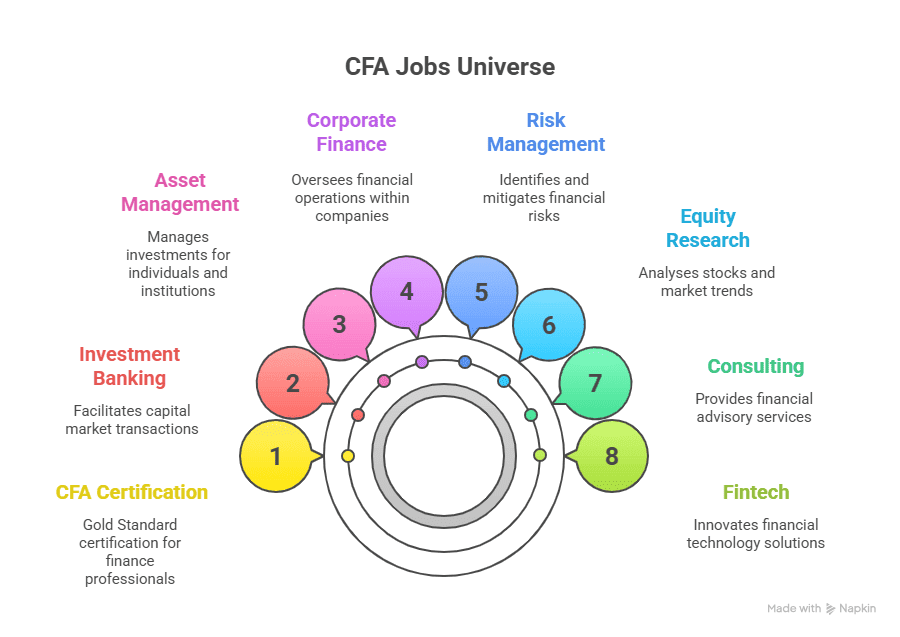
CFAs thrive in roles like:

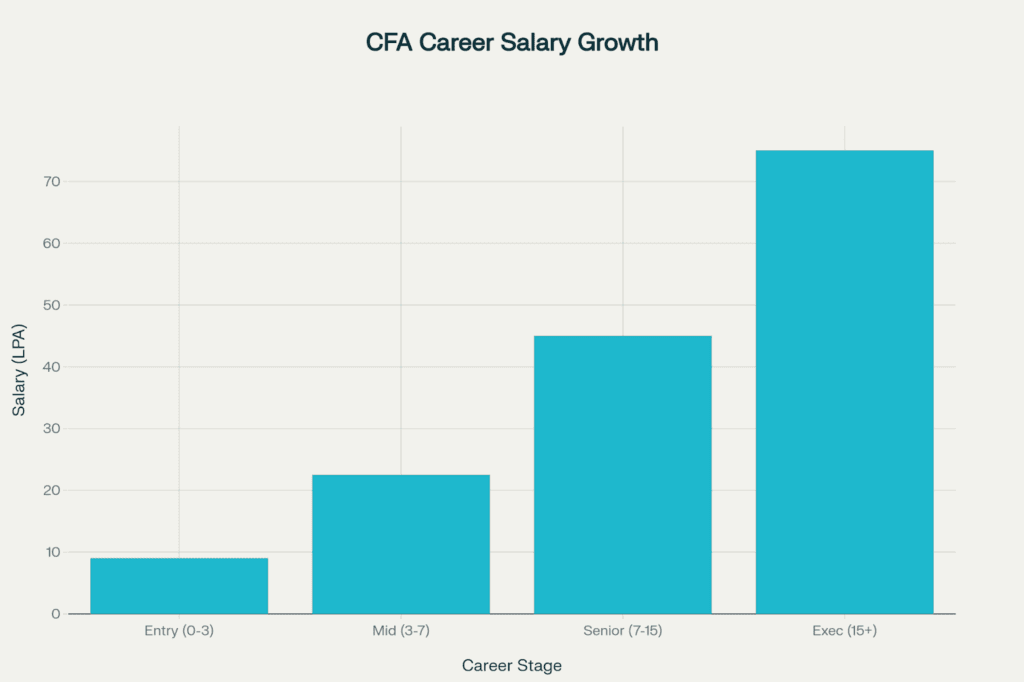
Employers worldwide trust CFAs to make crucial financial decisions. Your salary potential grows alongside this trust, with entry-level CFAs in India averaging ₹8-10 LPA and seasoned professionals earning well into the ₹40 LPA+ range.

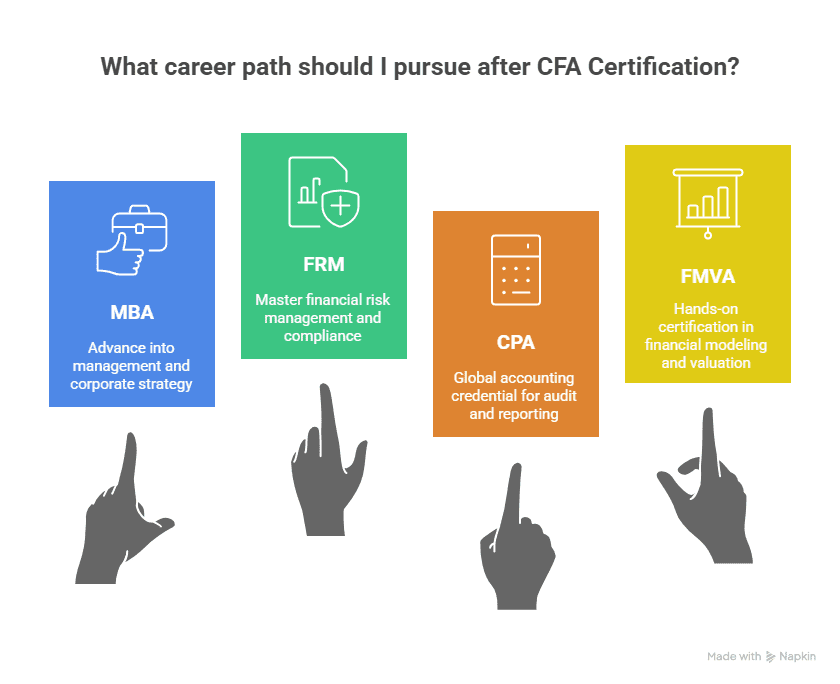
If you’re curious about how the CFA designation can shape your professional journey, check out our detailed guide on the career options after CFA certification.


Interesting Fact: According to the CFA Institute, 91% of charterholders report that their designation has enhanced career opportunities.


Salary After Completing CFA

Now, onto the part that really catches everyone’s attention – the salary. Earning your CFA charter definitely opens the door to better paychecks, but it’s also about the career growth and opportunities that come with it.

Entry-level CFAs in India can usually expect salaries around ₹8-12 lakhs per annum, which is generally higher than non-certified peers in finance roles. And experience makes a significant difference. Mid-career professionals with a CFA often reach ₹20-40 lakhs or more, especially in multinational companies or investment firms.

CFA Level 1 – Entry-Level Roles & Salary Growth

CFA Level 1 candidates often start in analyst or support roles; salary growth accelerates with experience or after clearing Level 2.

Job RoleEntry-Level (0-2 yrs)Mid-Level (3-5 yrs)Senior-Level (6-10 yrs)
Research Analyst (Intern/Junior)₹4-6 LPA₹7-10 LPA₹12-15 LPA
Financial Analyst₹5-8 LPA₹9-12 LPA₹14-18 LPA
Equity Research Associate₹6-9 LPA₹10-14 LPA₹15-20 LPA
Data/Valuation Analyst₹4-7 LPA₹8-11 LPA₹12-16 LPA
Investment Banking Support Analyst₹6-10 LPA₹12-16 LPA₹18-25 LPA

CFA Level 2 – Intermediate Roles & Salary Growth

After Level 2, professionals often move into front-office or client-facing roles with noticeable pay jumps.

Job RoleEntry-Level (0-2 yrs)Mid-Level (3-5 yrs)Senior-Level (6-10 yrs)
Equity Research Analyst₹8-12 LPA₹14-20 LPA₹20-28 LPA
Investment Banking Associate₹10-15 LPA₹18-25 LPA₹28-35 LPA
Portfolio Analyst₹9-13 LPA₹15-22 LPA₹22-30 LPA
Credit/Risk Analyst₹8-12 LPA₹14-20 LPA₹20-26 LPA
Corporate Finance Analyst₹7-11 LPA₹12-18 LPA₹18-25 LPA

CFA Level 3 – Charterholder/Advanced Roles & Salary Growth

CFA Level 3 pass-outs and charterholders are eligible for senior, leadership, and client advisory roles. Compensation includes bonuses and performance-linked pay.

Job RoleEntry-Level (0-2 yrs)Mid-Level (3-5 yrs)Senior-Level (6-10+ yrs)
Portfolio Manager₹12-18 LPA₹20-35 LPA₹40-60 LPA+
Investment Manager₹14-20 LPA₹25-40 LPA₹45-70 LPA+
Equity/Research Head₹10-16 LPA₹20-30 LPA₹35-50 LPA+
Risk/Strategy Consultant₹12-18 LPA₹22-32 LPA₹35-55 LPA+
Wealth/Asset Manager₹10-15 LPA₹18-28 LPA₹30-45 LPA+

Globally, the story looks even more impressive. Fresh CFAs can start at $70,000+ annually in countries like the US, UK, or Singapore. Senior CFAs, especially portfolio managers or executives, easily pull in six-figure salaries – sometimes well over $200,000. If you’re curious about how these numbers compare closer to home, check out our detailed breakdown of CFA salary in India to see how earning potential grows with experience and role.

But here’s a little secret: the salary is more than just your base pay. CFA holders often get bonuses, stock options, and profit-sharing opportunities that can multiply their total income. Plus, the global nature of the CFA means you can explore career avenues around the world – and that international edge can be a game-changer.

Of course, the CFA alone isn’t an instant ticket to a massive paycheck. It’s a respected credential that, combined with real-world experience, networking, and continuous learning, propels your career forward steadily but surely.


CFA Course vs. Other Finance Certifications

If you’ve met professionals with CPA, FRM, or CA certifications, you might wonder how the CFA course compares. Think of it as choosing between various vehicles for a financial career journey – the CFA course is particularly tailored to investment and portfolio management, while the CPA focuses more on accounting and auditing, and the FRM zeroes in on risk analysis. The CFA charter’s global recognition and emphasis on ethics make it especially coveted in asset management circles, offering a unique blend of depth and applicability. Here’s a concise overview of the CFA course with other popular finance certifications to help you get a better understanding.

AspectCFACPAFRMCA
EligibilityBachelor’s or final yearBachelor’s + accounting creditsBachelor’s degree10+2 or graduation
Levels3423
Exam StyleMCQs + case studiesMCQs + simulationsMCQsDescriptive + objective
Pass Rate~40–45%~50%~45–50%~10–15%
FocusInvestments & financeAccounting & auditingRisk managementAccounting & taxation
Job RolesAnalyst, PM, StrategistAuditor, CFO, ControllerRisk Analyst, Risk ManagerAuditor, Finance Manager
Salary Range₹8-25 LPA₹7-20 LPA₹8-22 LPA₹6-18 LPA
Global RecognitionVery highHigh (esp. U.S.)HighStrong in the Commonwealth

Why Choose Imarticus for Your CFA Course Journey?

Having a CFA program on your resume is one thing; mastering it is another. Here’s why I feel Imarticus Learning is a great learning partner for your CFA course preparation:

  • Structured Learning & Mentorship: Every student gets one-on-one guidance from industry experts to help understand tough concepts and stay on track.
  • Global Curriculum Standards: Imarticus is aligned with CFA Institute guidelines, ensuring you’re prepared for exam rigour worldwide.
  • Practical Exposure: Through case studies, simulations, and workshops, you learn to connect theory with real-world decision-making.
  • Career Support: Resume-building, interview preparation, and access to global networks help you transition from certification to career.

With this kind of backing, I always tell you’re not just studying for the CFA course; you’re preparing to step into a role where your decisions matter.


FAQs About the CFA Course

If you’ve made it this far, you probably still have a few questions swirling in your mind. These frequently asked questions break down everything you need to know about the CFA course.

What is a CFA course?

The CFA course is a globally respected program that trains you in investment management, financial analysis, and ethical decision-making. It’s way more than just studying numbers – it’s about learning to see what those numbers mean, how they influence markets, and how to make smart, confident financial decisions that matter. Think of it as a deep dive into the language and mindset of the world’s top investment pros.

Is CFA harder than CA?

It depends on your strengths. CA is more technical and accounting-heavy, with tough exams and lots of memorisation. CFA, meanwhile, focuses on investment analysis, markets, and decision-making – it’s about applying concepts, not just recalling them. Both are challenging, but in different ways. If you love finance and markets, the CFA course might feel more your style.

What is a CFA salary?

CFA charterholders usually see a strong boost in earnings. In India, fresh CFAs earn around ₹8-12 LPA, while experienced professionals can make ₹20-40 LPA or more, especially at top firms. Globally, salaries often start above $70,000 and rise quickly with experience. It’s not instant – but it’s a steady, rewarding climb. With Imarticus Learning’s comprehensive CFA training programs, you can strengthen your conceptual foundation, gain industry insights, and position yourself for these high-growth career opportunities.

How many years is the CFA course?

On average, it takes about 2.5 to 4 years to complete all three levels of the CFA course, considering you pass each on your first try and accumulate necessary work experience. With structured guidance and expert mentorship from Imarticus Learning, you can streamline your CFA journey and stay on track to achieve your certification efficiently.

Who is eligible for the CFA course?

You need a bachelor’s degree or equivalent, or be in your final year of studies. Alternatively, if you have a combination of work experience and education equaling four years, you can apply for the CFA course. You don’t need prior investment experience to start; it’s designed to welcome diverse backgrounds. With Imarticus Learning’s CFA prep program, you can get personalised guidance and structured study support to confidently meet eligibility requirements and excel in your exams.

Is CFA higher than MBA?

They serve different purposes. CFA is a deep specialisation in investment and finance, focusing on technical expertise and ethical practice. MBA covers broader business management topics like strategy, marketing, leadership, and operations. Many professionals actually complement their MBA with CFA to get both breadth and depth.

What is the CFA course pass rate?

Historically, pass rates for the CFA course hover below 50%. The exams are tough and designed to be challenging – they filter out those who aren’t fully prepared. With the right preparation and mindset, you can absolutely ace it. At Imarticus Learning, you’ll get guidance from expert mentors, a hands-on, industry-focused curriculum, and continuous support throughout your journey.

Is 27 too late for pursuing the CFA course?

Absolutely not! The CFA program has no age limit. Whether you’re 22 or 40, if you have the drive to learn and grow in finance, this credential is for you. Many people pursue the CFA mid-career to switch tracks or boost their credentials.

How many papers are in the CFA course?

Instead of ‘papers,’ the CFA program has three levels – Level 1, 2, and 3. Each level has a unique exam format covering core finance topics, increasingly testing your analytical and portfolio management skills as you progress.

Is the CFA course in demand?

Yes! CFA charterholders are highly sought after in investment banking, asset management, equity research, risk management, and wealth planning. The global finance industry values CFA expertise, and demand continues to grow alongside complex financial markets.

Which degree is better with the CFA Course?

CFA course pairs well with degrees in finance, economics, accounting, business, or even engineering and math. If you want a smooth learning curve, a finance or commerce background helps, but CFA’s design welcomes all analytical minds ready to dive deep into investments.

Can CFA earn 1 crore?

Yes, senior CFAs in leadership roles like Chief Investment Officers or Fund Managers in top firms can earn ₹1 crore or more annually, counting bonuses and profit shares. It’s not guaranteed overnight, but it is attainable with experience, skill, and the right opportunities.


Elevate Your Finance Career with the CFA Course

Completing the CFA Course isn’t just a qualification – it’s a transformation. It represents the shift from knowing what happens in finance to understanding why it matters, and having the confidence to act on that knowledge. 

As the CFA Institute puts it: For many of us, ‘CFA charterholder’ is a defining attribute. It means you have made a significant commitment to your practice, putting investors first, and maintaining the highest ethical and professional standards.

Earning this credential isn’t just about a certificate or clearing the levels – it’s a key that opens doors to careers in investment management, wealth advisory, risk strategy, and beyond. It tells employers around the world that you’re not just qualified – you’re ready to lead.

CFA Course is more than a certificate – it’s your chance to think, decide, and lead like a finance pro. When you finish, you’ll stand out, make an impact, and speak the language of global finance. Ready to begin your career as a CFA Charter? 

The Growth of CFA Courses and 2020-2027’s Outlook

The Chartered Financial Analyst tag is obtained only after months of blood, sweat and tears going into preparations. Yet the CFA designation remains one of the most coveted job roles in the world and, in recent times has seen astonishing growth in hopeful candidates.

What is CFA?

The CFA has come to be one of the most influential and recognisable investment insignia worldwide. The designation is bestowed upon successful candidates by the CFA Institute which was formerly known as the Association for Investment Management and Research (AIMR). This institution is responsible for the examination and certification of financial analysts; their exams are frequented by thousands every year.

The CFA exam has three levels, the successful completion of which will establish candidates as masters in the investment and management fields.

Why Are CFA Courses Increasing?

  • The increased flow of money: The CFA designation is still heavily sought after, despite the rigorous run-up to the examinations. For starters, this is because the demand for highly qualified finance professionals is increasing with the proliferation of globalisation and the increased flow of money.
  • Great job prospects: CFAs are usually in demand for top decision-making positions where each ‘yes’ or ‘no’ has significant bearings on the functioning of the company. Naturally, then, passing the CFA exams and earning yourself the tag will guarantee excellent job prospects at top tier firms in several investment areas. From investment firms to hedge funds, investment-related entities know and value the knowledge base acquired by CFAs in the duration of their course. Thus, their resumes place top, over all other candidates in related fields.
  • Knowledge of regulatory standards: CFAs are also valued for their high professional and ethical standards. Companies benefit from hiring financial analysts who know the laws of the game like the back of their hand– this prevents any auditing and regulatory hiccups in the future which tend to spell massive losses at any scale.
  • Experience and practise: The charter is conferred after four years in the industry– rigorous years of practice and experience that are of immeasurable value to companies locked in aggressive competition. The ideal CFA course allows candidates to engage in real-world scenarios to sharpen their problem-solving and analytical abilities.
  • Abundant networking opportunities: Numerous worldwide CFA societies allow graduates to build unbeatable connections. These global networks are beneficial in that fresh graduates can find job opportunities while veteran CFAs can find willing partners to either employ or collaborate with over a venture.
  • More focused than MBAs: While 2-year MBA programmes offer students a wide and comprehensive perspective of the investment field, no course goes as in-depth into financial analysis as an international CFA course does. It is also a more affordable option for those looking to jump into the industry but unwilling to pay ceiling-high tuition fees for MBA courses.

What Does 2020-2027 Look Like?

As of 2019, over 167,000 investment analysts and professionals hold the official CFA charter. In the coming few years, the number is likely to increase, especially since India is moving to the forefront. International financial entities are setting their eyes on India to outsource a massive amount of work and set up remote offices and branches. As they will be looking to recruit the highest credentials in the investment world, obtaining a CFA charter all the more important for Indian investment professionals.

The growth of wealth management will also aid the expansion of CFA charter-holders across the globe, India included. The industry has been growing at a year-on-year figure of 20%.

As time goes by, more and more exciting opportunities will crop up for investment professionals to make their mark. The CFA course aims to create a pool of professionals that are steeped in ethics and knowledge, ready to lead the industry in the coming years.

What Businesses Hire a Corporate Financial Analyst?

‘Information is power’ but only to those who know how to use it well and make sense of it! Let’s start this note by finding out what does this astonishingly hefty job tile holds in its realm.

The primary task of a corporate financial analyst involves analyzing piles of data and deriving something meaningful out of it, making sense of the numbers even when it’s not very evident in the first glance. fin
The job role involves making strategic decisions based on the finding supported by the database.

Comparing the records with that of a previous couple of years to see how well or bad the company is performing in the contemporary. They also assess the performance of stocks, bonds commodities and other investment tools to provide their recommendations and investment guidance to individuals and companies.

Where do they fit in?
Capitalism is all about maximizing profit and these guys know how to lead a company to prosperity based on facts and figures.

The role of a financial analyst is such that every business at some point or the other needs it if it’s planning strategic growth. If I have to keep it simple yet philosophical, I would say if a company is willing to learn from its past mistakes and prosper in the future, it needs the expertise of a financial analyst.

The investment banks, pension funds, insurance companies remain the predominated segments for absorbing the talent pool of financial analysts. Majorly all those corporations who are deploying money as a commodity, dealing in large chunks of money on a continuous basis are the prime employers of this job title.

Investment houses happen to have their own funds which require a well-calculated investment risk and return benefit, the financial analyst adds value by providing them with their insights based on the data analyzed.

In the world of finance, there are two types of firms, buy-side firms, and sell-side firms. Understanding the role of financial analysts in both contexts will help us in obtaining better insights.

The role of a buy-side firm is to make investment decisions, these are the firms who have massive capital to deploy for investing and generating profit in the future. Some big players include Fidelity, Blackstone, Citadel, etc.
The role of financial analysts working for a buy-side firm includes making investment strategies for their employer with the help of data insights and suggesting different avenues for investment that will help maximize the ROI.

Coming to the sell-side firms, these are the firms that sell investment banking services like acquisition advisory, trading services, stock research, etc. While working with sell-side firms financial analysts mostly write research reports and recommendations for stocks, whether to buy, hold or sell a particular security. Their remarkable compensations speak volumes for the weight they hold in the capacity of a financial analyst for a sell-side firm.

In addition to the prime employers, any business house that deals in a lot of data and is dependent on using data insights to function and be profitable will necessarily employ a financial analyst. In today’s changing technological landscape data is the king and strategic use of data’s army will help win the war of business.

As the experience of financial analysts increases, they chose a particular segment a niche sector to focus upon and thus their job role gets more particular and defined. Some of them are fund managers, portfolio managers, risk analysts, rating analysts, etc. They cater to specific segments within the industry by leveraging their experience in a particular field.

Companies like Boston Consulting Group, Goldman Sachs, Morgan Stanley, Citi, Fidelity Investments are some established players in the financial domain and they have a plethora of opportunities for those who want to pursue a career as a financial analyst.

Conclusion
In the contemporary world where economies are growing at an enormous scale, the key driver of growth remains the financial industry. Piloting this growth is the people working in the capacity of a financial analyst who uses complex data to provide strategic solutions and in turn help to drive investments. Investment firms, pension funds & insurance companies are some of the prime employers of these skillsets. Other than the prime employers there is a lot of prospects in companies that are data-centric.

CFA Program – All You Should Know About CFA Certification

CFA Program is an expert accreditation offered by CFA Institute to Investment and Financial experts. In the wake of finishing and passing the CFA Program one will connect scholarly theory, assess current industry rehearse, and learn moral and expert guidelines to give a solid establishment of cutting edge speculation investigation and true portfolio administration aptitudes.
You are qualified in the event that you are in the last year of your single man’s program or as of now have a four year certification, or have proficient working knowledge that aggregates up to 4 years. The following is the CFA qualification criteria course in India.

  • Current MBA understudies/MBA wannabes
  • B Com/M Com understudies
  • CA aspirants
  • IT experts

CFA Course is especially known as Chartered Financial Analyst Course, which is an affirmation offered to the general population who have a place with the field of bookkeeping and back keeping in mind the end goal to connect up the hole amongst hypothetical and pragmatic points of view. The accreditation is in charge of giving its learners the speculation and administration abilities under the leader of fund. CFA is a universally perceived accreditation which secures ones future as far as splendid extension and fruitful profession. There are sure tips said underneath with the assistance of which the CFA certification can be effectively finished:

Sort out Yourselves:

For finishing the course on time effectively, one must sort out himself or herself comprehensive of his or her schedules. CFA course requires no less than 250 hours of autonomous examination which implies one should in any event ponder 12 hours per week. Subsequently, legitimate calendar ought to be made by the person who intends to get this confirmation deferentially. Following are the sure activities which should be possible by the learners keeping in mind the end goal to arrange his or her normal according to the prerequisites of the course:

Begin Studying Early in the morning

Observe all in all syllabus before beginning

Outline an objective arrangement, enrolling your objectives

Build up an arrangement to amend the entire course

Make a productive timetable

Before beginning the investigation, a productive and scholarly timetable ought to be made by the understudy that must be taken after totally by him or her as it will choose the eventual fate of the understudy. While arranging, following focuses ought to be remembered:

Must know the results of all lessons already

Go for sticky notes and schedules for reminding reason

Separate between the subjective and quantitative examination

Eat healthy, remain sound

Go for a Recap of the entire course

In the wake of having a total and nitty gritty investigation with respect to the entire course, one must go for the survey of the entire course through imperative focuses. This will assist a considerable measure amid the exam time!

Finance Courses Would In Great Demand In The Near Future

The 21st century has witnessed a great many revolutionary changes in every sphere of the humankind’s existence. Education is one field, which has experienced quite a few changes in terms of how people perceive it, especially in the professional sphere of things. There has been a subtle move from classic courses to the more advanced and specialized courses, offering a candidate with a specific set of skills. The importance of more general educational programs, which dealt with a more holistic development has been ebbing away gradually. These are rapidly being replaced with more specific, specialization finance courses, which are bound to give you the proper foundation, which a lot of HR Managers are looking for in today’s day and age. With a lot of importance being laid upon the soft skills and industry relevant, technical skills, the importance of these courses is multiplied.
This applies to every single field out there. When it comes to the uber-challenging field of Finance, general programs like the management programs are very holistic in nature, which basically results in them being very general. On the other hand, there are various specialization programs in finance offered by institutes, which are very intensive in nature as well as highly focused on imparting specific knowledge.
Imarticus Learning is a pioneers in offering such industry endorsed specialization courses, which are backed with experimental learning as well driver by experts from the industry. One thing is certain, that these courses especially in the field of Finance are definitely here to stay and will only grow in popularity soon. Corporate Finance, Investment Banking, Wealth Management, Portfolio Management, Financial Modelling, Chartered Accountants and various other branches have their own set of specialization courses, all of which are a mandate for any financial professional out there.
There are two courses in Finance, which show full potential of becoming the most demanded ones in the near future.
These are as follows:

Chartered Financial Analyst

The CFA is considered to be the most prestigious credential, offered by the CFA Institute for professionals, working in the fields of Investment and Finance. Any candidate who successfully completes this program, is then awarded the CFA Charter and is known as a Charter Holder then on. This designation has become the most respected and recognised one in the field of Investment Banking mainly because of its curriculum, which deals with all the concepts and skills, which one would need at various stages of their career. With employers and firms everyone beginning to recognize this designation, as a yardstick to measure the competence and integrity of a professional, this course is definitely going to be in great demand in the near future. A lot of institutes including Imarticus Learning offer great courses to crack the CFA exam.

Corporate Finance Courses

The Corporate Finance Courses are slowly becoming the most sought after ones, by all the finance aspirants. This is one field which constitutes of various techniques, decisions and activities that deal with the numerous aspects of firm’s financial standing. If we speak in broad terms, everything related to the operations in a business, falls under the category of corporate finance. The challenging nature of the field and the many benefits offered here, have begun to attract a lot of finance aspirants
Both these designations have just about begun to get their deserved recognition and would only increase in demand in the near future, for all the finance aspirants.

CFA Level 1: Your Complete Guide to Cracking the Exam

The world of finance has never stood still. Markets evolve, investor behaviour shifts, and technologies redefine how value moves. Yet one professional qualification remains the benchmark for analytical excellence, the CFA Level 1 certification. For students and professionals in India hoping to build a meaningful career in investment management, equity research, or financial analysis, earning the Chartered Financial Analyst (CFA) Level 1 credential is often the first concrete step.

The CFA Program, offered by the CFA Institute, is globally recognised as the gold standard for ethics, analytical rigour, and financial knowledge. The first level, CFA Level 1, acts as both a filter and a foundation. It tests candidates across 10 critical finance domains, from quantitative methods to portfolio management. It isn’t an exam of memorisation; it’s a test of conceptual clarity and consistent application.

But here’s where most aspirants falter: they treat CFA Level 1 like another university test. It’s not. It demands a structured strategy, sustained discipline, and an understanding of how concepts interconnect, which is why this detailed guide breaks down every element: from syllabus to strategy, from fees to study plan, and from exam trends to career outcomes.


What is the CFA Certification?

If finance were a language, the CFA Certification would make you fluent in it.
The Chartered Financial Analyst (CFA) program is one of the most respected credentials in the world of investment and financial management. It’s not just about passing an exam; it’s about learning to see the financial world through an analyst’s lens, where every number tells a story, every graph reveals a pattern, and every decision is backed by data.

So, what is CFA really about? It’s about transforming how you think about money.

Here’s a simple way to picture it.
Imagine you’re planning to buy a house. Most people look at the design, the price, and maybe the location. But a CFA-trained mind looks deeper, analysing the property’s long-term appreciation potential, comparing mortgage options, assessing interest rate risks, and evaluating whether it fits into the broader portfolio of assets.
You gain the expertise to look beyond the obvious, measure risk against return, and make decisions that create value over time.

At its foundation, the CFA course is divided into three progressive levels: CFA Level 1, Level 2, and Level 3.

  • CFA Level 1 builds your base. Introducing you to financial statements, quantitative analysis, and ethics.
  • Level 2 sharpens your valuation and analytical skills. Applying theory to real-world investment cases.
  • Level 3 brings it all together. Testing how you manage portfolios, balance risk, and deliver sustainable performance.

Each level is like a stage in mastering financial thinking:

  • Level 1 teaches you to understand the markets.
  • Level 2 teaches you to evaluate opportunities.
  • Level 3 teaches you to act strategically as an investment leader.

Understanding CFA Level 1 

The CFA charter isn’t merely a certificate; it’s a global badge of trust. As per the CFA Institute, more than 190,000 charterholders currently work in over 160 countries. In India, the number of CFA candidates has grown by nearly 25% year-on-year since 2019, signalling the program’s rising relevance in emerging markets.

At a Glance:

  • Administered by: CFA Institute
  • Exam levels: 3 (Level 1, Level 2, Level 3)
  • Exam frequency (Level 1): 4 times a year (Feb | May | Aug | Nov)
  • Global pass rate (2024 avg): ~45% (source)
  • Average study hours: 300 – 350
  • Duration to complete all levels: ~2.5 to 3 years

In India, the CFA Level 1 certificate has become a yardstick for employers when assessing financial analysts and investment associates. Major firms such as JP Morgan, Goldman Sachs, Citi, ICICI Securities, and Deloitte actively recruit Level 1 cleared candidates for research and support functions.

CFA Level 1 Exam Snapshot

ParameterDetail
Exam Frequency4 times a year (Feb, May, Aug, Nov)
Format180 MCQs (2 sessions of 90 each)
Passing ScoreAround 70% (not officially disclosed)
Global Pass Rate (2024)39%
Recommended Study Time300 hours
Average Prep Duration5–6 months
Fees (approx.)$940–$1,250 depending on registration period
Credential AwardedCFA Level 1 Certificate

Eligibility and Registration Process for CFA Level 1

One of the most common questions aspirants ask is whether they’re even eligible to sit for the exam. Thankfully, the CFA Institute keeps the entry barriers fair but defined.

Eligibility CriteriaDetails
EducationFinal-year undergraduate students or graduates (any discipline).
Work ExperienceAt least 4,000 hours of professional experience or combined education + experience over 3 years.
PassportA valid international passport is mandatory for registration.
English ProficiencyThe exam is conducted only in English.

Registration Timeline (2025):

  • Early Registration: September 2024 – USD 940
  • Standard Registration: November 2024 – USD 1,250
  • One-Time Enrollment Fee: USD 350 (CFA Institute Fees)
    (In INR, total cost ≈ ₹2.3 – ₹2.7 lakhs depending on exchange rate)

Most Indian candidates begin preparing during the final year of college or while working. Professionals from non-finance backgrounds, such as IT or engineering, also increasingly attempt CFA Level 1 to pivot into finance.

Behind the formulas and ethics codes, CFA Level 1 is a training ground for sharper decision-making. This skill wheel shows the mental toolkit you’ll develop throughout your prep.

Skills Required to Become CFA Level 1

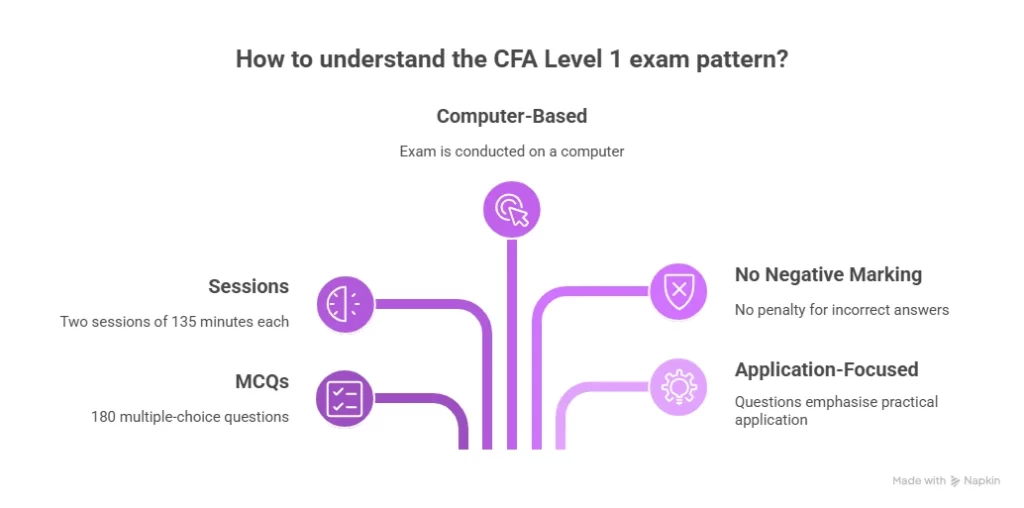
CFA Level 1 Exam Pattern and Structure

Before you learn how to crack CFA Level 1, it’s essential to understand what you’re preparing for.

Exam Format Overview

ComponentDetails
FormatComputer-Based Testing (CBT)
Duration4.5 hours (total) – 2 sessions of 2 hours 15 minutes each
Questions180 multiple-choice (MCQs) – 90 per session
ScoringNo negative marking; each question = 1 mark
LanguageEnglish
Exam Centres (India)Mumbai, Delhi NCR, Bengaluru, Hyderabad, Chennai, Pune, Kolkata and others

Did you know? 68% believe certifications are more valuable than postgraduate degrees for career growth (Business Wire).


Topic-Wise Weightage in the CFA Level 1

CFA Level 1 tests 10 key subject areas, each designed to build a foundation for advanced levels. Knowing the weightage helps you plan study hours strategically.

TopicWeightage (%)Recommended Study Hours (out of 350)
Ethical & Professional Standards15 – 2055 – 65
Quantitative Methods8 – 1230 – 40
Economics8 – 1230 – 40
Financial Reporting & Analysis13 – 1745 – 55
Corporate Finance8 – 1230 – 40
Equity Investments10 – 1235 – 45
Fixed Income10 – 1235 – 45
Derivatives5 – 820 – 25
Alternative Investments5 – 820 – 25
Portfolio Management5 – 820 – 25

Study Hours and Time Commitment

Every CFA Level 1 certificate aspirant dreams of clearing it on the first attempt. The difference between success and burnout lies in the strategy of preparation, not just effort.

A common misconception is that “more hours equal higher success.” However, what truly matters is how you use those hours. The CFA Institute recommends approximately 300 hours of study per level, but successful candidates often structure those hours in phases.

Ideal Timeline (6-Month Plan)

MonthFocus AreaTasks
Month 1Ethics & Quantitative MethodsLay the foundation, practice concept questions.
Month 2Economics & Financial ReportingBuild conceptual clarity through examples from Indian markets.
Month 3Corporate Finance & Equity InvestmentsRelate to real company valuations like Infosys and Reliance.
Month 4Fixed Income & DerivativesUse visual tools to grasp yield curves and options pricing.
Month 5Alternative Investments & Portfolio ManagementFocus on case studies from mutual funds and VC funds.
Month 6Revision + Mock TestsTake 3 – 5 full-length mocks, analyse errors, and refine timing.

Tips from Charterholders

  • Divide your study hours: Aim for 12–15 hours a week, not cramming before the last month.
  • Morning > Night: Studying quantitative or analytical subjects early in the morning improves retention.
  • Daily Revision Ritual: Spend 15 minutes revising formulas before sleep. This spaced repetition solidifies learning.
  • Mock Tests are Gold: Attempt at least 5 full-length mocks to understand your performance under pressure.

Every CFA Level 1 aspirant needs clarity on where to start and what to study each week. The visual guide is designed to help you cover every concept with confidence and strategy.

CFA Level 1 Study Timeline

Study Strategies That Actually Work for CFA Level 1

Cracking the exam isn’t about cramming; it’s about systematic preparation. Here’s how to make your hours count.

a. Follow the Learning Outcome Statements (LOS)

Every CFA book begins with LOS, the exact skills you’ll be tested on. Write them down and tick each as you master it. Think of this as your personal checklist.

b. Use Active Recall and Spaced Repetition

Use flashcards for formulae, for instance, TVM (Time Value of Money) and DCF (Discounted Cash Flow). Revise them weekly to move knowledge from short-term to long-term memory.

c. Mock Tests Are Non-Negotiable

Take at least five mocks under real exam conditions. Analyse your performance to identify weak areas. Students who attempt 5+ mocks typically score 12-15% higher than those who don’t.

d. Focus on Ethics

Ethics is often a deciding factor, especially when you’re on the borderline score. The CFA Institute applies the ‘Ethics Adjustment,’ which can push you from failing to passing if your ethics score is strong.

e. Build a Study Community

Join peer groups on Reddit, LinkedIn or Telegram. Sharing notes and solving questions collectively keeps you accountable. Imarticus CFA students often form cohorts guided by industry mentors, a model that consistently delivers superior pass rates.

f. Stay Current with Financial News

Relate concepts to real-world events. For example, when studying Fixed Income, follow RBI’s repo-rate announcements. It cements your understanding and prepares you for practical application questions.


This insightful mock interview offers a realistic glimpse into how candidates with the CFA Level 1 credential are evaluated in top-tier investment banking roles


Cracking the CFA Level 1 With Smart Study Resources

CFA Level 1 covers a wide conceptual ground, from ethics to derivatives. Choosing the right study resources can drastically shorten your learning curve.

Top Recommended Resources

  1. CFA Institute’s Learning Ecosystem (LES) – the most reliable and updated source.
  2. Kaplan Schweser Notes – concise, easy-to-digest summaries for revision.
  3. Imarticus CFA Prep Program – personalised mentorship-led training designed for Indian learners.

The Imarticus CFA Level 1 prep course stands out because it pairs you with industry professionals and CFA Charterholders who mentor you throughout your journey. This guidance ensures your study plan isn’t generic but tailored to your individual strengths.

Moreover, their guaranteed refund policy (if you don’t clear the exam after following the prescribed schedule) reflects their confidence in their mentorship-driven approach. Explore the program here.


This video dives into three proven strategies to help you effectively manage your time, stay focused, and pass the CFA Level 1 exam on your first attempt.


Breaking Down Key Sections of CFA Level 1

Now that we’ve seen the exam’s scope, let’s dive deeper into what each major topic demands and how you can approach it smartly.

1. Ethics and Professional Standards (15–20%)

Ethics is the bedrock of the CFA program. It defines how analysts maintain integrity and transparency.
Many students ignore it till the end, which is a grave mistake. Ethics is heavily tested, and the Institute often uses Ethics as a tiebreaker in borderline cases.

Approach:

  • Study from the CFA Handbook’s Ethics section directly.
  • Revisit Ethics every week; it’s more about context than memory.
  • Solve case-based questions to understand ethical dilemmas in practical settings.

2. Financial Reporting and Analysis (FRA)

Arguably the most technical section, FRA accounts for 13–17% of the exam.
Understanding income statements, cash flows, and ratio analysis is vital for analysts.

Example:
If a company’s Return on Equity (ROE) is rising, is it due to operational efficiency or increased leverage?
CFA Level 1 ensures you can read beyond the numbers.

Preparation Strategy:

  • Focus on IFRS vs GAAP differences.
  • Practice calculating ratios like ROA, ROE, and EPS manually.
  • Use past question banks to test conceptual clarity.

3. Quantitative Methods

This section tests your statistical intuition, from probability to hypothesis testing.
You use examples from daily life, like estimating average returns from past stock data.

Study tip:
Practice time value of money (TVM) using a financial calculator (e.g., Texas Instruments BA II Plus). Mastering this one tool saves you minutes in every exam.

4. Portfolio Management and Investments

While less weighted, this section introduces fundamental portfolio theories (CAPM, diversification).
Here’s where you start connecting dots, understanding how Ethics, Quant, and FRA translate into actual portfolio decisions.


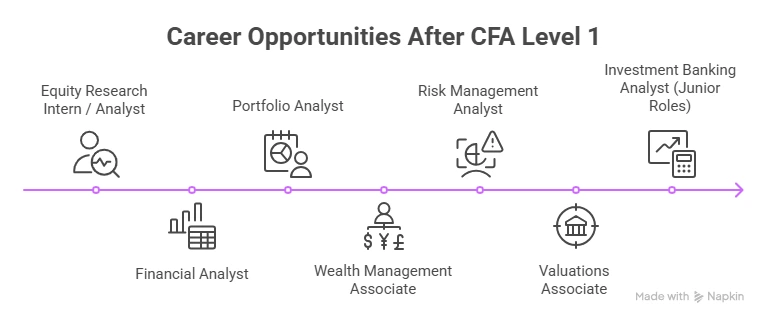
Career Scope After Earning the CFA Level 1 Certificate

Clearing CFA Level 1 is more than just an academic feat; it’s a gateway to global finance. Even at this stage, before completing all three levels, professionals start to unlock significant opportunities in the finance and investment sectors.

The CFA Level 1 certificate demonstrates your grasp of core finance concepts, from ethics and valuation to portfolio management, making you an attractive hire for employers seeking analytical talent.

Top Career Paths After CFA Level 1

  1. Investment Banking Analyst – Supporting M&A transactions, pitchbooks, and valuation models.
  2. Equity Research Associate – Analysing listed companies and preparing reports for institutional investors.
  3. Portfolio Management Assistant – Helping senior managers with asset allocation and performance tracking.
  4. Risk Analyst – Measuring credit, operational, or market risks using statistical models.
  5. Corporate Finance Associate – Managing internal financial strategies and capital structures.

These roles allow you to apply CFA concepts directly in real-world business decisions.


CFA Level 1 Salary in India and Abroad

While the CFA Level 1 salary varies based on geography and experience, data consistently shows that CFA-certified professionals earn significantly higher than their non-certified peers.

Let’s look at the salary insights based on 2025 industry surveys from Glassdoor, Payscale, and CFA Institute Career Centre.

RegionAverage Annual Salary (Post Level 1)Typical Job Roles
India₹6–10 LPAResearch Analyst, Risk Associate, Portfolio Support
UAEAED 95,000–130,000Investment Analyst, Finance Consultant
UK£35,000–50,000Junior Analyst, Investment Banking Intern
USA$65,000–85,000Financial Analyst, Equity Research Associate
SingaporeSGD 70,000–90,000Corporate Finance Associate

(Sources: Glassdoor, Payscale, CFA Institute Career Centre)

Key Insight:

Employers in investment banks, asset management firms, and consulting companies value CFA candidates because of their proven commitment and analytical discipline.

Top recruiters for CFA Level 1 candidates include:

  • JPMorgan Chase & Co.
  • Deloitte
  • EY
  • Goldman Sachs
  • KPMG
  • Morgan Stanley

How to Crack CFA Level 1: Proven Techniques

Passing CFA Level 1 isn’t about memorising; it’s about consistency and method. Here’s a curated list of effective strategies compiled from experienced Imarticus CFA mentors and successful charterholders.

1. Active Recall Over Passive Reading

Instead of rereading textbooks, summarise formulas and concepts in your own words. Use flashcards or spaced repetition apps like Anki for better memory retention.

2. Focus on High-Yield Topics

Prioritise Ethics, FRA, and Quantitative Methods – they make up 45–50% of the exam weight.
Consistent scoring in these ensures a safety margin, even if smaller topics feel shaky.

3. Simulate Exam Conditions

Take at least 5–6 full-length mocks in a realistic setting. This reduces cognitive fatigue and improves time management.

4. Join a Mentor-Led Prep Course

A mentor who’s already a CFA Charterholder can guide you with study pacing, conceptual clarity, and mock test insights. This is where the Imarticus CFA Level 1 program excels.

5. Revisit Ethics in the Final Week

Many toppers recommend dedicating the last week exclusively to Ethics and formula sheets: the Ethics section often acts as the pass/fail differentiator.


Why Choose Imarticus Learning For Your CFA Preparation

When it comes to preparing for the CFA Course, what truly makes a difference isn’t just access to study material; it’s having the right guidance, structure, and support system throughout the journey. That’s exactly what this program delivers. It’s not another generic prep course; it’s a complete mentorship ecosystem built around how real candidates study, struggle, and succeed.

1. Mentor-Led Learning from CFA Charterholders

One of the biggest strengths of the program is its mentor-led classes, conducted by seasoned CFA Charterholders who’ve not only cleared all three levels but also worked in the finance industry. Their real-world insights help bridge the gap between theory and application, making complex topics like equity valuation or derivatives far easier to grasp. This guidance gives learners clarity on what matters most for the exam and how to think like a finance professional.

2. AI-Driven Mock Test Analytics for Smarter Prep

Simply practising questions isn’t enough; knowing where you go wrong and why is what accelerates improvement. Imarticus provides full-length mock tests backed by AI-powered analytics, which break down your performance by topic, difficulty level, and time management. This lets you adjust your strategy early, focus on weak areas, and walk into the exam with confidence and data-backed preparation.

3. End-to-End Career Support and Placement Opportunities

Unlike most CFA prep providers that end their role after the exam, Imarticus extends support beyond certification. Learners gain access to career services, resume building, and placement opportunities with top finance firms, including banks, consulting companies, and investment firms. This is particularly valuable for candidates looking to transition into finance roles or seeking global exposure post-certification.

4. Flexible Schedules for Working Professionals and Students

Balancing CFA prep with a job or college can be challenging. That’s why the Imarticus program offers flexible learning schedules, including weekend and online batches, so learners can maintain consistency without compromising their existing commitments. This balance ensures that candidates stay disciplined without feeling burnt out.

5. Guaranteed Refund Policy for Performance Assurance

Perhaps the most confidence-inspiring feature of the program is its Guaranteed Refund Policy. If you follow the complete study plan and still don’t clear the exam, Imarticus offers a money-back guarantee. 

6. Structured Curriculum Aligned with Global CFA Standards

The program structure mirrors the official CFA Institute’s curriculum but with added localised context for Indian learners—helping you connect theoretical frameworks to practical, market-relevant scenarios. Each module builds on the last, reinforcing learning through case studies, revision bootcamps, and topic-wise tests

7. Personalised Mentorship and Peer Learning Network

Learning doesn’t happen in isolation. Imarticus fosters a strong peer-learning community where aspirants can discuss doubts, share strategies, and learn collaboratively. On top of that, the one-on-one mentorship sessions help you build a study plan tailored to your strengths, pace, and exam timeline.


FAQs on CFA Level 1

Before you begin your CFA Level 1 journey, it’s natural to have a few questions. This section brings together the most frequently asked questions about the Chartered Financial Analyst Level 1 certification, explained in simple, practical terms.

Is CFA Level 1 very tough?

The CFA Level 1 exam is challenging but not insurmountable. Its difficulty comes from its breadth, covering 10 subject areas, rather than extreme complexity. With structured preparation of around 300 hours, you can comfortably pass. The key lies in consistency, not last-minute cramming.

What is CFA Level 1 for?

The CFA Level 1 certificate serves as the foundational step toward becoming a Chartered Financial Analyst. It validates your understanding of ethics, financial analysis, and portfolio management, all essential for roles in investment banking, asset management, and equity research.

Is CFA harder than CA?

Both exams demand rigour but test different skill sets. A CA (Chartered Accountant) focuses on accounting, auditing, and taxation, while CFA Level 1 emphasises valuation, investments, and ethics. For those aiming for global roles, CFA is more internationally aligned. With expert mentorship and structured guidance from Imarticus Learning, students can navigate CFA Level 1 preparation with greater clarity and confidence.

What is the CFA Level 1 salary?

In India, a CFA Level 1 professional typically earns between ₹6-10 LPA, depending on the firm and role. Internationally, the starting average ranges between $60,000-$85,000 per year. Salaries rise sharply with experience and higher-level completion.

Is 27 too late for CFA?

Absolutely not. The average CFA candidate age is around 27–30 years, and many start even later while working full-time. Employers value maturity and applied learning, so starting at 27 is perfectly strategic.

Is CFA equivalent to an MBA?

Not exactly. MBA focuses on broad management training, while CFA is a specialised credential for investment and finance professionals. Many professionals pursue CFA to gain a technical edge, and with Imarticus Learning’s structured mentoring and placement-driven approach, candidates can translate this specialised knowledge into strong career outcomes similar to top finance-focused MBA graduates.

Can CFA earn 1 crore?

Yes, with experience. Senior CFA Charterholders working in portfolio management, private equity, or investment banking can earn ₹1 crore+ annually. However, it typically takes 5–8 years of post-charter experience to reach that level.

Who is eligible for the CFA exam?

To appear for CFA Level 1, you must have either completed your bachelor’s degree or be in your final year. Candidates also need a valid international travel passport. Professionals with relevant work experience can apply too.

Does JP Morgan hire CFA?

Yes. Global firms like JP Morgan, Goldman Sachs, and Morgan Stanley actively recruit CFA candidates for analytical and investment roles. CFA’s emphasis on ethics and quantitative skills aligns perfectly with such employers’ requirements.

Do Indian banks hire CFA?

Yes. Many Indian financial institutions, including ICICI Bank, HDFC Bank, and Axis Bank, hire CFA candidates for roles in risk analysis, wealth management, and corporate finance. The credential enhances credibility in regulated financial services, and with Imarticus Learning’s placement support and industry connections, candidates gain a strong pathway to such opportunities in top-tier financial institutions.

What is the CFA pass rate?

According to the CFA Institute, the global pass rate for CFA Level 1 in 2024 was 39%. This shows the exam’s competitiveness, but also that nearly 4 out of 10 candidates clear it with proper preparation.


Endnote for Every CFA Level 1 Aspirant

Preparing for CFA Level 1 is a test of consistency more than anything else. The syllabus is vast, the concepts are detailed, and balancing it with work or college can feel overwhelming at times. But once you understand how to break it down, setting weekly targets, revising regularly, and practising mock tests, the entire process becomes manageable.

The biggest takeaway most candidates share after clearing Level 1 is this: success doesn’t come from studying the most, but from studying smart. Focus on understanding concepts, not just memorising them. Simulate exam conditions early, and track your weak areas before they snowball.

That’s also where structured guidance, like the CFA Program in collaboration with KPMG in India, offered by Imarticus Learning, makes a difference. It gives you a clear roadmap, personalised mentorship, and placement support to translate your hard work into real career outcomes.