


When people search for ACCA vs CMA, they are rarely looking for a syllabus breakdown alone. The real question usually forms when someone imagines their future workday. The real curiosity lies in how each qualification shapes the way a professional thinks, works, and grows inside an organisation. I approach this comparison by focusing on outcomes rather than labels, because careers rarely unfold on paper the way syllabi do. Let’s start by considering these scenarios:
→ Do they see themselves reviewing financial statements that travel across borders, signing off on reports that stakeholders rely on, and working within structured governance frameworks?
→ Or do they picture themselves sitting closer to the business, shaping budgets, questioning costs, and helping leaders decide where the next rupee or dollar should be spent.
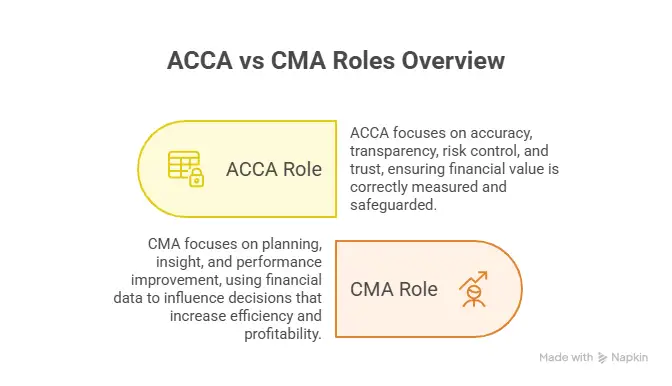
Both ACCA and CMA sit within the same finance ecosystem, yet they influence organisations in very different ways. Professionals with ACCA Certification often become the custodians of financial truth. Their work supports credibility, compliance, and consistency, especially in environments where reporting standards and regulatory clarity matter.
CMA professionals, on the other hand, operate closer to business movement. They work with numbers while they are still flexible, using them to guide planning, performance, and operational decisions.
This difference shapes everything that follows. It affects how responsibility grows, how pressure feels at work, how careers progress, and how value is created inside organisations.
Before comparing ACCA vs CMA, salaries or difficulty, it helps to understand how ACCA and CMA position you inside a business.
Understanding What is ACCA
To evaluate the ACCA vs CMA decision meaningfully, it helps first to understand what ACCA represents and how it fits into the global finance landscape. ACCA, or the Association of Chartered Certified Accountants, is a professional qualification designed to build strong expertise in accounting, financial reporting, audit, taxation, and business governance. It is recognised across industries where accuracy, compliance, and financial credibility are critical.
The structure of the ACCA supports gradual professional development. Learners progress from fundamental accounting concepts to advanced professional judgement, making the qualification suitable for students as well as working professionals who want long-term stability and global relevance in finance roles.
For readers comparing ACCA vs CMA, understanding what is ACCAclarifies why it aligns closely with careers that involve external reporting, audit assurance, regulatory compliance, and cross-border accounting responsibilities.
What ACCA Focuses On
Before looking at comparisons, it helps to understand the core areas ACCA develops:
- Financial accounting and international reporting standards
- Audit and assurance frameworks used by global firms
- Taxation principles across jurisdictions
- Ethics, governance, and professional conduct
- Business analysis and strategic thinking
These areas explain why ACCA is widely accepted by audit firms, consulting organisations, and multinational companies. Here is a detailed look at the ACCA qualification and how it is poised to help you grow into top finance roles:
Key ACCA Facts at a Glance
The table below offers a quick overview of ACCA, highlighting its core features and what it represents as a global finance qualification that allows you to work in 180+ countries.
| Aspect | ACCA Overview |
| Full Form | Association of Chartered Certified Accountants |
| Global Recognition | Accepted in over 180 countries |
| Core Career Alignment | Audit, accounting, reporting, compliance |
| Typical Employers | Big 4 firms, MNCs, consulting firms, GCCs |
| Learning Structure | Progressive levels from basics to professional |
| Entry Pathways | Multiple routes based on academic background |
How ACCA and CMA Shape Professional Thinking
Let’s talk about how ACCA and CMA influence the way finance professionals approach problems, do data analysis, and make decisions at work. It highlights how each qualification shapes thinking patterns that align with different responsibilities inside organisations, setting the context for how careers develop over time.
ACCA Thinking Style in Practice
ACCA professionals are trained to see businesses through the lens of external reporting and governance. The work often involves:
- Interpreting financial statements with precision
- Understanding international accounting standards
- Working within audit frameworks and compliance cycles
- Communicating financial outcomes to regulators, investors, and boards
In real workplaces, this thinking shows up strongly in audit firms, consulting practices, and global accounting teams. ACCA holders are usually trusted to ensure accuracy, consistency, and compliance across jurisdictions. This explains why ACCA vs CMA India searches often come from students aiming for Big 4 audit or global accounting roles.
CMA Thinking Style in Practice
CMA thinking develops closer to operational decision-making. The focus moves inward toward how money behaves inside the organisation. Typical responsibilities include:
- Analysing cost structures and margins
- Supporting budgeting and forecasting
- Evaluating performance metrics
- Translating financial data into management decisions
This thinking aligns naturally with FP&A teams, strategy offices, and finance leadership tracks. When people ask CMA vs ACCA which is better, the answer often depends on whether they see themselves influencing decisions or validating outcomes.
This overview helps frame how financial responsibilities are distributed across organisations when comparing ACCA vs CMA. It adds context to the roles typically associated with each qualification and how these responsibilities often work together within the same business environment:
Eligibility and Entry Pathways Explained Simply
Before choosing between ACCA vs CMA, it helps to understand who can start and how flexible each path is.
ACCA Entry Routes
ACCA is designed to be accessible at multiple stages of an academic or professional journey. Its flexible entry structure allows learners to start early or join later with exemptions, depending on prior education. This adaptability is one of the reasons ACCA remains popular in India, particularly among students who want a structured global qualification without waiting to complete multiple degrees. Understanding the available entry routes helps clarify how ACCA can fit into different career timelines.
ACCA eligibility pathways are a crucial stepping stone in your ACCA journey, and as an aspirant, you need to have a thorough understanding of them and should always refer to them before planning entry or exemptions.
ACCA Entry Pathways at a Glance
| Academic Background | Entry Route | What It Means |
| Class 12 (Commerce) | Direct entry to ACCA | Students can begin ACCA immediately after school and progress through all levels |
| Class 12 (Non-Commerce) | Foundation route | Requires completion of foundational papers before moving to core ACCA levels |
| Bachelor’s Degree in Commerce or Accounting | Entry with exemptions | Eligible candidates may receive exemptions from select papers |
| Professional Qualifications or Relevant Degrees | Advanced exemptions | Prior learning can reduce the number of exams required |
CMA Entry Routes
CMA is structured for professionals who prefer a focused and clearly defined certification pathway. Administered by the Institute of Management Accountants in the US, the CMA program limits complexity by concentrating on a small number of exams while setting clear education and experience requirements. This makes CMA especially appealing to graduates and working professionals who want a direct route into management accounting and business finance roles without navigating a large exam framework.
CMA Entry Pathways at a Glance
| Requirement Area | CMA Entry Condition | What It Means |
| Educational Requirement | Bachelor’s degree | Required to earn the CMA designation |
| Exam Eligibility | Can appear before graduation | Candidates may sit for exams while completing their degree |
| Professional Experience | Two years of relevant experience | Experience in management accounting or financial management is required |
| Administering Body | Institute of Management Accountants (IMA) | Governs curriculum, exams, and certification standards |
Candidates should review IMA IMA-issued guidelines carefully to understand CMA eligibility, experience requirements, and certification timelines before planning their CMA journey.
Duration and Time Investment Reality
Time commitment often shapes perception around ACCA or CMA, which is tough. In reality, duration varies based on exemptions, study intensity, and personal schedule.
| Qualification | Typical Completion Time | Key Influencing Factors |
| ACCA | 2.5 to 4 years | Exemptions, exam sittings, work-study balance |
| CMA | 12 to 18 months | Study intensity, exam scheduling |
These figures are based on completion trends published by ACCA Global and IMA, along with aggregated candidate timelines shared in official annual reports.
What matters more than raw duration is how that time feels. ACCA course duration spreads effort across many subjects, while CMA compresses effort into fewer but deeper exams. This difference heavily influences perceptions around ACCA vs CMA, which is easy.
ACCA vs CMA: Difficulty Through a Practical Lens
Difficulty in ACCA vs CMA is easier to understand when compared to learning styles rather than intelligence. Think of it like driving. Some people are comfortable following clear traffic rules, signs, and lanes, while others are more at ease navigating unfamiliar roads by judging speed, distance, and direction on the spot. Neither approach is harder by default. They simply demand different ways of thinking.
The ACCA course details tend to suit learners who are comfortable with structure, defined standards, and step-by-step problem solving. CMA feels more natural to those who enjoy interpreting situations, weighing options, and deciding the best course of action with limited information. When your natural approach matches the exam style, preparation feels manageable. When it does not, the same syllabus can feel unnecessarily difficult.
Where ACCA Feels Challenging
ACCA demands consistency. The volume of papers means candidates must maintain momentum over a long period. Subjects like financial reporting and audit require comfort with standards and structured answers.
Students from commerce or accounting backgrounds often adjust faster. Others may need time to build accounting fundamentals.
Where CMA Feels Challenging
CMA exams are fewer, but the questions demand applied thinking. Candidates must interpret scenarios, evaluate trade-offs, and justify decisions. The challenge lies in depth rather than breadth.
This is why ACCA or CMA, which is tough, depends strongly on how you prefer to study and think. To understand ACCA course challenges, some thrive on structured rules, others on applied analysis.
Did You Know? ACCA global pass rates typically range between 35% to 55% per paper, depending on the level. (Source: ACCA Global Pass Rates)
Market Recognition and Employer Perception
When evaluating ACCA vs CMA, market recognition and employer perception play a decisive role in how each qualification is valued across industries and regions. Employers often assess ACCA and CMA not just as certifications, but as signals of the kind of work a professional is trained to handle.
In many hiring conversations, questions around CMA vs ACCA, which is better, are framed by role requirements, geography, and business needs rather than course difficulty. Understanding how organisations perceive ACCA or CMA for specific functions helps clarify where each qualification fits within audit firms, corporate finance teams, and global organisations.
ACCA Recognition Patterns
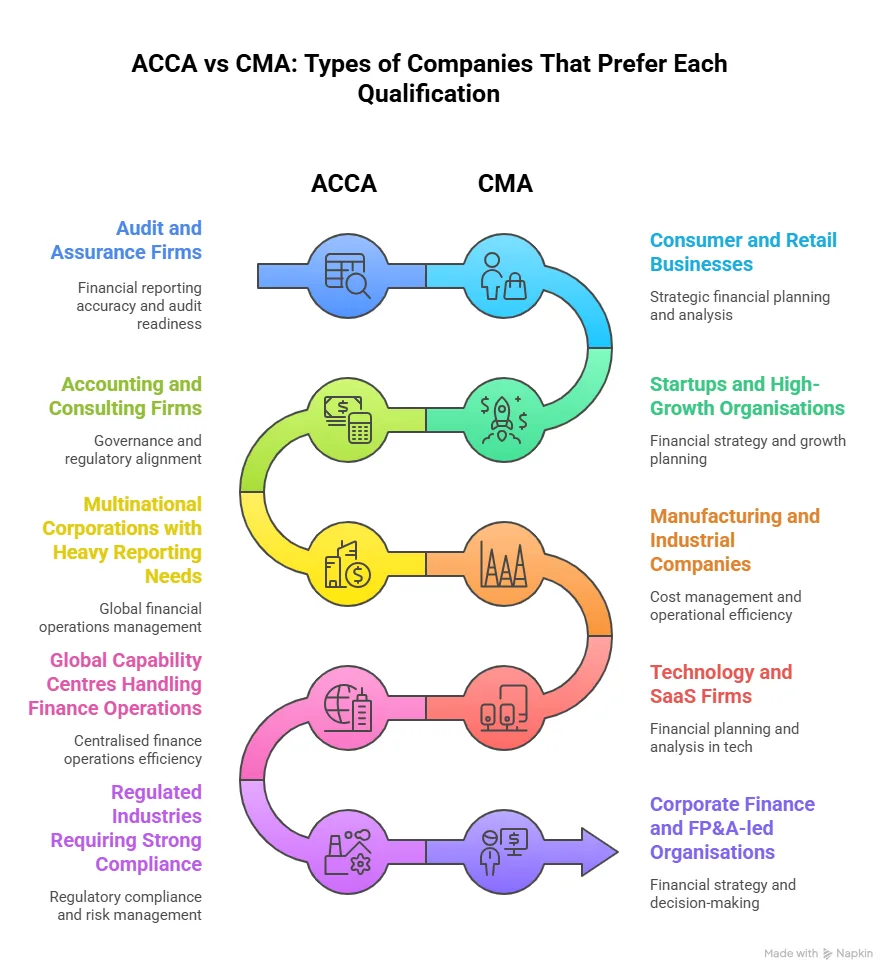
ACCA enjoys strong recognition across Europe, the UK, the Middle East, and Commonwealth markets. In India, ACCA is widely accepted by audit firms, consulting firms, and global shared service centres. This explains the consistent search interest around ACCA vs CMA India.
Big 4 firms openly list ACCA as a recognised qualification for audit and accounting roles. You can find this referenced across recruitment pages on Deloitte, PwC, EY, and KPMG career portals.
CMA Recognition Patterns
CMA holds strong credibility in US-based organisations, multinational corporations, and global capability centres. In India, CMA is increasingly visible in FP&A teams, business finance roles, and leadership pipelines within corporates.
The IMA regularly publishes employer recognition data highlighting CMA adoption across Fortune 500 companies. This visual highlights how different types of organisations naturally align with ACCA vs CMA, based on the kind of finance work they prioritise. It helps connect employer expectations with real business environments, showing where ACCA and CMA are most commonly valued:
ACCA vs CMA Salary and Career Progression
Salary is often the most searched angle in any ACCA vs CMA discussion, yet raw numbers rarely tell the full story. Compensation grows differently for each qualification because the roles, promotion cycles, and value metrics differ. I prefer looking at salary as a progression curve rather than a fixed milestone.
Before going into tables, it is important to understand one thing. Early salaries reflect entry roles. Mid-career salaries reflect how well the qualification compounds with experience. Long-term salaries reflect leadership access.
ACCA vs CMA Salary in India: Entry to Mid-Career Reality
India’s finance job market rewards both ACCA and CMA, but in different pockets of the economy.
Early Career Salary Trends in India
At the entry level, ACCA salary in India and CMA Salary in India tend to sit closer than many expect. The difference starts showing after the first few years of work.
| Career Stage | ACCA Salary Range India | CMA Salary Range India |
| Entry level (0-2 years) | ₹4-7 LPA | ₹5-8 LPA |
| Early mid-career (3-5 years) | ₹7-12 LPA | ₹8-14 LPA |
(Source: AmbitionBox, Glassdoor, PayScale)
This is where searches like CMA vs ACCA salary or ACCA vs CMA salary in India usually peak. The numbers appear close, yet the nature of the roles differs. ACCA roles at this stage are often reporting, audit, or compliance-focused. CMA roles lean more toward analysis, budgeting, and internal finance support.
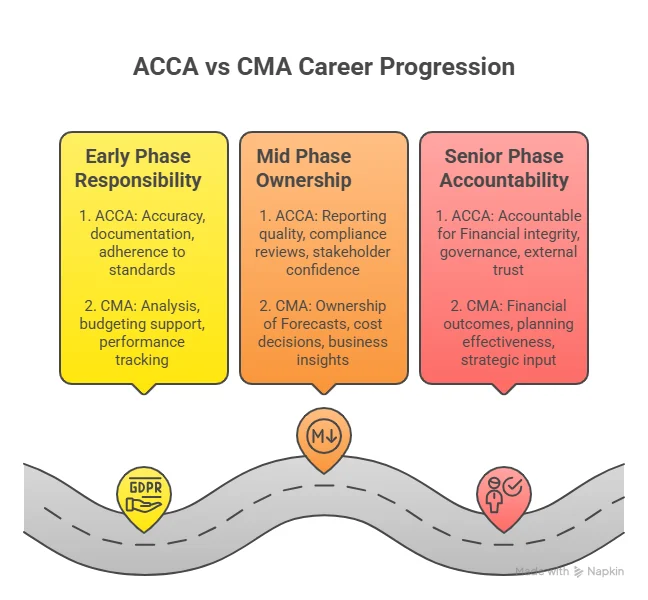
This adds clarity to how professional responsibility evolves over time within the ACCA vs CMA context. It helps connect early role expectations for ACCA Jobs and CMA Jobs with long-term accountability, showing how growth is shaped by the kind of work handled and the level of ownership taken on as careers develop.
ACCA Growth Pattern in India
ACCA professionals see steady growth as they move into:
- Audit management
- Financial reporting leadership
- Risk and compliance roles
- Global accounting operations
Growth tends to be structured, with increments tied to hierarchy and responsibility expansion.
CMA Growth Pattern in India
CMA professionals often see sharper jumps when they transition into:
- FP&A leadership
- Business finance manager roles
- Strategic finance and cost leadership
- CFO office support roles
These trajectories often influence how people evaluate CMA or ACCA, which is better for long-term growth, the ACCA salary insights, and the ACCA career scope.
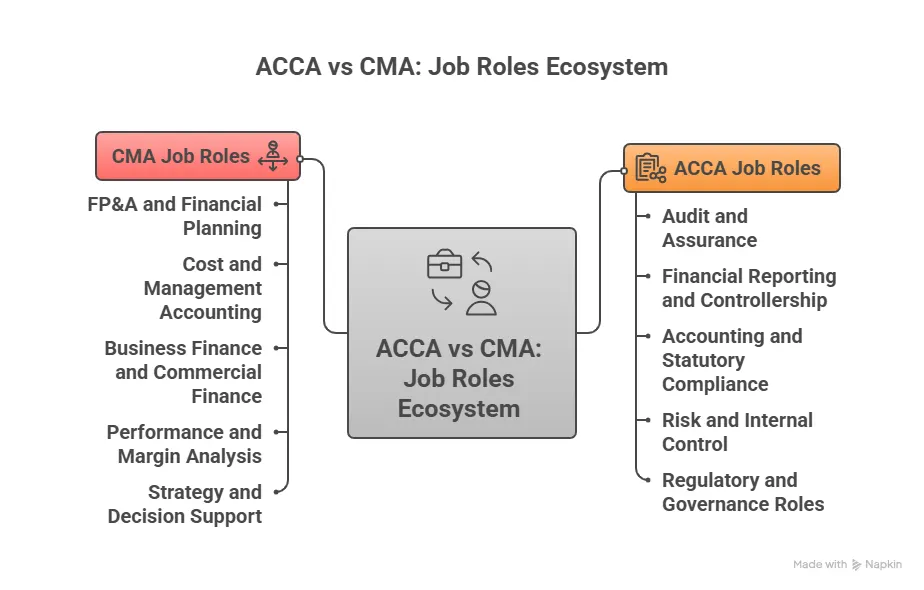
This brings together the role ecosystem within the ACCA vs CMA discussion by showing how finance responsibilities coexist rather than operate in isolation. It helps explain how different roles align with each qualification and how they interact within organisations, reinforcing the idea that ACCA and CMA can serve complementary functions across the finance ecosystem.
ACCA vs CMA USA and Global Salary Landscape
Let’s explore how earning potential and role value differ across regions within the ACCA vs CMA context. ACCA opens doors to high-paying finance jobs by building strong expertise in accounting, audit, and financial reporting roles that are trusted by global firms and multinational organisations across markets. It provides clarity on how global markets, especially the US and other international hubs, recognise each qualification and translate that recognition into compensation, responsibility, and long-term career opportunities.
ACCA vs CMA US Salary Patterns
In the US and other developed markets, CMA holds strong brand equity, especially in corporate finance roles.
| Market | ACCA Average Salary | CMA Average Salary |
| United States | $65,000 to $95,000 | $80,000 to $120,000 |
| Middle East | USD 50,000 to 85,000 | USD 70,000 to 110,000 |
(Source: IMA, Robert Half)
Return on Investment for ACCA vs CMA
ROI is where the ACCA vs CMA comparison becomes practical.
Cost of Qualification
| Qualification | Approximate Total Cost |
| ACCA | ₹2.5-3.5 lakhs |
| CMA | ₹3-4 lakhs |
Time to Recover Cost
- ACCA candidates often recover costs gradually through steady salary growth.
- CMA candidates often recover costs faster due to quicker role transitions.
This difference explains why many working professionals ask ACCA or CMA which is better from an ROI lens rather than an academic one.
Decision Matrix for Choosing Between ACCA and CMA
Choosing between ACCA vs CMA becomes much easier when the decision is grounded in real situations rather than general comparisons. Most students and professionals approach this choice with specific constraints. These could include academic background, career goals, preferred work style, geography, or the time they can realistically commit to preparation. This decision matrix brings those scenarios together and maps them to the qualification that typically fits best.
The intent here is not to declare a winner, but to help you recognise patterns.
| Your Situation or Goal | ACCA Fits Better When | CMA Fits Better When |
| Class 12 student | Early entry into a global accounting qualification | Complete your graduation first, or prefer a shorter certification later |
| Commerce graduate | Want exemptions and a clear path into audit or accounting roles | Aiming for corporate finance or planning roles |
| Working professional | Work in audit, reporting, or compliance and want global recognition | Work in FP&A, business finance, or analysis and want deeper decision exposure |
| Prefer structured study | Defined standards, formats, and rule-based answers | Prefer applied thinking and scenario-based questions |
| Big 4 exposure | Aiming for audit or assurance roles in large firms | Want corporate roles within Big 4 advisory or client finance teams |
| Faster completion | You are comfortable with a longer but steady journey | You want a compact exam structure with fewer papers |
| Global mobility | You want recognition across multiple countries and regions | You want strong relevance in the US and corporate-led markets |
| Value external credibility | Want roles where compliance and accuracy build trust | Want roles where insight and performance drive value |
| Leadership roles | Seeing yourself growing through governance and reporting authority | Influencing strategy and financial decisions |
If Big 4 roles feature in your career plans, seeing how interview questions are framed around audit and finance work can add useful clarity. Here is a short video walkthrough that can help you understand what firms actually look for.
FAQs on ACCA vs CMA
This section addresses the most frequently asked questions around ACCA vs CMA, focusing on career outcomes, salary expectations, difficulty level, and real-world applicability. The answers are designed to clarify common doubts that arise while comparing ACCA and CMA, helping readers connect the qualification choice with practical work roles, long-term growth, and employer expectations across India and global markets.
Which is better, CMA or ACCA?
ACCA vs CMA does not have a universal winner. CMA works better for professionals aiming at internal finance, FP&A, and leadership roles where decisions shape business outcomes. ACCA works better for professionals targeting audit, accounting, compliance, and global reporting roles. The better option depends on how you want to contribute inside an organisation and how you want your career to progress over time.
What is the salary of a CMA and ACCA?
In India, ACCA professionals typically earn between ₹4 to 12 LPA in early to mid-career roles, while CMA professionals often earn between ₹5 to 14 LPA, depending on role and sector. In the US and global markets, CMA salaries often trend higher due to role proximity to business decisions, as seen in ACCA vs CMA USA comparisons.
Do Big 4 accept ACCA?
Yes, Big 4 firms accept ACCA widely. ACCA has a strong advantage in audit and assurance roles. Deloitte, EY, PwC, and KPMG list ACCA as a recognised qualification for audit and accounting profiles across multiple regions. For candidates preparing for these roles, structured training can make a meaningful difference. Programs offered by Imarticus Learning focus on building exam readiness alongside practical exposure.
Can CMA earn 1 crore per month?
In the ACCA vs CMA context, extremely high earnings come from leadership roles, not certifications alone. A CMA professional can earn very high compensation if they reach a CFO or executive finance position in large organisations. Such outcomes depend on experience, business impact, and leadership responsibility rather than the qualification alone.
Is CMA losing value?
CMA is not losing value. In fact, reports show that CMA relevance is increasing in corporate finance, analytics, and strategic roles. As companies focus more on cost control and performance management, CMA-aligned skills remain in demand. Imarticus Learning help CMA aspirants connect exam concepts with real-world finance scenarios, ensuring that the qualification translates into practical value.
Is ACCA tough or easy?
ACCA vs CMA, which is easy, depends on learning style. ACCA can feel challenging due to the number of papers and the need for consistency over time. For students who enjoy structured accounting and reporting, ACCA becomes manageable with disciplined preparation. Coaching support from Imarticus Learning can help candidates stay structured and exam-ready.
What are the disadvantages of CMA?
In ACCA vs CMA comparisons, CMA disadvantages include limited exposure to audit roles and higher pressure due to fewer exams. CMA demands strong application skills, which may feel challenging for candidates without prior work experience. These factors do not reduce CMA value but highlight the importance of preparation quality.
Can I complete ACCA in 6 months?
Completing ACCA in 6 months is not realistic for most candidates. ACCA involves multiple papers and practical experience requirements. Some candidates with extensive exemptions may progress faster, but quality learning still takes time. Structured programs offered by Imarticus Learning focus on realistic planning rather than compressed expectations.
Can I clear ACCA without coaching?
It is possible to clear ACCA without coaching, but ACCA vs CMA success rates show that structured guidance improves consistency. Coaching provides exam strategy, doubt resolution, and accountability. Many candidates choose Imarticus Learning to balance self-study with expert support, especially while managing work or college commitments.
Where Your Finance Journey Takes Shape
Deciding between ACCA vs CMA is less about choosing a qualification and more about choosing the kind of professional identity you want to build. This blog has explored how each path influences daily work, responsibility, salary growth, and long-term relevance across India and global markets. ACCA emerges as a strong fit for those who value structured learning, global recognition, and roles rooted in accounting, audit, financial reporting, and compliance. Its progression mirrors how trust is built in finance, step by step, through accuracy, judgment, and consistency.
When preparation aligns with career intent, the journey feels clearer and more focused. Many learners find that a guided approach helps translate syllabus knowledge into real professional confidence. The ACCA Course prep offered by Imarticus Learning is designed to support this transition, blending exam preparation with industry context.
As you weigh your options and map your next steps, choosing a preparation path that reinforces your long-term goals can make all the difference in how confidently you move forward.