


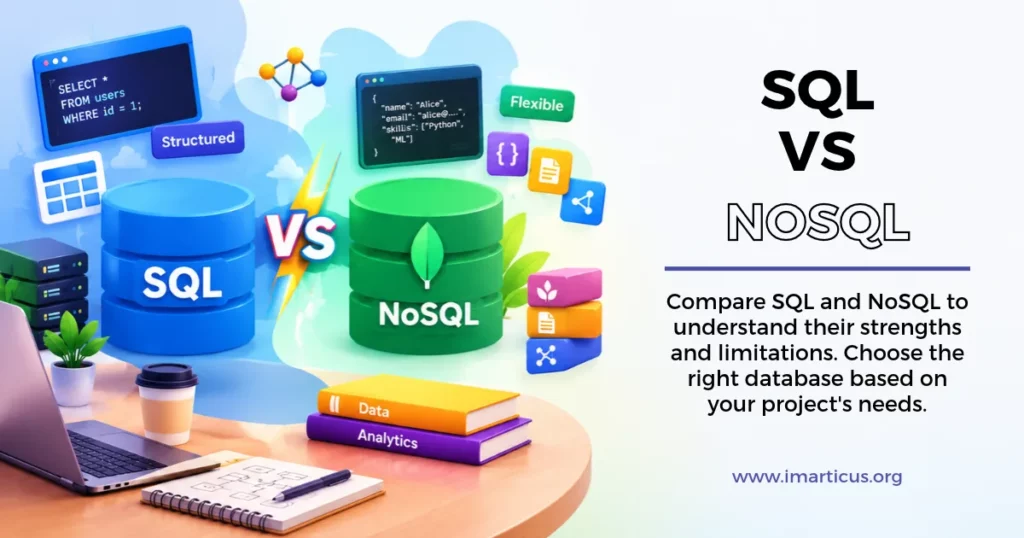
SQL vs NoSQL is a question of how strong you want your data to be. SQL databases like MySQL and PostgreSQL store data in tables with set columns, which makes them a good fit for money, orders, and anything where the numbers must match exactly. NoSQL databases like MongoDB and Redis don’t need a fixed table, so they handle messy, changing, or very large data more comfortably. One isn’t faster than the other in every case. It depends on the work. Pick SQL when your data is connected and accuracy matters. Pick NoSQL when the data is loose, or the traffic is huge. Plenty of real products end up using both.
When it comes to SQL vs NoSQL, the right choice depends on your project. I learnt this on one of my early projects, where I picked a database in the first week, and by month three the data looked very different from what I had planned. Rebuilding it taught me a lot. Since then, I ask two simple questions before choosing anything: what will the data look like, and how big will it get? Answering those two points me to the right database every time.
This blog walks through the difference between tables and diagrams, then covers when to use which one, what happens with speed, the questions people get asked in interviews, and what is worth learning first. If you want to learn this properly and not from scattered videos, the Data Analytics Course at Imarticus starts from your first query and goes up to real projects.
SQL vs NoSQL Database
Think about a school admission desk. There’s a cupboard full of printed forms. Every form has the same boxes: name, roll number, class, parent’s phone number. Nobody can skip a box, so if something is missing, you notice at once. Finding a student is quick because every form is laid out the same way.
Don’t Let Our Best Advice Get Buried
Add Imarticus as a Preferred Source — see more of what we publish, every time you search.

Next to it is another cupboard, and this one is a mess. Each student has a folder, and teachers throw in whatever they have. One folder has a photo and a report card. Another has a swimming certificate and a letter from a parent. No two folders match. The first cupboard is SQL. The second one is NoSQL. Once you picture that, you’ve got most of the SQL vs NoSQL idea already. The rest is detail.
A rough way to remember it:
- Same boxes every time means SQL.
- Different stuff in every folder means NoSQL.
SQL Database Meaning
SQL stands for Structured Query Language. A SQL database is also called a relational database, and it keeps everything in tables. One row is one record, like a single customer. One column is one detail about that record, like the city. You have to decide the columns before you add any data. Tables are linked using keys, so an order table can hold just a customer ID and not the whole address again and again.
MySQL and PostgreSQL are the ones you will meet most. Oracle and Microsoft SQL Server show up a lot in bigger companies. Learn SQL on one of them and moving to another is easy, because the language stays almost the same.
NoSQL Database Meaning
The name is usually read as “not only SQL”. It’s a little confusing because NoSQL isn’t one database. It’s a group of them, and what they share is that they don’t need a fixed table. Data can be saved as documents, as key-value pairs, as columns, or as connected points. Two records in the same place don’t have to look alike, and beginners usually find that strange at first.
Many NoSQL databases were made so that data can be spread across lots of machines. That is the reason apps with millions of users like them. In the SQL vs NoSQL databases debate, both sides store and fetch data. They only argue about how strict to be.
Did You Know?
SQL has existed since the 1970s. The term NoSQL only became popular around 2009. Both are still in heavy use today. (Source)
SQL vs NoSQL Difference at a Glance
When I teach this to freshers, I start with a table. It saves a lot of talking. Here is the SQL vs NoSQL comparison table I use.
| Feature | SQL | NoSQL |
| Data model | Tables with rows and columns | Documents, key-value, wide-column, or graph |
| Schema | Fixed, set before data goes in | Flexible, can change any time |
| Query language | SQL | Varies by database |
| Relationships | Strong, handled with joins | Often handled by nesting data |
| Transactions | Full ACID support | Varies; many follow BASE |
| Scaling | Mostly vertical, a bigger server | Mostly horizontal, more servers |
| Best for | Structured data, reports, accuracy | Large, varied, fast-changing data |
| Examples | MySQL, PostgreSQL, Oracle | MongoDB, Redis, Cassandra, Neo4j |
So what is the SQL vs NoSQL difference in simple terms? SQL is strict and gives you accuracy. NoSQL is loose and gives you room to grow. Some people search for it as NoSQL vs SQL, but it’s the same question. Below is a SQL vs NoSQL comparison diagram that puts the same idea in one picture.
What the table means when you are actually building something:
- If every record has the same fields, a table feels natural.
- If records keep changing shape, documents will save you from a lot of rework.
- If a wrong number costs real money, you want SQL’s strict rules.
- If you expect users to jump from thousands to millions, a database built to add servers makes life easier.
- SQL is one language you learn once. Each NoSQL database has its own way of doing things.
- If your manager keeps asking for monthly totals and filters, SQL is the comfortable choice.
SQL vs NoSQL Diagram
Let me use one small example. Asha orders two notebooks and five pens from an online shop. The order is the same in both databases, but it’s stored in a very different way. This SQL vs. NoSQL diagram shows how.
In a SQL database, the order is cut into three tables so nothing gets saved twice. First, the customer.
| id | name | city |
| 1 | Asha | Pune |
customers
Then the order, which only holds Asha’s customer ID.
| id | customer_id | date |
| 101 | 1 | 12 Oct 2026 |
orders
Then the items, one row for each product.
| order_id | product | qty |
| 101 | Notebook | 2 |
| 101 | Pen | 5 |
order_items
In a document database like MongoDB, the whole thing sits in one document:
Now look at the NoSQL vs SQL diagram and think about a normal working day.
- To read the order, SQL has to join three tables. NoSQL picks up one document.
- If Asha moves to a new city, SQL changes a single row. In NoSQL, her city may be copied into many old orders, so you have more to update.
- If you want to start saving gift messages, SQL needs a new column first. NoSQL just lets the next document have one.
- SQL saves Asha once, so you won’t end up with her name spelled two different ways.
Neither one is wrong. SQL stays tidy and avoids repeats. NoSQL keeps related things together, so reading is quick.
Also Read: SQL for Data Science
Types of NoSQL Databases
When someone says “we use NoSQL”, ask which one. There are four main types, and they are very different from each other. Mixing them up is how teams pick the wrong tool. Here is what each type does in a SQL vs NoSQL choice.
| Type | How it stores data | Popular example | Typical use |
| Document | JSON-like documents in collections | MongoDB | Product catalogues, user profiles |
| Key-value | A key linked to a value, like a giant dictionary | Redis | Caching, sessions, leaderboards |
| Wide-column | Rows with flexible columns across many servers | Cassandra | IoT data, logs, heavy writes |
| Graph | Nodes and the links between them | Neo4j | Social networks, fraud checks, recommendations |
A simple way to picture them:
- A document database is a folder of papers.
- A key-value store is a locker. One key opens one thing.
- A wide-column store is a huge spreadsheet where each row can have its own columns.
- A graph database is a map of who knows whom, with lines drawn between people.
These are also the SQL vs NoSQL examples people usually ask about in interviews. MySQL and PostgreSQL on one side, and these four on the other.
Also Read: MongoDB: Definition, Uses and Benefits
SQL vs NoSQL Speed, Scale and Consistency
“Which one is faster?” Everybody asks this in the SQL vs NoSQL debate, and the answer I give is always a bit irritating. It depends on what you ask the database to do.
Speed Depends on the Task
Speed isn’t a built-in feature of one type. It changes with the job.
- For simple lookups at a huge scale, a key-value store like Redis is hard to beat. It keeps data in memory, so replies often come in under a millisecond.
- For reports with totals and filters across many tables, SQL is built for exactly that, and a few good indexes make it quick.
- For writes where the data keeps changing shape, document and wide-column stores are comfortable, because nothing checks each record against a fixed design.
- A badly designed database is slow in either camp. Check your queries before blaming the type.
Scaling Up and Scaling Out
SQL databases usually grow by getting a bigger machine. That is called scaling up. NoSQL databases usually grow by adding more machines, and the data gets spread across them. That is called sharding, or scaling out. SQL can be spread over servers too, but it takes planning and a bit of patience.
Think of a tea stall. Scaling up is buying a bigger kettle. Scaling out is opening three more stalls down the road.
ACID and BASE in Simple Words
SQL follows ACID. It sounds heavy, but the idea is easy. A transaction either finishes fully or doesn’t happen at all. If you send ₹5,000 to a friend, your account is debited, and theirs is credited together. You never end up in a state where only half of it happened.
Many NoSQL databases follow BASE instead. The data is available, and the copies on different servers catch up with each other after a short delay. Nobody cares if a like counter is two seconds late. Everybody cares if a bank balance is two seconds late. The gap has also shrunk, since MongoDB and a few others now support multi-document transactions.
Some questions help you decide:
- Can this data be a few seconds old without hurting anyone?
- Will two people ever change the same record at the same time?
- Would half a finished transaction cause real damage?
Pro Tip:
Test with your own data before you decide. A small trial with realistic data tells you more than any benchmark online.
When to Use SQL vs NoSQL
Start from your data and not from the tool you like. Whenever someone asks me about SQL vs NoSQL and when to use each, I go through three checks.
- Look at the shape of the data. Same fields in every record point to SQL. Records that vary a lot or sit inside each other point to NoSQL.
- Think about what a mistake costs. Money, stock, and medical records deserve strict rules.
- Think about how fast you will grow. Millions of writes an hour from many sources is what NoSQL was made for.
Choose SQL When
- Your data is full of connections, like customers, orders, and payments depending on each other.
- Accuracy can’t slip, as in banking, billing, and accounting.
- You need dashboards and totals across several tables.
- You already know your fields, and they rarely change.
- Your team already knows SQL, which saves a surprising amount of time.
Choose NoSQL When
- New fields keep appearing every few weeks, and you don’t want to redesign tables each time.
- Logs, sensor readings, or clicks arrive faster than one server can store.
- Speed matters more than strict rules, like caches, login sessions, and live feeds.
- The links between things are the main point, like friends and recommendations, which suits a graph database.
- You are building a quick prototype and the final shape of the data is still unknown.
Here is a SQL vs NoSQL database comparison by use case. Screenshot it if you like.
| Your situation | Better fit | Why |
| Banking, payments, billing | SQL | Exact, consistent transactions |
| Inventory and ERP systems | SQL | Clear links between records |
| Reporting and BI dashboards | SQL | Easy totals and joins |
| Product catalogue with varied details | NoSQL (document) | Each product has different fields |
| Live chat and activity feeds | NoSQL | Fast writes, flexible data |
| Caching and login sessions | NoSQL (key-value) | Very quick reads |
| Social networks, recommendations | NoSQL (graph) | Easy to follow connections |
| IoT sensor data | NoSQL (wide-column) | Heavy write volume |
That’s when to use SQL vs NoSQL on one page. If your project sits somewhere in between, I tell beginners to start with SQL. It’s easier to find help for, and it’s seldom a bad first choice.
NoSQL vs SQL Database in System Design and Interviews
This topic comes up in interviews a lot, and searches for SQL vs NoSQL system design and interview questions keep going up. The interviewer is usually not checking whether you remember a definition. They want to see how you think. These are the questions you’ll hear most.
- Explain the difference between SQL and NoSQL in your own words.
- When would you pick MongoDB over MySQL?
- What does ACID mean and why does it matter?
- How would you design the database for a ride-booking app?
- What is sharding and when do you need it?
A simple way to answer almost any of them is to go through three things.
- The shape of the data. Is it structured and linked, or varied and nested?
- The access pattern. Will it be read a lot, written a lot, or used for heavy reports?
- The size and consistency. How big will it get, and can it be slightly out of date for a moment?
End with the line interviewers like to hear: “In a real system I would probably use both.” It shows you know a NoSQL vs SQL database choice is made feature by feature, not once for the whole company.
A few things that quietly hurt your answer:
- Saying one database is always better, with no reason.
- Not mentioning how much data and traffic you are designing for.
- Skipping consistency, which interviewers often poke at on purpose.
Real Projects Where SQL and NoSQL Work Together
Most real products don’t choose a side in the NoSQL vs SQL argument. Go back to the online shop. A sensible setup could look like this.
- Orders and payments in SQL, because every rupee has to add up.
- The product catalogue in a document database, because a phone and a shirt have very different details.
- Cart and login sessions in a key-value store, because speed matters there.
- The “people also bought” suggestions from a graph database that follows links between buyers and products.
There’s even a name for this: polyglot persistence. It sounds fancy, but it just means using the right database for each job.
You see the same thing in learner projects. In capstone-style work by Imarticus learners, MongoDB and PostgreSQL often sit side by side, one for flexible app data and one for structured records. After you’ve seen that a few times, SQL vs NoSQL stops feeling like a fight.
Also Read: Top Data Analytics Skills Every Professional Needs
Who Should Learn SQL and NoSQL
SQL vs NoSQL isn’t only for developers. Anyone who works with data gets something out of knowing both, even a little. This is how I’d split it up.
Students
If you are still in college, start SQL as early as you can. Do a few weeks of daily practice on something small, like a library or a movie database. Then build the same thing in MongoDB and see what changes. That is the quickest way to feel the SQL vs NoSQL difference yourself.
Working Professionals
Analysts, testers, marketers, and operations people often wait days for someone else’s report. If you learn SQL, you can pull the numbers yourself. NoSQL starts to matter when you work with app data, logs, or user activity.
Non-Technical Background
SQL reads almost like English. A line like SELECT name FROM customers WHERE city = ‘Pune’ makes sense even on day one. You don’t need a coding degree. Many people from commerce and arts pick it up faster than they expect.
Whatever your background is, the first step is the same. Write real queries on real data. Reading about it only goes so far.
When to Learn SQL and NoSQL
- After the 12th or in college, learn SQL basics along with your first programming language.
- After graduation, add Excel, Python, and a dashboard tool next to SQL so you are job-ready.
- If you are changing careers, start with SQL because it gives useful results fast.
- If you already work with data, add NoSQL when you meet app data that won’t fit into rows.
SQL isn’t going anywhere. It sits under most analyst and data jobs, and newer databases keep adding SQL-style querying.
Where SQL and NoSQL Each Fall Short
Every database gives up something, and SQL vs NoSQL is no different. It’s better to know the limits now than find them in the middle of a migration.
Limits of SQL Databases
- Changing a table on a huge, busy database needs careful planning.
- Spreading one database across many servers is harder than in most NoSQL systems.
- Deeply nested or very varied records don’t sit well inside tables.
- Too many joins on big tables can slow reports down if nobody looks after the indexes.
Limits of NoSQL Databases
- Joins are weaker, so combining data from different collections takes more effort.
- Details copied into many documents are easy to miss when you update.
- Every tool has its own style, so learning MongoDB doesn’t teach you Cassandra.
- With a loose structure, messy data creeps in if nobody sets any rules.
This is why mixing the two works so well. Each one covers the other’s weak spots.
The Future of SQL vs NoSQL
The two sides are slowly moving closer, which is good news for anyone learning them. Some of it is already happening.
- SQL databases can now store and search JSON. PostgreSQL’s JSONB type is the well-known example.
- NoSQL databases now offer transactions and SQL-like querying.
- Cloud providers run both as managed services, so there is less setup work.
- Both sides are adding vector search, which helps AI tools find similar text and images.
Will one side win? I doubt it. The better skill is knowing both well enough to choose without stress. That’s also why I keep telling beginners to learn SQL first and add NoSQL after.
Also Read: Data Science Skills and Tools
Why Choose Imarticus for Data and Database Skills
You only really learn SQL vs NoSQL when you write queries, break things, and fix them. That’s the idea behind the Data Analytics Course at Imarticus. It is a postgraduate programme in data science and analytics with GenAI, made for freshers and people changing careers.
These are the points that stand out on the course page.
| What you get | Why it helps |
| SQL for Data Handling module | Covers database creation, E-R diagrams, joins, GROUP BY, subqueries, window functions and CTEs, with AI-assisted query optimisation |
| 300+ hours of live learning | Classroom or live online sessions with regular doubt clearing |
| 35+ tools and projects | Excel, SQL, Python, Power BI, Tableau and more, used on real datasets |
| 3-week Project Bootcamp | Group projects with expert feedback |
| Data Science and AI Studio | Hackathons, blogathons and masterclasses that build your portfolio |
| Internships | Merit-based internships through the Imarticus Data Science Consulting Club |
| Career support | 40+ hours of live job prep, 10 guaranteed interviews and 100% job assurance |
| Mentorship | A dedicated program manager and 1:1 guidance from industry experts |
| Certification | A postgraduate certificate backed by NSDC and Skill India |
The programme runs for 6 months on weekdays or 10 months on weekends. You don’t just read about SQL vs NoSQL. You use SQL on structured data, see NoSQL in real projects, and finish with a portfolio to show employers.
FAQs About SQL vs NoSQL
Still stuck between SQL vs NoSQL for a project or an interview? Frequently asked questions about SQL vs NoSQL that I hear most from beginners, answered in a few lines each.
Is MongoDB NoSQL or SQL?
MongoDB is NoSQL. It stores data as JSON-like documents and not as rows and columns. It has its own query language, though some tools now let you use SQL-style queries on it.
What is the difference between NoSQL and MySQL?
MySQL is one particular SQL database. NoSQL is a whole group that includes MongoDB, Redis, and Cassandra. A fair comparison is MySQL vs MongoDB, or SQL vs NoSQL as two approaches.
Is SQL a dying skill?
No. SQL is still one of the first skills asked for in analyst and data jobs, and it sits at the base of our own data analytics programme. Newer databases keep adding SQL-style querying, which shows where things are going.
Is SQL faster than NoSQL?
In the SQL vs NoSQL speed debate, neither wins everywhere. SQL does better on complex reports with joins. NoSQL does better on simple lookups and heavy writes at very large scale. Test with your own data.
Does Netflix use NoSQL?
Yes. Netflix is widely reported to use Cassandra, a NoSQL database, for a large part of its data, along with other kinds of databases. Big platforms rarely depend on one tool.
Is SQL better than MongoDB?
Not SQL is not better than MongoDB, just different. SQL suits structured data with lots of connections and strict accuracy. MongoDB suits flexible, nested data that changes shape often. The better one is whichever matches your data.
Which NoSQL DB is best?
There isn’t one best. MongoDB is the usual pick for general document data, Redis for caching, Cassandra for write-heavy data across many servers, and Neo4j for connected data like social graphs.
Why MongoDB instead of MySQL?
Teams choose MongoDB when their data is nested or changes often, because they can add fields without redesigning tables. MySQL stays the better choice when you need strict structure and lots of joins.
Is MongoDB hard to learn?
Not MongoDB is not hard to learn, especially if you know basic JSON. The first steps are easy. Aggregation pipelines and data modelling need more practice, and learning SQL first makes the whole path smoother.
Choosing Between SQL and NoSQL
I said at the start that neither database wins, and I still think that. SQL gives you order, accuracy, and a language every data team understands. NoSQL gives you room to grow and lets you store data in whatever shape it comes in. SQL vs NoSQL is really a question about your data, not about which tool is trending this year.
So next time it comes up, look at your data, run a small test, and be ready to use both if the project needs it. And if you want to build these skills with live classes, real projects, and interview support, the Data Analytics Course is where I would send a friend to start. Choose the database that fits the problem, and the rest gets easier.
Liked This? Follow Us Where You Already Search.
Preferred Sources is Google’s built-in follow button — no app, no login, just more Imarticus in your results.