


Last updated on May 15th, 2026 at 03:08 pm
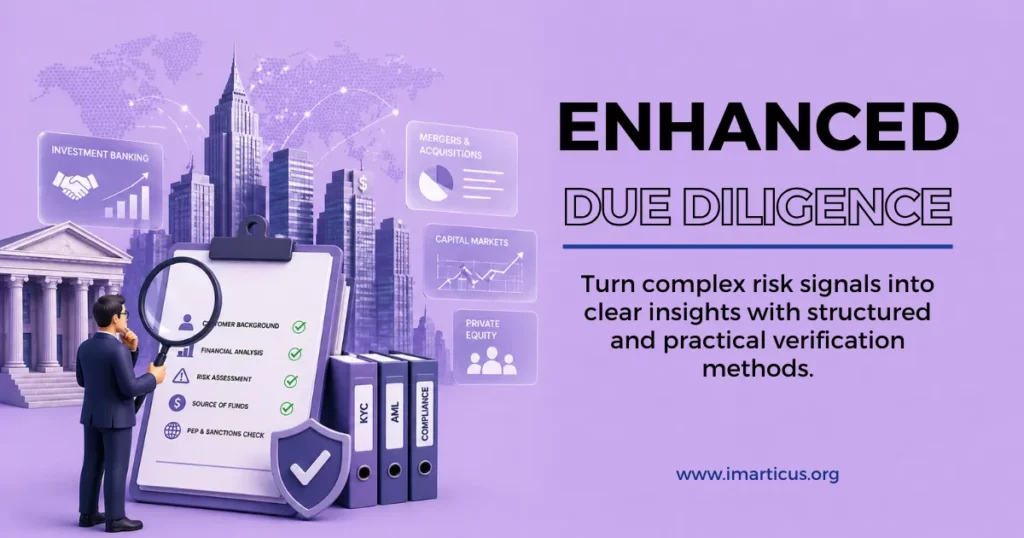
Most risks don’t announce themselves. They sit quietly inside clean documents, normal-looking transactions, and familiar profiles. On the surface, everything checks out. So how do financial institutions decide when something deserves a second look? That question sits at the heart of enhanced due diligence.
It is not about distrusting every customer. It is about knowing when basic checks stop being enough. You will often see this come up when people search for what is enhanced due diligence or try to understand the enhanced due diligence meaning in practical terms.
Think about this for a moment. If someone opens an account with standard documents and a stable profile, the process stays simple. But,
→ What if large transactions start appearing without a clear source?
→ Or the ownership structure suddenly becomes layered and difficult to trace?
This is where enhanced due diligence EDD moves from theory to necessity. It steps in quietly, but it changes how every detail is examined.
The interesting part is that most people do not realise when enhanced due diligence is required to be done when these shifts happen. It is not always dramatic. Sometimes, it is just a small inconsistency that does not quite fit. And yet, those small gaps are exactly where larger risks tend to grow.
Don’t Let Our Best Advice Get Buried
Add Imarticus as a Preferred Source — see more of what we publish, every time you search.

If you are looking at finance as a serious career path, this is the kind of thinking that sets you apart. Understanding how to question data, connect patterns, and apply deeper checks is not just useful. It is expected. This is also where structured learning paths, like an investment banking certification, begin to make more sense because they focus on how these decisions are actually made, not just what they are called.
By the time you finish this blog, you will not just know what enhanced due diligence is. You will start to recognise where it fits, why it matters, and how it quietly shapes the decisions that keep financial systems stable.
What Is Enhanced Due Diligence
If I had to explain, ‘what is enhanced due diligence’ in the simplest way, I would say this. It is what you do when a basic check doesn’t give you enough confidence. The enhanced due diligence meaning becomes clearer when you look at everyday situations. Imagine lending money to a friend. If it’s a small amount, you don’t think much. If it’s a large amount, you ask questions.
→ Where will it go?
→ When will it come back?
That extra layer of questioning is the same idea. In finance, this becomes structured. The system cannot rely on trust alone. It needs proof.
Now, while understanding, ‘What is Investment Banking’, you’ll notice something subtle. A lot of decisions are not just about returns. They are about risk. And risk needs context. That context comes from processes like enhanced due diligence EDD.
What Actually Happens During Enhanced Due Diligence
This is where things move beyond theory. The process is not just about collecting documents. It is about connecting dots.
- A person’s identity is checked across more than one source, so there is no room for a mismatch or error.
- Financial activity is reviewed over time instead of looking at a single transaction in isolation.
- The source of funds is examined carefully to ensure money is coming from legitimate channels.
- Connections with businesses or individuals are studied to understand hidden relationships.
- Activity is monitored continuously because risk can change over time without warning.
Each of these steps may seem simple on its own. Together, they create a much clearer picture.
Understanding investment banking adds context to how financial decisions are made. It clarifies what investment bankers do, how deals are structured, and how roles connect with risk evaluation and client analysis in real-world finance.
EDD Full Form In Banking And Why It Matters
The EDD full form is Enhanced Due Diligence. In banking, the EDD full form in banking carries more weight than it sounds. It is not just a label. It signals that a customer falls into a category where extra care is required. You’ll see EDD used in banks, fintech platforms, insurance companies, and even investment firms. Anywhere money flows, risk follows. And where risk increases, EDD follows closely behind.
Where You Will See EDD In Practice
It helps to look at how different industries and investment banking roles use this in their own way.
| Sector | Where EDD Fits In | Why It Is Used |
| Banking | Large transactions and high-risk clients | To prevent fraud and comply with regulations |
| Fintech | Digital onboarding and identity checks | To stop fake identities early |
| Insurance | Policy approvals and claims review | To avoid fraudulent claims |
| Investment Firms | Client verification and fund tracking | To ensure money is legitimate |
| Crypto Platforms | Wallet and transaction tracking | To monitor anonymous activity |
Each industry adapts it slightly. The purpose stays the same. Reduce uncertainty before it becomes a problem. Once you see this across sectors, EDD stops feeling like a technical term. It starts feeling like a necessary habit.
Why Enhanced Due Diligence Becomes Necessary
There is a point where basic checks stop being enough. That point is not always obvious. Enhanced due diligence becomes important when something does not fully add up. Not wrong. Just unclear.
Think of it like meeting someone for the first time. A short conversation gives you a basic sense. A longer one reveals intent, consistency, and sometimes contradictions. Financial systems work in a similar way.
Why Institutions Rely On Enhanced Due Diligence
- It helps uncover risks that are not visible during standard verification processes used for low-risk customers.
- It allows organisations to comply with strict global regulations that demand deeper investigation in certain cases.
- It protects businesses from being linked to illegal activities that can damage reputation and credibility.
- It improves decision-making by offering a fuller view of customer behaviour over time.
- It reduces long-term losses by catching issues early instead of reacting after damage is done.
There is also a scale factor here. According to reports, financial systems handle massive volumes daily. Even a small percentage of risky activity can lead to significant losses if not caught early. That is where enhanced due diligence earns its place.
When Enhanced Due Diligence Is Required
Not every situation calls for deeper checks. The system is designed to focus effort where it matters most. The phrase enhanced due diligence is required to be done when risk crosses a certain threshold. This threshold is based on patterns, behaviour, and sometimes geography.
You’ll often hear that enhanced due diligence is usually required for high-risk customers. That is accurate, but it helps to break it down further.
Situations That Require Enhanced Due Diligence
- When a customer is linked to political exposure, it increases the chance of financial misuse or influence.
- When transactions involve countries with weaker financial regulations or higher corruption risks.
- When large sums of money move without a clear and traceable source of origin.
- When business structures are layered in a way that hides the real owner behind multiple entities.
- When transaction patterns shift suddenly without a logical explanation tied to past behaviour.
How Risk Levels Influence EDD
| Situation | Risk Level | Action Taken |
| Politically exposed individuals | High | Detailed background checks |
| Cross-border transactions | Medium to high | Source verification |
| Large financial transfers | High | Fund tracing |
| Complex ownership structures | High | Ownership analysis |
| Irregular transaction patterns | High | Continuous monitoring |
Each of these situations adds a layer of uncertainty. Enhanced due diligence steps in to remove that uncertainty as much as possible. After a point, it becomes less about rules and more about judgment supported by data.
Enhanced Due Diligence Vs Customer Due Diligence
This is where many people get confused. The difference seems small on the surface, but it changes how decisions are made.
- Customer due diligence is applied to everyone. It is the starting point. Basic identity checks, simple verification, standard onboarding.
- Enhanced customer due diligence meaning goes further. It is applied when risk is higher and basic checks leave gaps.
Understanding The Difference Clearly
| Factor | Customer Due Diligence | Enhanced Due Diligence |
| Scope | Basic verification | Detailed investigation |
| Risk Level | Low to medium | High |
| Monitoring | Occasional | Continuous |
| Data Depth | Limited | Extensive |
| Application | All customers | Select high-risk cases |
Once you see this side by side, the distinction becomes clearer. CDD builds the foundation. EDD strengthens it when needed. And that balance is what keeps financial systems steady.
Enhanced Due Diligence Process Step By Step
Once you move past definitions, the real value lies in how enhanced due diligence is actually carried out. This is where many explanations become too rigid. In reality, the process is structured, but it still needs judgment at every step.
I like to think of it as building a case. You do not jump to conclusions. You gather pieces. You test them. You keep checking if the story makes sense. That is how enhanced due diligence EDD works in practice.
How The Process Unfolds In Real Situations
Before getting into structure, it helps to see the flow as something continuous rather than a checklist that ends.
- A profile is first flagged based on certain risk indicators that suggest a deeper review may be needed.
- Information is then collected in more detail, going beyond identity to include financial behaviour and history.
- Every piece of information is verified through reliable sources to avoid relying on assumptions.
- Patterns are studied carefully to identify anything that feels inconsistent or out of place.
- Monitoring continues even after onboarding because risk does not stay constant over time.
Each stage depends on the one before it. If the early steps are weak, everything that follows becomes unreliable.
Step-by-Step Structure Of Enhanced Due Diligence
| Step | What Happens | Why It Matters |
| Risk Identification | Customers are flagged based on predefined criteria | Helps focus effort where risk is higher |
| Data Collection | Detailed financial and identity information is gathered | Builds a complete profile |
| Verification | Information is cross-checked across sources | Ensures accuracy |
| Risk Analysis | Behaviour and patterns are examined | Detects hidden risks |
| Ongoing Monitoring | Activity is tracked over time | Captures changes early |
What stands out here is that nothing is done in isolation. The process keeps feeding into itself. Once you see it this way, enhanced due diligence stops feeling like a one-time task. It becomes a system that keeps running in the background.
Enhanced Due Diligence Checklist
A strong enhanced due diligence checklist brings discipline into this process. Without it, even experienced teams can miss small details that later turn into bigger issues. The idea is simple. When the process becomes repeatable, it becomes reliable. At the same time, a checklist should not feel mechanical. It should guide thinking, not replace it.
What Goes Into A Practical EDD Checklist
Before laying it out in structure, it helps to understand that each item exists for a reason.
- Identity needs to be verified through more than one source to reduce the chances of false information slipping through.
- Financial activity should be reviewed over a period of time instead of relying on a snapshot.
- The source of funds must be clear and traceable to avoid hidden risks.
- Connections with other entities should be checked to uncover indirect relationships.
- Ongoing monitoring should be planned from the start rather than treated as an afterthought.
Structured Enhanced Due Diligence Checklist
| Checklist Area | What Is Reviewed | Purpose |
| Identity Verification | Government IDs and independent records | Confirm authenticity |
| Financial Review | Income, transactions, account activity | Understand behaviour |
| Source Of Funds | Origin of money and assets | Ensure legitimacy |
| Relationship Mapping | Business and personal links | Identify hidden risks |
| Monitoring Plan | Alerts and periodic reviews | Track future activity |
A checklist like this does more than organise tasks. It creates consistency across cases. And consistency is what makes enhanced due diligence dependable.
Enhanced Due Diligence Form And Documentation
At some point, all this information needs to be recorded properly. That is where the enhanced due diligence form comes in. This is not just documentation for the sake of compliance. It is a structured way to bring everything together in one place. When I look at these forms, I see them as a summary of the entire thought process behind a decision.
What An Enhanced Due Diligence Form Captures
Before going into the structure, it helps to understand the intent behind each section.
- Basic identity details are recorded clearly, so there is no confusion about who is being assessed.
- Financial information is documented to give context to the customer’s economic activity.
- Business connections are outlined to reveal any indirect risks that may not be obvious at first glance.
- Risk assessments are noted so future reviews can understand past decisions.
- Monitoring updates are added over time to keep the record current and relevant.
Structure Of An Enhanced Due Diligence Form
| Section | Details Included | Why It Matters |
| Personal Information | Name, address, identification numbers | Establish identity |
| Financial Details | Income, assets, transaction history | Provide context |
| Business Links | Ownership and affiliations | Reveal connections |
| Risk Evaluation | Risk level and reasoning | Support decisions |
| Monitoring Updates | Alerts and changes over time | Maintain accuracy |
Once everything is documented this way, it becomes easier to revisit and reassess when needed. That continuity is what gives enhanced due diligence long-term value.
Industries Where Enhanced Due Diligence Is Applied
Different industries use enhanced due diligence in slightly different ways, but the core idea remains the same. Understand risk before it becomes a problem. What changes is how that risk shows up. In banking and financial services, it may be large transactions. In fintech, it may be digital identity. In crypto, it may be anonymity.
Where You Will See EDD In Action
Before the structure of EDD in risk management, it helps to see how each sector adapts the process.
- Banks focus heavily on transaction monitoring because money flows constantly and needs oversight.
- Fintech platforms pay attention to onboarding because everything happens digitally and quickly.
- Insurance firms look at claims and policyholders where fraud can appear after onboarding.
- Investment firms examine client profiles closely to ensure funds are legitimate.
- Crypto platforms track wallet activity where identity is often less visible.
Industry Use Of Enhanced Due Diligence
| Industry | Focus Area | Key Benefit |
| Banking | Transactions and account activity | Fraud prevention |
| Fintech | Digital identity verification | Secure onboarding |
| Insurance | Claims and policy checks | Reduced fraud |
| Investment Firms | Client background checks | Safer investments |
| Crypto | Wallet tracking and behaviour | Risk control |
Seeing it across industries makes one thing clear. Enhanced due diligence is not limited to one use case. It adapts to wherever risk exists.
A strong start in investment banking often comes from building the right mix of technical skills, practical exposure, and industry awareness. Knowing what roles demand and how hiring works can make the transition into this space more structured and achievable.
Common Challenges In Enhanced Due Diligence
Even with a strong process, challenges show up. Most of them come from the scale and complexity of data. The goal is not to eliminate challenges completely. It is to manage them well.
Where Things Get Difficult
Before putting it into structure, it helps to recognise that these issues are often connected.
- Large volumes of data can slow down financial analysis and make it harder to focus on what matters.
- Information from different sources may not always match, which creates confusion.
- Screening systems can sometimes flag harmless activity, leading to unnecessary reviews.
- Regulations keep changing, which means processes need constant updates.
- Customers expect quick onboarding, which can conflict with deeper checks.
Challenges And How They Affect The Process
| Challenge | What Happens | Impact |
| Data Volume | Too much information to process | Slower decisions |
| Data Mismatch | Conflicting records | Reduced confidence |
| False Positives | Unnecessary alerts | Wasted effort |
| Regulatory Changes | Frequent updates needed | Compliance pressure |
| Customer Experience | Delays in onboarding | Friction |
Managing these challenges well is what separates a functional system from an effective one. Enhanced due diligence works best when it balances depth with efficiency.
Best Practices For Effective Enhanced Due Diligence
When the finance basics are in place, the next step is to make the process sharper. This is where small improvements start to matter. Enhanced due diligence works best when it becomes part of how decisions are made, not something that is done only when required.
I have noticed that teams that treat this as a routine habit tend to avoid bigger problems later. It is less about adding more steps and more about doing the right steps well.
What Makes Enhanced Due Diligence Work Better
Before getting into structure, it helps to see that these are practical habits, not complicated strategies.
- Use more than one source when verifying information so the decision is not based on a single input.
- Keep reviewing customer activity over time instead of relying only on the first set of checks.
- Make documentation clear and consistent so anyone reviewing it later can understand the reasoning.
- Train teams regularly so they can recognise early signs of risk without hesitation.
- Keep the process simple enough so it does not slow down genuine customers unnecessarily.
Best Practices And Their Value
| Practice | How It Is Applied | Result |
| Multi-Source Checks | Verify data across independent platforms | Better accuracy |
| Continuous Monitoring | Track behaviour over time | Early detection |
| Clear Documentation | Maintain structured records | Easy review |
| Team Awareness | Regular training sessions | Faster decisions |
| Balanced Process | Combine depth with speed | Better experience |
When these practices are followed consistently, enhanced due diligence becomes more reliable without becoming heavy or slow.
Advanced Approaches That Improve Enhanced Due Diligence
As systems grow, the need for smarter methods becomes more visible. Basic processes still matter, but they are often supported by tools and models that make them faster and more precise. This does not replace human judgment. It supports it.
How Advanced Methods Strengthen EDD
Before putting it into a table, it helps to understand the shift here. The focus moves from reacting to problems to anticipating them.
- Data tools can scan large volumes quickly and highlight patterns that are difficult to see manually.
- Integrated systems allow access to information across regions without delay.
- Behaviour tracking helps identify changes that may not be obvious at first glance.
- Risk scoring helps teams decide where to focus attention first.
- Predictive models can signal possible issues before they fully develop.
Advanced Strategy Overview
| Approach | What It Does | Outcome |
| Data Analysis Tools | Process large datasets quickly | Faster insights |
| System Integration | Connect multiple data sources | Wider coverage |
| Behaviour Tracking | Monitor activity trends | Better visibility |
| Risk Scoring | Rank cases by importance | Efficient focus |
| Predictive Models | Anticipate future risks | Proactive action |
These approaches give enhanced due diligence EDD an added layer of strength. They help manage complexity without losing clarity.
Preparing for investment banking roles often involves understanding the types of questions recruiters focus on. It helps build clarity around expectations, sharpen responses, and approach interviews with more structure and confidence.
Why Choose Imarticus Learning For An Investment Banking Operations Course
Choosing the right learning platform can shape how quickly and confidently you step into the world of finance. What stands out about the Investment Banking Course offered by Imarticus Learning is how the program blends practical exposure with structured career support, making the transition into investment banking roles feel more guided and achievable.
Key Highlights That Set Imarticus Learning Apart
- The program offers 100% job assurance with guaranteed interview opportunities, helping you actively step into the investment banking job market instead of navigating it alone.
- You gain hands-on, job-relevant skills across securities, wealth management, and asset management operations, ensuring your learning directly matches industry requirements.
- You receive comprehensive career support, including resume building, soft skills training, and interview preparation, helping you improve your overall employability.
- With an 85% placement track record and opportunities across top financial firms, the program is aligned with real hiring outcomes.
- The course structure covers core areas like financial markets, risk management, AML, and trade lifecycle, giving you a strong operational foundation.
- You also benefit from multiple guaranteed interview opportunities (minimum 7), which increases your chances of securing a role faster.
This combination of structured learning, practical exposure, and placement support makes the journey into an investment banking career more defined and outcome-focused.
FAQs About Enhanced Due Diligence
These are some of the most frequently asked questions that come up when people try to understand how this works in real situations.
What Are The 4 P’s Of Due Diligence?
The 4 P’s usually refer to people, process, performance, and potential risk areas. Enhanced due diligence helps examine each of these in depth, so decisions are based on clear and verified information.
What Is EDD In KYC?
EDD in KYC means applying deeper checks for customers who present a higher risk. Enhanced due diligence ensures identity, financial activity, and background are reviewed more closely than standard onboarding processes.
What Is CDD Vs. EDD?
CDD covers basic checks for all customers, while enhanced due diligence focuses on cases where risk is higher and more detailed verification is needed to understand the full picture.
What Are The Typical Areas Of Due Diligence?
Typical areas include identity verification, financial activity, legal compliance, and background checks. Enhanced due diligence expands these areas to include deeper investigation and continuous monitoring.
Why Is Enhanced Due Diligence Important?
Enhanced due diligence is important because it helps detect risks early, supports compliance, and protects organisations from potential financial and reputational damage.
What Are Enhanced Due Diligence Reports?
Enhanced due diligence reports document findings from detailed checks. They include identity details, financial insights, and risk assessments that support informed decision-making.
What Is An Enhanced Due Diligence Checklist?
An enhanced due diligence checklist outlines the steps required to verify high-risk customers and ensures that all necessary checks are completed consistently.
What Is An Example Of Due Diligence?
A simple example would be verifying identity, reviewing financial activity, and checking the source of funds. Enhanced due diligence applies when deeper verification is required due to higher risk.
Bringing Enhanced Due Diligence Into Practice
Enhanced due diligence often sits behind the scenes, but it quietly shapes some of the most important financial decisions. Once you understand how it works, it becomes easier to see risk with more clarity and act with more confidence. From identifying high-risk situations to following a structured process and checklist, each part of enhanced due diligence adds a layer of control that basic checks cannot provide.
What makes the difference over time is not just knowing these concepts, but being able to apply them in real situations. That is where structured learning and guided practice start to matter. If you are looking to build a strong foundation in financial processes and move closer to roles in investment banking operations, learning through a program that focuses on practical exposure can make that transition smoother.
Exploring a well-designed pathway like the Investment Banking Course with Imarticus Learning can be a useful step in that direction, especially if you want to connect concepts like enhanced due diligence with real-world application and career outcomes.
Liked This? Follow Us Where You Already Search.
Preferred Sources is Google’s built-in follow button — no app, no login, just more Imarticus in your results.