



Last Updated on 2 weeks ago by Imarticus Learning
Let me start with a scenario I encounter almost every week. Someone is two or three years into their finance career – maybe working in banking, asset management, or corporate finance – and they’re asking whether CFA training is worth it. They’ve heard it’s hard. They’ve heard it opens doors. And they’re trying to figure out whether the time, money, and energy make sense for their specific situation.
Have you ever come across a finance professional who just gets it – the one who gets called into strategy meetings, who the CFO listens to, who seems to grow faster than everyone else in the same batch? Chances are, behind that person is a credential that’s quietly becoming one of the most sought-after in Indian finance: the CFA designation.
The CFA Certification, awarded by the CFA Institute (USA), is not just another line on a resume. It’s a signal to employers that you’re serious about building a world-class finance career.
But here’s the thing: deciding to pursue CFA training is one of the most significant investments you’ll make as a finance professional. And like any investment, it pays to go in informed. So let’s break it all down, real talk, real numbers, and practical guidance you can actually use.
Key Insight:
According to the CFA Institute, because fewer than half of candidates pass each exam level, many aspiring finance professionals rely on structured CFA training programs to improve their preparation strategy, understand complex investment concepts, and increase their chances of success.
What is CFA? And Why Does It Matter?
If you’re exploring a career in finance, understanding what CFA is is the first step to building expertise in investment analysis and financial management. The Chartered Financial Analyst credential is widely considered the gold standard in the field of investment management and financial analysis. It’s recognised across 160+ countries and is held by over 1,90,000 professionals worldwide.
What sets it apart? The curriculum doesn’t just teach you finance theory – it builds the kind of analytical depth, ethical grounding, and investment judgment that employers genuinely struggle to find. From portfolio management and equity research to risk analysis and derivatives, the CFA program covers the full spectrum of what modern finance demands.
If your ambition is to work in investment management, equity research, wealth management, or financial analysis, the CFA is likely the most powerful credential you can hold. And with India’s capital markets growing rapidly, the timing has never been better.
What CFA Training Actually Signals
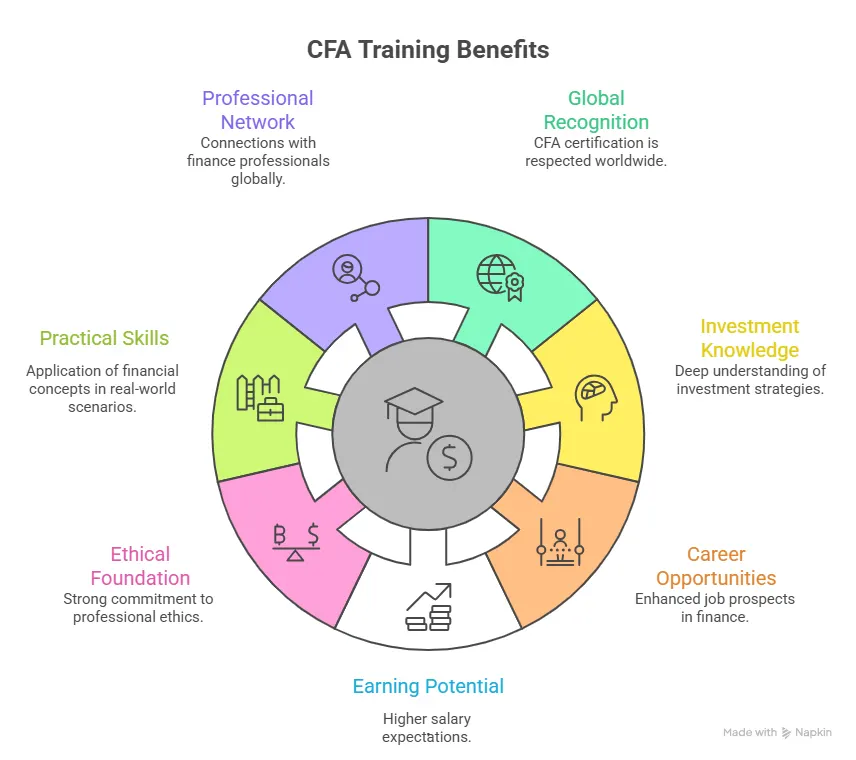
Here’s the thing most people don’t tell you – CFA certification training doesn’t just teach you finance. It signals something about your character: that you can commit to a multi-year process, manage enormous workloads outside of a demanding job, and push through material that doesn’t come easily to most people.
Employers in investment management, equity research, and asset allocation understand this deeply. When they see those three letters on a resume, they’re not just reading “knows how to value a bond.” They’re reading: disciplined, serious, long-term thinkers.
“The signal matters – particularly early in your career when your track record is still thin.”
Also Read: All you need to know about CFA salary in India as a CFA aspirant.
The Landscape of CFA Training in India
India has become one of the strongest markets globally for CFA candidates, and CFA training in India has matured accordingly. The best CFA training providers in Indian cities now offer infrastructure that rivals international counterparts, often at a fraction of the cost.
What’s interesting is how location-specific the ecosystem has become.
- CFA training institutes in Pune have grown significantly, given the city’s expanding financial services sector.
- CFA training institute in Chennai options have multiplied as the city builds out its fintech and investment management presence.
- The CFA training institute in Hyderabad provides cater to both the traditional finance community and the growing analytics-driven investment firms in the city.
For those looking internationally, CFA training in Dubai is worth mentioning, particularly for Indian finance professionals working in the GCC region. The exam infrastructure is strong there, and several Indian-origin training providers have established credible operations.
Understanding the Three Levels of CFA Training
The CFA program is structured across three progressive levels – each building on the last, and each demanding a different kind of preparation. Let’s understand what CFA tests and what you’re walking into:
CFA Level 1 Training: Building the Foundation
One practical approach I recommend to anyone starting: treat Level 1 as your test run.
Not because CFA Level 1 training is easy, it isn’t, but because the study habits and scheduling discipline you build there will determine whether you finish all three CFA levels.
- This is where your CFA journey begins. CFA Level 1 training covers the fundamentals: financial statement analysis, economics, quantitative methods, ethics, fixed income, equity, and more.
- The exam format is objective – 180 multiple-choice questions across two sessions.
- Level 1 works as your credibility builder. It signals to employers that you’ve mastered the vocabulary and logic of institutional finance.
Pass Rate Reality Check: The global CFA Level 1 exam pass rate hovers around 35-44%. Structured preparation – not just self-study is what separates those who pass from those who repeat.
CFA Level 2 Training: Where the Real Work Begins
One practical approach that consistently works: work backwards from practice exams. Identify your two or three weakest topic areas after the first mock, and allocate the bulk of your remaining study time there. Don’t spread evenly. The exam rewards depth in weak areas more than marginal improvement in strong ones.
- CFA Level 2 training is widely regarded as the toughest of the three, as it is technically demanding.
- The shift from standalone questions to complex item-set vignettes catches many candidates off guard. Here, you apply financial concepts in realistic scenarios – valuing companies, assessing portfolio risk, and interpreting financial models.
- The material goes deeper into equity valuation, fixed income, and financial reporting analysis.
- What I often see candidates underestimate is how much the questions test application rather than recall. You can know the formula cold and still miss the question if you can’t identify which formula applies in the context given.
Subjects go deeper: equity valuation, fixed income analysis, derivatives, alternative investments, and financial reporting. If you’re not consistently practising with quality mock exams, the exam day experience can feel like a different language entirely.
CFA Level 3 Training: Thinking Like a Portfolio Manager
One practical approach I recommend at this stage: stop thinking like a student and start thinking like a portfolio manager. Level 3 is testing something different from the first two levels. It’s testing whether you can apply everything you’ve learned under real-world constraints, not just recall or analyse it.
- CFA Level 3 training is where everything comes together. The format includes essay-style written responses alongside item sets, and this trips up even strong candidates who haven’t practised the written component.
- The focus here is portfolio management: asset allocation, behavioural finance, performance attribution, and wealth planning.
- CFA Level 3 training is where it shifts from knowing finance to applying it in a portfolio context. That’s where the material gets genuinely interesting for practitioners.
Many charterholders describe Level 3 as the most intellectually satisfying part of the journey. And the good news: pass rates at Level 3 are historically the highest of the three. Here’s a quick level-wise summary of the CFA:
| Level | Focus | Format | Avg. Study Hours | Pass Rate (Approx.) |
| Level 1 | Foundational Knowledge | 180 MCQs | 300 hrs | 35-44% |
| Level 2 | Application & Analysis | Vignette-based MCQs | 300–350 hrs | 40-50% |
| Level 3 | Portfolio Management | Essays + Vignettes | 300 hrs | 52-56% |
Also Read: A smart guide for CFA aspirants to plan the CFA course fees.
Who Should Actually Pursue CFA Training?
From what I’ve seen, CFA training courses make the most sense if your career ambitions sit clearly in one of a few areas: portfolio management, equity research, fixed income analysis, or institutional investment. If you’re aiming to eventually sit on the buy-side – managing money, building models, making asset allocation decisions – the CFA curriculum maps directly to your daily work.
What I often see, though, is people enrolling in a CFA training program when their career is pointed somewhere the designation doesn’t carry nearly as much weight. If you’re in M&A execution or corporate finance at a consumer goods company, the CFA won’t hurt – but it may not move the needle the way an MBA or specialised financial modelling training might.
| Ideal Candidates | Why CFA Training is Useful |
| Finance Graduates | Builds strong expertise in investment analysis, portfolio management, and financial markets. |
| Commerce & Accounting Students | Helps transition from accounting roles to finance roles like equity research and investment analysis. |
| MBA (Finance) Aspirants | Adds global credibility and practical financial market knowledge alongside an MBA. |
| Investment Banking Aspirants | Provides core skills in valuation, financial modelling, and capital markets. |
| Equity Research & Portfolio Management Professionals | Deepens analytical skills required for stock analysis and portfolio strategy. |
| Working Professionals in Finance | Helps move into higher-level roles in asset management, corporate finance, and wealth management. |
| Entrepreneurs & Business Owners | Improves understanding of investments, capital allocation, and financial decision-making. |
Don’t do it because it sounds prestigious. Do it because it fits your direction.
In the quick video below, you’ll learn practical strategies to balance work and study, manage your time efficiently, and improve your chances of clearing CFA Level 1 on your first attempt.
Choosing the Right CFA Training Institute
This is where the decision gets more practical. Whether you’re looking at CFA training in Hyderabad, CFA training in Bangalore, CFA training in Delhi, CFA training in Pune, or CFA training in Chennai, the quality of instruction varies meaningfully. Not all providers are the same.
From what I’ve seen, evaluating the best CFA training institutes in India, the ones worth your time share a few consistent traits:
- Faculty with real practitioner experience – not just academic credentials. You want someone who’s sat the exams and worked in markets.
- Structured mock exam programs – the gap between understanding concepts and passing the actual exam is bridged almost entirely by timed practice under exam conditions.
- Strong CFA training material – the official CFA Institute curriculum is comprehensive but dense. Good institutes supplement it with curated notes and question banks.
- Pass-rate data – any institute that can’t give you a credible breakdown of student outcomes should give you pause.
- Peer learning community – Study groups and peer accountability matter more than most candidates expect. Candidates who study in cohorts consistently outperform isolated self-studiers.
If you’re in Mumbai, for example, CFA Level 1 training in Mumbai is available through several well-established providers. The same applies in Bangalore, where CFA training institutes in Bangalore range from boutique CFA coaching setups to larger structured academies. Do your due diligence before committing.
Did you know?
CFA Level 1 training in Mumbai and other major cities typically runs for 4-6 months, though self-paced online options are increasingly popular.
Online vs. Classroom CFA Training
The rise of CFA training online has changed the landscape of how students perceive classroom training. CFA Level 1 training online in particular has become the default for many working professionals, and I understand why. It’s flexible, often more affordable, and the quality has improved significantly over the past few years.
That said, online learning only works if you’re genuinely self-disciplined. What I often see is candidates start strong in the beginning, lose momentum midway, and struggle in the final weeks. If that sounds like you, a structured classroom program with scheduled sessions and a peer group around you may be the better investment.
The ideal scenario for many people is a hybrid: strong online CFA training material combined with periodic in-person doubt-clearing sessions and a study group. That combination tends to produce better outcomes than either extreme alone.
| Your Situation | Recommended Approach |
| Working full-time, disciplined self-studier | Online CFA training with a structured schedule |
| Need accountability & structured schedule | Classroom-based CFA training program |
| Want flexibility but need some support | Hybrid: online lectures + in-person doubt sessions |
| First-time candidate, no finance background | Instructor-led program strongly recommended |
| Repeating candidate (retake) | Targeted coaching + heavy mock exam focus |
Also Read: Smart ways to plan your journey to pursue CFA in Delhi.
CFA Training Across Indian Cities And Beyond
The CFA exam training curriculum is genuinely rigorous, and it’s worth knowing what you’re walking into before you enrol at any CFA training institute. The CFA training institutes in India differ meaningfully by city – not just in cost, but in faculty quality, peer network, and post-training placement support.
CFA training in Bangalore
- The combination of a technology hub and a growing finance market makes CFA in Bangalore a strong base for CFA aspirants targeting fintech, analytics-driven roles, and MNC financial planning teams.
- Several well-regarded CFA training institutes in Bangalore now offer both weekend classroom batches and live-online programs.
CFA training Mumbai
- India’s financial capital is naturally the most competitive market. CFA Level 1 training in Mumbai options range from intensive weekend programmes to full-time accelerated batches.
- If you’re targeting investment banking or asset management, Mumbai’s CFA training ecosystem is unmatched.
CFA training in Delhi
Strong demand from consulting and PE aspirants. Delhi NCR-based CFA training programs increasingly integrate Excel, Bloomberg, and financial modelling into the curriculum.
CFA training in Hyderabad
A growing hub with a quality CFA training institute in Hyderabad is emerging to cater to the city’s expanding analytics and financial services sector.
CFA training in Pune
Strong in corporate finance and manufacturing-adjacent roles. CFA training institutes in Pune typically offer smaller batch sizes and more personalised attention.
CFA training in Chennai
Banking and financial services are the dominant target sectors. The CFA training institute in Chennai has grown steadily over the past three years.
CFA training in Dubai
For Indian finance professionals based in the GCC region, CFA training in Dubai is increasingly accessible through both in-person and live-online providers with Indian instructors.
To help you understand how to prepare effectively for CFA Level 1, Level 2, and Level 3 interviews, watch the video below where an expert explains common interview questions and preparation strategies.
CFA Training Material
In CFA training, when it comes to CFA books and study resources, you have two core tracks: the official CFA Institute curriculum and third-party providers. Here’s the honest breakdown:
- Official CFA Curriculum – Comprehensive and exam-authoritative. Every concept that could appear in the exam is here. The downside: it’s long, and reading it cover to cover without active recall practice is a common (and costly) mistake.
- Third-Party Notes (Kaplan Schweser, Wiley) – Condensed, exam-focused, and written with test strategy in mind. Most successful candidates use these as their primary study resource and refer to the official curriculum for deep dives.
- Question Banks – Non-negotiable. You should be solving thousands of practice questions across your preparation, not hundreds. The exam rewards pattern recognition built through repetition.
- Mock Exams – In the final 6-8 weeks, mock exams under timed, exam-like conditions should become your primary activity. Review wrong answers ruthlessly – that’s where the learning actually happens.
What the Data Shows:
Candidates who combine structured online CFA training material with peer study groups and timed mocks have significantly higher pass rates than pure self-studiers, regardless of academic background.
CFA Training Jobs and Opportunities
I get this question constantly: What will CFA training actually do for my career? Here’s my honest answer. The charter significantly improves access to CFA training jobs in investment management, equity research, credit analysis, and wealth management. In these fields, the CFA is often a prerequisite for senior roles – not just a differentiator. It tells hiring managers that you’ve mastered the theoretical foundation of the work and that you can commit to rigorous standards.
Where I’d temper expectations: the CFA course doesn’t replace experience. Candidates who pass all three levels and enter the workforce expecting immediate senior roles are often disappointed. The credential accelerates your trajectory. It doesn’t replace the years of doing the actual work.
The sweet spot I’ve observed is using CFA training to complement two to four years of relevant work experience. At that point, the combination of a charter and real-world track record is genuinely powerful. This table shows a simplified overview of how the ROI increases with CFA:
| Stage | Without CFA | With the CFA Charter | Salary Uplift |
| 0-2 yrs | ₹4-7 LPA | ₹6-10 LPA | +25-40% |
| 3-5 yrs | ₹7-12 LPA | ₹10-16 LPA | +20-35% |
| 6-10 yrs | ₹10-18 LPA | ₹16-28 LPA | +30-45% |
| 10+ yrs | ₹15-25 LPA | ₹25-50 LPA+ | +40-60% |
Also Read: Check CFA Eligibility and plan your career path.
Is CFA Training Worth the Investment?
Let’s talk about what everyone wants to know but sometimes hesitates to ask: Is CFA certification training worth it financially? I’ll give you the honest version.
The CFA certification training pays off most significantly for those who pair it with relevant work experience and a clear career direction. The credential accelerates your trajectory into higher-paying, higher-influence roles. But it doesn’t replace experience – it multiplies it.
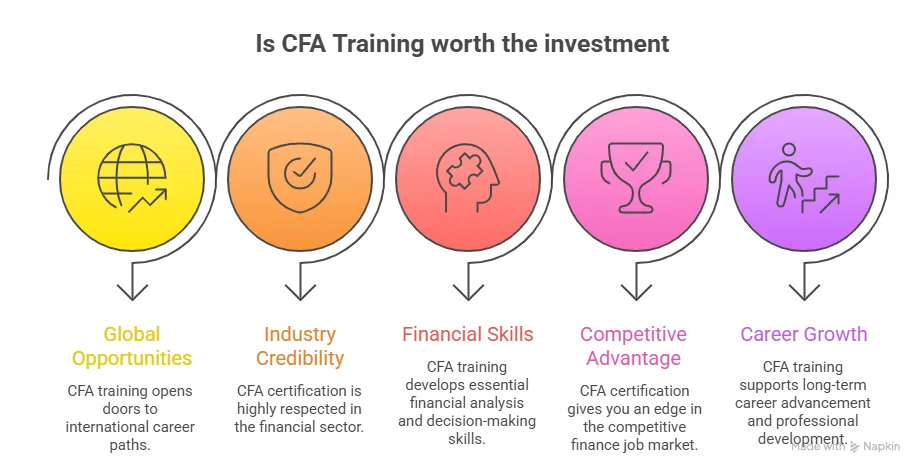
The CFA is most financially impactful in investment management roles, where it’s effectively a baseline expectation at mid-to-senior levels. It can accelerate your entry into roles that would otherwise take longer to reach. In markets like India, the Middle East, Singapore, and the UK, the CFA charter carries significant professional weight.
From what I’ve seen, the candidates who see the strongest returns are those who pair the credential with genuine experience, strong communication skills, and a clear sense of where they’re taking their careers. The CFA opens doors – you still have to walk through them with something to say.
To understand the real scope of CFA in India and set realistic salary expectations in 2026, watch the video below.
Why Students Prefer Imarticus Learning for CFA Training
The first thing that matters for choosing a CFA training provider is whether the preparation connects to real work – not just real exams. Imarticus is the only institute in India that is an approved prep provider for all five of the world’s top finance certifications: CFA, ACCA, US CPA, US CMA, and FRM. That breadth tells you something about the seriousness of the operation.
A few reasons that make the CFA Program training at Imarticus worth it are:
- You receive a joint certification from Imarticus and KPMG in India on completing the program – something that carries weight on a resume beyond the CFA designation itself.
- The study material is specifically curated for CFA aspirants, not generic finance content repurposed for the exam.
- Both offline and online learning modes are available, with six months of structured preparation per level.
- There is a money-back guarantee, which tells you the institute is confident enough in its outcomes to back them financially.
From what I’ve seen, the candidates who get the most out of Imarticus are those who treat the KPMG case studies and live sessions as seriously as the exam preparation itself. The combination of exam-readiness and practitioner exposure is what makes the difference between passing the CFA and being ready for what comes after it.
FAQs About CFA Training
Over the years, I’ve noticed that candidates ask variations of the same handful of questions, not because they haven’t done their research, but because they want someone to level with them. That’s what I’ve tried to do here through these frequently asked questions.
Is CFA training online as effective as classroom?
For genuinely self-motivated candidates with structured schedules, online CFA training works excellently and often produces better outcomes than the classroom, because the flexibility allows for consistent daily study rather than cramming around fixed batch timings. For candidates who know they lose momentum without structure – and most people fall into this category if they’re honest – a classroom programme or at minimum a hybrid approach with live sessions and a study group is worth the extra investment.
Can I do CFA training while working full-time?
Yes, and most people who complete the CFA do exactly that. What I often see is that the scheduling works on paper but breaks down in practice. Imarticus Learning helps you structure your preparation. The candidates who complete all three levels while working full-time are not necessarily the most talented – they’re the most consistent.
Is CFA training available online in India?
CFA training online is widely available and has become the preferred choice for working professionals. CFA Level 1 training online is particularly well-served, with multiple providers offering live classes, recorded sessions, and digital study material. The key is structure and consistency, not just access.
What jobs can I get after CFA training?
It depends on which direction you want to take your career. The credential was built for investment-oriented work, and that’s where it opens the most doors: equity research, portfolio management, asset management, and fund management. If you’re targeting those roles, CFA is about as strong a signal as you can send to an employer.
How long does CFA training take in India?
It takes three to five years if you’re working full-time alongside your preparation, which most candidates in India are. Each level needs roughly four to six months of serious, structured study. Whether you’re doing CFA training online or in a classroom, the quality of preparation matters more than the pace of it. Move at a pace you can sustain without cutting corners – that’s the approach that actually finishes fastest.
What is the best CFA training institute in India?
Don’t start with the institute – start with what you need from it. Do you need evening batches because you’re working? Do you need strong mock exam support? Do you need faculty who can answer questions beyond the standard curriculum? Once you know what matters to you, shortlist two or three options, and this part is important – talk to people who recently completed the program there. Their experience will tell you more than any ranking will.
When should I start CFA training – right after graduation or after some work experience?
Both paths work, and I’ve seen strong charterholders come from both. But the experience of the preparation is meaningfully different depending on when you start. The CFA charter requires four years of qualified work experience anyway before you can use the designation. So if you start right after graduation, factor in that your charter won’t be active until that experience requirement is met, regardless of when you pass the exams.
What is the difference between CFA training and CFA self-study?
The material is largely the same. The difference is everything around the material. From what I’ve seen, the candidates who attempt pure self-study and succeed tend to have two things in common: a strong finance background that gives them a head start on the material, and an unusually high capacity for self-directed discipline over a sustained period. If you’re confident you have both, self-study is a legitimate path. If you’re uncertain about either, structured training is the lower-risk investment.
Build Your Career with CFA Training
Finance careers are built on decisions. And the decision to pursue the CFA – to do the work, go through the process, and earn the charter – tends to compound for decades. I always tell people who are on the fence: the question isn’t really “is CFA training worth it?” The real question is – worth it for what specific outcome?
Get clear on where you want to be in five to seven years. Then ask whether the CFA is the most efficient path to that destination. If the answer is yes, go in fully. Commit to the process, find the right CFA training institute for your situation, invest in quality study material, and build a plan you can actually sustain.
The Indian finance market is growing. The demand for credentialed, analytical, and strategically capable professionals is growing even faster. And among all the options available to finance aspirants today, few credentials offer the combination of depth, global recognition, and career impact that the CFA does.
The credential is valuable precisely because it’s difficult and not everyone who starts it finishes. If you go in with clear intent and genuine discipline, it can be one of the best investments you make in your professional life. So if you’re ready to invest in yourself, the CFA Course might just be the best return you’ll ever generate.
