


Last Updated on 7 hours ago by Geeta Bhat
There is a reason investment banks, asset managers, and hedge funds across the world shortlist CFA charterholders before they even look at the rest of a resume. The charter signals something specific. Not just that you studied finance, but that you survived three of the most demanding exams the industry has produced, stayed consistent across years of preparation for CFA subjects, and can apply what you know to situations that do not come with a formula attached.
The CFA certification covers ten subjects across three levels. Each level asks something different of you. Level 1 wants to know if you understand the fundamentals. Level 2 wants to know if you can apply them when the data is messy and the context is unfamiliar. Level 3 wants to know if you can make sound decisions for a real client with real money on the line.
This guide breaks down every subject across all three levels. You will find the topic-wise weightage for each, a difficulty breakdown, a comparison table, and a study strategy rooted in how the marks are actually distributed. Whether you are trying to figure out how many subjects in CFA Level 1 you need to cover, or you want to understand how CFA subjects connect across the full program, everything you need is here.
Did You Know?
The CFA Institute has signalled a multi-year commitment to curriculum stability after major structural changes between 2021 and 2025. Topic weights for all three levels remain identical to 2025 for the 2026 exam cycle.
An Overview of the CFA Certification
Finance has no shortage of credentials. But few carry the kind of cross-border, cross-industry recognition that the CFA charter does. Portfolio managers in Singapore, equity analysts in London, and risk professionals in Mumbai all sit for the same exam and are held to the same professional standard. That uniformity is precisely what makes it so globally respected.
If you are still figuring out: what is CFA and whether it suits your career, this covers CFA eligibility, fees, and outcomes in full. For those already committed, here is what the program involves:
- Administered by the CFA Institute, a global non-profit with over 190,000 active charterholders across 160+ countries.
- Three levels, each progressively deeper in terms of CFA subjects and syllabus complexity
- Level 1 is fully multiple choice. Level 2 uses case-based item sets. Level 3 adds essay-style questions.
- Roughly 300 study hours are recommended per level, totalling around 900 hours across the full CFA course breakdown.
- Requires 4,000 hours of relevant professional experience alongside the exams.
The program rewards candidates who treat it as a long-term professional investment rather than just an exam to clear.
A career in finance demands more than just theoretical knowledge. It requires a strong foundation in analysis, valuation, and decision-making, along with global credibility that sets you apart in a highly competitive industry.
How Many CFA Subjects Are in the Program?
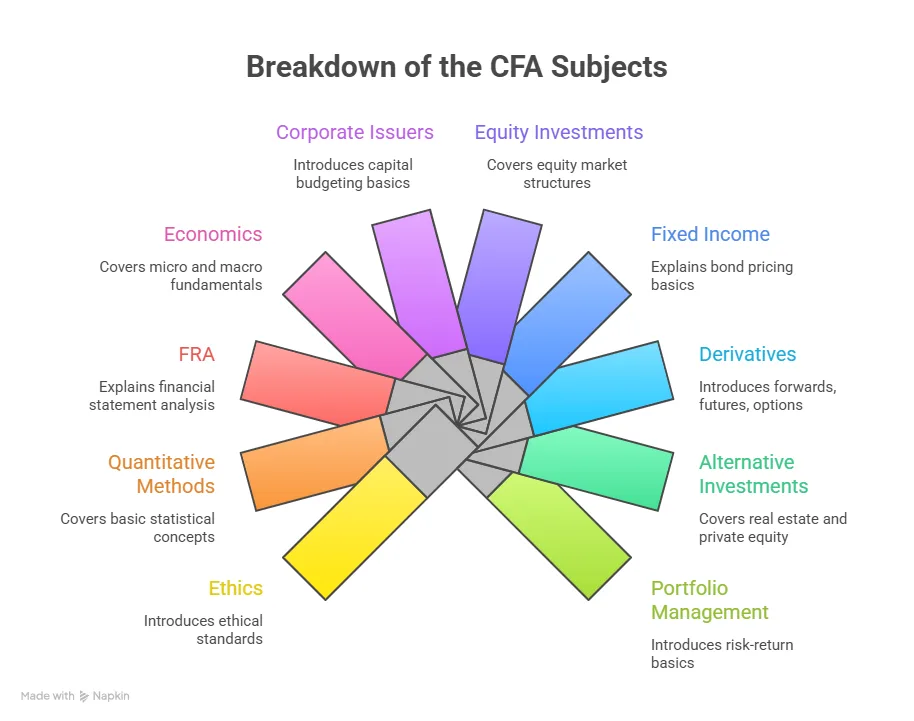
The CFA program has 10 subjects, and they run across all three levels. The names do not change. What changes, often dramatically, is the depth at which each subject is tested and the percentage of the paper it occupies.
Think of it this way.
You know how a recipe looks simple when you first read it, but by the time you are actually cooking it for the third time, you are catching the nuances that the instructions never bothered spelling out.
That is essentially the CFA subject progression. The ingredient list stays fixed. What you are asked to do with those ingredients gets harder each time.
The complete CFA subject list is:
- Ethical and Professional Standards
- Quantitative Methods
- Economics
- Financial Statement Analysis
- Corporate Issuers
- Equity Investments
- Fixed Income
- Derivatives
- Alternative Investments
- Portfolio Management and Wealth Planning
The Level 1 curriculum alone stretches across over 3,000 pages, covering 6 books with 10 topics and 93 modules. That scope is intentional. The CFA course subjects are designed to cover the full breadth of investment knowledge a working professional actually needs.
Also Read: CFA Remains the Gold Standard for Finance Professionals
Breakdown of the CFA Level 1 Subjects
The first thing to understand about the CFA Level 1 is that it is not an application exam. You are not being asked to manage a portfolio or value a company. You are being asked to prove that you understand the foundational concepts well enough. The exam has 180 multiple-choice questions split across two sessions of two hours and fifteen minutes each.
For Level 1, the heaviest weights are Ethical and Professional Standards at 15-20% and Financial Statement Analysis at 11-14%. Equity Investments and Fixed Income share that same 11-14% bracket, making them equally critical.
Here is the full CFA Level 1 subject list with official weightage:
| CFA Level 1 Subject | Exam Weightage |
| Ethical and Professional Standards | 15-20% |
| Quantitative Methods | 8-12% |
| Economics | 8-12% |
| Financial Statement Analysis | 11-14% |
| Corporate Issuers | 8-12% |
| Equity Investments | 11-14% |
| Fixed Income | 11-14% |
| Derivatives | 5-8% |
| Alternative Investments | 5-8% |
| Portfolio Management and Wealth Planning | 8-12% |
The CFA Level 1 subject weightage tells you something important. The CFA subjects at the bottom of the table, Derivatives and Alternatives, carry less weight individually, but collectively they still make up around 10-16% of your paper.
Also Read: This CFA Level 1 Guide Shows You How to Crack the Exam
Study Hours Plan for CFA Subjects for Level 1
The weightage of subjects in CFA Level 1 gives you a direct steer on study time allocation. With a suggested study time of 300 hours per testing level, you should be spending roughly 180 hours on the five heaviest CFA subjects alone. Here is a practical hour breakdown for Level 1 based on subject weightage in CFA Level 1:
| Subject | Suggested Study Hours |
| Ethical and Professional Standards | 50-60 hrs |
| Financial Statement Analysis | 45-50 hrs |
| Equity Investments | 30-35 hrs |
| Fixed Income | 30-35 hrs |
| Quantitative Methods | 25-30 hrs |
| Economics | 20-25 hrs |
| Corporate Issuers | 20-25 hrs |
| Portfolio Management | 20-25 hrs |
| Derivatives | 15-20 hrs |
| Alternative Investments | 12-18 hrs |
A commerce graduate who has already studied financial statements will spend fewer hours on FSA. Someone from a pure science background will likely need more time for both FSA and Quantitative Methods. The CFA Level 1 subject weights give you the direction.
Starting your CFA Level 1 journey can feel overwhelming, especially with the breadth of concepts and exam expectations. A structured approach, smart study planning, and clarity on high-impact areas can make preparation far more focused and effective.
Breakdown of the CFA Level 2 Subjects
The CFA L2 subjects are identical in name to everything you studied at Level 1. The difference is in what you are expected to do with that knowledge. At Level 1, a question about Fixed Income might ask you to calculate bond duration using a given formula.
At Level 2, you are handed a four-paragraph vignette about a fixed-income portfolio, asked to identify the analyst’s error in duration estimation, and then recommend a hedging approach.
The Level 2 exam consists of 88 total multiple-choice questions across 22 item sets, 11 per session. Two of the 22 item sets are typically unscored trial questions. Here is the CFA Level 2 subject weightage:
| CFA Level 2 Subject | Exam Weightage |
| Ethical and Professional Standards | 10-15% |
| Quantitative Methods | 5-10% |
| Economics | 5-10% |
| Financial Statement Analysis | 10-15% |
| Corporate Issuers | 5-10% |
| Equity Investments | 10-15% |
| Fixed Income | 10-15% |
| Derivatives | 5-10% |
| Alternative Investments | 5-10% |
| Portfolio Management and Wealth Planning | 10-15% |
The most important topics in Level 2 are Equity Investments, Financial Statement Analysis, Fixed Income, Portfolio Management and Ethics. It is recommended that you spend around 60% of your study time focused on these five areas.
What the CFA Level 2 Subject Weightage Actually Means for Your Study Plan
At Level 2, the spread of marks is tighter than at Level 1. At Level 1, you could afford to treat lower-weighted CFA subjects as secondary priorities. At Level 2, even a 5-10% subject is tested through an entire item set, which means four to six consecutive questions all linked to one case.
The CFA subjects where most Level 2 candidates lose marks:
- Equity Investments: Valuation models get significantly more detailed. Residual income, dividend discount variations, and free cash flow models all appear with contextual twists.
- Fixed Income: Credit analysis, term structure models, and interest rate risk management are tested in depth.
- Financial Statement Analysis: The accounting adjustments required at Level 2 go well beyond what Level 1 covered.
Did You Know?
CFA Level 2 pass rates fluctuate, with a higher rate of 54% in May 2025 and 44% in August, showing how exam timing and candidate preparation cycles affect outcomes.
(Source: CFA Institute)
Breakdown of the CFA Level 3 Subjects
By the time you reach Level 3, the nature of the CFA subjects and syllabus changes in a fundamental way. Every subject at this level is looked at through the lens of one central question: how does this help you make better decisions for a real client with real money?
The 2026 Level 3 exam retains the Specialised Pathway format introduced in the previous curriculum cycle. Every Level 3 candidate covers the Common Core curriculum, which accounts for 65-70% of the paper. After that, you choose one of three pathways, which accounts for the remaining 30-35%.
The three pathways are:
- Portfolio Management Pathway – Covers institutional portfolio management, index-based and active equity strategies, liability-driven investing, and advanced fixed income portfolio construction.
- Private Wealth Pathway – Focuses on managing assets for high-net-worth individuals and families. Covers tax planning, estate planning, behavioural finance as it applies to wealthy clients, and intergenerational wealth transfer.
- Private Markets Pathway – Covers private equity, private debt, infrastructure, private real estate, and special situations investing.
Once a pathway is selected, it cannot be changed. All 2025 Core readings and all three Pathway curricula are unchanged for 2026.
Also Read: How CFA Professionals Unlock Diverse Career Opportunities in Finance?
Topic Weightage of the CFA Subjects for Level 3
The CFA Level 3 subject weightage for the Common Core looks like this, per the CFA Institute:
| CFA Level 3 Subject | Core Exam Weightage |
| Ethical and Professional Standards | 10-15% |
| Economics | 5-10% |
| Equity Investments | 10-15% |
| Fixed Income | 15-20% |
| Derivatives | 5-10% |
| Alternative Investments | 5-10% |
| Portfolio Management and Wealth Planning | 35-40% |
Portfolio Management commands up to 40% of the core paper. That is a concentration of marks that has no parallel at either of the two earlier levels. The CFA L3 subjects are also tested through a combination of constructed response questions in the morning session and item sets in the afternoon. Constructed response means you write out your answers, not pick from options.
Also Read: CFA Certification Supports Careers but Demands Consistency
Theory CFA Subjects vs Calculation-Heavy Subjects in Level 1
This is one of the most useful ways to sort your CFA 1 subjects when building a study plan. Some subjects in the CFA Level 1 subject list are entirely conceptual. Others will have you staring at formulas for weeks.
Theory subjects in CFA Level 1:
- Ethical and Professional Standards – Scenario-driven. You read a situation and decide what a professional should or should not do. No formulas. No calculations. But the scenarios are deliberately written to be ambiguous, which makes preparation more about judgment than memory.
- Economics – Mostly conceptual. Supply and demand curves, monetary policy, and international trade. Some graph interpretation is involved, but the heavy quantitative work lives elsewhere.
- Corporate Issuers – Corporate governance frameworks, capital structure decisions, dividend policy. Again, logic-based rather than formula-driven.
Calculation-heavy CFA subjects:
- Quantitative Methods – Time value of money, probability distributions, hypothesis testing. This subject is often where candidates from non-finance backgrounds hit their first wall.
- Financial Statement Analysis – Ratio analysis, accounting for leases, pension obligations, and intercorporate investments. The calculations here are not always complex, but there are a lot of them, and the detail required is significant.
- Fixed Income – Bond pricing, duration, convexity, yield measures. Heavily formula-dependent.
- Derivatives – Options, futures, forwards, swaps. The concepts build on each other, so falling behind early makes catching up genuinely hard.
Candidates often list Financial Statement Analysis, Fixed Income, and Derivatives as the hardest CFA Level 1 topics due to their complex calculations, detailed concepts, and the challenge of applying theory to real-world scenarios.
Interesting Insight→ Level 1 pass rates range from 43% to 45%, reflecting the challenge of mastering foundational concepts at the start of the CFA journey.
CFA Subjects and Weightage Compared Across All Three Levels
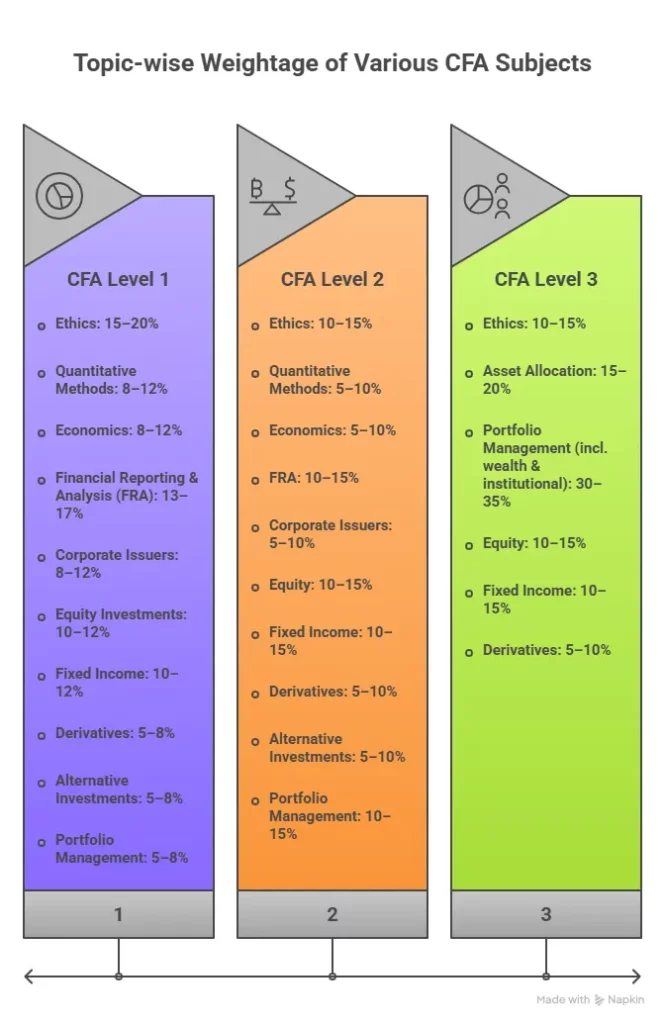
Seeing all three levels side by side is the clearest way to understand how the program evolves. The CFA subjects weightage shifts noticeably from breadth at Level 1 to depth and concentration at Level 3.
| Subject | Level 1 | Level 2 | Level 3 |
| Ethics | 15-20% | 10-15% | 10-15% |
| Quantitative Methods | 8-12% | 5-10% | Not separately tested |
| Economics | 8-12% | 5-10% | 5-10% |
| Financial Statement Analysis | 11-14% | 10-15% | Not separately tested |
| Corporate Issuers | 8-12% | 5-10% | Not separately tested |
| Equity Investments | 11-14% | 10-15% | 10-15% |
| Fixed Income | 11-14% | 10-15% | 15-20% |
| Derivatives | 5-8% | 5-10% | 5-10% |
| Alternative Investments | 5-8% | 5-10% | 5-10% |
| Portfolio Management | 8-12% | 10-15% | 35-40% |
Notice what happens to Portfolio Management. It starts as one of the smaller CFA subjects at Level 1 and ends as the single largest block at Level 3. The reverse happens with Financial Statement Analysis, which dominates at Levels 1 and 2 but does not appear as a standalone subject at Level 3.
Also Read: Is CFA in 2026 Still Worth It for Your Career Growth?
Difficulty Comparison of CFA Subjects Across Levels
Difficulty in the CFA program is relative. A subject that a finance professional finds manageable can take a candidate from a different background weeks to get comfortable with. Here is a difficulty matrix for CFA exam subjects across all three levels:
| Subject | Level 1 | Level 2 | Level 3 |
| Ethics | Moderate | Hard | Hard |
| Quantitative Methods | Hard | Moderate | Not applicable |
| Economics | Moderate | Moderate | Moderate |
| Financial Statement Analysis | Hard | Very Hard | Not applicable |
| Corporate Issuers | Manageable | Moderate | Not applicable |
| Equity Investments | Moderate | Hard | Hard |
| Fixed Income | Hard | Very Hard | Very Hard |
| Derivatives | Hard | Very Hard | Hard |
| Alternative Investments | Manageable | Moderate | Moderate |
| Portfolio Management | Manageable | Moderate | Very Hard |
Ethics is a different kind of difficult. The concepts are not technically complex, but the exam questions at Levels 2 and 3 are written specifically to test whether you can hold your ethical judgment steady when a scenario is presented in a way that makes the wrong choice look reasonable.
Also Read: These 6 Tips Help You Become a Winning Chartered Financial Analyst
Must-know Things About CFA Course Subjects in India
The CFA program is global. The exam content does not change based on where you sit it. But for candidates preparing in India, a few practical realities are worth factoring in early.
Exam Availability of CFA Subjects Across India
The CFA Institute runs computer-based testing at authorised centres in Mumbai, Delhi, Bengaluru, Hyderabad, Chennai, Kolkata, and Pune.
- Level 1 runs four times a year.
- Levels 2 and 3 each run twice a year.
- Registration windows open several months before exam dates, and early registration saves a significant amount on fees.
Salary Data for CFA Charterholders in India
CFA salary in India for charterholders ranges considerably by role and city:
- Junior analyst roles post-Level 1 clearance: ₹5-8 LPA
- Mid-level roles post-charter or post-Level 2: ₹12-22 LPA
- Senior portfolio and research roles with the full charter: ₹25-50 LPA
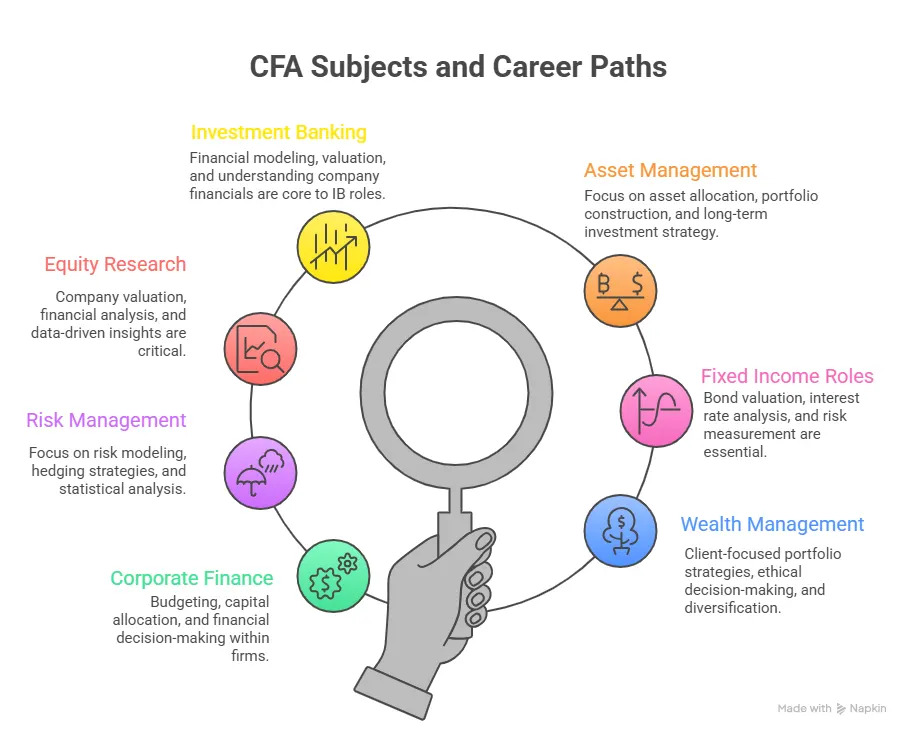
Roles in equity research, investment banking, risk management, and portfolio advisory are the primary destinations for CFA charterholders in India.
Why a Commerce or CA Background Helps More Than People Expect
If you have a BCom, BBA, or have cleared CA Intermediate, you already have a meaningful grounding in Financial Statement Analysis and Economics. That prior exposure does not replace preparation, but it does reduce the hours you need on those specific CFA subjects at Level 1. That time saved can be redirected toward Quantitative Methods or Fixed Income.
Also Read: What Skills Should Every CFA Professional Master?
Building a Study Plan Around CFA Subject Weights
Every effective CFA study plan starts with the same question: where is the paper actually scored? A few principles that hold regardless of which level you are preparing for:
Lead with Ethics, every level, every time: Ethics appears across all three levels and carries marks that can determine a borderline result. More importantly, studying Ethics early builds the professional mindset that makes the rest of the curriculum easier to contextualise.
Do not park Derivatives at the end: It is the subject most candidates defer because the initial learning curve feels steep. By the time they circle back to it, energy and time are both running low. Hence, schedule Derivatives in the middle of your prep.
Track your time against subject weights: At the end of each week, check whether your actual study hours match the weightage of the CFA subjects in Level 1, Level 2, or Level 3 that you are working through.
Mock exams are a separate skill from knowing the material: Build in at least three full mocks per level, not just topic quizzes, spread across the final four to six weeks.
Preparing for CFA interviews goes beyond knowing the curriculum. It requires the ability to clearly explain concepts, apply them to real scenarios, and demonstrate strong financial thinking across different levels.
Why Choose Imarticus Learning for your CFA Preparation
Clearing the CFA is as much about your preparation environment as it is about the hours you put in. Imarticus Learning’s CFA Program prep is built in collaboration with KPMG and carries authorised prep provider recognition, meaning the curriculum directly aligns with CFA Institute standards.
- Kaplan Schweser study material, question banks and mock exams included.
- A dedicated second teacher available for 24/7 one-on-one doubt resolution.
- Partial fee refund guarantee if you follow the prescribed schedule and still do not clear.
- Structured placement support after Level 1, covering resume building, mock interviews and hiring access.
- Monthly industry webinars and live sessions by KPMG practitioners.
- Available in both online and classroom formats for working professionals and students.
FAQs About CFA Subjects
When starting, many candidates have some doubts about CFA subjects. Get clear answers to the most frequently asked questions, helping you understand the structure, expectations, and what to focus on before you begin your preparation.
How Many Subjects Are in CFA?
The CFA program covers 10 CFA subjects across all three levels. These are Ethics, Quantitative Methods, Economics, Financial Statement Analysis, Corporate Issuers, Equity Investments, Fixed Income, Derivatives, Alternative Investments, and Portfolio Management. Imarticus Learning covers all 10 subjects with dedicated live sessions and subject-wise mock tests.
What Are the Subjects Under CFA?
The full CFA subject list covers ethics, quantitative analysis, economics, financial reporting, corporate finance, equity, fixed income, derivatives, alternatives, and portfolio management. Imarticus Learning maps each of these CFA course subjects to structured learning modules with weekly practice and doubt-clearing sessions.
Is CFA Level 1 Very Hard?
CFA Level 1 is demanding primarily because of the volume of CFA subjects covered in a single exam. With a global pass rate sitting around 44%, the challenge is real. A structured daily study routine and strong time allocation across subjects make clearing it in one attempt very achievable.
Is CFA Level 1 Only MCQ?
Yes. The Level 1 CFA exam format includes 180 multiple-choice questions, 90 in Session 1 and 90 in Session 2. All CFA L1 subjects are tested exclusively through this format. Imarticus Learning builds its mock exams to mirror this structure of CFA subjects, so candidates practise under realistic exam conditions from day one.
What Is the Main Difference Between CFA Level 1 and CFA Level 2?
Level 1 tests whether you understand the CFA subjects conceptually. Level 2 tests whether you can apply them to complex real-world cases presented as vignettes. The CFA Level 2 subjects carry the same names but demand a fundamentally different level of analytical thinking and data interpretation from every candidate.
What Is the Most Difficult Subject in CFA Level 1?
Financial Statement Analysis and Fixed Income consistently rank as the hardest CFA Level 1 subjects. Both require numerical precision and a strong grasp of underlying concepts that take time to build. Imarticus Learning offers focused modules within its CFA preparation programme.
How Hard Is CFA Level 2?
CFA Level 2 pass rates fluctuate, with results as varied as 44% to 54% depending on the exam window. The CFA L2 subjects are applied through case-based item sets, making preparation more intensive than Level 1. Most candidates benefit from dedicating 350 hours or more to this level.
Which CFA Level Is the Most Difficult?
Level 2 is widely considered the hardest in terms of analytical depth and the demands of the item set format. Level 3 presents a distinct challenge through its constructed response questions and the concentration of marks in Portfolio Management. Imarticus Learning structures preparation for all three levels as separate tracks, each designed for the specific demands of that stage.
Now You Know the CFA Subjects. Here Is What Comes Next
Ten subjects. Three levels. By now, you have the full picture of what the CFA subject list looks like, how the weightage shifts from Level 1 through Level 3, and where the real preparation effort needs to go.
A few things are worth holding onto from everything covered above. The CFA Level 1 subject weightage tells you that Ethics and Financial Statement Analysis together decide more about your result than any other combination of subjects. The CFA Level 2 subject weightage tells you that application matters more than memory. And by Level 3, Portfolio Management carries so much of the paper that treating it as just another subject is a mistake candidates tend to make only once.
If you are ready to start and want a preparation environment that is built specifically around how the CFA subjects and syllabus are examined, Imarticus Learning’s CFA Course prep is worth a serious look. The curriculum is aligned with CFA Institute standards, the faculty holds the charter, and the structure is designed for candidates who are serious about clearing.
