Learn the latest cybersecurity trends with cyber security training online

In recent years, the way we operate in our businesses has evolved dramatically. Companies must adapt to the digital environment to survive. Their personnel, on the other hand, require thorough training. An employee takes some dangers the instant he or she accesses the Internet, whether to surf or receive email. They can be phished, infected with a virus, infected with a computer worm, or infected with any other sort of malware if they are not appropriately trained.

As a result, it’s becoming increasingly practical for businesses to devote a portion of their resources to staff training. In this article, we are going to talk about the latest trends in cybersecurity online learning and training. Most Demanded Security Certifications.

The cyber security certifications online have among their most demanded courses those related to:

CompTIA Security + certification courses that cover everything from social engineering techniques to basic cryptography principles.
Fundamentals of cloud security.
OWASP (Open Web Application Security Project).
Cyber security analyst training online.
Certified ethical hacker training online.
Trends in Cybersecurity

Cybersecurity has become a worldwide issue. A cyber assault is no longer limited to the local level; it now targets a country’s essential infrastructure. Companies, on the other hand, are converting their information technology as an important element of new business models, and the availability of their computer systems, including the integrity and security of the data utilized for decision-making, are critical to their operations. Meeting the demands of private and public organizations is critical in ensuring that employees are equipped to handle the emerging global cybersecurity threats.

You will discover the keys to understanding the current ideas and strategies used in cybersecurity and be prepared for current attacks on technical infrastructures in the Cybersecurity program that we provide at Imarticus.

Cybersecurity Powered by AI

Artificial intelligence (AI) can fight cybercrime by spotting odd patterns of behavior, similar to how it is used in financial services for fraud detection. Artificial intelligence is used to detect possible issues in systems that process thousands of inputs per second, making them very vulnerable to hackers since aberrant occurrences are more easily hidden.

Regrettably, hackers are aware of AI’s predictive powers and advantages, and new attacks are developing that leverage machine learning technology to circumvent security solutions. As a result, AI becomes even more important, as it is the only way to combat AI-driven cyberattacks.

Vulnerable Internet of Things

By 2022, there will be 18 billion linked gadgets. As a result, fraudsters will have access to a far larger number of computers. The Internet of Things (IoT) has long been recognized as a distinct threat: previous assaults have directly linked hackers utilizing connected goods, such as refrigerators and kettles, to obtain access to networks and, from there, hack into PCs or cellphones containing sensitive information.

IoT will become more advanced as well as more pervasive by 2022. Digital twins, which are digital replicas of whole systems, including businesses, are already being developed by a number of organizations. These models are frequently linked to operational systems in order to handle the data they collect.

These cloned systems may have greater vulnerabilities than the originals if security is not taken into account, although data access is the same. Attackers are targeting edge computing equipment, which operates data as close to the place of the collection as feasible, as well as centralized cloud infrastructure.

Conclusion
Visit Imarticus today to learn more about our Cybersecurity program and to discover the latest cybersecurity trends with cyber security training online.


Learn blockchain development: What are nodes and masternodes?

The base of any type of development is the proper infrastructure. Blockchain development is no different! When you learn blockchain development, you will be coming across terms such as nodes and master nodes. These are some crucial components of the infrastructure of blockchain. They help with the accessibility of the data in a blockchain. What are they? What do they mean? Let’s find out!

What is a node in blockchain?

As you know, in a blockchain, data is stored in blocks. Nodes refer to the specific areas in these blocks where the data is stored. In simple terms, nodes are the building blocks of blockchain and comprise the computer systems, servers, or any devices that are used for transactions. The nodes are all interconnected to form a strong network that will be hard to manipulate. 

There are different forms of nodes such as light nodes which are the users, full nodes which means the systems used for the information transfer, and the master node that has a larger role over the others. There also are other types of nodes depending on their functions and capabilities. A blockchain developer course in India provides more insight into the various types of nodes. 

Masternodes are the components that have more authorization for the various functions among the nodes. They come with sophisticated software specifications to perform additional tasks other than the common function such as storage, validation, or broadcasting. They also act as the governing center and the law enforcement department of the blockchain. 

To become a blockchain developer one must master the knowledge about nodes and master nodes. Even then, operating master nodes is not easy as it requires paid permission to gain access to it. 

How to become a blockchain developer?

Now, you might have got a glimpse of what constitutes a blockchain. So to become a master developer, the primary requirement is to learn blockchain development with the help of a top course. 

The SCBI course here at Imarticus will be a great start. This is a 9-month course offered in collaboration with IIT Guwahati. This Certification in Software Engineering for Cloud, Blockchain & IoT course provides in-depth knowledge in all three areas. The course is suitable for anyone starting from scratch as well as for those having some experience in this field. But obviously, it will be easier for those with some experience. 

What more is there with blockchain development?

Understanding nodes and master nodes are just entry points for blockchain development. They are just some significant parts of the blockchain system but there is a lot more to learn for developing a system. 

The road ahead reveals some programming languages, concepts of mining, hashing, etc. A quality course will also give you the opportunity to learn from the experts in this industry and a chance to be mentored by them. 

Having hands-on experience with a project to finish off the course will prepare you well for the job description and the challenges associated. It will also enable you to come up with an innovative way for the models and their implementation. 

Types of blockchain developers

There are two types of blockchain developers- Blockchain software developers and Core blockchain developers. The former create applications based on the protocols and provided architecture. The latter type of developers is the ones who create a blockchain architecture from scratch. 

The SCBI course helps the former type of developers to create application-based blockchains. It also covers the data science areas such as programming languages, AI, ML, etc. 

An introduction to Cybersecurity certification and capture the flags contest

The Cybersecurity course we offer at Imarticus delves into the vast topic of cybersecurity, focusing on the significance of data confidentiality, cybersecurity, best practices for using social media and the internet securely, and prospective job prospects in this rapidly increasing industry. It discusses how to secure your privacy and personal data online and on social media, as well as why cybersecurity knowledge and awareness are becoming increasingly important in IT careers.

We are all increasingly exposed to cyber-attacks in today’s linked society. The cyber security certifications online are for you whether you’re drawn to the relatively new field of cybersecurity professions or just want to safeguard yourself online and on social media.

It delves into cyber trends, risks, and the broader issue of cybersecurity in a way that is personally relevant to you. You will, for example, learn how to safeguard your privacy online and about the issues that corporations, governments, and educational institutions face.

Cybersecurity: Necessity and Opportunity for Every Profession.

From a hazy rumor to an ethereal reality, the phrase has come a long way.

Functioning in an ever-changing, fast-paced, and frequently hostile environment is becoming increasingly challenging for security employees with minimal IT or administrative abilities. As the globe becomes increasingly networked and globalized, the lines between security and technology departments are dissolving and merging.

Every social, commercial, and governmental layer is affected by cybersecurity. To interfere with the US election, a country can manipulate public opinion. Terrorists may attempt to hack into a nuclear power plant’s network. For ransom, a criminal network might take over a company’s database. Hacking into ATMs in Taiwan resulted in the theft of more than $200,000 in one night. Hackers gained access to the computers of prominent stock market investors, allowing them to purchase shares in milliseconds.

To pass on secret information, a manager may be blackmailed for virtual sex (“Sextortion”). With a single mouse click, an employee may download a virus and shut down the firm for a day, resulting in millions of dollars in damages. This is only the tip of the iceberg when it comes to the possibilities. We must prepare for what is still to come, which we cannot conceive. It is necessary to plan ahead.

Surveillance cameras, physical barriers and high walls, and ongoing training are all part of today’s security systems, yet everything is placed in danger every time someone walks past the security arch with a smartphone and a flash drive, and no one seems to notice.

CTF

Today’s security measures include high walls and physical barriers, surveillance cameras, and continual training, yet everything is put in jeopardy whenever someone passes past the security arch with a flash drive and a smartphone, and no one appears to notice.

To summarize, each CTF’s goal is to complete a sequence of tasks that progressively become more difficult as the number of points indicated in each job increases. These tournaments normally last 2-3 days, after which writeups for each suggested challenge are released willingly, allowing other players to learn about their strategies. If a challenge is not completed by a particular number of teams, the CTF organizers will generally provide some tips to make obtaining the flag, also known as a key, simpler.

CTFs can be classified into the following groups:

  • Miscellaneous [Misc]: Random challenges that can belong to different unspecified categories.
  • Trivia: Different questions related to computer security.
  • Recognition [Recon]: Searching for the flag in different sites on the Internet. Clues, such as a person’s name, are given to solve it.
  • Web: Discovery of vulnerabilities in a web application.
  • Programming [PPC]: Also known as PPC (Professional Programming & Coding), challenges that require developing a program or script that performs a certain task.
  • Reverse engineering [Reversing]: Inferring in the operation of the software. Most commonly, Windows and Linux binaries.
  • Pwning: Discovery of vulnerabilities in a server.
  • Steganography [Stego]: Images, sounds, or videos that hide information inside.
  • Cryptography [Crypto]: Texts encrypted using a specific cryptosystem.
  • Forensics: Most common; memory images, hard disk images or network captures, which store different types of information.

Conclusion

Become a certified ethical hacker by taking one of our Cybersecurity programs. Here at Imarticus, you can study to be a certified ethical hacker and participate in a CTF. Visit our website today to learn more.

What does it take to become an IoT and Cloud genius?

The cloud computing landscape has expanded its horizons in past years. Just a few years ago, cloud computing was something that only large companies could afford, but now cloud services are available to everyone at an affordable rate and without the need for on-site hardware.

As cloud computing becomes more prevalent and IoT technologies become cheaper, there are many new opportunities for professionals in the cloud DevOps field.

This article discusses what actually cloud computing is, what it takes to become an IoT and cloud genius and provides some helpful information about certification programs you can take to get started!

What actually cloud computing is?

We live in a modern world where IoT and cloud computing is a fundamental part of our lives. Cloud computing is just like cloud storage – it allows us to access our files from anywhere at any time. In cloud computing, applications and data are stored on servers located in remote data centers rather than a physical computer or local server.

What does it take to become an IoT and Cloud genius?

If you would like to become an IoT and cloud genius, then it is essential that you gain some cloud computing education. Gaining cloud computing education is the best choice to open the doors to making a career. A degree in Cloud computing is a great way to prepare yourself for a cloud DevOps career and the job market.

Some information about certification programs?

There are many different cloud DevOps training courses available out there that allow you to study at home in your own time. However, the main cloud certification you should know about is the professional cloud DevOps engineer certification. The professional cloud certification will teach you all the skills and knowledge required to become a cloud DevOps expert in your organization, so that means less stress for you and your employer!

What is the career path that cloud DevOps professionals follow?

The cloud career path is not an easy one – it takes dedication and hard work to succeed! However, once you have got your foot in the door, cloud computing is a career that will provide you with both satisfaction and financial stability. This path is an exciting and fulfilling one.

The cloud computing industry is constantly growing and evolving; therefore, there will always be a need for cloud DevOps engineers like you! You just have to learn the skills, gain certification, and move towards a successful cloud DevOps career. After cloud DevOps certification, cloud admins can go on to become cloud architects or cloud engineers.

Explore Cloud certification programs with Imarticus Learning.

Imarticus Learning cloud certification programs are designed to help you build your cloud career. Imarticus provides instructor-led training, practice exams, and learning paths for popular cloud certifications. Imarticus Learning courses come in multiple formats – live virtual or self-paced online classes with 24/365 support which is great for cloud professionals who want to study at their own pace.

best software engineering certification courseCourse USP’s:

Best suited for cloud professionals and cloud career aspirants.
Training from world-class academic professionals.
Industry-approved curriculum and cloud certification.
Flexible study options: live virtual classes or self-paced learning path.

The insane demand for cybersecurity certification in 2022

What is Cybersecurity? 

In this age of increased usage of the internet, people have forgotten to draw a line or limit themselves. Everything is on the internet right from one’s banking details to confidential data. Technology has grown by leaps and bounds and some people take advantage of the loopholes and vulnerabilities in the system. They are known as hackers. Some hackers can steal data and other important details like pictures, documents, and personal details from phones and computer systems.

To tackle these mischievous hackers, Cybersecurity has to step in. Cybersecurity is the term used for the application of technology to increase security and to protect systems, devices, and networks from hackers. Cybersecurity reduces the risk of data theft and protects systems from being illegally exploited by malicious hackers. 

A Cybersecurity expert has the responsibility of securing his organization’s network and preventing a security breach. Organizations have private and confidential data on their networks and there is often a chance that a black hat hacker can penetrate through a weak link in the network.

A Cybersecurity expert is given authority by the organization to ethically hack into the network to find and fix any discrepancies. There are many Cybersecurity certifications online and individuals with an interest in the field can opt for a career in this field. 

The Need for Cybersecurity Workers 

Given the boom in technology, everything is moving online. Be it important data or information, everything is stored on the internet. With spies and hackers all over the internet, it is necessary to safeguard one’s data and network.

This is where Cybersecurity workers step in. Cybersecurity is in huge demand in government offices, defense, IT companies, etc., since all these organizations have sensitive data that is stored on their network. If the data is stolen by unauthorized people, it can be a threat to a large number of people. 

There is a huge demand for the role of Cybersecurity experts and this is a great career path for anyone who is proficient in IT and has a knack for different computer languages. One can become a certified ethical hacker. With newer technology and tools, hackers have found various ways to hack into systems and networks. Hence, there is a need for Cybersecurity experts in many organizations. 

According to reports, the need for Cybersecurity experts is 3 folds higher than any other job profile. It is a fast-growing role and there is a dearth of good experts in this field. The demand is higher than the number of qualified Cyber experts. Cybersecurity jobs are 13% of the entire IT industry and that is a big chunk compared to the various roles available in the field. Reputed institutions are offering certified Ethical hacker certification. The top job profiles in Cybersecurity are:

  • Risk Management- Risk management is a crucial position in the IT industry since it requires the expert to identify, analyze and evaluate the Cybersecurity threats to the organization.

  • Application development security- There is a huge demand for this Cybersecurity skill in the US and the demand is said to increase heavily by 2025. It is fast-growing and there are chances of a 164% increase in the vacancies for this role.

  • Cloud Security- With many operating systems relying on cloud computing systems for the storage of their data, there is a huge demand for Cybersecurity experts with Cloud Security skills. Cloud Security involves protecting the data and information stored online via Cloud computing from theft and leak. 

The Future of Cybersecurity Experts in the Industry 

With a surge in digitalization, criminals have come up with innovative ways to get their hands on sensitive and confidential information. Many organizations are facing a threat to their important data.

To ensure the safety of important data, there is going to be a heavy demand for Cybersecurity experts in various organizations. In the year 2022, close to 2 million job openings are available for qualified Cybersecurity professionals. 

Individuals who have a keen interest in this field can take up a PG Program in Cybersecurity from Imarticus Learning

With the increase in technology, hackers will find newer ways to steal data, and the only way to control this scenario would be to have more Cybersecurity experts. 

Five key steps to get your first software engineering job

Software engineering is a challenging and rewarding field. A software engineering degree from a reputable institute is the best way to start your career. Software engineering is a challenging and rewarding field. 

Software engineering jobs are in high demand right now, with some companies reporting that they have 100 or more applicants for every position. It makes it more exciting to differentiate yourself from the crowd of people vying for a coveted spot on an engineering team. To help you stand out and get your first software engineering job, we’ve put together five key steps:

#01. Have a strong portfolio

A strong portfolio is the most vital thing you can have when looking for a software engineering job.  If you don’t have any work experience, consider creating open-source projects to showcase your abilities.

#02. Have a strong resume

A resume is your chance to make a perfect impression on potential employers. Ensure it’s well-written and error-free, and highlight your skills and experience. If you don’t have any work experience, consider doing some volunteer work or internships to gain some relevant experience.

#03. Network

Networking is an essential part of a job search, and it’s imperative when looking for a software engineering job. Attend industry events, meetups, and other networking events to meet people in your field. You can also reach out to friends and family members who work in tech companies to get advice and connections.

#04. Prepare for interviews

Interviewing can be tricky since you’ll likely ask to solve complex problems on the spot. Make sure you practice solving coding challenges and problem scenarios, so you’re ready for anything. You should also first research the company you’re interviewing with and come up with questions to ask them about their culture, products, and team.

#05. Stay motivated

The job search can be frustrating and lengthy, but staying motivated is essential. Participants need to stay positive and believe in themselves, and they’ll eventually land the job of their dreams.

 If you follow these steps and stay motivated, you will be on your way to getting a fulfilling software engineering job.

What is the job of a software engineer?

Software engineers are responsible for writing and testing code and working with software designers to ensure the final product is user-friendly. They may also be responsible for training and supervising other software engineers. To become a software engineer, you need strong analytical, problem-solving, and mathematical skills.

Discover more with IoT Software Engineering Course with Imarticus Learning

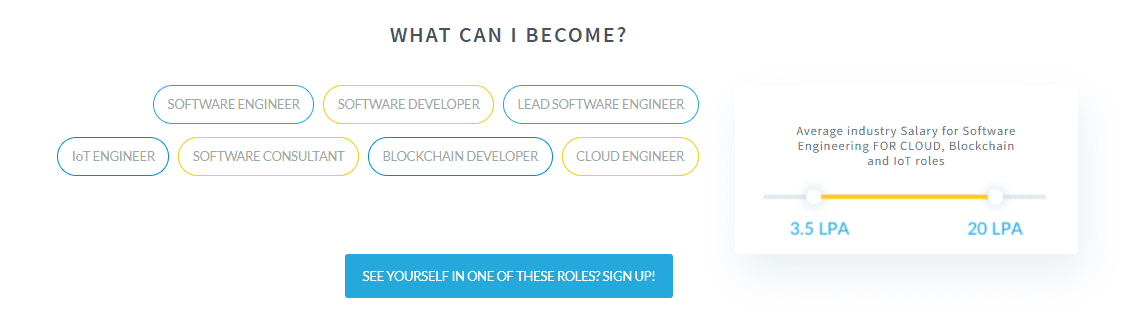
The Certification in Software Engineering for Blockchain, Cloud, and IoT program collaborates with IIT Guwahati, E&ICT Academy, and industry experts to give aspiring Software Engineers the most satisfactory learning experience possible. This 9-month curriculum will prepare students for the new-age Software Engineer position, focusing on Cloud, Blockchain, and IoT.

Course Benefits for Learners:

  • Impress employers & showcase skills with IOT Software Engineering courses recognized by India’s prestigious academic collaborations.
  • Through real-world projects from various sectors, the student will create a strong foundation of Software Engineering ideas. Industry professionals will assist them in learning the practical application of Cloud, Blockchain, and IoT.
  • This Certification in Software Engineering course will assist students in unlocking lucrative job options in the ever-expanding sector of Software Engineering.

What are the benefits of combining blockchain with AI, cloud and IoT?

Blockchain, AI, cloud, and IoT are all transformative technologies that are rapidly evolving and growing in popularity. When these technologies are combined, they can create powerful synergies that drive innovation and create new opportunities.

The combination of blockchain, AI, cloud, and IoT offers many potential benefits, including the ability of an intelligent device to operate independently without the need for a centralized authority. It can also monitor how gadgets interact with one another. This blog will discuss the advantages of merging blockchain with AI, cloud, and IoT and how can AI and Blockchain work together.

The benefits of combining blockchain with AI, cloud, and IoT include:

Increased security: By using blockchain to secure information, you can protect data from a range of threats. Since you can share all transactions across the network in real-time, it becomes impractical for hackers to attempt to alter any part of it.

Increased efficiency: Blockchain technology can increasingly replace business processes that people typically perform due to increasing speed and lower manual errors.

Increased connectivity: Blockchain enables devices to communicate more efficiently, leading to new business models. These possibilities are precious to cross-industry businesses such as AI solution providers, manufacturing companies, and intelligent transportation service providers.

How can AI and Blockchain work together?

A blockchain-based AI system would be tamper-proof, with no single point of failure. It would also be transparent, so everyone could see the data used to train the AI algorithm. That would create a level of trust and accountability not possible with today’s centralized AI systems.

 A few instances of how you can use blockchain alongside AI, cloud, and IoT technologies:

  1. Fraud detection: By harnessing the power of AI and blockchain, businesses can detect fraudulent activities with greater accuracy. In addition, the immutable nature of blockchain makes it difficult for criminals to alter records undetected.

  2. Supply chain management: You can use blockchain to manage and track the movement of goods along the supply chain. It helps to ensure that products are not counterfeit and that all stakeholders comply with quality and safety standards.

  3. Data management: IoT devices generate large amounts of data. Businesses can store and manage this data securely and transparently by using blockchain. It can help organizations make better decisions by allowing system administrators to analyze historical information.

  4. Machine learning: The power of machine learning is further enhanced when it is combined with blockchain and IoT technologies, leading to greater efficiency and more powerful insights.

  5. Smart contracts: Blockchain-based intelligent contracts allow parties to exchange money, property, shares, or anything of value in a transparent, secure, and tamper-proof manner. It could revolutionize the way contracts are negotiated and executed.

The potential benefits of combining blockchain with AI, cloud, and IoT are limitless. As these technologies continue to evolve, the possibilities for collaboration will only become more exciting. 

Explore and Learn with Imarticus Learning

Learn about complicated securities and derivatives, their trade-lifecycles, and the services that make up investment banking operations. This 180-hour powerhouse IOT certification course will thoroughly prepare a student for a job in investment banking operations, treasury, and clearing services.

Course Benefits for Learners:

  • Impress employers & showcase skills with IOT certification courses recognized by India’s prestigious academic collaborations.
  • Student’s working at most global investment banks have the CIBOP certificate, which the London Stock Exchange recognizes.
  • Students will get an industry-recognized, internationally validated Certificate of Excellence after completing the CIBOP course.

Click here to know more about the  E&ICT Academy, IIT software engineering course, and explore better opportunities!

Why Cybersecurity certification is about much more than learning about hacking

With an increase in the use of technology globally, several organizations are at risk of losing their data to cyber-attacks. To tackle these malicious hackers, Cybersecurity and Ethical Hacking step in. Both Cybersecurity and Ethical Hacking serve the same purpose, which is protecting online data and preventing networks from being hacked.

Cybersecurity is a broader field while Ethical Hacking is just one part of it. Many students take up Ethical hacking and Cybersecurity courses to make a career in the field. An individual needs to have good knowledge about IT to pursue this course. There are several Cybersecurity courses online

Cybersecurity protects systems connected to the internet and prevents unauthorized access to networks and data stored online. Cybersecurity includes different security techniques such as ethical hacking, data forensics, and data security. Cybersecurity can be broken down into: 

  • Network Security
  • Application Security
  • Mobile Security
  • Cloud Security
  • Data Security
  • Information Security
  • Endpoint Security
  • Identity Management

Cyber threats are targeting organizations globally. Organizations need to increase their security level to prevent data theft and network hacking. 

Cybersecurity Expert Role

A Cybersecurity expert needs to be well-versed with all Cybersecurity skills and ensure that the user’s data is secure from theft. A Cybersecurity expert needs to have in-depth knowledge of all types of Cybersecurity tools, concepts, and techniques to tackle challenges such as ransomware or malware. 

Responsibilities of a Cybersecurity expert include-

  • Strengthening the network security system of the organization
  • Implementing the latest technology and techniques to improve security
  • Look for vulnerabilities and loopholes
  • Protecting the organization’s data and network from unauthorized access
  • Supervising and guiding the security team 

Ethical Hacking and Role of an Ethical Hacker

An Ethical Hacker hacks into the organization’s system with prior permission to check for susceptibilities in the security system. Ethical Hackers later present a report to the organization about the route taken to hack into the system. An Ethical hacker is responsible for: 

  • Hacking into the organization’s system legally and finding the weak links
  • Enhancing the security system by providing helpful solutions
  • Alerting the organization about a cyber attack
  • Testing the security system of the organization and evaluating its performance

Cybersecurity and Ethical hacking deal with the safety and security of systems and networks. Cybersecurity is branched out and has different techniques to increase security while Ethical hacking is more of a subset. Ultimately both focus on protecting data. 

Ethical hackers find out the vulnerabilities in a network and rectify them before malicious hackers can hack into the system. Cybersecurity experts focus on implementing newer technology and reducing the risk of theft and leaks in the security system. 

How is a Cybersecurity Certification a Better Option? 

On the whole, Cybersecurity is a vast field and a cybersecurity certification will open more doors and can provide better future opportunities.  Individuals with an interest in this field can opt for a Cybersecurity course and make a great career out of it. The IT industry has many openings for the role of Cybersecurity experts. Imarticus Learning offers a Post Graduate Program in Cybersecurity that covers Ethical hacking as well.

Along with an excellent curriculum, students will also be mentored by the best people in the field of Cybersecurity along with placements in some of the best companies across the world. Students are trained by industry experts to deal with real situations and are also readied for security certification exams such as Comp TIA security and EC-Council Certified Ethical Hacker.

The PG Program provides a core curriculum and students can choose to specialize later based on their area of interest.  The certifications will create more opportunities and provide a better career.

How will IoT improve the way startups do business in 2022?

From alarm clocks to auto lights at home, we are surrounded by IoT everywhere. In the 21st century, IoT has become one of the most essential technologies affecting our daily lifestyle. IoT stands for Internet of Things. It describes the network of physical objects or things that includes sensors, software, and other related technology that allows connecting and exchanging data within devices and systems over the internet. 

According to a study published at gsma.com in 2019, IoT has increased productivity and makes up to 0.2% of the GDP. Apart from this, McKinsey Global Institute estimates that by 2025, IoT will have a total economic impact of $11 trillion. Thus, it will be beneficial for young entrepreneurs or software engineers to opt for IoT training beforehand.

Here are the key ways how IoT will improve a start-up’s business.


  • Productivity and efficiency 


When a business for a start-up kicks off well, companies often look to increase scalability and productivity. Thus, using IoT correctly will help develop an efficient system to increase the revenue of a business. Using different techniques can cut off human effort considerably, reducing chances of human errors to increase productivity and revenue. 


  • Cutting extra costs and reducing downtime 


In the near future, with a challenge to deliver a product or provide services faster, start-ups will need to know the use of IoT. Thus, enrolling in an IoT Software Engineering course might be beneficial. Additionally, introducing IoT will help reduce downtime and will provide faster results. 


  • Fast business insights and access customer experience


Good customer service helps in developing the trust of a start-up. Hence, new ventures need to monitor their business frequently to locate any miscommunication or disparity. IoT can assist in locating problems fast to enhance the customer experience. Thus, students willing to become IoT software engineers must monitor this problem to provide a better customer experience. 


  • Monitoring patients better


Entrepreneurs looking to make a mark in the medical area are advised to get IoT training as this is important in monitoring patients. The IoT for the health care system is responsible for monitoring thousands of patients, thus improving human lives. IoT for the healthcare system is used by two primary means –


  • Health Data Analysis


Health devices produce massive amounts of data and store them in the cloud for research purposes and future use. In this case, IoT becomes a handy information source and can also correct incorrect data. 


  • Remote monitoring  of patients 


Medical devices can monitor patients’ health and warn them in case of any irregularities from miles away. This type of medical device uses the Internet of Medical Things (IoMT) technology and can recognize symptoms to provide a cure without the need of a doctor. 


  • Recognizing business patterns for future development


Start-ups can use IoT for monitoring devices across businesses for its assessment. Also, understanding customer behaviors is essential for business development. Customer interaction with a particular product or service can help improve business by taking necessary reviews and altering those accordingly. Here, IoT can assist start-ups in reaching more customers in a short time, thus improving the business. Hence, individuals looking to improve their business can enroll in an IoT Software Engineering course to become IoT software engineers to improve the business.

So, IoT training can be beneficial for entrepreneurs to run or improve a business in 2022, as this technology will have considerable implications to increase efficiency and productivity. Additionally, the use of IoT in enhanced customer service and business expansion is worth mentioning. 

4 predictions to improve your cybersecurity posture in 2021

According to Forrester’s predictions for 2021, the funding for non-U.S. headquartered cybersecurity companies will increase by 20%. Additionally, the U.S. Department of Health and Human Services (HHS) Breach Portal noted that in 2020, cyberattacks on healthcare facilities affected 17.3 million people.

Thus, it is clear that cyberattacks and companies dealing with cybersecurity are increasing, and hackers are coming up with new tactics every day to breach security systems. So, to tackle this problem, software developers and other individuals can opt for a cybersecurity course to step into this career.  

Four predictions to improve cybersecurity posture are – 


  • Business Email Compromise/Phishing is Going to Increase 


The breaching of security and phishing attacks in all forms is extensive globally. Attacks like BEC, company-wide emails, and voice phishing are here to stay. One of the essential factors to consider in security is to keep the latest technology in place, including Artificial Intelligence. So, it doesn’t matter how powerful filters a company is using; some of the phishing emails can still make their way into an employee’s inbox if the technology is not updated. 

One of the most important things to consider is that employers can stop these attacks before they start through SETA. It stands for Security Education, Training, and Awareness. SETA is one of the best ways to tackle a threat within a workforce. Thus, companies can go for a certification course for cyber security to tackle threats within a workforce. 


  • Virtual Security will be in Demand 


The speed of cyber threats can outpace smaller companies, and hiring a Chief Information Security Officer to scrutinize security issues is not possible for most small and medium businesses. Thus, to get consultation about security VCISO (Virtual Chief Information Security Officer) might be the way to go. The skills of an expert with relevant suggestions will help analyze SMB’s potential security threats without spending a huge amount on CISO. 


  • Working With Right Partners Will Pace up Success in New Hybrid Environment    


We have already entered into a hybrid corporate environment where legacy, cloud, on-premises are all within the same domain. A single workforce is distributed into remote full-time, office full-time or even office part-time in the present scenario. Many corporate companies also think that the changes they made during the pandemic are not sustainable and are planning to change the workforce plan. 

However, due to the change in the workforce, the need for security is more now, and the demand for cybersecurity will not end soon. So, individuals looking to become cybersecurity experts can opt for a cybersecurity course, as jobs in this sector will inflate considerably. 


  • The Internet of Behaviour Will Continue to Grow in Importance 


Internet of Behaviour of IoB is a term coined by Gartner and is “about using data to change behaviors”. When major businesses use IoT to change customer behavior, it is termed IoB. It is not new that subsets of data we provide to our devices through facial recognition, watches, and others provide more customized results. 

So technically, breaching personal data isn’t that hard as we provide the data throughout our devices that use IoT. Thus, it is quite evident that the use of these IoT devices will increase and have a considerable impact on our lives. Hence, individuals looking to excel in the field of cybersecurity must consider a certification course for cybersecurity

Cybersecurity Ventures expects global cybercrime costs to shoot up to 15% in the coming five years and will hit $10.5 trillion by 2025. This shows how big the cybersecurity industry is going to be. Thus, the above-mentioned predictions will significantly improve cybersecurity postures in 2021.