Types of projects to do in a Machine learning course

Machine learning, as the name suggests, revolves around technology. It is a set of programs designed by the coders to analyze the data. It is an algorithm where we put the data as input to get predictions. 

AIML is the future and today we are dependent on it for our day-to-day activities. Have you ever thought about how you can track the exact location and date of your online order? Or how does Google voice assistant answer your every query? It is possible through a machine learning program. Siri and Alexa are some examples of machine learning.

Machine Learning Course at Imarticus

As machine learning becomes increasingly prevalent, an increasing number of people are pursuing employment in machine learning analytics. At Imarticus, we recognize the need of this era, and therefore, we have designed post-graduation in machine learning whereby you will learn the real-world application of data science. We also teach you to prepare models to generate insight and make predictions.

Our data analytics course is known for job interviews and placement chances. We teach you Python, SQL, data analytics, machine learning, and data visualization with Tableau. We provide our students with focused sessions with hands-on exercises for easy and effective learning. Our classroom exercises, real-world projects, and case studies help our students in their careers.

Machine Learning Projects

The AIML projects make you familiar with the real-world workflow. They help you to decipher your area of interest and let you focus on the specific career path. 

Here is the list of top 5 projects which at Imarticus, we give to our students:

  1. Loan prediction– Nowadays, many lending and banking apps require a loan eligibility model. For this project, you will need certain financial data such as earning and spending trends. You will learn how to train your model to understand patterns and forecast loan eligibility after receiving new information.
  2. Sentiment Analysis– This project is for those who have a talent for writing. You will categorize or group texts into positive or negative impressions. You will start with text mining to investigate the patterns of the texts in question and then proceed to determine the major characteristics throughout your dataset. This project will introduce you to the fundamentals of text manipulation and how spam detection works.
  1. Logistic Regression Model– It is a simple classification model, ideal for beginners. . It calculates the likelihood of discrete occurrences. You will start with a database that has discreet values like, “Yes” and “No,” or “Good” and “Bad”. If you wish to forecast more than two outcomes, you can look at multinomial logistic regression.
  2. Image Recognition– This project is for facial recognition and fake image detection technologies. For this, you require a basic understanding of Artificial Neural Networks (ANN). This project may appear difficult but it is an easy one. It will give you a good knowledge of deep learning ideas.
  3. Classification and Prediction of Cancer-This project will teach you to apply your machine learning knowledge to medical fields. You can create a model to classify new cancer cases into appropriate surgery categories. You may also create a model to detect cancer.

At Imarticus, we teach our students to become successful data analysts. We want them to excel in their career and desire a successful life for them.


Different types of supply chain analytics

Large-scale corporations use the method of supply chain analytics to acquire deep insights and extract value from extensive quantities of data concerned with the processing, distribution, and procurement of goods.

Though it has existed as a discipline for over a century now, the data infrastructure, mathematical models, and applications have evolved remarkably over time. Accomplishing end-to-end supply chain analytics demands putting information together across the procurement of raw materials and extends through production, distribution, and aftermarket services. 

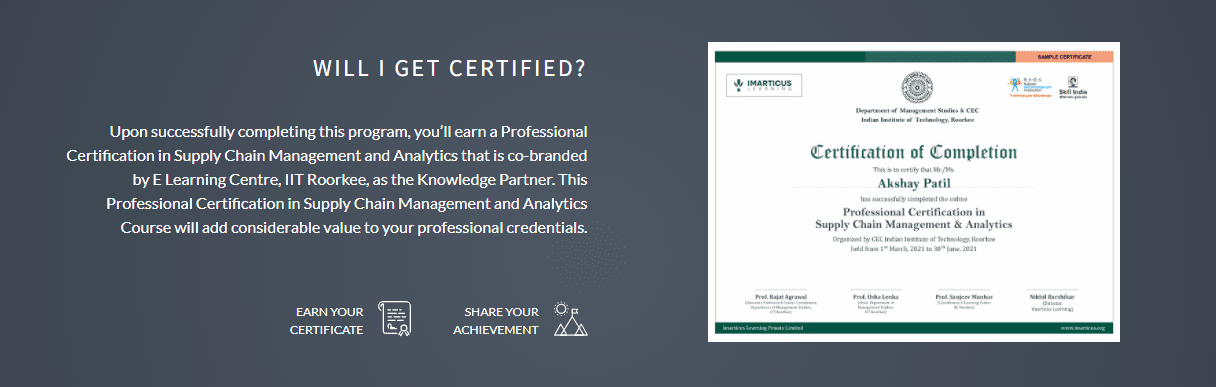
To cater to the growing demand in this field, Imarticus Learning has come up with Professional Certification in Supply Chain Management and Analytics. This Supply Chain Management course with Analytics furnishes candidates with a chance to work on 6 real-world projects and learn from the best faculty.

This article will give you an elementary understanding of different types of uncertainties managed in the supply chain and walk you through the various aspects of supply chain analytics. A supply chain analytics course training can give you an in-depth knowledge of this field.

Understanding supply chain analytics

Corporations need to analyze the deluge of information they gather from numerous applications affiliated with their supply chain. These include data from inventory, order warehouse management, procurement, transportation, and shipping costs.

The whole system of the supply chain acts like dominoes, with each step directly dependent on the other. Any problems at any step of the entire process can impact the overall result and hamper customer expectations. Supply chain analytics help you to analyze the data and ensure a smooth running of the total operation. 

Different types of supply chain analytics

There are mainly 3 types of supply chain analytics that will help you to in managing your business better:

  • Descriptive Analytics: These help you keep track of your daily operations and the changes required monthly.
  • Predictive Analytics: These provide you with an early warning so that you can gear up production, staffing, and procurement to fulfill the increase in demand.
  • Prescriptive Analytics: They provide suggestions so that you can maximize your inventory system performance and serve as the best posture for your entire inventory policy.

Best practices in supply chain analytics

If you are in the position of managing the supply chain of your trade firm, then these supply chain analytics practices will help you to optimize your decisions: 

  • Help you maintain your inventory history for accurate forecasts
  • Use the Product Life Cycle (PLC) to adapt your forecast
  • Use analytics to plan your shelf space and increase sales
  • Organize your prime hours with overlapping shifts
  • Help you identify the possibility of Full Truck Load (FTL) given various frequencies of replenishment

Key deliverables of supply chain analytics

Some of the key deliverables of supply chain analytics to boost your business are:

  • Reduce inventory and release cash 
  • Improve fill rates and deliver growth 
  • Eliminate wastages and improve margins 
  • Improve forecast accuracy 
  • Improve service levels 
  • Reduce cost to serve

Supply chain analytics compliance requirements

With your business expanding and integrating more and more technology suppliers, you will have to blend supplier compliance management into your all-around compliance agenda. Quality management systems (QMS) record the methods, strategies, and obligations for quality and control objectives.

They also include the management of vendor relationships. Try to concentrate on the most business-critical vendors first to uphold business continuity and protect your customers.

Some major supply chain analytics compliance requirements are: 

  • Define your control requirements in all Service Level Agreements (SLAs)
  • Try to set key performance indicators for monitoring your suppliers
  • Establish communications by moving to a shared digital portal

Conclusion

The field of supply chain management is an evolving one and promises a lot of scopes to grow and prosper. Take the Supply Chain Management course with Analytics by Imarticus Learning and become a supply chain analyst for a career of great promises, prosperity, and growth. 

A supply chain analytics certification with IIT, Roorkee can help students get into top positions in this field.

Here’s how AI is used in Executive job search

Artificial intelligence (AI) has the potential to simplify the process of searching for a job. There are various ways through which artificial intelligence can assist candidates and businesses in the recruitment and hiring process. Currently, corporate sectors are using artificial intelligence in the early stages of recruitment.

This helps in increasing the pace of screening resumes and scheduling interviews. To find a suitable job for a candidate, AI software requires access to simple data about his/her expertise, career history, and location. 

A candidate searching for a job can use artificial intelligence job search tools to find an open position in a firm or a company that matches his/her skill set. This helps save a significant amount of time and effort for a job seeker.

Artificial intelligence assists organizations in avoiding the unavoidable biases that slide into the recruitment process while deciding the deserving candidates for the position. Furthermore, it assists businesses in identifying growth opportunities for existing employees who are ready for future promotions.

Did you know the term ‘artificial intelligence’ was first coined in 1956? But, it wasn’t accepted by society and went through a lot of controversies until 1997 when IBM’s Deep Blue computer became the first artificial intelligence computer to defeat Russia’s chess grandmaster Garry Kasparov. 

How Does Artificial Intelligence Work in Recruitment For Executive Jobs?

Artificial intelligence helps recruiters who cannot go through each and every resume by analyzing the data of resumes based on keywords, qualifications, and other talents required for the job. Most of the time, recruiters are less in number, which makes it more difficult for them to manage the entire process alone. Therefore, they rely on artificial intelligence in getting the best-fit candidate in their team.

Artificial intelligence uses the following algorithm in job search: 

  1. Matching: AI matches the resumes and the keywords instilled in them, such as job title, etc. 
  2. Screening: AI screens the resume of candidates based on their data which helps in deciding if the candidate’s talents match the requirement of the job posted. These talents are mainly educational background, work experience, location, specialization, etc. 
  3. Response: AI has increased the scale of responses given to candidates. In the traditional approach to recruitment, a plethora of candidates applied for the job by sending their resumes which the recruiters used to check manually because of which they used to miss looking into a few resumes.Hence, those candidates get skipped in receiving a response from the company’s hiring board. But, now with the help of artificial intelligence, a recruiter easily scans the candidate’s data without going through the resume and picks the suitable candidate to whom the artificial intelligence sends a response regarding the interview.

Tips For Job Seekers to go Past The Artificial Intelligence Process

  • While preparing your resume or cover letter make sure to add the keywords that match the terminology of the posted job. 
  • Ensure the resume is readable and easy to skim through, and that it does not sound like an automated machine. 
  • Prepare for the interviews taken by the artificial intelligence bots. These bots would not give you a chance to rectify what you say during the interview but will focus on how you say it. 

We know that artificial intelligence is the future of technology, but presently there is a shortage of workforce in the field. So, if anyone is interested in starting a career in artificial intelligence, then he/she can be certain about a promising future since almost every field is trying to get upgraded with an AI certification program. 

Obtaining an artificial intelligence certification has become easy since many related courses are made available online by various well-reputed educational institutions such as IITs in India. To pursue these AICTE approved courses, students need to have a basic knowledge of computer language and programming to join the IIT AI ML course


Indisputably, artificial intelligence will play a crucial role in the upcoming boom in the recruitment industry. So, if you want to be a part of it, then join Imarticus’
artificial and machine learning course, which is designed by IIT Guwahati and will give you deep insights into artificial intelligence.

AI courses: Human geography inspired machine learning algorithms

Numerous industries like finance, healthcare, insurance, and computer system businesses employ software developers. If you wish to become a software developer, you can choose Imarticus Learning’s SCBI course. It is one of the best certifications for software engineers

What are 6 Main Practices for a Successful Career in Software Development? 

To become a software developer, you need to be aware of the business conditions. This will help you understand what skills you need. A software engineering certification is also essential. Similar to these, there are a few more practices that will ensure a long and rewarding career. Take a look at the following things you can do to improve your prospects in the field. 


  • Learn Programming Languages


If you wish to become a successful software developer, you need to learn relevant programming languages. You can focus on Java as it is a programming language that works for different platforms and purposes. You can also learn other programming languages like C++, Python, and Scala. 


  • Choose a Niche and Practice


Software development includes different aspects like app design, DevOps, and the development of computer infrastructure. So you need to choose a niche. As a software developer, you will need to focus on one particular aspect and hone your skills. You can always focus on different aspects but it is best to become an expert in one area. This will help companies identify you as a developer within that niche and thus, improve your chances of employment. 


  • Create a Portfolio


As you develop your skills and try your hand at design or development projects, you need to start creating a portfolio. A portfolio will help companies understand the extent of their knowledge.


  • Explore Potential Industries to Figure Out a Target


You need to check what industries are currently requiring software development services. Once you figure out which industry you want to work in, you can start learning the necessary skills. It is important to research every industry and then work towards an end goal. 


  • Focus on Soft Skills


While industry knowledge and software development training are necessary, you also need to have proper soft skills. Spend time improving your techniques, interact with peers and experts and build a network. 


  • Receive Training and Certification for All Skills


The final practice which is crucial is a certification. While you can be a self-taught software developer, it is best to receive a certificate from a renowned institute like Imarticus Learning. This will help you stand out and also approach important companies in the industry. 

How to Start Your Career as a Software Developer? 

Before you start a career in software development, you need to enroll in a software developer course. At Imarticus Learning, we offer Certification in Software Engineering for Cloud, Blockchain, and IoT.

For this course, Imarticus Learning has collaborated with IIT Guwahati and E&ICT Academy. Experts from these institutions have created a curriculum that is futuristic and closely related to the current business needs and conditions.

Academicians hold interactive sessions and encourage students to learn through active participation. You can also interact with your peers and develop your soft skills. The duration of this program is 9 months and over this period, you will receive intensive, hands-on training. You will learn the fundamentals of new-age software development and engineering and software architecture. 

Once you complete the course from Imarticus Learning, you will be able to sit for interviews and land lucrative jobs at reputable companies. The industry experience that you receive through 6 Capstone projects will help you secure your future as a software developer.

Role of social media in a supply chain analytics course

With the boom in technology, companies encourage their employees to embrace and actively participate in social media platforms. The vigilant and active social media approach helps the companies expand their online reach and identify and tap new revenue sources. 

The Supply chain analytics certification, in addition to the activeness of employees on social media, helps to build active brand awareness.

Over time, the logistic arena has embraced social media in the supply chain tactics. Although widespread adoption of social media in the supply chain is unlikely to occur overnight, a gradual adoption over time appears to be the safe bet.

Social media could dramatically transform the industry’s procedures. Supply chain management professionals are currently keeping a close eye on what’s going on in social media and preparing themselves as best they can for future developments.

The SCM course at Imarticus prepares you to become supply chain analyst.

How Social Media is Useful in Supply Chain

We cannot deny that social media is all about forming connections and utilizing them throughout the supply chain. When the supply chain partners use social media, they get insight into a variety of supply chain, industry, and competition challenges. It also helps establish partnerships and identify critical performance indicators, such as a carrier’s on-time performance or slow shipper payments. Some business entities also use social media to gather feedback from their clients and improve suggestions.

Supply chain participants can also use social media to keep track of supply chain events and transactions, such as a delivery delay or a carrier failure to pick up a shipment, and keep everyone informed about current happenings. Companies may know about a shipment’s arrival or departure from a particular warehouse through Twitter messages. Twitter can announce the demand for specific loads or notify drivers about accidents or road closures. Social media also helps companies get more timely and meaningful information about risks and occurrences, allowing them to take remedial action faster and reduce the impact of a supply chain interruption.

It is a valuable tool for supply chain professionals to find innovations, evaluate commodity and pricing trends, capture best practices, and engage with clients, colleagues, and suppliers, social media. It can improve existing processes, reduce risk, and boost efficiency. Businesses may promote supply chain innovation by leveraging the pooled ideas and knowledge of supply chain players, which leads to continual improvement and commercial growth.

Supply chain management is about finding the most efficient means to convey information to the ultimate users. Inevitably, social media aids in disseminating critical information and continues to be an effective and successful means for businesses to communicate that information quickly. Companies that disregard social media miss these prospects and potential commercial growth.

Do you want to utilize social media in your IIT supply chain management operations? For this, you should thoroughly evaluate both its benefits and the implications.

We at Imarticus, through the SCM program, teach you to improve supply chain management utilizing social media. It can improve visibility, communication, control, and minimize operational and personnel expenses. With a more efficient and reliable supply chain, you can have improved customer satisfaction. The benefits of adopting social media to better supply chain management do wonders for your organization, and you will feel these benefits throughout your entire firm.

Here’s why you should choose supply chain planning as a career

IIT supply chain management manages supply chain activities to optimize customer value and gain a last competitive advantage. Supply chain organizations deliberately attempt to construct and run supply chains most effectively and efficiently feasible. Product development, sourcing, production, and logistics are all covered by supply chain operations, as are the information systems required to coordinate them.

The supply chain analytics certification at Imarticus covers the following points:

  • The first is that almost every product that reaches a customer results from a collaboration between several firms. The supply chain refers to all of these businesses working together.
  • The second point is that, even though supply chains have been there for a long time, most businesses have solely focused on what happens within their “four walls.” Few companies comprehended, let alone managed, the complete chain of events that led to the final delivery of products to the client. As a result, supply chains have become disconnected and inefficient.
  • Further, the organizations connect with physical flows or information flows.

A physical flow transforms, transit, and storage of items and materials. They are the supply chain’s most visible component as the flow of information is crucial for every organization.

Information flows are essential for every organization as it governs the day-to-day flow of goods and materials moving around the supply chain.  The SCM program at Imarticus helps develop the strategy to take care of the needs and requirements of the customers.

How to Become a Supply Chain Analyst

Data collection is essential for working in any organization, but management and handling of data to be helpful in the organization is even more crucial. You can have a promising career in supply chain analytics.

So, what does supply chain analytics do? A supply chain analyst examines the flow of goods through a distribution system. The analyst looks for flaws in the current process and then works to find solutions to enhance it, ultimately boosting supply chain performance.

Further, analysts are essential at every level of the supply chain management process, including obtaining data, interpreting data, communicating with supervisors, peers, and subordinates, and facilitating decision-making.

Stages of Supply Chain Management

Every stage of supply chain management requires analysts. Analysts are critical in every aspect of the supply chain, from material procurement to network architecture and all in between. Here are some supply chain management stages (areas) to consider:

  • Raw material sourcing
  • Production planning
  • Inventory management
  • Demand planning
  • Distribution planning
  • Network design

Career Options at Supply Chain Management

Supply chain management is a lucrative career opportunity. By opting for SCM course at Imarticus, you have the following career options:

  • Sourcing analyst
  • Material analyst or material planner
  • Production analyst
  • Inventory analyst
  • Demand planning analyst
  • Deployment analyst
  • Transportation analyst
  • Supply chain modeling analyst

Data analysis using SQL – All you need to know

SQL, the programming language, is the best companion for data analysts. SQL means Structured Query Language, which helps companies to build tools that can easily garner data from their databases. 

This is a valuable tool to analyze the data and make appropriate decisions based on them. Since data analysis is crucial for finding the trends and predicting them for the long-term benefits of the institutions. So data analysis using SQL is significant to get quality data from the database. 

What is SQL for Data Analysis?

A data analyst can easily access the data using SQL and read or manipulate them as needed. It is further used for analyzing the selected and stored data to get the right insights that will be beneficial for the business. 

SQL uses some basic techniques involved with it for achieving these said tasks. It also has a set of five commands to control, manipulate and analyze the data. 

Those having a basic degree or certificate such as the Post Graduate Program in Data Analytics can easily follow the instructions or handle this program comfortably. 

  • SQL is used for scripting Data Integration Scripts and is a widely used tool by Database Administrators. 
  •  It is used for handling analytical queries to get insights.  
  •  It is useful for the modification of data like deletion, insertion, or updating of the databases.  

How beneficial is SQL for Data Analysis?

SQL is a data management language that stores data in a table format. It is easy to find data and build custom models for the business. The data management here is precise and shows optimum results. 

SQL is ideal not only for data storage, it can also process, retrieve, and analyze the data as well as get insights from it, no matter how complex it is. The main reasons why SQL is beneficial for data analysis are,

  • SQL for data analysis is a user-friendly language and is quite easy to learn or understand.
  • It can efficiently process and retrieve from any of the various databases associated with it. 
  • SQL follows the standard documentation so that users can handle it well.
  • It is a widely used tool.
  • It’s useful for testing and manipulation of the data as well.
  • You don’t need any coding experience to handle SQL
  • It is completely portable and usable across all devices. 

Limitations of SQL for Data Analysis

SQL is not without errors, it has its own set of limitations.

  • The lack of a user interface often makes it challenging when dealing with larger size of databases.
  • It is difficult to do complex statistical analysis.
  • SQL will be inadequate for handling unstructured data as it requires the data to be in table format and that from the column format will not be compatible.
  • There are certain versions of SQL that are inaccessible for many users as they are expensive. 

Where to learn SQL Programming?

There are several online courses available for both freshers and working professionals to excel at this programming language. One of the best courses is the Post Graduate Program in Data Analytics & Machine Learning at Imarticus. This course is available separately for freshers and professionals to suit their schedules. The classes will be conducted on weekdays or weekends as per choice. 

The curriculum will be different according to the chosen program. The learning process includes multiple in-class projects from the real world so that the candidates are industry ready for the jobs. There will also be preparation workshops, personalized mentoring, and mock interviews. 

What learning supply chain management at the IITs is like (share like an experience)

As a student of commerce, Supply chain management seems like a prospective career choice because of how lucrative the job role is in the market. Initially, as a rookie student with an interest in this field, I was more drawn towards this sector because of how in-demand this job role is. To elaborate, expert professionals in the supply chain sector are mainly involved in the management of the entire production flow of goods and services, between locations and businesses. It is also inclusive of the storage and movement of raw materials, inventory, and even finished goods. 

To make it big in Supply Chain Management, a background or a qualification in this field is a mandate. Students with commerce backgrounds are open to choosing any specialization or field they want after graduation or finishing higher studies. A professional six-month program in Supply Chain Management from IIT has indeed been a life-changing course. As expected from a top-tier premier institute like IIT, it is truly the best that one can go for if they want to make it big in this industry. 

Key Highlights of This Course

Needless to say, the very mention of IIT in your CV is bound to give your career a boost amongst the numerous candidates who apply for the same job role you are aiming for. Speaking from experience, it is an advantage over other potential candidates in this field. Down below is a list of some of the reasons why taking up this course has been one of the best decisions: –

Premium Faculty

As far as personal experience goes, studying a course in IIT has been more than an honor. It has lived up to every expectation because of the premium faculties in Supply Chain Management. One to one session with expert IIT faculty has indeed helped grasp the key concepts that are a mandate in this field.

Exclusively Designed by Professionals

This 6-months program is professionally designed by industry experts and IIT faculty for students to learn. Job roles involving e-commerce are increasing day by day because of the increasing amount of movement of goods and services. This has led to an increase in demand for supply chain management professionals. With the number of job roles that have increased for Supply Chain Management worldwide, it has indeed made it better for students with this certification. With more opportunities in the market, nailing a job has become much easier thanks to the IIT affiliation as well. 

Gaining Experience Through Learning

This course is designed to make you solve real-industry problems that will give you a simulation of working in the field itself. This experience is extremely helpful in understanding crucial concepts, developing skillsets that prove beneficial for professionals in this field, and even having a thorough grasp of business contexts as well. 

Campus Immersion 

You can participate in the three-day campus Immersion module to visit the IIT Roorkee campus. You can interact with peers and learn from the IIT faculty during the campus immersion. Visit the Delhi or Noida campus and work on the Capstone Project under the esteemed guidance of professional mentors.

Big Data and Analytics Knowledge

Supply chains are hubs of massive datasets making them a part of Big Data. This course had helped not only in training traditional techniques of Supply Chain management but has even implemented a data-centric approach to SCM-related decision-making.

Conclusion

Being fresh alumni of this elite supply chain and analytics management course is bound to take your supply chain career to heights you’ve never imagined. Enroll in the from Imarticus.

How AI courses are empowering Influencer Marketing?

The AI certification is more relatable to the industries such as security, e-commerce, surveillance, etc. People don’t usually think of it in terms of marketing, especially influencer marketing. But it is one of the most effective strategies to promote a product. 

Influencers are the big thing these days in marketing. People tend to follow and believe them and try to implement the tips and tricks by these experts in their lives. Brands are looking for those successful influencers to market their products in their relevant industries and niches. 

There may not be a wider range of customers with influencer marketing but the small number of them could turn out to be more loyal and make a strong base. This is why it is essential to find successful influencers in the respective niches. Artificial Intelligence can help in this search for influencers and save them time and effort. 

How do AI courses help?

For the successful application of AI in influencer marketing, one must know how it works in this industry. Those who pursue any kind of Artificial intelligence and Machine Learning course must be doing a project at the end of their course. Courses such as the AIML from Imarticus offer this opportunity by options of projections from various industries, including marketing and social media marketing. 

To find the most suitable customers for any [rduct, one must find out who is interested, what their age groups and other minute factors. What helps with this finding is ML and the model projected by it. It helps narrow down the target and then goes and finds the best influencers in this field. 

An example of one such project with Imarticus certification course is Marketing Classification that finds out about the interests of teenagers to help with product marketing. Someone having experience in such a task can help find the right targets and market the products better. 

What is the result?

The result of using AI, Machine learning, NLP and other tools here will 

  • Help create a framework that helps reach the target audience
  • Identify those microblogging content creators for each marketing segment
  • Can identify the influencers who are willing to be on board for a long term
  • Helps create a constant digital presence with minimal expense 
  • Create a workflow plan to make the process easier.

Choosing the right course

Artificial Intelligence is applied in almost all industries. Each industry will be using it for the various departments and each department will be using it for different purposes. AI is not a single technology but one that uses various technologies to come up with a working model. The best course in AI will be covering multiple fields and having the expertise of the leaders of the industry.

This Imarticus course Certification In Artificial Intelligence & Machine Learning is conducted by IIT Guwahati. It not only covers a wider and relevant field in AI and ML but also conducts various discussions, exercises, projects, and assessments with the help of experts and mentors. This is one course that will help you be updated with the latest technologies. The Capstone project will help boost your knowledge and experience in the required field. 

Conclusion

Having someone with an Artificial Intelligence certification can help a company assess the various aspects of digital marketing and fine-tune the process by eliminating unnecessary segments and diverting attention to the most useful ideas and their implementation. Influencer marketing is one such advantageous segment of digital marketing that helps improve engagement rate and content quality. It has helped the leading brands in achieving their goals quickly and accurately. 

Supply chain analytics course: Reimagine organizational operations by fusing design thinking with cutting-edge technologies

Supply chain analytics is vital for corporate success because it directly influences a company’s capacity to provide a pleasant customer experience while accounting for many expenses that impact overall profitability. The supply chain is a network that connects suppliers, businesses, and end-users, and it includes everything from acquiring raw materials to delivering products to customers.

Companies can collect, analyze, and act on data created by their supply chains using supply chain analytics. It enables them to make immediate adjustments and long-term strategic improvements to provide a competitive edge.

Hence, what is the need to become a supply chain analyst? Supply chain analytics is becoming increasingly important in the day-to-day operations of today’s most successful firms. Organizations are paying more attention to these figures than ever before, and they’re utilizing a variety of analytics approaches to improve each connection in the network. We at Imarticus help you learn about the supply chain with our SCM program.

best supply chain management coursesTypes of Supply Chain Analyst

Mainly there are four types of supply chain analytics, and we at Imarticus, through the SCM program, brief about them:

Descriptive Analytics

Descriptive analytics examines the past and recognizes trends in historical data. This data could come from internal and external systems that provide visibility across suppliers, distributors, sales channels, and customers. Analytics can uncover patterns and postulate potential reasons for change by comparing the same type of data from different times.

Predictive Analytics

Predictive analytics assists businesses in predicting what might happen and the business impact of various situations, such as supply chain interruptions and other outcomes. Leaders can be proactive rather than reactive by forcing them to evaluate these prospective circumstances before they arise. They have enough time to plan a strategy for a potential surge or drop in demand, for example, and can react appropriately.

Prescriptive Analytics

Prescriptive analytics combines descriptive and predictive analytics data to propose what actions a company should take right now to achieve its objectives. This type of analytics could aid businesses in resolving issues and avoiding significant supply chain interruptions by assessing internal and external data. Because prescriptive analytics is more complicated, powerful software can quickly handle and analyze large amounts of data.

Cognitive Analytics

Cognitive analytics aspires to mimic human thinking and behaviour, and they can assist businesses in answering challenging, complex problems. Though, when it comes to evaluating data, these analytics can recognize things like context. Cognitive analytics utilizes artificial intelligence (AI), notably machine learning and deep learning to accomplish this.

It also allows it to learn and improve over time, and it may drastically cut the time taken by employees to develop these reports and analyses. It also empowers employees outside the data science team to access and comprehend the data.

Benefits of Supply Chain Course

The supply chain analytics report and dashboards assist businesses in identifying and understanding potential risks, improving planning inventory management, and better meeting the high expectations of their consumers. It can help with planning by providing more precise estimates, allowing you to put all of the operational components in place to match the anticipated volume.

The supply chain analytics course training at Imarticus SCM program, we help you to develop the metrics and numbers to help businesses meet customer expectations.