How Machine Learning is Reshaping Location-Based Services?

Today life is a lot different from what it used to be a decade ago. The use of smartphones and location-empowered services is commonplace today. Think about the driving maps, forecasts of local weather and how the products that flash on your screen are perhaps just what you were looking for.

Location-enabled GPS services, devices that use them and each time we interact and use them generates data that allows data analysts to learn about our user-preferences, opportunities for expansion of their products, competitor services and much more. And all this was made possible by intelligent use of AI and ML concepts.

Here are some scenarios where AI and ML are set to make our lives better through location-based services.

Smart real-time gaming options without geographical boundaries.
Automatic driver-less transport.
Use of futuristic smartphone-like cyborgs.
Executing perilous tasks like bomb-disposals, precision cutting, and welding, etc.
Thermostats and smart grids for energy distribution to mitigate damage to our environment.
Robots and elderly care improvements.
Healthcare and diagnosis of diseases like cancer, diabetes, and more.
Monitoring banking, credit card and financial frauds.
Personalized tools for the digital media experience.
Customized investment reports and advice.
Improved logistics and systems for distribution.
Smart homes.
Integration of face and voice integration, biometrics and security into smart apps.
So how can machine learning actually impact the geo-location empowered services?

Navigational ease:

Firstly, through navigation that is empowering, democratic, accurate and proactive. This does mean that those days of paper maps, searching for the nearest petrol station or location, being late at the office since the traffic pileups were huge and so many more small inconveniences will be a thing of the past. We will gracefully move to enhanced machine learning smartphones that use the past data and recognize patterns to inform us if the route we use to commute to office has traffic snarls and provide us with alternative routes, suggest the nearest restaurant at lunchtime, find our misplaced keys, help us locate old friends in the area etc all by using a voice command to the digital assistant like Alexa, Siri or Google.

Machine Learning can make planning your day, how and when to get to where you need to be, providing you driving and navigational routes and information, and pinging you on when to leave your location a breeze. No wonder then that most companies like Uber, Nokia, Tesla, Lyft and even smarter startups that are yet to shine are investing heavily on ML and its development for real-time, locational navigational aids, smart cars, driverless electric vehicles and more.

Better applications:

Secondly, our apps are set to get smarter by the moment. At the moment most smartphones including Google, Apple, Nokia among many others are functioning as assistants and have replaced those to-do lists and calendar keeping for chores that include shopping, grocery pickups, and such.

Greater use of smart recommendatory technology:

And thirdly, mobile apps set smartphones apart and the more intelligent apps the better the phone experience gets. The time is not far off when ML will be able to use your data to actually know your preferences and needs. Imagine your phone keeping very accurate track of your grocery lists, where you buy them, planning and scheduling your shopping trips, reminding you when your gas is low, providing you with the easiest time-saving route to commute to wherever you need to go and yes, keep dreaming and letting the manufacturer’s know your needs for the future apps. The smart apps of the future would use your voice commands to suggest hotels, holiday destinations, diners, and even help you in budgeting. That’s where the applications of the future are headed to.

In summation, ML has the potential to pair with location-using technologies to improve and get smarter by the day. The future appears to be one where this pairing will be gainfully used and pay huge dividends in making life more easily livable.

To do the best machine learning courses try Imarticus Learning. They have an excellent track record of being industrially relevant, have an assured placement program and use futuristic and modern practical learning enabled ways of teaching even complex subjects like AI, ML and many more. Go ahead and empower yourself with such a course if you believe in a bright locational enabled ML smart future.


The best research and investment tools for a machine learning course

As machine learning becomes more popular, many people look to get into the field. But what are the best research and investment tools for a machine learning course in 2022?

This post will discuss the critical tools you will need to succeed in a machine learning course. So, if you are pursuing a career in machine learning, make sure to read this blog post!

Why are research and investment tools necessary?

Research and investment tools are essential because they allow you to research and invest in new technologies. In a machine learning course, you will need to complete a lot of research to keep up with the developments in the field. Additionally, you will need to invest in new technologies to improve your skillset. Thus, research and investment tools are essential for any machine learning course.

What are some of the best research and investment tools?

Many different options are available for research and investment tools for machine learning. Each has its benefits and weaknesses, so choosing the right tool for your needs is crucial.

Here are some tools for machine learning course in 2022:

#01: Python

Python is one of the most popular programming languages for machine learning. It has a large community, and there are many open-source libraries available. Additionally, it is easy to learn, and you can use Python in your research projects because it is an interpreted language with dynamic typing and garbage collection.

#02: TensorFlow

TensorFlow is a popular open-source library for machine learning. Google developed it, allowing you to perform complex mathematical operations on data. TensorFlow is also widely used in the industry, so it is a great tool to learn if you want to pursue a machine learning career.

#03: Keras

Keras is an open-source neural network library written in Python. François Chollet developed it, and it allows you to design quickly and train deep learning models using a few lines of code.

#04: PyTorch

PyTorch is another popular machine learning framework based on Torch, an open-source machine learning library. PyTorch is for deep learning, and it allows you to develop and test your models quickly.

These are just a few research and investment tools available for machine learning courses in 2022. Make sure to explore all different options before choosing the right tool for your needs.

Discover Artificial Intelligence And Machine Learning Course with Imarticus Learning

This IIT AIML course gives students the skills they’ll need for positions in today’s digital workplace. This intensive Artificial Intelligence certification will prepare the student as a data scientist, analyst, or engineer-a professional who can use AI tools from machine learning through reinforcement algorithms and deep neural networks while developing their understanding of how these technologies work under different circumstances.

Course Benefits For Learners:

  • The Expert Mentorship program provides AIML expertise through practical experience for those who want to learn more about this exciting field of study, leading them to careers as artificial intelligence professionals or experts!

  • This course will help students gain access to attractive professional prospects in Artificial Intelligence and Machine Learning.

  • Academic professors will help students construct Data Science concepts, while industry specialists will teach students how to utilize Machine Learning, Deep Learning, and AI approaches in real-world applications.

How a machine learning course will transform your resume in 2022?

An artificial intelligence (AI) technology that trains computers to learn and better itself based on experience without being explicitly designed is termed Machine learning (ML). It is a set of computer programs trained to retrieve and use data. Machine learning enables computers to observe the data and provide a result without any human intervention or observation.

Machine Learning with Python

AI is the machine intelligence that leads to the practical solution to the problem, and machine learning takes AI technologies a step further by employing algorithms to examine data, learn, and make intelligent conclusions. 

For AIML, the program developers use the programming language python because it has many libraries and frameworks to make coding easy, and it also saves time.

Thus, machine learning is all about application, and if you know python, you can grasp machine learning fast. To implement anything, you should know how to code it.

Machine Learning Course

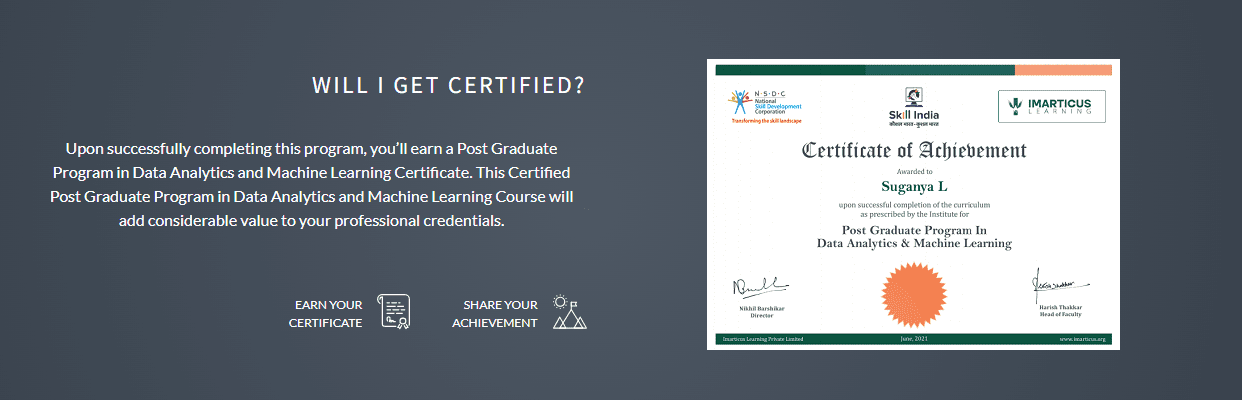
At Imarticus, we offer you an extensive program to become a data scientist, data analyst, machine learning engineer, or AI engineer, and, by becoming analytics, you can build machines and systems that will react as humans do.

In the Data analytics certification, we will teach the technique to create a machine learning model that will accurately work to give suitable and best outcomes. We will develop your analytical abilities to choose the correct algorithm as per the model compatibility and your requirement.

The first requirement of a machine learning model is data collection and its interpretation. Therefore, at Imarticus, we give you the knowledge of data manipulation, analysis, and visualization. 

As analytics, you learn to extract ideas from your team, choose proper tools, use a machine learning framework, and stay up to date with the latest development. 

The key responsibilities of analytics are:

  • Collect data, study, and then convert it into data science prototypes
  • Research for the appropriate machine learning tools and algorithm
  • Build a machine learning application that will meet the industry requirement
  • Choose the correct data and the visualization methods
  • Perform machine learning tests
  • Execute statistical analysis from the test results.
  • Set the model for accurate results

Machine Learning Resume

Your resume is your introduction and first impression for recruiters, but writing perfect codes and preparing a good model may not get you your dream job. You have to delve deeper.

Furthermore, if you want to survive in the job market, you should not only have the skills, but you should also know how to endorse these skills to your name. Furthermore, you should have an exceptional and organized resume. Hence, you must include the following points in your resume:

  • You are a certified machine learning engineer
  • Briefly mention your projects and your contribution
  • Describe your work experience in one-liner points
  • List down every information in reverse chronological format
  • Prepare a summary of your resume while highlighting your contributions

 Machine learning has a promising future, and these professionals are high in demand. At Imarticus, we know this so, the expert mentors will give you a practical understanding of AIML. They will help you to develop skills to unlock lucrative career opportunities. 

A Complete Guide On How To Approach A Machine Learning Problem For Beginners!

As beginners in machine learning, you will want to have questions answered to common problems. Questions like how to approach, how to start, which algorithm fits best, and so on.

Common problems in machine learning for beginners

Here, we will help you resolve those problems by answering common questions:

Where can you use machine learning?

You can use machine learning for problems when:

  • Automation is involved
  • Learning from data is needed
  • An estimated outcome is required
  • Need to understand pattern like user sentiments and developing recommendation systems
  • Object required to identify or detect an entity

How to solve machine learning problems?

Here are steps to solve problems in machine learning:

  • Read data from JSON and CSV
  • Identify dependent and independent variables
  • Find out if there are missing values in the data or if it is categorical
  • Apply pre-processing data methods if there are missing data to bring it in a go to go format
  • Split data in groups for testing and training for concerned purposes
  • Spilt data and fit into a suitable model and move on validating the model
  • Change parameters in the model if needed and keep up the testing
  • An optional step is to switch algorithms to get different answers to the same problem and weigh the accuracies for a better understanding – this explains the accuracy paradox
  • Visualize the results to understand where the data is headed and to explain better while representing it

What algorithm should you use?

You need to understand what labelling is to answer this. Labels are the values we need to make an estimate. This represents the Y variable, also known as the dependent variable.

Here is a small example to help you understand this:

if

dependent_variable_exists==True:

supervised learning()

else:

unsupervised learning()

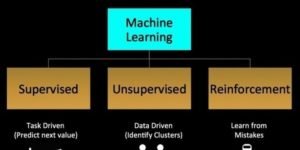
Machine Learning CourseWhile you’re learning from a machine learning course, you will understand that your supervision and training refers to supervised learning. This means that the results need to be compared by a frame. The frame here is the dependent variable. However, there is no reference for frame under unsupervised learning, which is why the name.

It is time to figure out how algorithms are served. However, it is essential to note that this is a generalized approach. The situations can differ, and so will be the usage of algorithms:

  • Numeric data for linear regression
  • Logistic regression when the variable is binary
  • Multiple category classification through a linear discriminant approach
  • Decision Tree, Naive Bayes, KNN, and Ensembles for regression and classification

Machine Learning Course

As you grow in your machine learning career, you will learn how to take random XG boost, forest, Adaboost, among other algorithms for ensembles. You can try these for both regression and classification.

Ensembles, as the name goes, refer to a group of at least two classifiers or regressors. Moreover, it doesn’t matter if it is the same or if working towards the same goals.

Building visualizations

Here are some of the things to remember when visualizing reports:

  • You can show class clustering with a scatter plot
  • Avoid scatter plot if there are several data points
  • Class comparisons can be explained through histogram
  • Creating pie charts help comparative breakdown
  • Line charts can help analyze reports with frequent deviations like stocks

If a scatter plot has too many data points, it will look clumsy. It will not be a presentable representation to show stakeholders. In such cases, you should use scatter charts.

Final thoughts

These points will help a beginner in machine learning career to become more aware of how to solve problems. You now know the essential things to do and things to avoid to get accurate results.

Developing digital health care solutions with an artificial intelligence and machine learning course

In the current times, digitization is seen in every sector, and healthcare organizations are not far behind. Artificial intelligence with machine learning and algorithms is the newest aspect of the technological developments that can help to automate various processes.

If you are interested in implementing AI in healthcare, you can opt for Imarticus Learning’s artificial intelligence and machine learning course. The course includes relevant use of technology across industries, including healthcare. 

How to Implement Artificial Intelligence and Machine Learning in Healthcare? 

Artificial intelligence has various roles in the healthcare industry. If you choose to get an artificial intelligence certification, you will learn more about the following aspects. 


  • Prediction of Treatments


Artificial intelligence and machine learning can be implemented for the accurate analysis of patient information. AI solutions can analyse medical conditions and help doctors arrive at accurate treatment plans that will be beneficial to the patients. While reviewing all medical information is necessary for correct diagnosis, doing so manually increases workload and may even lead to errors. Artificial intelligence and machine learning can automate specific processes and ensure error-free treatment plans. 


  • Improvement of Workflow


From the IT infrastructure in healthcare organizations to diagnostic tasks, workflows can be automated and optimized. This will improve business processes and ensure better outcomes. All organizational tasks will be seamless and less time-consuming. 


  • Detection of Anomalies


Most healthcare organizations include digital databases and rely on workflow automation. While AI can assist in automation, it can also monitor the entire system. Failure of systems in any industry leads to loss, however, in the healthcare industry, anomalies can lead to loss of lives and not just revenue. Therefore, it is important to use artificial intelligence and machine learning tools to detect gaps within the system so that professionals can take better precautions. 


  • Introduction of Opportunities for Clinical Trials


While artificial intelligence solutions are capable of predicting treatment plans through a thorough analysis of symptoms, they can also assist in clinical trials. Artificial intelligence can be used to determine if certain patients are suitable candidates for trials. Such solutions can also help doctors predict patient responses to trials. AI and machine learning create space for safer clinical trials by ensuring that patients can withstand treatments. 

How Can Imarticus Learning’s Al ML Course Prepare You for a Career in Healthcare? 

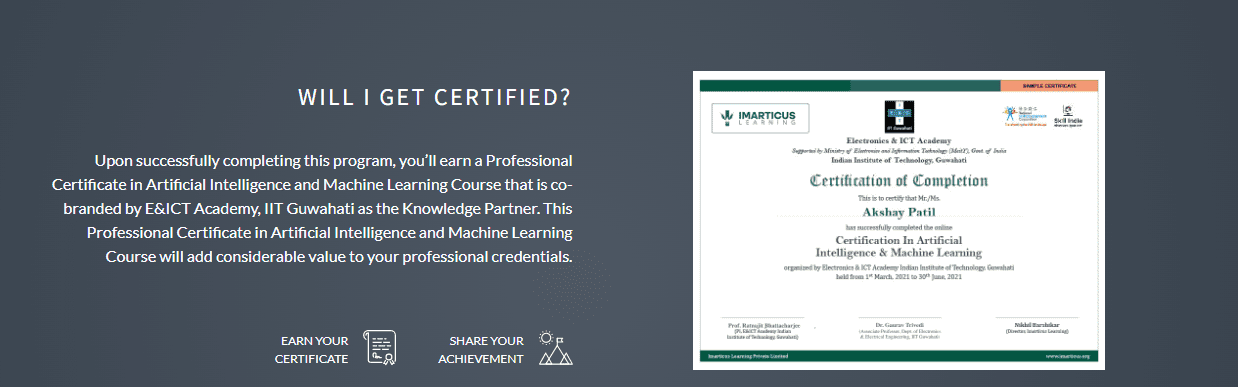
If you wish to enter the healthcare sector and work in the digitization of healthcare solutions, then Imarticus Learning’s Certification in Artificial Intelligence & Machine Learning is a great option. Our course is in collaboration with E&ICT Academy and IIT Guwahati. So, you will have access to lectures and curricula designed by renowned academicians and industry professionals.

At Imarticus Learning, we ensure that the IIT AI ML course prepares students for a long and rewarding career in data science and machine learning engineering. You will be attending live sessions for eight hours every week and we encourage you to interact with all teachers and peers. Imarticus Learning creates opportunities for students to network and hones their soft skills while preparing for work in the industry.

To ensure hands-on experience, we offer twenty-five projects that are based on real business issues and more than one hundred assignments. 

The certificate course in artificial intelligence and machine learning at Imarticus Learning is ideal for students who have completed graduation in computer science, engineering, statistics, mathematics, science, or economics. If you have a minimum of 50%, you can enroll in our program and receive education and industry training from experts.

How blockchain is adding transparency and efficiency to supply chain management

Blockchain technology is quickly becoming one of the most important innovations in recent history. It has the power to transform every sector, from manufacturing to finance and more. Blockchain can help businesses streamline their supply chain management by providing transparency while reducing costs for all parties involved. 

This blog post will explore how blockchain benefits supply chain management and why it is essential for business owners to understand this new technology!

What is blockchain, and how does it work?

The blockchain is a technology that stores information in blocks, each block containing data of any size. Once data is stored, it can’t be changed or removed. It makes the blockchain incredibly secure and tamper-proof.

Blockchain is the world’s leading software platform for digital assets. Offering the largest production blockchain platform globally, we are using new technology to build a radically better financial system. Blockchain enables transformation across every business, government, and institution.

One of the key ways to use blockchain in supply chain management is to add transparency and efficiency. Blockchain can help businesses keep track of their inventory and get the best deals on supplies by creating a tamper-proof ledger of transactions. Additionally, blockchain can help companies save money and time by reducing the need for intermediaries.

What are some of the benefits of using blockchain in supply chain management?

The key benefits of using blockchain in supply chain management include increased transparency, reduced costs, and improved efficiency. By creating a shared ledger of tamper-proof and secure transactions, businesses can reduce the need for intermediaries and create a more efficient supply chain.

As it becomes easier for businesses to track the provenance of their products, consumers can also feel confident that they are buying ethically sourced goods. For example, if someone buys diamonds mined in South Africa on De Beers’ blockchain-based platform Tracr, they will be able to trace the provenance of those diamonds through that supply chain.

The ability to track goods from origin to end-user means a more transparent and therefore traceable product journey, enabling businesses to prove compliance with governmental regulations for food safety, quality assurance, or other aspects of their offerings. 

What challenges need to get addressed before you can widely adopt blockchain in supply chain management?

 One of the key challenges is that blockchain is still in its early stages, and many businesses are unsure how to implement it. Additionally, there are some concerns around security and privacy when sharing data on a blockchain network.

Another challenge facing blockchain in supply chain management is the lack of standardization. Because different businesses use different blockchains, it cannot be easy to transfer data between them. You could address it by developing a universal standard for blockchain technology.

Explore Supply chain Management Career with Imarticus Learning.

Supply chain management certification online is in partnership with DoMS and E-learning Centre, IIT Roorkee, and industry professionals to equip candidates interested in entering the operations and supply chain business with a cutting-edge experience.

Course Benefits For Learners

  • Supply chain management online course prepares students for jobs such as Demand Planner, Data Scientist, Supply Planner, and Supply and Operations Planner, which are in great demand.supply chain management courses


  • With a certification authorized by one of the top-ranked IITs, IIT Roorkee, students can impress employers and demonstrate their new-age SCM and Analytics abilities. 
  • Students Attend 1:1 mentorship sessions and get their questions addressed by Supply Chain Management industry leaders.

How learning a tableau course can enhance your career prospects

With the advancement of technology, data skills are in demand. Everything we do revolves around the analysis of people’s behavior and understanding the statistics behind their decisions. Tableau is a computerized program that improves this analysis by making data more simple and accessible. It converts big data into a small and understandable form, at the same time giving an insight into the small data. 

The Tableau course at Imarticus will build a career in business intelligence and data analytics. You can get answers fast and also develop an unforeseen insight into statistics.

Tableau Career Opportunities

Today, companies have an enormous inflow of data with implications in their business. Therefore business corporations across the globe need an interactive and easy-to-use tool that can examine the data while giving an insight into it. 

Tableau software helps these corporations to visualize, explore, examine, and share the data so that they can take timely action and spread their business.

Tableau Analytics should have analytical skills. They should be problem-solving, innovative, and detail-oriented. They should also be a team worker and know business intelligence tools and Query languages.

With the data analytics course with placement by Imarticus, you will become a Tableau professional. Our program covers all the fundamentals and topics for building a promising Tableau career. We will teach you everything from scratch so that your career moves to the peak level. After the completion of this course, you will have varied career options, such as: business analytics certification courseTableau consultant

  • Data analyst
  • Business analyst
  • Business intelligence analyst
  • Business intelligence developer
  • Business intelligence manager

As a Tableau developer, you will prepare visualization and presentation and conclude data to improve business excellence. Tableau visualization will assist you to create innovative solutions for business problems.  

Tableau professionals can work on business problems and provide technical solutions for them. The visualization of the data will help them in finding an innovative solution and they can also work with the storage tools. With the development and expansion of the organization, the inflow of business data will also increase. Tableau Analytics can also enhance the system of the organization to meet this increase in data.

Data visualization and business intelligence are the requirements for the success of business organizations. The growth of many organizations depends upon these. Thus, the future of a Tableau professional is promising and bright.

Data Analytics Certification

We know that data is the backbone of every organization. With the increase in data, its storage is also increasing. Therefore, data visualization tools like Tableau help us to visualize data and examine the results.

At Imarticus, we know the value of data science. With our Data Analytics and Machine Learning Course, you will learn the real-world application of data science. You can build significant models that will give insight into the business. You can also make predictions.

If you are looking for a career in data science and Analytics, our course will help you become a Tableau professional. We have a 100% track record of interview and placement after completing this course successfully.

Spark or Hadoop? Here’s the Answer to this Dilemma

Every year, an increasing number of distributed systems to manage data are introduced to the industry. Among them, Spark and Hadoop have emerged as the most successful ones. This article discusses these two systems and tries to find out which one is better.

What’s Hadoop?
Hadoop is a general-purpose form of distributed processing that consists of several components. The Hadoop Distributed File System (HDFS), YARN and MapReduce are some very important components of Hadoop. Even though this system is entirely built in Java, it is accessible through many other languages including Python. An SQL like interface which allows running queries on HDFS, Hive is another important feature of Hadoop.

What’s Spark?

Spark is a relatively new project developed in 2012. It enables us to process data in parallel across a cluster. The major difference with Hadoop is that it works in-memory. Spark can process data in RAM using a concept called RDD or Resilient Distributed Dataset. It also comes with several APIs. Even though the original interface was written in Scala, based on the heavy usage by data scientists, R and Python endpoints were also provided.

Now let’s take a look at these platforms in different perspectives such as performance, cost and machine learning.

Performance
It is found that spark can run 100 times faster in-memory and ten times faster on disk than Hadoop. Especially when it comes to machine learning applications such as Naive Bayes and K-means, Spark is much faster. Following are the crucial reasons behind the better performance of Spark.

While running a selected part of a MapReduce task, Spark is not limited by the input-output concerns. It enables faster operation in applications.
The DAGs of spark permits optimization between each step. So, there would be performance tuning during the process which is not present in Hadoop.
However, in situations where the spark is running on YARN, the performance is found to be reduced. Also, sometimes it could lead to RAM overhead memory leaks. So, in a batch processing use-case, Hadoop is the more efficient system.

Costs
Since both Spark and Hadoop are open-source Apache projects, you can potentially use them with zero installation cost. However, there are other costs such as maintenance, hardware purchase and costs of supporting team. We know that the Hadoop requires more memory on disk and spark requires more RAM. In that sense, spark clusters are more expensive to set up. Also, since it is a new system, the experts of Spark would be rarer and more expensive.

Machine Learning Capabilities

Spark comes with a machine learning library, MLLib to use for the iterative machine learning applications. It includes regression and classification. Also, you can build machine learning pipelines with hyperparameter tuning using it.

Hadoop makes use of Mahout to process data. It has clustering, batch based collaborative filtering, and classification. Lately, it is being phased out in favor of Samsara. It is a Scala-backed DSL language and allows you to build your own algorithms.

Conclusion
It is sure that these two are the most prominent distributed systems available today for data processing. Between them, Hadoop is mainly recommended for disk-heavy operations while Spark is more flexible. However, the in-memory processing architecture Spark is more expensive than that of the Hadoop. So pointing out one as better than the other is not easy. It varies under different circumstances.

Beat the market: Learn Computer Vision in Python

Are you looking to learn a new skill that can give you an edge over your competition? If so, then you should consider learning computer vision with Python. This powerful programming language has become increasingly popular in recent years and is perfect for tackling complex computer vision tasks.

This blog post will discuss computer vision and learn it using Python. We will also provide a few resources to get you started!

According to the World Economic Forum, nearly half of all jobs will get replaced by automation within the next 20 years. To stay relevant in this speedily changing world, we must learn new skills that can help us adapt and succeed.

One such skill is computer vision which allows you to teach computers to see as humans do! It’s an excellent process to stand out from the crowd, and you can use it in various industries such as security, manufacturing, healthcare, and more.

What is computer vision?

It is a field of AI that trains machines to understand the content of digital images or videos. You can do it by using algorithms, machine learning techniques, and deep learning networks to identify objects in an image or video frame.

With Python programming language, it’s possible to create programs quickly without having profound knowledge about computer vision algorithms or models. 

Tips to get started with computer vision in Python

There are many different ways to get started with computer vision in Python.

OpenCV library:

The OpenCV library is a popular choice for working with computer vision in Python. It provides a wide range of functions that allow you to efficiently perform tasks such as object detection and feature extraction from images or video streams. 

Scikit-learn library:

The Scikit-learn library is another popular choice for working with computer vision in Python. It provides a range of algorithms for performing image classification, object detection, and regression analysis tasks. 

Keras library:

The Keras library is another popular choice for working with computer vision in Python. It provides a high-level neural networks API, making it easy to build and train deep learning models. 

Tensorflow library: 

The Tensorflow library is another popular choice for Python computer vision. Python’s high-level programming language provides an API for building and training neural networks.  

Matplotlib library: 

The Matplotlib library is another popular choice for working with computer vision in Python. It provides a high-level API for creating charts and graphs using the Matplotlib library is another popular choice for working with computer vision in Python.

 Discover AIML Course with Imarticus Learning

The Artificial Intelligence and Machine Learning certification collaborate with industry professionals to deliver the most satisfactory learning experience for aspiring AIML students.

best artificial intelligence courses by E&ICT Academy, IIT GuwahatiThis intensive Python certification will prepare the student for a data scientist, Data Analyst, Machine Learning Engineer, and AI Engineer.

Course Benefits For Learners:

  • This Supervised Learning course will help students improve their Artificial Intelligence basic abilities.
    Students can take advantage of our Expert Mentorship program to learn about AIML in a practical setting.
     
  • Impress employers and demonstrate their AI talents with a Supervised Learning certification supported by India’s most famous academic collaborations. 
  • This course will help students gain access to attractive professional prospects in Artificial Intelligence and Machine Learning.

Procurement- Switch your focus from sourcing to supply chain management and analytics

The world of procurement has changed dramatically in the past decade. With an increasing shortage of skilled labor and a rising global economy, companies are experiencing growing pains trying to keep up with the demands for goods and services. 

One way to meet these challenges is by adopting new procurement methods to serve your organization’s needs better. This blog post discusses how to start focusing on supply chain management and analytics instead of just sourcing materials for production! 

What is supply chain management?

Supply chain management is the process of planning, organizing, and managing the flow of materials and goods from supplier to consumer. It includes forecasting demand, coordinating production schedules, managing inventory levels, and ensuring that products are delivered on time and in good condition. 

The reason to focus on supply chain management is that it allows you to optimize your entire production process. By understanding how the different parts of the supply chain interact, you can identify and address any inefficiencies. It will help you reduce costs, improve quality, and increase production speed. In addition, you can use supply chain analytics to make better decisions about where to allocate resources and how to respond to market fluctuations.

The benefits of focusing on supply chain management 

The main challenge in focusing on supply chain management is that it requires a lot of time and effort to set up and optimize. Getting everyone on board with the new approach can also be challenging. However, with careful planning and execution, the benefits of supply chain management will far outweigh the costs. 

Some of the benefits include:

  • Reduced manufacturing and inventory costs
  • Improved quality and speed of production
  • More accurate forecasting of demand
  • Easier identification and resolution of problems in the supply chain
  • Greater flexibility to respond to changes in the marketplace

How to start focusing on supply chain management?

Focusing on supply chain management is not easy, and it will take some time to design your system correctly. One way that you can start making this transition is by setting up a dedicated team within procurement. This team should create an overall strategy and work with other departments (such as engineering) to implement changes. You will also need to invest in the right tools and software to help you manage your supply chain.

The procurement world is changing, and those who don’t adapt will be left behind. By switching your focus from sourcing materials to managing the entire supply chain, you can improve efficiency, reduce costs, and stay ahead of the competition.

Explore Supply chain Management Career with Imarticus Learning.

The supply chain management course with analytics offers an experience beyond just classroom learning – our partnerships allow candidates interested in entering this hands-on field training from some of today’s top professionals!

Course Benefits For Learners:

  • We prepare students for a rewarding career in Supply Chain Analytics course by immersing themselves in six real-world projects that will provide them with a thorough understanding of the sector. 
  • Supply chain management course prepares students for competitive jobs such as Demand Planner or Data Scientist, which employers today have in high demand! 
  • By utilizing the power of Python, this course will help students become more data-centric and enhance Supply Chain decision-making.