


Last updated on March 3rd, 2026 at 11:23 am
Last Updated on 3 weeks ago by Imarticus Learning
Most students who explore BBA with ACCA are already thinking a few steps ahead. They are not only asking which degree to pick. They are trying to picture the kind of work they want to do after college. They imagine sitting in a finance team, reviewing reports, helping a company plan its next move, or working with clients across countries. That picture begins to make sense only when you understand what ACCA really brings into the course.
ACCA certification is a global accounting qualification that teaches you how businesses handle money in the real world. It focuses on how companies record transactions, report profits, manage taxes, and stay compliant with laws. Every company, from a startup to a large multinational, depends on these systems to function properly. When you place ACCA inside BBA with ACCA, it turns a general business degree into something far more practical and career-focused.
Considering ACCA?
Get personalized guidance on your ACCA journey—eligibility, exam roadmap, and career outcomes in a 15-minute call with our expert counsellor.
No commitment required • 200+ students counselled this month
Imagine a situation where a company wants to open a new branch. The marketing team may say there is demand. The operations team may say it is possible. But the final decision depends on numbers.
→ What will it cost?
→ What will be the expected revenue?
→ What risks are involved?
ACCA prepares you to work on these questions with clarity. It trains you to read financial data and support decisions that affect the future of a business.
At its core, ACCA is about making sense of how money moves through a business and how those movements guide decisions. When this knowledge sits alongside a business degree, you gain both the management view and the financial view of a company. That combination is what makes BBA with ACCA a strong starting point for a career in finance, accounting, and business strategy.
Did you know?
ACCA members work in top firms like Deloitte, EY, PwC, and KPMG. These firms recruit heavily from finance and accounting programs that include ACCA.
A Quick Overview of the ACCA Qualification
Before I move deeper into BBA with ACCA, it helps to understand what ACCA really is and why it matters in this course. If you have ever wondered what is ACCA?, it stands for the Association of Chartered Certified Accountants. It is a global professional qualification in accounting and finance. It is accepted in more than 180 countries and is used by companies, audit firms, and financial institutions across the world.
In simple words, ACCA teaches you how money flows in a business and how to manage it correctly.
What ACCA Focuses on
ACCA is not just about numbers. It is about how businesses make financial decisions. Here are the main areas ACCA covers:
- Financial reporting
- Audit and assurance
- Audit & Taxation
- Financial management
- Business strategy
These topics are the backbone of most finance roles in companies.
How ACCA Connects with BBA with ACCA
In a BBA with ACCA program, your degree subjects and ACCA papers are linked. You do not study them separately in isolation.
For example:
| BBA Subject | Related ACCA Paper |
| Financial Accounting | Financial Reporting |
| Business Law | Corporate and Business Law |
| Cost Accounting | Performance Management |
| Business Finance | Financial Management |
Here is how the structure usually looks in most ACCA with BBA F&A programs:
- Year 1: Core business subjects + basic accounting papers
- Year 2: Financial reporting + management accounting
- Year 3: Advanced audit, taxation, and strategic finance
This integration helps you understand concepts better and also reduces your exam load through exemptions.
Structure of the ACCA Qualification
ACCA has three levels. Each level builds on the previous one.
| Level | What you learn |
| Applied Knowledge | Basics of accounting and business |
| Applied Skills | Core finance and audit concepts |
| Strategic Professional | Advanced business and leadership skills |
In most ACCA with BBA F&A programs, you get exemptions from the first few papers because you study similar subjects in your degree.
Skills You Build Through ACCA
The ACCA with BBA F&A integrated course syllabus is designed to build a mix of skills.
Technical skills
- Financial reporting
- Taxation
- Audit procedures
- Cost accounting
Business skills
- Communication
- Decision making
- Business analysis
- Leadership
These skills make you ready for corporate roles from day one.
Why Employers Value ACCA
Companies prefer ACCA qualified professionals because they understand global standards like IFRS and corporate governance. Top firms that hire ACCA professionals include:
- Deloitte
- PwC
- EY
- KPMG
These companies look for candidates who can handle global financial reporting and compliance.
Where ACCA Can Take You
After completing BBA with ACCA, you can explore careers in:
- Accounting firms
- Corporate finance teams
- Consulting companies
- Banking and financial services
ACCA also gives you the flexibility to work in countries like the UK, UAE, and Singapore.
For many students, ACCA can feel unclear at the start. A simple breakdown of what the qualification includes, how the papers are structured, and the kind of roles it prepares you for can make things easier to understand. Looking at its global recognition, skill focus, and career outcomes gives a clear picture of why it is widely chosen for accounting and finance careers.
Can I Do ACCA with a BBA in India?
A very common question is Can I do ACCA with BBA in India. The answer is yes. You can either:
- Enrol in an integrated BBA with ACCA program
- Do BBA and register separately with ACCA
The integrated route is more structured. It gives you academic and exam support together.
Why Students In India Are Choosing BBA with ACCA
Students in India today want three things from their degree:
- Global opportunities
- Strong salary potential
- A clear career path
This is where BBA with ACCA stands out.
Did you know?
ACCA is accepted in more than 180 countries. According to the official ACCA website, there are over 241,000 members globally. That means your qualification is portable across borders. (Source: ACCA)
ACCA with BBA F&A Course Duration
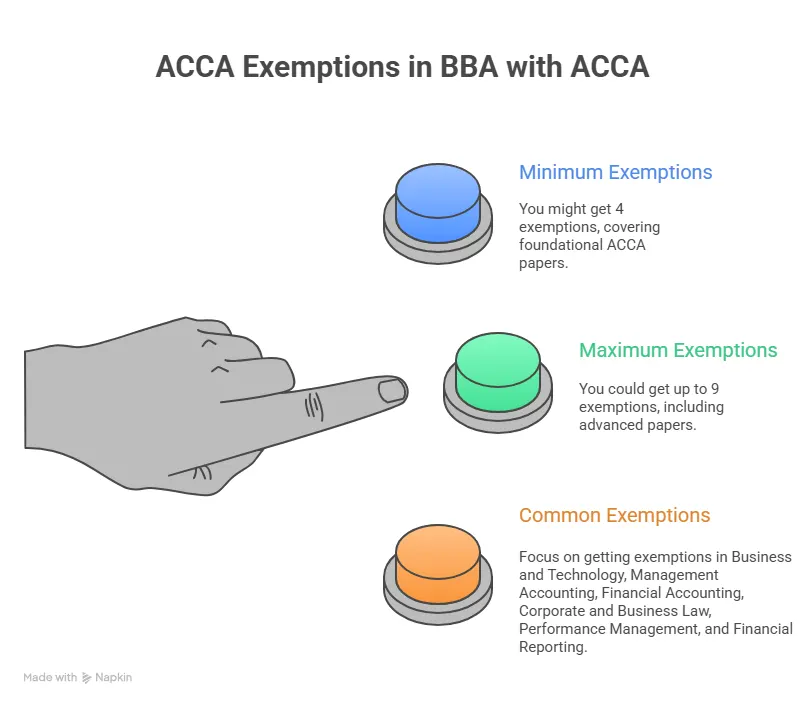
Many students ask about ACCA with the BBA F&A course duration. The duration is usually 3 years because it runs parallel to your BBA degree. However, ACCA itself has 13 papers. With ACCA exemptions, you may need to clear only 7 to 9 papers, depending on your college. Here is a simple timeline:
| Stage | What you study | Duration |
| Foundation level | Business and technology basics | 6 to 8 months |
| Skills level | Financial reporting, audit, tax | 12 to 18 months |
| Professional level | Strategic business leadership | 12 months |
The ACCA with BBA F&A course duration becomes efficient because you study these along with your degree subjects.
Also Read: Which ACCA Course Subjects are the Most Challenging?
ACCA With BBA F&A Integrated Course Syllabus
The ACCA with BBA F&A integrated course syllabus is designed to mirror global finance practices. Here is what you typically study:
BBA subjects
- Principles of management
- Marketing management
- Business economics
- Human resource management
ACCA-aligned subjects
- Financial reporting
- Audit and assurance
- Corporate and business law
- Taxation
- Financial management
This combination prepares you for roles where you need both business understanding and technical accounting knowledge.
Also Read: How Long is the ACCA Course?
BBA with ACCA Colleges in India
Many universities now offer a BBA with ACCA. The number of BBA with ACCA colleges in India has increased in the last few years. Before you choose a college, it helps to evaluate a few factors:
- ACCA exemptions offered
- Faculty support for ACCA papers
- Placement assistance
- Internship tie-ups
Below is a sample comparison to help you think clearly.
| Factor | Why it matters |
| Exemptions | Fewer papers to clear later |
| Faculty | Helps with complex ACCA topics |
| Placement support | Helps you enter Big4 or MNCs |
| Location | Better exposure and internships |
How Tough Is BBA Finance And Accounting With ACCA
Students often worry about how tough is BBA finance and accounting with ACCA? The difficulty level depends on your interest in numbers and concepts. ACCA papers test:
- Concept clarity
- Application of knowledge
- Analytical thinking
If you study regularly and practice questions, it becomes manageable.
BBA Marketing with ACCA
Some students come from a marketing background. They ask if BBA marketing with ACCA is possible. Yes, some colleges offer this combination. It allows you to understand:
- Marketing strategy
- Business finance
- Costing and pricing
This is useful for roles like product finance or pricing analyst.
Also Read: Effective Strategies to Pass the ACCA Advanced Taxation Exam
Career Scope After BBA with ACCA
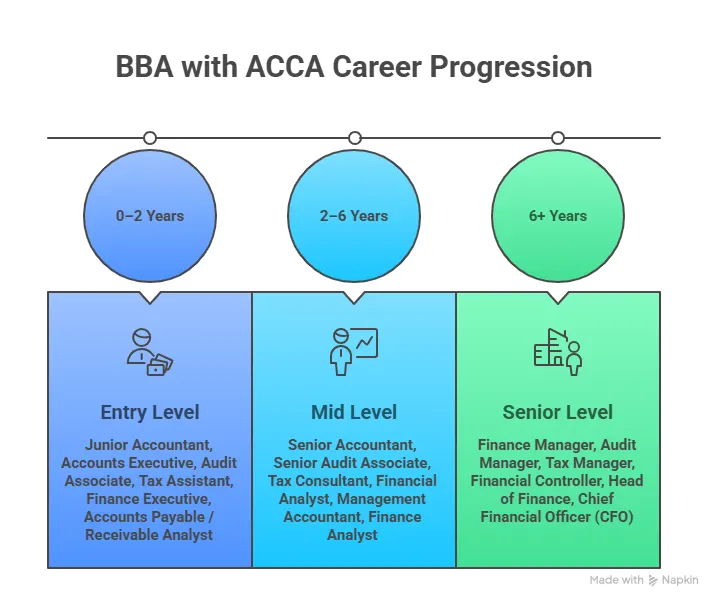
Once I complete BBA with ACCA, I open doors to roles that combine business sense with financial expertise. Companies today want professionals who can understand numbers and also make business decisions. Here are some common job roles with an ACCA career after completing ACCA with BBA F&A:
- Financial analyst
- Audit associate
- Tax consultant
- Management accountant
- Risk analyst
- Business finance executive
Each of these roles plays a key part in how companies manage money and plan growth.
A simple way to understand these roles
Think of a company like a household.
- A financial analyst tracks income and expenses
- A tax consultant ensures all rules are followed
- An auditor checks if records are accurate
- A management accountant helps plan future spending
This is the value you bring with a BBA with ACCA.
Internships and Industry Exposure
During BBA with ACCA, internships play a big role in building confidence and ACCA skills. Students usually get opportunities in:
- Audit firms
- Corporate finance teams
- Accounting service companies
- Startups
These internships help you apply what you study in class.
Also Read: How I Passed All My ACCA Exams on the First Try
Salary After BBA with ACCA in India and Abroad
Salary depends on your skill level, city, and company. Freshers with a BBA with ACCA in India can expect starting salaries between ₹4 lakh and ₹8 lakh per year. With experience and completed ACCA papers, this can grow quickly. Here is a basic ACCA fresher salary in India view:
| Role | Average Salary Range |
| Financial Analyst | ₹5 – 9 LPA |
| Audit Associate | ₹4 – 7 LPA |
| Tax Consultant | ₹5 – 10 LPA |
| Management Accountant | ₹6 – 12 LPA |
Global Salary Scope
ACCA professionals in countries like the UK and UAE earn much higher.
- The UK average salary for ACCA members is around £40,000 per year
- UAE average salary ranges between AED 8,000 and AED 18,000 per month
These numbers are based on market reports from ACCA Global salary insights.
If you are trying to understand where an ACCA qualification can take you in India, it helps to look at the roles it leads to and the salaries professionals earn at different stages. A closer look at current salary trends, job demand, and growth potential in India gives a practical view of what you can expect as you progress in this field.
Return on Investment of BBA with ACCA
Students often compare course fees with expected income. This helps in understanding ROI. Here is a simple breakdown.
Typical cost components
- BBA tuition fees
- ACCA registration and exam fees
- Coaching or study material
Expected returns
- Early entry into professional roles
- Faster salary growth due to a global certification
- Opportunity to work abroad
When you look at this over a 5-year period, BBA with ACCA gives strong returns because you start working earlier in specialised roles.
Also Read: Can I Do ACCA After 12th?
BCom with ACCA or BBA with ACCA
Many students are confused between BCom with ACCA and BBA with ACCA. Both paths lead to accounting careers. The difference lies in exposure. Below is a clear comparison.
| Factor | BCom with ACCA | BBA with ACCA |
| Core focus | Accounting and commerce | Business + finance |
| Management exposure | Limited | Strong |
| Career roles | Accounting roles | Finance + management roles |
| Skill development | Technical | Technical + strategic |
If I want a pure accounting path, BCom works well. If I want leadership and business exposure along with finance, a BBA with ACCA is a better fit.
Also Read: ACCA Certificate Recognition: Is It Valid Worldwide?
BBA with ACCA in Hyderabad and Kerala
Cities like Hyderabad and regions like Kerala are seeing rising demand for BBA with ACCA graduates.
BBA with ACCA Colleges in Kerala
Kerala has become a popular destination for commerce education. There are several BBA with ACCA colleges in Kerala that offer integrated programs.
Students prefer Kerala because:
- Strong academic discipline
- Focus on professional courses
- Good coaching support
Kerala market demand
Kerala has a strong base of commerce education. Many students from BBA with ACCA colleges in Kerala move to the Gulf countries for jobs. The demand for ACCA professionals in the UAE and Qatar is high.
BBA with ACCA Colleges in Hyderabad
Hyderabad is another fast-growing hub. The number of BBA with ACCA coaching in Hyderabad has increased because of the city’s finance and IT ecosystem.
Students in Hyderabad get exposure to:
- Corporate internships
- Shared service centres
- Financial analytics firms
Hyderabad market demand
Hyderabad has many multinational companies and shared service centres. This creates demand for finance professionals. Students from BBA with ACCA classes and colleges in Hyderabad often get exposure to:
- Financial analytics
- Corporate accounting
- Audit support roles
Did you know? India’s finance and accounting outsourcing industry is expected to grow at over 8% CAGR in the coming years. This means more job opportunities for students with accounting qualifications. (Source: IBEF)
Fees for BBA with ACCA in India
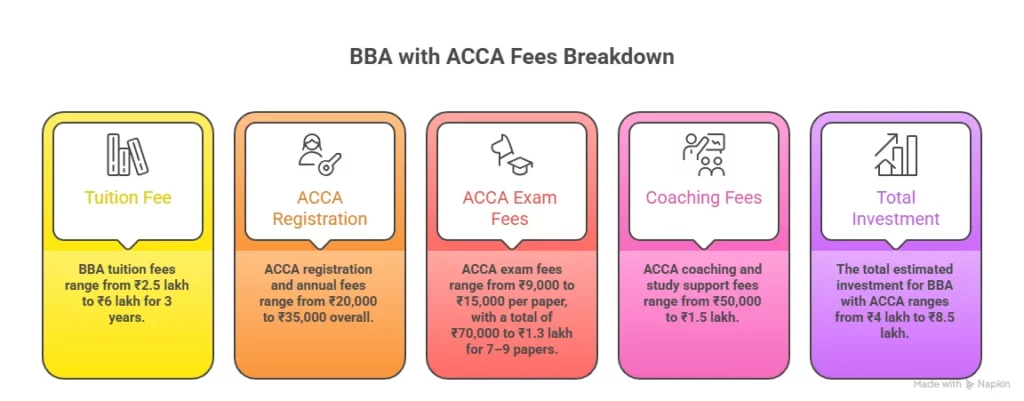
When I evaluate the cost of BBA with ACCA, I break it into three clear parts. This makes it easy to understand where the money goes and what I get in return.
Tuition Fees
The tuition fee for BBA varies by college and city. On average, BBA with ACCA programs in India range between ₹2.5 lakh and ₹6 lakh for the full course.
ACCA Registration and Exam Fees
ACCA course fees include:
- Initial registration fee
- Annual subscription
- Exam fees per paper
According to the official ACCA fee page, the total cost can range between £1,200 and £2,000 depending on exemptions and the number of attempts.
Coaching and Study Material
Some colleges include ACCA coaching in the tuition fee. Others may charge separately. This usually ranges from ₹50,000 to ₹1.5 lakh.
Also Read: How to Prepare for ACCA Exam Online?
Eligibility Criteria For BBA with ACCA
To apply for BBA with ACCA, I need:
- Completion of Class 12 from a recognised board
- Minimum 50% marks in most colleges
- A basic understanding of commerce subjects is helpful
Students from science or arts streams can also apply, but they may need to build basic accounting knowledge.
Admission Process for BBA with ACCA Colleges in India
Admission into BBA with ACCA colleges in India is usually simple and transparent. Most colleges follow these steps:
- Class 12 marks evaluation
- Basic aptitude or entrance test
- Personal interview
Some institutions also conduct group discussions to test communication skills.
Understanding how the ACCA exam structure works makes the journey much easier to plan. A clear exam timeline, along with the expected study hours and preparation approach for each level, helps you stay consistent and avoid last-minute pressure.
Choosing the Right College for BBA with ACCA
While selecting from BBA with ACCA colleges in Kerala or BBA with ACCA colleges in Hyderabad or other cities, I check these factors carefully:
- Number of ACCA exemptions offered
- Faculty qualifications
- Placement records
- Internship tie-ups
- Student support services
A quick checklist for decision-making
| Factor | What to check |
| Exemptions | Minimum 6 papers exemption |
| Placement | Companies visiting campus |
| Faculty | ACCA qualified trainers |
| Industry exposure | Internship programs |
This helps me make a clear and confident decision.
Also Read: Why Choose ACCA for Mastering the Art of Accountancy
Deep Dive into ACCA Paper Structure
ACCA has 13 papers divided into levels.
Applied Knowledge level
- Business and Technology
- Management Accounting
- Financial Accounting
Applied Skills level
- Corporate and Business Law
- Performance Management
- Taxation
- Financial Reporting
- Audit and Assurance
- Financial Management
Strategic Professional level
- Strategic Business Leader
- Strategic Business Reporting
- Optional papers
Many ACCA with BBA f&a integrated course syllabus programs provide exemptions for Applied Knowledge and some Applied Skills papers.
How to Prepare for ACCA Papers During BBA
Here are some simple steps that make preparation smooth:
- Focus on concepts instead of memorising
- Solve past papers regularly
- Join study groups
- Take mock exams seriously
These steps reduce stress and improve confidence.
Did you know?
India’s professional services sector, including accounting and consulting, contributes a major share to the service economy. This shows long-term demand for finance professionals. (Source: IBEF)
Why Students Choose Imarticus Learning For ACCA Preparation
When I look at how students approach BBA with ACCA today, one thing becomes clear. The right preparation and support can make a big difference to how smoothly you move through the ACCA papers. Many students prefer a structured pathway that combines concept clarity, exam readiness, and industry exposure in one place. This is where Imarticus Learning stands out as a preparation partner for ACCA.
Here are some of the key strengths of the ACCA Program offered by Imarticus Learning, based on what is actually provided in the course.
- Industry collaboration with KPMG in India: The program is delivered in collaboration with KPMG in India and includes real business case studies and practical exposure that connects classroom learning with real work situations.
- Joint certification with KPMG in India: Along with ACCA, students receive a joint certification that strengthens their professional profile and global appeal.
- Gold status ACCA learning partner: Imarticus Learning is a Gold Status ACCA learning partner, which means the training standards, content quality, and faculty meet global ACCA benchmarks.
- Kaplan-powered study material and content: Students get access to Kaplan study resources, practice papers, flashcards, and question banks that are aligned with official ACCA exam patterns.
- Structured mentorship and faculty support: The program includes mentor-led learning, weekly progress tracking, and doubt-solving sessions so students stay consistent with preparation.
- Placement or internship support and career readiness: The program includes placement assistance, interview preparation, and pre placement bootcamps to help students move into finance roles after completing their ACCA levels.
FAQs on BBA with ACCA
Many students explore BBA with ACCA with practical doubts about eligibility, difficulty, salary, and career scope. Clear answers to these common questions can help you move forward with confidence and make informed decisions about your course and future path.
Is a BBA with ACCA worth it?
BBA with ACCA is worth it for students who want a global finance career and strong earning potential. The program combines a business degree with an international accounting qualification, which improves job opportunities in India and abroad. Institutes like Imarticus Learning support students with structured learning and industry exposure, which adds value to this qualification.
Can I do ACCA along with BBA?
Yes, a BBA with ACCA allows you to study both together through an integrated format offered by many universities in India. This structure saves time and helps you complete ACCA papers while finishing your degree. Imarticus Learning also supports integrated learning pathways that help students manage both academic and professional requirements smoothly.
Can I do a BBA with the ACCA course?
You can enrol in a BBA with ACCA course directly after Class 12 if you meet the eligibility criteria of the college you choose. The program is designed for students who want to enter the accounting and finance domain early and gain global certification along with their degree. Imarticus Learning provides guidance on course selection and preparation.
Which BBA is best for ACCA?
The best option for BBA with ACCA is a finance and accounting specialisation, such as ACCA with BBA F&A, because it aligns closely with ACCA subjects and gives maximum exemptions. This combination builds strong technical knowledge and prepares you for roles in accounting, audit, and financial management.
What is the salary of ACCA BBA Plus?
The salary after completing BBA with ACCA varies based on skills and location, but fresh graduates can earn between ₹4 lakh and ₹8 lakh per year in India. With experience and completion of ACCA papers, salaries can grow significantly and reach global pay scales in countries like the UK and UAE.
Is ACCA or BBA harder?
When studying BBA with ACCA, students often find ACCA papers more concept-based and analytical, while BBA subjects are more theoretical and management-focused. With consistent study habits and proper guidance from Imarticus Learning, students can manage both parts of the program effectively.
Who earns more, an MBA or an ACCA?
Earning potential depends on the role and experience, but BBA with ACCA graduates who complete their professional papers can reach senior finance positions with high salaries over time. MBA graduates may start with management roles, while ACCA professionals grow into specialised finance leadership positions.
How many papers are in ACCA with BBA?
In BBA with ACCA programs, students usually get exemptions for several ACCA papers, so they may need to clear around 7 to 9 papers instead of all 13, depending on their college and syllabus alignment. Training partners like Imarticus Learning help students plan their exam strategy and preparation timeline.
Make Your Move Towards BBA With ACCA
By now, you have a clear picture of BBA with ACCA. It is a course that mixes business basics with strong accounting skills. It helps you start early in finance roles and gives you options to work in India or abroad. The structure, exemptions, and career scope all come together to make it a practical choice for many students.
The next step is to look at your own goals. Check the colleges you are interested in. Look at the syllabus, exemptions, and placement support. Think about the kind of work you would enjoy after graduation. This small exercise can make your decision much clearer.
If you choose this path, a steady study plan will help you manage both your degree and ACCA papers. Many students find it useful to follow a guided approach for their ACCA Course prep so that concepts and revision stay on track. If you feel you need that support, you can explore learning options with Imarticus Learning and see if it suits your style.
Take your time. Review your options. Choose what feels right for you. A clear start now can make your journey in BBA with ACCA much smoother.

