


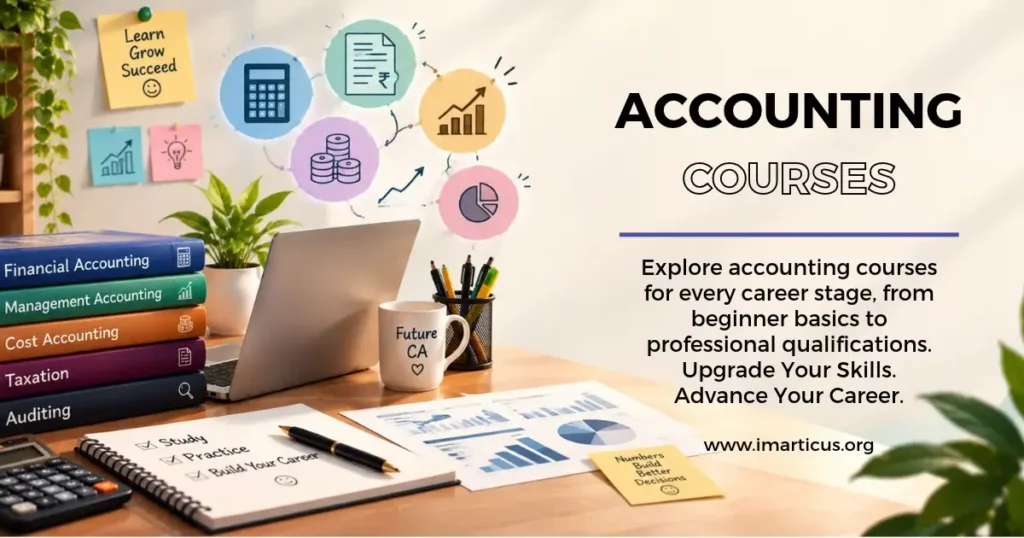
Accounting courses honestly depend on where you are right now. If you want a job quickly, a Tally and GST certificate takes just a few weeks. If you’ve just finished school, a B.Com or a diploma gives you a solid base. And if you’re thinking long term, the professional route (CA, CMA, ACCA or US CPA) takes a few years of hard work but opens the biggest doors, including jobs abroad. Free and online accounting courses are a cheap way to test the waters. Certifications that end in a recognised exam count for more when an employer reads your resume. Forensic accounting and AI accounting courses are newer, and they’re worth a look because the job is slowly shifting from data entry to analysis and advice.
Almost every month, someone asks me the same thing: which accounting courses should I do? I get why it’s hard. There’s CA, CMA, ACCA, CPA, Tally, GST, B.Com, forensic accounting, and now AI on top of it all. Ask your cousin, a CA uncle and a college senior, and you’ll get three different answers. Each of them will tell you to do what they did.
So I’ve put everything in one place. You’ll find the full accounting courses list, which course suits each person, how long it takes, and what kind of job it can lead to. I’ve also covered what to do after 12th, whether free and online courses are worth your time, and where forensic accounting and AI fit in. Want to turn your interest in numbers into a career? Explore our ACCA Course and take the first step today.
Accounting Courses Meaning
Before you compare course names, it helps to know what an accounting course actually teaches. This section covers what’s inside one and where it can take you.
Don’t Let Our Best Advice Get Buried
Add Imarticus as a Preferred Source — see more of what we publish, every time you search.

At the core, accounting courses teach you to record money, check it, and report it clearly. That’s it. Some do this in four weeks on Tally. Others take five years and a lot of exams. Same subject, very different jobs at the end. The majority of them address some combination of these:
- Bookkeeping involves recording business transactions in ledgers or a bookkeeping program, otherwise known as writing down the transactions.
- In financial accounting, the balance sheet, profit and loss account, and cash flow statement are all of key importance.
- Bookkeeping, primarily related to taxation like GST, TDS, and income tax returns
- Auditing – checking that the books are correct and rules are followed
- Financial accounting, costing and controlling: managers are informed about where the money goes,
Scope of Accounting Courses
Most people don’t realize the range it has. You may become an accountant, tax executive, auditor, financial analyst, payroll specialist, or finance manager. Some people open their own practice. I’ve seen people start with a basic bookkeeping course and, a few years later, run finance for a mid-sized company. The course didn’t do all of that. It just got them through the first door.
There’s also a shift worth noticing. Accounting isn’t only about recording what already happened anymore. Newer courses teach you to read the numbers, spot a trend, and explain it to someone who has never opened a balance sheet. That last part is what managers really pay for, and it’s why even a short course can change how you work.
Find the Right Accounting Course for You
Choose your education, career goal and study duration.
Why Accounting Courses Still Matter in 2026
With all the talk about automation, people ask if accounting is still worth studying. I think it is, and these are my reasons.
- Every business needs accounts. A corner shop and a listed company both have books to keep and returns to file.
- The rules keep moving. GST changes, new reporting standards, tax updates. Employers want people who keep up.
- The path is clear. Executive, then manager, then finance head. You can plan it years ahead.
- Banks, factories, hospitals, schools, and start-ups all hire finance people.
- Qualifications like ACCA, CMA, and CPA are recognised in many countries, so working abroad is possible.
From what I’ve seen, the people who struggle aren’t the ones who studied accounting. They’re the ones who stopped learning after the first certificate.
Did You Know?
Even a very small business has to keep proper books for tax and compliance. That steady need is a big reason accounting skills stay in demand. (Source)
Accounting Courses List for Every Level
This is the accounting courses list I usually share with people who ask where to begin. It starts with short certificates and goes up to full professional qualifications. Durations are rough, and they’ll change with your pace and any exemptions you get.
| Course | Level | Typical Duration | Best For |
| Tally and GST certification | Entry | 1 to 3 months | Quick readiness for accounts roles |
| Diploma in accounting | Entry | 6 to 12 months | Beginners who want the basics |
| B.Com | Degree | 3 years | A degree plus a base for professional exams |
| CA | Professional | About 4.5 to 5 years or more | Audit, tax and advisory careers in India |
| US CMA | Professional | 6 to 12 months of study for most people | Management accounting and corporate finance |
| ACCA | Professional | 2 to 4 years | Global accounting and finance careers |
| US CPA | Professional | 12 to 18 months of study for many candidates | Audit and reporting roles with global firms |
| Forensic accounting certificate | Specialist | 3 to 6 months | Fraud, investigation and risk roles |
| AI in accounting certificate | Specialist | 1 to 3 months | Accountants who want to work with smart tools |
If you need a job soon, begin with a certification. If you want a long-term seat at the finance table, go for a professional qualification. Plenty of people do both, one after the other.
Accounting Courses After 12th
Just finished school and not sure what’s next? If I were starting again after Class 12, these are the routes I’d look at.
- B.Com or BBA: three years, gives you the basics, and leaves room for a professional course on the side.
- CA Foundation: the first step to becoming a Chartered Accountant. It’s open right after Class 12.
- ACCA: you can start through the entry-level papers while your degree runs alongside. I’ve covered the eligibility in this guide on ACCA after 12th.
- CMA and CPA: CMA can start early. CPA rules depend on the state board, so check eligibility first.
- Short certifications like Tally, GST, and Excel for accounting. Easy to do alongside college, and you walk out with something you can actually use at work.
If you want a simple plan, here’s mine: one degree, one professional track, and one practical skill like Tally or Excel. Hard to beat.
Also Read: Courses After 12th Commerce
Accounting Certification Courses
Certifications are the quickest way to add a skill that employers keep asking for. They’re short, focused, and easy to fit around college or a job. These are the accounting certification courses that show up most often in job descriptions.
| Certification | What You Learn | Who It Suits |
| Tally and bookkeeping | Daily entries, ledgers, invoices, and reports in accounting software | Freshers and small business staff |
| GST and TDS | Returns, input credit, deductions, and compliance | Tax executives and accounts staff |
| Excel for accounting | Formulas, pivots, reconciliations and dashboards | Almost every accounting role |
| IFRS and Ind AS | Reporting standards for companies | Graduates moving into financial reporting |
| Financial modelling | Forecasting and valuation models | Analysts and finance aspirants |
| US CMA, ACCA and US CPA | Professional-level accounting and finance | Career builders looking at global roles |
Think of these as building blocks. Tally gets you the first job. Excel makes you faster at it. A professional qualification takes you higher. If you’re starting from zero, our Accounting Fundamentals Certification is a good place to begin. For the professional route, look at ACCA, US CMA, and US CPA, and add financial modelling if you lean towards analysis.
Online Accounting Courses
Studying from home is normal now. The trick is telling a good online course from a time waster. Are online accounting courses as good as classroom ones? They can be, if you pick well. Accounting courses online give you flexibility, which matters if you’re working or still in college. And you can replay a tough topic like depreciation as many times as you need. Nobody will judge you. Before you enrol, check a few things:
- The syllabus. If it’s all theory, with no entries, reconciliations, or returns, walk away.
- Doubt support. Can you ask a real person, or is it only recorded videos?
- Practice. Assignments and case studies teach more than hours of lectures ever will.
- The certificate. Is there a known body behind it, or does it lead to an exam? A random PDF won’t impress anyone.
- Career help, like resume feedback, mock interviews, and placements. Worth asking about before you pay.
Honestly, a good online course should feel like a workplace, not a lecture hall. Here’s my test. Finish the course, then try to build a trial balance from scratch. If you can’t, it didn’t work. Anyway, here’s how online and classroom study compare.
| Factor | Online Accounting Courses | Classroom Courses |
| Schedule | Flexible; you set the pace | Fixed timings |
| Revision | Rewatch recordings any time | Limited to class notes |
| Peer interaction | Through forums and live sessions | Face-to-face |
| Best for | Working professionals and college students | Learners who like a set routine |
Neither format wins every time. The best online accounting courses give working people a fair shot at upskilling without quitting their jobs, so go with whichever format you’ll actually stick to.
Also Read: A Beginner’s Guide to Globally Best Accounting Courses
Free Accounting Courses
Not ready to spend money yet? Fair. Free accounting courses, and free online accounting courses with certificates, let you find out whether you even like this stuff before spending a rupee.
They’re fine for basics: debit and credit rules, journal entries, ledgers, the trial balance. You also get to try accounting software for nothing.
The catch is that they stop early. You learn the basics and then nothing on tax, audit, or reporting. And that free certificate? It shows you tried, which is nice, but recruiters look for recognised exams and for what you can do on a screen. Stuck on something? Usually there’s nobody to ask.
What I’d do: give a free course a month. One topic at a time. Do the exercises in a spreadsheet, because watching alone doesn’t stick. Keep a little notebook of rules you keep forgetting (we all have a few). When the month is over, you’ll know. If you liked it, go for a proper programme. If you didn’t, you lost a few evenings and learnt how a business keeps its books. Fine by me. Many accounting courses online start with a free first module, so it’s easy to try.
Forensic Accounting Courses
This is the detective side of accounting. It’s also where AI is a real help and not a threat.
A forensic accountant is a bit like a detective who happens to love spreadsheets. They go through records, sometimes for weeks, looking for fraud and money that doesn’t add up. They sometimes help in court cases too. Software can scan every single transaction in a company and flag the strange ones. Then it’s over to the accountant, who asks why, gathers proof, and writes it all up.
Most forensic accounting courses take only a few months. In them you’ll learn to spot red flags in financial statements, keep evidence the proper way, use Excel to trace patterns, and write up what you found so a manager or a judge can follow it.
When you compare forensic accounting courses, ask whether they use real case studies, because that’s where you learn the most. I wouldn’t make it your first course. Get your accounting base first, and some data skills help a lot.
Also Read: Everything You Need To Know About Forensic Accounting
AI Accounting Courses for a Smarter Career
AI isn’t a threat to accountants who learn to use it. It’s more like a very capable assistant. Here’s how to make the most of it.
Will AI make accountants obsolete? I don’t think so, and what I see on the ground points the other way. AI handles the dull stuff, like reading invoices and matching bank entries, so accountants can spend time on analysis, advice, and decisions. That’s a good deal for anyone who likes thinking more than typing.
AI accounting courses teach you to work with these tools instead of against them. A typical course covers:
- How software reads invoices, tags expenses, and posts entries
- Matching accounts faster and flagging differences
- Spotting unusual transactions that need a human look
- Using data to predict cash flow and plan budgets
- Checking AI output, protecting client data and knowing where your judgement is still needed
| Task | What AI Helps With | What You Still Do |
| Data entry | Reads and sorts invoices and receipts | Checks unusual items and approves |
| Reconciliation | Matches bank and ledger entries quickly | Investigates the differences |
| Audit support | Scans full sets of transactions for odd patterns | Applies judgement and reports |
| Reporting | Drafts reports and charts | Explains the story to management |
| Tax and compliance | Prepares return data | Interprets rules and advises |
Pick up some Excel, dashboards and basic analytics along the way. And keep an open mind. The tools change every year, so being willing to learn matters more than knowing any single one. If you want to build that mix, a programme like data analytics with Gen AI is worth a look.
Top 10 Accounting Courses in India
These are the best accounting courses in my view. I ranked them by how widely they’re recognised and how many doors they open, not by how easy they are. This is the top 10 accounting courses in India at a glance.
| Rank | Course | Best For |
| 1 | CA | Audit, tax, and advisory in India |
| 2 | ACCA | Global accounting and finance careers |
| 3 | US CMA | Management accounting and corporate finance |
| 4 | US CPA | Audit and reporting with global firms |
| 5 | B.Com | A degree base with flexibility |
| 6 | Tally and GST certification | Quick entry into accounts jobs |
| 7 | Excel for accounting | Speed and accuracy in every role |
| 8 | IFRS certification | Financial reporting roles |
| 9 | Forensic accounting | Fraud and risk roles |
| 10 | AI in accounting | Future-ready accountants |
Any ranking is personal, and yours might look different. If I had to pick one starting point for most people, it would be a degree, one professional track, and one practical skill.
Career Options After Accounting Courses
A course only matters if it leads somewhere. This table shows the roles most learners move into, and which courses help for each.
| Role | What You Do | Courses That Help |
| Accounts executive | Maintain books, process invoices and payments | Tally, GST, B.Com |
| Tax executive | Prepare returns and handle notices | GST and TDS certification, CA |
| Auditor | Check records and report findings | CA, ACCA, US CPA |
| Management accountant | Budget, forecast and support decisions | US CMA, ACCA |
| Financial analyst | Study performance and build models | Financial modelling, Excel |
| Forensic accountant | Investigate fraud and irregularities | Forensic accounting, CA |
Notice that one course rarely covers a whole career. Most people grow through a mix of a degree, a professional qualification and a few well-chosen skills. So decide on the role you want first, then work backwards to the course.
How to Choose the Right Accounting Courses
Too many options can freeze anyone. Try answering a few questions in order. It takes about fifteen minutes.
- Where are you now: after 12th, after graduation, or already working? Your starting point cuts the list down fast.
- What’s the goal? A job in three months, a profession in five years, and a career switch all need different courses.
- How many hours can you give each week, and what can you spend? Be honest here.
- Do you want India-focused recognition or global recognition?
- Will you get mentors, practice material, and placement help? They make a real difference.
- Can you try a free module first, before you commit to the full course?
Write your answers down. When I do this with students, the right course usually becomes obvious by the third question.
Future of Accounting Courses in India
Courses a few years from now will look different from the ones a decade ago. Here’s what I expect.
- Accounting will be mixed with Excel, data, and AI in a single programme.
- Short, skill-based certifications will sit beside degrees.
- Regular upskilling will become normal as tax rules and tools change.
Employers already want people who can read a balance sheet and also build a dashboard. If you prepare for both, you’ll have an easy time.
Also Read: Accounting Ratios
Learn ACCA With Imarticus
If you’d rather learn with guidance than go it alone, here’s what we offer. These points come from our finance programmes.
| Our USP | What It Means for You |
| Trusted partnerships | Learning material built with global industry leaders and internationally recognised certifications |
| Job assured programmes | Career services that back our 100% job assurance courses |
| Approved prep provider | India’s first and only approved prep provider for four global accounting and finance programmes |
| Experienced faculty | Trainers with 15 plus years of industry experience |
| Future-ready curriculum | Progressive, tailored programmes that keep up with changing industries |
| Placement record | 40,000+ placements and 1500+ hiring partners |
Recognised programmes, trainers who have worked in the industry and real career support. That’s what I’d look for in any provider. If you’re leaning towards a global qualification, you can start with our ACCA Course. And if you’re comparing ACCA, US CMA and US CPA, the programme pages have the details.
FAQs About Accounting Courses
These are the frequently asked questions asked most by students and working people. I’ve kept the answers short, so you can get on with deciding.
Which accountant course is best?
CA is the pick for audit and tax in India. ACCA, US CMA, and US CPA work better if you want a global career. And if you just need a job soon, Tally and GST will do. Start with your goal and how much time you have, then choose.
Can I learn accounting in 6 months?
Yes, you can learn accounting in 6 months, but only the basics. Bookkeeping, Tally and GST are doable in six months if you practise daily, and that’s enough to apply for a first accounts job. A professional qualification takes much longer, though.
What are the 7 types of accounting?
The 7 types of accounting are financial, management, cost, tax, forensic, auditing, and government accounting. Some sources swap one out for project or public accounting, so don’t be surprised if you see a slightly different seven elsewhere.
Is accounting 2 or 4 years?
It depends on which route you take. A diploma can be finished in one to two years, B.Com takes three, and a few bachelor’s programmes run four. The professional ones take longer than all of these.
Which is a good accounting course?
The good accounting course for a first job, B.Com with Tally and GST, is a solid combination. Later, add CA, ACCA, US CMA, or US CPA if you want to grow. Whatever you pick, make sure there’s practical work, a mentor, and a certificate that someone recognises.
What are the various courses related to accounting?
The various courses related to accounting are B.Com, professional qualifications such as CA, CMA, ACCA, and CPA, and shorter certifications in Tally, GST, IFRS, forensic accounting, and AI in accounting.
Which is the best accounting course for students?
The best accounting course for students after 12th is to do B.Com along with CA Foundation or ACCA with Imarticus Learning. Learn Tally and Excel on the side. You’ll finish college with a degree and a skill you can use.
Picking the Right Accounting Courses for You
So, back to the question I hear every month: which accounting courses should you do? Honestly, it depends on where you stand and where you want to reach. Start with a degree or a short certification. Add a professional track like CA, ACCA, US CMA, or US CPA when you’re ready, and layer on forensic or AI skills to stand out. Use free courses to test the waters, and online courses to fit learning around your life.
None of this has to happen at once. It takes one good decision, followed by steady effort. If you’d like some guidance along the way, our ACCA Course is built to help you take that step, with mentors, practice, and career support behind you.
Liked This? Follow Us Where You Already Search.
Preferred Sources is Google’s built-in follow button — no app, no login, just more Imarticus in your results.
