


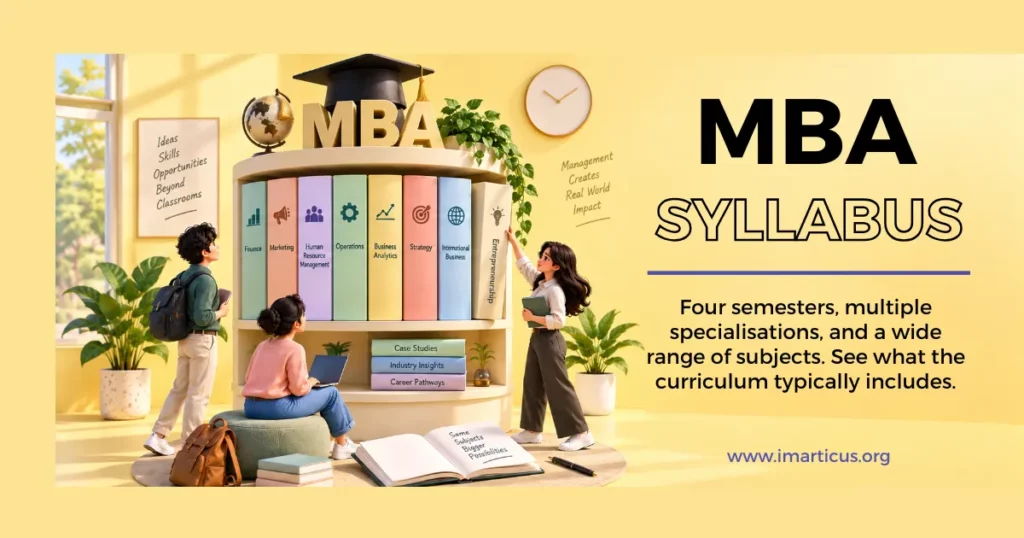
When you look at an MBA syllabus, you will usually find subjects such as finance, accounting, marketing, HR, economics, operations, analytics and strategy. The first year generally gives you this common business foundation, while the second year brings in more electives and specialisation papers. The subject mix depends on your university and specialisation, so always check the official curriculum for your programme. Also keep your degree syllabus separate from the entrance test syllabus, since CAT, MBA CET, CUET PG, GMAT, PGCET and TANCET test different areas.
The MBA syllabus tells you far more than which subjects you have to pass. Read it closely, and you can see how your business knowledge is meant to build over the two years. You will usually begin with subjects such as accounting, economics, finance, marketing, operations and organisational behaviour. Later, electives and specialisation papers let you spend more time in the area you want to pursue.
That is why an MBA Finance syllabus will look quite different from an MBA HR, Marketing or Business Analytics syllabus. The qualification has the same name, but the subjects you choose can give your MBA a very different direction.
There is one distinction worth making from the start. The MBA entrance exam syllabus covers what you need for admission, while the MBA curriculum covers what you study after you get in. CAT, MBA CET, CUET PG and GMAT each have their own test structure. I have covered both below, along with the semester-wise subjects and major specialisations.
Don’t Let Our Best Advice Get Buried
Add Imarticus as a Preferred Source — see more of what we publish, every time you search.

That makes the MBA Syllabus useful when you are comparing colleges. It also gives you a good base before you choose specialist finance courses in areas such as CFA, banking, FinTech or risk management.
MBA Syllabus At A Glance
I would first look at the broad structure before getting into individual papers. Most two-year MBA programmes move from common management subjects towards electives and specialisation. The exact pattern depends on the university.
| MBA Area | Common Subjects | Main Purpose |
| Management | Principles of Management | Understand how organisations are managed |
| Finance | Financial Management | Make and assess financial decisions |
| Marketing | Marketing Management | Study customers, products and markets |
| Human Resources | HR Management | Manage people and workplace needs |
| Economics | Managerial Economics | Apply economic ideas to business |
| Operations | Operations Management | Improve processes and business systems |
| Analytics | Statistics and Analytics | Use data for business decisions |
I would use this table as a starting point, not as a fixed national template. Current IIM curricula show why this matters. IIMA lists areas such as finance, marketing, HR, operations, economics and information systems in its core curriculum, while IIM Calcutta uses its own term and credit structure.
Did You Know?
Some MBA Programmes Now Put AI Directly Into The Curriculum IIM Ahmedabad’s MBA-BPGP in Business Analytics and AI includes Advanced Machine Learning and AI, Natural Language Processing, Deep Learning, Generative AI and Agentic AI applications in business within its curriculum.
MBA Syllabus Semester-wise
The semester-wise MBA Syllabus is usually the first thing you will want to check. It shows how your course moves from basic management ideas to more focused study.
There is one point worth keeping clear from the start. Every university does not use the same semester structure. Some programmes use four semesters. Others use terms within the academic year. IIMA, for example, structures its first year across three terms.
MBA 1st Semester Syllabus
The first semester gives you a base across several areas. I would expect subjects linked to financial accounting, economics, marketing, finance, people and quantitative skills.
| Subject Area | Common Subject | What You May Study |
| Finance | Financial Accounting | Business transactions and financial reports |
| Economics | Managerial Economics | Demand, supply and business decisions |
| Marketing | Marketing Management | Customers, products and markets |
| HR | Organisational Behaviour | People and workplace behaviour |
| Management | Principles of Management | Planning and managerial decisions |
| Quantitative Skills | Business Statistics | Numbers, patterns and business data |
| Communication | Business Communication | Clear writing and professional communication |
The exact list can change by college. IIMA’s current first-year curriculum, for example, includes Financial Reporting and Analysis, Financial Markets, Marketing, Microeconomics, Operations Management, Quantitative Methods and Human Resource Management. I would also pay attention to the subjects you enjoy here. Your first semester can give you an early clue about the specialisation you may want later.
MBA 2nd Semester Syllabus
The second semester usually builds on your first set of subjects. You may move towards financial decisions, operations, research, technology and human resource management.
| Subject Area | Common Subject | Practical Focus |
| Finance | Financial Management | Investment and funding decisions |
| Operations | Operations Management | Processes, supply and production |
| HR | Human Resource Management | Hiring, training and performance |
| Research | Research Methodology | Finding and assessing business information |
| Technology | Management Information Systems | Using information for decisions |
| Economics | Macroeconomics | Wider economic conditions |
| Law | Business Law | Rules affecting business activities |
I would read the detailed units here rather than stopping at the paper names. A subject called Financial Management may cover very different topics across two universities. For example, IIM Calcutta’s current first-year curriculum includes corporate financial reporting, cost management, corporate finance, statistics, operations research, information technology and systems, and strategic management.
That gives you a better idea of why the MBA Syllabus can vary even when two colleges offer courses with similar names.
MBA 3rd Semester Syllabus
The third semester is where your course can start becoming more personal. You may select electives linked to Finance, Marketing, HR, Operations, Analytics or another area offered by your college.
| Study Area | Typical Papers | What Changes |
| Finance | Investments and Corporate Finance | More specialist finance work |
| Marketing | Consumer Behaviour and Branding | Greater focus on customers |
| HR | Talent and Performance | Deeper people management |
| Analytics | Business Intelligence | More data-led decision work |
| Strategy | Strategic Management | Wider business decisions |
| Operations | Supply Chain Management | More process-focused learning |
| Electives | College-specific subjects | Greater choice |
Your third-semester MBA Syllabus may therefore look very different from another student’s course. That is normal. The choice of electives starts shaping the type of work you can discuss in interviews and projects.
MBA 4th Semester Syllabus
The final semester usually gives you room for advanced electives, projects, dissertations or other forms of applied work. I would look closely at this part when comparing colleges. A programme may give you several electives. Another may put more weight on a final project. The difference can affect how much practical work you complete before graduation.
| Component | What It May Include | What You Gain |
| Advanced Electives | Specialist business subjects | Deeper subject knowledge |
| Project | Business research or analysis | Practical problem solving |
| Dissertation | Structured academic research | Research skills |
| Internship | Industry-based work | Workplace exposure |
| Capstone | Larger business problem | Cross-functional thinking |
| Presentations | Individual or team work | Communication practice |
I would treat the final semester as the point where your earlier subjects come together. A finance project may need accounting and economics. A marketing project may need statistics and customer research.
MBA Syllabus With Its Core Subjects
Core subjects give you the common base that most MBA students need. You may later choose Finance or Marketing, but you still need to understand how the wider business works.
Finance And Accounting
Finance and accounting appear early in most MBA programmes because money sits inside almost every business decision.
You may study financial reporting, financial management, costing, corporate finance and financial markets. IIMA’s current curriculum includes Financial Reporting and Analysis, Financial Markets, Costing and Control Systems and Corporate Finance.
The MBA finance syllabus then goes deeper when you choose Finance as your specialisation. You may move towards valuation, investments, portfolio management or risk.
Marketing
The MBA Syllabus usually introduces marketing through customers, products, pricing, sales and market research.
I would think of marketing as the part of the course that asks why people buy something. A company can have a good product and still struggle when it does not understand its customers. The MBA marketing syllabus can later include consumer behaviour, branding, digital marketing, sales management and marketing research.
Human Resources
The people side of a business gets its own place in the MBA Syllabus through Human Resource Management and Organisational Behaviour.
You may study recruitment, training, compensation, performance and employee relations. The MBA HR syllabus can then take you into talent management, HR analytics and strategic HR. The MBA in HR syllabus can therefore become quite broad. You may study both everyday employee issues and larger workforce decisions.
Operations Management
Operations looks at how a business delivers its product or service. Imagine ordering something online. A customer sees only the order and delivery. Behind that simple action sit inventory, suppliers, warehouses, technology, staff and transport. Operations connects these moving parts.
The MBA Syllabus can introduce operations research, production management, quality and supply chain topics. The exact mix depends on the programme.
Business Analytics And Statistics
Numbers become useful when you know what question you are trying to answer. Business statistics helps you read patterns. Analytics helps you use those patterns for decisions. The MBA business analytics syllabus can take this further through data visualisation, business intelligence, forecasting and other data-focused subjects.
IIMA’s current Business Analytics and AI programme shows how far this field can go. Its curriculum includes probability and statistics, programming, data management, optimisation, data visualisation, machine learning, databases and AI applications.
Strategy And General Management
Strategy asks you to look beyond one department. You may study why a company enters a market, how it responds to changing demand or how it decides where to invest. You also start connecting finance, marketing, operations and people. That is why strategy usually appears after you have already studied several core areas.
MBA Syllabus Specialisation-Wise
The specialisation stage gives you a chance to spend more time on one business area. Your college may offer Finance, Marketing, HR, Business Analytics, IT, Operations or other options.
MBA Finance Syllabus
The MBA finance syllabus can take you from basic financial management into more detailed work around investments, markets and company decisions. You may study:
| Finance Subject | Main Topic | Example Of Use |
| Corporate Finance | Funding and investment | Assessing an expansion |
| Investment Analysis | Investment choices | Studying a company |
| Portfolio Management | Investment mix | Managing several assets |
| Financial Markets | Market activity | Understanding capital flows |
| Risk Management | Financial uncertainty | Assessing possible losses |
| Valuation | Business value | Estimating company worth |
The MBA in finance syllabus can also include derivatives, international finance, banking and financial modelling. IIMA’s current elective list includes subjects such as Alternative Investments, Behavioural Finance, Banking and Financial Intermediation, Financial Statement Analysis, Futures and Options, Investment and Portfolio Management, and Valuation of Firms.
That range gives you several directions to consider after an MBA. You can then build greater skills through specialist finance courses.
MBA HR Syllabus
The MBA HR syllabus covers the systems used to manage people within an organisation. You may study recruitment, training, performance management, compensation and employee relations. The MBA in HR syllabus may then move towards talent management, leadership and HR analytics.
Your choice of electives matters here. Someone interested in hiring may choose a different path from someone who wants to work in compensation or people analytics.
MBA Marketing Syllabus
The MBA marketing syllabus usually moves into customer behaviour, branding, product management, sales and research. You may study why customers choose a brand. You may also look at how companies test products, set prices or decide where to advertise.
That makes the subject easier to connect with daily life. Almost every product you buy has a marketing decision behind it.
MBA Business Analytics Syllabus
The MBA business analytics syllabus is useful when you enjoy working with numbers but also want to solve business problems. You may study data visualisation, forecasting, business intelligence, statistics and decision models. Some programmes can go much further into machine learning and AI.
MBA IT Syllabus
The MBA IT syllabus focuses on how businesses manage technology. You may study information systems, digital transformation, technology strategy and IT governance. You can then move into roles that sit between business teams and technology teams.
Your MBA Syllabus gives you the wider business view. Your specialisation gives you the deeper subject focus.
How MBA Syllabus Changes By Specialisation
Your specialisation changes the subjects you spend more time on. It also changes the type of business questions you may work through.
- Finance: The MBA finance syllabus can move into investments, valuation, corporate finance, markets and risk. The MBA in finance syllabus may also include financial modelling and banking. IIMA’s current Finance and Accounting electives include Banking and Financial Intermediation, Financial Statement Analysis, Fixed Income Securities, Futures, Options and Risk Management, and Strategic Perspectives in Banking.
- Human Resources: The MBA HR syllabus can move beyond basic HR management into talent, leadership, compensation and people analytics. The MBA in HR syllabus can suit you when you want to work with workforce planning, recruitment, employee development or people strategy.
- Marketing: The MBA marketing syllabus can include consumer behaviour, brand management, market research, sales and digital marketing. Your projects may ask you to study why customers choose one product over another. That makes market research a practical part of the course.
- Business Analytics: The MBA business analytics syllabus can combine management with statistics, data tools and decision-making. IIMA’s current analytics curriculum includes probability, statistics, programming, data management, optimisation, machine learning and AI.
- Information Technology: The MBA IT syllabus usually looks at technology from a management angle. You may study digital transformation, information systems, IT strategy and technology governance. Your work may then involve decisions about how a company should use technology.
Also Read: What are the best MBA jobs for freshers in India?
MBA Entrance Exam Syllabus
I would keep the MBA entrance exam syllabus separate from the university curriculum in your notes. The purpose is different. You prepare for an entrance test to gain admission. You study the MBA Syllabus after you enter the programme.
That difference becomes important when you search for terms such as CAT syllabus for MBA or MBA CET syllabus. Those searches can refer to admission tests rather than the subjects taught during the degree.
CAT Exam Syllabus For MBA
The CAT exam syllabus for MBA covers three broad areas: Verbal Ability and Reading Comprehension, Data Interpretation and Logical Reasoning, and Quantitative Ability. The CAT syllabus for MBA therefore needs more than basic maths. You need reading skills, logical thinking and the ability to work with data under time pressure.
I would split your preparation into small topic groups. Read passages regularly. Practise charts and tables. Keep working through arithmetic and algebra questions. That gives you a much clearer study routine than trying to memorise one large CAT topic list.
MBA CET Syllabus
The MBA CET syllabus covers Logical Reasoning, Abstract Reasoning, Quantitative Aptitude and Verbal Ability and Reading Comprehension.
- For the MBA CET syllabus 2026, the Maharashtra State CET Cell’s official information brochure lists these areas and provides the current examination structure.
- The MBA CET syllabus 2026 also gives you a useful reminder about preparation. You may need to work with figures, diagrams, arithmetic, charts, vocabulary, grammar and comprehension.
I would always use the latest official notice when you prepare. Exam rules can change from one year to another.
CUET PG MBA Syllabus
The CUET PG MBA syllabus depends on the paper and examination framework applicable to the programme you are applying for. The CUET MBA syllabus should therefore be checked against the latest National Testing Agency information and the requirements of the university you want to join.
I would avoid using an old topic list found on a random preparation website. Check the current examination notice first. Then make your own topic checklist.
GMAT Syllabus For MBA
The GMAT syllabus for MBA currently has three sections: Quantitative Reasoning, Verbal Reasoning and Data Insights. The official GMAT structure lists 64 questions in total. Quantitative Reasoning has 21 questions. Verbal Reasoning has 23. Data Insights has 20. Each section has 45 minutes.
The GMAT syllabus for MBA also differs from older GMAT material you may find online. The current official exam uses the three-section format above. That makes the publication date of your preparation material worth checking.
PGCET Syllabus For MBA
The PGCET syllabus for MBA depends on the relevant state examination authority. I would use the official notification for your examination year as the first source. Then break the listed topics into a weekly study plan. The same rule applies to other state-level MBA entrance tests. The name of an exam can stay the same while the current details change.
TANCET MBA Syllabus
The TANCET MBA syllabus tests several practical skills.
- Anna University’s 2026 brochure says the MBA test covers data use in business situations, comprehension, graduate-level mathematics, data sufficiency and written English.
- The TANCET MBA syllabus therefore needs a mix of maths, reading and reasoning practice.
The TANCET syllabus for MBA is easier to handle when you divide each area into smaller tasks. You can then track the topics where you lose marks most often.
Also Read: Can I do an MBA after BCom?
MBA Syllabus At Top Indian B-Schools
I would never use one generic MBA Syllabus as the exact curriculum for every IIM or B-school. The official curricula show clear differences. IIMA’s current MBA curriculum uses three terms in the first year and then offers a wide set of second-year electives. IIM Calcutta uses a term and credit structure with subjects grouped by academic areas.
| Institution Type | Common Structure | What You Should Check |
| IIM | Core courses and electives | Term structure and elective areas |
| IIT B-School | Management and analytical subjects | Quantitative and technology content |
| University MBA | Semester-based curriculum | Credits and compulsory papers |
| Private B-School | Core and specialist subjects | Industry projects and electives |
| Online MBA | Core subjects with flexible delivery | Assessment and practical work |
| Specialist MBA | Management plus domain subjects | Domain-specific papers |
I would always read the official curriculum before you compare colleges. The same subject title can hide a very different set of units.
Also Read: What is the BBA syllabus for 2026?
How Many Subjects Are There In An MBA?
There is no single answer for every college. I would avoid trusting a fixed subject count without checking the programme document. Some universities use semesters. Some use terms. Some separate electives from core papers. Some include projects as credit-bearing components.
For example, IIMA says its first-year core programme has about 30 courses across three terms. IIM Calcutta presents its first-year curriculum using credits across terms and academic groups. That shows why the MBA Syllabus needs to be read as a curriculum rather than as one national subject list.
Is MBA Syllabus The Same For Every University?
The MBA Syllabus can differ from one university to another. You may see Finance, Marketing, Economics and Operations in several programmes. The detailed units can still vary. One college may give more weight to analytics. Another may offer more finance electives. A third may use a different term structure. I would check five things before deciding:
- Read the detailed paper descriptions because subject names alone do not show what you will actually study.
- Check the elective list because your second-year choices can shape your career direction.
- Review the project requirements because practical work can show how the course applies classroom ideas.
- Look at the credit structure because it tells you how much weight each paper carries.
- Check the latest curriculum document because an old MBA Syllabus may no longer apply.
How To Read An MBA Syllabus Before Choosing A College?
You can learn a lot from a curriculum document when you know where to look. Start with the compulsory papers. Then look at the electives. After that, check the project and internship requirements.
I would also look for specialist subjects that match your career interest. If you want Finance, check whether the college offers subjects around valuation, investments, markets or banking. If you want Analytics, look for statistics, data and business intelligence. The best curriculum for you will depend on the work you want to do later.
A BCom can give you a solid grounding in commerce and accounting, while a professional qualification can take that foundation towards a more specialised finance career. The choice between ACCA, FRM, CFA and CMA depends largely on the kind of work you want to build your expertise around.
MBA Syllabus And Practical Finance Skills
An MBA gives you a broad business foundation. Finance roles can then require more focused skills. You may understand financial management in class and still need practice before you feel comfortable analysing a company. The same applies to banking, FinTech and risk.
This is where specialist learning can add value. Imarticus Learning currently offers finance courses covering areas such as CFA, banking and finance, FinTech and financial risk management. The portfolio can give you several directions to consider alongside your MBA.
| Career Interest | Specialist Direction | Skills To Build |
| Investments | CFA | Valuation and investment analysis |
| Retail Banking | Banking | Credit and banking operations |
| Commercial Banking | Banking | Lending and financial analysis |
| FinTech | FinTech | Digital finance and technology |
| Risk | Risk Management | Financial risk and controls |
| Corporate Finance | Financial Analysis | Modelling and business analysis |
I would choose the specialist area after you have identified the part of the MBA Syllabus that interests you most. That keeps your extra learning focused.
- Building Towards CFA: The CFA route can make sense when investments, valuation and financial analysis interest you. You may already meet these ideas through your MBA Syllabus. Specialist study can then take you further into investment-focused topics.
- Building Towards Retail And Commercial Banking: Banking gives you another direction. Retail banking deals with products and services used by individuals. Commercial banking focuses more heavily on businesses and their financial needs. A student interested in this route can build knowledge around credit, lending, financial analysis and banking operations.
- Building Towards FinTech: FinTech brings financial services and technology together. You may see this in digital payments, online lending, wealth platforms and technology-led banking services. The MBA business analytics syllabus or MBA IT syllabus can give you useful academic links to this field.
- Building Towards Risk Management: Risk management asks what could go wrong and how a business should respond. The work can involve credit risk, market risk or operational risk. Finance students can connect this area with subjects already covered in their MBA Syllabus.
A career in finance can take you into investment analysis, portfolio management, asset management and several other specialised roles. The right qualification depends on the kind of work you want to pursue, so it helps to look at what CFA training adds to a broader finance or management background.
What To Check Before You Finalise Your MBA College
I would spend time with the actual curriculum before you make your final choice. The college website may show a short subject list. The full curriculum can tell you much more about credits, electives, projects and specialisation options.
- Read every semester because the order of subjects shows how your business knowledge develops during the programme.
- Check the elective list because your preferred specialisation may depend on the choices offered in later semesters.
- Read the detailed units because two subjects with the same name can cover different topics.
- Check the project structure because applied work can show how much practical learning forms part of the course.
- Review the internship rules because industry exposure can affect how you use your academic knowledge.
- Check the latest academic year because universities may update their MBA Syllabus from time to time.
- Look at the faculty areas because specialist teaching can shape the depth of particular subjects.
- Review career support because your learning needs to connect with the roles you want after graduation.
A few minutes spent reading the full document can prevent a lot of confusion later.
Also Read: Which are the top MBA colleges in India?
Why Imarticus Learning Stands Out For Finance Careers?
Once you have covered the basics through an MBA, you may want to go deeper into one part of finance. That is where the choice of programme starts to matter. Imarticus Learning has built its finance courses around specific career tracks rather than putting every learner through one broad finance course. You can choose from Investment Banking, Capital Markets, Retail and Corporate Banking, Wealth Management, Finance and Accounting, FinTech and other specialist areas.
- 15+ finance programmes give you several routes to choose from, covering areas such as Investment Banking, Capital Markets, Banking, Wealth Management, Finance and Accounting, FinTech and Risk Management.
- Imarticus is listed as India’s first and only approved prep provider for four global accounting and finance programmes, which is a specific credential worth checking when you are choosing a certification route.
- The finance portfolio includes programmes linked to IIMs and other recognised institutions, including executive programmes from IIM Lucknow, IIM Calcutta and IIM Indore, along with programmes from ISB and other partners.
- The platform reports 40,000+ placements, 1,500+ hiring partners, a ₹7 LPA average salary and a ₹22 LPA highest salary on its current finance page. These figures are Imarticus-reported outcomes and should be read in that context.
- Selected programmes carry 100% job assurance, with Imarticus describing these programmes as supported by its career services and job-assurance model. The specific terms can vary by programme, so you should check them before enrolling.
- The faculty includes finance professionals with substantial industry backgrounds, including an Investment Banking trainer with 15+ years of experience and professionals with experience across financial services, consulting and Big 4 firms.
FAQs About MBA Syllabus
Got doubts about subjects, specialisations, entrance exams, or how the curriculum changes across colleges? These answers to the frequently asked questions cover the points you are most likely to consider while comparing an MBA syllabus and choosing the right programme.
How Many Subjects Are In A First-Year MBA Syllabus?
A first-year MBA Syllabus can include around 12 to 16 core papers in many programmes, although the number varies by university. Some institutions use terms instead of semesters and may include additional courses, workshops or projects.
Does The Syllabus Of 1st Year In MBA Remains The Same In All Programme?
The first-year MBA Syllabus can change across programmes. Most courses cover areas such as finance, marketing, economics, management and operations, while paper names, credits and teaching structure can differ between institutions.
What Is The Syllabus For An MBA?
The MBA Syllabus usually covers management, finance, accounting, economics, marketing, HR, operations, analytics and strategy. Your later semesters may include electives, specialist subjects, projects and other practical components.
Is The Syllabus For MBA Different In Different Colleges?
Yes. The MBA Syllabus can vary across colleges because universities design their own curriculum. You may see similar core areas, while electives, credit values, projects and specialist papers can differ. The current university document should be your final reference.
What Is The Syllabus For An MBA In Finance In IIM?
The MBA Syllabus for Finance at an IIM depends on the institute and available electives. Current IIMA electives include financial statement analysis, banking, investments, valuation and risk-related subjects. Imarticus Learning can add focused finance learning alongside your degree.
What Are Syllabus Core Marketing Of MBA 2nd Year?
The MBA Syllabus in second-year Marketing can include consumer behaviour, brand management, marketing research, sales, digital marketing and product management. Your college may classify some of these as electives, so check the programme’s current curriculum.
What Is The MBA Syllabus In Life Sciences?
The MBA Syllabus for a life sciences programme can combine management with subjects linked to healthcare, biotechnology, pharmaceuticals or related industries. Imarticus Learning can complement this wider business base with specialist finance learning where it fits your career plans.
Is The Syllabus For A BBA Similar To An MBA?
The MBA Syllabus can share areas such as accounting, marketing and management with a BBA. An MBA usually takes these subjects further through advanced papers, electives, projects and specialisations. Imarticus Learning also offers finance-focused programmes for graduates building specialist skills.
Take The Right Direction After Your MBA Syllabus
The MBA Syllabus gives you a broad view of business before you move into deeper areas. You may begin with accounting, economics, marketing, finance, operations and people management. Later, your electives can take you towards Finance, HR, Marketing, Analytics or IT.
That wider base can help you make a better choice about your next step. You may find yourself drawn to investments and valuation. CFA can then give you a more focused route. You may prefer banking and lending. Retail and commercial banking can build that knowledge. You may enjoy technology and financial services. FinTech can take that interest further. Risk management can suit you when financial uncertainty and controls catch your attention.
I would use your MBA Syllabus as the point where you identify that direction. Then build the specialist skill that supports it. Explore Imarticus Learning’s finance courses and take your next step towards CFA, Retail and Commercial Banking, FinTech or Risk Management. Build specialist finance skills that give your MBA a clear career direction.
Liked This? Follow Us Where You Already Search.
Preferred Sources is Google’s built-in follow button — no app, no login, just more Imarticus in your results.