


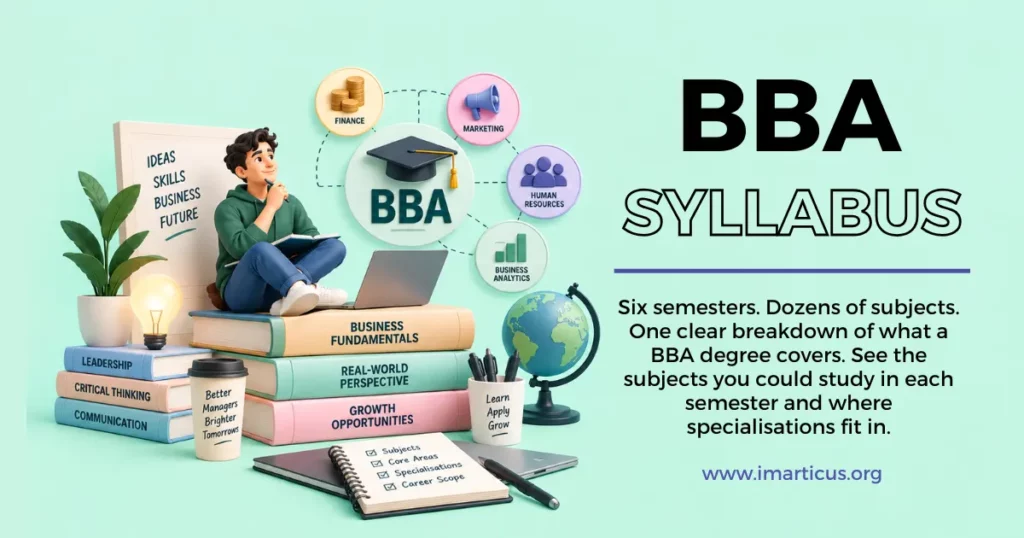
What is actually in a BBA syllabus? At its core, it is the roadmap of subjects you study to understand how a business runs. You start with papers such as financial accounting, economics, management, communication and business mathematics. Later, the syllabus brings in marketing, HR, operations, finance, statistics and analytics, along with electives and specialisation papers. A typical three-year BBA has six semesters, but the structure is not identical at every university. Some now follow eight-semester programmes.
This guide covers the BBA syllabus 2026 semester by semester, with the subjects for each year and an explanation of what they involve. It also covers BBA specialisations, electives, internships, projects, the BBA maths syllabus, BBA business analytics syllabus, BBA entrance exam syllabus and BBA LLB syllabus. The aim is simple: give you a clear picture of what you will study before you choose your course.
A BBA syllabus can tell you far more than which subjects you will study. Look at it closely and you can see how a university moves you from basic business concepts in the first year to finance, marketing, analytics, operations and other specialised areas later on.
That progression matters. If you enjoy accounting in your first year, for instance, finance may deserve a closer look later. If working with numbers feels more interesting than memorising management theories, the BBA maths syllabus and BBA business analytics syllabus may tell you more about where the course could take you.
If finance starts to interest you during the degree, you can also build beyond the general business base. Finance courses covering areas such as ACCA and CFA can take you into more focused work. CIBOP is another option if banking operations and financial services are where you want to head.
Don’t Let Our Best Advice Get Buried
Add Imarticus as a Preferred Source — see more of what we publish, every time you search.

In this guide, I have broken down the BBA course syllabus semester by semester, explained what the major subjects cover, and looked at specialisations, practical work, entrance tests and the difference between a BBA and BBA LLB syllabus. I have also pointed out where universities differ, because the syllabus of BBA is not identical across institutions. If you are already thinking about what comes after graduation, I have included the finance courses worth considering alongside a BBA too.
BBA Syllabus 2026 At A Glance
You will usually spend the early part of the degree learning how businesses work. Later, you get closer to specific areas such as finance, marketing management, HR, analytics and strategy. The broad structure looks like this:
| Area | Subjects You May Find | What You Study |
| Management | Principles of Management, Strategy | How business activities are planned and managed |
| Accounting | Financial Accounting, Costing | How transactions and financial records work |
| Finance | Financial Management, Investments | How businesses handle and use money |
| Marketing | Marketing Management, Consumer Behaviour | How businesses reach and retain customers |
| Economics | Business Economics, Microeconomics | How markets and economic forces affect firms |
| Quantitative Skills | Mathematics, Statistics | How numbers support business decisions |
| Technology | Information Systems, Excel, Analytics | How digital tools support business work |
This is also where the BBA syllabus 2026 is changing in some universities. Data tools and analytics are getting more space. A typical curriculum includes a Data Analysis using Excel Lab, while its Business Analytics specialisation includes Power BI, Tableau, machine learning tools, data mining, and Python for Managers.
You can therefore expect a mix of old and new business subjects. Accounting and economics still matter. So do spreadsheets, data and technology.
BBA First Year Syllabus
The BBA first year syllabus gives you the base you will need for the rest of the degree. You may already know some ideas from school. You may have studied basic accounts or economics. University takes those ideas further and puts them into a business setting. Management is one example. You already know what a manager does in simple terms. A manager gives people work and makes sure the work gets done. Your course goes deeper into planning, organisation, staffing and control.
Financial Accounting works in much the same way. You move from simple entries towards financial records and financial statements.
BBA First Semester Syllabus
The BBA first semester syllabus usually introduces the main business subjects. The exact mix changes by university. Amrita currently places Financial Accounting, Principles of Management, Economics for Decision Making and Mathematics for Business in Semester 1. It also includes a PC lab.
| Subject | Areas You May Cover | Why You Need It |
| Financial Accounting | Transactions, ledgers, statements | To read and record business finances |
| Principles Of Management | Planning, organising, staffing | To understand basic management work |
| Business Economics | Demand, supply, markets | To understand business conditions |
| Mathematics For Business | Equations, matrices, commercial arithmetic | To handle business calculations |
| Business Communication | Writing and presentations | To explain ideas clearly |
| Computer Applications | Basic digital tools | To work with common business software |
The mathematics paper may worry you if you have not touched numbers for a while. Look at the actual topics before assuming it will be difficult.
Let’s say, a BBA student: Amrita’s current curriculum includes a Data Analysis using Excel Lab, while its Business Analytics specialisation includes Power BI, Tableau, machine learning tools, data mining and Python for Managers.
Those topics have a clear business link. Interest connects with borrowing and investment. Ratios connect with financial analysis. Equations help you solve business problems.
BBA Second Semester
By the second semester, you start moving away from pure foundations. Marketing enters the picture. So does business data. Information systems may also appear.
Amrita currently lists Marketing Management, Business Environment, Management Information Systems, Business Statistics and Operations Research and Data Analysis using Excel in Semester 2.
That Excel paper is worth noticing. The current course material covers formulas, IF functions, VLOOKUP and HLOOKUP, filtering, PivotTables, charts and macros.
| Subject Area | Topics You May Meet | A Typical Use |
| Marketing | Customers, pricing, promotion | Deciding how to sell a product |
| Statistics | Data and numerical analysis | Reading sales figures |
| Information Systems | Business information and technology | Managing business information |
| Excel | Formulas, tables and charts | Preparing reports |
| Business Environment | External business factors | Reading changes around a company |
| Operations Research | Quantitative business decisions | Comparing possible decisions |
The practical side starts showing up here. You are no longer only reading about business. You are also handling the tools businesses use.
Also Read: What are the different areas of finance?
BBA Second Year Syllabus
The second year usually gives you more specialised business knowledge. This is where finance, HR, operations, law, research and costing can enter the picture. You start seeing what happens inside individual departments.
The BBA syllabus can also become more demanding because subjects begin to depend on what you learnt earlier. For example, financial management becomes easier when you understand accounting. Marketing becomes easier when you understand economics. Business research makes more sense once you are comfortable reading data.
Semester 3
You may see subjects such as Costing, Operations Management, Company Law, HR Management and Research Methods.
Amrita’s current BBA Business Analytics programme places Fundamentals of Costing, Production and Operations Management, Business Law, Human Resource Management and Introduction to Research Project in Semester 3.
This is also a stage where the BBA maths syllabus can matter more. You may work with figures, averages, ratios or other quantitative methods depending on your university. Do not judge the entire course by one difficult chapter. Look at the paper as a whole.
Semester 4
Semester 4 often moves further into business functions. Financial management can appear here. So can research, operations, business law, entrepreneurship or other electives. You may also start getting a clearer idea of your preferred area.
If you enjoy looking at company accounts, finance may be worth exploring. If customer behaviour keeps your attention, marketing could be a better fit. If spreadsheets and data are the subjects you enjoy most, business analytics deserves a closer look.
That choice becomes more useful later when you select electives or consider professional courses.
Also Read: What are the key elements of financial management?
BBA Third Year Syllabus
The third year is where your course can become more career-focused. You may study strategic management, international business, entrepreneurship and advanced finance. You may also have a project, internship or discipline-specific electives.
Amrita’s current sixth semester includes Entrepreneurship Development, Strategic Management, Financial Management, an elective and a project.
Semester 5
International business and corporate governance can appear at this stage. You may also get more choice through discipline-specific electives.
An internship can be part of the programme too. Amrita currently includes a Summer Internship in Semester 5. This is a useful point in the degree to stop treating every paper as something you only need to pass.
Look at the work behind the subject. If financial management interests you, read a company’s annual report. If marketing interests you, study how a familiar brand prices and promotes a product. If analytics interests you, take a sales dataset and see what you can find. You start getting a better sense of the work involved.
Semester 6
The final semester can bring strategy, entrepreneurship, financial management, electives and a major project. A project gives you space to take one business question and work through it in detail. The topic can vary by university and specialisation.
You may also have a viva or presentation attached to it. The BBA syllabus at this stage is less about collecting isolated facts. You are expected to connect different business areas.
Suppose you study whether a company should launch a new product. You may need market research to understand demand. You may need accounting and finance to estimate costs. You may need marketing to decide how to position the product. That is where the different subjects start making sense together.
Also Read: What are the main functions of accounting?
How The BBA Syllabus Changes From Year 1 To Year 3
The progression is fairly easy to see once you stop looking at individual papers.
| Stage | What You Are Learning | Examples |
| Year 1 | Basic business knowledge | Management, accounts, economics |
| Year 2 | Business functions | Finance, HR, marketing, operations |
| Year 3 | Advanced business study | Strategy, electives, specialisation |
| Practical Stage | Using what you know | Internship, lab work, case studies |
| Final Stage | Showing what you can do | Project, presentation, research |
There are plenty of university-level differences. Some programmes introduce specialisations earlier. Some have four-year structures. Jamia Millia Islamia currently lists an eight-semester BBA under its NEP structure, which is a good example of why you should check the programme you are applying for rather than relying on a generic six-semester list.
BBA Subjects List
A list of twenty or thirty subjects can make the degree look more complicated than it is. Group the papers by what they deal with and the picture becomes clearer.
- Management covers planning, organisation, operations and strategy.
- Accounting and finance deal with money, financial records and financial decisions.
- Marketing deals with customers, brands, pricing and sales.
- HR deals with employees and workplace systems.
- Economics helps you understand markets and business conditions.
- Analytics deals with numbers, data and business decisions.
| Subject Group | Common Papers | Main Question |
| Management | Principles, Operations, Strategy | How should the business be run? |
| Accounting | Financial Accounting, Costing | What happened to the money? |
| Finance | Financial Management, Investments | How should money be used? |
| Marketing | Marketing, Sales, Consumer Behaviour | What will customers buy? |
| HR | HRM, Organisational Behaviour | How should people be managed? |
| Analytics | Statistics, Business Analytics | What does the data show? |
This is the part of the syllabus that I would keep in mind when you choose electives. You do not need to love every paper. You do need to know which areas you want to study in greater depth.
What Does Each BBA Subject Cover?
You can understand most BBA subjects through the business problem sitting behind them.
Principles Of Management
You learn how work gets organised. Planning, staffing, directing and control are common topics. Take a retail store. Someone decides how many people are needed on a busy day. Someone plans the stock. Someone checks whether sales are on target. Management gives you a framework for these decisions.
Financial Accounting
You learn how transactions are recorded and turned into financial statements. The practical question is simple: if you run a business, can you tell where your money came from and where it went?
Marketing Management
You look at customers, products, pricing, promotion and distribution. A company can have a good product and still struggle if the wrong customers see it. Marketing helps you understand that gap.
Human Resource Management
You study recruitment, training, performance, compensation and employee relations. The subject gives you a clearer picture of what happens between hiring someone and building a productive team.
Business Economics
You study demand, supply, production, costs and markets. A price change in a product can affect demand. A rise in input costs can affect profit. Economics helps you understand those links.
Business Statistics
You work with numbers collected from business activity. You may calculate averages, identify trends and read tables. The goal is to make large amounts of information easier to use.
That combination forms much of the BBA syllabus. You learn the parts of a business first. Then you start joining them together.
BBA Maths Syllabus
The BBA maths syllabus is different from one university to another. You may get one mathematics paper. You may get mathematics followed by statistics. A finance or analytics specialisation may add more quantitative work.
Amrita’s current Mathematics for Business paper covers quadratic equations, permutations and combinations, matrices, determinants, simple and compound interest, sinking funds, annuities and bill discounting. You may therefore come across:
- Percentages and ratios can help you compare sales, costs and other business figures.
- Profit and loss can help you work out whether a transaction has produced a gain or loss.
- Simple and compound interest can introduce common financial calculations.
- Equations can help you solve problems where one business value depends on another.
- Matrices can appear in programmes with a more detailed quantitative paper.
- Probability can help you work with uncertain business outcomes.
- Statistics can help you make sense of sales and customer information.
- Data interpretation can help you read charts and tables.
If you are worried about maths, check the actual paper before making a decision about BBA. The subject may be more commercial and applied than the word “mathematics” suggests.
BBA Business Analytics Syllabus
The BBA business analytics syllabus is worth a closer look if you like numbers but also want to work with technology.
Current programmes are already putting practical data work into the degree. Amrita’s curriculum includes Data Analysis using Excel, while its Business Analytics specialisation includes Foundations of Business Analytics, Power BI and Tableau, machine learning tools, data mining, Python for Managers, big data analytics and R programming.
| Area | What You May Learn | Where You Could Use It |
| Excel | Formulas, PivotTables, charts | Business reports |
| Statistics | Trends and averages | Sales analysis |
| Data Visualization | Dashboards and charts | Presenting results |
| Databases | Storing and finding data | Customer information |
| Business Analytics | Business-focused data analysis | Decision support |
| Programming | Python or R in some courses | Data handling |
The Excel component can be more detailed than you might expect. Amrita’s current course includes VLOOKUP, HLOOKUP, PivotTables, charts and macros.
Think of a retailer with thousands of transactions. A spreadsheet can show which products sold the most. A dashboard can show sales by month. A data analysis tool can help identify patterns that are hard to spot in a raw list. That is where the subject moves from classroom theory into practical business work.
Also Read: What are the alternatives to CA and MBA after BCom or BBA?
BBA Syllabus By Specialisation
The specialisation you choose can change the papers you study in the later part of the degree. The names can be similar across universities while the actual papers differ. Bharathiar University, for example, lists separate BBA routes in areas including International Business, Financial Management, Investment and Logistics.
- BBA Finance Syllabus: You may study financial management, investment, banking, financial markets and financial statement analysis. If you enjoy working with company figures, this is an area worth exploring in detail.
- BBA Marketing Syllabus: You may study consumer behaviour, advertising, sales, digital marketing and brand management. The focus is on how customers think and how companies turn that understanding into sales.
- BBA Human Resource Management Syllabus: You may study recruitment, training, employee performance, compensation and workplace relations.
- BBA Business Analytics Syllabus: You may study statistics, business intelligence, visualisation, databases and programming, depending on the programme.
- BBA International Business Syllabus: You may study global markets, international trade, international marketing and cross-border business.
- BBA Entrepreneurship Syllabus: You may study business planning, innovation, startup management and venture creation.
I would compare the actual elective list before choosing a specialisation. A label such as “Finance” tells you the broad direction. The paper list tells you what you will really study.
Core, Elective And Practical Components In The BBA Course Syllabus
The BBA course syllabus can contain more than traditional classroom papers. You may have core subjects that everyone takes. You may choose electives. You may also have labs, projects and internships.
| Component | What You Get | Example |
| Core Subject | The main academic foundation | Financial Accounting |
| Elective | A choice within your course | Investment |
| Skill Course | A practical skill | Excel |
| Laboratory Work | Hands-on practice | Data Analysis |
| Internship | Workplace exposure | Summer Internship |
| Project | Extended applied work | Business Research |
Amrita’s current programme includes a PC lab, Excel data analysis, internship and project work. This matters when you compare colleges. Do not look only at how many subjects appear on the page. Check how much practical work sits alongside them.
BBA Entrance Exam Syllabus
The BBA entrance exam syllabus is separate from your college syllabus. Entrance tests can check your existing ability in mathematics, reasoning, English, data interpretation and general awareness. The exact sections depend on the exam.
| Area | Common Topics | What To Work On |
| Quantitative Aptitude | Arithmetic, percentages, ratios | Speed and accuracy |
| Logical Reasoning | Series, patterns, arrangements | Problem solving |
| English | Grammar, vocabulary, comprehension | Reading |
| Data Interpretation | Charts and tables | Quick calculations |
| General Awareness | Current affairs | Regular reading |
| Exam-Specific Areas | Depends on the test | Latest official pattern |
There is some overlap with the BBA maths syllabus, but you should keep the two separate in your mind. The entrance test checks whether you are ready to enter the course. The degree teaches you how to apply business concepts after you get there.
BBA LLB Syllabus And Regular BBA
The BBA LLB syllabus can look similar at first because both courses contain business subjects. The difference becomes obvious once you look at the legal papers.
- BBA LLB combines business with law. You can expect subjects such as constitutional law, contracts, criminal law and corporate law alongside business papers.
- A regular BBA gives you much more room for management, finance, marketing, economics, HR, operations and analytics.
If you want to work towards corporate law, an integrated BBA LLB can make sense. If finance, marketing, analytics or general management appeals to you, a regular BBA may be the more direct route.
Also Read: Which are the top BCom colleges in India?
University-Wise BBA Syllabus Variations
This is the part of online syllabus searches that can cause the most confusion. You may find one site showing six semesters and another showing eight. You may see Python in one curriculum and no programming paper in another.
Both can be correct. Universities design their programmes differently. Current official sources show this clearly. Jamia Millia Islamia lists an eight-semester BBA under its current NEP structure. Amrita currently lists a six-semester BBA.
| Programme Type | Structure Can Vary | Subjects Can Focus On |
| General BBA | Three or four years | Broad business knowledge |
| BBA Honours | Often four years | Deeper academic study |
| BBA Finance | University dependent | Finance and financial services |
| BBA Business Analytics | University dependent | Data and technology |
| BBA International Business | University dependent | Global business |
| BBA Logistics | University dependent | Supply chain and operations |
Before you download a BBA syllabus 2026 PDF, check the university, programme name and academic year. A syllabus from an older batch may have subjects that no longer appear in the current course.
How To Choose Your Next Step After BBA
You do not need to collect qualifications simply because they are available. Start with the work you want to do.
If you want accounting and reporting work, look closely at ACCA. If investment analysis and markets interest you, study the CFA route. If you see yourself in banking operations, look at CIBOP by Imarticus Learning.
Then compare the syllabus, assessment pattern, time needed and career outcomes. A general BBA gives you a broad business education. Your next qualification can make that education more specific.
Which Finance Route Fits You?
Your BBA gives you a broad base. Answer four quick questions to see which finance route may suit your interests.
Which kind of finance work sounds most interesting?
Your strongest match
CFA
Investment Analysis & Markets
Want To Know More About CFA?
You already have the broad business foundation from your BBA. Now compare the programme, curriculum and other details before deciding if it fits your plans.
CFA Certification
View the current programme details on Imarticus Learning.
What To Do After BBA? Explore Finance Courses With Imarticus Learning
By the time you finish your BBA, you have touched almost every major part of business. You may like accounting, enjoy working with numbers, or find yourself more interested in banking and investments. That makes this a good time to choose one area and go deeper. Imarticus Learning offers finance courses that can help you build on the subjects you have already studied during your BBA.
- Investment Banking: If deals, valuations and capital markets interest you, Imarticus has programmes focused on investment banking and related roles.
- Financial Analysis: If you enjoyed accounting and working with financial data, financial analysis is a natural area to explore after BBA.
- Global Accounting and Finance: Imarticus offers programmes in global accounting and finance for graduates who want to take their accounting knowledge further.
- Banking: Retail and commercial banking programmes can be considered if you see yourself building a career in banking and financial services.
- FinTech: Students who enjoy both business and technology can look at FinTech programmes and roles.
- Wealth Management: This is another option if you are interested in investments, financial planning and working with clients.
- Risk Management: If assessing financial risk and making informed decisions appeals to you, risk management is another specialised route.
Why Explore Imarticus After BBA?
The finance portfolio has 15+ programmes, so you can compare different areas before deciding where you want to specialise. It also includes programmes associated with institutions such as IIM Lucknow, IIM Calcutta, IIM Indore and ISB, along with certification programmes associated with KPMG in India.
The faculty listed on the finance page includes professionals with experience at Citi, Credit Suisse, Deutsche Bank, BNP Paribas and HSBC. Imarticus also lists career services, placement support and job-assurance offerings for selected programmes.
So, you do not have to choose another course simply because it is the usual option after BBA. Look at the kind of finance work you want to do first, then choose a programme that gives you more depth in that area. That could mean investment banking, financial analysis, accounting, banking, FinTech, wealth management or risk management.
Explore Imarticus Learning Finance Courses Here
FAQs About BBA Syllabus
A course can look perfect on paper and still leave you with a few nagging questions. Is there too much maths? Does the degree really have good career value? What happens if you did not study maths in school? These are some frequently asked questions that often matter more than a long subject list, so let’s settle them clearly.
Choose Your Next Step After BBA With More Clarity
You will cover a lot during a BBA. The first year gives you accounting, management, economics, communication and quantitative skills. The next stage brings finance, marketing, HR, operations and research into the picture. Later, you get more room for electives, specialisations and projects. I would use those years to work out where you fit.
If finance keeps pulling your attention, take that interest seriously. You can move beyond the broad business foundation with a focused qualification.
ACCA can take you towards accounting and financial reporting. CFA can take you deeper into investment analysis and financial markets. CIBOP can help you build towards banking operations and financial services. You do not have to decide everything when you start BBA. You do need to make your next step count.
Explore Imarticus Learning’s finance courses and compare the ACCA, CFA and CIBOP routes. Pick the one that matches the work you want to do, the skills you want to build and the direction you want your career to take.
Liked This? Follow Us Where You Already Search.
Preferred Sources is Google’s built-in follow button — no app, no login, just more Imarticus in your results.