


Last updated on September 22nd, 2026 at 04:20 pm
Summary
Capital expenditure starts with one question: will this spending keep paying off long after the money’s left the bank? If yes, you’re looking at CapEx. A new machine, an office building, a company vehicle, a major software rollout- these all keep earning their keep for years. That’s why the full cost never lands on this year’s profit and loss statement. Instead, it sits on the balance sheet as an asset and gets chipped away at slowly through depreciation.
In this post, I’m covering the different types of CapEx, how you actually calculate the number, where companies get the money to fund it, and how all of this is different from revenue expenditure. I’ll also show you how looking at CapEx trends and a few key ratios can tell you a surprising amount about where a company’s headed, what it’s betting on, and whether its finances are in good shape.
Here’s a scenario I’ve seen play out more times than I can count. A company buys a new machine. Or maybe it opens up a new office or puts money into upgrading a factory. Before any of that gets logged in the books, someone in finance has to stop and ask: Is this capital expenditure, or is it just a regular expense? It sounds like a small thing, but I’ve sat in enough budget meetings to tell you it’s not. That one decision affects how the company reports its profit, what it owes the taxman, and, honestly, how it plans out the next five years. Mess it up, and your balance sheet starts telling a story that isn’t even true.
So that’s what this post is really about: breaking down capital expenditure in a way that actually makes sense, minus all the textbook language that usually makes it more confusing than it needs to be. I’ll walk through what this kind of spending covers, how it’s different from revenue expenditure, the formula behind calculating it, and some real examples from industries you probably run into all the time. By the time you finish reading, you’ll be able to glance at pretty much any company expense and know right away which category it falls into.
Don’t Let Our Best Advice Get Buried
Add Imarticus as a Preferred Source — see more of what we publish, every time you search.

Want to go beyond just reading about it? Imarticus Learning’s finance courses take you from these basics to full financial analysis.
Did You Know?
Firms in capital-heavy sectors, like telecom and infrastructure, often spend more than 15% of yearly revenue on CapEx. That one number says a lot about how a firm plans to grow.
Understanding Capital Expenditure ( CapEx) in Simple Terms
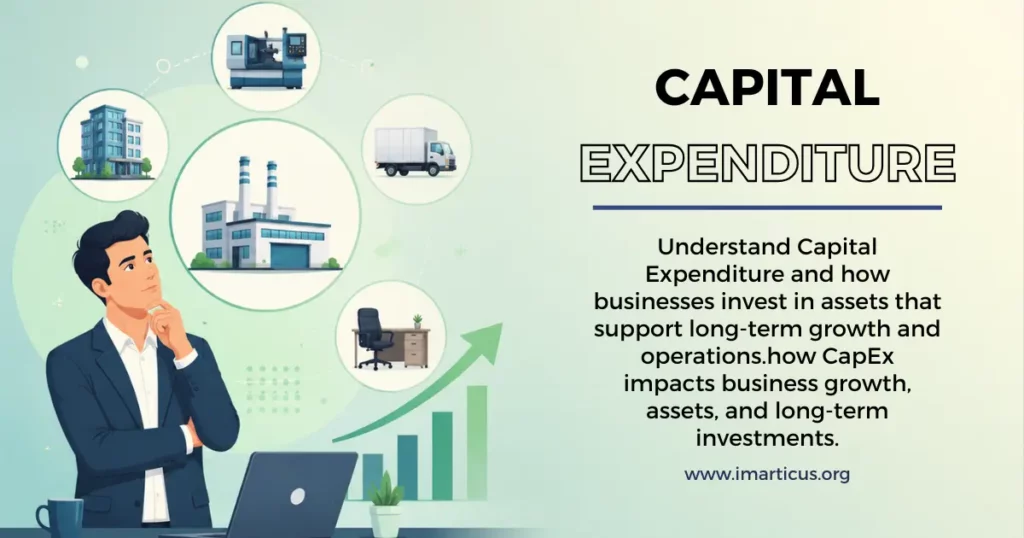
This term is often shortened to CapEx. It means the money a business spends on long-term assets. Think land, buildings, machines, vehicles, computers, and big software systems. A firm expects to use these for years, not months. The key point is simple. The benefit lasts beyond this year. This spending doesn’t hit the profit and loss account right away. Instead, it sits on what is balance sheet as a fixed asset. It then moves to the income statement slowly, through depreciation. This is one of the first ideas every accounting student learns. It’s also one of the most confusing. Here’s a simple way to picture it.
A bakery buys flour for tomorrow’s bread. That’s a running cost. The same bakery buys a new oven. That oven will bake bread for ten years. That’s capital expenditure. The flour is gone in days. The oven keeps making money long after you pay for it. There’s a grey zone here too. Repainting the oven adds no new output. Swapping a worn belt for a new one also adds no new output. Both count as revenue spending. But a new, more powerful motor is different. If it doubles output, that’s capital spending. It truly improves the asset.
- Long useful life: This spending covers assets used for more than one year. Daily costs don’t work this way.
- Capitalised, not expensed: The cost gets booked as an asset first. It moves to the income statement slowly, through depreciation.
- Strategic in nature: Most CapEx calls tie to growth. They tie to expansion. They tie to staying ahead, not day-to-day survival.
- Threshold matters: Many firms set a rupee cutoff. Below that line, even a long-lasting item, like a chair, gets expensed at once. Tracking small items rarely pays off.
Why Capital Expenditure (Capex) Matters for Every Business
People outside finance often call this spending boring. But it’s actually a clear signal. It shows where a company is headed. A business raises its capital spending year after year. That usually means one thing. Leaders feel sure about future demand. They’re ready to bet real money on growth. A sudden drop tells a different story. It can be a warning sign. It might mean the firm is saving cash. It might mean the firm is delaying plans. It might mean tough times lie ahead. Investors track free cash flow next to this spending for good reason.
Together, both numbers show how much cash is left after growth spending. This spending also shapes how a firm competes. A factory that keeps upgrading its lines runs more smoothly. Compare that to one stuck with old gear. A retail chain that builds new stores serves buyers faster. Compare that to a rival stuck with a weak setup. In short, this spending is more than an entry in a ledger. It’s a signal of intent. Linking these spending calls to corporate finance strategy is a real skill. It’s what sets a strong analyst apart from an average one.
- Growth signal: More spending on new assets, year after year, often points to strong confidence in demand.
- Risk flag: A sharp, sudden cut can hint at cash stress. It can hint at a slowdown that hasn’t hit profits yet.
- Competitive marker: Firms that keep upgrading gear tend to hold their market spot for longer.
Types of Capital Expenditure Every Company Should Know
Not all capital spending looks the same. Firms sort it into a few broad groups. The group depends on why the money goes out.
- Expansion spending: Money spent to grow the firm. Think of a new plant or a new city. This spending usually ties to revenue growth targets.
- Maintenance spending: Money spent just to keep things running. Think fixing worn parts or a fresh coat of paint. It adds no new output. It just keeps what’s already there.
- Replacement spending: New assets that swap out old ones. The old ones reached the end of their life. This often boosts output or meets new rules.
- Regulatory spending: Spending forced by law. Think pollution gear or new safety systems.
- Strategic spending: Money spent to enter new lines of business. A shop building its first online warehouse is one example. This carries the highest risk. The payoff is hard to predict.
Firms often list these types, at least broadly, in annual reports. Analysts watch the split between growth and upkeep spending closely. It shows how much investment truly drives growth. It also shows how much just keeps the lights on. Picture a firm that spends most of its budget on upkeep, year after year, with little going to growth. That pattern often means the firm has matured past its high-growth phase.
Also Read: What are the methods used for capital budgeting analysis?
How Companies Fund Their CapEx
A firm decides it needs new machines. Or a bigger warehouse. Or a fresh IT system. The next question is simple. Where does the cash come from? Big purchases rarely come from daily cash flow. Most firms use a mix of funding routes. The mix says a lot about how much risk a firm will carry.
- Internal funds: Using saved profit to pay for new assets, with no debt. It’s the safest route. But it slows down growth.
- Debt: Taking a loan or issuing bonds to fund a big buy. This spreads the cost over years, while cash stays free. It adds interest costs and repayment stress, though.
- Equity: Raising cash by selling new shares. This skips debt repayment entirely. But it dilutes the current owners. Firms save this for very large plans.
- Leasing: Renting gear instead of buying it. This often keeps the asset off the balance sheet. It also cuts the upfront cash needed. The choice usually comes down to three things. A firm’s current debt load. How sure it feels about future cash. How fast does it need the asset to pay off? A sharp finance team weighs debt financing against equity cost before it picks a route. The wrong pick can strain a firm’s finances for years.
This is also where working capital management matters. Big outflows for new assets can squeeze the cash a firm needs day-to-day. I’ve also seen small firms fund big buys with short-term loans. The paperwork just moves faster this way. But this quietly hurts cash flow later. Cash meant for stock or payroll gets stuck in a machine. That machine will take years to pay for itself.
How to Calculate Capital Expenditure
Analysts use a standard formula to work out this number. It comes straight from a firm’s financial statements. This matters most when the figure isn’t shown on its own.
Capital Expenditure = Net Increase in Fixed Assets + Depreciation Expense for the Period.
You need two numbers for this formula. First, the change in net fixed assets across two dates. Second, the depreciation charged in that period. Add depreciation back for a simple reason. It’s a non-cash drop in value on assets already booked, not new spending. Let’s walk through a quick example. A firm’s net fixed assets stood at 500 crore at the start of the year. By year-end, they hit 620 crore. Depreciation for the year was 40 crore.
| Item | Amount (in crore) |
|---|---|
| Net Fixed Assets at Year End | 620 |
| Net Fixed Assets at Year Start | 500 |
| Increase in Net Fixed Assets | 120 |
| Add: Depreciation for the Year | 40 |
| Capital Expenditure | 160 |
So this firm’s CapEx for the year comes to 160 crore. This figure usually matches the actual CapEx line in the cash flow statement. That’s why many analysts use it as a check.
Capital Expenditure, Operating Expenditure, and Revenue Expenditure Compared
This is where most mix-ups happen. And that’s fair. All three types of spend sit in the same books, and OpEx often gets confused with revenue expenditure since both hit the profit and loss account in the same year. Here’s a quick side-by-side view of all three.
| Basis | CapEx | Revenue Expenditure | Operating Expenditure (OpEx) |
| Nature | One-time or infrequent spending on assets | Regular, recurring operational spending | Day-to-day running costs of the business |
| Accounting Treatment | Capitalised on the balance sheet | Expensed fully in the income statement | Expensed fully in the income statement |
| Benefit Period | More than one accounting year | Limited to the current accounting year | Limited to the current accounting year |
| Impact on Profit | Spread over years through depreciation | Reduces profit in the same year | Reduces profit in the same year |
| Examples | Machinery, buildings, vehicles | Salaries, rent, repairs, utility bills | Rent, wages, subscriptions, marketing, office supplies |
Once you see all three side by side, the rule is easy to recall. Spend that builds something lasting? That’s capital. It’s the money that keeps the business running today, whether you call it revenue or operating expenditure. That falls in the same bucket for accounting purposes, even if the terms are used slightly differently across industries.
The Five-Question Checklist for CapEx, Revenue Expenditure, and OpEx
Ask yourself these five questions the next time an invoice lands on your desk.
- Will it outlive the financial year? If yes, it’s CapEx. A machine doesn’t care what year it is; it just keeps running. Revenue expenditure and OpEx both vanish into the same twelve months they were spent in, whether that’s rent, salaries, or a software subscription.
- Does the taxman make you wait? CapEx makes you earn your tax break in instalments, spread out through depreciation like a loan you’re slowly repaying yourself. Revenue expenditure and OpEx hand it to you upfront, deducted the same year, no waiting period.
- Does it show up on the balance sheet or just pass through? CapEx leaves a footprint, an asset sitting on the books long after the invoice is paid. Revenue expenditure and OpEx are ghosts. They’re there, they’re gone, and the only proof is a smaller profit number.
- Who has to say yes before you spend it? A new server rack probably needs a nod from someone with a corner office. Routine revenue and OpEx items, like restocking supplies or paying the electricity bill, usually don’t.
- Would it happen again next month, next quarter, or next year? If it’s routine, predictable, and boringly regular, that’s revenue expenditure or OpEx. CapEx shows up once, makes a big entrance, and doesn’t come back for years.
Run any expense through this checklist, and the difference between capital expenditure and revenue expenditure mostly answers itself, with OpEx following the same logic as revenue expenditure in most cases. These gaps show up a lot in accounting ratios and finance papers. It’s worth learning the logic, not just the definitions.
Also Read: Income Statement Guide: Structure, Format and Real Examples
Examples of Capital Expenditure Across Industries
This spending looks very different by industry. Real examples make it stick.
- Manufacturing: A car maker buys a new line or welding robots to boost output.
- Telecom: A telecom firm lays fibre cable or builds new towers to widen coverage.
- Retail: A retail chain opens new stores, upgrades checkout systems, or builds a new warehouse.
- Technology: A software firm builds new data centres or buys big servers for growing demand.
- Real Estate: A builder buys land and puts up new homes or offices.
- Healthcare: A hospital chain buys scan machines or opens in a new city with full gear. Each case ties spending to fixed assets that pay off for years. That’s what sets this spend apart from routine costs. Studying how each sector spends helps you spot broader trends in corporate finance. The payback time also shifts by case. A store fit-out might pay for itself in a year or tw, through more footfall.
A telecom tower or a factory can take years to break even. Yet both sit in the same broad group. That gap explains why finance teams can’t use one rule for all spending. A team’s request for new laptops needs less scrutiny than a plant’s request for a new line. Both count as long-term spend. But they aren’t the same bet.
Capital Expenditure Ratios and Financial Analysis
Analysts rarely view this spend as a lone number. Instead, they weigh it against other numbers. This shows whether a firm’s spending is smart and safe.
- CapEx to Revenue Ratio: Shows what share of revenue goes back into long-term assets. Useful for comparing firms in the same sector.
- CapEx to Operating Cash Flow Ratio: Shows how much cash from daily work funds this spend. This shows whether growth is self-funded or debt-funded.
- Asset Turnover Ratio: Shows how well a firm uses its assets to earn revenue. It ties closely to the broader asset turnover ratio used in equity research.
- Depreciation to CapEx Ratio: Shows if a firm spends enough to replace old assets. Or if it lets its asset base shrink over time. Finance teams lean on these ratios in capital budgeting calls.
They help judge if a planned spend will pay off. None of these ratios mean much alone, though. A high CapEx-to-Revenue Ratio can mean fast growth in one firm. In another, it can flag trouble. It depends on the source. Healthy cash flow or rising debt? This is why analysts read these numbers next to the income statement and cash flow together. They rarely judge spending alone.
Check a firm’s ratios against its own past, over five to ten years. Check them against close rivals too. That gives a far more honest view than one year’s snapshot. Reading these ratios like an analyst takes practice.
Also Read: What do you understand by working capital management?
Common Mistakes in Managing Capital Expenditure
Even sharp finance teams slip up here. It usually comes down to a few repeated mistakes.
- Skipping upkeep needs: Chasing growth spend while ignoring the upkeep spend that keeps current assets running.
- Weak ROI tracking: Signing off on big spend, with no clear way to measure return on investment later.
- Wrong booking: Booking revenue, capital spend, or the reverse. This throws off both the balance sheet and the income statement.
- Skipping the budget process: Signing off on spend outside a set budgeting process. This often strains cash later in the year.
- Missing the tax angle: Not checking how a spend hits taxation rules, mainly around depreciation and write-offs.
- Skipping the review: Signing off on a spend, then never checking back. Did the asset actually pay off?
- Chasing trends: Buying new gear just because rivals did. Not because the business truly needs it. I’ve seen these slips cost firms real money. The buy itself often wasn’t bad. The planning and follow-up were weak.
Why Choose Imarticus Learning For Your Finance Courses?
Do you want to grasp corporate finance at a pro level, not just a textbook level? Real financial statements, not just theory: Courses mix case studies, live tools, and actual company data, so ideas like CapEx, financial modeling, and ratios stop feeling abstract.
- Built for job-readiness: Whether you’re a CA hopeful, a commerce grad, or switching into finance, the programs are designed to build skills employers actually test for, not just exam-ready facts.
- Industry-experienced faculty: Course content stays current with how firms actually spend and invest today, taught by people who’ve worked the roles.
- A clear starting point: Still weighing which finance course fits your goals? Imarticus Learning’s certification finder helps you match a program to where you’re headed.
Want to be the one who calls these spend decisions, not just read about them? Imarticus Learning’s finance courses are a solid next step.
FAQs About Capital Expenditure
Here are the most-searched questions on capital expenditure. Short answers, for a fast, sharp refresher.
What is meant by the term capital expenditure?
Capital expenditure, in simple terms, means the money a firm spends to buy, build, or upgrade long-term assets, like machines or buildings. It sits on the balance sheet, then moves to the books slowly through depreciation, since its gain lasts past this year.
What are CapEx and OpEx?
CapEx covers long-term asset purchases. These get booked and spread out over years. OpEx, or running spend, covers daily costs, like rent, pay, and bills. These get booked in the same year they’re spent.
What are considered capital expenditures?
In capital expenditure, the common cases are: new machines, factory builds, firm vehicles, IT upgrades, and big software. Any buy that adds a long-term asset, meant to pay off for over a year, usually counts.
What is capital expenditure in accounting?
Capital expenditure (CapEx) is spending on long-term assets like machinery or buildings, capitalised on the balance sheet rather than expensed immediately. It’s then written off gradually through depreciation over the asset’s useful life.
What is another word for capital expenditure?
People also call it CapEx, apart from Capital expenditure, capital spend, capital outlay, or fixed capital investment. All these terms mean the same thing. Spend on assets meant to be paid off over years.
Is Capital Expenditure considered a development expense?
It’s spent on long-term assets, booked and spread out over time. Development spend is close, but not the same. It covers costs like research or new products, booked or expensed based on set rules.
What are two examples of capital expenditure?
Two common cases of capital expenditure: a maker buys a new line, and a retail chain builds a new store. Both are long-term assets, meant to pay off well past this year.
What is the difference between capital expenditure and development expenditure?
One covers real, long-term assets, like machines or buildings. Development spend covers costs tied to new products or skills. It is treated in different ways, based on set rules.
What is an example of how to use capital expenditure?
A telecom firm uses CapEx to lay fibre cable and build towers, widening its coverage. This spend gets booked and spread out over the asset’s useful life.
What is the definition of a capital expenditure in project finance?
In project finance, Capital Expenditure is the upfront spend needed to build a project’s core assets. Think of a power plant or a toll road. Lenders weigh this against expected future project cash flow.
The Real Takeaway on Capital Expenditure
Going back to that budget meeting from the start, that one classification call matters for a simple reason. Capital expenditure quietly shapes most of a firm’s financial story, from reported profit and tax bills to asset value, and ultimately how investors judge growth versus mere spend. Once you can split CapEx from revenue spend, work it out from a balance sheet, and read what it signals about strategy, you have built a skill that stays useful across every finance role, from equity research to corporate strategy to auditing.
It is a small idea on paper, but it carries real weight in practice, whether you are reading a balance sheet or sitting in a budget meeting of your own. If you want to dig deeper into how professionals actually read this kind of spending, financial statements, and investment decisions, Imarticus Learning’s finance courses build exactly this next step, turning this foundational understanding into a career-ready skill set.
Liked This? Follow Us Where You Already Search.
Preferred Sources is Google’s built-in follow button — no app, no login, just more Imarticus in your results.