The economy and financial market are interrelated entities shaping the global landscape. The financial market plays a significant role in the growth of an economy, as it provides a platform for individuals, businesses, and governments to invest, borrow, and raise capital. Thus, it results in the subsequent rise in efficiency, new businesses, and employment. This blog will give a complete picture of the financial market and its role in driving economic growth, focusing on the important areas along the way.
What is a financial market?
A financial market is an exchange platform where you may trade derivatives, equities, bonds, and other financial products. As they make it possible for organisations and people to manage risk and invest in assets, financial markets are essential to the operation of the global economy. Financial markets can be divided into two main categories, primary and secondary markets. Apart from these, other types of markets include forex markets, money markets and derivatives markets.
Primary markets
A primary market is a financial market in which freshly issued assets, such as stocks and bonds, are offered for the first time to the general public. Companies often sell shares directly to potential investors to raise capital via an initial public offering (IPO) in the primary market. Let’s say you own an organisation and can list your company on the financial market. You can list your company through the primary market, as it is designed to enable issuers like you to obtain the funds you require to finance your growth prospects.
Secondary markets
Secondary markets allow you to trade existing securities with other traders, unlike the primary market, where new securities are produced and offered to the public for the first time.
A vital part of the monetary system, the secondary market provides investors with a place to buy and sell their assets when they need to raise capital.
Many variables, like economic conditions, company performance, and investor sentiments, affect the price of assets in this market, which may significantly impact their yield.
National Stock Exchange (NSE) and Bombay Stock Exchange (BSE) dominate the secondary markets in India. These markets provide a platform for Indian traders to buy and sell stocks and other financial instruments.
How does the financial market contribute to the growth of an economy?
Through its complex web of operations, the financial market has a major bearing on economic expansion. Capital formation, resource allocation, risk management, and liquidity provision are just a few areas in which it contributes to the economy’s growth. Let’s go through each of them to gain a deeper insight into the contributions it makes to the growth of the economy.
Capital formation and redistribution of funds
Financial markets facilitate capital creation by providing a forum for individuals and organisations to invest in businesses through the purchase of stocks and bonds. In turn, this investment facilitates firms’ access to the capital it needs to prosper, stimulating the economy and creating more employment. Further, financial markets are important as they allow for the redistribution of funds, laying the groundwork for the ongoing reorganisation of the economy essential to its expansion.
Allocation of resources in the most effective way
A financial market also plays a vital role by allocating resources effectively. It ensures that the economy makes good use of its resources and promotes productivity by directing funding towards the businesses with the greatest potential for development and profit.
Managing risks
Financial markets are helpful when they come to risk management. Businesses participate in derivative markets to protect themselves from possible financial losses, such as those for futures on commodities and currency exchanges.
Liquidity
Liquidity is a crucial factor in the financial market. Notably, markets may have a more challenging time finding buyers or sellers for their assets if they need more liquidity, which might increase transaction costs and widen bid-ask gaps. As a consequence, enterprises and individuals may find it tough to access money and obtain cash for investment, which may lead to a drop in market activity and overall growth of the economy.
Conclusion
The importance of the financial sector to economic growth is indisputable. The financial market is crucial to the global economy’s success because of its role in capital generation, efficient resource allocation, prudent risk management and much more. If you’re interested in pursuing a career in finance, then Imarticus Learning’s Postgraduate Certificate Programme for Emerging CFOs is a good place to start. This CFO course covers the theoretical foundation of finance and accounting as well as their practical application in real-world scenarios. Enrol in the IIM Indore finance programme now!
As the world is progressing at a formidable pace, people are becoming highly dependent on mobile computing and the internet for every procedure. The need for cyber security experts has increased rapidly to cope with the cyber threats that are swarming all over the internet.
But the question arises, what is the need for a cyber security analyst? Hackers are now using new and sophisticated techniques to hack organisations’ sensitive data. Hence, it is compelling cyber security analysts to become creative with safeguarding the data.
In this article, we are going to discuss who is a cyber security analyst, how to become a cyber security analyst, what their job entails and many more!
Who is a cyber security analyst?
The cyber security analyst is responsible for protecting the company’s network and systems from any kind of cyber attack. They keep on researching about latest IT trends, creating plans with contingency reviews for any kind of suspicious activity and security breaches. They also have the primal responsibility to educate the company on valuable security measures.
Additionally, cyber security analysts are the ones in charge of implementing any form of threat protection measures and enhancing security controls. They help in simulating every kind of security attack to find out potential vulnerabilities that might exist within the organisation. They also need to be very updated with the latest digital weapons as well as to be informed of various developments.
Methods to Become a Cyber Security Analyst
Since a job for becoming a cyber security analyst is in high demand, it is essential for the candidate to have a sound knowledge of information systems and networks. They should also have hands-on technical experiences as well and be updated with the latest cyber security training propaganda.
Here are a few ways that vigorous training and practice can lead to becoming a cyber security analyst:
Learning the fundamentals of cyber security
Before you start dealing with the technical aspects that are needed to become a cyber security analyst, you should be aware of the current threat landscape.
Technology is an ever-changing and ever-evolving phenomenon. With its evolving nature, it is important to understand the vulnerabilities and threats.
The fundamentals of cyber security are as follows:
Vulnerabilities in the Information Technology systems
Anticipating and detecting threats
Routing and switching
Being aware of the network architecture and protocol
Firewalls
Practising the technical skills of cyber security
Once you are well aware of the fundamentals of cyber security fundamental skills, it is imperative that you can apply your knowledge and practise the most common tasks in cyber security. This includes performing security audits, analysing the traffic in the network, securing information via encryption etc.
Many cyber security online training labs simulate workplace environments so you can brush up on your knowledge. This will help with the opportunity to make cyber security training worthwhile and handle real-life challenges.
A certificate in cyber security
Taking a cyber security certificate course can help you study in depth about cyber security, current risks and digital tools used to guard against those attacks in the long run. Additionally, it can offer you an edge in interviews and make you stand out in the employment market. Even those without a technological background can benefit from it.
The certificates that are required to become a specialist in cyber security are:
Certified Ethical Hacking Certification
CISSP Certification
CISA Certification
Extensive research on the cyber security industry
With its evolving discipline, technology is innovative and creative. In turn, the cyber attackers are taking advantage and coming up with creative tactics and work around. As a successful cyber security analyst, one must stay up on top of new developments in cyberspace. Once you grasp the newest trends in the security and information technology industry, you can ensure that your knowledge and skills are matching the industrial standards.
Apply to different jobs in cyber security
The professionals of cyber security are in high demand with a considerable lack of supply. There are many positions/jobs in cyber security and they are constantly growing with technology.
The jobs are as follows:
Cyber Security Engineer
System Analyst
Systems Engineer
Network Engineer or Architect
Vulnerability Analyst
Penetration Tester
Forensic Computer Analyst
Chief Information Security Officer
Salary of a Cyber Security Analyst
The salary of cyber security analysts depends upon their qualifications and experience and certification. The demand for cyber security analysts is huge all over the world. The average salary of a cyber security analyst is ₹5,92,009 a year.
Conclusion
Becoming a cyber security analyst poses a great many advantages. It does not only confine ethical hacking, but it also has a vast range of providing different security measures to ensure the organisation’s security.
When a company reports record profits or nails a major acquisition, the headlines usually celebrate the CEO or investors. Rarely does anyone mention the quiet professionals who shaped those financial strategies behind the scenes.
Those people are often CMAs. They’re the invisible architects of corporate decision-making. Professionals who don’t just record what happened, but help define what should happen next.
That’s exactly where the CMA Certification (Certified Management Accountant) steps in.
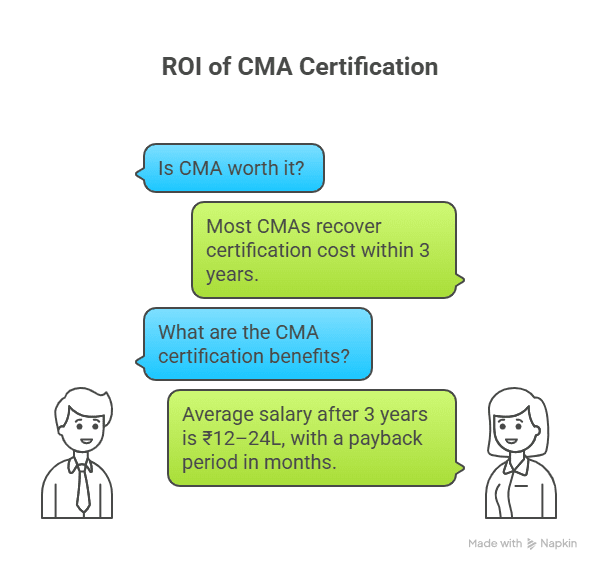
In 2025, the global demand for CMAs hit a new record, especially across India, the UAE, and Singapore, where multinational firms are scaling finance operations post-AI disruption. According to the IMA’s 2023 Global Salary Survey, CMA-certified professionals earned 58% higher salaries than their non-certified peers.
So, if you’ve been wondering things like:
Is the CMA certification really worth it in India? What are its actual benefits and downsides? Should I choose the US CMA or the Indian CMA?
You’re asking the right questions. And that’s exactly what we’ll unpack in this article – what the CMA Certification really is, how it compares with other qualifications like CA and CPA, how much it costs, the career paths it opens, and yes, whether it’s genuinely worth your time, money, and effort.
What Is the CMA Certification?
The CMA Certification is awarded by the Institute of Management Accountants (IMA), USA, a globally recognised body with over 150,000 members in 150+ countries.
Unlike CPA or CA, which focus heavily on accounting compliance, CMA focuses on strategic financial management, budgeting, analytics, cost management, and decision-making.
Here’s a Simple Example:
Imagine two professionals working in a company –
Rahul, a CA, prepares the company’s financial statements and ensures they meet all legal and tax requirements.
Sneha, a CMA, takes those statements and says, “Our operating costs are 12% higher this quarter because our logistics expenses spiked in the north zone. If we shift part of our distribution to a third-party partner, we could save ₹80 lakh annually.”
Rahul ensures compliance, while Sneha drives profitability.
That’s the essence of what is CMA and what they do; they don’t just crunch numbers, they shift one’s mindset from compliance to profitability and strategy that move a business forward.
Aspect
CMA USA
CA (India)
CPA (US)
Focus
Management & Strategy
Auditing & Taxation
Accounting & Regulation
Duration
6-12 months (flexible)
3-5 years
1.5-2 years
Exam Parts
2 parts
3 levels
4 parts
Global Recognition
🌎 High
🇮🇳 National
🌎 High
Ideal Career Path
Corporate Finance, FP&A, CFO roles
Accounting, Audit, Tax
Audit, Compliance
Watch this video that breaks down the real benefits of the CMA-US certification: what job roles it opens up and whether it’s the right career move for you.
A Brief Look at Tangible Returns: Career & Global Mobility
When you invest your time and effort into a certification, the real question isn’t just “what’s the salary?” – it’s “how far can this take me?” The CMA certification answers that in clear, measurable ways. On average, professionals with the US CMA credential earn 35–50% higher salaries than their non-certified peers in India, and up to $100,000+ globally, according to the IMA Global Salary Survey.
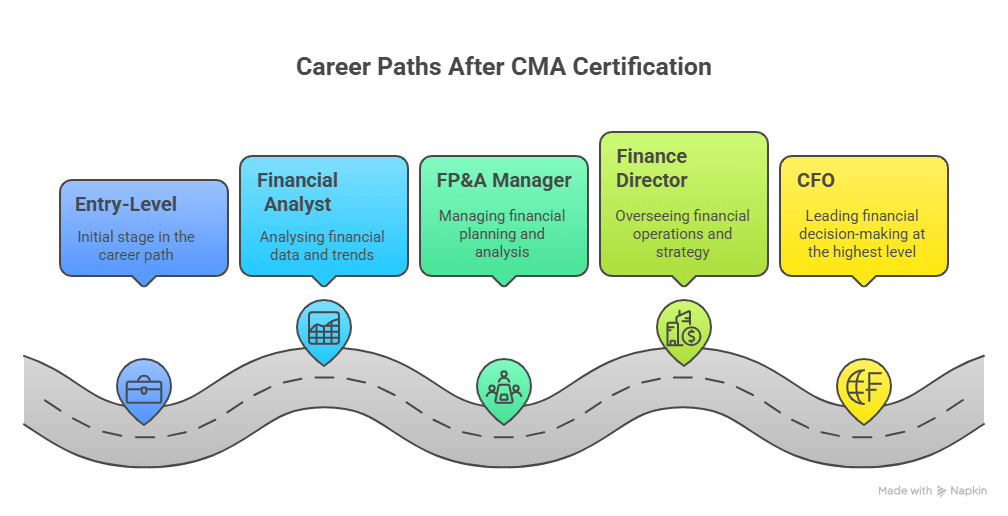
But beyond the paycheque, it’s the quality of roles that changes. CMAs move from routine accounting to decision-making positions in
FP&A
Corporate Finance
Business Strategy
Within five years, many transition from analyst roles to managerial or controller-level positions, a leap that usually takes others nearly twice as long.
But the real magic of the CMA lies in what it unlocks beyond borders. Think of it as a global passport for finance careers. While Indian CMAs largely work within domestic regulations, the US CMA gives you mobility – recognition in 100+ countries, and access to roles across MNCs, Big Four firms, and tech-driven startups worldwide.
Employers value CMAs because they think like business partners, as professionals who understand numbers and the narrative behind them. In short, CMA doesn’t just grow your income; it expands your map.
CMA in India: Is It Worth It?
If you’re in India, here’s the truth: the CMA US credential is gaining massive traction.
In 2025, companies like Accenture, Deloitte, and Amazon actively hired CMA-certified analysts for FP&A, cost control, and business partnering roles.
Why It Works in India:
Indian companies are now more global. They need people trained in US GAAP, IFRS, and analytics.
CMA brings international credibility, unlike CMA India, which has more local recognition.
With India’s CFO market expanding by 22% YoY, CMAs are preferred for strategy-aligned finance roles.
In this video, get an honest rundown of the challenge level of the CMA (US) exam, real-talk on how much effort it takes, and why it’s entirely achievable if you’re committed.
CMA Advantages and Disadvantages
Like any qualification, the CMA has its pros and cons. It’s not a golden ticket that guarantees success, but if your goals align with what the CMA certification benefits, it can really speed up your career growth.
There is more than one reason to get your CMA certification. The good part? It can open doors to global opportunities, better pay, and roles where you’re part of real business decisions, not just managing numbers. But it’s also demanding. You’ll need to put in serious study hours, stay consistent, and build a solid understanding of finance to get through the two exams.
Before jumping in, it’s worth taking a balanced look at what makes the CMA such a strong career move, and where it might not be the perfect fit for everyone.
Advantages of CMA Certification
✅ Global Recognition: Accepted in over 100 countries. ✅ Career Mobility: Move from accounting to management roles easily. ✅ Faster Completion: Can be done in under a year. ✅ Salary Uplift: Significant jump in compensation and leadership exposure. ✅ Future-Proof Skills: Aligns with data-driven finance and automation trends.
Disadvantages of CMA Certification
❌ Costly: Average total cost can reach ₹3 lakh with coaching. ❌ Challenging Exam: Global pass rate hovers around 45-50%. ❌ Less Relevance for Non-Finance Roles: If you’re shifting to marketing, tech, or HR, CMA adds little value.
The CMA Journey: Course Structure and Fees
The CMA Certification is built for professionals who want to move from accounting to strategic finance. It’s a two-part program that tests how well you can apply financial data to real-world business decisions.
What’s interesting is how compact yet globally rigorous it is: most candidates complete it within 12–18 months, while balancing full-time jobs. The standout factor is the return on learning: the CMA syllabus builds the bridge between accounting and management, a combination that directly translates into higher-value roles like FP&A, business finance, and strategy.
CMA Course Overview
The CMA exam is divided into two parts, testing both operational and strategic expertise.
Part
Topics Covered
Weightage
Part 1: Financial Planning, Performance, and Analytics
Cost management, budgeting, variance analysis, data analytics
The CMA certification course fees range from $1,000 to 2,000 in 2025. That’s around ₹85,000 to ₹1.6 lakh, depending on exchange rates. You’re paying for IMA membership, entrance fees, and the two exam registrations. They don’t take it all at once. You pay in stages as you register for different parts.
Component
Fee (USD)
Equivalent (INR)
IMA Membership (Annual)
$145
₹12,000
Entrance Fee
$280
₹23,000
Exam Registration (2 parts)
$830
₹69,000
Study Materials & Coaching
$1,000–$2,000
₹80,000–₹1.6 lakh
Total Estimated Cost
$2,000–$3,500
₹1.7–2.9 lakh
CMA Salary in India and Abroad: What’s the ROI?
You really start to see the benefits of a CMA certification once you enter the job market. In India, CMAs are partaking in key business discussions and shaping strategy. From multinational companies to consulting firms and startups, employers are looking for professionals who can read the story behind the numbers and turn it into action. This is reflected in the CMA salary in India.
The difference shows up in the pay, too. As per the IMA Global Salary Survey, CMAs in India earn around 58% more than those without the certification. Mid-level professionals usually make between ₹12–20 lakhs a year, while senior positions can cross ₹30 lakhs. The global picture is just as strong. CMAs in the US typically earn between $90,000 and $120,000, and in the UAE, salaries often fall in the AED 250,000–300,000 range.
Region
Average Annual Salary (2025)
Source
India
₹14-24 LPA
IMA Salary Survey 2025
USA
$90,000-$110,000
Glassdoor
Middle East
$60,000-$80,000
PwC Gulf Salary Guide
Singapore
SGD 120,000
Michael Page Salary Report
📈 A CMA in India typically earns 35–50% higher than a non-certified finance professional in the same role.
US CMA vs Indian CMA: Which One Should You Choose?
The US CMA prepares you for global roles where strategy, performance, and decision-making take centre stage. The Indian CMA, on the other hand, is rooted in cost control, compliance, and financial accuracy within Indian regulations.
Think of it like this. The US CMA helps you understand why a company performs the way it does, while the Indian CMA focuses on how to make that performance more efficient. Both paths lead to respected careers, but they cater to very different goals.
Here’s a simple breakdown to help you see the difference clearly:
Parameter
US CMA
CMA India
Governing Body
IMA (USA)
ICMAI (India)
Recognition
Global
National
Exam Parts
2
3
Focus
Management & Analytics
Cost Accounting
Duration
6-12 months
2-3 years
Ideal Career
MNCs, Corporate Strategy, FP&A
Indian PSUs, Cost Audit
🎯 If your career goal is to work in MNCs, startups, or abroad, choose the US CMA. If your interest lies in Indian public enterprises or domestic accounting, CMA India may fit better.
Is CMA Worth It After CPA, CA, or MBA?
If you already hold a CA, CPA, or MBA, CMA adds strategic and global depth.
After CA: CMA brings management orientation and analytics capability.
After MBA: Strengthens your financial decision-making credibility.
After CPA: Adds the strategic finance layer to an accounting background.
💬 As a mentor, I often tell my students that CA gives you the foundation, but CMA gives you the direction.
CMA Certification: Exam Pattern and Difficulty Level
Each exam part has 100 MCQs + 2 essay scenarios, testing your ability to think, not memorise.
Focus on decision analysis and ethics; most overlooked but high-weightage areas.
Real-World Career Examples: Where CMAs Work
CMA professionals are found in diverse sectors like tech, manufacturing, BFSI, and consulting.
Industry
Roles for CMAs
Top Employers
IT & Tech
FP&A Analyst, Business Controller
Amazon, Microsoft, TCS
Manufacturing
Cost Controller, Plant Finance Head
Larsen & Toubro, Siemens
Consulting
Financial Strategist, Risk Consultant
Deloitte, PwC, EY
Banking & FinTech
Treasury Analyst, Product Finance
HDFC, Razorpay, Paytm
CMA Salary Growth Over Time
The true value of the CMA Certification unfolds over time, not in the first payslip, but in the career trajectory it builds. Most CMAs don’t start at sky-high salaries; they grow into them. The certification acts like a career multiplier. The deeper you go into management decision-making, the steeper your salary curve becomes.
Experience Level
Average Salary (India)
0–2 years
₹8–12 LPA
3–5 years
₹14–20 LPA
6–10 years
₹25–35 LPA
10+ years
₹40 LPA+ (CFO/Controller roles)
👉 CMAs often move into senior finance roles within 4–5 years, compared to 7–8 years for non-certified peers.
Why Choose Imarticus Learning for the US CMA Course?
When you decide to pursue the US CMA certification, who you learn with matters just as much as what you learn. At Imarticus Learning, you’re not just signing up for exam preparation; you’re entering a full‐fledged launchpad built for global finance roles. Here’s what you will get from this course:
Industry-Aligned Curriculum: Imarticus has partnered with KPMG in India and uses globally recognised content (via Surgent) with an 83 % pass-rate backing.
Money-Back Guarantee: They stand behind their program. If you don’t clear both CMA exam parts under their terms, you’re eligible for a 50 % refund of the course fee.
Placement & Career Support: Beyond the exam, there’s a pre-placement boot camp, resume/interview prep, and assured interview opportunities with global firms, giving you hands-on career launch support.
High-Impact Modules: Real-world case studies (23 curated by KPMG), live expert sessions, tailored materials aligned with global roles, not just exam “drill”.
Global Recognition, Local Relevance: Imarticus is India’s first & only authorised prep provider for top finance credentials (US CMA, US CPA, ACCA, etc.).
Clear Career Outcomes: Salary ranges and job roles are laid out (e.g. ₹8 LPA–₹18 LPA for entry‐level CMA roles in India) so you have realistic expectations.
FAQs on CMA Certification
When it comes to the CMA Certification, it’s natural to have practical questions. How long does it take to complete? What are the costs involved? What kind of jobs and salaries can you expect? And how does it compare to other finance qualifications?
This section answers these questions clearly and directly. It’s designed to give you real insight into the certification, its benefits, and challenges, so you can decide if it aligns with your career goals without any confusion or guesswork.
What is a CMA Certification?
CMA is a Certified Management Accountant. It’s from the Institute of Management Accountants in the US. Covers financial planning, cost management, performance tracking, and business strategy. You’re not just doing bookkeeping, you’re helping companies make decisions using financial data.
For Indians in finance, a US CMA gets you into international jobs. Corporate finance, FP&A, strategy roles. Two exams total. Amazon, Deloitte, and Accenture hire CMAs because they connect finance to business outcomes.
Is CMA higher than CA?
Different things. CA is tax, audit, and compliance. Statutory stuff. CMA is management accounting, planning, and strategic decisions. Depends on what you’re after.
Globally, CMAs do strategy. CAs do technical accounting and tax. Some Indians do both. If you want CFO roles or international finance leadership, CMA has more management weight.
Which is higher, CPA or CMA?
Neither’s higher. CPA is external auditing, tax, and financial reporting. Compliance focus. CMA is internal – cost control, performance, and financial analysis. They work together in companies. CPA makes sure things are legal and accurate. CMA focuses on making money and strategy.
Corporate finance or FP&A? CMA’s better. Public accounting in the US? Need a CPA. Lots of CFOs have both.
What is CMA in salary?
India: ₹8–24 lakhs depending on experience and company. Senior CMAs in MNCs can hit ₹30+ lakhs. Globally, it averages $100k, often with 20% bonuses.
IMA data shows CMAs earn 58% more than people without it. Pretty good ROI.
Is CMA hard to pass?
Yeah, it’s hard. Two exams. Financial reporting, performance management, cost control, and strategy. Pass rate around 45–50%. Same ballpark as CPA or CFA. It tests how you think, not what you memorise.
With Imarticus Learning’s expert-led CMA prep, students get structured study plans, practice mocks, and guided mentoring, making the journey smoother and far more achievable within 6–9 months per part.
Is CMA a government job?
No. It’s a credential. But it helps you get finance jobs in the government or private sector. Some PSUs like BHEL, ONGC, Railways, hire CMAs for cost accounting, budgeting, and audit.
CMA India (ICMAI) is separate. US CMA mostly gets you private sector work in multinationals. Not a government job itself, but it opens doors in both sectors.
How many years to complete CMA?
12–18 months usually. Two exams, so it depends on how hard you work. Working people often finish in a year, doing 10–12 hours weekly. Exam windows are flexible, so you can work around your schedule.
IMA gives you three years max. Structured programs help people finish faster.
Who is eligible to do CMA?
Anyone with a bachelor’s degree (in any stream) can pursue the US CMA certification. You can even start the exams before graduating and complete the two years of relevant work experience later.
For Indian students, this flexibility is a big plus — especially with the CMA program in collaboration with KPMG in India offered by Imarticus Learning. The structured guidance helps you meet eligibility requirements, prepare effectively, and build real-world finance skills along the way.
Which degree is best for CMA?
No specific requirement, but commerce, accounting, finance, and economics help. B.Com, BBA Finance, MBA give you a base. Engineers do fine if they’re decent with numbers and willing to learn.
Experience matters more than the degree. BBA Finance plus CMA gets you into FP&A or business analysis. CA plus CMA is a CFO track.
How many exams are in CMA?
There are two parts.
Part 1: Financial Planning, Performance, Analytics Part 2: Strategic Financial Management
100 multiple choice plus two essays each. Take them in any order. Three windows yearly: Jan–Feb, May–Jun, Sep–Oct. Most finish both in a year.
A quick way to get a global credential without years of study.
Is CMA in demand?
Yes. India’s seen a 25% demand increase. Companies want data-driven decisions, so they need CMAs for FP&A, cost control, finance management, and CFO positions.
EY, KPMG, Deloitte, Genpact, and Amazon all hire US CMAs. They want people who link accounting to strategy. Financial planning keeps showing up as a critical skill. Demand’s growing.
Is CMA tougher than MBA?
Different. CMA is technical, finance, analytics, and strategy-heavy. For people good with numbers. MBA is broader. Marketing, HR, operations, plus finance.
Lots of people do both. MBA for leadership, CMA for finance depth. CMA is two exams versus two years, but more concentrated. CMA’s harder on finance specifics, MBA’s wider. Both together can get you to senior management or the CFO faster.
Bringing It All Together
Here’s the honest mentor take: CMA isn’t for everyone, but if you love strategic thinking, want to lead business decisions, and are ready to invest a few months of effort, it’s absolutely worth it.
It bridges the gap between accounting and strategy, data and decision, and India and the world.
💡 So, whether you’re a fresh graduate or mid-level finance professional, 2025 might be your best time to pursue the CMA certification.
Before understanding the trade life cycle of reconciliation, let’s study the term: reconciliation.
Reconciliation
Reconciliation is basically a process in which an accountant compares two separate records and evaluates the accuracy of the agreement. It is a verification method to ensure that the process of trading is correct, secure and consistent in practice.
The process of reconciliation is done in order to protect businesses from fraud and illegal activities in trade. The frequency of reconciliation depends on the body with regular check frequencies of daily, once in a month or in a year.
In most institutions, the process of reconciliation is machine-oriented, thereby automated. But the process still requires humans to double-check the accuracy of the document and look for errors. Reconciliation consists of the following steps, let’s understand them one by one:
1. Checking the cash register with the bank statement
The first step of reconciliation is to compare and check the transaction in the cash register to that of the bank statement.
2. Finding missing transactions in the bank statement, and matching it with that of the cash register
There are instances when a transaction is not recorded in the bank statement, but it is present in the cash register. The role of an accountant here is to find the missing transaction and fix it in the records.
3. Ensuring transactions are recorded in both bank statement as well as company internal register
As an accountant, it is important to record every transaction of the company in a two-medium form. One in the cash register, and second in the internal cash register. This helps in making the process of accounting and reconciliation easier.
4. Check for bank errors
Sometimes there can be printing or technical errors in bank statements which can lead to major differences in transactions in the bank statements and cash register. So it is important to identify the errors, fix them and produce new adjusted bank statements. The accountant can add, subtract or modify the bank statement to match with the cash register in case of a printing error or technical error. The purpose of the process is to make it transparent and secure for the company.
5. Balancing the bank statement and internal cash records
The reason why reconciliation is done is to ensure that the bank statement matches with internal cash records and vice versa. The accountant must identify, correct and modify the errors in any of the maintenance records ( bank statements and internal cash records) in order to depict the good financial health of the company.
There are two ways to check records, one is with the help of double-accounting which we have discussed above. The second is to use analytics to identify major fraudulent activities in the financial system and report them.
If you’re too new finance and banking industry and are looking forward to learning Capital Market, bonds, equities, and investment banking, then we highly recommend having a look at our courses in finance at Imarticus Learning. It will help you in understanding the fundamentals of finance and know about how economies work.
For more such articles, feel free to explore more by,
The service that financial institutions provide to their non-financial clients is known as retail banking. Retail banking does not include corporations, corporations or other banks. Many personal finance products and services are available to individuals through retail banking. Let’s examine the features of retail banking and take a closer look at this branch of banking.
Characteristics of retail banking
Small ticket transactions
One of the main characteristics of retail banking is the small number of transactions in this sector. For example, depending on the bank’s policies and location, retail credit ticket sizes range from $1,000 to $100,000 or more, whereas for fixed deposits, transaction sizes typically range from $100 to $100,000.
Diversification
As far as banks are concerned, bank risks are diversified in case of retail banking. For example, if a bank makes a $500,000 business loan and the borrower defaults due to a problem, the bank risks losing the entire amount. However, if the same bank lends $5,000 to 100 different retail customers, and even if 5 or 10 borrowers default, the bank may incur losses due to the diversification of the retail banking business.
Several branches
This is also one of the main features of retail banking. The retail banking system requires banks to open branches in different centers to attract customers as it is unlike investment banks or wholesale banks which only need 2 or 3 branches to serve a small customer base. But when it comes to retail banks, they need to open a number of branches to serve their huge customer base.
Multiple Services
Retail banking is largely characterized by the presence of various services. Customers who use retail banking usually do so to meet a variety of needs, not just one. Unlike investment banks, which must only provide investment-related banking services, retail banks must offer all services including opening savings and checking accounts and issuing debit and credit cards to customers, making home loans, auto loans, personal loans and other types of loans. loans, car sales for third prize, among others.
Strong competition
Because many market participants and customers are price and performance sensitive, the private customer business also has the disadvantage of being highly competitive. For example, if one bank offers a fixed deposit rate of 5% and another bank offers an interest rate of 5.50%, the customer switches to a bank with a higher fixed deposit rate. The same goes for loans, where customers are quickly switched to other banks, even if the difference in interest rates is only 10 or 20%.
Higher administrative fees and expenses
Administrative costs for banks increase as the number of branches increases, as more operational costs for branch maintenance are borne than for investment banks or larger banks, including rent for branch facilities, staff salaries, and electricity costs. After discussing the important characteristics of retail banking, let’s also learn about the types of banks that are included in retail banking.