
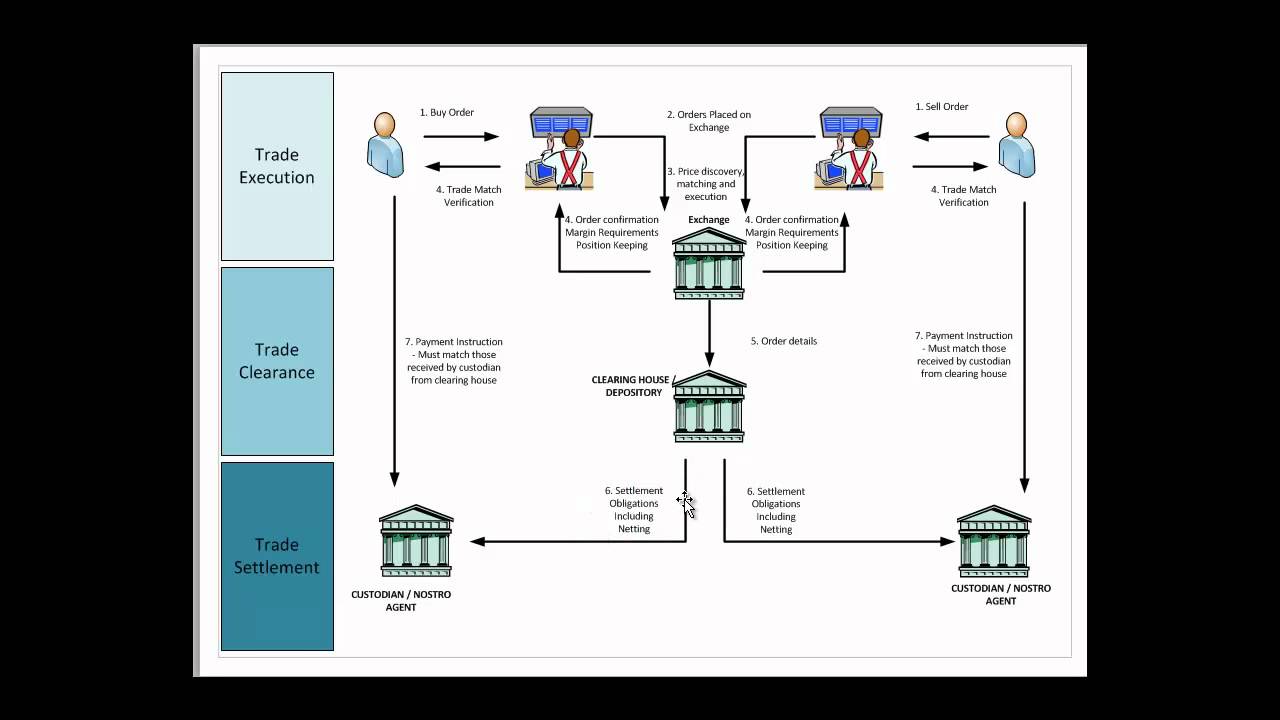
Trade life cycle in Capital Markets

Trade life cycle in Capital Markets

Any financial instrument traded in the market is determined by its supply and demand in the capital market. First, let us try to understand what are financial instruments and capital market. A financial instrument is a certificate of ownership for any kind of monetary contract between parties. It can be company shares or bonds or any stock owned by a person after a monetary arrangement and paid to the respective parties.
And a capital market refers to the place where different institutions and entities trade these financial instruments. For instance, the stock market in India is one of the biggest capital markets in the world, and the Bombay Stock Exchange (BSE) is the oldest in Asia. For better understanding, one can opt for Capital Market Course and capital market tutorial provided by experts in the domain.
In order to understand how these financial instruments are traded, we first need to know the process of the trade life cycle. It follows the following steps:
1. Order Initiation and Delivery
The main idea behind any trade is the profit that one generates within a stipulated time though their investment. Similarly, in the stock market, an order is initiated by a retail client or an institutional investor through a broker or an agency, keeping in mind the perception of the movement of the share market. These orders are placed through the brokers with the help of online trading or through phone calls.
By market order, we mean the buy or sell or share or stocks of listed companies in the share market. When orders are placed, the broker or agencies record and process them carefully and allocate the shares or stocks to their respective clients.
2. Risk Management and Order Processing
In buying and selling shares by the investor, the broker places a query to verify whether sufficient balance is being maintained in the client’s account or whether sufficient stocks are available, respectively. Upon confirmation on the same, the order is placed while the order receipt is being generated. Any default by the investor has to be made good by the agency to the clearing institution. Therefore, the risk management by brokers or agencies comes at a price, called a margin which is levied by the clearing institute, and their responsibility to recover the same from their clients.
3. Order Matching and Trade Conversion
Once orders are collated by the broker from their clients with their respective quantity, amount, date and time, they are sent to the exchange for verification and to allot respective shares and volume accordingly. The clients are charged a minimum commission as a brokerage fee by the agencies and an official order confirmation through mail or post are being forwarded in the form of a contract note. The client details are recorded by the broker and are assigned a unique customer ID for each of them for trade convenience.
4. Trade Confirmation and Validation
An agency called a custodian is engaged by every institution in order to assist them in the clearance and settlement processes. The institution, with the assistance of their fund manager, sends details to the custodian about the order allocation including the type of securities, quantity, and price for the respective orders. This process prepares him to be aware of the trade details he is soon expected to receive from the broker along with their commission charges.
The custodian thus compares and validates the trade details and forwards an affirmation note to the broker. To know the basics of online trading and how it functions, nowadays it has become much easier as there are organizations offering capital market course and capital market tutorial by experts at reasonable rates.
5. Trade Settlement and Clearance
Trades executed are being collated and are settled 2 days after the transaction i.e. T 2 days. Once the clearing institute or corporation informs regarding their obligations to the investors on their securities and funds, the balance of payments are executed.
This follows the allocation of shares and funds in the respective demat accounts of the investors. Share amounts are credited to their linked accounts as sales proceed, and respective shares allocated for their volumes being invested. The detailed report is again forwarded by clearance houses to the guardian and to the exchange offices for records purpose.

Other Resources: 

What is Trade Life Cycle

Difference Between Trade Affirmation And Trade Confirmation

How are Online Retailers Using Big Data Analytics?

Data is being generated at every moment of the day and has grown from retailers using their own data to databases available across industrial verticals. It is so huge that cloud storage is now the buzz word. Data analytics with the Big tag deals with data primarily and the predictions or forecasts from analyzing databases that help with informed decision making in all processes related to business. This could run into volumes of several petabytes of data.
But, why would one need a Big Data Analytics Course? Because smaller databases that are less than a terabyte size-wise can be tackled with traditional tools. However, modern data tends to be unstructured and comes in the form of videos, audio clips, blog posts, reviews, and more which are challenging to clean, organize and include huge volumes of data.
The tools and techniques involved in the capture, storage, and cleaning of data need necessarily to be updated. One also would need faster software that can compare databases across platforms, operating systems, programming languages and such complexities of technology.
The speed and agility of analytics offer big advantages and savings in making informed business decisions. That’s why investing in data analytics and Data Analytics Training is such a popular choice across industrial verticals and sectors.
Let us look at the data analytics improvements of some real-life examples.

Offering marketing insights:

Foresight from analytics has the potential to change marketing strategy, operations and more in all firms. Whether it be effective marketing strategy or promotional campaigns, decision making, purchasing, cost-saving measures, targeting the customers, promoting products or improving efficiency through the predictions, insights, forecasts, etc help make those decisions. Just look at the campaign of Netflix covering over 100 million customers for inspiration.

Boosting retention and Customer-Acquisition:

Coca Cola used their data foresight to draw up their retention and loyalty reward programs and to improve their services, products, and customer stories. Besides boosting sales such improvements trigger loyalty too.

Regulatory compliance and Risk Management insights:

Singapore based UOB did their risk assessment and management for the financial sector and budgeting. Foresight and predictions can also be effectively used as a critical investment in regulatory compliance.

Product innovations:

Take the example of Amazon’s diversification into groceries, food, and fresh-foods segment. Their analytics program was based on the acceptance of customers trends and successfully helped innovate product lines, design models of innovation in saleable products, etc.

Management of logistics and supply-chains:

This essential field can be transformed very effectively as Pepsico did with improved processes, scheduling deliveries, warehouse management, reconciling logistics and shipment needs and more.
Budget and spending predictions:
The loyalty of customers is reflected in spending patterns and data is collected from use of credit cards, effects of promotional programs and customer retention data, web users log-in data, IP addresses, etc to gauge predictions for spending and effective budgeting. Did you know that Amazon analyses accounts that run into astounding figures like 150 Mil customers and their analytics programs increased sales by 29 percent and new customers by 40 percent? That’s huge profits from data analytics!

Bettering customer service:

Improvement in customer experience yields big dividends as in the case of Costco where specific customers who were at risk with listeria contamination in fruits and were warned instead of creating a scare with emails to all customers.

Demand forecasting:

Just look at the Pantene and Walgreens hair-care products sales figures. They promoted the products based on a demand prediction of weather and anticipated higher humidity affecting sales of anti-frizz hair products. Pantene recorded a 10 % increase and Walgreens a 4% sales increase. Smart use of data analytical predictions by retailers!

Research on journeys of customers:

This graph is never a straight line and when in retail marketing analytics with many thousands of customers, one can help understand data like where an individual customer will seek product info, how and where to reach such customers, why the customer loyalty changed, etc. Looking for the needle in the haystack is now easy with data analytics.

Concluding note:

All enterprises, especially in the retail sector, need big data analytics to have reduced operational expenses, a competitive edge, enhanced customer loyalty, better productivity, and retention. The demand for data analysts keeps growing alongside the growth of data and is an ideal choice of careers with scope, payouts, and growth. If you wish for a Data Analytics career, then do a big data analytics course at the reputed Imarticus Learning. Their data analytics training with assured placement, certification, soft skill modules,industry-suited curriculum, and real-time project work offers the best career choices. Enroll today!