


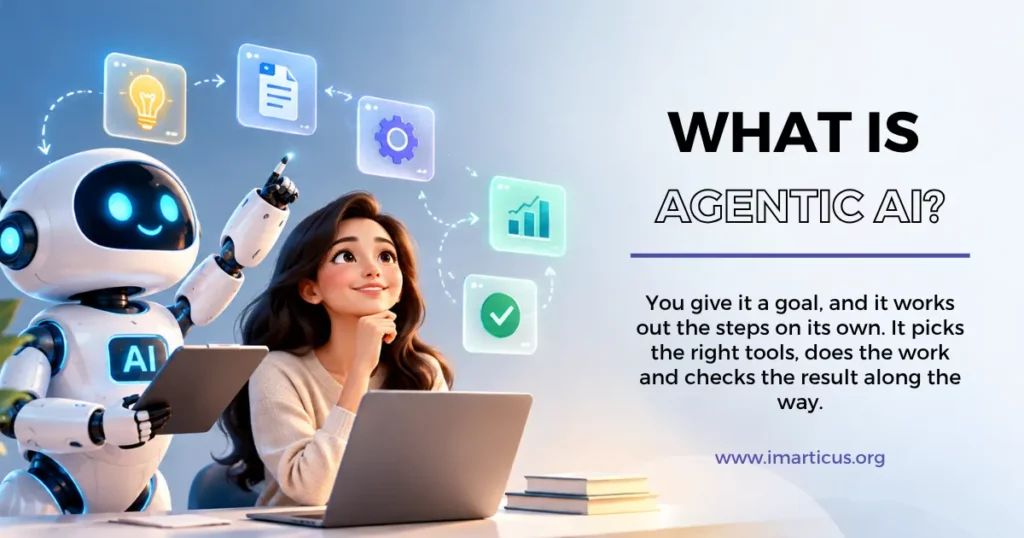
Agentic AI is a type of AI that can plan, make decisions, and take action to achieve a goal without much human supervision, relying on tools and data. Agentic AI is a type of generative AI that performs multiple tasks, like resolving a support ticket or generating a report. This is why agentic AI jobs, courses, and certification options are proliferating: Gartner predicts that 40% of enterprise apps will feature task-specific AI agents by the end of 2026.
Most of us still use AI to get answers, but what is agentic AI? Agentic AI is the version that gets things done, and that shift is what I want to break down here. If you have been searching for what is agentic AI, this guide covers the meaning, examples, tools, jobs, the Google angle, and where it is heading, all in plain language. And if you would rather build these systems than just read about them, our data analytics course teaches the Python, machine learning, and GenAI skills they run on.
What Is Agentic AI?
What is agentic AI? Remove all jargon from artificial intelligence; its essence is straightforward – an application designed to serve purposes. Tell me what I need. It decides where it goes. It is about choosing instruments to do tasks by way of procedures done properly or corrected if needed.
Let’s see what is agentic ai? Usual chatbots sit there waiting for you to send another message. An agentic system doesn’t wait. A large language model (LLM) usually acts as the brain, while apps, APIs and databases act as the hands. So how do you tell if something is properly agentic? Run it against this list.
Don’t Let Our Best Advice Get Buried
Add Imarticus as a Preferred Source — see more of what we publish, every time you search.

| Trait | What it means | Example |
| Autonomy | Needs very little human input | Handles a refund start to finish |
| Goal focus | Chases a result, not one reply | “Get this invoice paid” |
| Planning | Breaks a big job into small steps | Turns a market report into research, analysis and a draft |
| Tool use | Talks to apps, APIs and databases | Updates a CRM, sends an email |
| Memory | Remembers what it already tried | Doesn’t repeat a step that failed |
| Adaptability | Changes course when something breaks | Moves to another data source |
Most tools tick a couple of boxes. A few tick all of them. I’d call it a scale, not a yes or no. What is agentic AI? A chatbot with web search? Barely agentic. Does this software book itself to pay for you and send me an update?
Did You Know?
Gartner expects 40% of enterprise applications to include task-specific AI agents by the end of 2026, up from less than 5% in 2025. (Source)
How does Agentic AI work?
It’s easiest for me to think of What is agentic AI as a circle. It spins continually until it is finished or it requires human help.
- Perceive: Gathers information from your instructions, documents, apps, and Data.
- Reason and plan: The LLM figures out what is to be done and the sequence of actions.
- Act: Use tools to complete each step (search, code, APIs, email).
- Check: It reads the result and identifies any mistakes and/or omissions.
- Learn and repeat: Modifies the plan, saves what it learned, and continues, or gives to people if it gets “stuck.
Let’s take the example of the stock you’re thinking of buying. If a customer makes a request for a refund. The agent reads the request, looks at the order in your system, verifies it adheres to the refund policies, provides the money, emails the customer, and records the case. In the event the quantity appears to be out of the norm, it halts and asks a Manager. This brief jaunt around a man is a strength, rather than a weakness.
There are guardrails in good systems around this loop: limited permissions, spending limits, and approval from humans for risky steps. Agentic AI is best used in a contained environment, rather than being unleashed.
Agentic AI vs Generative AI
Getting confused about what is agentic ai? This is the one everyone asks about, so let’s settle it. Generative AI makes things. Agentic AI does things. Agents are called agents while Generators are generators; however, they often work together with an agent to function properly. They work together. Here’s the agentic AI vs. generative AI side-by-side.
| Point | Generative AI | Agentic AI |
| Main job | Creates text, images, or code | Gets tasks and goals done |
| How it starts | A prompt, every single time | A goal, once |
| Steps handled | Usually one | Many, in a chain |
| Tool access | Limited | Apps, APIs and databases |
| Memory | Short, inside one chat | Carries context across steps |
| Example | Drafts an email | Reads the inbox, replies, books the meeting |
| Main risk | Wrong or made-up content | Wrong actions in real systems |
- I like a simple test for gen AI vs. what is agentic AI. Does the tool stop after giving you an answer? That’s generative.
- Does it keep going and use that answer to do something? That’s agentic.
And if you want a one-liner for the generative AI vs. agentic AI difference, try this. GenAI is a brilliant writer. The agent of an AI helps with writing tasks while remembering to reserve rooms for meetings.
AI Agents vs Agentic AI
People use these as if they’re the same thing. They’re close, but not the same. Whether you’ve searched AI agent vs agentic AI or agentic AI vs AI agents, the short answer is size.
An AI agent is one program with one job, like a bot that reschedules your meetings. Agentic AI is the bigger setup, where one or several agents plan together and go after a larger goal. One agent is a good employee. Agentic AI is the team, the manager, and the project plan. That’s really all there is to AI agents vs. agentic AI.
| Point | AI agent | Agentic AI |
| Scope | One task or role | A whole workflow |
| Number | Single | Often several working together |
| Planning | Follows set steps | Replans when needed |
| Autonomy | Limited | Higher |
| Example | A meeting scheduler bot | A claims system running from intake to payout |
Small warning, though. Marketing teams love the word “agentic” and stick it on almost anything. Analysts call that agent washing. So when you read any AI agents vs agentic AI comparison, ask what the product really does.
Also Read: A Detailed Guide to AI Jobs in 2026
Agentic AI Examples
The easiest way to get agentic AI examples is by industry.
| Industry | What the agent does | Result |
| Customer support | Reads the ticket, checks the order, refunds, replies | Fewer manual tickets |
| Banking and finance | Collects documents, runs checks, flags risky cases | Faster onboarding |
| Software | Finds a bug, writes a fix, runs tests, raises it for review | Quicker releases |
| IT and security | Looks into alerts, links related logs, takes the first response | Faster reaction |
| Retail | Tracks stock, reorders, handles returns | Fewer stock-outs |
| HR | Screens CVs, books interviews, sends updates | Less admin |
Spot the pattern in these agentic AI examples? Anything risky still goes to a person. The agent does the boring bit.
Google Agentic AI
Google agentic AI work is hard to miss, so it gets its own section. These are the Google agentic AI tools I’d know about:
- Agent2Agent (A2A) protocol. An open standard that allows vendors to communicate with agents. It was launched by Google in 2025, along with over 50 partners.
- Agent Development Kit (ADK). A library to create agents using code.
- Gemini Enterprise Agent Platform. Unveiled at Google Cloud Next in April 2026 as the next generation of Vertex AI. You can make with coding or without coding.
- Project Mariner. A software program that acts for you when surfing the web.
- Learning: don’t worry about taking sides. Python, APIs, LLMs, and data work the same way everywhere. That’s the Google agentic AI takeaway, really.
Also Read: Data Science: What The Field Actually Involves In 2026
Agentic AI Tools
What is agentic AI tools? Honestly, nobody needs to learn every one of the agentic AI tools. Here’s a quick cheat sheet.
| Tool | Best for | Suits |
| LangGraph | Controllable agent workflows in Python | Developers |
| CrewAI | Role-based teams of agents | Developers |
| AutoGen | Multi-agent chats and research setups | Developers and researchers |
| Google ADK | Building and deploying agents on Google Cloud | Cloud teams |
| Microsoft Copilot Studio | Low-code business agents | Business users |
| Salesforce Agentforce | Agents inside sales and service work | CRM teams |
My recommendations for agentic tools: choose one code-first tool and one low-code tool, and create one actual product or service using each. Two accomplished projects defeated 10 partial view tutorials.
Benefits of Agentic AI
The benefits of what is agentic AI come down to hours saved and fewer mistakes on work nobody enjoys doing. Your team gets that time back for the things that actually need a human.
- Time back on repetitive work. Normal activities are completed, and no one is responsible for supervision.
- All-day service – no queues during the night and on weekends.
- Multiple-step jobs carried out immediately. Needs to be one goal to trigger research, analysis, action, and follow-up.
- Fewer stupid mistakes, as it performs the same checks each time, even mid-Friday at 6 pm.
- Easy scaling. It’s faster to add another agent than to train and hire another agent.
- More space for your team to exercise judgement, such as in strategy setting and communicating with customers.
Take a finance team. Month-end reconciliation usually eats days of manual matching. An agent can match the entries, flag the mismatches, and write the summary, so the team only looks at the exceptions.
There’s a catch, though. Agentic AI on a messy, unclear process just automates the mess.
Risks of Agentic AI
It wouldn’t be fair to only talk about the good stuff. Here’s what we need to take care of:
- Hype. Gartner estimates only about 130 of the thousands of vendors claiming agentic AI are the real thing.
- Cancelled projects. Gartner also predicts over 40% of agentic AI projects will be cancelled by the end of 2027, thanks to rising costs, unclear value, or weak risk controls.
- Security. An agent with too much access can do real damage if it’s tricked or just gets something wrong.
- Wrong actions. A made-up fact in a chat is annoying. A wrong action in a payment system is expensive.
- Accountability. Somebody in your company has to own what the agent does.
- Skills gap. Plenty of teams don’t have people who can build, test, and monitor agents.
It also helps to know when not to use it. Fixed, predictable processes don’t need it, because simple rules do that job cheaper. Anything that can’t be undone needs a human check first. And if your data is a mess, agents will inherit every problem you already have.
So no, the answer isn’t to avoid it. Start small, measure what happens, and keep people in charge of the risky steps.
Agentic AI Trends 2026
These are the agentic AI trends 2026 is actually showing us.
| Trend | What’s happening |
| Agents inside apps | Everyday business software is adding built-in agents for specific jobs |
| Multi-agent teams | Several specialised agents share one workflow, instead of one giant agent doing it all |
| Open standards | Protocols like A2A help agents from different vendors work together |
| Humans in the loop | Approvals, audit trails, and monitoring are becoming standard |
| Low-code builders | Business teams can make simple agents without heavy coding |
| Reality check | Companies are moving from demos to measurable results and asking about return on investment |
Of all the agentic AI trends 2026 has thrown up, the last row matters most. This is the year agentic AI is being judged on results, not excitement.
Also Read: AI and Data Science Are Changing the Rules, Here’s How to Stay Ahead
Agentic AI Jobs
There’s an increase in demand for agentic AI positions since companies are looking for humans to create agents and tame them. There are lots of these positions available, and even the job titles will vary from company to company. These are the common ones.
| Role | What you do | Core skills |
| AI agent engineer | Builds and tests agents | Python, LLMs, APIs |
| AI automation engineer | Connects agents to business tools | Workflows, APIs, SQL |
| Agent operations engineer | Monitors and improves live agents | Cloud, logging, evaluation |
| AI product manager | Decides what agents should do and how success is measured | Strategy, data, communication |
| AI solutions architect | Designs agent systems for a company | Architecture, security, cloud |
Pay for agentic AI jobs swings a lot by city and company. Entry-level jobs on job portals typically go for ₹6 – 12 LPA, and experienced production specialists for over ₹30 LPA. As a general rule, not a hard-and-fast rule.
The skills behind agentic AI jobs are very learnable:
- Python and SQL, the daily bread of anyone working with data and agents
- Machine learning basics, so you know what models can and can’t do
- LLMs, prompting, and RAG, which is how you hand a model the right context and your own data
- APIs and cloud, so agents connect to real systems and run reliably
- Testing and governance, meaning you check an agent works and set safe limits
Who can move into agentic AI jobs? As many as you may imagine. Freshers can get a job as a data analyst or a junior machine learning Engineer, develop projects, and then move towards agent work. It’s a great advantage to have what you know in finance, marketing/operations, and have Python and GenAI to add to that. It’s not something that will require a tech-savvy individual. Simply plan a well-organized course, and practice for a few months.
Agentic AI Course and Certification
Search for an agentic AI course, and you’ll find dozens of agentic AI courses, all with very different depth. This is what I’d check before paying for any agentic AI course.
| What to check | Why it matters |
| Python and machine learning foundation | Agents are software first, so weak basics will hurt later |
| GenAI, LLMs and RAG coverage | This is the engine of agentic systems |
| Hands-on projects | Employers want proof you can build |
| Deployment skills | A project that only runs on your laptop isn’t enough |
| Mentorship and live doubt solving | Self-paced videos alone are easy to quit |
| Placement support | Interview prep and hiring links shorten the job hunt |
When it comes to AI certification by agents, don’t be overly optimistic. They are still in their infancy; they are diverse, and none of them is recognized globally. Having an agentic AI certificate is a good indicator to establish credibility, but it’s the collection of working projects that usually make the difference in an interview.
Future of Agentic AI
What is agentic AI? Does it have any future? Predictions aren’t facts, but the direction is pretty clear for anyone asking what is agentic AI and where it goes next. These are the Gartner forecasts I find most useful:
- 33% of enterprise software applications are expected to include agentic AI by 2028.
- By 2028, at least 15% of all decisions made in the day-to-day should take place without the support of supervisors.
- Today’s task-specific agents are expected to be expanded to become networks of agents across applications by 2029.
- By 2029, at least 50% of the knowledge workers will develop skills to operate, control, or design agents.
In other words, instead of doing all the work, you’ll start with setting goals, checking the work, and dealing with the exceptions.
So what should you do about it? Learn the data basics, because Python, SQL, and statistics never go out of date, and get your answers about what is agentic AI. Build one small agent project, even a simple one, since it’ll show you exactly where agents fall over. And get comfortable with governance. Knowing how to set limits is a skill companies will pay for.
To everyone asking what is agentic AI? My view is simple. Agentic AI won’t replace people who understand data and can steer these systems. It’ll reward them. The sooner you build that base, the better.
Why Choose Imarticus Learning
I read the course page as a learner would – you’d likely ask the questions that I asked. Let’s address the above-mentioned points in the context of an agentic AI course that you may be considering to shortlist. In this context, let’s discuss the aforementioned points in terms of the Postgraduate Program in Data Science and Analytics with GenAI.
- 300+ Hours of Live Learning: Learn with a live classroom or online session, record for review, and have a programme manager who can track your learning.
- 35+ Tools and Real-World Projects: Develop real-world skills through projects, a 3-week Project Bootcamp, capstones, hackathons, blogathons, and masterclasses.
- Hands-On GenAI Training: Learn how to work with ChatGPT, Copilot, Gemini and Claude, prompt engineering, LLM, RAG based Chatbots and model deployment.
- Career & Placement Support: 100% Job Guarantee, 10 Guaranteed Interviews, Resume & Interview Preparation for 40+ hours, and Mentorship + access to 2000+ hiring partners 1:1.
- Industry-Recognised Certification: Skill India has awarded an NSDC certificate to secure a recognised certificate from the industry.
- Flexible Learning Options: Start the programme either on weekdays or on weekends – whether a beginner or a working professional – as long as you finish in 6 months.
- Strong Career Outcomes: Learners have, on average, seen a 52% increase in their salary, with the highest salary garnered so far being at the rate of ₹22.5 LPA.
Looking for a little more detail? Look at all the data analytics course info and discuss with a career specialist.
FAQs about Agentic AI
Explore frequently asked questions about what is agentic ai and learn more about it.
Is ChatGPT an agentic AI?
Not really. The primary type of AI that ChatGPT falls under is known as generative AI. It solves problems and generates content. Agentic AI attaches a model such as it to its brain and adds planning, memory, and tools to accomplish tasks.
What is the difference between gen AI and agentic AI?
The gen AI vs. agentic AI question is around the creation of content when prompted by gen AI. Agentic AI is an AI system that autonomously implements goals. Gen AI is responsible for composing the email. Agentic AI reads the email, responds, and schedules the meeting.
Who are the big 4 AI agents?
There isn’t a definitive list. Typically, it’s going to be the agents from the largest AI firms, such as OpenAI, Google, Anthropic, and Microsoft. Products are updated continuously, so make sure to see each company’s latest product.
What is the difference between AI and agentic?
AI is the general term that’s used for all the things that machines do that require human intelligence. Agentic: It is a characteristic of an AI that it plans, decides, and acts towards a goal with little supervision.
Which company is the top agentic AI provider?
It will depend on the requirements. All of them have good offerings: Google, Salesforce, Microsoft, OpenAI, and Anthropic. Not the one that wins, but who they are to be compared on your use case, cost and security needs.
Which is the best agentic AI app?
There isn’t one best one. This will depend on your role as a developer, business user, or learner. Both business teams and developers tend to begin with tools that are built with agentic AI such as LangGraph or CrewAI, or those built with low-code such as Microsoft Copilot Studio.
Who is using agentic AI today?
For agencies, mostly for repeat tasks such as refunds, onboarding, bug fixes, handling alerts, etc., banks, retailers, software companies, support teams, and IT teams are their target audiences. Even most continue to require a human to give permission to take dangerous actions.
What is the most powerful agentic AI model right now?
No one is allowed to be the leader forever. New models come out every couple of months, and the ranks continue to change. Review independent recent benchmarks, and then test a model on a task that you have.
Agentic AI: Next Step in Your Career.
The bottom line of what is agentic AI is this: most AI answers are agentic. The one thing to take from what is agentic AI is this: Most AI answers are agentic. It’s that gap that’s driving businesses to restructure workflows, create new job roles, and an agentic AI course that is on every learner’s wish list.
The tools will continually be updated. The foundation won’t. Every agent is based on Python, data, machine learning, and GenAI. We started with an idea – most of the answers about AI and the agentic act of AI. It’s this gap that’s leading to the reconstruction of workflows, new job roles, and the presence of courses about it all over. But the tools will keep changing, and the foundation will not. Python, data, machine learning, and GenAI are what every agent is built on. If you are ready to build that base with live mentoring, real projects, and placement support, start with the data analytics course at Imarticus.
Liked This? Follow Us Where You Already Search.
Preferred Sources is Google’s built-in follow button — no app, no login, just more Imarticus in your results.