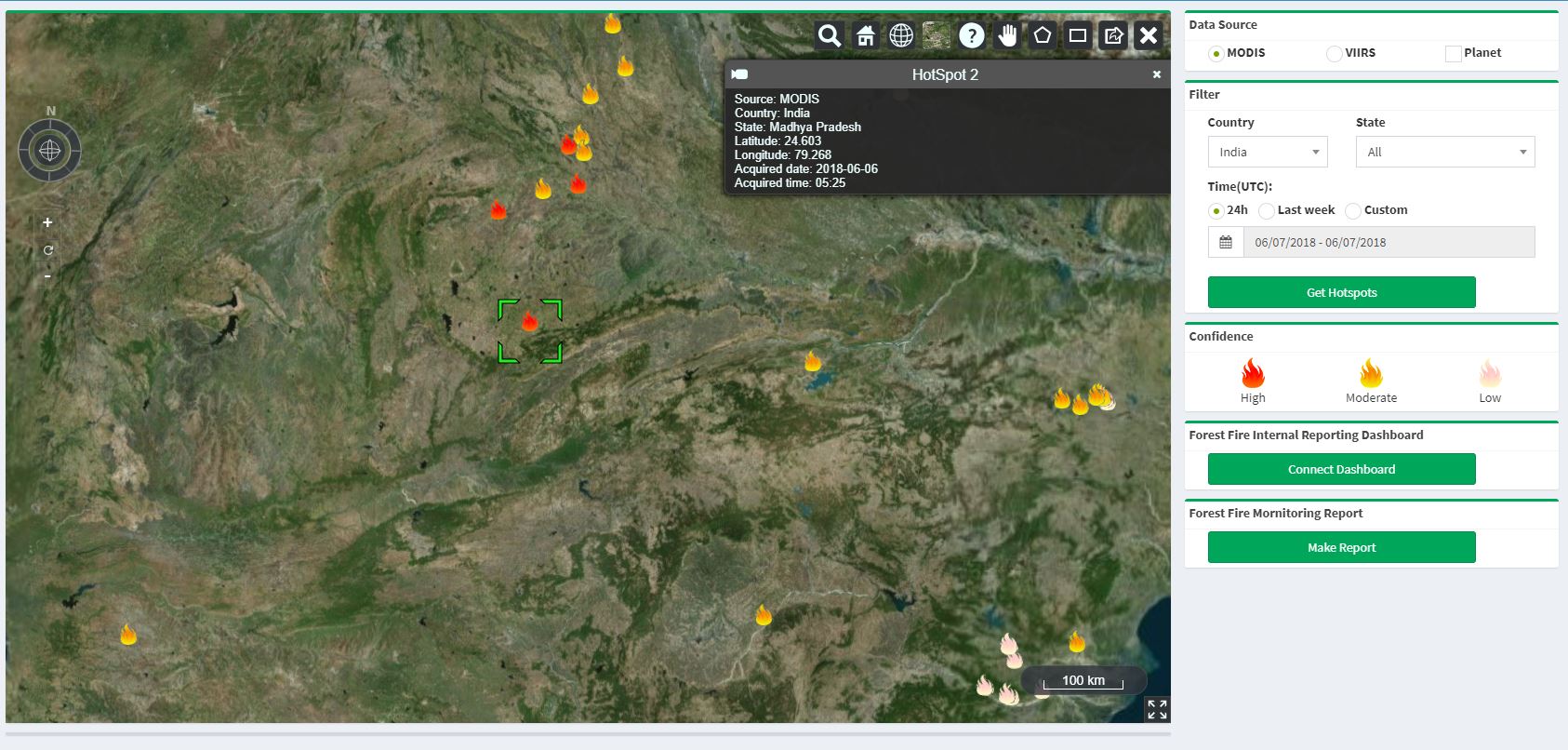
Machine Learning Tech Can Enhance Wildfire Modelling

Firefighting is expensive and machine learning tools are helping in analyses of forest fires to predict and prevent future disasters, here is everything you need to know on Machine Learning. 
Every year destructive wildfire destroys many forests across the globe. With climate change and global warming, there is a growing concern amongst scientists and world leaders regarding how to combat natural calamities. In the U.S. alone millions of dollars are poured into disaster management and rehabilitation.
There is significant research being conducted in the space of wildfire disaster management and one of the biggest investments in technology is towards artificial intelligence and machine learning. Risk modelers such as Egecat, RMS, AIR is not developing fully fledged versions of the probable places which have a high vulnerability to wildfire and what factors influence the activity. Several factors such as climate change, weather conditions, and region create a conducive environment for a forest fire to break out.
These can be assessed by artificial intelligence tools. Machines are inherently well-versed when it comes to picking up information quickly and this is known as machine learning. It can analyze a richer dataset than traditional forecasting systems, thereby helping researchers make informed decisions quickly. Once a high-risk scenario is detected, drones can be commissioned to ensuing fires.  This leads to effective utilization of resources such as firefighters, water and medication thereby helping the government protect their citizens.
Due to this rapid growth in ability, machine learning can help in urban planning and revolutionize disaster management and resource planning.
Here are the top ways a machine learning course is helping governments and organizations combat wildfire.

Data Science Course

Aiding Rescue 
One of the most important things when it comes to any natural disaster is rescue and rehabilitation. Time is of the essence during this crucial time. Finding survivors by using artificial intelligence tools which skim through social media data is a key development. Another component in machine learning is the ability to process historical data and deliver better disaster response management abilities i.e. using the limited resources in the best way possible.
Predictability of Wildfires
Machines can analyze vast amounts of historical and real-time data to get an understanding of the likely places where wildfires will hit. There are also able to determine the factors that influence the magnitude of the fire. These possible predictions can help researchers prepare ahead of time and help mitigate the damage.
Insurance Risk Assessment
There is a massive potential for machine learning to grow in the insurance industry when it comes to assessment and allocation. Real-time data processed by machines can be used in complement with prediction tools to help understand the risks and allocate resources better, thereby cutting down on the losses. Insurers can align their interest in disaster resilience, safety and urban development in partnership with the government due to machine learning.
Conclusion
When forest fires are detected early using machine learning, it can help firefighters deal with blazes, help in recovery and prevention.

Linear Regression and Its Applications in Machine Learning!

Machine Learning needs to be supervised for the computers to effectively and efficiently utilise their time and efforts. One of the top ways to do it is through linear regression and here’s how.

Even the most deligent managers can make mistakes in organisations. But today, we live in a world where automation powers most industries, thereby reducing cost, increasing efficiency, and eliminating human error. The rising application of machine learning and artificial intelligence dominates this. So, what gives machines the ability to learn and understand large volumes of data? It is through the learning methodologies such as linear regression with the help of a dedicated data science course

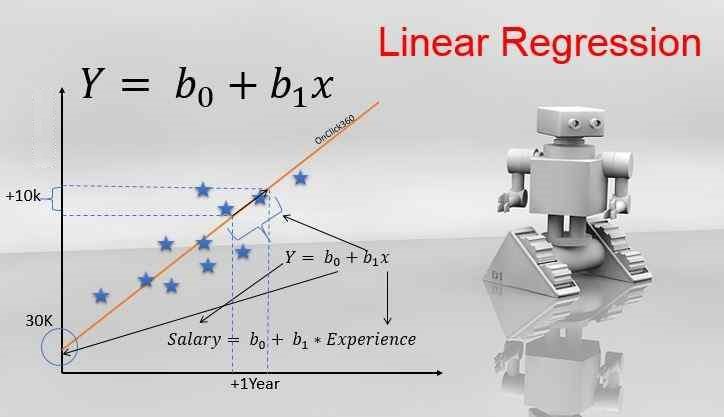
So, what is linear regression? Simply put, machines must be supervised to effectively learn new things. Linear regression is a machine learning algorithm that enables this. Machines’ biggest ability is learning about problems and executing solutions seamlessly. This greatly reduces and eliminates human error.

It is also used to find the relationship between forecasting and variables. A task is performed based on a dependable variable by analyzing the impact of an independent variable on it. Those proficient in programming software such as Python, C can sci-kit learn the library to import the linear regression model or create their custom algorithm before applying it to the machines. This means that it is highly customisable and easy to learn. Organizations worldwide are heavily investing in linear regression training for their employees to prepare the workforce for the future.

The top benefits of linear regression in machine learning are as follows.

Forecasting

A top advantage of using a linear regression model in machine learning is the ability to forecast trends and make feasible predictions. Data scientists can use these predictions and make further deductions based on machine learning. It is quick, efficient, and accurate. This is predominantly since machines process large volumes of data and there is minimum human intervention. Once the algorithm is established, the process of learning becomes simplified.

Beneficial to small businesses

By altering one or two variables, machines can understand the impact on sales. Since deploying linear regression is cost-effective, it is greatly advantageous to small businesses since short- and long-term forecasts can be made for sales. Small businesses can plan their resources well and create a growth trajectory. They will also understand the market and its preferences and learn about supply and demand.

Preparing Strategies

Since machine learning enables prediction, one of the biggest advantages of a linear regression model is the ability to prepare a strategy for a given situation well in advance and analyse various outcomes. Meaningful information can be derived from the forecasting regression model, helping companies plan strategically and make executive decisions.

Conclusion

Linear regression is one of the most common machine learning processes in the world and it helps prepare businesses in a volatile and dynamic environment. At Imarticus Learning we have a dedicated data science course for all the aspiring data scientists, data analysts like you.

Frequently Asked Questions

Why should I go for a data science course?

The field of data science has the potential to enhance our lifestyle and professional endeavours, empowering individuals to make more informed decisions, tackle complex problems, uncover innovative breakthroughs, and confront some of society’s most critical challenges. A career in data science positions you as an active contributor to this transformative journey, where your skills can play a pivotal role in shaping a better future.

What is a data science course in general?

Data science encompasses studying and analysing extensive datasets through contemporary tools and methodologies, aiming to unveil concealed patterns, extract meaningful insights, and facilitate informed business decision-making. Intricate machine learning algorithms are leveraged to construct predictive models within this domain, showcasing the dynamic intersection of data exploration and advanced computational techniques.

What is the salary in a data science course?

In India, the salary for Data Scientists spans from ₹3.9 Lakhs to ₹27.9 Lakhs, with an average annual income of ₹14.3 Lakhs. These salary estimates are derived from the latest data, considering inputs from 38.9k individuals working in Data Science.

The Ultimate Glossary of Terms About Machine Learning

Machine learning is an artificial intelligence application which provides computer systems with the ability to learn on its own and improve with experience without any explicit requirement of additional programming. Machine learning has its focus on developing computer programs whole can access data and utilize the data to learn on its own.
Some of the commonly used terminology used in Machine Learning are as follows:

  • Adam Optimisation

It is an algorithm utilized to train models of deep learning and is an extension of the Stochastic Gradient Descent. In this algorithm, the average is run employing both gradients and using the gradient’s second moments. It is useful for computing the rate of adaptive learning for every parameter.

  • Bootstrapping

It is a form of the sequential process wherein each subsequent model tries to correct the errors in the earlier models. Each model is dependent on its previous model.

  • Clustering

It is a form of unsupervised learning utilized for discovering inherent groupings within a set of data. For instance, a grouping of consumers on the basis of their buying behavior which can be further used to segment the customers. It provides useful data which the companies can exploit to generate more revenues and profits.

  • Dashboard

It is an informative tool which aids in the visual tracking, analysis of data by displaying key indicators, metrics and data points on a single screen in an organized manner. Dashboards are often customizable and can be altered based upon the preference of the user or according to the requirement so of a project.

  • Deep Learning

It is a form of a Machine Learning algorithm which utilized the concepts of the human brain towards facilitation of the modeling of arbitrary functions. It requires a large volume of data, and the flexibility of this algorithm enables multiple outputs of different models at the same time.

  • Early Stopping

It is a technique of avoiding overfitting while training an ML model using iterative methods. Early stoppings are set in such a manner that it halts the performance of improvement on validation sets.

  • Goodness of Fit

It is a model which explains a proper fitment with a set of observations. Its measurements can be summarised into the discrepancies between its observed values with that of the expected values using a certain model.
This Machine Learning Course is a good fir when the errors on the models which are on training data along with the minimum test data. With time, this algorithm learns the errors in a model and corrects the same.

  • Iteration

It is the number of times the parameters of an algorithm is updated during training of a dataset on a model.

  • Market Basket Analysis

It is a popular technique utilized by marketers for identification of the best combination of services and products which are frequently purchased by consumers. It is also known as product association analysis.

  • MIS

Also known as Management Information System, it is a computerized system comprising of software and hardware which serve as the heart of a corporation’s operations. It compiles data from various online and integrated systems, conducts an analysis on the gathered data, and generates reports which enable the management to make informed and educated business decisions.

  • One Shot Learning

This form of machine learning trains the model which a single example. These are generally utilized for product classification.

  • Pattern Recognition

It is a form of machine learning which focuses on recognizing regularities and patterns in data. Some examples of pattern recognition used in many daily applications include face detection, optical character recognition, object detection, facial recognition, classification of objects etc.

  • Range

It is the difference between the lowest and the highest value in a data set.

How Do You Start Applying Deep Learning For My Problems?

Deep Learning helps machine learn by example via modern architectures like Neural Networks. A deep algorithm processes the input data using multiple linear or non-linear transformations before generating the output.
As the concept and applications of Deep Learning are becoming popular, many frameworks have been designed to facilitate the modeling process. Students going for Deep Learning, Machine Learning course in India often face the challenge of choosing a suitable framework.
Machine Learning Course
Following list aims to help students understand the available frameworks in-order to make an informed choice about, which Deep Learning course they want to take.

1.    TensorFlow 
TensorFlow by Google is considered to be the best Deep Learning framework, especially for beginners. TensorFlow offers a flexible architecture that enabled many tech giants to embrace it on a scale; for example Airbus, Twitter, IBM, etc. It supports Python, C++, and R to create models and libraries. A Tensor Board is used for visualization of network modeling and performance. While for rapid development and deployment of new algorithms, Google offers TensorFlow which retains the same server architecture and APIs.
2.    Caffe 
Supported with interfaces like C, C++, Python, MATLAB, in addition to the Command Line Interface, Caffe is famous for its speed. The biggest perk of Caffe comes with its C++ libraries that allow access to the ‘Caffe Model Zoo’, a repository containing pre-trained and ready to use networks of almost every kind. Companies like Facebook and Pinterest use Caffe for maximum performance. Caffe is very efficient when it comes to computer vision and image processing, but it is not an attractive choice for sequence modeling and Recurrent Neural Networks (RNN).
3.    The Microsoft Cognitive Toolkit/CNTK
Microsoft offers Cognitive Toolkit (CNTK) an open source Deep Learning framework for creating and training Deep Learning models. CNTK specializes in creating efficient RNN and Convoluted Neural Networks (CNN) alongside image, speech, and text-based data training. It is also supported by interfaces like Python, C++ and the Command Line Interface just like Caffe. However, CNTK’s capability on mobile is limited due to lack of support on ARM architecture.
4.    Torch/PyTorch
Facebook, Twitter and Google etc have actively adopted a Lua based Deep Learning framework PyTorch. PyTorch employs CUDA along with C/C++ libraries for processing. The entire deep modeling process is simpler and transparent given PyTorch framework’s architectural style and its support for Python.
5.    MXNet
MXNet is a Deep Learning framework supported by Python, R, C++, Julia, and Scala. This allows users to train their Deep Learning models with a variety of common Machine Learning languages. Along with RNN and CNN, it also supports Long Short-Term Memory (LTSM) networks. MXNet is a scalable framework making it valuable to enterprises like Amazon, which uses MXNet as its reference library for Deep Learning.
6.    Chainer
Designed on “The define by run” strategy Chainer is a very powerful and dynamic Python based Deep Learning framework in use today. Supporting both CUDA and multi GPU computation, Chainer is used primarily for sentiment analysis speech recognition etc. using RNN and CNN.
7.    Keras
Keras is a minimalist neural network library, which is lightweight and very easy to use while stocking multiple layers to build Deep Learning models. Keras was designed for quick experimentation of models to be run on TensorFlow or Theano. It is primarily used for classification, tagging, text generation and summarization, speech recognition, etc.
8.    Deeplearning4j
Developed in Java and Scala, Deeplearning4j provides parallel training, micro-service architecture adaption, along with distributed CPUs and GPUs. It uses map reduce to train the network like CNN, RNN, Recursive Neural Tensor Network (RNTN) and LTSM.
There are many Deep Learning, Machine Learning courses in India offering training on a variety of frameworks. For beginners, a Python-based framework like TensorFlow or Chainer would be more appropriate. For seasoned programmers, Java and C++ based frameworks would provide better choices for micro-management.

11 Ways Investing in Machine Learning Can Make You Successful

Machine learning is certainly a buzzword, most of us have been hearing about lately. In this digital age, most of us are exposed to technology on a daily basis, especially when it comes to our field of work. When applied properly, technology can yield mammoth results which can benefit the majority of us. Machine learning is a tool which is being used by various businesses, to predict market behavior, so be it marketing or finance, everyone is making the most of this particular technology. So let us find out how you can make the most of machine learning to carve your pathway to success.

  • Develop your business

If you are an entrepreneur, big or small, chances are, you will need machine learning for analyzing the market. Businesses these days make the most of the algorithms to boost their sales and profit. Machine learning allows business owners to know their buyers better, apart from that, it helps in analyzing trends and allows the business owners to curate plans, on the framework provided by the trends. If you know machine learning, you can successfully run a good online business campaign.

  • Accuracy in marketing

If you happen to be in the marketing team, and you have a good grip on the subject of machine learning, then your bosses will look at you as a huge asset to their company. Marketers are using machine learning to device new and improved campaigns, which can bring profit to your company, and therefore, get you a promotion.

  • Machine learning for hospital staff

If you happen to work at a hospital, then machine learning can help you out with data entry and making medical predictions as well as diagnosis.  ML helps in making identification of diseases nearly perfect and helps in building an accurate diagnosis and cure which facilitates faster recovery in patients.

  • Efficient utilization of resources

Time cycle reduction, helps in the proper utilization of resources. So matter which field you belong to, the machine learning course will help you to derive the optimum use of your resources.

  • Helps you act fast in practical situations

Machine learning can bring forth all the data predictions, but acting on it is in the hands of the entrepreneurs as well as the employees. If you know all about machine learning and can derive all the necessary data from it, then you can very easily help in making future plans pertaining to the business and please your bosses to climb the stairway to success

  • Spam detection

Machine learning is one of the best tools to solve the problems related to spam, by filtering them. So if you work in the tech sector, then machine learning is an absolutely imperative tool to become successful.

  • Better segmentation

Machine learning helps in achieving accurate predictions for individual marketing offers, which is a more customized approach to a data-driven market. Those who know about this subject, can easily segment their customers and trigger new marketing campaigns which are more persuasive than others, to woo the customer.

  • Forecast business maintenance

Those employees, who can make big contributions to the company by making a clear-cut analysis of the trends, go higher up in the company. Huge companies are making the most of machine learning, which is why a degree or diploma in the subject will help in landing up with a good job in a reputed company.

  • Do well in finance

Machine learning is known to work magic when it comes to analyzing financial data. Dealing with customer data, bills, money transfers etc. will become really easy with the use of ML. So, if you wish to do well in the finance sector, a course in machine learning can take you a long way.

  •     Network security

If your brand happens to be an online startup, machine learning algorithms can help with network security and financial monitoring. This way you can retain the trust and confidentiality of your customer’s personal details and gain their trust.

  •       Precision

Accuracy and precision have a great role to play in every field. With Machine learning, the analyses you make are a lot more accurate, which can help in making future decisions, with utmost clarity, thus enhancing your reputation, as an employee or staff member.

AI for IT Services Firms Backup Recovery And Cybersecurity

The coming of the Age of Artificial Intelligence is an apt way to describe how IT services like cyber-security, recovery of data and backup of data has been impacted by AI developments globally. Any event on cybersecurity throws up newer requirements in cyber-security and a bouquet of innovative solutions using artificial intelligence, cloud storage, and data recovery tools.
Virus detection is a challenge-area that about 29 percent of surveyed professionals look to AI for as per ESG research. Besides speedy discovery, 27 percent of the surveyed professionals in the security field look to AI to hasten the response time of reported incidents.AI is being touted as today’s technological marvel that can analyze huge volumes of code in very short time periods. This is rightly true and the mind-boggling speeds and analysis of data have made AI all pervasive and the panacea to almost all ills in the IT sector.
AI Vs ML:
The terms AI and ML are being used oft interchangeably. In reality, both are useful tools that differ in their thinking abilities. ML uses algorithms to detect breaches in security which restricts their use to think outside the set framework. On the other hand, AI does not need algorithms or any further data when it comes to terms with any issue. It arrives at an unassisted intelligent conclusion.Both AI and ML techniques are the focus areas of dealing with advances in cyber threats. These techniques when applied can transform the scenario from defence to early detection and quick response to cyber infections.
Areas, where ML makes a huge difference, are

  • In scouring huge data volumes across thousands on nodes looking for potential threats.
  • In firewall applications, gateways, and APIs where traffic patterns need to be analyzed.
  • In classifying data objects and governance of data
  • In access-control and authorization systems and practices using auto-generate policies, and analysis of the regulatory measure, rules etc
  • In detecting anomalies and setting baselines for user behavioural analysis and SIEM events of cybersecurity.

Hacker’s too can use ML and AI:

Alongside the new developments in AI, cyber-security, and ML there is a the all real possibility of hackers also using the same infection-detection technology and malware samples to advance the technology of cyber-threats. It is reasonable to predict that the very same techniques are used by hackers to create modified code-samples depending on the way AI detects infections. This then leads to a situation where the infections last longer and since the code is smaller it becomes near undetectable.

Storage challenges and Cybersecurity:

The feasible option for safe storage of data today is by backing data to a reliable disaster recovery cloud which enables rapid recovery of files while ensuring the data stays protected, safe and encrypted. The market has many technological options like Avast, CA Technologies secure, Keeper, etc that can help keep data copies out of reach by hackers and yet available on an easy-to-use platform.
In conclusion, the use of ML and AI can help resolve issues and challenges faced in cybersecurity, data recovery, and storage. The evolution of threats and detection techniques continue in tandem in a seemingly unending fashion where users and hackers are both looking to AL and ML for solutions.

How Should You Learn Python For Machine Learning And Artificial Intelligence?

In an era where Machine Learning/ML and Artificial intelligence/AI rule the roost of technology and analytics one can understand why Python experts are most sought after. With the advent and use of AI and ML in everything you do, there is an urgent need for collaborators who can tweak software, create new applications, use the predictive and forecasting alerts and insights gainfully to improve profits, efficiency and save time, effort and costs. It is still early days and the right time to upgrade and re-skill with machine-learning courses that will enable smart and creative use of Machine learning benefits. Big-data Hadoop training courses are also required to help ML understand and use the mind-boggling quantities of data that is now usable. Without the will to effectively use data and the training required to adapt you will be left far behind. The situation today is adapting, or die!
Python’s library versatility:
Learn-by-doing for tasks involving data analytics in Python machine learning which will help in the following.
Web development is simplified with Bottle, Flask, Pyramid, Django, etc especially to cover REST APIs at the backend.
Game development is not so difficult with Pygame where you can use the Python modules to build video and animated games.
Computer VisionTools like Face detection, Opency, Color detection and more are available for specific tasks in the Python suite.
Website Scraping that cannot expose data without an API is regularly undertaken using Python libraries like Requests, BeautifulSoup, Scrapy, Pydoop, and PyMongo by e-commerce sites for price-comparison, data and news aggregators and others.
ML algorithmic tasks like predicting stock prices, identification of fingerprints, spam detection and more using AI and ML is enhanced in Python’s modules and libraries like Scikit-learn, Theano, Tensorflow, etc. Even Deep Learning is possible with Tensorflow.
GUI desktop cross-platform applications can easily be developed with the Python modules of Tkinter, PyQt, etc.
Robotics uses Raspberry-Pi as its foundation for coding in Python.
Offline/online data-analytics needing data cleaning and being sourced from various databases can be achieved using Pandas. Find patterns and data visualization with Matplotlib which is an essential step before executing the ML algorithm.
Automation of browser tasks like FB posts, browser opening, and checking of status are rapid in Python’s library Selenium.
Tasks in Content- Management including advanced functions are quicker executed in Django, Plone, CMS, etc.
Big-Data handling libraries in Python are more flexible and can be used as effective learning tools.

Why Python?

Data Science and its analytics require good knowledge and the flexibility to work with statistical data including various graphics. Python is tomorrow’s language and has a vast array of tools and libraries. Its installation program Anaconda works with many operating systems and protocols like XML, HTML, JSON, etc. It scores because it is an OO language well-suited for web development, gaming, ML and its algorithms, Big Data operations, and so much more.
Its Scipy module is excellent for computing, engineering and mathematical tasks allowing analysis, modeling, and even recording/ editing sessions in IPython which has an interactive shell supporting visualization and parallel computing of data. The decorators of functionality are a good feature in Python. Its latest V3.6 features the a-sync-io module, API stability, JIT compiler, Pyjion, and CPython aids.

Learning Python Step-by-Step

Become a Kaggler on Python from an absolute newbie using the step-by-step approach to emerge complete with skills in Python tools and ready to kick-start your career in data-sciences.

  • Step 1: Read, learn and understand why you are using Python

Zero in on your reasons for learning to use Python, its features, functions and why it scores in the various verticals of data sciences like ML, AI, financial applications, Fintech applications and more.

  • Step 2: Machine set-up procedures

Firstly use Continuum.io to download Anaconda. Just in case you need help, refer to complete instructions for the OS by just clicking on the link.

  • Step 3: Python language fundamentals learning:

It is always better to gain experience from a reputed institute like Imarticus Learning for doing a Machine learning course on data analytics and data sciences. Their curriculum is excellent and includes hands-on practice, mentoring and enhancing practical Python machine learning skills. The topics covered include linear and logistical regression, decision trees, K-clustering, dimensionality reduction, Vector Machines, ML algorithms and much more.

  • Step 4: Use Python in interactive coding and ‘Regular Expressions’:

When using data from various sources the data will need cleaning before the analytics stage. Try assignments like choosing baby-names and data wrangling steps to become adept at this task.

  • Step 5: Gain proficiency in Python libraries like Matplotlib, NumPy, Pandas, and SciPy.

Practice in these frequently used libraries is very important. Try out these following tasks and resources like NumPy tutorial and NumPy arrays, SciPy tutorials, Matplotlib tutorial, the ipython notebook, Pandas, Data munging and exploratory analysis of data.

  • Step 6: Use Python for Visualization

A good resource is linked in the CS 109 lecture series.

  • Step 7: Learn Scikit-learn and ML

These are very important data analysis steps.

  • Step 8: Practice using Python and then practice more

Try webinars, hackathons like DataHack, Kaggle, and such fun Python machine learning resources.

  • Step 9: Neural networks and Deep Learning

Do short courses on the above topics to enhance your skills.
Concluding note:
Machine learning and AI in data processing have changed drastically the way things work in enterprises and even our daily lives. Digital technology has been able to enable machines with ML software and algorithms to process intelligently and unsupervised the large volumes of data generated. The advent of the internet and such limitless uninterrupted data processing has generated many an error-free gainful insight. Businesses can use the Python programming language and shift gears to the high-efficiency mode where profits increase and employee-time is well-used in creatively use of forecasts and insight provided by data analytics, ML, big-data processing, and concise clear predictive analysis.
The Python machine learning course at Imarticus offers certification and other advantages such as global updated industry-relevant curriculum, learning through convenient modes and timings, extensive hands-on practice, mentoring, etc that ensure you use the mentorship to be career and job-ready from the very first day.

How Does a Beginner Start To Learn Machine Learning, Having Some Knowledge of Programming Languages?

So you have learnt to programme and were having a happy time at work, by putting into practice what you learnt. Suddenly, out of nowhere, this huge wave of Machine Learning comes up, and you are all at sea! You know programming, but now you need to learn machine learning to stay relevant. And you are staring at a Herculean task, sifting through all the available machine learning courses online – unable to decide, whether any of them can actually help you out!
The first question you should ask yourself is what the kind of role that you see yourself playing in the future is? Yes, before actually diving into the time and effort consuming task of attending machine learning courses, you should make an effort to read as much as possible. Read articles, participate in forums, talk to people and find out, what are the kind of roles on offer in this field. See which of these matches your aspirations and career goals. Before you start to learn machine learning, you should know the field, however abstract it may seem.
Once you know, what the hullabaloo is all about, it is extremely crucial to assess your current skills. Yes, you know programming, but which languages are you familiar with? Can they help you in getting deeper in the domain of machine learning and artificial intelligence? If your answer is no, the first set of machine learning courses you should look into are the ones that familiarize you with such languages like R or Python.
As you become familiar with the programming languages that will help you learn machine learning, do an honest assessment, whether you really like programming in them and have you decided to pursue the career as a programmer. In that scenario, you should look at more and more advanced machine learning courses that teach you the intricate details of programming in R or Python. Also, you should undertake some of the basic machine learning courses that help you to familiarize yourself with algorithms and statistics.
In case programming is not what you want to pursue, but analytics is where your heart and ambition lies; you should look at machine learning courses or even generic artificial intelligence courses dealing with statistics, algorithms, when and where to use them. This will give you a much better grip on which algorithm to apply in which situation and the logic behind it.
As you become more and more proficient in the logic, you should also be able to develop quick prototypes of your proposed solutions with your understanding of the programming languages. This is the benefit of your efforts to learn machine learning in a streamlined manner. You can easily relate to the problem, identify solutions, build prototypes, evaluate and improvise. No one can actually stop you.
And lo! You have crossed the hurdle with the help of machine learning courses online. All you needed was a firm decision to learn machine learning and determination to achieve your goals with dedicated efforts.

Which Skills are Required for Machine Learning Jobs?

Machine language is generally related artificial intelligence, which provides the machine or computers with the ability to complete certain tasks like diagnosis, planning, prediction, recognition or robot control. It consists of different algorithms, which you can use to teach the machines to change and grow when exposed to new data.

The process of implementing machine language is somewhat similar to data mining because the process looks through data and searches for the same pattern. Now that you have an idea of what machine learning is, let’s have a look at the skills that are required to get a machine learning job.

Also Read: Future of Machine Learning in India

Computer Science & Programming Skills

Some of the fundamentals of computer science are essential when you are looking to learn machine learning. Concepts like data structure, algorithms, complexity and computability, along with computer architecture are essential for artificial intelligence. In fact, you should also have knowledge of programming languages like C, C++, Java, Python and R, among others. A little bit knowledge of assembly language doesn’t hurt either.

Probability & Statistics

Conditional probability, and its characteristics and the techniques derived from it plays a key role in the machine learning algorithms. Moreover, you should also know about the different terms of statistics like mean, median and mode along with variance and standard deviation. These are all necessary to not only observe the pattern but also validate the data that is received through different means. Some machine learning algorithms are in essence an extension of the common statistical operation procedures.

Applied Mathematics & Algorithms

You need to know not only how to solve a problem but also how to implement it in short executable steps when it comes to machine learning. Algorithms help you to understand how to break down a problem into executable steps, and that is why this is important. In addition, you also need to know about gradient, convex optimization and its application in daily life, so that you can implement it in machine learning.

Operating Systems

When it comes to machine learning, most of the coding is done in Linux or some version of it. So, you need to be versatile with Unix or a version of Linux, which is in use presently. You also need to know about the Linux tools, which will make your life easier in the long run. Some examples include grep, find, sort and tr.

Software Engineering & Designing of Systems

When you are designing a machine learning tool, you are also designing an advanced software. So, at the end of the day, you need to know how to design system, and how you can implement your ideas in that. You also need to understand how different algorithms interact with your system, and how you can speed up the process without compromising on the resource space.

Now that you know about the skills required for machine learning jobs, it is time to get started on acquiring these skills. In case you have some of these skills, make sure you hone them so that you can implement it and build a great system when the time comes. Good luck!

Related Article: What is The Easiest Way To Learn Machine Learning?

Want To Learn Artificial Intelligence And Machine Learning? Where Can You Start?

These are exciting times to be a part of the technology industry, what with newer and fascinating fields being discovered every day. With the tech companies leading the way, the newer fields like Artificial Intelligence and Machine Learning are finding takers in multiple domains. Probably, this is the reason the demand for machine learning courses is at an all-time high.
Every second person, in the technology domain, you interact with would wax eloquent about how they are going to learn machine learning or how they have been taking the latest and most difficult artificial intelligence courses. Hearing this can be quite an unnerving experience, especially if you are a newbie in the field and looking to find out some machine learning courses that can help you unravel this mysterious world.
But, fear no more, as in this article, we try to help you find your initial foothold in this domain and slowly but surely come up to speed in your quest to learn machine learning. The first thing that confuses newcomers and throws them off-track when they begin to learn machine learning is the different terms and their interrelationships. What do the terms – Artificial Intelligence, Deep Learning, Neural Network Programming, Machine Learning – mean and how are they related.
If you somehow can navigate through the maze of big data and machine learning courses and get a hang of these terms, another big question comes up. Do I need to learn programming, statistics as well as calculus? Is this the right direction for my career, even though I do not understand either of this? Is there a way to learn machine learning without being proficient in all these?

There are no straight forward answers to these questions. But below are a few pointers that may help you to take your first step as well as identifying the correct artificial intelligence courses for yourself.
First and foremost, we need to understand the interrelationship between artificial intelligence and machine learning. Artificial intelligence is mostly trying to mimic human intelligence and behaviour by the machines including creativity, learning and reactions to any situation. As you start to learn machine learning with the help of machine learning courses, you realize that machine learning is nothing but a subset of artificial intelligence, dealing with pattern recognition and self-learning.
Now, the next fundamental question – do you need to learn programming language or statistics to complete artificial intelligence courses? You definitely need to have some basics in both as the statistics help you understand what you are doing, and the programming language shows how it is done. In case either of these is unknown to you, it is recommended you start your quest to learn machine learning with the courses for these.
You can find some excellent courses to learn programming languages like R or Python, models and algorithms basics through – imarticus.org Or also can contact on – info@imarticus.com or 1-800-267-7679 Or else you can visit our different training locations in India – Mumbai, Pune, Thane, New Delhi, Banglore, Chennai, Gurgaon, Hyderabad and Ahmedabad.
Keep Learning…!!