What are the Useful Things One Learns Working in Investment Banking

When one looks back to what one really learnt from working in investment banking, it definitely will not be anything to do with investment banking itself per se. Rather; it emerges from a wide variety of answers on quora.com that most bankers listed out the following attributes that they learnt from being involved in this sector. Let us quickly list them in no particular order to help you understand the importance of soft-skills and personality development if you wish to make a career and are looking to learn investment banking.

Key Takeaways

A. Meticulous attention to details:
The areas of investment banking deal primarily with the IB advising his investor clients on how and where to invest their monies. The importance of these deals and their sheer sizes mean very often that the IB is good at number crunching and doing so with the ease of a trapeze artist over various areas of the business analysis decision impacting factors.

The attention to details is what ensures those decisions are right. The industry is definitely very competitive and hard work, money, time, effort and your reputation can be badly damaged if you make a mistake. So this is very important and never taught in colleges as a subject essential for IBs.

B. Hard work and discipline:
The investment banking sector is known to be extremely demanding and an 80 to 120 hour week should never surprise you. You probably will have zero time for social life and more than 44% of the fresh IBs quit in the first three years. So, other than the learn investment banking training you receive it means you develop the basics of being disciplined and working the long hours. At the end of the day, it is monetarily very rewarding.

C. Office politics:
Politics do exist in all organizations and it is just the scale that differs. Larger institutions should have more politics and these can affect your career progression as well. However, it really is not so bad as it looks since most novices learn their way around the hierarchies and develop their innovative ways of getting around this hurdle.

Such negatives do bring out the many positives of being innovative, having a pleasing personality, dealing with conflicting situations and more. It is just about the scale and how you learn to handle it.

D.The sales pitches:
IB is about selling and it starts very early in the IB career. You will quickly learn to effectively sell
• Your technical skills at the interviews.
• To your client with effective sales pitches.
• Your value to the organization in bringing in the deals.
• The institution’s products that you sell to the client.

Don’t worry at all. In life, you learn to sell ideas from the time you are an infant. Bawl and mamma comes running, fall sick and avoid homework etc. It is not aggressive selling, but you get the hang of selling ideas and improving your selling skills fast.

E. Business and financial modelling:
This is perhaps the one measurable, tangible and technical skill that you walk away with. You become adept at looking at the financial and business models and data without hassles and manipulating data and databases to give those valuable insights for business decisions and forecasts of trends in everything from stocks, to prices, industry trends, market conditions, and expert opinions and solutions on flop deals, foreclosures, bankruptcies and more. And yes, you present them in Microsoft Excel with ease!

F. Acting under pressure:
This attribute is a must to meet the many deadlines you face in a harrying day. Commuting, communicating, reporting deadlines, fire-drills, safety and compliance hurdles and what not. Every one of them is to be treated with equanimity and calm if you wish to avoid burnout. Of course, no one expects a robot. But it helps when you get trained to handle working and acting under pressure. That’s why you need to ‘learn investment banking’.

G. Being a global person:
This is definitely not jargon! Communicative skills, having a broad-minded perspective, linguistic skills and being able to use learning to practice and real-life situations can save many a deal and just being able to tackle the world at large.

H. Entrepreneurial spirit:
With so much exposure and pressure at work, it won’t be long before you wish to be an entrepreneur yourself after the burnout. Not easy but doable for an IB. Your learning, academics and continued learning of the client’s ecosystem will teach you to be a good entrepreneur.

In parting, we have just seen the important takeaways from investment banking. These are never taught in colleges and should have been essential subjects! At Imarticus Learning, you can learn investment banking from people who place special emphasis on training you to take the IB demands in your stride.


How Investment Banking is Different From Asset Management

One of the biggest and obvious differences between asset management and investment banking is that assets are managed in asset management which is fundamentally managing investments that clients have and wish to invest for better returns, while investment banking deals with the raising of capital funds needed by companies, organizations, and even governments. While Asset management is about investors IB is about raising capital for activities that are basically about expansion and infrastructure building.
Investment Banking resorts to many ways to raise funds like acquisitions and mergers, stock purchases, initial public offerings etc to raise capital. It could be on the sell or buy side of the investment. For example on the sell-side of investment banking activities include capital-raising stocks and bonds issues among others while the buy-side involves activities like advising clients for private equity, insurance, mutual funds among others.
Investment Banking also has trading equities, marketing assistance to clients, securities research, derivatives, dealing in commodities and fixed-income securities as part of its activities. Asset management is a dedicated division for investments of its client’s funds in derivatives, equities, commodities, currencies, securities, etc., to earn higher returns and grow their size through issues and investments based on the risk-preferences and client needs.

Asset Management Vs Investment Banking as a Career Choice:

Education:
Both IB and AM do require sound financial knowledge and though not mandatory a degree/ graduation in economics, finance, business administration, math, etc does give you an edge. So do the certifications in the field when they come from a reputed institute like Imarticus and serve as measurable indices of skill and experience in the required concepts of IB or AM. There may be the odd-man-out in both fields who starts as an Intern, through to Associateship, VP, MD job roles etc.
Skills required:
Both the Asset Management and Investment Banking fields require these essential skills.
• A minimum of graduation in finance, law, economics etc.
• Proficiency in PowerPoint presentations, Excel techniques, Office and Word suites.
• 80 plus long hours every week.
• Being an effective learner and team player.
• Effective organizer with an eye for details.
• A quick learner who takes instructions well.
• Excellent conceptual knowledge of finance and accounting tasks.
• A practical IB or AM course.
• Certification of your practical skills.
• Great skills in financial modelling.
The ladder to climb:
Here is the figurative AM/ IB ladder of career progression. Starting as an intern and working your way up to the licensing in the US is very popular.
• 2 to 3 years as an Intern Financial Analyst in both fields.
• AM/IB Associate.
• VP- Investment Banking/ Asset Management.
• IB/AM Director.
• MD, CFO etc.
Scope for jobs:
Both areas have great scope for the unending demand of aspirants seeking bank- job prospects. The US Labor Department predicts a decade of growth of 12% starting from 2014. This is so as the financial instruments too, are evolving fast based on market requirements and both the technology and concept applications get complex and new-age. AM does score marginally over the IB aspirants in terms of jobs and scope as the investor base has grown tremendously with digital transactions, availability of online products, and ease of investment has increased too.
Salaries:
There is hardly any difference in the pay packages of the AM and IB. In early 2004, the median AM salary was 168,000 USD while that of the professional IB was315,000 USD. A decade later the figures for the AM was 263,000 USD versus the IB salary of 288,000 USD. Investopedia reports suggest the median 2015 banker’s salary was in the range of 75,000 to 85,000 USD. The performance bonuses added to take it to 140,000 USD for bankers in the early first year. AM pay packages varied between 55,000 to 100,000 USD with a flat cut in the funds managed by them. The financial crisis, global shifts in capital markets and new financial products will see the gaps close according to an FT article source.
Parting notes:
In terms of career prospects, salaries, job roles and working conditions there is a lot of overlap between the asset management and investment banking sectors. However, AM has a slight lead in job prospects. Join the financial courses at Imarticus Learning if you are interested in being an AM or IB and have the inclination for it. Their reputation is superb and they offer a host of benefits including certification for aspirants. All the best in your banking career!

Difference Types Of Investment Banking

Investment banking is all about providing expert advice and management services for complex, large financial transactions, and the provision of services related to raising and creation of capital for corporations, organizations or even governments. The two primary roles for IBs are in underwriting debt/ credit financing and the equity issuances like IPOs, acquisitions, mergers, and buyouts of and for companies. IBs also offer advice to clients in the sale of securities, placement of stocks, handling placing of investments and trade brokering for large companies, corporate clients, governments, independent entities and HNIs.

Investment banks also form groups to aid coverage and financial products. Such types of investment banking groups within the bank have FAs with immense expertise in specific verticals, market sectors and industries like the technology, health-care, and medical sectors. The groups improve relationships with client companies and facilitate the financing, M and A, equity issue, etc. Thus they bring in new business and clients to the bank. Other such groups may exist in leasing, asset financing, public and leveraged financing, syndicated financing, etc. Each of the bank’s products also will have one or more groups for M and A, restructuring, corporate finance, IPOs, etc. The groups can also be designated depending on the areas they work in like debt capital, equity capital markets, sales, asset management, equity research, and trading.

IB firms can also be categorized in an investment banking course into boutique, middle-market, and bulge bracket banks. The boutique banks are further subdivided as elite and regional boutique banks. Size is used to classify banks and such a comparison can be relative to the number of offices, employees, average size of M and A deals and such parameters.

Regional Boutiques:
The size and deal sizes are both small and these banks may not offer a full range of services. The number of employees, offices, products and geographical areas of operation set them apart. Their deal size is typically 50 to 100 million USD deals or even lesser.

Elite Boutiques:
They are like the bulge bracket banks in terms of their deal-sizes ranging from large to over 1 billion USD deals happening most times. They are known to be in international, domestic and niche markets while lacking the global presence of the biggie like JP Morgan and Chase. Elite boutiques are known to limit services to M and A issues, asset management, and restructuring deals. The well-known players are Qatalyst Partners, Evercore Group LLC, Moelis & Company and Lazard LLC.

Middle-Market firms:
Some of the better known firms in this sector are the Cowen Group, Houlihan Lokey and Piper Jaffray Companies. Middle-market investment firms and banks are smaller than the large bulge-bracket and larger than the small regional banks. Their deal range is 50 to 500 million USD and they also offer the full range of services with special groups for specific sectors like the KBW for financial sector clients.

Bulge-Bracket banks:
These banks are the large majors like Deutsche Bank, Goldman Sachs, Morgan Stanley, Credit Suisse Group AG, and the Bank of America. The numbers of employees, offices, large multi-million deals, large corporate clients, Fortune 500 clients, etc help identify such banks. Their transactions are always high value and run into thousands of millions even in slumping economic situations.
They have both domestic and international presence, global offices, and generally, offer the entire range of services. Though M and A are the main focus areas they are not shy to cross sell products.
Though bulge bracket banks do cater to Fortune 500’s and large companies or groups a startling fact is that many of them prefer to do business with elite boutique firms and banks instead.

Conclusions:
If you aspire to work in IB research the type of work the bank does and see if it suits you. Remember that the one-type or size of a bank does not necessarily offer all products in the other groups. Should the M and A sector interest you, then, it is better to join smaller banks. They do offer quicker progression on the career path and enable you actually handling such deals.
To learn all about the types of investment banking, do an investment banking course at the reputed Imarticus Learning. Very simply put it is a wise first-step to the banking career with assured placements, soft-skill development modules and most importantly the best curriculum on the global markets with widely accepted certifications. Hurry! Start your IB journey today.

Half Yearly PE Roundup 2019


The volatile stock-markets in India were impacted by a number of factors both global and domestic like the LS-elections, the international trade war, the NBFC crisis, falling earnings, the MPC meet, weakened auto-sales and such.

Nifty and Sensex indices saw a high on the day of election results and continued moving up to 12,103.05 and about 40,312 respectively. The 1-year target-price of these indices was hiked by the brokerage firms in spite of the capping of the upper limit in the current short term. The expected Nifty-EPS is anticipated to grow to 604 Rs or 26%. Both indices rallied by 9% in the first six months of benchmarking. Nifty Media lost 19% while its realty arm gained 18% making Nifty Media the top loser for the half-year.

Factor’s that impacted PE markets:

The top five events impacting the performance of PE markets were

Victory for NDA:

The benchmarking indices rose after the general election results and even on the exit-polls forecasts. The mandate was overwhelmingly for the BJP when Nifty rose by 3.7%. Investors were pleased the reforms introduced would continue when the uncertainty of poll results saw an end to it with the political party BJP garnering 303 seats out of the total 543. The full budget expected on 5th July offered a window to the indices that stabilized at 10% in the first half of 2019. According to SAMCO Securities’ research head Umesh Mehta, Nifty is trading at a highly-valued top-end with 29xPE and onwards confirming that after the 10% rally the Nifty will hold ground till the budget presentation.

Cut in RBI-policy rates:

The 6th June review-meet on policies by the RBI cut the repo-rates downwards by 25 bps. The expected cut was in line with RBI’s stance to be accommodative rather than neutral, amid growth-concerns. According to Fitch Ratings, the interest rates will see another 25 bps decline by RBI attributed to inflation and growth momentum being well within the targeted limits. Most analysts agreed with this assessment.

Kotak Mahindra AMC’s Head- Debts and Products Lakshmi Iyer, who is the CIO stated the cuts in repo-rate was expected since RBIs changed stance removed doubts regarding the rate-of-action and its direction. The package is silent about any concessions to NBFC’s and focuses on studying the liquidity problems by appointing a working-group for it.

The tanking of Jet Airways:

The first half-year of 2019 saw shares of the cash-strapped aviation giant Jet Airways shares tank by almost 80%. The company was hauled to the NCLT in Mumbai and forced to shut down operations by lenders and the 20th June insolvency petition filed by SBI the largest creditor. The SBI led bank consortium had earlier declined emergency-funds of 400 Cr in Rs for operational expenses. A total of 15000 employees were stranded without salaries from January and approached the police for recovery action. Jet Airways may never be up and running again.

The trade war between US and China:

Donald Trump the US President levied stiff tariffs on trade partners across the globe to strengthen the economy and reduce trade-deficits of the US economy. China was in the protesting forefront and in India the stock markets were affected and under pressure amid the rising tensions and a possibility of a tariff war between China and the US. The 26th June meeting could also see a deal between Xi Jinping and Trump that could ease the ongoing trade war.

The crisis in the NBFC sector:

The alarming defaults in 2018 by IL&FS saw the NBFC crisis deepen and the markets respond to the stimuli. Most NBFC found the banks were wary of lending and the NBFC’s found it hard to raise capital. The lending rates increased the funds-costs by  150 basis-points! RBI tried to ease their position by buying 300,000 Cr Rs governmental papers in the debt markets in 2018-2019 as NBFC’s do not use it as a collateral measure. Yet, the costs are very high on NBFC borrowings.

The very sustainability and liquidity of NBFCs came under scrutiny with DHFL defaulting in paying interest on its debentures held by investors. CRISIL and ICRA quickly downgraded the DHFL ratings. The commercial papers of DHFL saw CRISIL downgrading the credit rating and simultaneously Reliance Commercial and Home Finance owned by the group of Anil Ambani also got CARE down-graded.

HDFC Life Insurance’s CIO Prasun Gajri states that the investor’s risk aversion for debt capital markets could be temporary. Well, we hope so too!

In conclusion, the PE market trends in the round-up for the half-year of 2019 were impacted by the events both regulatory and political. Learn about the PE trends at Imarticus Learning and make your career in data analytics.

How Good Is Investment Banking As A Career

Have you chosen an IB career? Read on, to see if you are a good fit here. Investment banking has very good scope for MBAs, undergraduates, Masters in Economics, Statistics etc, data analysts and young interns who can learn-on-the-job. If you are motivated, can take long hours in your stride, have a head for math and economics then this is an ideal choice for you with the highest payouts and great scope.
As an investment banker or financial/data analyst, your investment banking career task-list includes
• Executing issuances and client debt-portfolios.
• Advising and pitching these instruments to clients replete with credible answers.
• Creating data and market reports.
• Reporting the trends, foresight, case studies in the form of client presentations.\

What is in store:
Do you realize that the high pay and pressure job sees at least 44per cent quit in the first 3 years according to the news at efinancial careers. If you value your social life the IB career will put the finished tag there as the best bonuses, high payouts and quick progress come at the cost of excellent training, continuous hard work, pressing job demands and lots of coffee or alternatives to just withstand the heat.

The Skills Required:
To ensure you do fine in IB check out the following crucial attributes.
• A minimum of graduation in finance, law, economics etc.
• Proficiency in PowerPoint presentations, Excel techniques, Office and Word suites.
• 80 plus long hours every week.
• Being an effective learner and team player.
• Effective organizer with an eye for details.
• A quick learner who takes instructions well.
• Excellent conceptual knowledge of finance and accounting tasks.
A practical investment banking course.
• Certification of your practical skills.
• Great skills in financial modeling.

The Ladder to Climb:
Here is the figurative Investment Banking Ladder of Career Progression.
• 2 to 3 years as a Financial Analyst.
• IB Associate.
• VP- Investment Banking.
• IB Director.
• MD, CFO etc.
Internship for undergraduates lasts for 2 to 3-years, on the job in an Analyst position, after which you have to compete to become an IB-Associate. Many of those who do the course at Imarticus Learning have benefitted from their soft-skills training by being placed as Associates directly under their assured placement programs and a basic MBA qualification. The higher you go certifications and continued learning become crucial for better progression and higher bonuses and payouts.

Investment Banking Career-Scope and Payouts:

Now have a look at this table, where Payscale reports an average salary of 508, 855 Rs for a fresh starter. Salary components can vary between 177,560 to 1,545, 630 Rs and have added bonuses from 2,517 to 524, 023Rs depending on your skills and performance. Thus the total pay can be much higher and very lucrative in comparison to other jobs. However, doing a course is essential and the Investment banking certification provides the measure of your skill and knowledge and has come to also be a prerequisite for interviewers.

How to Crack The Investment Banking Interviews

Just remember at interviews to dress neat and professional, prepare well and reinforce your learning till perfect. Some questions that you will be asked are
General type:
• What does IB mean to you?
• Talk me through your CV.
• What does the IB role/ present market condition mean to you?
• What do you think this company can achieve?
• Why do you want to become an IB?
• What are your achievements/ weaknesses/ strengths?
• How do you handle leadership/stress/ failure/ accomplishments?
• Why should you be hired?
Technical type:
• Explain what this means to you. Financial models/ valuation methods like DCF/ Weighted capital costs/ deferred tax assets and such topics
• How can you play the field using earnings?
Wrap up:
With data analytics and a highly dynamic and evolving technological scenario present in India and globally, European companies like Lehman Brothers, Merrill Lynch, Credit Suisse and very many large financial banks, groups and even NBFCs operate in India. This ensures the aspirants find lucrative jobs and make their careers in IB.
If you feel you are a good fit, you’re next step should be to do the investment banking course at Imarticus Learning a reputed institute where you can get proficient at learning the IB job role well, hone your personality and soft-skills for the job and be better prepared to crack the interview and set off on the IB career path. Best of luck!

We offer Investment Banking Courses at our centers in Mumbai, Thane, Pune, Jaipur, Delhi, Gurgaon, Bangalore, Chennai, Hyderabad, Coimbatore.

Interesting Things About Investment Banking In India

Among the well-known banks currently operating in India are HSBC, ABN-AMRO, BNP Paribas, Deutsche Bank, Nomura, Citi Bank, and the Mellon Bank of New York. Large financers like Goldman Sachs, JPMorgan Chase Bank, Morgan Stanley, and Barclays also operate from here. Among our very own Indian investment banking well-knowns are ICICI IB and Securities, HDFC, Avendus, Kotak Capital, Bajaj Capital, SBI IB division and Yes Bank.
Services offered:
Investment banking plays the intermediary role in assisting HNIs, Corporations and even small companies raise and manage their financial investments. They provide assistance in selling equity and debt securities like shares, stocks, debts, bonds and more. Investment banking certification covers and teaches you all about the services of an investment banking career. Namely,
• Acquisition advisory
• M and A mergers
• Security trading
• AMC
• Custodial services
• Corporate finance
• Debt restructuring
• Other services.
Why Foreign Banks Love India:
Do you know why most foreign banks operate from India? This is so, due to the availability of talent, such employees being largely English spoken, and lowers operating costs when compared to the other English speaking nations like UK, USA, Australia and such. Back-offices are also readily available in terms of LPO, KPO, transcription, and such services being readily offered by Wipro, TCS, Infosys, Syntel etc among many others.
IB markets:
Investment Banking focuses on exploring the bank’s services in the markets. Here is a brief explanation of the markets involved in an investment banking career.
Equity Markets:
The Equity Market has three categories:
Equity Fund services: Here raising capital, IPOs, financing deals are the mainstays.
Convertible Bonds: Debts that convert into a share in equity help raise company capital through the issuance of such convertible bonds.
Syndicated: This interbank transaction involves multiple-bank equity deals.
Debt Markets:
Debt investment banking markets where sales, funding and trading are involved based on the asset class, the objective of the investment and structure. The noteworthy segments are
The mutual funds: The money collected from investors is invested to make sizeable profit/loss as a partnership effort.
Equity Funds: Funds invested in company shares, equities and stocks carry a high degree of risk and provide higher returns when traded in or sold.
Debt Funds: These government bonds, company debentures, and other fixed assets are considered low risk as they provide a fixed percentage of income on maturity and when traded in.

Investment Banking Career Scope and Payouts

With data analytics and a highly dynamic and evolving technological scenario present in India and globally, European companies like Lehman Brothers, Merrill Lynch, Credit Suisse and very many large financial banks, groups and even NBFCs operate in India. This ensures the local talents find lucrative jobs and make their careers in investment banking. There is hence great demand for talented youngsters, training and investment banking courses that actually make you job-prepared. Good institutes like Imarticus Learning have mushroomed over the last decade with a global footprint. Hence the scope for job-roles in investment banking has steadily grown and is today the most popular choice of career aspirants.
Now have a look at this table, where Payscale reports an average salary of 508, 855 Rs for a fresh starter. Salary components can vary between 177,560 to 1,545, 630 Rs and have added bonuses from 2,517 to 524, 023Rs depending on your skills and performance. Thus the total pay can be much higher and very lucrative in comparison to other jobs. However, doing a course is essential and the Investment banking certification provides the measure of your skill and knowledge and has come to also be a prerequisite for interviewers.
Just remember at interviews to
• Dress neat and professional.
• Prepare for the interview and research your subjects, the company applied to, job-profile etc well.
• Practice and reinforce your learning until perfect.
Requisite investment banking skills:
To become a successful investment banker you will need to be one who has
• Good academic record and at least a graduate.
• Fluency in English communication.
• Analytical-thinking ability.
• Excellent forecasting, predictive and analytical skills.
• Problem-solving capacity.
• Subject expertise is very desirable.
• Strong skills in Excel, other financial software.
Wrap up notes:
The IB role is both financially and career-wise a rewarding prospect. Essential to the whole equation is knowledge and training at the interview, placement and on-the-job stages. Do your at Imarticus Learning to take advantage of certification, assured placements and a firm footing in the industry. Hurry and enroll.

Half Yearly M&A Roundup 2019


The acquisitions and mergers started just seven days into the year.  2019 saw the start-off with two deals running into billions of dollars with one of them at a record USD 82 billion. The deal was among the all-time top ten!

Fourteen deals in the biopharma sector took the M and A total to USD 173.326 in billions for the half-year according to the CRG- Chimera Research. While CRG does not add the deals in technology and tools in the sector in this figure, the tech and tools M and A deals had 2 with a total of USD 22.7 between them. Again, the deals completed and announced earlier like Takeda Pharmaceuticals purchasing of Shire at GBP 46 billion is not factored in these figures.

If one looks at the top ten bio-pharma announced/completed M and A deals the half-year statistics show a total value surpassing the USD 250 billion marks very easily. In comparison to the half-year statistics of 2018 valued at USD 170.2 in billions over the top ten deals 2019 has a 47 percent increase in value according to the GEN’s List January-June 2018 Top 10 M and A Deals.

According to Deloitte’s Center for Health Solutions, the key factor responsible for the R and D in the biopharma sector is that traditional methods like in-house R and D have shown poor ROI. In keeping with this trend, the fall recorded was 1.9 percent in 2018, in 2017 3.7% and in 2010 10.1% when Deloitte started the study. Deloitte attributes the decline to the increasing median costs for gaining market approvals especially for treatments that are new. Such diminishes in the ROI effectively mean drug developers use M and A to fill their pipelines and expend the range of portfolios of marketed drugs where they face an exclusivity loss.

In keeping with this premise, the May 8th deal of Novartis’ buying IFM Tre, saw 2 programs of the non-clinical type and 1 of the clinical type in the pipeline expansion. The programs focus on inhibiting targets related to chronic inflammation of the underlying immune system. This large deal was considered too small to be reflected in the list of Gen A’s top-10. And this deal was valued USD 1.575 billion!

The top tech/tools deals:

Here’s a peek at the deals that found a place on the list by Gen A.

  • Catalent bought Paragon Bioservices’ gene-therapy capacities at USD1.2 billion completing the deal on 19th May.
  • Clementia Pharmaceuticals’ buying-license of 2014 for a drug treating rare diseases from Roche, was acquired by Ipsen and the deal completed on 19th April was valued at USD 1.31 billion.
  • The pending merger of Pacific Biosciences with  Illumina valued at USD 1.2 billion was anticipated to be delayed. In this case, the Authority for Markets and Competition in the UK flagged on 18th June the issue of anti-competitiveness in its first phase of investigations which could now last another investigative round.
  • Exonic Therapeutics was bought on 6th June by Vertex for USD 1 billion. Vertex plans to cash in on the genetic neuromuscular diseases range and the CRISPR-based Duchenne muscular dystrophy treatment was just right for it.

The Gen A’s list:

The top M and A list in the first six months of 2019 include the value of the deal in USD, with details of the acquirer, acquire, deal status, and the reason for the deal. The details therein are in keeping with tech/ tools and drug developer’s disclosures. Only whole company purchases are considered excluding specific drug rights like the Astra Zeneca deal of USD 6.9 in billions for global commercialization and development of DS 8201 aka trastuzumab deruxtecan through Daiichi Sankyo’s agreement, and the 1st July purchase deal of Novartis from Takeda of 5%- lifitegrast solution for ophthalmics-Xiidra®.

The list of the top ten includes: 

  1. The 24th June Bristol-Myers Squibb’s acquisition of Celgene for USD 74 billion.
  2. The 25th June AbbVie’s acquisition of Allergan for USD 63 billion.
  3. The 7th January Takeda Pharmaceutical’s acquisition of Shire for USD 58.6 billion.
  4. The 25th February Danaher’s acquisition of GE BioPharma for USD 21.4 billion.
  5. The 17th June Pfizer acquisition of Array BioPharma for USD 11.4 billion.
  6. Eli Lilly’s 15th Feb acquisition of Loxo Oncology for USD 8 billion.
  7. GSK’s 22nd January acquisition of Tesaro for USD 5.1 billion.
  8. Roche’s 10th June acquisition of Spark Therapeutics for USD 4.8 billion.
  9. The third quarter scheduled Merck & Co acquisition of Peloton Therapeutics for USD 2.2 billion.
  10. The 1st May completed Thermo Fisher Scientific acquisition of Brammer Bio for USD 1.7 billion.

In parting, if you are impressed then come to Imarticus Learning for a career in M&A.

My formula for a Successful Investment Banking Career

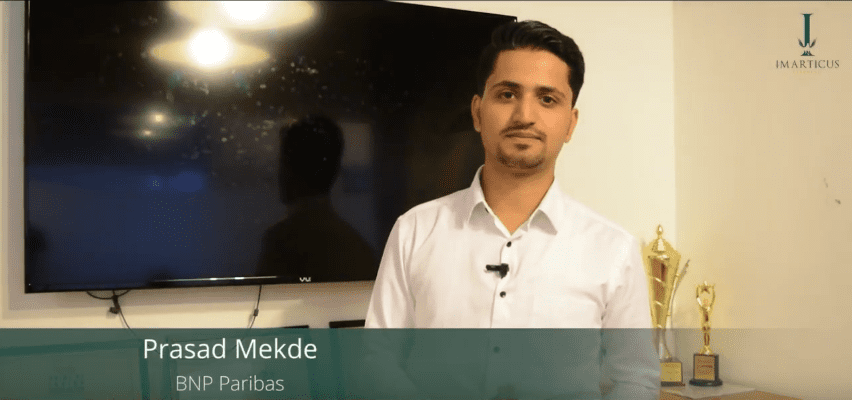
Prasad Mekde reminisces and talks about his experience which helped him land a prestigious job at BNP Paribas and earn a confirmation of service in just a few months.
Hello. My name is Prasad Mekde. I graduated in 2015 and enrolled in the investment banking operations course at Imarticus. Shortly after I completed the course I was placed at BNP Paribas and confirmed soon thereafter.
The highlights of Imarticus’ Investment Banking Course
Batch 68 is where 30 graduates came together at Imarticus Learning to realize their dreams of being tomorrow’s successful investment bankers. Every individual’s skill set is honed at Imarticus to present and mould them in the best possible manner and this is what they helped me with. The result is the job that I landed with BNP Paribas!
I enrolled for the program based on the recommendation of a friend and the encouraging Imarticus learning reviews. In my opinion, the best part of the course was the sharing of knowledge on investment banking in a practical manner which helped me get an insider’s view into the role of an investment banker and what exactly I needed to do in this role.
The knowledge and fine tuning of perceptions related to skill sets for investment banking, understanding the role and learning to apply the technical skills I acquired were the major areas I benefitted. The regular revisions and learning reinforcement ensured I had a good foundation in Investment Banking.
The training methodology:
The training comprised of 3 holistic approaches. The book references helped me gain theoretical knowledge and certification gave me added confidence. Imarticus Learning used assignments, projects, and live simulations to help me create the essential attributes of confidence. This essentially meant practically implementing my knowledge of the basics and concepts, presenting the information based on an analysis in lucid presentations and interacting with all relevant people collaboratively.
The trainer’s and faculty members helped boost my morale and give me a clear picture of my work-day and role as an investment banker. The classroom sessions, market simulations, hands-on, and do-and-learn experiential methods helped boost and kick-start my career.
Why I recommend Imarticus to all aspirants:
Imarticus Learning’s placement services and the industry-endorsed certification helped me stand head-and-shoulders above other candidates. The training and learning sessions enhanced my communicative skills and knowledge of the latest technological tools and helped me build a well-presented resume.
If you have a yearning to follow a career in Investment Banking click here for complete information or speak to the counselors to allay any fears you might have.

My Journey from an Introvert to a Successful Investment Banking Career.

Jason Lobo explains how he overcame his fears to emerge as a winner with a great IB career.
Yes, I wanted to be an investment banker but lacked confidence and was an introvert.
My name is Jason Lobo and I finished my graduation from the KES Shroff Commerce and Arts College. As the first step to an investment banking career, I equipped myself by pursuing courses in Advanced Excel and Tally. However, my greatest hurdle was that I would hesitate to speak to strangers and lacked the confidence to interview for an investment banking job. That’s the moment I decided to approach Imarticus Learning!
After speaking to the counselors at Imarticus, I found that their Investment Banking Course was ideal for me. I looked over the syllabus that the course covered and found it to be extremely comprehensive.

Investment Banking Course
I checked their website and other portals like Glassdoor and found that there were many candidates who had finished their course and had given positive Imarticus learning reviews. I personally felt that the Imarticus learning placement program was unique and offered a 100% assurance of placements.
The training course is unique, amazing and result-oriented:
The training is truly among the best. The faculty members were excellent and mold you into a person who can seamlessly fit into teams and Investment Banking positions. The certification exams, job preparation, frequent mock interviews, and invaluable interview guidance helped me face the interviewer confidently and I landed a job GlobeOp.
My transformation:
Though I took many job-interviews I found it very difficult to make a breakthrough. With the Imarticus training, it became possible for me to achieve the dream job of many aspirants. Their soft-skill development sessions were personalized for each student. My entire personality changed to becoming a confident extrovert armed with both theoretical and practical knowledge.
Their placement experts, especially Mr. Rohan, take great responsibility to ensure you get placed. Moreover, the efforts of Ms. Lourdes, Mr. Dharmesh and Mr. Mithul in providing me with the essential soft-skill training, interview knowledge and an idea of the role of an investment banker helped me groom myself and get into this industry with confidence.
Thank you Imarticus!
Post the course and successful placement at SS&C GlobeOp, I find I can speak endlessly about many subjects and even talk to strangers. I owe my new job and career to Imarticus! I have been able to conquer my fears to confidently face interviews, realize my career ambition and overcome a lack of confidence in my skills.
If you want an Investment Banking career, click here for complete information or speak to the counselors to allay any fears you might have. Hurry and enroll today. Your career hinges on your decision.

How I Aced the BNP Paribas Interviews to Kick-Start my Investment Banking Career

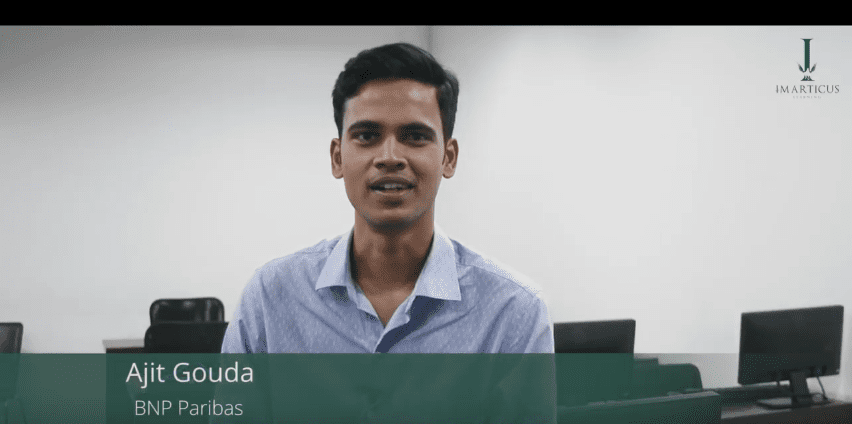
Hello. I’m Ajith Gouda and have a Bachelor degree in Management Studies from Mumbai University. I completed the Investment Banking Certification Course 2 months ago and am presently working at BNP Paribas.
Why I opted for Imarticus Learning’s Investment Banking Course?
The Indian Express claims that Investment Banking is today’s hot-choice among careers. And, they’re right. It’s anticipated that in 2019-2020 alone around 750,000 openings are available in global financial firms and banks. The payouts, job-security, and growth in this field are amazing and second to none. Moreover, the Imarticus Learning reviews concurred and I used this amazing course to launch my IB career.
This course is truly awesome:
The innovative and unique teaching methodology helped me imbibe theoretical learning through classroom training, where instruction was coupled with experiential learning. The practical approach with regular reviews and reinforcement of learning and the many live market-sessions helped me connect the dots and understand why knowledge and the ability to practically implement that knowledge is so vital to an investment banker. They gave me the insider-view and provided me with clarity on the investment banker’s job role.
My learning summary:
Since I had no idea or insider view of the real investment banking job role, I did have my concerns about whether I would be job-ready after the course. My fears were put to rest since the course helped me with knowledge of finance institutions, market participants,  modules on basics and advanced concepts of the financial and money system, the business sides of sell and buy, market types, the regulators, regulations and risks involved, all about various kinds of shares, capital markets, financial institutions, bonds, shares, receipts, stock exchange operation, yield, complex Forex operations like credit, defaults, hedging, swaps and  all that is essentially required to operate as an investment banker.
Investment Banking Course
The actual training course highlights:
Imarticus helped me gain all this information through practical assignments, projects, and simulations and helped me create good self-projecting attributes where I used both practicality and sound knowledge. Their excellent faculty, classroom sessions, market simulations, hands-on, and do-and-learn experiential methods helped me kick-start my career. I am grateful to Imarticus for the great learning platform which was informational, easy-to-recall, used the latest technological aids and reinforced my learning through the various aids at the right time.
The last and best self-development module:
Learning is all about ongoing changes and I found that Imarticus Learning is the biggest and best platform available today for aspiring graduate students looking to make a career in investment banking.
This certification helped me raise the bar and is like a feather in my educational cap. Their learning sessions to grow your skill sets also cover enhancing your communication skills, ensuring you can handle the technologically latest software programs, building your CV, mock interviews, mock domain sessions, and invaluable interview guidance. This helped me ace my interview in just a few months. Thank you Imarticus!
Looking for a foothold in the investment banking industry? Click here and speak to a career counselor today.