Frequently Asked Questions on Fintech

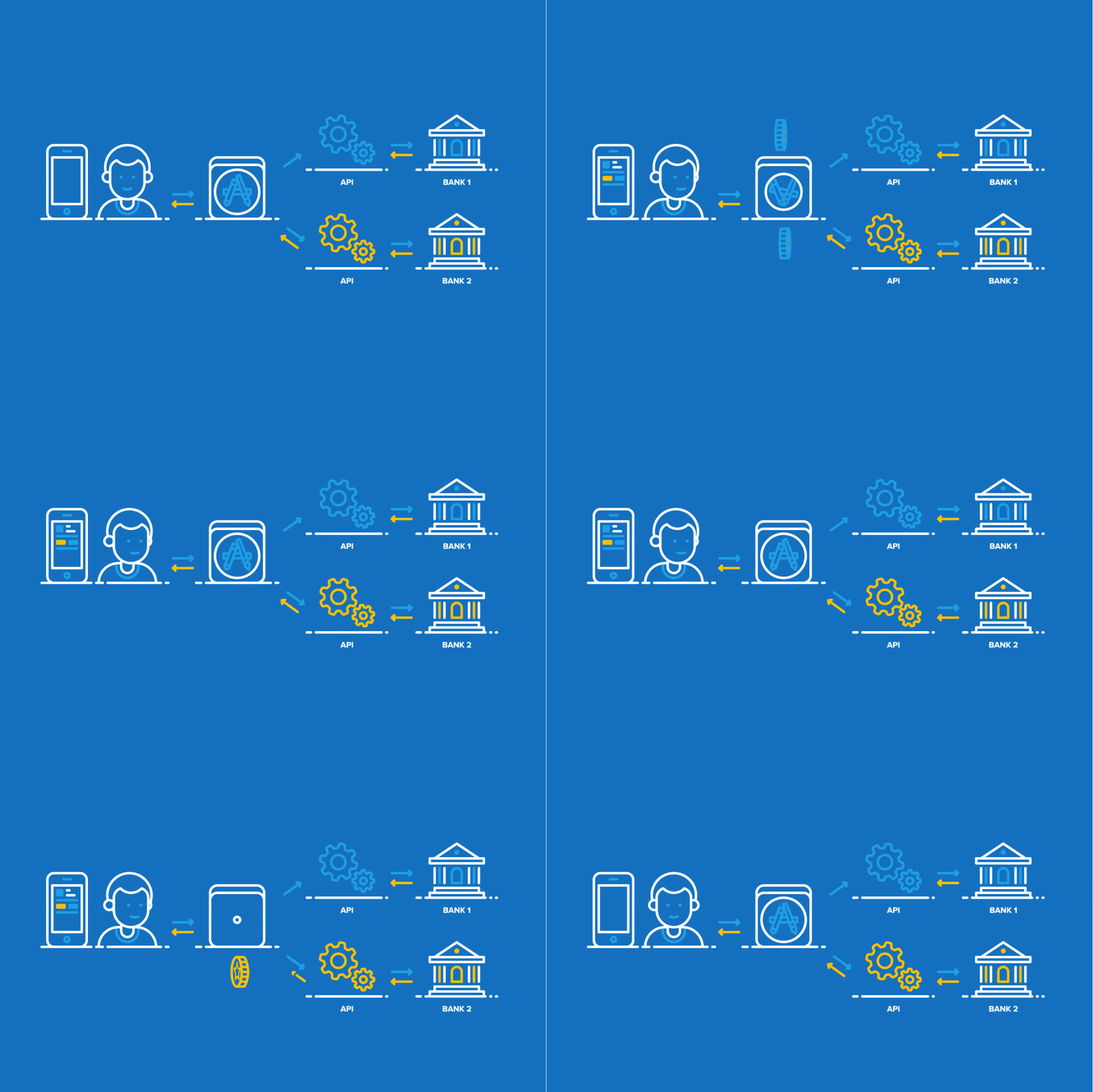
Example to understand the Fintech domain

Fintech is the short form used to denote the financial technology industry. The Fintech industry has revolutionised the traditional banking and finance industry by leveraging progressive technology to boost customer satisfaction. In the contemporary digital landscape, customers are more accustomed to using their smart devices for purchasing goods and services and thus making payments for the same.
The growth in online transactions as a result of booming e-commerce led to technological progress in the field of finance. Fintech is the amalgamation of finance and technology. It is the infusion of cutting-edge technology to solve the challenges faced by the traditional banking and financial services industry. Fintech is making the banking industry more efficient using tools like chatbots, mobile applications, UPI payments, etc. to improve customer satisfaction.
PayPal is a very relevant example to understand the Fintech domain. PayPal is a leading Fintech company that helps to facilitate personal and business transactions, payments and credit services online using the application or through its website. PayPal has an international presence and is valid across 200 countries worldwide and is accepted by millions of websites. It is also used for other transactions like online donations, fundraising, etc.

How Do I Learn Fintech?

Technology is touching all industries and transforming the way the world runs. Finance is one major industry which has made the best use of technology. The integration of Finance with Technology to bring in the required automation in the Finance sector is referred to as FinTech. FinTech is everywhere. It has enveloped us in a way that it has become a part of a modern man’s life. FinTech finds its use in various domains like Payment apps and even cryptocurrency!

FinTech is becoming a very popular field to work in. Learn FinTech if you have an interest in going into the field of Finance. To get insights into FinTech, one can start knowing about the major sub-topics which build the FinTech industry like lending, borrowing, working of blockchain and cryptocurrency, payments, etc. This will help you in analysing the underlying potential of the industry and also help you in understanding your interest areas in the particular domain.

Various online courses on FinTech are available on renowned online learning platforms. One can enrol in these short-term courses and start gaining perspective on the sub-topics. Also, you can network with people who are already a part of this industry. This will give you in-depth insights on FinTech and its subsidiaries.

What is FinTech Course?

FinTech is a popular term that is commonly used for Financial Technology. FinTech is any company that makes use of technology to deliver its services. It deals with multiple functions like managing cryptocurrency, payments, etc. FinTech makes it easy for consumers to manage their finances and also transact with ease.

With FinTech, the space of accessing finance has changed drastically. FinTech has brought about huge and major changes in the field of traditional finance and investments. FinTech provides modern tools that are disrupting the way consumers manage their finances. FinTech has demonstrated its utility in Crowdfunding platforms, Blockchain, Payments, Insurance, Robot-Advertising, Stock-Trading, Budgeting apps, etc.

The FinTech course is an introductory course that gives insights on FinTech and how technology is bringing about a major change in the field of Finance. FinTech courses are designed for Finance professionals who want to keep themselves at par with the industry and also for the newbies who are willing to join the Fintech or Finance industry.

FinTech courses are brought forward by various online learning platforms. They collaborate with industry experts and professors of renowned Universities to compile the best material on FinTech and its subsidiaries. These courses also provide multiple certifications which can help in increasing your credibility in the field.

What Is the Blockchain Course?

Blockchain is a list of transactions which are stored on any network and can be accessed when needed. Blockchain is used by various cryptocurrencies like Bitcoins to store and record transactional data. Blockchain technology is finding great uses in various businesses as it can keep a record of events, contracts, personal information like medical history, monetary transactions and a lot more.

Blockchain has disrupted the way data is stored and managed. It is increasingly becoming popular due to multiple usages and also the automation of various industries and companies. Blockchain is a relatively new field where everybody is getting to know how it works and then converting their knowledge to potential gains.

A Blockchain course can help your cause. Various courses on blockchain and how it works is present on various learning platforms. A course on the blockchain can help you in knowing how blockchain is helping businesses. It will also give you insights on how this technology can add value to a particular business or a project.

A course on the blockchain will help you understand its basics, how it is tackling the prevailing problems, types of blockchains and how blockchains are disrupting the whole business space and creating a whole new world. These courses will help you enhance your knowledge and understanding of the subject. Also, you can seek employment is connected fields after taking up a blockchain course.

How Do I Get My Blockchain Certification?

Blockchain technology has brought about a disruption which has affected the whole world. Blockchain is creating a lot of jobs as companies need people who understand how blockchain works so that they can make the best use of the resources in hand.

To get into the Blockchain space, you must be certified. Also, you must have relevant and in-depth information on the subject matter to find your space in the blockchain industry. Getting certified in any aspect of blockchain would be the first step. One can get Blockchain certification on innumerable online and offline learning platforms. Also, certifications give you the required knowledge in the subject matter without burning a hole in your pocket.

Certifications are universally accepted and have an instant impact on your career as they give out an impression that the person is well-versed with the topic. Blockchain certifications can be received after successfully completing various learning modules and assessments provided by the offline and online learning portals.

Using these learning portals, you can upgrade your knowledge and understanding of the topic and become more employable. Blockchain certifications cover multiple aspects on the topic and can get you ready for the market. With blockchain certification, you can get ready for the next big step of your career.


Also Read: All You Need To Know About Fintech Technology

How Challenging Is the Lockdown for Fintech Players?

Humanity is facing a tough time today. The Novel Coronavirus is spreading at a fast rate globally. Some countries are tackling it hard while some have lost many of its citizens. Almost all the countries are under lockdown and all the economic activities have hit a speed bumper. People cannot go to banks and ATMs regularly nowadays as compared to normal days. A lot of financial activities are done through online transactions and digital payment methods are witnessing a rise in demand.

There are a lot of firms that had a huge cash inflow/outflow which has been affected due to lockdown. A lot of small vendors are closing their shops who do not deal in digital transactions. The Fintech players have been posed with the challenge to fulfil the demands of people and to maintain economic stability in these tough times. Let us discuss more the challenges faced by Fintech companies during this outbreak.

Many people earn their meals by working every day. If they don’t work, they can’t survive. Many countries have ensured necessary funds for these people and it is the job of a Business correspondent (BC) to deliver the funds to them. They help people who have less financial knowledge in accessing their bank accounts. Many economic activities have come to a halt and the cash flow is decreasing. It is very tough to provide cash to these people as many financial institutions are reporting cash shortage issues. The BCs of Fintech companies who were looking to expand themselves in rural areas are now facing the challenge of cash shortage. The financial exchanges of these rural people are mostly in cash and it is not possible to make the rural economy cashless overnight amidst this crisis.

There are restrictions on human movement because that is the only cure till now. The Fintech companies have to provide cash to these BCs and then the BCs have to ensure this money reaches the one in need. People cannot gather at one place to collect their share because of fear of an outbreak. The Fintech companies will find it hard in authentication, accessibility, and distribution.

A lot of people are shifting towards digital payments due to cash shortage. The load on servers of this Fintech firms is also increasing day by day. The fear of data loss or server lag is always there. The Fintech players have to adapt and bring technological advancements so they manage the load. If the server crashes, then a lot of transactions will get affected.

The data/information which is generated each day has also to be secure. A lot of people are using the services of Fintech firms and they are trusting them with their valuable transactions and personal information. The Fintech players have to cope up with the security challenges.

There is a lockdown imposed in many countries and is strictly monitored by the authorities. The Fintech players and their BCs have to cooperate with the local authorities and they have to make sure they follow the permissions and guidelines.

Due to this epidemic, cross border transactions and activities are witnessing a fall. The Fintech players have to make sure they manage the loss. They have to find innovative and secure ways for the demands of customers across the border.

Conclusion
There is a lot of load on these Fintech players but it is also an opportunity where they can leave an impact on their customers. The firms which will adapt will come out stronger from this situation. After all, there is hope to hang on! This article was all about the challenges faced by Fintech players amidst the lockdown. I hope it helps!

Blockchain: A Solution for Positive Shopping Behaviours Amid Covid19

The world is battling against the recent pandemic of the novel coronavirus. The whole world has come to a standstill and everyone is trying to practice social distancing and safety measures. Not only medically, but this pandemic has also challenged people financially, mentally, etc. We are lucky that we have so many technologies that are doing our share of work. One such technology is blockchain which is helping a lot nowadays amidst this pandemic. In this article, we will discuss the benefits of blockchain technology in the shopping sector amidst this chaos.

What is Blockchain technology?

Blockchain is a technology that supports payments through digital channels. It takes care of digital information/data during online transfers. It allows the user to share digital data with any person and that information can only be read. Blockchain ensures that people can only access information about digital payments and history. They cannot change or manipulate the data/information.

The power of authority is equally shared among people as there is no central controlling point in blockchain technology. Security is the main responsibility of blockchain. Blockchain is widely used in digital transactions and cryptocurrency distribution. Let us see the positive effect of blockchain technology on shopping behaviors of people.

Less portal charges

You can transfer information from one point to another using blockchain technology without any transaction fees or portal charges. The block/information which is to be transferred is passed on to the millions of computers around the globe before reaching its final destination. If someone tries to falsify this information, then he/she has to falsify all the million checkpoints too through which the information is passed before reaching its final location.

For example, whenever we do a credit card transaction on any online portal, we give a few transaction charges which are taken by the credit card company or the service provider. There are no transaction charges cut by the blockchain technology in such transactions. Amidst this pandemic, we can apply this technology worldwide to reduce buying costs for all the people involved.

Distribution of control

There is no central authority in the blockchain. It is a decentralized technology. Covid19 has forced people to stay in their homes and work from home. If there was a centralized technology, then all the information would be stored on one entity only and people would have to monitor and control it, if any damage comes to the central authority, it can result in complete data loss and security concerns. Blockchain enables information sharing by everyone without being manipulated. This will surely help in shopping and marketing amidst this novel coronavirus outbreak.

Transparency and Stability

If you want to look up to transactions of any cryptocurrency institution, you can easily see it using blockchain technology. But you can only see the transactions and cannot manipulate them. For each block, a hash code is generated and it is hard to break all the security protocols. All the transaction done with a public address on blockchain technology is visible to everyone. This also forces these firms to follow honesty. Blockchain technology is transparent and secure at the same time.

Since human interaction in physical terms is impossible amidst this outbreak, this technology can clarify the doubts of buyers and can also be trusted because of its transparency. Immutability is also a major concern in blockchain technology. One can understand these things practically through various blockchain online courses.

Note – A hash code is generated through a hash function in which the input string is changed into a different output string. The output string is generally large and tough to decode. Any small changes made in the input string affects the output string by a huge margin.

Conclusion

The human society has taken a huge blow due to covid19. Amidst this pandemic, blockchain technology can ease our difficulties by modifying our shopping habits. One can easily find many blockchain online courses to start learning. It will help us in adapting to the current scenario. This article was all about the pros of shopping through blockchain. I hope it helps!

Also Read: Why Fighting COVID-19 Needs More Than Blockchain to Succeed?

AI in the FinTech Industry: What Will 2020 to 2025 Look Like?

The financial industry has, for long, been keen followers of technological advancements for their own benefit. Many big names in the industry have been early adopters of disruptive technologies in a bid to streamline processes, reduce manual labour and negate the chances of error.

Artificial intelligence is a paradigm-shifting field that the financial industry has forayed into very recently, sitting still at the tip of the iceberg. Here is a breakdown of the trends, growth, and scope of Artificial intelligence in the FinTech industry during the years to come.

AI in FinTech: Global Market Share, Size and Investment Analysis

In 2019, the AI in the FinTech market was estimated at USD7.2 billion. By 2025, this figure is expected to reach a staggering USD35.40 billion, according to a Mordor Intelligence report. The Compound Annual Growth Rate (CAGR) has been put at 31.5% for the years between 2020 and 2025.

This double-digit surge is no doubt a result of exponential technological advancements and deeper penetration of the internet. Software tools are expected to receive the largest market share because the need of the hour, and the foundation of all further processes, is the extraction of data.

When it comes to deployment, cloud-based AI developments are expected to rake in the highest CAGR in the following years when compared to on-premise deployments. This goes hand in hand with the shift in data storage and management from on-site servers to remote, centrally-controlled cloud silos to facilitate better access and higher security.

Regionally, AI in FinTech is gaining traction across many geographical splits. The current largest market is North America; however, Asia Pacific is expected to see the fastest growth in the coming years. This comes off the back of massive research and development investments in developed economies in the United States and Canada. Europe, South America, Africa and the Middle East will also see a surge in AI adoption and advancements, though perhaps not at the scale of Asia Pacific as yet.

AI in FinTech: Trends and Growth

Fraud prevention: AI is expected to be deployed the most to ensure fraud detection and prevention. Naturally, this segment will drive most of the IT expenditure in companies of varying sizes. This trend appears in a bid to keep up with the changing face of fraud in the FinTech industry as well as the greater proliferation of digital channels and the need to secure them all.

Transactional bots: As financial entities solidify their online presence, transactional bots and digital assistants will increase to keep up with remote demands. Apart from managing customer relationships, these assistants will also be equipped to deal with term life renewals, cheque or balance notifications, withdrawal limit warnings and more.

Risk profiling: AI will become a massive driving force in evaluating client credit risk and creating profiles. Using historical client data and outliers, logical algorithms can segregate risks by range, allowing advisors and risk managers to make more accurate mitigation decisions.

AI in FinTech: Challenges

Cultural changes: With changing landscapes and evolving customer demands, cultural shifts within the company are inevitable. Employees at all levels must be reoriented so that the introduction of AI becomes helpful rather than disruptive.

Security: Increased exposure to digital forums, ironically, also means being laid bare to cyber-threats. While adopting artificial intelligence in any form, financial entities must strengthen security systems at the same time.

In light of the changes to come, it is imperative that new-age students enrol in a FinTech online course that encourages deeper thinking. With every shift in the level of computational power, FinTech industry leaders will be seen integrating beyond-human technologies into nearly every critical stage of their operations. The leaders of tomorrow, then, will benefit from a FinTech online course that preps them to make and implement these changes with minimum disruption and maximum confidence.

Coronavirus: New Challenges and Opportunities for Fintech

The COVID-19 pandemic has so far infected over 1.2 million people and killed over 60,000 people, and has spread to more than 205 countries. While at some locations a handful of cases were reported, others with early community transmission have a few hundred. Unfortunately, at geographies with widespread transmission have reported thousands of cases.

This pandemic has caused major disruption to global economies owing to the containment measures and lockdowns all over. It is quite evident now that because of the virus-containment measures global economies will be hit to a great extent. Lockdowns, social-distancing and other coronavirus-containment measures have led to a massive fall in the global economic activity – plummeting consumer demand, fall in crude oil prices, crash in global stock markets, and equally decreasing global banking revenues.

The COVID-19 outbreak has had far-reaching implications for almost all possible aspects of the economy. From consumer, retail, manufacturing, entertainment, packaged goods, sports, travel, etc. every sector has been impacted in some or the other way. This pandemic is certainly devastating for many companies, but that’s not same when it comes to Fintech. Though Fintech is feeling the pressure of the increasing crisis, but this crisis is also shining a spotlight on the power of Fintechs.

The coronavirus pandemic could be devastating for many companies, but it’s also shining a spotlight on the power of Fintechs. For Fintech it’s a mixed-bag of challenges and equal or more opportunities. Let’s take a look at the challenges and opportunities for Fintech:

Challenges Facing Fintech

Jolt to Venture Capital Funding – Since, the markets are highly volatile there is limited or minimum scope of fundraising activities as investors and funding groups fall back to more cautious positions. With uncertainty over the pandemic getting over, the only hope is seen only in the medium-term where leaner fundraising Fintechs will excel again.

Conferences and Events cancelled or postponed – To break the chain of transmission of the coronavirus and, almost all events across sectors have either been cancelled or postponed. The cancelled or indefinitely postponed conferences and events are a loss too Fintechs as they help develop new business and strengthen business relationships.

Decrease in payments – Fintechs which handle payments could witness a fall in activity from consumers because of the dwindling economy.

Consumers may be less willing to invest savings – Fintechs with a focus on consumer investments may be impacted by consumer wariness about investing during such a volatile moment. Even those investors lucky enough to be relatively insulated from the economic fallout may choose to put their money in safer options for the time being.

In such a volatile market, the consumer exercises caution which and refrains from making huge investments.   This impacts the consumer investments in Fintechs.

Opportunities For Fintech

Modernised workforces are more likely to flourish – Companies sporting higher levels of modernisation and distant workforces are better positioned to not just survive but also to thrive during this difficult moment.

United approach to adopt contactless payment systems – As the world suffers through COVID19 pandemic, people from all corners of the world are finding ways to reduce the use of currency both paper and coins which changes hands many times over (possible for the virus to lurk over the surface). Encouragement from all sectors to call for digital / contactless payment systems will boost the growth of Fintechs.

High chances of reversing rollbacks on regulation – Many countries who have managed to curb the spread of coronavirus are likely to relax regulations on certain industries in order to spur economic recovery. Fintech is one of the industries targeted as part of that recovery program.

Preference to digital systems – Amid lockdowns and self-quarantine period, it has become imperative for banks to incorporate the best of digital solutions. Fintechs are well-positioned to step in to offer solutions to replace legacy systems.

Top 5 Fintech Trends Everyone Should Be Watching in 2020

The finance industry has undergone a massive technological transformation in the past few decades. This amalgamation of Finance and Technology has given birth to a new trend in the finance industry called Fintech. The Fintech industry is comprised of companies that leverage cutting-edge technology to provide creative solutions to traditional problems which were earlier unaddressed by the traditional system of banking and finance. The emphasis is on providing a seamless experience for the customer and boosting customer satisfaction by eradicating the roadblocks using technology.

With the proliferation of the internet and smart devices, consumer behaviour has changed in general. Consumers are more aware and more demanding today as compared to a few decades ago. The general technological advancement has been such that the need to provide instant solution to the problem is paramount. People are buying goods through the web using their smartphones. Now without the latest technological evolution this wouldn’t be possible, to cater to such growing demands from different industries the finance sector had to level-up and satisfy the needs of the customers. Digital wallet, digital banking, mobile banking, etc. are recent developments in the Finance industry that can be categorised under Fintech.


What’s Trending In The Fintech Domain?

The Fintech industry itself has evolved to a great extent in the last few years. With mobile banking and digital wallet being quickly adopted by the masses, some of the latest developments are still to be seen. Let’s delve deeper into the latest trends in the Fintech domain.

Contextual Banking

Contextual banking is the need of the hour, with the increase in hyper-personalization services customers are getting used to more specific products and services. The one size fits all approach is obsolete in the age of AI and machine learning. The contextual banking model is based on providing the right products or services to the customer at the right time and place. With the growth of big data and AI it is getting easier to provide contextual banking to customers based on their historical transactions and other relevant data.

Robo-Advisors

Technology has made it possible to train robots to carry out complex tasks that earlier required human intellect and interference. Robo-Advisor is a recent development in the Fintech industry where robots will provide complex investment and asset management solutions to customers. The advisory services can be availed online and require very minimal to no human involvements. Robo-Advisors factor in the risk-return profile of the customer and then accordingly provide investment solutions.

Robotic Process Automation

Robotic process automation continues to be a major trend in the Fintech segment. It not only helps the Finance companies to be more efficient in their functioning but also helps them to effectively comply with the latest rules and regulations set by regulatory bodies. The automation is not just limited to substituting human labour and performing a task but also includes suggesting improvements to the existing processes.

Blockchain

The recent technological developments have also exposed us to a new league of criminals who are tech-savvy and technologically advanced to break into our online portals. In the contemporary digital world, data is the real deal, identity fraud and theft of data, in general, is a major concern with increasing dependence on technology. Blockchain is being adopted to boost security in the financial services industry, from smart contracts to digital payments and identity management it has a whole lot to offer.

Innovations In The Mobile Payment Systems

With the increased internet penetration and affordable smartphones, the whole world has entered the digital revolution. Transferring payments using smartphone applications has been the norm since the past couple of years and rightly so given the convenience it brings to the customers. The technology however is not static and drives further innovations into this Fintech segment, like for example biometric access control that includes facial and finger print recognition. Other developments include suggesting users on their purchase decisions by factoring in their transaction history. There is much more going on in the mobile payment segment of the Fintech space.

Conclusion

The Fintech industry is still in its nascent phase and is growing by the day. It has proved to be a game-changer in the Finance industry and still has a lot more to offer.

What Are Examples of Fintech?

Understanding Fintech

The 21st-century customers demand more and better, thankfully for businesses, technology has evolved to save the day. Every industry today has been going under a technological transformation to meet the needs of its consumers whose behaviour has been influenced by time and technological advancements. The brick and motor stores have got a dot com address to serve their customers online. Traditional banking services have been upgraded to digital banking services to cater to the needs of their customers on a 24*7 basis. This change has been possible only because of major technological advancements in the banking and financial services industry; this amalgamation of technology and finance has given birth to the Fintech industry.

The major emphasis of the Fintech industry is to provide more refined and targeted services to the customers and overcome the challenges faced by the traditional banking and finance segment. At the core of the Fintech industry lays the idea of leveraging technology to solve problems creatively, providing maximum customer satisfaction and creating a pool of loyal customers. Fintech also includes the development and utilisation of cutting-edge cryptocurrency. It’s a broad term that incorporates all progressive technological innovations in the given space.

Examples of Fintech Applications

Now that we have a basic understanding of the Fintech industry, let’s delve deeper into the subject and find out about the different applications of Fintech that are improving the world for better.

Mobile Payments

Today, it doesn’t seem like a big deal to transfer payments given the mobile payment solutions provided by various companies. A few decades ago it was just a dream, transferring payments was a challenge and it required you to visit your banks in some cases to do the drill. Now with the advent of progressive Fintech technology, you just need to use your smartphone to make a purchase and that too within a few seconds.

Robo-Advisors and Financial Management

Who would’ve thought that the 21st century will offer Robo-Advisors to guide a human on viable investment solutions and address finance related queries? Robo-advisors are the latest trend in the Fintech sphere. With the growth in Artificial Intelligence and Machine Learning technology, robots are being trained to do more complex tasks that earlier required human intervention. This technology provides leverages various algorithms to provide asset management solutions for different customers by assessing their needs and requirements.

Blockchain and Cryptocurrency

Cryptocurrency has been gaining widespread acceptance and popularity from the customers. There are cryptocurrency exchanges that facilitate the buying and selling of cryptocurrencies like Bitcoin. Blockchain is gaining widespread acceptance and being used for security purposes to maintain the privacy of data and keep it from being misused.

Crowdfunding Platforms

There are various crowdfunding platforms like Kickstart, GofundMe, etc. that became popular in the recent years. These crowdfunding platforms allow users on the internet to send and receive money from other users who visit the platform. The major applications of these portals have been realised while accumulating funds for a cause. People also use these portals to get funding for their business or project from investors across the globe.

Insurance

Fintech has also spread across the insurance industry, InsureTech has been the buzz word in the insurance sector that takes a holistic approach to insurance services and covers everything including car insurance, home insurance, data protection, etc. InsureTech and personal finance companies like Mint, LifeLock, etc. are gaining traction from investors in the Fintech space.

Conclusion

The word Fintech is an amalgamation of Finance and technology; it has revolutionized the financial services industry and has spread across other related sectors like insurance and banking providing maximum customer satisfaction.

What is the Next Big Thing in Fintech?

Breaking down the evolution

Have you ever wondered what would be the case if money wasn’t into the picture? To simplify even further imagine a world where the banking and finance industry is alien to people. Well, it was the case when money wasn’t used as a medium of exchange. The barter economy was running the whole game, exchanging goods for goods and finding people who needed them. It was a lot more complicated than it sounds.

It’s hard to imagine a time like the barter economy when we are sending money through smartphones using the Fintech companies.

When money was introduced as a medium of exchange, it simplified a lot of things that were no less than chaos earlier. From providing a unit of measurement to assigning a standard value for goods and services there was a lot that money solved. But there was still a whole lot that could be done with money as a medium of exchange.

Realizing the potential of this ultimate exchange medium, the bank started leveraging on the multiplier effect of money; there was no end to this revolution of wealth creation and wealth management. As we progressed further and became more technically advanced, technology was leveraged to create Fintech companies, an amalgamation of finance and technology that helped solved the loopholes of traditional banking methods.

Popular trends in Fintech

All the major economies which were earlier cash-oriented are going cashless; this observation is enough to say that the Fintech industry is thriving in the contemporary landscape. The introduction of the internet totally changed the game for almost every industry and the banking & finance industry were no exception to this chain of progressive evolution.

A few decades ago it was just a thought and now it has been the norm. The deep internet penetration and introduction of smartphones have paved the way for success for companies in the Fintech industry. The next big thing in the Fintech industry seems more in favor of digitisation and automation of financial services. The Fintech industry has been limitless so far, let’s look into some prominent developments within this sector that will come out as a game-changer.

Digital Lending Portals

There are companies in the Fintech domain whose main goal is to bring more transparency and convenience in the whole lending process. To minimize the cost of the loan and make it available for even the poorest individual has been the mission for these companies. All of this on a digital portal that can be accessed through your smartphones and laptops, it has been never this easy to get credit from the banks.

Robo-Advisors

The future is all about automation; it has been rightly proved with this big thing in the Fintech circle. No, it’s not a sci-fi movie; robots are here to guide humans on their investment decision. These cutting edge technologies use algorithms to find the best investment solutions for individuals and businesses. It covers all aspects of your investments; from rebalancing to asset allocation you can trust your Robo-advisor for maximizing your investment returns.

RegTech

Leveraging technology to solve regulatory challenges for financial institutions is what RegTech is all about. It’s a combination of the words ‘regulatory’ and ‘technology’. When you are dealing with financial products and services the risks are endless, RegTech is here to save you by mitigating the risks and providing solutions to challenges using technology.

Conclusion

The next big thing in the Fintech industry is not about payment solutions using smartphones but it takes into consideration the broader set of challenges like financial inclusion, regulatory barriers for businesses, credit for the remotest consumer, etc. There is a major scope for companies that are willing to solve these set of challenges.

What Is Fintech in Banking?

Understanding Fintech in General

Fintech can be explained as the use of cutting edge technology to provide solutions in the financial domain to increase customer satisfaction and bring more convenience to the final users.

This evolution within the financial industry aims to introduce new tech-savvy financial products and services most of which helps to automate repetitive processes that earlier required human intervention.

The digital world is fast-paced and the use of the internet has transformed every industry. To cater to the needs of an aggressive customer base, the evolution within the financial domain was indispensable. The collective approach towards problem-solving in the financial services domain using technology has produced a spin-off that has been coined as Fin-tech.

Fintech in the Banking domain

Fintech is totally on the verge of disrupting the consumer banking industry. The disruption is inevitable given the simplicity of services in the traditional form of banking which can now be rendered very conveniently through the use of technology.

If you look closely the technological advancements have also changed the financial procedures and the way these institutions function.

Let’s look contextually into some of the major aspects of banking that the Fintech has redefined.

Credit Services 

Fintech has expanded the horizons when it comes to providing loans. Some of the prominent Fintech companies have taken upon themselves to bring more transparency and ease in the borrowing process by eradicating unnecessary documentation and other loopholes. They aim to simplify the process of obtaining financial aids for businesses and individuals.

Payment Services

Not much long ago, payment transfers and related services was a challenge for the customer. From long queues to limited banking hours and whatnot, it was a painful experience. Today a service or a product is not just limited to providing a solution but providing a memorable experience for the customer.

Keeping the customer experience in mind the Fintech companies have revolutionized the payment services segment totally. Payment using smartphone applications and the internet is the norm today, thanks to the harbingers of the Fintech revolution.

Wealth Management Services

Fintech training has redefined the way people are saving and investing their hard-earned money.

There are companies like Robinhood whose mission is to reduce the income inequality that prevails in society by providing commission-free trading and investing platform.

Today people want what’s best for them and not a general best seller, realizing this gap Fintech companies are catering to customized investment solutions for people looking to invest their money.

How is it changing the banking domain?

Let’s see how the banking sector has been transformed drastically with the advent of Fintech companies in the context of digital & mobile banking services.

Digital Banking

One of the best things about the digital space is that it is not constrained by geographies. This feature alone has helped many banks to expand their customer base in multiple territories without having to invest in building a brick and mortar outlet. Other than this the services are available for the 21st-century consumers who don’t sleep, meaning 24*7 has been the norm.

Mobile Banking

With the proliferation of e-commerce and food-tech companies, the consumers needed a more convenient method to do the transaction. Realizing this need the Fintech companies have designed mobile banking solutions that just require your smartphone and bank details to start a transaction. Problem solved!

Conclusion

Fintech has totally changed the banking industry for good. Mobile banking and digital banking services have mended the follies of traditional banking services. Focusing more on the customer experience aspect the Fintech companies are boosting the customer satisfaction level to new heights making them more loyal and committed to the service providers.

Scope of Fintech Courses in India

Also known as Financial Technology, the word Fintech is used to describe companies that give financial services to consumers and businesses using technology. Therefore making it a combination of finance and technology. Those who are engaged in this industry aim to create new technologies that can take over traditional institutions like banks and insurance companies.

Benefits of Fintech

● It gives you protection against risks that no other traditional insurance company will offer.
● You can save a lot of money since you do not have to spend money by hiring local rental staff.
● Helps in making quick decisions as it can compile the customer’s detailed profile along with the financial history, risk factors, and habits, all at once. It is hence helping in making lending decisions easier, quicker and more efficient.
● With the help of this technology, you do not have to contact the customer face to face, if they have a sales terminal near them with a wave of their phones, they can make contactless payments.
● Smooth transfer of money is one of the most essential features of fintech companies and you can always check your bank account details with a touch of your phone.
● The requirement to go to the bank to check your transactions is no more needed.
● Readily available loans to students as well as the public.

Scope of Fintech

Fintech has completely changed the way that companies and customers do payments and transactions on a day to day basis. This is also the reason why investments worldwide in Fintech is skyrocketing.
The best part about the financial industry in India is the fact that eighty-seven percent of the bills are made in cash, and almost forty percent of the population is not related to banks. Hence, it has a vast market place that is untapped for such startups.
Fintech companies use smartphones as a medium of interaction. Hence, with the booming industry of smartphones in India, the net penetration of this technology is also increasing steadily. The potential that Fintech has in India can’t be overstated.
Along with that, any existing financial institution or a traditional bank can use Fintech to create a healthy financial relationship between their present customers by introducing new digital products and enhance their service performance. It can also help in spreading modernization to traditional areas and educate many on technology thus facilitating a more easier way of transactions.
Things will continue to look good for the Indian Fintech market as technologies like blockchain, artificial intelligence, and intelligent automation can take Fintech to an altogether another level.

Scope for Fintech Courses in India

Courses on Fintech are widely provided in India. Some even include internships along with the course. If you are planning to get into the field of Fintech, it is much better if you do a crash course on it or have a certification for the same.
There are various courses like online courses, Fintech foundation programs, Fintech Prodegree, MBA in Fintech, etc. that are offered in multiple universities around India. To take up these courses, the candidate should have a bachelor’s degree or at least a background in computers.
With the increase in the market for Fintech technology, comes the rise in opportunity for people to work in the same field. Countless startups have entered the market and are looking for talented minds and workers to make their business a success.

Some of the examples of Fintech companies are:

● Paytm
● BHIM
● Mobikwik
● PhonePe
● PayU
● Shubh Loans
● Lazypay
● Policy Bazaar etc

Conclusion

Fintech startups have created a revolutionary change in the way payments are given and received. Businesses have an easier way of accepting payments. There is no need to worry about hard cash, and other applications use options like Ola money and their own software wallets for payments, which makes it even easier for people to facilitate transactions in their day to day lives.
With the increasing popularity of this trend in this technology and more fintech courses coming online, the requirement for experienced and trained individuals are increasing, making this a worthwhile investment.

Even students get to do internships for companies such as Paytm and BHIM, which says a lot about the scope for jobs in this field. Having a certification in Fintech will make sure that you can start your work in this field with a good post and a satisfying salary.