
Mastering CPA Skills: The Importance of Financial Reporting

Table of Contents

  • Introduction
  • Understanding Financial Reporting in Accounting
  • CPA Financial Reporting: Building Your Foundation
  • Key CPA Skills: What Sets Top CPAs Apart
  • Why the Importance of Financial Reporting Can’t Be Ignored
  • CPA Accounting Expertise: Real-World Impact
  • CPA Skills for Success in the Job Market
  • Accounting and Financial Reporting: An Evolving Relationship
  • FAQs on Financial Reporting & CPA Skills
  • Key Takeaways
  • Conclusion

Introduction

So, you are thinking of taking up CPA as your career or probably boosting your finance. It’s really a good idea—in this era of fast-paced finance. Be it a student dreaming about global opportunities or a professional transitioning into the accounting sector, financial reporting has become a compulsory rather than an optional skill set. Within a few years, the demand for CPAs is expected to increase enormously, where companies will look for more than just theoretical knowledge – they will want a sharp, quick mind that can interpret financial data, tell a story through numbers, and convey the vision with accuracy.

This blog will help you know about the fact that financial reporting is not just another subject within the CPA syllabus – it is the backbone of CPA accounting expertise. It will break it down step-by-step.

Understanding Financial Reporting in Accounting

In an organisation, financial reporting constitutes preparing statements that reflect the financial status to the management, investors, regulators, and the general public. It manifests as transparency and accountability as well as making a significant impact on strategic decision-making by the organisation.

For anyone serious about accounting, understanding financial reporting in accounting is critical. This section dives into what it is, why it matters, and how it’s changing in today’s tech-driven landscape.

Key Components of Financial Reporting:

ComponentDescription
Income StatementShows profitability over a specific period
Balance SheetProvides a snapshot of financial position at a given time
Cash Flow StatementTracks the flow of cash in and out of the business
Shareholders’ EquityRepresents company’s value to shareholders

External Source: IFAC’s Guide to Financial Reporting provides insights into global standards that CPAs must follow.

CPA Financial Reporting: Building Your Foundation

If you’re preparing for the CPA exam or working in the field -you’ll know that CPA financial reporting is one of the core sections tested. It requires not just knowledge, but application.

A solid foundation in financial reporting empowers CPAs to analyse data, recognise red flags, and deliver credible financial statements. Especially for candidates aiming for international roles, mastering this section can be a game-changer.

Why CPA Financial Reporting Matters:

  • It covers U.S. GAAP and IFRS standards
  • Prepares you for roles in audit, assurance, and compliance
  • Enhances your ability to work with multinational teams

External Source: Stay updated with AICPA’s Financial Reporting Updates

Key CPA Skills: What Sets Top CPAs Apart

CPA professionals are more than just number crunchers—they’re strategic thinkers. The key CPA skills needed today go beyond basic accounting. They involve technology, communication, and regulatory understanding.

Whether you’re working in India or abroad, these skills are vital for a successful CPA journey.

Top CPA Skills Required:

  • Analytical Thinking: For decoding complex financial data
  • Technical Proficiency: In tools like Excel, SAP, QuickBooks
  • Regulatory Knowledge: Understanding of global standards (IFRS, GAAP)
  • Communication Skills: To explain numbers to non-finance stakeholders
  • Ethical Judgment: A non-negotiable skill in financial reporting

Did You Know? According to a Deloitte survey, over 70% of CFOs expect finance professionals to have both technical and soft skills in today’s hybrid work models.

Why the Importance of Financial Reporting Can’t Be Ignored

The importance of financial reporting lies in how it guides business decisions, investor confidence, and economic stability. For CPAs, this is where you prove your value—not just in doing the math but interpreting what the numbers mean.

Inaccurate or delayed reporting can shake investor trust, cause legal troubles, or even shutter companies. This is why organisations place a premium on CPA skills for financial reporting.

Benefits of Strong Financial Reporting:

  • Ensures compliance with laws and regulations
  • Helps in budgeting and forecasting
  • Attracts investors and funding
  • Promotes internal control and audit readiness

CPA Accounting Expertise: Real-World Impact

Your CPA accounting expertise is like a toolkit—and financial reporting is one of its most powerful tools. From mergers and acquisitions to internal audits, your ability to interpret reports can shape company futures.

Multinational firms and Big Four companies increasingly demand CPAs who are fluent in global reporting standards.

Where Financial Reporting Makes an Impact:

IndustryApplication of CPA Expertise
Banking & FinanceAnalyzing financial health, loan decisions
Corporate FinanceStrategic planning, investor relations
Audit FirmsEnsuring regulatory compliance and accuracy
StartupsFinancial modeling and pitch readiness

CPA Skills for Success in the Job Market

With globalisation and financial reforms, the finance sector is evolving rapidly. Employers seek professionals with top-notch CPA skills for success, especially those who understand financial reporting.
Financial Reporting

Financial reporting allows CPAs to work in roles that were once exclusive to foreign professionals. And with India moving closer to full IFRS adoption, the demand for these skills is only rising.

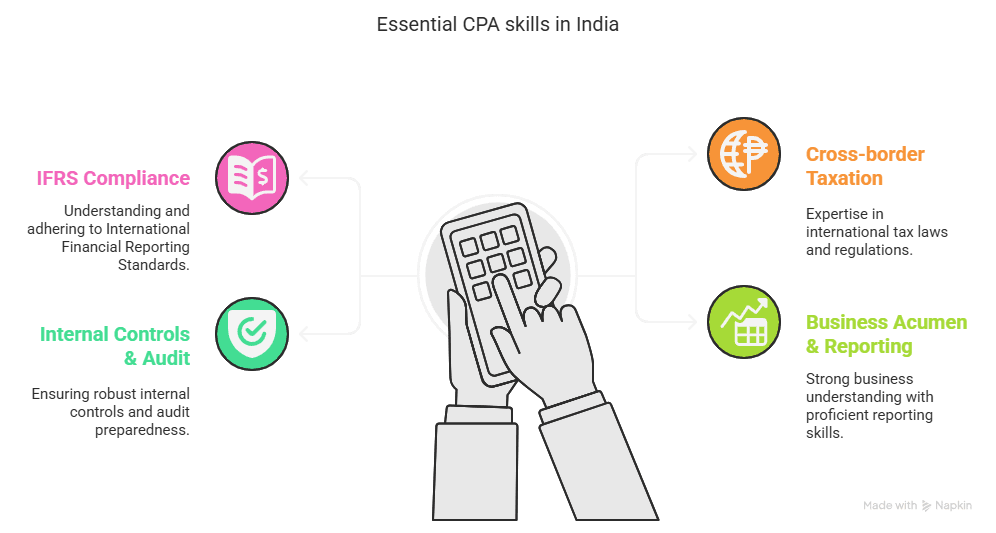
Key CPA Skills Needed:

  • IFRS Compliance
  • Cross-border Taxation Knowledge
  • Internal Controls & Audit Readiness
  • Business Acumen with Reporting Proficiency

Accounting and Financial Reporting: An Evolving Relationship

The world of accounting and financial reporting is not static. Technology, regulations, and market expectations are reshaping the landscape. As automation takes over routine accounting tasks, strategic financial reporting becomes the real differentiator.

For CPA professionals, this means upskilling and staying current with changes in reporting frameworks, AI tools, and data analytics.

Trends Reshaping Financial Reporting:

  • AI and Automation in statement preparation
  • Real-time Reporting with cloud platforms
  • Sustainability Reporting becoming standard
  • Blockchain Integration for secure ledgers

FAQs on Financial Reporting & CPA Skills

1. Why is financial reporting important for CPA professionals?

Financial reporting is important to CPA professionals.. as it establishes a system of reporting a company’s financial performance while ensuring compliance, transparency, and purposeful decision-making based on reliable information.

2. How does CPA financial reporting differ from general accounting?

General accounting focuses on recording transactions, while CPA financial reporting focuses on analysing and preparing regulated company reports or standardised statements adopted by regulators and investors.

3. Can I get a job from CPA with financial reporting skills?

Yes, many firms or MNCs employ and value CPA-certified employees who have financial reporting skills – especially those that have experience with IFRS or US GAAP.

4. Are financial reporting standards the same globally?

 Not entirely—most countries follow either IFRS or GAAP, but CPA professionals must understand the nuances of both, especially in multinational environments.

5. What tools are used in financial reporting?

 Common tools include Microsoft Excel, SAP, Oracle Financials, & QuickBooks – along with BI tools like Tableau and Power BI for data visualization.

6. Is CPA certification worth it for finance professionals?

 Absolutely. A CPA credential boosts your credibility, expands global job opportunities, and makes you more competitive in fields like auditing, taxation, and financial reporting.

7. What are the challenges in mastering financial reporting?

 Staying updated with – changing regulations, managing large data sets and interpreting complex financial events can be challenging but rewarding.

8. How often do financial reporting standards change?

 Updates happen frequently. Professionals must stay current by following bodies like the IASB and FASB and taking regular CPE courses.

9. What is the future of accounting and financial reporting?

 It’s moving towards real-time, tech-enabled, and sustainability-focused reporting. Skills in data analytics and automation will become critical.

10. Do all CPA exams include financial reporting?

 Yes, financial reporting is a core part of the CPA exam—tested under the FAR (Financial Accounting and Reporting) section.

Key Takeaways

  • Financial reporting is a foundational CPA skill with real-world application.
  • On top are the professionals who flaunt a CPA certificate considering that there are verifiable needs all over the world regarding compliance.
  • The trend lines for long-term success within career models, preparing the grounds for contributing to changing understandings of accounting and financial reporting.
  • Specialisation in CPA financial reporting will give you an advantage in domestic and international employment scenarios.
  • Trends like AI, sustainability, and blockchain are replacing the way CPAs deal with reporting.

Conclusion

Financial reporting is not merely a box to tick on the CPA route; it is an avenue toward achieving credibility, career advancement, and worldwide opportunities. For finance professionals, this competency paves the way to roles that require strategic thinking coupled with technical depth. As businesses continue to grow more complicated and global, we lean on those who can interpret and simplify the numbers and then share them effectively. Make sure that whether you are getting your CPA or are in the news cycle and want to upgrade your skills, you make financial reporting your priority because it is not just a skill, it is your superpower.

Common Financial Reporting Mistakes and How to Avoid Them

Financial reporting…is a fundamental aspect of business operations- ensuring transparency, compliance and strategic decision-making. However, many companies—both large and small—struggle with financial reporting mistakes… which can lead to misstatements, tax penalties, investor distrust, and even legal consequences.

In this blog- we will explore the most common financial reporting mistakes, their impact on businesses, and practical strategies to prevent them. Whether you are a finance professional, a business owner, or an aspiring accountant – this guide will help you refine your financial reporting skills.

What is Financial Reporting?

Before diving into the common errors- let’s define what is financial reporting & the reason of its importance.

The process of documenting, summarising & presenting an organisation’s financial data- through structured reports- is called Financial reporting. 

These reports- offer insights into a company’s financial position…helping stakeholders, investors & regulators make informed decision.

The key components of financial reporting include:

– Income Statement: Outlines revenue, expenses & profits over a specific period.

 – Balance Sheet – Displays assets, liabilities & shareholder equity.

 ✅ Cash Flow Statement – Tracks cash inflows and outflows ensuring liquidity management.

Precise financial reporting is crucial for regulatory conformity such as.IFRS (International Financial Reporting Standards) & UK GAAP (Generally Accepted Accounting Principles). But frequent accounting errors can produce mis statements of severe consequences.

Why Do Financial Reporting Mistakes Happen?

Several factors contribute to financial reporting mistakes, including- 

– Lack of expertise:  Finance teams may not fully understand complex accounting principles.

 – Manual data entry mistakes – Human errors when recording financial transactions.

–  Weak internal controls – Poor oversight & auditing processes.

–  Failure to adapt to regulatory changes – Not staying up-to-date with evolving tax laws & reporting standards.

 –  Reliance on outdated systems – Using spreadsheets instead of automated financial tools.

Regardless of the cause, these errors can lead to financial mismanagement, regulatory penalties, & a loss of credibility. Below, we examine the most frequent financial reporting mistakes and how to prevent them.

Common Financial Reporting Mistakes and How to Avoid Them

Below is a detailed table outlining the most frequent- financial reporting mistakes, their consequences, and solutions:

Mistake Impact How to Avoid It
Revenue Recognition Errors Overstating or understating revenue can mislead stakeholders. Follow IFRS/GAAP principles and recognise revenue only when it is earned.
Incorrect Expense Classification Leads to inaccurate financial analysis and incorrect tax reporting. Categorise expenses accurately and review classifications regularly.
Failing to Reconcile Accounts Can result in undetected fraud or financial misstatements. Conduct regular bank reconciliations and audits.
Manual Data Entry Errors Leads to incorrect reports and financial discrepancies. Use automated accounting software to reduce errors.
Non-Compliance with Regulatory Standards May result in fines, reputational damage, and financial losses. Stay informed about financial regulations and undergo periodic audits.

Let’s examine these issues in more detail.

1. Revenue Recognition Errors

One of the most serious financial reporting mistakes is incorrect revenue recognition. Some businesses- record revenue upon receiving payment…instead of when the service or product is delivered, leading to misleading financial statements.

🔴 Impact:

  • Overstated or understated revenue figures.
  • Misrepresentation of financial health.
  • Potential tax and compliance violations.

Solution:

  • Follow IFRS/GAAP guidelines for revenue recognition.
  • Train finance teams to record revenue correctly.
  • Consider enrolling in an ACCA course for expert knowledge on revenue accounting.

2. Incorrect Expense Classification

Misclassifying expenses can distort financial statements and lead to incorrect tax filings.

🔴 Impact:

  • Errors in cost analysis and budget planning.
  • Potential tax penalties due to misreported expenses.
  • Inefficiencies in financial decision-making.

Solution:

  • Implement clear accounting policies for expense categorisation.
  • Use accounting software with automated classification features.
  • Conduct quarterly financial reviews to ensure accurate reporting.

For a deeper dive into accounting principles, check out this ACCA blog.

3. Accounting Errors Due to Manual Data Entry

Many businesses still rely on manual data entry, increasing the risk of accounting errors.

🔴 Impact:

  • Inaccurate financial reports.
  • Complications in tax reporting and audits.
  • Reduced trust from investors and stakeholders.

Solution:

  • Automate financial reporting using cloud-based accounting software.
  • Implement double-entry bookkeeping to improve accuracy.
  • Provide training for employees on spotting and correcting errors.

4. Failing to Reconcile Accounts

Failure to reconcile accounts can lead to unnoticed fraudulent transactions or unbalanced books.

🔴 Impact:

  • Discrepancies in cash flow and balance sheets.
  • Increased risk of financial fraud.
  • Unreliable financial statements.

Solution:

  • Perform monthly bank reconciliations.
  • Use reconciliation software to track discrepancies.
  • Strengthen internal audit procedures.

To enhance your financial skills, explore this ACCA guide.

5. Non-Compliance with Financial Regulations

Adhering to financial regulations is essential to avoid legal & financial penalties.

🔴 Impact:

  • Legal action and hefty fines.
  • Damaged reputation & loss of business credibility.
  • Increased scrutiny from auditors and regulatory bodies.

Solution:

  • Keep up to date with changing financial laws and tax regulations.
  • Conduct periodic internal and external audits.
  • Enrol in an ACCA course to learn about global financial reporting standards.

Final Thoughts

Accurate financial reporting- is crucial for business success, compliance & investor confidence. Understanding what is financial reporting, recognising financial reporting mistakes & eliminating accounting errors will enhance financial transparency and efficiency.

Key Takeaways:


✔ Automate processes to reduce financial reporting mistakes.
✔ Regular audits help prevent accounting errors.
✔ Stay updated with financial regulations through an ACCA course.

By following these best practices, businesses can avoid costly errors and build a strong financial foundation.

FAQs

1. What is financial reporting and why is it important?

Financial reporting is the process of preparing and presenting an organisation’s financial statements, including income statements, balance sheets, and cash flow statements. It ensures transparency, regulatory compliance, and informed decision-making for businesses and stakeholders.

2. What are the most common financial reporting mistakes?

Some of the most frequent financial reporting mistakes include revenue recognition errors, incorrect expense classification, failure to reconcile accounts, and manual data entry errors. These mistakes can lead to inaccurate financial statements and regulatory fines.

3. How can businesses prevent accounting errors in financial reporting?

To avoid accounting errors, businesses should automate financial processes, conduct regular audits, follow IFRS/GAAP guidelines, and provide financial training to employees. Taking an ACCA course can also help finance professionals master best practices in financial reporting.

4. What are the consequences of financial reporting mistakes?

Incorrect financial reporting can lead to tax penalties, regulatory fines, legal action, reputational damage, and loss of investor confidence. Businesses may also face challenges in securing funding due to unreliable financial data.

5. How often should financial reports be reviewed to prevent financial reporting mistakes?

Businesses should review their financial reporting regularly—either monthly or quarterly. Frequent reconciliations and audits help detect financial reporting mistakes early and ensure compliance with financial regulations.

6. Can an ACCA course help in mastering financial reporting?

Yes! An ACCA course provides a deep understanding of what is financial reporting, financial compliance, and how to prevent accounting errors. It is highly beneficial for finance professionals looking to improve their expertise in financial management.

7. What tools can help reduce accounting errors in financial reporting?

Using cloud-based accounting software like QuickBooks, Xero, and SAP can help businesses reduce accounting errors by automating financial processes, reconciliations, and reporting. These tools improve the accuracy of financial reporting.

8. How can a business ensure compliance with financial reporting standards?

To ensure compliance with financial reporting standards, businesses should:

  • Follow IFRS/GAAP guidelines.
  • Conduct regular internal and external audits.
  • Train employees to avoid financial reporting mistakes.
  • Stay updated with regulatory changes through professional qualifications like an ACCA course.

Financial Planning in 2025: A Strategic Guide for CMAs to Thrive

As markets change and grow, keeping in line with them is not only the goal but a necessity. Thus, financial planning for 2025 is a challenge and a potential opportunity for re-imagining strategic success for Certified Management Accountants (CMAs). 

The global rating agency projects 6.8% growth for the current financial year and forecasts an increase to 6.9% by FY26. S&P Global’s FY25 growth estimate exceeds the Reserve Bank of India’s (RBI) projection of 6.6% by 20 basis points (bps).

In this post, we delve into actionable insights and emerging trends that will shape the future of financial planning for CMAs, ensuring they thrive amidst change.

What is the need for Strategic Financial Planning?

Financial planning has long evolved from simply calculating and generating a document containing financial goals. For CMAs, it now encompasses the analysis of future financial planning trends, data usage, and applied flexibility. 

In 2025, the focus is shifting towards:

  • Data-Driven Decision-Making: Over time, this means that CMAs need to understand tools in financial reporting that can offer information in real-time.
  • Sustainability Integration: People wish to increase strategies that conform to ESG factors.
  • Global Market Navigation: When international markets interrelate, a need for international functioning arises, thus creating a helpful guide for CMAs to consider cross-border functioning during their planning.

Key Shifts in Financial Planning (2023 vs 2025)

Aspect 2023 Focus 2025 Focus
Reporting Historical analysis Predictive analytics
Decision Framework Static models Dynamic, real-time systems
Compliance Local regulations Global ESG standards

CMA Strategic Planning: The Path to Excellence

CMAs play a pivotal role in organisational growth. Incorporating CMA strategic planning can enhance decision-making processes and drive business objectives. 

Key elements of an effective strategy include:

  1. Technology Adoption:
    • Implement AI-powered forecasting tools to identify future risks and opportunities.
    • Use blockchain for transparent and secure financial reporting.
  2. Skill Enhancement:
    • Pursue certifications like the CMA USA course, which prepares professionals for global roles.
    • Stay updated with workshops on topics such as advanced analytics and risk management.
  3. Collaboration:
    • Build cross-functional teams that bring diverse perspectives.
    • Engage with industry experts to understand shifting trends.

Emerging Trends in Financial Planning for CMAs

The financial world is undergoing a metamorphosis, and future financial planning trends are defining the roadmap for CMAs. 

Let’s explore some key developments:

1. Predictive Analytics:

  • CMAs are leveraging data-driven insights to anticipate market fluctuations.
  • Tools like Tableau and Power BI enable dynamic reporting and forecasting.

2. ESG Integration:

  • Incorporating sustainability metrics into financial reporting ensures alignment with stakeholder values.
  • CMAs are now assessing not just profitability but also environmental and social impacts.

3. Flexible Budgeting Models:

  • Traditional budgets are giving way to rolling forecasts.
  • This allows organisations to adapt quickly to economic shifts.

Financial Planning for 2025: Key Action Points

The year 2025 demands that CMAs adopt a proactive mindset. 

Here’s how they can lead with confidence:

A. Build Resilience with Scenario Planning:

  • Evaluate multiple scenarios, from best-case to worst-case, to prepare for uncertainties.
  • Use TCS or Infosys simulations to refine risk assessments.

B. Upskill Continuously:

  • Enrol in advanced courses like the CMA USA course, which equips professionals with a global perspective.
  • Learn coding basics to interact seamlessly with financial automation tools.

C. Engage in Stakeholder Communication:

  • Present financial reporting in simplified formats for better understanding.
  • Use visual dashboards to share insights effectively.

Practical Tips for CMAs to Thrive

  1. Focus on Technology:
    • Adopt ERP systems for integrated financial planning.
    • Leverage cloud solutions to enhance data accessibility.
  2. Develop a Growth Mindset:
    • Embrace challenges as opportunities for innovation.
    • Collaborate with peers to exchange best practices.
  3. Network Proactively:
    • Attend industry events to stay informed about future financial planning trends.
    • Join CMA-specific forums to share experiences and gain insights.

Why is the CMA USA Course Crucial for 2025?

The CMA (Certified Management Accountant) USA course is very significant for 2025, as it improves the abilities of effective financial management and strategic thinking, which are highly valuable in the context of the modern, dynamic business world. 

As companies proceed with desk-based plans, the certified managers of cost and assets are better placed to support planning, analysis, control, and decision-making as informed by CMA certification. 

Moreover, as companies operate in recovery mode after the pandemic and stabilise and update their regulatory requirements, the CMA may be in great demand in the labour market.

The CMA USA course is more than just a certification; it’s a career accelerator. With its focus on strategic management and financial decision-making, it equips professionals to handle:

  • Complex financial scenarios in global markets.
  • The increasing demand for sustainability-focused planning.
  • Advanced tools for effective financial reporting.

Benefits:

  • Global Recognition: Gain credibility worldwide.
  • Career Growth: Qualify for senior management roles.
  • Practical Knowledge: Learn concepts that have immediate workplace applications.

Closing Thoughts: Master the CMA Journey with Imarticus Learning

Financial planning in 2025 is a blend of tradition and innovation. For CMAs, it’s a continuous learning, adaptability, and leadership journey. By mastering financial planning, leveraging tools, and embracing change, they can position themselves as indispensable assets to their organisations. 

Imarticus Learning CMA programme empowers you with the skills, confidence, and opportunities needed to excel. Imarticus Learning provides unparalleled support to help you easily conquer the world of accounting and finance.

Our CMA graduates secure prestigious roles in Fortune 500 companies and global management positions. With Imarticus Learning, you’ll work with top brands in the financial sector, accounting, consulting, and multinational corporations across diverse business domains.

The 30th Elets World Education Summit 2024 recognised Imarticus Learning as the best finance education provider. We are India’s first and only authorised prep provider for the world’s top four certifications in accounting and finance.

Start your journey towards becoming a Certified Management Accountant with Imarticus Learning. Enrol now and lead the world of accounting and finance with confidence and credibility.

Transform Your Career Today!

Communicating Financial Insights: Best Practices for Reporting in the Era of Transparency

In today’s era of transparency and accountability, effective communication of financial insights is crucial for businesses. Clear and concise financial reporting is essential for building trust with stakeholders, including investors, customers, employees, and the public.

If you wish to become an expert in accounting and finance, enrol in Imarticus Learning’s financial accounting course.

The Importance of Transparency in Financial Reporting

Transparent financial reporting is essential for several reasons:

  1. Investor Confidence: Clear and accurate financial reporting builds trust, encouraging investors to invest in the company.
  2. Stakeholder Relations: Transparent and effective financial communication fosters positive relationships with stakeholders, including customers, employees, and suppliers.
  3. Regulatory Compliance: Financial reporting must comply with various regulations and standards, such as Generally Accepted Accounting Principles (GAAP) or International Financial Reporting Standards (IFRS).   
  4. Risk Management: Transparent reporting can help identify and mitigate financial risks.
  5. Decision Making: Accurate financial information is essential for making informed business decisions.

Key Components of Financial Reporting

Effective financial insights reporting strategies include the following components:

  • Financial Statements: The core of financial reporting consists of the income statement, balance sheet, and cash flow statement. These statements comprehensively overview a company’s financial performance, position, and cash flow.   
  • Notes to the Financial Statements: These notes provide additional information to clarify and supplement the financial statements. They may include details about accounting policies, significant judgments, and contingent liabilities.
  • Management’s Discussion and Analysis (MD&A): This section provides a narrative overview of the company’s financial performance, including key trends, risks, and uncertainties.
  • Financial Reporting Framework: The framework for preparing financial statements, such as GAAP or IFRS.

Best Practices for Financial Reporting

  1. Clarity and Conciseness: Financial reports should be clear, concise, and easy to understand, even for non-financial professionals.
  2. Accuracy and Completeness: Ensure financial information is accurate, complete, and relevant.
  3. Timeliness: Financial reports should be issued in a timely manner to provide stakeholders with up-to-date information.
  4. Comparability: Financial reports should be comparable to previous periods and those of other companies in the same industry.
  5. Consistency: Use consistent accounting policies and methods over time.
  6. Disclosure: Disclose all material information that could affect investors’ decisions.

Enhancing Transparency through Technology

Technology can significantly enhance transparency in financial reporting. For example, companies can use XBRL (Extensible Business Reporting Language) to create interactive financial reports that can be easily analysed and compared. Additionally, companies can use data visualisation tools to present complex financial information clearly and understandably.

Challenges and Opportunities in Financial Reporting

The financial reporting landscape constantly evolves, with new challenges and opportunities arising. Despite these challenges, businesses also have significant opportunities to enhance their financial reporting. By embracing technology, adopting best practices, and fostering a culture of transparency, companies can build trust with stakeholders and improve their overall financial performance.

Some of the key challenges include:

  • Complexity: Financial reporting can be complex, making it difficult for stakeholders to understand.
  • Data Privacy: Protecting sensitive financial data is a critical concern.
  • Global Standards: Ensuring compliance with global accounting standards can be challenging for multinational companies.

The Role of Internal Controls in Financial Reporting

Strong internal controls are essential for ensuring the reliability and accuracy of financial information. Internal controls help prevent fraud, errors, and inefficiencies. By implementing effective internal controls, companies can enhance the credibility of their financial reports and build trust with stakeholders.

The Importance of Ethical Conduct in Financial Reporting

Ethical conduct is fundamental in financial reporting. Accountants and other professionals must adhere to ethical standards and avoid conflicts of interest. Ethical behaviour enhances the credibility of financial information and protects the profession’s integrity.

The Role of Financial Reporting in Risk Management

Financial reporting can help businesses identify and manage financial risks. Companies can assess their risk exposure and develop mitigation strategies by analysing financial data and trends.

The Importance of Stakeholder Engagement in Financial Reporting

Effective communication with stakeholders is essential for building trust and understanding. Companies should engage with stakeholders to gather feedback, address concerns, and ensure financial reports meet their needs.

The Future of Financial Reporting

The domain of financial reporting is constantly evolving, driven by technological advancements, regulatory changes, and changing stakeholder expectations. Companies must stay informed about emerging trends and adapt their financial reporting practices accordingly.

Technology has revolutionised financial reporting, enabling companies to automate processes, improve efficiency, and enhance transparency. Advanced accounting software and data analytics tools can help businesses produce accurate and timely financial reports.

Wrapping Up

Effective communication of financial insights is essential for building trust with stakeholders, managing risks, and making informed business decisions. By adhering to best practices for financial reporting, companies can enhance their transparency, credibility, and overall financial performance.

Businesses must strive to provide stakeholders with clear, accurate, and timely financial information. By doing so, they can build trust, foster positive relationships, and achieve long-term success. If you wish to master accounting and financial management, enrol in Imarticus Learning’s Postgraduate Financial Accounting and Management Program.

Frequently Asked Questions

What is the difference between financial accounting and managerial accounting?

Financial accounting provides external stakeholders information about a company’s financial performance and position. Managerial accounting provides internal management with information to aid in decision-making and planning.

What are the key financial statements?

The three primary financial statements are the income statement, balance sheet, and cash flow statement.   

What is the role of auditing in financial reporting?

Auditing involves examining an organisation’s financial records to ensure they are accurate, complete, and comply with relevant accounting standards. Auditors provide an independent assessment of the financial statements.   

What are some emerging trends in financial reporting?

Emerging trends in financial reporting include the increased use of technology, data analytics, and sustainability reporting. Additionally, there is a growing emphasis on transparency and accountability in financial reporting.