
What Are the Types of Financial Analysis?

What is Financial Analysis?

Financial Analysis can be understood as the process of complex business evaluation to assess and find out about the viability and profitability of an enterprise. Financial analysis can also be applied to a specific project or business segment to determine if it’ll be a profitable opportunity to pursue based on various financial parameters. A business can also be judged on its liquidity and solvency aspects using various financial analysis techniques by the analysts.
Financial analysis is often used by businesses to build financial policies for the firm, predict economic trends, identify profitable investment avenues, frame long-term business plans based on calculated trends. One of the mainstream ways to do financial analysis is using u ratios that are calculated using the financial statements and are compared with the historical ratios of the firm to evaluate the performance.

Different Types Of Financial Analysis

In the traditional sense, financial analysis can be categorised under two categories – Fundamental financial analysis and Technical financial analysis. If we go deeper into the categories it has multiple dimensions, for an example, (based on modus operandi) it can be categorised under Horizontal analysis and Vertical analysis. Based on entities involved it can be categorised as Inter-firm analysis and Intra-firm analysis, based on time horizon we can classify it under Short-term analysis and Long-term analysis. There are other such bases on which we can divide and categorise the types of financial analysis. Let’s delve deeper into the broader category that includes Fundamental analysis and Technical analysis.

Fundamental Analysis

The concept of fundamental analysis is built on the grounds of finding the intrinsic value of the business or the stocks. It is carried out to find whether the stocks that are trading currently in the market reflect the true value of the business or not. At the end of the fundamental analysis, analysts rate the stocks as undervalued or overvalued. It is rated as undervalued when the intrinsic value is more than the price of the stock in the market, meaning that it’ll be beneficial to buy it. Overvalued means the exact opposite, it means that the stocks are overly priced in the market and the actual value is lower.
Fundamental analysis is carried out by calculating various ratios for the business from the data obtained using the financial statements. Ratio analysis takes a holistic approach and calculates metrics like earning per share, debt to equity ratio, liquidity ratio, etc. In addition to this, the process of fundamental analysis also includes doing a thorough financial and economic review of the organisation to arrive at a meaningful conclusion that factors in all aspects of financial viability.

Technical Analysis

Technical analysis is a method of financial analysis that is used to evaluate the Securities being traded. This approach has a different take to analyze the financial viability of the firm. It relies on statistics generated from the market to do the analysis, like using the charts and patterns of trading to conclude the performance. The technical analysis is about making predictions about the movement of the market prices of the security by taking the historical price movements into account. The market price is the sole determinant here instead of the internal performance data of the firm. It does not evaluate the intrinsic value of the firm. The major assumption here is that the price trends are likely to repeat themselves. The major emphasis here is to find out the right time to buy or sell a security based on past and current price movements.

Conclusion

Broadly speaking, there are two types of financial analysis techniques – Technical analysis and Fundamental analysis. One is focused on finding the intrinsic value and the second is focused on predicting future trends.

What Are the Tools of Financial Analysis?

Understanding Financial Analysis

Financial Analysis can be understood as the process in which the financial stability and profitability of a business or a project are determined by using various analysis techniques. It is also used to find out profitable investment opportunities and longevity of the business. It helps the managers to make informed future business decisions by acting on the predictions. In addition to this, it also helps managers to understand the historical business trends and paints a holistic picture of the organisation.

From a broader perspective, the financial analysis techniques are categorised under two types – Fundamental analysis and Technical analysis. The process of fundamental analysis is centred on finding the intrinsic value of the stocks or the business. It uses various ratio analysis techniques that rely on the data provided in the financial statements to determine the financial health of the business. It also takes a comprehensive view and evaluates the overall economic stability of the organisation. The technical analysis is different from fundamental analysis. Its main emphasis is to make future predictions based on past and current statistical data. It relies on the market information about the stock of an enterprise to come to any conclusion. It is carried out using various charts and trading patterns of the securities.

Tools of Financial Analysis

Now that we have understood what financial analysis is and what it entails, let’s delve deeper into the subject and find out the tools of financial analysis.

  • Common Size Statements: Common Size Statements are income statements in which each item in the statement are expressed as the percentage of a base metric. Each line item is expressed as a percentage of sales or revenue that helps to facilitate the analysis. The market is very diverse and organisations are operating at various scales, to make the comparison viable the units should be expressed in terms of percentage. This format of representing the financial data is globally accepted. Common size statements include a common size balance sheet that uses the total asset as the base value, common size income statement that uses revenue as the base figure, etc.
  • Ratio Analysis: Ratio analysis is the technique deployed in the fundamental analysis process to find out the intrinsic value of the security or the enterprise. Ratio analysis uses relevant figures from the financial statements to calculate various ratios. There are various types of ratios that are calculated to establish a comprehensive financial picture of the organisation. The ratios that are generally calculated to assist in the financial analysis include Profitability ratio, Rate of return analysis, Solvency ratio, Liquidity ratio, Turnover ratios, Business risk ratios, Operating profitability ratios, etc.
  • Benchmarking: In the benchmarking technique the actual financial figures and estimates are compared with the benchmark or standard figures set by the top-level management of the organisation. Benchmarking techniques can also put the best practices in the industry as the standard and organisations are required to meet the same. The process of benchmarking includes selecting the area or segment that needs to be optimized, identifying trigger points for comparison, setting up the standard or benchmark figure, evaluation of periodic performance, checking whether the performance matches the standard or not. If it doesn’t match the benchmark then the process is followed by variance analysis.
  • Comparative Financial Statements: The comparative financial statements are used in carrying out the horizontal financial analysis process. It helps in measuring period changes in financial variables and establishing the pain points of the business. It can be prepared in absolute or percentage form. The advantages of comparative financial statements include easy comparability, timely evaluation of financial performance, etc.

What is the Difference Between Financial Mathematics, Financial Analysis and Financial Economics?

The terms financial mathematics and financial economics are often interchanged and thought of as the same discipline. Financial analysis is a different discipline all-together that uses elements from financial mathematics and financial economics in doing an in-depth analysis of the targeted firm regarding its financial sustainability.

Let’s compare and see how they differ.

What is Financial Mathematics?

Financial mathematics can be understood as the field that is concerned with mathematical applications in finance. Solving financial problems using mathematical methods is the main focus of financial mathematics. Financial mathematics is alternatively termed as quantitative finance and computational finance.

The major applications of quantitative mathematics are in the field of securities valuation, risk management, and portfolio structuring, etc. by financial institutions like investment banks, hedge funds, and insurance companies. Financial mathematics also plays a crucial role in commodities-based industries.

The valuation of various financial instruments requires mathematical modelling of financial markets.

What is Financial Analysis?

Financial analysis can be defined as the process of evaluating a business or a project using different techniques such as ratio analysis that helps to ascertain the suitability and viability of the business. Major applications of financial analysis are in evaluating economic trends, building financial policy, etc.

The results obtained after a rigorous financial analysis help different stakeholders in decision making. Internally conducted financial analysis helps managers to make an informed decision or study successful historical trends. Financial analysis is further classified into two parts -fundamental analysis and technical analysis, let’s delve into the details of both the techniques.

Fundamental Analysis

Fundamental analysis uses the approach of evaluating securities and conducting financial analysis by measuring the intrinsic value of the security. Fundamental analysis takes a more comprehensive view of the organisation and considers different factors such as economic conditions, industry outlook, management of the company, etc. It also evaluates the company on account of assets, liabilities, expenses, income generated, etc.

Technical Analysis

Technical analysis is different from the fundamental analysis technique for evaluating the viability of the company. It has only two inputs in the whole evaluation method. The two elements of this technique are stock prices and volume. It assumes that stock prices reflect other important fundamentals of the company. This method uses stock charts and other tools to predict the future trends of the stock.

What is Financial Economics?

Financial economics is a discipline in economics that is concerned with the analysis of the use and distribution of resources in the market. It studies how different factors such as opportunity cost, risk, time, etc. play a crucial role in creating incentives or disincentives for any specific decision.

It involves employing complex financial models to test the variables influencing a particular decision. Rational consumer behaviour is an important and common assumption with these models. Microeconomics, econometrics and basic accounting concepts form the pillar of this discipline of economics. Financial economics requires a basic understanding of the concept of probability and statistics.

Comparing the three

Now that we have individually learned about all three disciplines the difference is very evident. Let’s compare how they differ from each other, starting with the comparison between financial mathematics and financial analysis.

Financial mathematics is a field of applied mathematics that is concerned with the financial markets whereas financial analysis is the assessment of different elements that paints a picture of the functioning of the business which will help different stakeholders in informed decision making.

Financial economics is heavily concentrated on two aspects of finance, asset pricing and corporate finance. The role of a financial economist requires collecting and analysing statistical data using different sampling and econometric techniques.

What is Excel Data Financial Analysis?

Stakeholders bank on Excel to perform technical calculations or yield basic accounting ratios. Companies, on the other hand, can leverage Excel to perform risk analysis, capital budgeting analysis or discount cash flows. Moreover, options traders generally utilize Excel to perform Black-Scholes pricing. There are myriads of standard financial analysis frameworks that could be done via Excel. Also, there are some courses for financial analysis certification that can aid use Excel for various finance-related purposes.

Excel for Finance Experts

For those pursuing a career in financial analysis, extensive working knowledge of Excel and proficiency in general Excel features are quite worthwhile. Data, of any kind, can be entered and processed, as far as it is calculable.

While it can be unfeasible to have a firm grip on every function of Excel, it is important to know the approach to do functions that are essential for a particular analyst job. You can go for a technique similar to the 80-20 rule to your Excel purposes, that is, 80% of your outcome might be a result of 20% of your Excel shortcuts and functions.
Some of the common financial analysis features are pivot tables, data manipulation, lookup, formatting, and valuation equations.

Excel for Stakeholders

Stakeholders run financial analysis in either of the two major methods. The first method relies on data received from the financial statements (fundamental analysis) of an organization that can deliver Excel with the core elements for advanced equations. The second method emphasizes on probabilities, charting, and if-then analysis, which is the technical analysis.

For fundamental analysts, excel has proved to be more fruitful. Technical analyses usually depend significantly on interactive charts that are simpler to utilize and keep up-to-date swiftly via actual technical charting software in lieu of Excel.

Excel for Consultants and Accountants

At times, financial analysis is associated with repeating existing data rather than forecasting future data. For consultants and accountants, Excel can manage functions for amortization, depreciation, budgeting, and taxes.
Excel, by nature, offers itself to cost accounting owing to its excellent flexibility quotient. In contrast to financial accounting, which contains strict rules and a relatively standard approach, cost accounting must be adjusted to align with the individual requirements of the company.

In addition to this, Excel can monitor, upgrade and deliver information in a way that permits enhanced business decision making.

Using Excel Efficiently

Preparing a number of financial documents for various clients for various reasons is a time-prohibitive process. The actual issue is not creating multiple financial reports, but the approach of financial documentation and the technique utilized, which is burdensome and outdated.

A majority of organizations still rely on Excel spreadsheets. It is a surprising fact that organizations with multi-million or billion-dollar returns depend on Excel spreadsheets for their financial analysis & reporting.

Although Excel can be used to create financial budgets or reports or forecasts, their accuracy remains a question. It is easy to commit mistakes while creating reports using Excel and equally hard to check them.

The situation achieves another level of toughness when a larger number of people enter data into the same spreadsheet as this exposes you to problems like if someone by mistake entered incorrect data or on which version everyone did their updates on.

This problem is again intensified when you have to extract data that is required for report generation and later maintain all these Excel spreadsheets. Eventually, you end up spending a considerable amount of time in verifying the numbers to make sure it follows the correct data as well as to ensure the links and formulas are accurate.

In such a situation, going for cloud-based budgeting, reporting and planning software would be a great fit to make Excel perform financial analysis & reporting efficiently. It is an approach which business professionals are aware of and implies that when they login to the software tool, they can either enter their inputs on the web or via Excel add-in.

How Do You Perform a Bottom’s Up Financial Analysis?

The process of evaluating businesses, projects, budgets, and other finance-related transactions to check their performance and suitability is known as financial analysis. Also, evaluating economic behavior, build long-term plans for business activity and identify projects or organizations for investment comes in the purview of financial analysis. This is carried out using the combination of financial data and various statistical measures.

Financial analysis is generally done by professionals who prepare reports using ratios that make use of information taken from the balance sheet and other financial reports. The analysis reports are then presented to the top management for making informed business decisions. This analysis can determine if a business will continue or not, it also helps to make investment decisions in the targeted organization. The financial analysis process also entails financial data to assess a company’s performance and make a recommendation on the required improvements.

Financial analysts primarily carry out their work in Excel using a spreadsheet which helps to analyze historical data and make predictions about the future performance of the company. There are many different types of analysis which are used by the analyst for the evaluation of the company.

A proper financial analysis consists of five major areas which include revenues, profit, operation efficiency, capital efficiency, solvency, and liquidity. The final part of the financial analysis is to draw a comparison to determine if the performance is aligned with appropriate benchmarks. The first basis is the company’s historical records, to determine if the financial condition has improved or is it getting worse. The second basis is the direct competitors and the final basis is the contractual covenants.

Understanding The Bottom-Up Approach

Bottom-up financial analysis is an investment approach that has focuses on the analysis of individual stocks. A bottom-up financial analysis includes the price to earnings (P/E), current ratio, return on equity and net profit margin. It also considers the assessment of earning growth including future expected earnings. In a broad sense, the bottom-up approach starts with specifics and then moves to general.

The bottom-up approach invests in stock where the factors are positive for the company. Bottom-up investors believe in individual scrutiny, they are of the opinion that one company’s success in a sector does not necessarily mean that all the companies in that sector will follow the trend. These investors try to search out the companies that would outperform the others. This is the main reason why bottoms-up investor spends so much time analysing different companies. Bottom-up investors review the research reports on a company presented by the analysts because they have intimate knowledge of the companies given their assessments. Moreover, bottom-up investors will compare companies and invest in them based on their beliefs.

Bottom-up investors are those people who employ long-term strategies that rely on financial analysis. This is because this approach gives a deep understanding of a company and its stock value. Bottom-up investors can be most successful when they would invest in a company, they are familiar with on the grass-roots level. Google, Tesla, etc. are some good examples of this practice, because they have many known products/services that are being used frequently. When an investor looks at the company from the bottom-up approach his first thought is to understand the value from the perspective of the relevance of consumers in the real world.

Facebook is a good candidate for a bottom-up approach because investors understand the products and services well. Once a candidate like Facebook has been identified as a good prospect, an investor conducts a deep dive into the management, financial statement, marketing efforts and also the price per share which will include calculations of financial ratios for the company. Analysing how these figures have changed over time and projecting future growth is also an important aspect of this strategy.

What is the Future of Financial Analysts in India

The role of a financial analyst is one of the most sought-after positions in the financial services industry. This is due to the fact that analysts have a scope to work in a range of industries together with high earning potential. An analyst plays a critical role in any business that he or she is representing on behalf of their firm.

In general, financial analysts work for KPOs, banks, investment firms, investment banks, insurance companies and even individual companies. A good analyst should be able to evaluate the company’s overall position in the industry in terms of its strengths, performance, prospects compared to its competitors. This involves an in-depth understanding of the company’s investments, finances, growth plans, etc.

Educational Qualification Required

To fit into the role of a financial analyst should have at least a bachelor’s degree, preferably with any of the finance subjects like accounting, economics or statistics as the major. In case the analysts want to equip themselves for better job opportunities and salaries they might consider pursuing a master’s degree in finance or a Master’s of Business Administration (MBA). Any kind of advanced education increases the value of these professionals in the eyes of their potential employers.

In some cases, it has been noticed that employers prefer hiring only those financial analysts who have done their certifications from the Chartered Financial Analyst Institute. They can also enrol into several programs designed to prepare these financial analysts for the challenges they might face in the workplace.

Skills Required for the Role

Some of the specific skills required for this position are:
• Excellent analytical skills
• Good mental judgement
• Sound knowledge
• A good team player

Role and Responsibilities of Financial Analyst

A financial analyst’s role usually differs depending on company to company. These analysts usually focus on a specific region, sector or type of product.

• They determine the cost of operations by gathering the operational data
• Comes up with a financial status by comparing and analysing the actual results with the forecasts
• Guides the process of cost analysis by creating and enforcing policies and procedures, explaining the process and techniques and recommending actions to the management
• Improves the financial status by identifying trends, monitoring variances and reconciling the transactions by correcting the data
• Increases the company’s productivity by developing automated accounting applications
• Maintains the company’s database
• Attends educational workshops to upgrade themselves
• Protects the operations by keeping financial information confidential

The Future of Financial Analysts in India

Today, the role of a financial analyst is considered one of the premier careers even in India. Reports says, there are over 7,000 financial analysts’ jobs available only in India. Once they attain the desired qualification they have the scope to work with financial institutions, multinational banks, Reserve Bank of India, Industrial & Development Bank of India, Unit Trust of India, finance and leasing companies, stockbroking firms, insurance companies, public sector organizations e.g. Railways, corporate sector and consultancies.

The Average Salary of a Financial Analyst in India
In India, at the entry-level financial analysts having less than a year’s experience can expect to earn an average salary of ₹313,149 per annum. With 5 to 9 years of experience, the compensation can go up to ₹574,432 per annum. With 10 to19 years of experience, one can expect around ₹981,857 per annum.

In the later part of the career, with 20 years of experience and more, employees can earn an average compensation of ₹1,502,000 per annum. For more details, one can check the website www.payscale.com.

Conclusion
A career as a financial analyst not only offers financial security but also gives an exciting opportunity to be a part of the country’s finance industry. Considering the rising scope of this career in India, one can obtain the essential education required and gear up for a lucrative job opportunity

Also Read: What is Financial Analyst Course

What is Financial Analysis

Financial analysis is the use of financial data and information to evaluate the performance of a company and come up with strategies and recommendations as to how to improve its operations.

Financial analysts are people who study and help analyse the historical data of a company and make predictions about its future performances.

Types of Financial Analysis

There are various kinds of financial analysis, which are:

  • Vertical Analysis
    This is a form of analysis where different components of an income statement are taken into consideration and then segregated on the basis of revenue to express them as a percentage. Results obtained are often compared with that of other companies in a similar industry to get a better overview of the company performance.
  • Horizontal Analysis
    This form of financial analysis involves the study of extensive financial data gathered over a couple of years which are then compared with each other to determine their rate of growth over time. This helps in understanding whether a certain organisation is growing or falling.
  • Leverage Analysis
    Highly popular among financial analysts, leverage ratios are used in the evaluation of an organisation’s performance. While complete debt is considered as a single financial metric and may not be completely helpful on its own, it can be evaluated against the total equity of a company to understand its complete capital structure.
  • Growth Rates
    Another big aspect of financial analysis is understanding growth rates and making predictions or projections regarding the same. Here are a couple of examples of how growth rate analysis is conducted:

    ● Regression analysis
    ● Year on year
    ● Bottom-up analysis
    ● Top-down analysis

  • Profitability Analysis
    This is a variation of an income statement analysis to understand if the economics of any business is in place or not. Here is how profitability analysis is conducted:

    ● Net profit margin
    ● Gross margin
    ● EBIT margin
    ● EBITDA margin

  • Liquidity Analysis
    This kind of financial analysis depends on the balance sheet of an organisation, mostly to understand if the short term obligations of a company have been met or not. Common methods of liquidity analysis are:

    ● Acid test
    ● Cash ratio
    ● Current ratio
    ● Net working capital

  • Efficiency Analysis
    Efficiency ratios are analysed to understand if an organisation can manage its assets well and effectively use them in cash flow and revenue generation. Most efficiency ratios are:

    ● Cash conversion ratio
    ● Inventory turnover ratio
    ● Asset turnover ratio
    ● Fixed asset turnover ratio

  • Cash Flow Analysis
    Any organisation’s ability to generate cash flow is one of the most crucial factors in the field of finance. Analysts usually start from the cash flow statement to understand the operating procedure of any company including their investing histories and finance activities. Common cash flow analysis methods are:

    ● Free cash flow
    ● Operating cash flow
    ● Free cash flow to the equity
    ● Free cash flow to the firm

  • Return Rates
    Analysing return on investment (ROI) is very crucial in the finance sector since investors are always concerned about the rate of return they can earn on the money they have invested. Common rates of return analysis include:

    ● Return on assets
    ● Return on equity
    ● Return on invested capital
    ● Capital gain
    ● Dividend yield
    ● Internal rate of return
    ● Accounting rate of return

  • Valuation Analysis
    The valuation of a business is an important part of financial analysis; financial analysts often spend time building financial models to understand this. There are quite a few approaches for valuation analysis, which can be:
    ● Market approach of relative value
    ❖ Precedent transactions
    ❖ Comparable company analysis
    ● Cost approach
    ❖ The cost of building or replacing
    ● Intrinsic value
    ❖ Discounted cash flow analysis
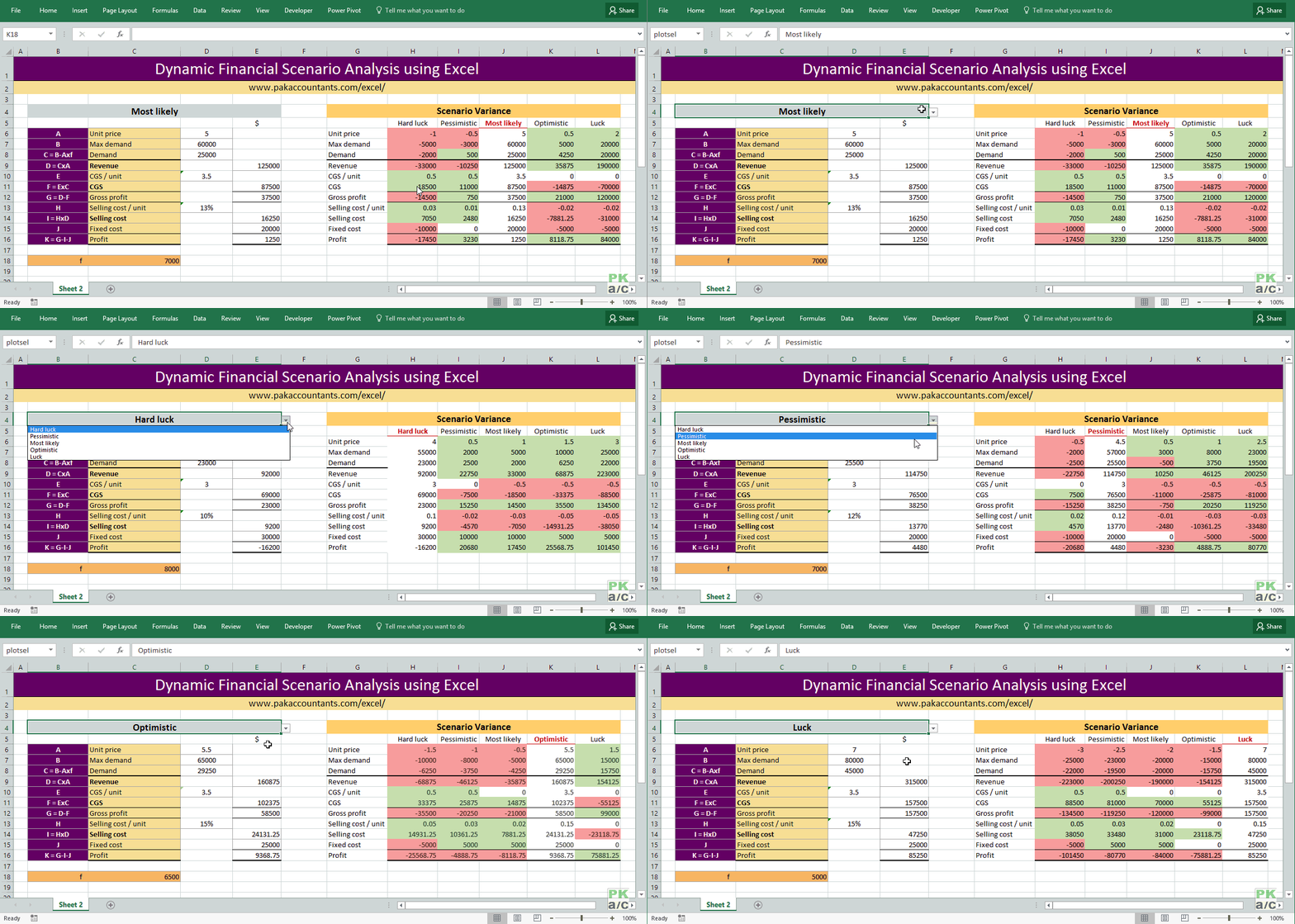
  • Sensitivity and Scenario Analysis
    Risk measurement of any business is conducted by the method of sensitivity and scenario analysis during financial modeling. This procedure is to value and predict the future of a company. Performing a sensitivity test could help understand if the future of a company might be at stake, which is why financial planning and analysis is essential. This also helps an organisation prepare budgets and make future predictions.
  • Variance Analysis
    A form of financial analysis, it is the method of comparing the budget or a forecast to the actual projections or results. Variance analysis is important for the finance and accounts departments of a company since it helps in budgeting, internal planning, and operations.

How is the Life of a Financial Analyst

The evolution of the finance industry has been on an unprecedented scale and every new phase has brought new financial innovations in terms of new ways of providing services to the customer and more advanced customized financial tools for investment. New jobs are created as a by-product of advancement in the industry. In the contemporary era where everything is run on data, the role of a financial analyst is very significant for the financial institution and the industry in general. Let’s see how they add value to this dynamic industry.

What do Financial Analysts do?

The role of a financial analyst is very dynamic, to say the least; it incorporates a range of tasks to be carried out by the personnel functioning in the capacity of the analyst for the firm. From collecting data to analyzing reports and making forecasts and projections they have to add value in multiple segments. Let’s dive a little deeper into some of the key roles and responsibilities handled by the financial analyst on a daily basis.

Collection & Organization of Valuable Information

It all starts with data and the more the merrier, the primary role of the financial analyst is to gather valuable and relevant data to work on and make an analysis. Most of the data collected to do the analysis are quantitative in nature. The data is collected from various sources such as the company’s database, Security and Exchange Commission (SEC), third party data providers like S&P Global, Bloomberg etc. Stock prices, historical financial and accounting data, industry-related research information, etc. are some of the examples of data collected by the financial analysts to do analysis and make predictions.

The next step after collecting relevant data is to organize it into a proper database, generally done in excel. The data that is collected is not filtered and has a lot of irrelevant added information that is unnecessary to the analysis, the data gathered is categorized, functions and formulas are applied to the database to make it more dynamic and formatting is used to make it easily interpretable.

 Analysis and Projection

When the data is organized and filtered, the financial analysts start with the analysis of past results. In order to perform such analysis they have to factor in metrics like profit margin, fixed costs, variable costs, Earning per share (EPS), debt to equity ratio, asset turnover ratio, an asset to liability ratio, return on equity, etc. The analysts have to look for patterns and trends and then have to compare the performance of the company with the industry standards and with competitors in the field. This is one of the key tasks that is carried out by financial analysts.

Coming to making forecasts and projections, after analysing complex historical records of the company the analyst has to use their financial crystal balls and make projections about the company’s future growth and performance. There are certain assumptions in place while predicting the performance of the company. Some of the mainstream forecasting methods include regression analysis, year on year growth rates, etc.

Make Recommendations

The role of the financial analyst also includes gaining valuable insights about the industry and the business and make recommendations as to how can the operations and functioning be improved in order to stay competitive in the market. Some examples of valuable recommendation by financial analysts include new areas to generate revenue, optimizing the price point, how to minimize the total costs, suggesting the proportion of fixed and variable costs to be used, methods to increase the market share and capture more customers for the business. These suggestions are presented to higher officials of the company including CEOs & Board of Directors.

Other days to day responsibilities of a financial analyst include making presentations, generating reports, etc. Building excel models with the help of financial modeling techniques are also a big part of the job when working with investment banks, equity research houses and corporate finance.

Conclusion

All in all the role of a financial analyst has multiple dimensions to it and requires you to excel on multiple fronts. The day to day activities includes data collection and organization, analysis & projection and making valuable recommendations to the firm. Making presentations and building excel models also comes as a part of the parcel.

#KnowledgeBytes: Bonus Shares

In this video, we will learn about Bonus Shares. Bonus share is additional share offered to existing shareholders based on the number of shares they hold but without changing the total market capitalization, and these are distributed at no additional cost. These earnings are converted into free shares. This video also explains how bonus shares is an indirect benefit to the companies as it encourages retail participation and it also gains the confidence of customers. Bonus shares are beneficial in the long run for the companies. Additionally, bonus shares are tax-free and do not change the face value, unlike stock split. Check our complete #ImarticusPrograms playlist here: https://bit.ly/2JP52hM Subscribe to our channel to get video updates.

Hit the subscribe button above. – – – – – – – – – – – – – – – – –

Why Imarticus?

Imarticus Learning offers a comprehensive range of professional Financial Services and Analytics programs that are designed to cater to an aspiring group of professionals who want a tailored program on making them career ready.

Our programs are driven by a constant need to be job relevant and stimulating, taking into consideration the dynamic nature of the Financial Services and Analytics market, and are taught by world-class professionals with specific domain expertise.

Headquartered in Mumbai, Imarticus has classroom and online delivery capabilities across India with dedicated centers located at Mumbai, Bangalore, Chennai, Pune, Hyderabad, Coimbatore, and Delhi.

For more information, please write back to us at info@imarticus.org Call us at IN: 1-800-267-7679 (toll free) – – – – – – – – – – – – – – – – –

Facebook: https://bit.ly/2y6UjKW

Twitter: https://bit.ly/2J11llx

LinkedIn: https://bit.ly/2xwSoPM

What is the Scope of a Corporate Financial Analyst?

What is the Scope of a Corporate Financial Analyst?

In this globalized world, the companies are growing with lightning-fast speed hence diversifying its operations. To keep up with the dynamic nature of the corporate surroundings, professionals have to strengthen their expertise to contribute significantly to the growth. Especially those finance guys.

Why are these companies growing? The answer to it is really simple though reaching there takes a quite lot – maximizing revenue. And the revenue which comes in has to grow multiple folds and to do this you need a lot of insights. There walks in your Finance guy.

A financial analyst has a role to lay in every organization- big or small. It is one of the most desired careers by people who have a knack towards managing money. The financial analysts play a more relevant role in the Financial services sector.

They are the pioneers of money. An analyst starts with a junior role brushing up his skills and moving forward to a senior role with the experience. The more they expose themselves to the industry, the wider become their career opportunities.

The financial services industry is made up of complex components and to break through is quite difficult. The typical work of a financial analyst includes examining financial data of companies, drawing valid conclusions from those statements and making business decisions thus preventing it from any monetary crisis.

A corporate financial analyst helps the companies to make the best use of the money available with them by making the right investing and budgeting decisions. Financial Analysts know their companies inside out and they keep a constant tap of the market which surrounds the companies. They use their expertise and the vaguely available data to draw conclusions, make predictions and take actions based on those conclusions.

At times, a company decides to merge with some other company and some decide to buy others. All of these are not decided overnight. Months of studies, analysis, and contemplation are done by these analysts who predict various scenarios and make such conclusions. An analyst can never rely on those principles which he learned during college. He has to be in touch with everything which is going around.

Also, the field of financial analysis has various niches that can be handled by financial analysts who have varied interests. The role of the Financial Analyst also depends on the company he works for. If he is on the buyer side of the business, his focus would be on how to manage the funds available, how to spend, how to make investment decisions that are in the best interest of the company, etc. These analysts don’t have a final say in any decisions taken by the company on how to use the conclusions drawn.

If the Financial Analyst is on the seller side of the business, he has to keep a tap on all elements involving different types of securities in a particular industry. They give their recommendations on what securities to buy, sell or hold. When to buy, sell or hold a particular security.

They also analyze various portfolios, the perks they reap and the risks which are associated with the combination of securities the portfolio is made up of. These insights are highly valued and are always the foundation of investment decisions. The insights can help the analysts to bag a huge amount of money as these are not very obvious insights.

Some financial analysts also work for various investment banks, where they curate securities, make bundles and portfolios with their knowledge and then sell it to the commoners at their price. They research a lot and analyze the performance of various securities, give them a price and make ‘buy and sell’ recommendations to the clients and helping these banks sell them.

Conclusion
These judgment and curation skill sets are uniquely blended in a Financial Analyst. This makes the Financial Analyst one of the highest-paid professionals in the Corporate arena. They use their power of risk analysis to make the opaque layer of the Finance world transparent also helping companies to make growth decisions and putting the right foot forward, transforming the world into aware finance capital.

Also Read: Future of Financial Analyst in India