


Last updated on May 15th, 2026 at 03:06 pm
Introduction
If you’ve ever scrolled through LinkedIn and wondered why blockchain jobs are exploding, you’re not alone. With crypto winters, regulation debates, and DeFi booms making headlines, one thing is clear: the demand for a skilled blockchain developer is skyrocketing. But here’s the catch – blockchain is not just about cryptocurrencies anymore. It’s about redefining trust, decentralization, and transparency across financial ecosystems.
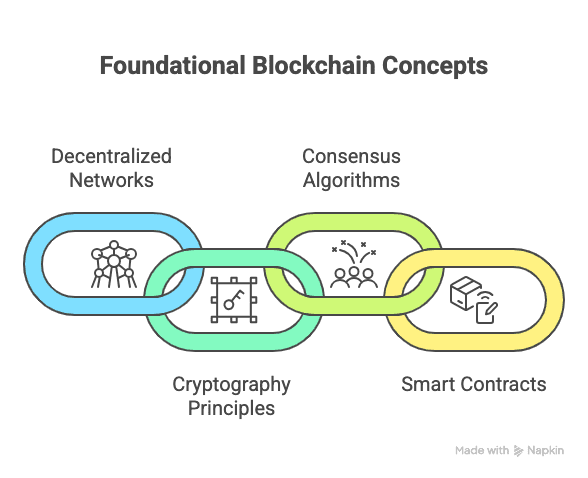
As we enter 2026, becoming a blockchain developer requires far more than knowing how to write a smart contract. From secure coding and cross-chain integration to mastering cryptographic protocols and regulatory compliance, the role is evolving. This blog breaks down the essential skills and tools you’ll need, along with future-facing use cases that make blockchain an irresistible career path.
Table of Contents
The Next Decade Belongs to FinTech Professionals
India’s FinTech market is hitting $642B, growing 3x faster than traditional banking.
- Why Blockchain Developers Are In Demand
- Blockchain Integration in Financial Systems
- Decentralized Finance (DeFi) Applications
- Smart Contract Development for Financial Services
- Cryptographic Techniques in Blockchain Security
- Blockain-based Digital Identity Solutions
- Tokenization of Assets in Financial Markets
- Regulatory Compliance in Blockchain Finance
- Top Tools Every Blockchain Developer Needs
- Key Takeaways
- FAQs
- Conclusion
Why Blockchain Developers Are In Demand
The global push toward decentralised systems, coupled with growing disillusionment with traditional financial institutions, has made the blockchain developer a central figure in digital transformation. Industries like banking, insurance, real estate, and even supply chain management are betting big on blockchain.
Don’t Let Our Best Advice Get Buried
Add Imarticus as a Preferred Source — see more of what we publish, every time you search.

According to a recent LinkedIn Emerging Jobs Report, blockchain development remains one of the top 5 fastest-growing roles globally. Companies are not just hiring developers for crypto projects—they’re also looking for innovators to lead integrations, create secure systems, and manage compliance.
Blockchain Integration in Financial Systems
With financial institutions embracing digitalisation, Blockchain Integration in Financial Systems has become a top priority. This shift enables -faster settlements, improved audit trails, and tamper-proof transactions across distributed ledgers.
Financial players like JPMorgan and HSBC are already experimenting with private blockchains to streamline operations. As a blockchain developer.. understanding how to integrate blockchain into legacy systems is vital.
🔍 Integration Layers Comparison
| Layer | Description | Blockchain Role |
| Application Layer | Front-end portals for users | UI/UX + smart contract triggers |
| Middleware | API bridges for external systems | Oracle integration |
| Blockchain Core | Distributed ledger and validation rules | Consensus + ledger recording |
Decentralized Finance (DeFi) Applications
The DeFi movement is ramping up full throttle and creating all sorts of break-neck innovation—lending protocols, DEXs, liquidity pools, yield farming, etc. Decentralized Finance (DeFi) Applications are connecting trusted transactions without intermediaries.
As a blockchain developer, this means learning about Ethereum layer-2 scaling, Bridge assets across chains, and ensuring wallet authentication and access is secure.
With platforms like Uniswap and Aave rewriting financial rules, the scope of DeFi in 2026 is only widening.
💡 DeFi Platforms You Should Explore:
- Compound Finance
- Curve
- MakerDAO
- dYdX
- Synthetix
These platforms can teach you DeFi mechanics in real time.
Smart Contract Development for Financial Services
Smart contracts are the programmable heart of blockchain logic. In Smart Contract Development for Financial Services, the developer’s role is to encode agreements that automatically execute once conditions are met—no middlemen, just pure logic.
A blockchain developer must master languages like Solidity (for Ethereum) or Rust (for Solana). You’ll also need testing frameworks like Truffle, Hardhat, and tools for code audit like MythX and Slither.
🛠️ Smart Contract Languages & Use Cases
| Language | Best Use Cases | Platforms |
| Solidity | Token creation, DeFi apps | Ethereum, BNB |
| Rust | High-speed applications, Solana DeFi | Solana, Polkadot |
| Vyper | Security-focused contracts | Ethereum |
Cryptographic Techniques in Blockchain Security
Every blockchain developer must understand Cryptographic Techniques in Blockchain Security. These include encryption algorithms, hashing functions, and zero-knowledge proofs (ZKPs), which protect data integrity and user privacy.
2026 is set to be the year of ZK-rollups, threshold cryptography, and multi-party computation. Integrating these techniques ensures your smart contracts and applications are robust against emerging cyber threats.
🔐 Key Cryptographic Methods Used:
- SHA-256, Keccak-256
- Elliptic Curve Digital Signature Algorithm (ECDSA)
- Zero-Knowledge Proofs (ZKPs)
- Merkle Trees
- BLS Signatures
Check out this MIT research on cryptographic advancements reshaping blockchain privacy.
Blockchain-Based Digital Identity Solutions
Traditional identity systems are fragmented, centralised, and vulnerable. Blockain-Based Digital Identity Solutions offer secure, user-controlled identity management, enabling better KYC processes for banks & financial institutions.
A blockchain developer can build -self-sovereign identity (SSI) platforms using decentralised identifiers (DIDs) and verifiable credentials (VCs). Frameworks like uPort, Civic, and Sovrin are paving the way forward.
✅ Features of Blockchain Identity Systems
- User data remains under their control
- Reduced need for redundant KYC processes
- Tamper-proof authentication records
- Improved user onboarding experiences
Tokenization of Assets in Financial Markets
The Tokenization of Assets in Financial Markets is changing how we invest. Everything – real estate, art, stocks – can now all be brought on-chain, and consequently, divisible and affordable to a greater number of people.
For a blockchain developer, this means creating security tokens, meeting KYC/AML standards, and using platforms such as Polymath or Securitize.
Check out this report from PwC showing how tokenization will change the future of global finance in the next five years.
Regulatory Compliance in Blockchain Finance
As blockchain becomes mainstream, Regulatory Compliance in Blockchain Finance is crucial. Compliance with KYC, AML, GDPR, and FATF guidelines is non-negotiable, especially in the financial sector.
A blockchain developer needs to embed regulatory logic into smart contracts and ensure audit trails are transparent and accessible for regulators. Knowledge of RegTech APIs like Chainalysis or TRM Labs is essential.
Top Tools Every Blockchain Developer Needs
The ecosystem is expanding rapidly, and every blockchain developer should always have the right tool for the job. You will need the right toolkit to assist you when you are debugging smart contracts, managing a local blockchain node, or running tests on a local testnet before deploying on the mainnet.
🧰 Must-Have Tools:
- Truffle Suite – for building and testing Ethereum contracts
- Ganache – personal blockchain for Ethereum testing
- MetaMask – wallet integration for web apps
- Remix IDE – browser-based smart contract editor
- Infura – connect apps to Ethereum without hosting nodes
- Alchemy – powerful API infrastructure for developers
Key Takeaways
- The role of a blockchain developer is expanding beyond crypto into core financial infrastructure.
- Integration, security, compliance, and smart contracts are now baseline expectations in the industry.
- Understanding DeFi, cryptography, tokenization, and digital ID solutions will be non-negotiable for staying relevant in 2026.
- Tools like Solidity, Truffle, Hardhat, and Infura are essential to fast and secure development.
- Staying ahead of regulatory changes and technological shifts is key to long-term success.
FAQs
1. What are responsibilities of a blockchain developer in 2026?
A blockchain developer in 2026 will be responsible for- designing, developing & maintaining blockchain-based applications across a variety of sectors including finance, supply chain, and healthcare. There will be a new prominent emphasis on security, compliance, and integration across the landscape.
2. Is learning Solidity still important in 2026?
Yes, Solidity is still the primary programming language used to develop Ethereum-based applications. Ethereum has controlled DeFi and smart contract usage around the world since its inception in 2015 and that makes learning the Solidity programming language still because so many industries are dependent on their applications being Ethereum based.
3. What skills do I need to be a blockchain developer?
Generally speaking.. if a developer wants to be a successful blockchain developer, they need to identify skills around smart contract development, cryptographic principles, consensus algorithms, application programming interface (API) integrations, and knowledge of multiple blockchains.
4. How important is blockchain compliance knowledge?
Very important. Developers should have a basic knowledge of the different compliance and governance measures available to ensure their generated application meets KYC/AML and data privacy guidelines and regulations. This is essential to avoid embedding legal risks in their applications.
5. Which languages are used in blockchain programming?
Some common programming languages included in blockchain development are Solidity, Rust, Go, Python, and JavaScript because there are many different blockchains, and every time there is a different application there are different programming requirements.
6. Can blockchain developers work in finance without prior banking experience?
Yes, although prior finance knowledge helps, technical skills are often more critical, and domain expertise can be acquired on the job.
7. Which platforms offer blockchain identity management tools?
Sovrin, Civic, and uPort are notable platforms offering decentralised identity services.
8. How is DeFi different from traditional finance?
DeFi removes intermediaries, allowing users to lend, borrow, and trade without central banks or brokers, offering more transparency and control.
9. What are asset tokenization benefits?
It allows fractional ownership, enhanced liquidity, faster settlement, and easier cross-border transactions in financial markets.
10. Is blockchain still a good career choice in 2026?
Absolutely. With mainstream adoption, high salaries, and cross-industry applications, blockchain development is a future-proof career.
Conclusion
Mastering blockchain development in 2026 means going beyond just Ethereum coding. You need to grasp concepts on finance, compliance, decentralisation, and the bleeding-edge cryptography therein. As the world of digital finance evolves, it is pertinent that you evolve right along. Armed with the right aptitudes, tools, and vision, you become the blockchain developer whom companies are fiercely competing to offer their jobs. The future belongs to you to code, whether building a DeFi unicorn or breaking up legacy banking systems.
Liked This? Follow Us Where You Already Search.
Preferred Sources is Google’s built-in follow button — no app, no login, just more Imarticus in your results.