



Last Updated on 3 days ago by Rina Chouhan
Somebody once told me that investment banking is the kind of career where the work finds you before you find it. That sounds poetic until you realise what it actually means. The analysts who land roles at Goldman Sachs, Kotak, or Avendus Capital did not stumble in. They made deliberate choices about where they studied, what they studied, and how they prepared. The Investment Banking Colleges question is where most of that preparation begins.
Most people think getting into investment banking certification is about attending the right college. Pick a prestigious name, get the degree, land the job. That logic works for some careers. In investment banking, it only gets you halfway there.
The analyst who walks into a Goldman Sachs or Kotak interview knowing how to build a DCF model from a blank Excel sheet, walk through merger accretion and dilution without notes, and defend every assumption with numbers is not the product of a college curriculum. That person prepared differently. They understood early that a finance degree opens the door to the interview room. It does not carry you through it. So what actually does?
That is what this guide is about. A clear picture of which investment banking colleges in India build real outcomes, what the degree-to-job path looks like, and where the gap between classroom learning and banking reality sits, so you can close it before it costs you.
Interesting Insight→ India’s equity capital markets hit a record $70 billion in deal volumes in 2024, up from $20 billion in 2022.
(Source: Goldman Sachs India)
What Investment Banking Colleges Actually Prepare You For
Most people asking about investment banking colleges are really asking a simpler question: what do I study, and where do I study it, to make myself hireable at a good bank? The answer is less about prestige rankings and more about what your education actually trains you to do.
Before that question even gets to colleges, it helps to be clear on ‘what is investment banking’ at the work level. The role looks very different from the inside than most career descriptions suggest, and that gap in understanding leads a lot of people to prepare for the wrong things entirely.
Banks look for people who understand financial statements the way a mechanic understands an engine. Not just the names of the parts, but how they interact, what breaks when something goes wrong, and what an anomaly in the numbers actually signals.
The finance degrees in India that build this understanding most directly are BCom, BBA Finance, BA Economics, and MBA Finance. Each takes a different entry point to the same destination.
→ A BCom gives you strong accounting and financial reporting foundations. Numbers feel familiar early. The gap is usually in applied finance skills like valuation and modelling.
→ A BBA in Finance adds business context. You study corporate strategy alongside finance, which helps when you are trying to explain a deal rationale to a client at 11 PM before a pitch at 9 AM.
→ A BA in Economics builds the macro thinking that underpins capital markets work. Equity research and trading desks particularly value this background.
→ An MBA in Finance is typically the acceleration point. Most front-office analyst and associate roles at bulge-bracket banks in India recruit at the post-MBA level. The IIMs, ISB, XLRI, and SP Jain are where this pipeline runs deepest.
The critical thing to understand about degrees required for investment banking is that no single degree guarantees entry. Banks do not require degrees. They hire people who can model a company, build a pitch book, think clearly under pressure, and communicate with precision.
Understand the fundamentals of investment banking, including how financial institutions support capital raising, mergers, and strategic transactions. This also sheds light on the day-to-day responsibilities, skill requirements, and decision-making roles of professionals working in this space.
Best Colleges for Investment Banking in India
Investment banking colleges that place students consistently into top finance fields do three things well.
→ It has faculty who maintain active industry connections.
→ It runs a strong placement cell with verified banking hires, not just aggregate finance placements.
→ And it exposes students to live-deal scenarios, case competitions, and financial modelling before graduation.
The name on the degree matters less than what the program actually puts in the room. That said, the best colleges for investment banking in India, by consistent placement outcomes, are:
- IIM Ahmedabad, Calcutta, Bangalore and Kozhikode: The primary source of front-office associate hires at domestic and global banks. The finance programs here blend theory, case methodology, and placement infrastructure that banks actively recruit into.
- ISB Hyderabad: Particularly strong for lateral hires and post-experience candidates. Global bank partnerships and a well-established alumni network in Mumbai’s banking community.
- SRCC, Delhi University: One of the few undergraduate investment banking colleges with a documented track record of direct placements at investment banks. Its BComH program has produced analysts at Deutsche Bank and other global firms.
- SP Jain School of Global Management: Strong for capital markets and finance-track placements, with campuses in Mumbai, Dubai, Singapore, and Sydney.
- NMIMS Mumbai: Well-regarded for its MBA finance stream, with a Mumbai location that naturally connects students with the banking ecosystem.
- Christ University, Bangalore: Growing finance program with a BCom Finance and Investment track and improving placement infrastructure.
Among the top colleges for investment banking in India at the undergraduate level, SRCC and NMIMS stand out specifically for finance-focused programs. At the postgraduate level, the IIMs and ISB lead by a significant margin.
The best universities for investment banking for students considering global exposure are IIM Calcutta and ISB at the domestic level, and Wharton, LSE, and LBS for international placements, though the latter require significantly higher investment and a different application strategy.
Also Read: Top Tools to Master for Investment Banking Jobs
How a Finance School Sets the Foundation for Investment Banking Careers
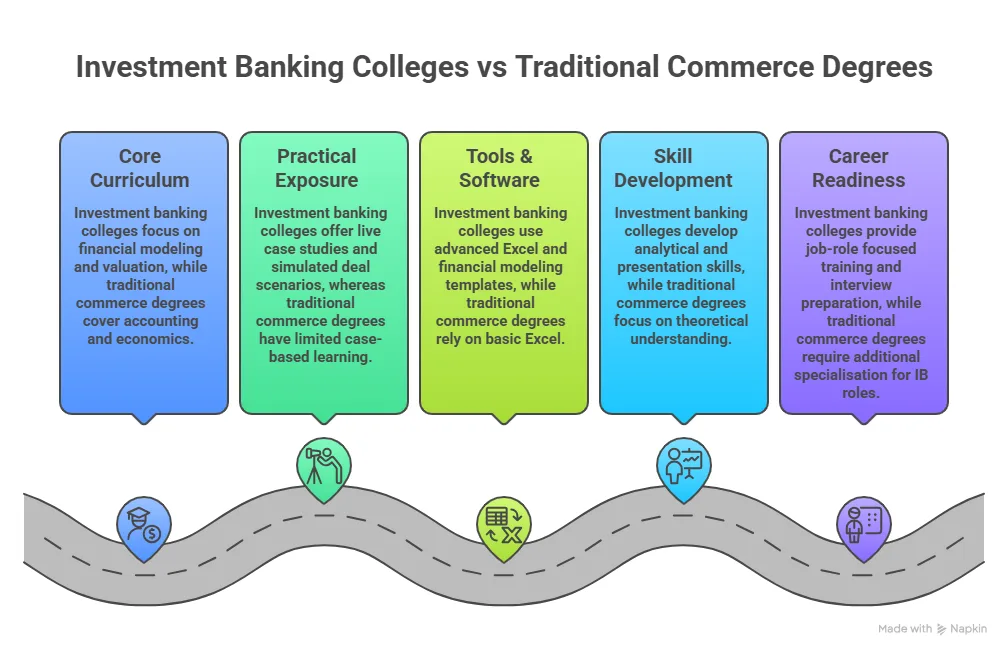
Investment banking colleges give you the vocabulary of finance. A good finance school gives you the grammar.
Think of it this way. You can spend four years studying music theory without ever sitting at a piano. You will understand scales, notation, and composition in the abstract. But you will not be able to play.
Investment banking is similar. The academic knowledge of DCF models, precedent transaction analysis, and LBO mechanics is widely available in textbooks. What separates a placed analyst from an unplaced one is whether they can build the model in Excel, correctly, under a deadline, without being told every step.
| What Finance Schools Teach | What Investment Banks Actually Test |
| Theory of DCF valuation | Building a DCF model from scratch in Excel with live company data |
| What an LBO is and how it works conceptually | Constructing a working LBO model with debt schedules and return analysis |
| Financial statement analysis as a subject | Spotting anomalies in actual audited financials under time pressure |
| M&A as a topic covered in a module | Building a merger model that tests accretion, dilution, and synergies |
| What a pitch book contains | Formatting and presenting a pitch book that a client can act on |
| Capital markets theory | Understanding deal structuring and pricing decisions on live transactions |
| Portfolio and investment theory | Running comparable company and precedent transaction analysis |
| Academic case studies | Applying valuation logic to real Indian deals with defendable assumptions |
This is why a financial modelling institute matters as much as your undergraduate or postgraduate institution. Finance programs at the best colleges cover the concepts. Finance workshops and specialised certifications cover the application. The students who get hired are the ones who did both.
Take a closer look at the evolving opportunities and challenges facing commerce students today, along with key decisions that can shape their career direction. It highlights important skills, industry expectations, and practical considerations to keep in mind as you move forward.
Does a CFA or CA Get You Into Investment Banking?
The two credentials that investment banks in India respond to most consistently are the CFA and the CA. They signal different things, and it is worth understanding the distinction.
The CFA, offered by the CFA Institute, is a globally recognised qualification covering investment analysis, portfolio management, ethics, and financial decision-making across three levels. JPMorgan, Goldman Sachs, Morgan Stanley, and BlackRock are among the firms that actively prioritise CFA charterholders. Completing even Level 1 adds measurable credibility to an analyst application.
The CA, completed through ICAI, develops deep accounting and audit expertise that banks value in transaction advisory, due diligence, and compliance-heavy roles. Many of the strongest investment banking profiles in India combine a CA with either an MBA or a CFA, creating a dual signal of technical depth and commercial breadth.
Neither is mandatory. But both are useful. The choice depends on which direction you want to go in investment banking.
- Front-office M&A and capital markets typically value the CFA.
- Transaction services and financial due diligence lean toward the CA.
Know which door you are trying to open before you commit to a three-year qualification program with investment banking colleges.
Also Read: Analytical Skills That Investment Bankers Must Have
Workflow of an Investment Bank
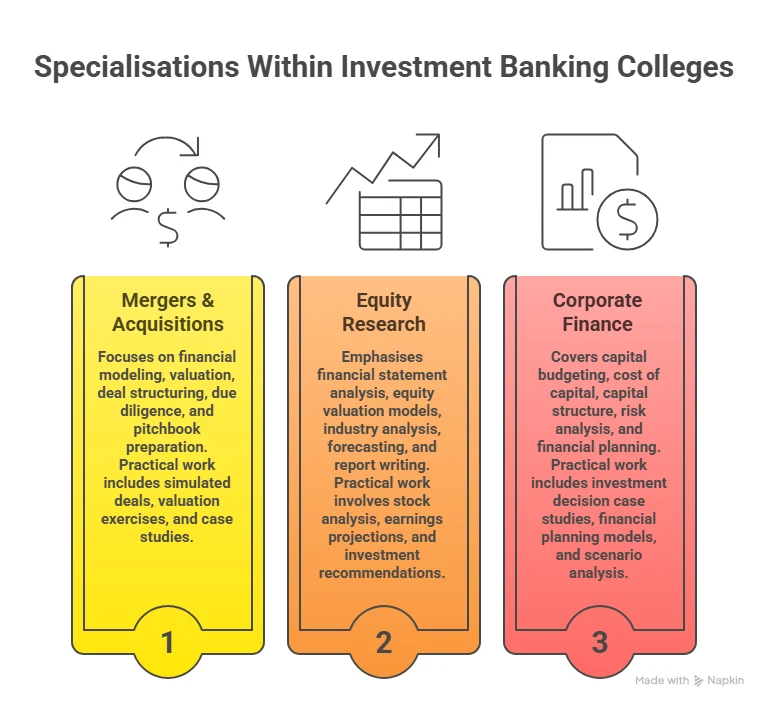
Before choosing the investment banking best colleges in India, it helps to understand what you are actually preparing to do. At the analyst level, you spend most of your time building financial models.
- A DCF model takes a company’s projected cash flows and discounts them back to a present value.
- A comparable company analysis benchmarks a firm against peers using market multiples like EV/EBITDA.
- A precedent transaction analysis looks at what similar companies sold for in past acquisitions.
These are not academic exercises. These are the actual documents that sit in front of a board when it decides whether to sell, acquire, or raise capital. Here is what the work looks like from the inside.
A company wants to acquire a competitor → The investment bank is hired to advise → The analyst team builds a merger model that projects what the combined entity looks like financially. What synergies are realistic, and whether the deal is accretive or dilutive to earnings per share.
The model has to be accurate, explainable, and defensible in a boardroom. It has been revised dozens of times. Every assumption gets challenged. That is what you train for in investment banking colleges.
Interesting Insight→ India’s M&A activity hit USD 26 billion in Q3 2025 alone. Source: EY India M&A Report. Behind every deal is a team doing exactly this work.
Which Financial Modelling Institute to Choose
Pick any analyst at a top domestic bank. Ask them what they use every day. The answer is Excel and PowerPoint, applied through financial models built on real company data. The technical interview that got them there tested exactly those skills.
A good financial modelling institute fills the gap between what colleges teach and what banks test. The distinction matters. Investment banking colleges teach valuation concepts in theory. There are several ways to access this training in India.
- Specialised programs from institutes focused on applied finance skills are the most direct route.
- Finance modelling workshops offered by industry professionals on platforms like Imarticus Learning, Breaking Into Wall Street, and BSE Institute give candidates practical modelling exposure alongside their degree.
The better institute for investment banking program combines modelling training with placement support and mock interview preparation.
Imarticus Learning runs a structured investment banking program specifically designed for this gap. The curriculum covers financial modelling, valuation techniques, mergers and acquisitions analysis, and capital markets fundamentals, with live case studies drawn from actual Indian deals and a placement cell that connects candidates with banking firms.
Also Read: What Do You Study in Investment Banking Courses?
Understanding the Difference Between Finance Programs vs. Finance Degrees
This distinction confuses a lot of people exploring investment banking colleges, and it is worth being direct about it.
- A finance program at a university leads to a degree. It takes two to four years, covers a broad curriculum, and qualifies you for a range of finance-adjacent careers. It is the foundation.
- A finance program at a specialised institute or professional training provider is shorter, narrower, and more applied. It targets a specific skill set and a specific career outcome. It is the accelerant.
- The Institute of Banking and Finance category in India includes both types. NSE Academy, BSE Institute, and NISM run recognised programs that sit between the two: structured enough to be credible, applied enough to be useful. NISM’s postgraduate certificate in investment banking and capital markets is a recognised credential among domestic banks.
The best institute for banking preparation is not a single answer. It depends on where you are in your education path. A final-year BCom student preparing for IIM entrance exams needs a different programme than a two-year CA pursuing an investment banking switch.
| Programme Type | Duration | Best For | Key Outcome |
| BCom / BBA Finance | 3 years | Undergraduate foundation | Eligibility for MBA and entry-level roles |
| MBA Finance (IIM/ISB/NMIMS) | 2 years | Post-grad, front-office entry | Associate-level banking placements |
| CFA Program | 3 to 4 years | Working professionals | Global credibility in investment analysis |
| CA (ICAI) | 4 to 5 years | Transaction advisory, due diligence | Strong for India-specific banking roles |
| Specialised IB Program (Imarticus, NSE Academy, etc.) | 3 to 12 months | Skill-building and placement | Practical modelling and banking readiness |
The table above is a practical reference, not a ranking for investment banking colleges. Multiple paths lead into investment banking. The question is which one fits your current profile and timeline.
Also Read: Is an Investment Banking Course Worth the Cost?
Investment Banking Salary in India
Investment banking salary expectations shape decisions about which programs and investment banker colleges in India to pursue. The numbers below come from live market data, not estimates.
According to Glassdoor India (December 2025), the average investment banking analyst salary is ₹8,72,500 per year. The range runs from ₹5,50,000 at the 25th percentile to ₹20,00,000 at the 75th percentile. Top earners (90th percentile) report up to ₹27,00,000.
| Role | Salary Range (India) | Notes |
| Analyst (0 to 3 years) | ₹6 – 19 LPA | Higher at global banks and Mumbai-based firms |
| Associate (3 to 7 years) | ₹15 – 30 LPA | Significant jump post-MBA or post-promotion |
| Vice President | ₹40 – 70 LPA | Deal exposure and client management are key |
| Managing Director | ₹55L to 1.5 Cr+ per annum | Bonus often exceeds base pay at this level |
The jump between analyst and associate is steep enough that people who start strong and stay at the same firm tend to build fast. Bonuses in good years can equal or exceed base salary at every level above analyst.
Explore what it truly takes to break into competitive finance roles, from building the right skill set to navigating hiring expectations. It offers a grounded perspective on preparation, positioning, and the steps that can improve your chances of entering the field.
How to Evaluate an Investment Banking College or Program
Choosing the right investment banking colleges is a decision that shapes your first few years in the industry. The criteria that actually matter go beyond brand reputation and campus rankings. Placement outcomes, curriculum depth, faculty quality, and interview preparation are the filters worth applying before you commit to any program.
Three questions cut through the noise faster than any ranking:
- Where did your last five batches go? Not aggregate placement percentages. Specific companies. Specific roles. If the answer is vague, the placement is vague.
- Who teaches the finance and modelling curriculum? Working bankers who do deals teach differently from career academics. Both have value, but the banking-specific skills that get tested in interviews are better learned from people who build models and pitch books today.
- What does the modelling curriculum actually cover? Ask for a session outline. A program worth your time will show you exactly what models are built, what datasets are used, and what the assessment looks like.
The best colleges for investment banking in India at the postgraduate level, measured by consistent investment banking placement outcomes in front-office roles, remain the IIMs, ISB, and XLRI.
Banking Tuition Near Me vs. Structured Programme
A lot of people search for banking tuition near me when they are preparing for interviews or trying to build modelling skills outside of their college curriculum. Tuition or a coaching centre that helps with exam preparation is useful for entrance exams like CAT, GMAT, or the CFA Level 1.
For the applied skills that investment banking colleges and interviews test, you need specialised programs. They teach you the skills, give you datasets to practise on, and provide feedback on your model outputs. They also prepare you for the specific interview formats used by investment banks.
The best institute for banking preparation will tell you upfront what kind of investment banking roles their recent graduates achieved. Fees at well-structured programs range from ₹50,000 for short certifications to ₹3 to 4 lakhs for comprehensive programs with placement support. That range is wide because the depth of preparation varies considerably.
Also Read: Is Investment Banking the Highest Paying Finance Career?
Why Imarticus Learning Stands Out for Investment Banking
Most programs teach investment banking as a subject. The Investment Banking Course at Imarticus Learning is built around a different idea entirely. The goal is not just to educate but to place. Every element of the program, from curriculum design to assessment to interview preparation, is structured around what banking firms actually hire for.
Here are the key features from the program that have over 50,000 learners trained and 1,000+ hiring partners on board
- 100% Job Assurance backed by the program structure.
- 85% investment banking placement rate across recent batches.
- 7 guaranteed interviews with banking and financial services firms.
- Salaries up to Rs. 9 LPA for placed graduates, with an average of Rs. 4 LPA across all placements.
- 1,200+ batches completed across weekday and weekend formats.
- Designed for BCom graduates, finance graduates, and professionals with 0 to 3 years of experience.
- Recognised as Best Education Provider in Finance at the 30th Elets World Education Summit 2024.
- Alumni are placed at JPMorgan, Goldman Sachs, Morgan Stanley, HSBC, BNP Paribas, Citibank, Fidelity, BNY Mellon, Capgemini, and Genpact, among others.
FAQs About Investment Banking Colleges
Get clear answers to the most frequently asked questions around admissions, curriculum, fees, placements, and career outcomes, helping you evaluate investment banking colleges with better clarity and confidence before making a decision.
Which college is best for investment banking?
For front-office roles at global and domestic banks, IIM Calcutta, IIM Ahmedabad, and ISB Hyderabad consistently place the most graduates. At the undergraduate level, SRCC Delhi and NMIMS Mumbai have strong finance track records. For a skills-focused path outside a traditional degree, Imarticus Learning offers a structured Data Analytics Course in Ahmedabad equivalent for investment banking, focused on applied modelling and placement support.
Which university is the best for investment banking?
Among investment banking colleges in India, ISB Hyderabad is widely considered the strongest for post-experience candidates due to its global bank partnerships and Mumbai alumni network. IIM Calcutta leads for fresh MBA placements in investment banking and capital markets. For global options, Wharton, LSE, and LBS remain the benchmark if you are targeting international banking roles.
Can I study investment banking?
Yes. Investment banking can be studied through finance degrees, MBA programs, certifications like the CFA, and specialised training programs. There is no single fixed route. Most working bankers in India come through MBA Finance from top B-schools, CA with banking-focused upskilling, or a combination of a finance degree and structured practical training. Imarticus Learning offers programs open to any graduate from any discipline, including non-finance backgrounds.
What is the Big 4 for investment banking?
In investment banking, the “Big 4” refers to the four largest global investment banks by deal volume and revenue: Goldman Sachs, JPMorgan, Morgan Stanley, and Citi. In the Indian context, the top domestic counterparts are Kotak Investment Banking, Avendus Capital, JM Financial, and ICICI Securities. All eight actively recruit from the best investment banking colleges and from structured training programs with verified placement outcomes.
Which course is best for investment banking jobs in India?
For freshers exploring investment banking colleges, a structured program that covers financial modelling, DCF valuation, M&A mechanics, and capital markets is the most direct route to interview readiness. For working professionals, the CFA combined with a focused modelling program is the most credible combination. Imarticus Learning offers an investment banking operations course designed specifically for the Indian job markets.
What is the best investment banking course with placement?
The best investment banking colleges with placement is one where the institute can show you named companies, specific roles, and verifiable salary ranges from recent batches. Imarticus Learning documents placement outcomes with this level of specificity. The program covers the full applied skill stack and includes a dedicated placement cell with active banking firm partnerships. This makes it one of the strongest options among investment banker colleges in India for practical training.
Which is the best institute for investment banking certification for experienced banking professionals?
For experienced professionals making a lateral move or seeking to formalise skills, the CFA is the most globally respected credential. For India-specific credentialing, NISM’s postgraduate certificate and programs from the Institute of Banking and Finance category, like those at BSE Institute and NSE Academy, are well-regarded. Imarticus Learning offers an advanced track within its investment banking program specifically structured for professionals with existing finance experience who want to move into deal-facing roles.
Which is the best institute for an investment banking course in India?
The right institute depends on your starting point. For MBA-level entry into front-office roles, the IIMs and ISB are the benchmark. For skills-first preparation with placement support, Imarticus Learning is one of the most structured options available, with a curriculum aligned to what top investment banking colleges do not teach: applied modelling, live case studies, and deal mechanics that banks test in every analyst interview.
The Decision That Actually Matters For Investment Banking Colleges
Most people thinking about investment banking colleges are really thinking about these two things: do I have what it takes, and is there a path in for someone with my background?
The answer to the first question is that investment banking is learnable. The skills are not innate. Financial modelling is a craft. Valuation is a framework. Pitch book construction is a format. All of them are teachable.
The answer to the second question is yes, there is a path. The finance degrees in India that lead into banking are accessible from commerce, economics, engineering, and even non-finance backgrounds. What makes the path navigable is building the right skills early, choosing investment banking colleges or programs with a real placement record, and not waiting until the final semester to start preparing for what comes next.
If investment banking is the career you are serious about, the gap between where you are and where you want to be is mostly a skills gap. A degree gets you considered. The right preparation gets you hired. Imarticus Learning’s Investment Banking Program is built precisely for that gap, with guaranteed interviews, verified placement outcomes, and a curriculum aligned to what banks actually test. The programme runs in both weekday and weekend formats, so your current schedule is not a barrier.
