


Last Updated on 3 days ago by Rina Chouhan
Scroll through any job listing in Ahmedabad today, and something stands out. The roles have changed. Not the industries, those are the same: pharma, textiles, finance, logistics. What has changed is what companies inside those industries are asking for. A distribution manager role at a pharma firm now lists Power BI as preferred, which is covered in a data analytics course in Ahmedabad.
→ An internal audit opening at a GIFT City company asks for SQL.
→ A supply chain position at a textile exporter wants someone who can build a demand forecast, not just read one.
Nobody is replacing accountants with algorithms. What is happening is simpler than that. Companies have more data than they know what to do with, and they are running out of patience for people who cannot use it.
A Data Analytics Course in Ahmedabad sits right at the centre of this shift. This piece covers what that course actually looks like, who it makes sense for, which certifications carry weight, and why auditors in particular have more to gain from analytics training than almost any other professional.
Did you know?
NASSCOM estimates a shortage of over 200,000 data professionals across India right now, from entry-level analysts to machine learning specialists.
(Source: Brototype / NASSCOM 2026 analysis)
Why is Ahmedabad Suitable for a Data Analytics Course
The assumption that data careers belong to Bengaluru or Hyderabad made sense once. It is getting harder to defend now.
GIFT City hosts over 600 financial entities under the IFSCA framework, according to IFSCA’s own data. TCS is scaling to 5,000 employees there. Deloitte, Capgemini, Wipro, and HCL all have delivery and analytics units in the city. A wave of BFSI-focused Global Capability Centres has arrived in the last 18 months. These are not satellite offices. These are teams with actual analytics hiring mandates.
Operating costs here run 30 to 40% lower than Bengaluru, per RKHRM’s GCC analysis. That gap is precisely why multinationals are choosing to build analytics functions here instead of expanding in cities where the talent is more expensive and harder to retain.
For someone entering a data analytics course in Ahmedabad now, the math is straightforward. The demand is here. The senior talent pool is still thin. The window where being reasonably skilled puts you ahead of most applicants will not stay open indefinitely.
Data analysts play a critical role in turning raw data into meaningful insights that guide business decisions. Beyond just numbers, they help organisations understand trends, improve processes, and make data-driven decisions across functions like marketing, finance, and operations.
What the Data Analytics Course in Ahmedabad Involves
Learning analytics is not unlike learning to cook in a professional kitchen. You do not start by plating a 7-course tasting menu. You start by learning how to prepare the ingredients, manage heat, and balance seasoning.
Only after those become second nature does the complex work make sense. Someone who skips the fundamentals will always be guessing when something goes wrong.
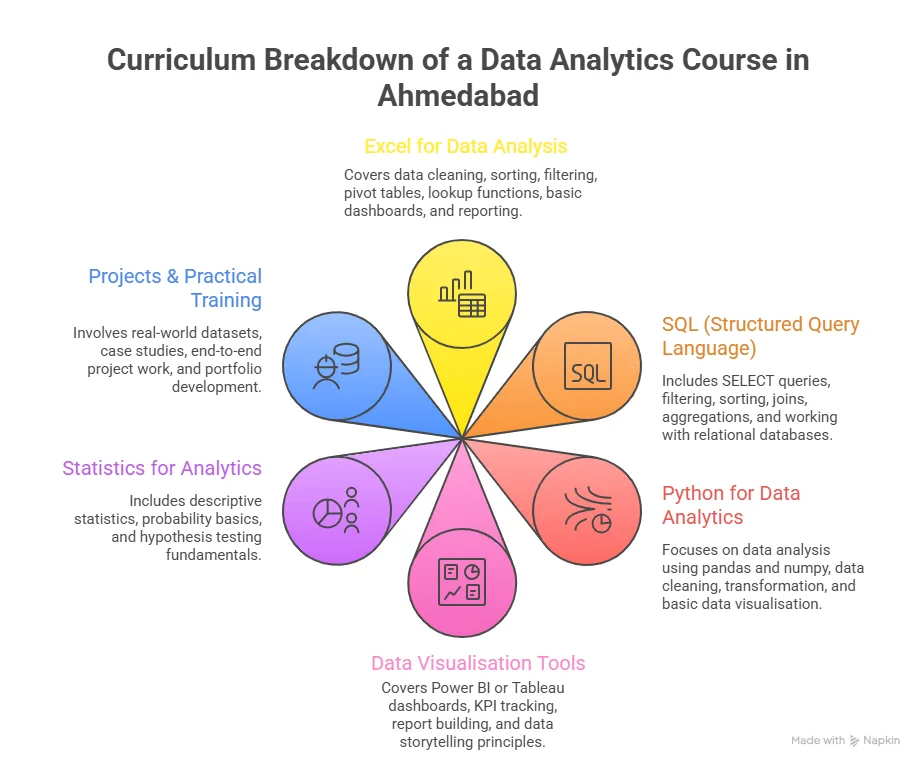
The foundations layer is Excel used properly, not for formatting cells but for pivot tables, lookups, and data manipulation at scale. SQL for pulling and filtering records from databases. Basic statistics: mean, median, variance, correlation. These are the skills working analysts use every single day.
The applied layer is where Python enters. Specifically, Pandas and NumPy, which are the libraries analysts use for cleaning and transforming data. A fair warning: roughly 40% of actual analyst work is getting data into a usable state before any analysis happens. Nobody tells you this upfront. Power BI and Tableau Online come in here for visualisation.
The communication layer is the one most courses treat as optional. It is not. An analysis that sits in a Python notebook and never influences a decision was a waste of time. This layer is about building interactive dashboards, writing findings for non-technical stakeholders, and structuring recommendations so they lead somewhere. Predictive analytics and segmentation come in at this stage, too.
| Tool / Skill | Used For | Most Relevant To |
| Excel and SQL | Pulling, sorting, and filtering records | Finance, Operations, HR |
| Python (Pandas, NumPy) | Cleaning and transforming datasets | Analysts, Researchers |
| Power BI and Tableau | Dashboards and visual reporting | Every business function |
| Statistics and Probability | Finding patterns and testing assumptions | Marketing, Research, BFSI |
| Machine Learning (introductory) | Forecasting and prediction | Advanced roles |
Most data analytics courses in Ahmedabad cover the first four thoroughly. Machine learning at an introductory level is included in some; in others, it is a separate advanced module. Neither approach is wrong, but it is worth knowing before you enrol what depth is covered and at which stage.
Also Read: Why Data Analytics Will Dominate 93% of Businesses by 2030?
Big Data Analytics Courses in Ahmedabad
Big data is not just a larger version of regular analytics. The tools, the infrastructure, and the problems being solved are fundamentally different.
Standard analytics works with data that fits in a spreadsheet or a conventional relational database. Big data is the territory you enter when the data is too large, arrives too fast, or is too structurally inconsistent for those tools to handle. The distinction is not about the size of the numbers. It is about the architecture needed to process the information at all.
One way to see the difference: tracking weekly sales at one store is a standard analytics problem. Tracking real-time customer movement across 1,000 stores simultaneously, processing each event as it happens, and surfacing patterns within seconds requires an entirely different infrastructure.
Big data analytics courses in Ahmedabad cover tools built specifically for that infrastructure:
- Apache Hadoop distributes large datasets across many machines and processes them in parallel. Used in telecom, banking, and e-commerce for large-scale batch processing.
- Apache Spark does similar work but operates in memory, which makes it significantly faster for real-time applications. Standard at fintech and large e-commerce companies.
- Cloud analytics platforms like AWS Redshift, Google BigQuery, and Azure Synapse Analytics are where most enterprise-scale analytics now live. All three have managed analytics services built in.
- NoSQL databases like MongoDB and Cassandra handle data that does not sit neatly in rows and columns, clickstream data, social records, and sensor outputs.
This track is not the right starting point for everyone. If you are coming from a non-technical background, the core analytics program is where to begin. Big data analytics courses in Ahmedabad make sense for IT professionals, backend developers, and data engineers who already understand database fundamentals and want to work at an enterprise scale.
Interesting Insight→ India’s big data analytics market is projected to grow from USD 19.49 billion in 2025 to USD 69.78 billion by 2035, at a CAGR of 13.6%.
(Source: Market Research Future)
Data Analytics Certification Courses in Ahmedabad
A certification functions as a filter. It tells a hiring manager: this person has demonstrated a minimum competency level through an external assessment, which reduces the risk of hiring someone who cannot do the job. That is its function. Employers are not ranking candidates by certification tier. They are using it to clear a baseline threshold.
The practical implication: an externally validated certification carries a different weight than an internal course completion certificate. Both have a place, but they signal different things. When evaluating data analytics certification courses in Ahmedabad, the question to ask any institute is straightforward. Does your program prepare me for an external exam, or does it offer an internal certificate? Ask it directly.
| Certification | Issued By | What It Tells an Employer | Best For |
| Google Data Analytics Certificate | Google via Coursera | Solid foundation with project-based assessment | Freshers and career switchers |
| IBM Data Analyst Professional | IBM via Coursera | Practical tool knowledge across the analytics stack | Mid-level professionals |
| Microsoft PL-300 | Microsoft | Power BI proficiency at a job-ready standard | Reporting and BI roles |
| IABAC Certified Data Analyst | IABAC | India-recognised credential with domestic employer recall | Local job market focus |
| Tableau Desktop Specialist | Salesforce / Tableau | Verified visualisation competency | BI and reporting roles |
Imarticus Learning structures its analytics programme to align with these external benchmarks, with live instruction, mock exams, and a placement support system built into the course rather than added as an afterthought.
Also Read: What Are Data Science Course Fees and Duration?
Classroom or Online Formats for Data Analytics Courses in Ahmedabad
People generally pick a course format based on what fits their calendar and move on. That is not the wrong question. It is just not the only question.
Two people enrol in the same data analytics classroom course in Ahmedabad.
→ One is 23, fresh out of college, with no work experience.
→The other is 31, works in operations at a logistics company, and travels two weeks a month.
The 23-year-old needs accountability. Without a cohort pulling them along and an instructor asking questions, self-paced online learning tends to fall apart around week three when the content gets harder. The 31-year-old has plenty of discipline but cannot commit to fixed evening batches. Same course. Completely different format requirements. Hence, the learning model of a data analytics course in Ahmedabad should be suitable according to the academic or professional commitments.
| Factor | Classroom | Online or Self-Paced |
| Feedback | Immediate, from someone in the room | Delayed, through forums or support tickets |
| Peer learning | A cohort you work with daily | Usually anonymous, minimal interaction |
| Schedule | Fixed, typically evenings or weekends | Fully flexible |
| Accountability | Built in | Entirely self-managed |
| Placement support | Usually included with dedicated staff | Varies widely |
| Best for | Freshers, career changers | Working professionals with strong self-direction |
Most quality institutes now offer a hybrid structure for their data analytics classroom course in Ahmedabad: live weekend sessions with recorded content for the week. It works well for professionals who want live instruction without losing five evenings every week.
One thing that does not change regardless of format: you need to work on real datasets during the course. A program that teaches tools without giving you messy, real-world data to apply them to is not preparing you for what the job actually involves.
Also Read: Healthcare Data Analytics: 10 Challenges You Should Know
Data Analytics Course in Ahmedabad for Auditor Professionals
If you are a Chartered Accountant or an internal auditor, you are already doing data analytics. The problem is you are doing it the slow way.
Every vendor payment review is a data problem. Every P&L variance analysis is a data problem. Every bank reconciliation is a data problem. The question is whether you spend three days on a sample of 200 transactions or three hours across all 40,000.
A data analytics course in Ahmedabad for auditor professionals is not a programming course. It is a course in making the work you already do faster, more complete, and harder to dispute.
What the audit toolkit looks like in practice:
- ACL Analytics (now Diligent Analytics): The most widely used audit data software globally. Designed for population-level transaction testing, Benford’s Law fraud detection, and duplicate payment identification. Big 4 firms and large internal audit functions run on this.
- CaseWare IDEA: Built specifically for financial data analysis and large-scale audit sampling. Common in statutory and forensic audit work.
- Python with Pandas: Not audit-specific, but increasingly used by audit teams for automated reconciliation, anomaly flagging across large datasets, and building repeatable scripts that cut manual effort across audit cycles.
- Power BI: For presenting findings to audit committees and boards in a way they can actually absorb, instead of a 70-slide deck nobody reads past slide 15.
A genuinely relevant data analytics course in Ahmedabad for auditor profiles will cover:
- Population testing versus sampling methodology
- Benford’s Law and anomaly scoring
- Segregation-of-duties analysis on access control records
- Building visual audit reports for non-technical stakeholders.
If the course you are considering does not include these applications by name, it is a general analytics course with a finance label. Worth doing, but not the same thing.
Choosing between data science and data analytics depends on your interests, skill set, and career goals. Both paths require strong data handling skills, but differ in complexity, tools, and role expectations, making it important to understand which aligns better with your long-term career direction.
What the Job Market in Ahmedabad Actually Pays
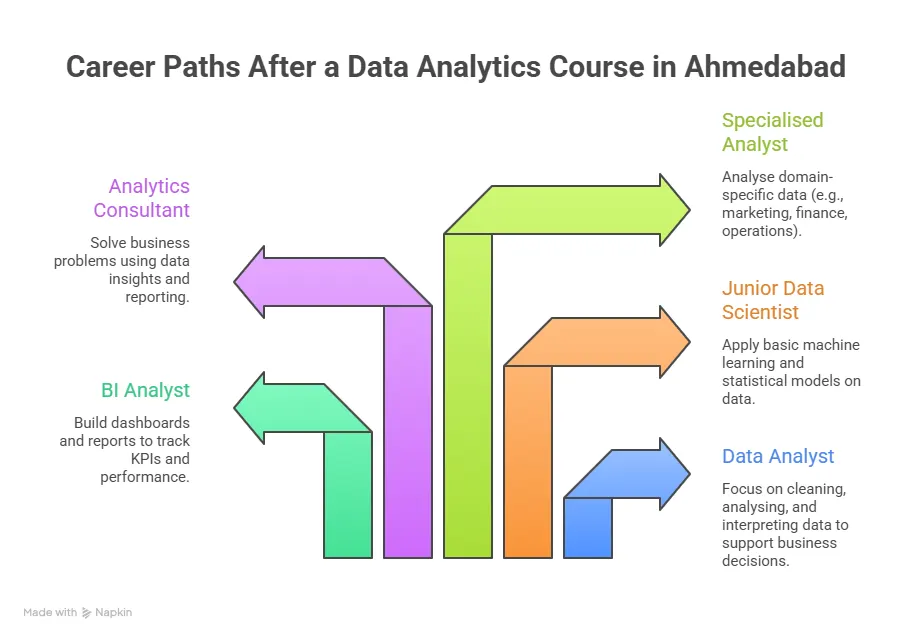
Glassdoor’s late 2025 data puts the average data analyst salary in Ahmedabad at ₹5,01,320 per year. Entry-level roles start around ₹4,30,000. Analysts with two to three years of project experience reach ₹6,50,000. Senior analysts earn between ₹5,48,000 and ₹12,30,000. Indeed’s December 2025 figures average at ₹5,26,335.
| Role | Salary Range | Key Skills |
| Data Analyst | ₹4.3 – 6.5 LPA | SQL, Python, Power BI |
| Senior Data Analyst | ₹5.5 – 12.3 LPA | Advanced Python, Tableau, ML basics |
| Business Analyst | ₹5 – 9 LPA | Excel, SQL, stakeholder communication |
| Audit Data Analyst | ₹5 – 10 LPA | ACL, Power BI, Python, BFSI domain knowledge |
| BI Developer | ₹6 – 12 LPA | Power BI, SQL, Azure |
| Data Engineer | ₹7 – 14 LPA | Python, Spark, cloud platforms |
Bengaluru pays ₹6.5L to ₹13.3L for equivalent roles. Ahmedabad is lower on paper. The cost-of-living gap makes the comparison less clean than it looks. For someone two to three years into their career, the salary-to-cost ratio here competes more favourably than the raw numbers suggest.
The industries actively hiring right now are BFSI and fintech in GIFT City, pharma and life sciences across the Ahmedabad-Anand belt, e-commerce operations, manufacturing analytics, and GCC units from multinationals that have set up in Ahmedabad over the last 18 months.
Also Read: Crack Interviews with These 40 Power BI Questions
How to Pick the Right Institute for a Data Analytics Course in Ahmedabad
More institutes offer data programmes in Ahmedabad now than two years ago. That is good news for learners and also means more noise.
Price and reviews are the two criteria most people use. Both are unreliable on their own. A cheap course that leaves you unemployable costs more in the long run than a more expensive one that gets you placed. Reviews tell you how past students felt about an experience, not whether the current curriculum reflects what the market actually needs.
Five things worth actually checking:
- Ask them to walk you through a project a recent student completed. Not a screenshot. A walkthrough. If they hesitate, you know what the live project component actually looks like.
- Find out where the instructors work now, not where they worked five years ago. An instructor who left the industry five years ago is teaching you five-year-old workflows.
- Ask for a placement breakdown with company names, roles, and salary ranges. A percentage figure without those specifics is not evidence of strong placement. It is a marketing number.
- Check whether you get licensed software access during training. Practising on trial versions or watching screencasts is not the same as working in a real environment.
- Ask about batch size. A class of 40 and a class of 20 are different experiences when you are learning a technical skill that requires feedback.
Starting a career in data analytics today involves building a strong foundation in tools like Excel, SQL, and Python. As the field continues to evolve, staying updated with industry tools and focusing on portfolio-building play a key role in transitioning into entry-level analytics roles.
How Businesses Leverage Skills from a Data Analytics Course in Ahmedabad
Understanding what companies in Ahmedabad do with analytics helps you understand what you are training toward.
- Forecasting customer behaviour is one of the most active use cases. Retailers and NBFCs run models that score each customer’s likelihood to churn, purchase again, or respond to an offer. When your banking app surfaces a pre-approved loan offer the week you start looking at property listings, that is one of these models working. The analyst does not just build it. They explain their outputs to a marketing team that does not read code.
- Supply chain planning at pharma companies along the Anand corridor has moved from spreadsheet intuition to demand forecasting models. Textile exporters use similar logic for yarn procurement, planned 90 days before delivery windows open.
- Fraud detection in real time runs at every GIFT City bank and NBFC on every transaction. The scoring model checks whether the transaction matches the account’s normal behaviour pattern. If it does not, the transaction is held. The team that builds, monitors, and improves that model is a data analytics team.
- Attrition prediction in HR is quieter but increasingly common. Leave records, performance scores, engagement data, and certain internal signals feed into models that flag employees likely to leave in the next 90 days. The goal is to give managers time to act before someone decides.
- Full-population audit testing is where the data analytics course in Ahmedabad for the auditor track becomes most obviously useful. When a team samples 200 of 40,000 transactions, the fraud hiding in the other 39,800 is invisible. Full-population testing changes the arithmetic of the audit entirely.
Also Read: Top Data Visualisation Techniques Every Business Analyst Should Know
Why Imarticus Learning Is the Right Place to Start Your Data Analytics Course in Ahmedabad
Most data analytics programs in Ahmedabad teach tools. The Data Analytics Course in Ahmedabad offered by Imarticus Learning is built around a different outcome entirely: getting you placed. If you are a fresh graduate or an early-career professional with a technical background, this is where structured preparation meets real hiring outcomes.
- 100% Job Assurance is built into the program structure
- 10 guaranteed interviews with hiring partners before you graduate
- 1,500+ students placed across recent batches
- The highest salary of Rs. 22.5 LPA was achieved by a placed graduate
- 52% average salary hike reported across the placed cohort
- 400+ hiring partners actively recruiting from the programme
- 25+ live projects completed during the course on real datasets
- 10+ tools covered, including Python, SQL, Power BI, Tableau, and more
- Flexible batch formats: 5 months weekday or 10 months weekend, both with classroom and live online options
- Alumni are placed at Deloitte, Goldman Sachs, Accenture, KPMG, IBM, Capgemini, Infosys, Genpact, and Cognizant, among others.
FAQs About the Data Analytics Course in Ahmedabad
Before choosing a program, most learners look for clarity on eligibility, syllabus, tools covered, fees, and career outcomes. These frequently asked questions help address practical concerns and give a clearer picture of what to expect from a data analytics course in Ahmedabad.
Which course is best for data analytics?
The best Data Analytics Course in Ahmedabad depends on where you start. Freshers need structured, project-led learning. Working professionals need tools that connect to their current role. Imarticus Learning covers both, with applied tracks and placement support built around each profile.
Which is the best institute for data analytics in Ahmedabad?
The institute worth choosing for data analytics courses in Ahmedabad will be identifiable by four things without much effort: a curriculum updated to reflect current tools and hiring patterns, faculty who are in the industry now, hands-on project work on actual datasets during the course, and placement outcomes documented at named companies. Imarticus Learning delivers on all four, with a full applied analytics stack covered and structured placement preparation included throughout.
Which is the institute for learning data analytics in Ahmedabad, and what are the eligibility criteria?
Imarticus Learning offers one of the more comprehensive applied analytics programmes in Ahmedabad, covering everything from foundations through advanced business analytics. Eligibility is open to graduates from any discipline: commerce, science, engineering, or humanities. Prior coding experience is not required. The programme begins with an onboarding module specifically designed for students without a technical background, bringing them to a common starting point before the core curriculum begins.
How do I find companies in Ahmedabad, Gujarat that provide internships in the data analytics field?
Internshala, LinkedIn, and Naukri list active analytics internships in Ahmedabad. GIFT City firms post regularly as their teams grow. Imarticus Learning connects enrolled students directly with hiring partners through its placement cell. A strong project portfolio from the course helps significantly.
What are the key features to look for in a good data analytics institute in Ahmedabad?
Live project work on real datasets, not just tool tutorials. Faculty currently working in analytics, not just teaching it. Licensed software access during training. A placement cell that can show you where recent graduates landed, at what company, in what role, and at what salary. Batch sizes are small enough for actual instructor interaction. Imarticus Learning’s data analytics certification courses in Ahmedabad are structured around all five of these as core requirements rather than optional features.
How can businesses best leverage data analytics?
Businesses gain the most when they move from reporting the past to predicting what comes next. Demand forecasting, fraud detection, attrition modelling, and operational analysis are already active in Ahmedabad’s industries. The analysts who translate those outputs into decisions that non-technical leaders can act on are the ones companies cannot stop hiring.
What are five uses of data analytics?
Customer segmentation, financial forecasting, fraud detection, operational efficiency analysis, and clinical analytics are the five most active use cases in Ahmedabad’s job market right now. Each one maps directly to a hiring need in this city. Completing a Data Analytics Course in Ahmedabad puts you squarely in the middle of that demand.
Your Next Step Starts with a Data Analytics Course in Ahmedabad
The people who benefit most from analytics training are not the ones who were always going to enter the tech world. They are the finance manager who realises their team is sitting on data they cannot read. The auditor who is tired of explaining to a board why they tested 0.5% of transactions. The operations professional who can see the problem in the numbers but cannot build the argument fast enough to matter.
The data analytics courses in Ahmedabad that are worth your time are the ones that treat your existing professional context as an asset, not as something to be overwritten. The tools are learnable. What takes longer to build is the ability to use them in the context of a real business problem. That combination is what the market is actually short of right now.
Ahmedabad’s job market is early enough in this shift that the gap still exists. It will not always. Imarticus Learning offers a Data Analytics Course in Ahmedabad for freshers and working professionals with classroom and online formats, live project work, and a placement cell that documents its outcomes. If a data analytics career in Ahmedabad is where you are headed, this is a strong place to begin.
