


Last Updated on 4 days ago by Rina Chouhan
People spend months researching the CFA program before they even touch the registration page. That research is useful. But the moment you decide to go for it, the first practical question shifts from “what is it” to “how do I actually get in.” CFA registration is the answer to that question, and it is more layered than most candidates expect.
Here is where most people go wrong. They assume registering for the CFA certification means paying a fee and showing up. It does not. There are two separate actions involved. The first is enrolling with the CFA Institute. The second is scheduling your exam with Prometric, which is the testing partner. Both have to be completed. If you pay the fee but never schedule your Prometric slot, you are not actually registered for anything. Think of it the way you would think about booking a hotel versus booking the flight to get there. One without the other leaves you stranded.
Over 300,000 candidates attempt the CFA exam globally each year. That number has only grown since the exam moved to a computer-based format and began offering multiple windows annually. More flexibility has brought more candidates into the pool. This also means more competition for Prometric slots in popular cities, especially around the May and November windows.
This guide covers everything around CFA registration: eligibility, fees across all three levels, exam dates, the step-by-step process, and what you, as an Indian candidate, specifically need to know before you begin.
Did you know?
Registering early can save you around $300 on the CFA exam registration fee compared to standard pricing.
What are the CFA Registration Requirements
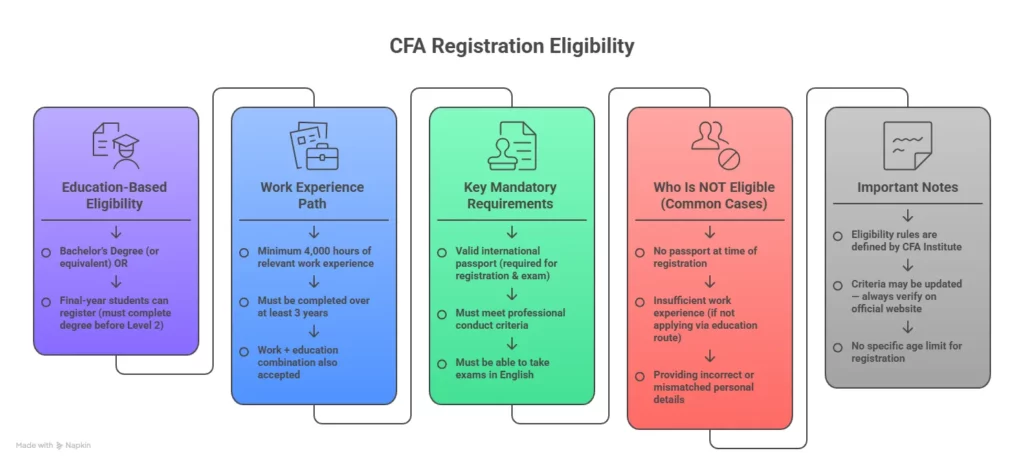
The CFA registration requirements are specific, and the CFA Institute does verify submissions. Here is what you actually need to qualify before starting your CFA Institute registration.
If you are still exploring whether this program is the right fit and want to understand: what is CFA before committing, that context matters here too. You need to satisfy one of the following before your CFA Institute registration can be completed:
- A completed bachelor’s degree from a recognised institution.
- Enrolment in the final year of a bachelor’s program at the time of registration.
- Four years of relevant professional work experience, which does not have to be in finance specifically.
- A combination of part-time work and education that adds up to four years in total.
Final-year students get a lot of questions on this. Yes, you can register before you graduate. But your degree has to be completed before you actually sit the exam. If you are still a semester away when the exam date arrives, you are ineligible to sit regardless of your registration status.
On Passports
This comes up constantly. Is a passport required for CFA registration? Yes, without exception. Your passport is your only accepted identity document at the Prometric centre on exam day. A driving licence, national ID, Aadhaar card, or college ID will not be accepted, no matter what. The name on your passport also has to match the name on your Prometric booking exactly.
If your passport has expired, renew it before you begin the CFA registration process. Beyond the passport, keep the following ready before you start:
- An email address you actively check, since all communication from the CFA Institute, including your admit card and results, goes there.
- Academic transcripts or a letter of enrolment from your institution.
- A professional reference if you are applying through the work experience pathway.
Also Read: What Sets CFA Apart as the Gold Standard in Finance?
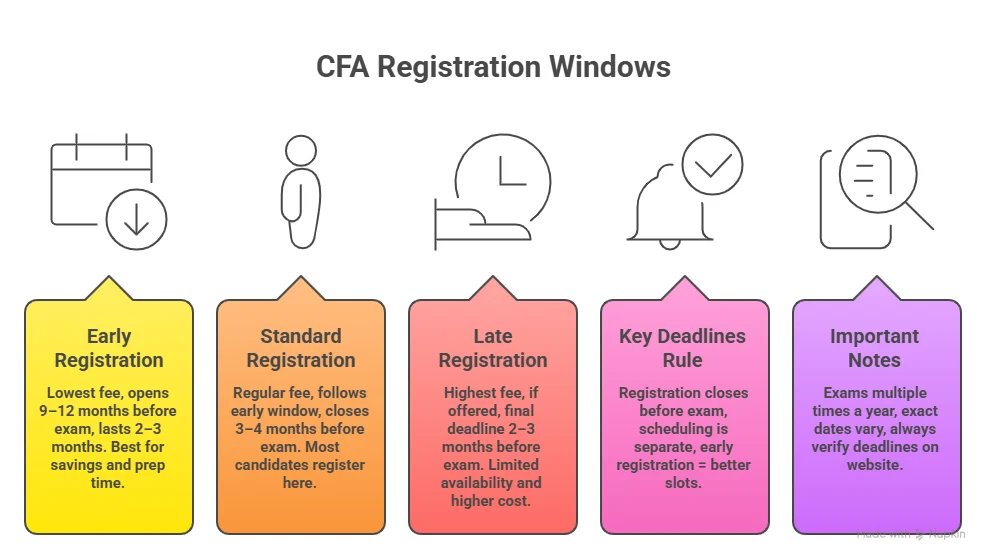
Planning Your Window For CFA Registration Dates 2026
Choosing the wrong CFA exam window is one of the more expensive mistakes a CFA candidate can make. Not because the fee changes drastically between windows, but because of what it costs in preparation time. Pick a window that does not give you enough runway, and you are either cramming or deferring, both of which cost money and momentum.
The CFA Level 1 registration date options are the most generous of any level. Four windows per year means you have real flexibility. CFA Level 2 registration covers three windows. CFA Level 3 registration runs on just two. Here is the full 2026 calendar:
| Exam Level | Exam Window | Early Registration Deadline | Standard Deadline | Late Deadline |
| Level 1 | February 2026 | September 2025 | October 2025 | November 2025 |
| May 2026 | November 2025 | January 2026 | February 2026 | |
| August 2026 | February 2026 | April 2026 | May 2026 | |
| November 2026 | May 2026 | August 2026 | September 2026 | |
| Level 2 | May 2026 | November 2025 | January 2026 | February 2026 |
| August 2026 | February 2026 | April 2026 | May 2026 | |
| November 2026 | May 2026 | August 2026 | September 2026 | |
| Level 3 | February 2026 | September 2025 | October 2025 | November 2025 |
| August 2026 | February 2026 | April 2026 | May 2026 |
The CFA Level 1 registration deadline for each window is a hard cutoff. There are no extensions. If you miss the late registration window entirely, you register for the next cycle and pay again from scratch. The CFA Level 1 registration last date is published well in advance.
Choosing the Right Exam Window After CFA Registration
There is no single right window for everyone. The right one is the window where your preparation time, professional schedule, and financial readiness line up.
- February & August windows suit candidates avoiding the high-pressure May cycle.
- February typically has lower global candidate volume, improving Prometric availability in smaller cities.
- May & November are the most popular windows, leading to higher competition for slots.
- Book your Prometric slot early as soon as scheduling opens to avoid last-minute issues.
In short, choosing the right exam window directly impacts availability, timing, and your overall CFA journey progression.
Interesting Insight→ Nearly 44% of CFA Level 1 candidates do not clear the exam on their first attempt. Candidates who register during the early window and use the full preparation period perform measurably better than those who register close to the deadline.
Step-by-step Process of the CFA Registration
The CFA registration process itself is not complicated once you know the sequence. The confusion usually comes from candidates treating enrolment and scheduling as the same step. They are not.
Step 1: Create Your CFA Institute Account:
Go to cfainstitute.org and set up a candidate account. Use an email you will have access to for years. Results, scheduling confirmations, and charter correspondence all come to this address.
Step 2: Submit Your Eligibility Details:
Enter your academic and professional information. Upload your transcripts or proof of enrolment. If you are applying through the work experience route, have your reference details ready. The CFA Institute reviews submissions, and any discrepancies can delay your registration.
Step 3: Select Your Exam Level and Window:
Choose the exam level you are registering for and the window that fits your preparation timeline. For CFA L1 registration, all four 2026 windows are open for selection. For CFA L2 registration and Level 3, availability is more limited.
Step 4: Pay the CFA Registration Fee:
Payment is made in USD regardless of where you are based. Use an internationally enabled credit or debit card.
Step 5: Schedule Through Prometric:
After payment is confirmed, you receive a scheduling email from Prometric. Log in, choose your test centre, and lock in your preferred date and time. Do this immediately. Urban test centres in cities like Mumbai, Bengaluru, and Delhi fill up fast, particularly for May and November windows.
Step 6: Save Everything:
Take a screenshot of both your CFA Institute registration confirmation and your Prometric booking. Store copies in your email and on your phone.
Also Read: Thinking About CFA? Here Are 5 Things to Know
What is the CFA Registration Fee
The CFA Institute eliminated the one-time enrolment fee of $350 that used to be charged to first-time candidates on top of the exam fee. Gone. That means the total cost for a first attempt at Level 1 is lower in 2026 than it was for candidates who registered even two years ago.
The CFA course fees themselves have gone up slightly. But the net effect for a first-time registrant is still lower overall. The key variable now is timing. CFA early registration gives you the lowest possible fee.
Fees apply equally to Level 1, Level 2, and Level 3. The registration fee does not increase as you move through the program. Here is the current fee structure across all three CFA levels:
| Fee Window | CFA Registration Fee (USD) | Approx. INR |
| Early Registration | $940 | ₹79,900 |
| Standard Registration | $1,090 | ₹92,650 |
| Late Registration | $1,290 | ₹1,09,650 |
A few additional costs worth knowing:
- Rescheduling fee: $250 if you change your Prometric slot after booking
- Deferral fee: $449 if you move your exam to a future window after you have already registered
- Retake cost: Each new attempt at any level requires a fresh CFA exam registration and full fee payment. You get up to six attempts per level.
CFA Registration Fees in India
The fee listed on the CFA Institute website is in USD. The rupee conversion, your bank’s foreign currency charges, and a few other India-specific factors quietly add up. Here is a breakdown of what the total cost looks like from an Indian candidate’s perspective.
- Foreign Currency Charges from Your Bank: Your bank or card issuer adds a foreign currency transaction markup on top of the conversion rate. This typically runs between 1.5% and 3.5%, depending on your card type. On a payment of ₹79,900, a 3% markup adds over ₹2,400 to your bill.
- GST Considerations: If you are registering as an individual, GST is typically not applied at the time of payment through the CFA Institute portal. But if your employer is sponsoring your fee, the tax treatment may differ.
Also Read: Does CFA Pay Off? Cost vs Career Returns Explained
The Strategic Advantage of CFA Early Registration
The financial savings are the obvious reason to use the early bird registration CFA window. But there is a less obvious reason that matters more: commitment. When you pay the CFA early registration fee months before your exam, you are not just saving money. You are installing a deadline into your calendar that feels real.
CFA Scholarships: The Option Almost Nobody Uses
The CFA Institute Access Scholarship reduces the exam fee to $250 for candidates who demonstrate financial need. The Women’s Scholarship does the same for female candidates. Applications go through the CFA Institute portal and are reviewed on a rolling basis.
If your institution holds CFA Institute University Affiliation status, you may also be eligible for a reduced-fee enrolment code through your university. Check with your academic office before you pay the full CFA Level 1 registration fee.
Balancing a full-time job with preparation often comes down to consistency rather than long study hours. A structured 2-hour daily approach can make the workload manageable while still keeping you on track with the syllabus and revision.
CFA Level 1 Registration
For most candidates, this is the first real step from research to action. CFA Level 1 registration is not just about signing up; it is where timelines, costs, and preparation start to come together. The process itself is straightforward through the CFA Institute, but small decisions here can impact your entire attempt.
What to expect
- You will complete your CFA Institute registration online and select your exam window.
- Eligibility is verified based on your education or work experience.
- A valid passport is mandatory.
Exam windows and flexibility
Level 1 offers the most flexibility, with multiple windows across the year,r such as February, May, August, and November. This makes it easier to plan your CFA Level 1 exam registration based on your schedule, but it can also lead to delays if you keep postponing.
How to approach it
- Decide your exam window based on realistic preparation time
- Track important CFA Level 1 registration dates and deadlines in advance
- Avoid rushing close to the CFA Level 1 registration deadline
Starting right with CFA L1 registration is less about speed and more about making informed decisions that set up your preparation properly.
Also Read: How to Crack CFA Level 1 in Your First Attempt?
CFA Level 2 Registration
Once you clear Level 1, your eligibility for CFA Level 2 registration is updated automatically by CFA Institute. This usually reflects within a few days after results are released, so there’s no need to rush into the next step immediately. At this stage, the CFA registration process itself remains familiar. What changes is how you approach timing and planning.
What to expect
- You can only proceed with CFA exam registration after your Level 1 result is officially updated.
- No additional documentation or approval is required
- The structure is similar to CFA Level 1 registration, but with less flexibility in timelines
Exam windows and planning
Level 2 is typically offered three times a year, most commonly in May, August, and November. While this gives you options, they are still more limited compared to Level 1. Many candidates prefer May or November since they align better with work schedules and allow more consistent preparation.
What really changes
- You need to think ahead about CFA registration dates instead of waiting till the last minute.
- Slot availability becomes more important, especially if you delay beyond the early registration CFA windows.
- The difference between early and standard CFA registration fees still exists, so timing can impact your total cost.
How to approach it
- Start thinking about your next attempt even before the results are out.
- Try to register during the CFA early bird registration window to save on the CFA exam registration fee.
- Choose a timeline that realistically fits your preparation, not just convenience.
Also Read: How To Do the CFA Course In India?
CFA Level 3 Registration
By the time you reach CFA Level 3 registration, the margin for delay becomes much smaller. With only two exam windows in a year, your decisions here directly affect how quickly you complete the program.
What to expect
- You become eligible only after clearing Level 2 and completing the CFA Institute registration update.
- The process is similar to earlier levels, but timelines are tighter and less forgiving.
Exam windows and limitations
Level 3 is typically conducted in February and August. This means:
- Missing a CFA registration deadline can push your attempt by at least six months.
- There is far less flexibility compared to CFA L2 registration or earlier stages.
Smart approach
- Treat Level 3 as a time-sensitive transition, not just another exam.
- Plan your attempt based on readiness, not just the next available window.
- Keep track of CFA registration fees in Indian rupees to budget accurately across levels.
Career outcomes can vary widely depending on your skills, interests, and experience. Understanding the most common roles and what they involve can help you see where the program can realistically take you in the Indian job market.
What Happens After You Complete CFA Registration
The confirmation email lands in your inbox. The Prometric slot is booked. Within 24 to 48 hours of CFA registration confirmation, the CFA Institute grants you access to the digital curriculum. The first two weeks after CFA exam registration should be spent on the orientation of the CFA course details. Here is a more productive way to use those first two weeks:
Week 1: Map the Terrain
Read through the Learning Outcome Statements for every CFA subject. These are the specific skills and concepts each exam question is designed to test. The LOS list tells you exactly what matters.
Then look at the official topic weights published by the CFA Institute. Financial Statement Analysis, Fixed Income, and Equity collectively account for a large portion of the Level 1 exam. Ethics is weighted heavily across all three levels.
Week 2: Build the Calendar
Count the weeks between today and your exam date. Divide your available study hours by the content coverage of the CFA curriculum you need. If the math does not work, it is better to know now and defer than to discover it six weeks before the exam.
Also Read: What Are the Top Career Options After CFA?
What Indian Candidates Should Know About Scholarship For CFA Registration
The CFA registration fees in Indian rupees are significant enough that the CFA scholarship question deserves its own space beyond a passing mention.
The CFA Institute Access Scholarship is available to candidates who demonstrate genuine financial need. The application is straightforward and does not require official financial documents beyond a personal statement. Awards bring the fee down to $250 per level.
The Women’s Scholarship runs on the same fee reduction structure. Female candidates who meet the basic eligibility criteria can apply. The application process is similar to the Access Scholarship.
For candidates whose institutions hold CFA Institute University Affiliation status, a separate scholarship channel exists through the university directly. Your academic office manages the application. If you are currently enrolled in a finance or accounting program, ask your department whether this affiliation exists.
A Final Checklist Before You Do Your CFA Registration
Before you start the CFA registration process, confirm the following:
- Your passport is valid and will remain valid through your exam date.
- Your card supports international transactions and has a sufficient limit for the fee in USD.
- You have confirmed your eligibility under the academic or work experience pathway.
- You have checked whether your institution holds CFA Institute University Affiliation status.
- You have looked at the scholarship portal if the fee is a significant financial stretch.
CFA registration is the starting line. What you do with the months between registration and exam day is what actually determines the outcome.
Preparing for different levels requires more than just subject knowledge. It involves understanding how expectations evolve, refining how you communicate your thinking, and aligning your preparation with the depth required at each stage.
Why Imarticus Learning Is a Strong Starting Point for Your CFA Prep
Once your CFA registration is done, the next decision is where you prepare. That choice matters more than most candidates realise. The right prep environment does not just teach you the content; it helps you stay consistent across months of study. Here is what Imarticus Learning’s CFA Program brings to the table, based on what the programme actually offers.
- India’s First and Only Approved Prep Provider for the World’s Top 5 Finance Certifications: Imarticus is India’s first and only approved prep provider for CFA, ACCA, US CPA, US CMA, and FRM.
- Industry-Led Programme in Collaboration with KPMG in India: The CFA prep program is built in collaboration with KPMG in India. This includes 2 original case studies developed by KPMG practitioners, monthly webinars on current industry trends, and 12 annual live sessions conducted by KPMG professionals.
- Joint Certification Upon Completion: Candidates who complete the program receive a joint certification from Imarticus Learning and KPMG in India.
- 50% Fee Refund Guarantee If You Do Not Pass: Imarticus offers a 100% pass commitment. If you complete the programme and do not clear your CFA exam, they will refund 50% of the course fee.
- Pre-Placement Bootcamp After CFA Level 1: After clearing Level 1, candidates get access to a dedicated placement support track. This includes resume building, mock interviews, mentorship, and real interview opportunities.
- Internship Opportunity at KPMG in India: The top performer across internal assessments and the certification exam is eligible for an internship at KPMG in India.
FAQs About CFA Registration
From choosing the right window to understanding fees, eligibility details, and what to do next, these frequently asked questions on CFA registration address the exact points candidates need clarity on before moving ahead.
How Do I Register for a CFA?
Go to cfainstitute.org and create a candidate account. Complete your eligibility details, select your exam level and window, and pay the CFA registration fee. Once payment is confirmed, schedule your exam slot through Prometric. Imarticus Learning offers dedicated counsellors who can walk you through each step of the process.
When Can We Register for CFA?
CFA exam registration dates open several months ahead of each exam window. For the May window, registration typically opens the previous August. For November, it opens around May. Exact dates are published on the CFA Institute website well in advance of each cycle.
What All Resources Do I Get If I Register for the Level 1 CFA Exam?
After completing CFA Level 1 registration, you get immediate access to the full digital curriculum, topic-level practice questions, and mock exams through the CFA Institute’s online platform. Imarticus Learning supplements this with live classes, structured question banks, and full-length mock tests.
How Should I Start Preparing for the CFA Level 1 Exam?
Start with the Learning Outcome Statements, not Chapter 1. Understand the topic weights, then build a study calendar working backwards from your exam date. Imarticus Learning offers a structured CFA Level 1 prep programme designed for both working professionals and recent graduates.
How Long After Registering for the CFA Level 1 Exam Do We Get Study Material?
Access to the official curriculum is typically granted within 24 to 48 hours of CFA registration confirmation. The material is fully digital and available immediately. There is no reason to wait before beginning your preparation.
How Should I Register for and Start Preparing for CFA Level 1?
Complete your CFA Level 1 exam registration during the early window to secure the lowest fee and the most preparation time. Download the curriculum within the first 48 hours and spend the first two weeks mapping the content before diving in. Imarticus Learning can help you structure a preparation plan from day one.
Which Are the Best Study Materials for CFA Level 1?
The official CFA Institute curriculum is the non-negotiable foundation. Beyond that, candidates consistently benefit from structured prep support. Imarticus Learning provides focused study material, topic summaries, and mock exams calibrated to the current CFA Level 1 exam format.
Ready for CFA Registration? Here Is How to Move Forward
At this stage, you already understand the CFA registration process, so getting started becomes much simpler. Begin with CFA Level 1 registration during the CFA early registration window. The CFA registration fee is lower, but more importantly, you gain time to prepare properly. Keep track of the CFA Level 1 registration date and the deadline so you don’t miss out.
Before paying the CFA exam registration fee, check scholarship options. Many candidates in India benefit from reduced CFA registration fees in Indian rupees through the Access Scholarship. Also, is a passport required for CFA registration? Yes, and it is essential. Make sure it is valid before completing your CFA Institute registration, as you will need it at the test centre.
Once your CFA Level 1 exam registration is confirmed, start studying within the first week. Build a plan based on your routine and stay consistent. If you want structured guidance, Imarticus Learning offers CFA Course preparation with live classes, mocks, and support across levels. The CFA registration dates are already open. You have the clarity. Now it’s time to act.
