



Last Updated on 1 month ago by Imarticus Learning
If you’re preparing for the CFA exams, you already know this isn’t a casual test you can crack with a few weeks of revision. It’s not the kind of certification where you show up and “see what happens.” The CFA programme is a globally respected professional benchmark, and clearing it demands serious commitment, discipline, and a well-planned approach.
The CFA Institute has designed these exams to test not just your memory, but your understanding, application, and consistency over time. Random studying or relying on last-minute motivation simply won’t work.
If your goal is to pass all three levels of the CFA Certification on the first attempt, then your preparation needs to be equally clear. Structured study plans, the right resources, regular practice, and honest self-assessment will make all the difference between just appearing for the exam and actually clearing it.
In this guide, I’ll break everything down step by step so you can prepare smarter. I’ll also cover how to design a practical CFA study strategy, how to choose the right prep books and study material, whether self-study or coaching is better for you, and how to plan your mock exams and revision effectively.
You’ll also get level-wise preparation tips, realistic study timelines, and a clear look at the common mistakes that quietly derail many candidates every year. Let’s build your CFA preparation the right way – with clarity, structure, and a plan that actually works.
Did you know?
Most CFA candidates don’t fail because they lack knowledge; they fail because they lack enough timed practice. Finishing the syllabus feels productive, but mock exams and question practice are what actually push you above the passing score.
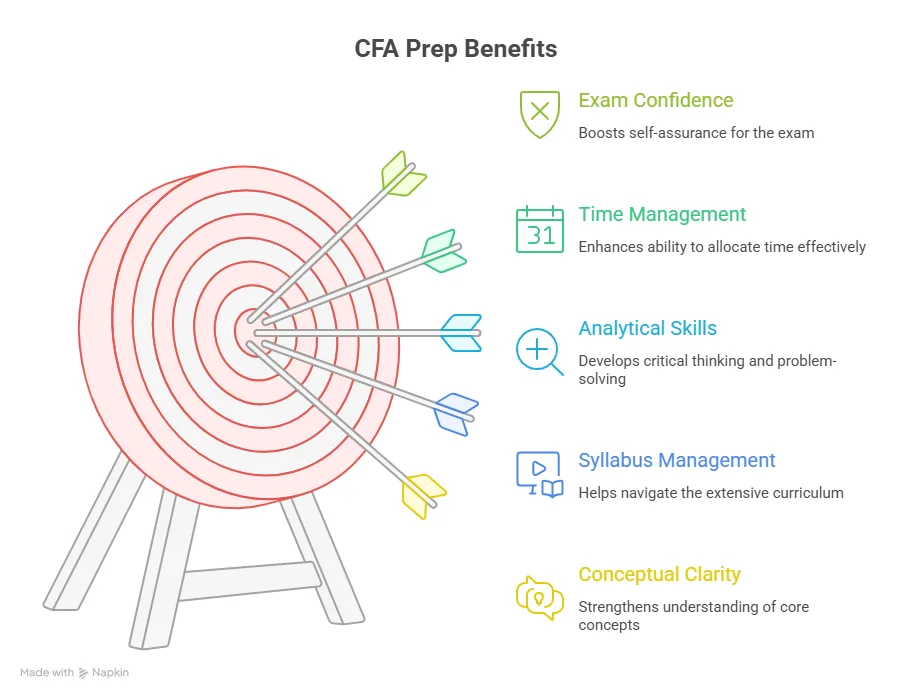
Why Is CFA Prep Important?
If you are confused about: What is CFA? It is a globally recognised credential that comprises 3 levels to receive the CFA Charter designation.
CFA Level 1 focuses on building strong conceptual clarity and understanding the basics across a wide syllabus. CFA Level 2 moves deeper into application and analytical thinking, while CFA Level 3 tests your ability to apply knowledge in real-world portfolio management and structured responses. In simple terms, the difficulty doesn’t just increase – the nature of the exam evolves.
That’s why having a level-wise preparation strategy for the CFA Certification becomes critical. You need to adjust how you study, practice, and revise based on what each level actually demands. From the way you read the curriculum to the type of mock exams you prioritise, your approach should become more refined as you progress.
Also Read: Choose the right CFA coaching to stay consistent and exam-ready.
Understanding the CFA Exam Structure
The CFA Program consists of three levels:
| Level | Focus | Nature of Testing |
| Level 1 | Investment tools | Conceptual + multiple choice |
| Level 2 | Asset valuation | Item sets, application-heavy |
| Level 3 | Portfolio management | Case studies + written responses |
The CFA levels require a different CFA prep approach. If you prepare for CFA Level 2 the way you prepared for CFA Level 1 exams, you’ll struggle. If you approach CFA Level 3 casually, you’ll regret it.
Build the Right CFA Prep Foundation
Your first decision shapes everything:
- Which CFA prep books will you use?
- Will you join a CFA prep course?
- Will you rely on CFA self-study?
- Which CFA prep materials will be your core source?
Do not jump between five sources. Choose one primary framework. Supplement carefully.
Best CFA Prep Books That Actually Work
When candidates search for the best CFA prep books, these names consistently come up:
CFA Institute Curriculum – Issued directly by the CFA Institute.
- Most detailed
- Best for Ethics
- Essential for Level 3 depth
- Downside? It’s heavy. Time-consuming.
But if you want conceptual clarity, nothing beats it.
Kaplan Schweser CFA Prep – Kaplan Schweser is one of the most widely used CFA prep providers globally.
- Concise notes
- Structured study plans
- Strong mock exams
If you want exam-focused learning, this is popular for a reason.
Wiley CFA Prep – Wiley Efficient Learning has a balanced explanation and practice. It is good for candidates who want slightly more explanation than Schweser but less volume than official CFA books.
If you’re asking: Which is the best CFA prep course? The honest answer is: The best CFA prep materials are the ones you consistently stick to. Switching sources mid-preparation destroys momentum.
This video shares a practical 2-hour-a-day CFA study plan designed specifically for working professionals. Instead of unrealistic 6-8 hour schedules, it focuses on how you can make steady progress with limited time by building a smart, structured routine.
Why Most Candidates Fail And How to Avoid That
Before we talk about the best CFA prep course or the best CFA prep provider, you need to understand why candidates fail. It’s usually one of these:
- Underestimating the depth of the syllabus
- Starting preparation too late
- Focusing more on reading than on CFA practice
- Ignoring weak subjects
- Not taking enough CFA practice tests.
The CFA exam isn’t memory-based. They test application, judgment, and integration of concepts. So your CFA study prep must reflect that.
Let’s be direct. Reading builds familiarity. CFA practice builds exam performance.
You need:
- 3,000-4,000 solved questions
- Multiple CFA practice tests
- At least 4-6 full CFA practice exams
- Your CFA test prep must include timed practice.
Why? Because exam pressure changes performance.
Aim for:
- 75%+ in Level 1 mocks
- 70%+ in Level 2 item sets
- Structured clarity in Level 3 essay responses
That’s your safety cushion.
Best Way to Study for CFA
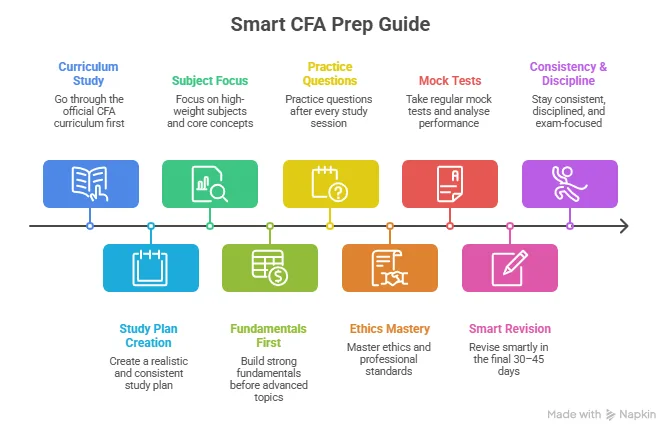
There’s no single “perfect” way to study for the CFA exams – but there is a smart way. And that usually makes the difference between candidates who just complete the syllabus and those who actually clear the exam.
The CFA course syllabus is vast, concept-heavy, and application-focused. Simply reading through the curriculum once isn’t enough. To perform well, you need a study approach that helps you understand concepts deeply, retain them for months, and apply them accurately under exam pressure. That requires a balance of learning, practice, and revision.
The best way to study for CFA is to follow a structured plan from the beginning. Start with building strong conceptual clarity using trusted study material, then gradually shift toward solving questions, reviewing mistakes, and testing yourself through mocks. Consistency matters more than intensity here – studying a few hours daily with focus is far more effective than occasional long study sessions.
It’s also important to adapt your strategy based on your schedule. Whether you’re a full-time student or a working professional, your study plan should be realistic enough to sustain for several months. When your preparation is organised and consistent, the syllabus starts to feel manageable, and your confidence grows with it.
Here’s a simple but powerful structure:
1. Daily Study Block (2-3 Hours)
- 90 minutes of reading
- 60 minutes CFA practice
- 30 minutes revision
2. Weekly Revision Day
- Revisit weak areas
- Solve 100+ questions
- Track accuracy
3. Monthly Mock
- Simulate real conditions
- Review deeply
Your CFA prep must include reflection – not just repetition.
If you’re preparing for CFA interviews, this video offers a practical breakdown of what to expect at each level. From explaining basic financial concepts confidently at Level 1 to demonstrating strong analytical thinking at Level 2and strategic decision-making at Level 3, interview preparation evolves as you move forward in the CFA journey.
Designing Your CFA Prep Timeline
Let’s be real for a moment. Every year, many CFA candidates begin their preparation feeling motivated and confident and then slowly realise just how demanding the journey actually is. The CFA exams aren’t only academically challenging; they test your discipline, planning, and consistency over several months. This isn’t an exam you can manage with last-minute revision or random study sessions. It requires a professional level of preparation.
Most successful candidates follow a general study-hour benchmark:
- CFA Level 1 – 300-350 hours
- CFA Level 2 – 350-400 hours
- CFA Level 3 – 350+ hours
These numbers aren’t arbitrary. They reflect the depth of the syllabus and the amount of practice required to truly understand and apply the concepts. But here’s something many candidates realise a bit late – simply completing a set number of hours doesn’t guarantee a pass.
You could spend 350 hours studying in a scattered, inconsistent way and still feel unprepared when the exam arrives. On the other hand, a focused 300-hour plan with proper revision, practice questions, and mock exams can be far more effective. What really makes the difference is how intentionally you use your study time.
Your CFA prep timeline should fit your real life, whether you’re a full-time student, a working professional, or balancing both. Instead of uncertain goals like “I’ll study more this week,” build a weekly structure. Decide what you’ll study, when you’ll practice questions, and when you’ll revise. When your plan is clear, staying consistent becomes much easier.
A simple structure that works well for most candidates looks like this:
- First 60% of your timeline – Focus on understanding concepts and making notes
- Next 25% – Move into heavy practice with question banks and topic tests
- Final 15% – Attempt full-length mocks, analyse performance, and revise thoroughly.
Consistency is your biggest advantage here. Studying for a few hours daily over several months is far more effective than engaging in occasional, long study sessions. CFA preparation isn’t a sprint you finish quickly – it’s a marathon that rewards steady, structured effort.
Once your plan becomes realistic and consistent, those recommended study hours stop feeling overwhelming and start translating into real, visible progress.
| Phase | Timeline | What You Should Focus On | Key Activities |
| Concept Phase | Months 1-3 | Build a strong conceptual foundation across all subjects | Read core CFA study books, take concise summary notes, and solve end-of-chapter questions after each topic |
| Application Phase | Months 4-5 | Strengthen understanding through practice and problem-solving | Intensive CFA practice, topic-wise quizzes, daily Qbank drilling, identify weak areas and revise concepts |
| Mock Phase | Months 6-7 | Simulate a real exam environment and improve accuracy | Attempt full CFA practice exams, timed simulations, detailed mock analysis, deep review and revision sessions |
If you skip the practice phase and jump straight from reading to mocks, your CFA preparation remains incomplete. Application and repetition are what convert knowledge into exam performance.
Also Read: Get clarity on CFA eligibility requirements and take the next step in your CFA journey.
CFA Self-Study vs CFA Prep Course
This is where most candidates overthink.
CFA self-study works if:
- You’re disciplined.
- You can commit 2-3 hours daily.
- You track your progress honestly.
CFA prep classes help if:
- You struggle with Quant or FRA.
- You procrastinate.
- You need structured deadlines.
There are several CFA prep providers globally:
- Kaplan Schweser
- Wiley Efficient Learning
- Bloomberg Exam Prep
Some candidates also explore Bloomberg CFA prep review options for analytics-driven learning. If you’re searching for the best CFA prep provider, focus on:
- Updated curriculum alignment
- Strong mock exam design
- Clear doubt support
- Structured revision tools
Popularity alone doesn’t guarantee effectiveness.
Also Read: Everything you should know about CFA classes to shape your success.
Level-Wise CFA Prep Strategy
Preparing for the CFA exams isn’t just about studying hard; it’s about studying differently at each level. Many candidates assume the same approach will work throughout the programme, but each level of the CFA tests a different skill set. What helps you clear Level 1 won’t necessarily be enough for Level 2 or Level 3. Now let’s break this down properly.
CFA Level 1 Prep Strategy
Level 1 is about breadth. The focus areas are:
- Ethics
- Financial Reporting & Analysis
- Quantitative Methods
Best Strategy:
- Finish syllabus 2 months before the exam.
- Memorise formulas early
- Daily CFA practice questions
Many candidates enrol in a CFA Level 1 prep course for structure. If you’re selecting the best CFA Level 1 prep books, prioritise concise notes + strong Qbanks.
CFA Level 2 Prep Strategy
The CFA Level 2 is where many strong Level 1 candidates fail. Why? Because it’s application-heavy. Best Strategy:
- Slow reading
- Deep understanding of valuation
- Daily item set practice
If you’re comparing the best CFA Level 2 prep provider, check for strong case-based teaching and Qbank depth. Level 2 demands intense CFA practice – not passive reading.
CFA Level 3 Prep Strategy
The CFA Level 3 tests your judgment. You must:
- Practice essay writing
- Learn structured answer formats.
- Master portfolio management
If you’re researching the best prep provider for CFA Level 3, focus on answer writing guidance. Level 3 is not about remembering. It’s about communicating like a portfolio manager.
Also Read: Plan your CFA Course in Delhi for strong career opportunities.
Common CFA Prep Mistakes
Let’s correct these early – because most failed attempts aren’t due to lack of intelligence. They’re due to poor strategy and avoidable habits.
| Common Mistake | Why It Hurts Your Chances | How to Avoid It |
| Starting preparation just 3 months before the exam | Leads to rushed learning, weak retention, and little time for revision or mocks | Start 6-8 months in advance. Break the syllabus into weekly targets and stick to a structured timeline |
| Ignoring Ethics | Ethics carries significant weight and often impacts borderline results | Study Ethics early and revise it multiple times. Practice scenario-based questions consistently |
| Constantly switching prep books/material | Creates confusion, gaps in understanding, and wasted time | Choose one primary source (CFA curriculum or a trusted provider) and stay consistent |
| Avoiding weak topics | Weak areas become score killers on exam day | Identify weak subjects early and allocate extra practice time instead of postponing them |
| Not attempting full CFA practice exams | Leaves you unprepared for time pressure and exam environment | Attempt at least 4-6 full-length mocks under timed conditions and review mistakes deeply |
The biggest shift you need to make is this: your CFA preparation must be disciplined, not emotional. Study when you don’t feel like it. Practice topics you find difficult. Stick to one plan instead of chasing shortcuts. The candidates who clear aren’t always the smartest – they’re the most consistent.
How to Pass CFA on First Attempt
If your goal is clear for the CFA course – first attempt success – here’s your direct action framework.
1. Start Early – Minimum 6 months preparation.
2. Choose One Core Source – Official curriculum + one supplementary provider.
3. Prioritise Practice – Reading alone will not carry you.
4. Track Your Scores – If your mock average is below 70%, you’re not exam-ready.
5. Never Ignore Ethics – Ethics can push borderline candidates above the passing score.
This CFA Mock Interview video walks you through common questions you’re likely to face, showing both how to structure thoughtful responses and how to connect your CFA knowledge to real finance situations.
Why Imarticus Learning is the Right Choice for CFA Prep
Preparing for the CFA isn’t just about finishing the syllabus – it’s about staying consistent for months, understanding concepts deeply, and having the right guidance when things start to feel overwhelming. Many students begin with strong motivation but lose direction midway. That’s where having a structured learning partner can really help.
Imarticus Learning focuses on making the CFA program preparation more organised and manageable. Instead of leaving you to figure everything out on your own, the programme gives you a clear path to follow. You know what to study, when to revise, and how to practice – which makes the entire process far less stressful.
Here’s what makes the experience stronger:
- Industry-relevant learning: The curriculum is designed in collaboration with KPMG in India, so you’re learning concepts that actually connect to real finance roles.
- A structured preparation approach: With a guided study plan, you don’t feel lost or overwhelmed by the vast CFA syllabus.
- Support from experienced faculty: Trainers simplify complex topics and help clear doubts so you can move forward with confidence.
- Practice that builds confidence: Regular tests and mock exams prepare you for the actual exam environment and highlight areas to improve.
- Flexible learning for busy schedules: Whether you’re studying full-time or working, the programme is designed to fit into your routine.
- Career-focused perspective: Beyond clearing exams, you gain practical understanding and guidance for long-term growth in finance.
CFA preparation can be intense, but with the right structure and support, it becomes far more manageable. With a guided approach and consistent practice, Imarticus helps you stay focused and confident throughout the journey.
FAQs About CFA Prep
If you’re preparing for the CFA exams, it’s completely normal to have questions. In fact, most candidates share the same doubts – about study hours, timelines, self-study vs coaching, mocks, and difficulty level. I’ll answer the frequently asked questions about CFA prep so you can prepare with clarity and confidence.
How many months are enough for CFA preparation?
Ideally, 6-8 months of consistent preparation is recommended for each CFA level. This gives you enough time for concept learning, practice, revision, and mock exams without last-minute pressure.
How many hours should I study daily for CFA?
Most candidates study 2-4 hours daily on weekdays and more on weekends. The goal is to complete around 300-400 total study hours per level with consistency over several months.
Can I clear CFA with self-study?
Yes, many candidates clear CFA through self-study using the CFA curriculum and trusted prep books. However, structured coaching like Imarticus Learning or prep courses can help if you need discipline, doubt-solving, or a guided study plan.
When should I start taking CFA mock exams?
You should begin full-length mock exams in the last 6-8 weeks before the exam. This helps you improve speed, accuracy, and confidence while identifying weak areas for final revision.
Is CFA difficult to pass?
CFA is challenging because of its vast syllabus and application-based questions. With structured preparation, regular practice, and consistency over months, it is definitely manageable.
Which is the best study material for CFA preparation?
The CFA Institute curriculum is the most reliable source. Many students also use supplementary prep providers for simplified notes, practice questions, and mock exams.
Can working professionals prepare for CFA successfully?
Yes. Many CFA candidates are working professionals. The key is a realistic study schedule, daily consistency, and effective use of weekends for revision and practice.
How important is revision in CFA preparation?
Revision is critical. Institutes like Imarticus Learning offer structured revision support to ensure proper preparation. Most successful candidates revise the entire syllabus at least 2 to 3 times and practice multiple mock exams before the actual test.
Your CFA Success Starts with the Right CFA Prep
The CFA journey is not easy, and it’s not meant to be. It’s designed to test your discipline, your understanding, and your ability to stay consistent when things get tough. But here’s the truth: it is absolutely achievable when you approach it with structure and intention.
Clearing all three levels on your first attempt isn’t about being the smartest candidate in the room. It’s about starting early, sticking to one clear strategy, prioritising practice over passive reading, and showing up every single day – even when motivation dips.
If you treat CFA preparation casually, the exam will expose that. If you treat it professionally, it rewards you professionally. Build a plan. Track your progress. Respect the process. And most importantly, stay consistent.
If you’re serious about passing the CFA course on your first attempt and want structured guidance, expert support, and a clear roadmap instead of confusion, explore how a guided prep programme can support your journey.
Your CFA result won’t depend on luck. It will depend on the preparation decisions you make today. Start building the right one.
