


Last updated on March 25th, 2026 at 03:49 pm
Last Updated on 6 days ago by Geeta Bhat
Picture this: it’s 11 pm, you’ve just decided you want to pursue the CFA charter, and you open the CFA Institute website for the first time. Within thirty seconds, you’re staring at the CFA modules with a list of topics – Ethics, Quant, FRA, Fixed Income, Derivatives, Portfolio Management and wondering whether you’ve accidentally browsed into a PhD program you didn’t apply for. That is how every aspirant starts. And I’ll be honest – I have seen most of them close the tab and do something else entirely for the rest of the evening.
But here’s what I wish every aspirant knew when they started: the CFA modules are not designed to overwhelm you. They’re actually built in a way that makes a lot of logical sense once someone explains the structure without trying to sound impressive. The curriculum is layered intentionally. You’re not being asked to know everything at once. You’re being walked through a ten-subject framework that deepens at each level, and once that clicks, the whole program starts to feel manageable rather than mountainous.
That’s what I’m here to do in this piece. Whether you’re still researching whether the CFA Certification is right for you, or you’ve just registered for Level 1 and you want to know what’s actually ahead, this guide will give you a grounded, honest picture of what the CFA course modules involve – and more importantly, what they’re really testing at each stage.
One thing to know going in: The ten CFA modules remain the same across all three levels. What changes dramatically is the depth of understanding required and the way the exam asks you to use that knowledge. That progression is the whole design of the program.
What Are the CFA Modules?
Apart from What is CFA? Why are there ten modules of CFA? is a question amongst most aspirants. The CFA curriculum is split into ten topic areas, often called modules, and there’s a clear reason behind that structure. These aren’t random subjects. Each one reflects a core skill that investment professionals actually use in the real world.
Here’s what the CFA modules cover:
- Ethical and Professional Standards
- Quantitative Methods
- Economics
- Financial Statement Analysis (FSA)
- Corporate Issuers
- Equity Investments
- Fixed Income
- Derivatives
- Alternative Investments
- Portfolio Management and Wealth Planning
At first glance, CFA modules can feel like a lot and maybe even a bit disconnected. But step back and think about what someone in finance really does day to day.
- They analyse company financials.
- They track how economic trends affect markets.
- They evaluate stocks and bonds.
- They manage risk, sometimes using derivatives.
- They build and adjust portfolios based on client goals.
And all of this has to sit on a strong ethical foundation. That’s exactly what these ten modules represent. Together, they map almost perfectly to the responsibilities of an investment analyst or portfolio manager.
Once you start seeing it this way, the curriculum stops feeling like a collection of subjects to “get through.” It starts to feel like a toolkit. Each module is a different lens, and the CFA is essentially training you to look at financial decisions from all of them, not just one.
This shift in perspective matters. It’s what helps you move from “Why do I need this?” to “How does this fit into the bigger picture?” And importantly, the curriculum isn’t static. The CFA Institute updates it regularly to keep pace with how the industry is evolving. Topics like ESG investing, machine learning, and alternative data have become far more prominent than they were a decade ago because that’s what today’s markets demand.
So those ten CFA modules aren’t just an academic structure. They’re a deliberate attempt to build a complete, well-rounded investment professional.
Also Read: Expert guide to plan CFA in Delhi for your finance career.
CFA Level 1 Modules
CFA Level 1 exams has to make sure you can speak the language of finance fluently before anyone asks you to have a conversation in it. Everything at CFA Level 1 is about establishing a solid conceptual baseline. You’re learning tools. You’re learning vocabulary. You’re learning how markets are structured, how companies report their finances, how derivatives are priced in theory, and how portfolios are constructed in principle. It’s broad, and it’s intentionally so, because CFA Level 2 will ask you to take all of this and do something with it.
The exam format at Level 1 is entirely multiple-choice – 180 questions across two sessions. The questions test whether you understand concepts well enough to apply them in relatively straightforward situations. You won’t be asked to build a full valuation model. You will be asked to know what a DCF is, what its components are, and when it’s appropriate to use.
Here’s an overview of CFA Level 1 modules, weightage and what you will learn in each one of them:
| Module | Exam Weight | What You’re Really Learning |
| Ethical & Professional Standards | 15-20% | The CFA Code of Ethics: how to act when the right answer isn’t obvious and how the Institute uses ethics scores |
| Quantitative Methods | 6-9% | Statistics, probability, time value of money – the mathematical backbone of every financial model you’ll ever use |
| Economics | 6-9% | Micro and macro principles, monetary policy, currency markets – how the wider world affects individual securities |
| Financial Statement Analysis | 11-14% | Reading income statements, balance sheets, cash flows and understanding why the numbers don’t always say what they seem to |
| Corporate Issuers | 6-9% | How companies raise capital, make payout decisions, and manage their capital structure – the logic behind the spreadsheets |
| Equity Investments | 11-14% | How equity markets are structured, what drives stock prices, and the first principles of equity valuation |
| Fixed Income | 11-14% | Bonds, yield curves, duration, credit risk – the world’s largest asset class, explained from the ground up. |
| Derivatives | 5-8% | Options, futures, forwards, swaps – conceptual understanding of instruments that everyone knows exist, but few can explain clearly |
| Alternative Investments | 7-10% | Real estate, private equity, hedge funds, commodities – an honest introduction to the asset classes outside the mainstream |
| Portfolio Management | 8-12% | Portfolio theory, risk-return trade-offs, and your first encounter with the Investment Policy Statement |
A few things I really want to flag here, because they matter more than the topic weights suggest.
Ethics
Ethics is not a soft topic. I know it’s tempting to treat Ethics as a manageable weight-filler of 15 to 20%, but how hard can it be?
- Quite hard, actually, if you approach it the wrong way. The CFA Institute doesn’t test whether you know the Code by memory.
- CFA tests whether you can apply it under ambiguous conditions. And here’s the part that changes the calculus entirely: at borderline pass/fail scores, the Institute uses your ethics performance to make the final call.
- A candidate who scored marginally on the aggregate but performed well on ethics has historically had a better chance of passing than one who didn’t. That’s been a known element of their grading approach for years.
Financial Statement Analysis
Financial Statement Analysis will test your patience before it tests your knowledge.
- Most candidates who struggle at Level 1 don’t struggle because the concepts are hard – they struggle because FSA requires patience and precision.
- You need to be comfortable sitting with a set of financials and pulling out the right numbers without rushing.
- If you don’t have an accounting background, give yourself extra time here.
One more thing about CFA Level 1 modules: don’t underestimate Fixed Income. It feels manageable in the first few readings, and then yield curve dynamics and duration calculations arrive, and suddenly it’s not. Candidates who save Fixed Income for the last few weeks of CFA prep are the ones who end up regretting it.
Quick Tip: When you access the official CFA Level 1 modules PDF through the Institute portal after registration, always read the Learning Outcome Statements (LOS) for each reading first. They are your actual exam targets. The readings give you context – but the LOS tell you exactly what you need to be able to do.
CFA Level 2 Modules
I’ll be direct with you about Level 2: this is where the CFA certification stops feeling like an advanced finance course and starts feeling like an actual job. The shift in how the exam tests you is significant, and most candidates who fail Level 2 do so not because they didn’t study the content, but because they studied it the wrong way.
Level 2 uses item sets, which the Institute also calls vignettes.
- Each question set gives you a case study – typically two to four pages long – about a company, a fund manager, a client scenario, or a portfolio situation.
- Then it asks you six questions based on that case. The questions aren’t straightforward recall.
- They ask you to extract the right information from a dense narrative, identify which analytical framework applies, and reach a conclusion that someone making real investment decisions would reach.
- That’s a fundamentally different cognitive task than answering multiple-choice questions about definitions.
And it’s why I’d encourage anyone heading into Level 2 to start practising with full vignette sets from the very first week of their study plan – not isolated questions, and definitely not flashcards alone.
Here’s the shift in one sentence:
- Level 1 asks you whether you know what a free cash flow to equity model is.
- Level 2 asks you to build one from a messy set of financial data, recognise where the company is manipulating its reported figures, and then make an investment recommendation with a justified conclusion.
- Same topic. Completely different demand.
Here’s an overview of the CFA Level 2 modules, exam weightage and what transforms at this level:
| Module | Exam Weight | How It Transforms at Level 2 |
| Ethical & Professional Standards | 10-15% | Complex applied scenarios – not ‘what does the Code say’ but ‘what should this analyst do given these specific facts’ |
| Quantitative Methods | 5-10% | Regression analysis, multiple regression, time series models, and the basics of machine learning applied to investment problems |
| Economics | 5-10% | Currency exchange frameworks in depth, business cycle analysis mapped to sector allocation decisions |
| Financial Statement Analysis | 10-15% | Quality of earnings analysis, intercorporate investments, pension accounting, and the impact of foreign exchange on reported numbers |
| Corporate Issuers | 5-10% | Capital allocation frameworks, M&A valuation and analysis, ESG considerations in corporate governance |
| Equity Investments | 10-15% | Full valuation models: DDM, FCFF, FCFE, residual income, price multiples – applied to real company scenarios |
| Fixed Income | 10-15% | Term structure models, credit analysis frameworks, securitisation structures and their risk characteristics |
| Derivatives | 5-10% | Pricing and valuation of options, futures, and swaps using no-arbitrage principles – not just naming them |
| Alternative Investments | 5-10% | Private equity valuation methodologies, real estate cap rate models, and REIT-specific analysis |
| Portfolio Management | 10-15% | Multifactor models, the Fundamental Law of Active Management, factor investing and portfolio attribution |
The CFA Level 2 modules are where candidates with a genuine finance background start to feel more at home and where candidates without one have to put in the most hours.
- That’s not a discouragement; it’s a reason to start earlier and give yourself more time on the heavy modules.
- Equity and FSA together can account for close to 30% of the Level 2 exam. If you’re going to invest disproportionate time anywhere in your study plan, it should be there.
- Followed closely by Fixed Income, which jumps significantly in technical depth from where you left it at Level 1.
- Pass rates at Level 2 have historically sat between 40 and 55%. That statistic isn’t there to scare you; it’s there to tell you that the candidates who clear this level are the ones who changed their study approach, not just increased their study hours.
Clearing CFA Level 1 is less about intelligence and more about strategy, consistency, and smart preparation. When you understand how to approach the syllabus, manage your time, and practice effectively, the exam becomes far more manageable.
CFA Level 3 Modules
Here’s something that surprised me about the CFA Level 3: it’s the level most candidates describe as the most intellectually satisfying and also the one they’d say taught them the most about what investment management actually is as a profession.
- By the time you reach Level 3, the CFA modules stop being a list of topics to get through.
- They become an integrated framework for thinking about money on behalf of other people. And that shift in perspective changes everything about how you study.
- Level 3 introduces constructed response questions alongside the vignettes – essay-style questions where you’re asked to write out a recommendation, justify an asset allocation, build an Investment Policy Statement, or explain why a particular strategy fits a client’s objectives.
- These aren’t open-ended essays. They have specific, structured answers.
- But they require you to do something that no multiple-choice format ever really could: show your reasoning, not just your conclusion.
- For the first time in the program, your ability to communicate financial judgment clearly is being assessed alongside your knowledge of it.
Here’s an overview of the CFA Level 3 modules, it’s weigtage and how the focus narrows down:
| Module | Exam Weight | What Level 3 Actually Demands |
| Ethical & Professional Standards | 10-15% | GIPS standards in depth, and ethical judgment applied to complex client and institutional scenarios |
| Portfolio Management & Wealth Planning | 35-40% | IPS construction, asset allocation strategies, liability-relative approaches, goals-based wealth management for individuals and institutions |
| Fixed Income | 15-20% | Fixed income portfolio strategies, liability-driven investing, yield curve positioning, interest rate risk management |
| Equity Investments | 10-15% | Active vs passive decision frameworks, factor-based strategies, quantitative equity approaches |
| Derivatives | 5-10% | Options strategies for return enhancement and hedging within a portfolio context – not just pricing them |
| Alternative Investments | 5-10% | The portfolio role of alternatives, due diligence frameworks, and performance evaluation of private assets |
| Economics, Quant, FSA, Corporate | Integrated | No standalone weight at Level 3 – these appear as analytical tools within portfolio and wealth management problems. |
The thing that stands out immediately in the Level 3 module weights is how dominant Portfolio Management has become. At Level 1, it was a foundation topic at 8 to 12%. At Level 3, it accounts for 35 to 40% of the entire exam. The program has been building towards this point all along.
- What I find genuinely interesting about this is that the earlier modules – Quant, Economics, FSA, Corporate Issuers – don’t disappear.
- They become the analytical vocabulary you use in portfolio problems. At Level 3, knowing how to read a balance sheet matters because you’re building an IPS for an institutional client whose pension liabilities appear on a balance sheet.
- Knowing how currency markets work matters because you’re making a tactical asset allocation recommendation across international markets.
- The curriculum converges at Level 3 in a way that makes you realise it was designed as a single piece of work, not ten separate syllabi.
- A note on the essay section: Many candidates are surprised by how structured the constructed response answers need to be. There’s often a template – command words like ‘justify,’ ‘explain,’ ‘determine,’ ‘calculate’ all signal specific answer formats.
- Practising with past exam answers from the CFA Institute’s resources (which they publish publicly) is one of the most valuable things you can do for Level 3 preparation.
Quick Tip: Don’t skip the GIPS standards section. It shows up consistently in the Level 3 exam, and a lot of candidates either don’t start it early enough or convince themselves it’s too niche to matter. It doesn’t matter. Budget a full study week for it.
CFA Online Modules and Study Resources
Preparing for the CFA exam today is no longer about just reading textbooks and CFA books – it’s about using the right mix of digital tools, structured content, and smart revision resources. From the official online curriculum provided by the CFA Institute to third-party notes and guided prep programs, candidates have multiple ways to approach the same syllabus. The key is not access – it’s how effectively you use these resources to stay consistent, cover the depth, and revise strategically.
| CFA Resource Type | Description | Format | Best For | Key Limitation |
| Official CFA Institute Curriculum | Complete study material including readings, LOS, and practice questions | Online + App (offline access) | Concept clarity & exam accuracy | No downloadable PDF |
| CFA Institute App | Access readings offline after download | Mobile app | Flexible, on-the-go study | Not a single compiled PDF |
| Kaplan Schweser / Wiley Notes | Condensed summaries of CFA modules | PDF + Books | Quick revision & time-saving | May miss deeper concepts |
| Structured CFA Prep Programs | Guided training with classes, mocks, and mentorship | Online | Working professionals need structure | Paid programs |
| Self-Study Approach | Mix of curriculum + notes | Flexible | Independent learners | Requires strong discipline |
Quick Tip: Regardless of which resources you use or what format of CFA classes you take, always treat the CFA Institute’s own mock exams and past constructed response questions (for Level 3) as sacred study material. These are the closest simulations of what the actual exam feels like, and they’re free for registered candidates.
Also Read: Everything you need to know about CFA coaching to become a CFA charter.
How CFA Modules Evolve Across All Three Levels
I think one of the clearest ways to understand the structure of the CFA program is to look at how the same subjects transform across the three levels. It’s the same ten modules, but here’s what that actually means in practice:
| Level | Core Demand | Exam Format | What It Ultimately Builds |
| Level 1 | Know and understand the tools | Multiple-choice, 180 questions | Financial literacy and analytical vocabulary |
| Level 2 | Apply the tools to real scenarios | Item sets (vignettes), 88 questions | Investment judgment and valuation competence |
| Level 3 | Synthesise and communicate strategy | Item sets + constructed response essays | Portfolio management and professional communication |
Each level requires somewhere between 300 and 450 hours of dedicated study – the CFA Institute recommends 300, but the data on pass rates suggests that candidates who clear each level typically study significantly more than that. Most people take between two and four years to complete all three levels, depending on how often they sit exams and how their professional lives allow them to study.
The three-level progression is also why the CFA charter is so difficult to simply ‘cram for.’ You can’t get through Level 3 without genuinely having internalised what you learned in Levels 1 and 2, because Level 3 assumes it. The program is designed to be cumulative by architecture.
Preparing for a CFA-related role doesn’t end with clearing exams; you also need to articulate what you’ve learned and apply it in real-world scenarios. That’s exactly where mock interviews come in. Watch this mock interview to understand what real CFA-level interviews feel like and how to answer confidently:
Study Tips That Actually Work for CFA Modules
Every CFA candidate hits at least one module that feels stubborn. The difference isn’t talent – it’s how you approach it. Here’s how to handle the toughest ones without getting stuck.
Financial Statement Analysis (FSA) – Don’t Just Read, Decode
- Treat FSA like a language, not a subject. You’re learning how businesses “communicate” performance.
- Build a strong base early: revenue recognition, inventories, long-lived assets – don’t rush these.
- At Level 2, slow down and practice heavily (intercorporate investments, pensions, currency translation).
- Use a two-pass method: first for understanding, second for application through questions.
- If accounting isn’t your background, give this module extra weekly hours – no shortcuts here.
Fixed Income – Start Early, Revisit Often
- Don’t treat this as a “later” topic – it compounds in complexity across levels.
- Focus on intuition first (what drives bond prices, yield curves) before formulas.
- At Level 2, break term structure models into small pieces – don’t try to absorb everything at once.
- At Level 3, connect concepts to real portfolios (liability matching, duration strategies).
- Revisit this module multiple times – one pass is never enough.
Derivatives – Build Logic, Not Fear
- Forget memorising formulas – focus on why pricing works (no-arbitrage logic).
- Draw payoff diagrams. Visualising options makes everything easier.
- Practice step-by-step problem solving instead of rushing solutions.
- At Level 3, shift your mindset from calculation to strategy (how derivatives manage risk).
- Give this more time than you think – most candidates underestimate it.
Quantitative Methods (Level 2) – Respect the Jump
- Don’t assume it’s just Level 1 repeated – it’s a different level of depth.
- Take time to understand concepts like regression assumptions, not just formulas.
- Break topics like quantitative methods and serial correlation into simple definitions + examples.
- Practice interpretation-based questions – the exam tests understanding, not just calculation.
- If you’re from a non-quant background, go slower – rushing here backfires.
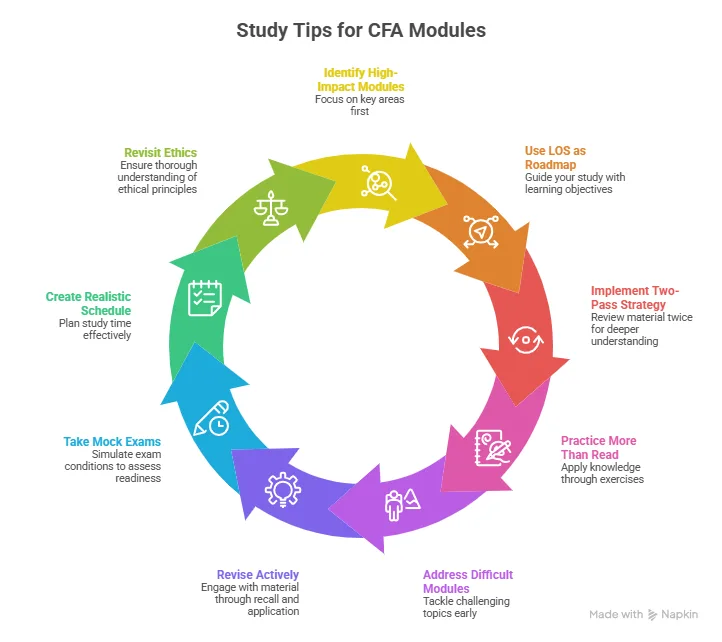
None of these CFA modules is “too difficult.” What they demand is:
- Consistency over intensity
- Multiple revisions, not one perfect pass
- Honest time allocation (don’t hide in easy topics)
If you stay structured and keep showing up, even your toughest CFA modules stop being a weakness – it becomes the edge most candidates never build.
Also Read: How CFA Training helps you to boost your exam performance.
Why Choose Imarticus for Your CFA Modules?
There’s no shortage of CFA prep options out there. So the real question isn’t whether Imarticus offers a CFA program – it’s whether what they offer is meaningfully different from what everyone else does.
- They’re India’s only approved prep provider for the world’s top 5 finance certifications – Imarticus is India’s first and only approved prep provider for CFA, ACCA, US CPA, US CMA, and FRM – all five of the most respected global finance credentials.
- The KPMG in India collaboration – The program is built in collaboration with KPMG in India, and includes 23 original business case studies, monthly webinars on industry trends, and 12 live sessions annually conducted by KPMG practitioners.
- You get Kaplan Schweser materials included – Study resources include books, study notes, question banks, and mock exams from Kaplan Schweser – the globally trusted CFA prep content. Most candidates buy these separately at high cost. Having them bundled into the programme fee changes the value equation considerably.
- The dual-teacher model addresses a real problem – A dual-teacher model means a charter faculty member conducts live classes while a second teacher is available for one-on-one support and guidance 24×7.
- Post-Level 1 placement support – After clearing CFA Level 1, Imarticus provides placement support, including mentorship, resume building, mock interviews, and real interview opportunities. For candidates who want to enter the job market mid-program rather than waiting until the charter, this is a practical bridge.
Also Read: Smart guide to preparing for the CFA Entrance Exam.
FAQs About CFA Modules
Still figuring out what the CFA modules actually involve? To help you make an informed decision, these are the frequently asked questions that most aspirants have.
Are the CFA modules the same at every level?
Yes, the ten topic areas are consistent across all three levels. What changes in those CFA modules are the depth, application format, and how much weight each module carries. Portfolio Management, for example, is an 8-12% module at Level 1 and a 35-40% module at Level 3. The subjects stay the same, with a completely different scope.
Where can I get the CFA Level 1 modules PDF or the CFA modules PDF for free?
The official curriculum is only available to registered candidates through the CFA Institute portal, not as a free PDF. The Institute’s app allows offline reading for registered candidates. Third-party condensed notes from Kaplan Schweser and Wiley are purchasable as PDFs and are widely used for revision alongside the official materials.
How long does it take to complete the CFA course modules at each level?
The CFA Institute recommends a minimum of 300 hours per level. Most successful candidates report studying between 350 and 500 hours, particularly at Levels 2 and 3. For a working professional, that typically means six months of disciplined daily study for CFA modules.
Can I do the CFA online modules fully through self-study?
Absolutely, you can do CFA modules through self-study – many charterholders have done exactly that. The official online curriculum, plus third-party notes and mock exams, is a viable self-study path. That said, Levels 2 and 3 benefit meaningfully from structured guidance and peer accountability, especially the constructed response format at Level 3.
Which CFA Level 2 modules carry the most weight?
Equity Investments, Financial Statement Analysis, and Fixed Income each carry 10-15%, and Portfolio Management carries up to 15%. Combined, these four CFA modules can represent 50-60% of your Level 2 exam. Any serious Level 2 study plan needs to treat these as the priority modules.
How is the CFA Level 3 module structure different from the other levels?
Level 3 is dominated by Portfolio Management and Wealth Planning, which carries 35-40% of the exam weight. Many of the earlier standalone CFA modules – Economics, Quant, FSA, Corporate – no longer appear with their own dedicated question sections; instead, they surface as analytical tools within portfolio and wealth management problems. The exam also introduces constructed response (essay) questions, which require candidates to write structured, justified answers rather than select from options.
What is the best order to study the CFA Level 1 modules?
Most study providers recommend starting with Quantitative Methods and Financial Statement Analysis – the two CFA modules that outperform almost everything else. Ethics should be studied twice: once early in your prep to set the tone, and again in the final weeks before the exam when specific scenario practice is most effective. Fixed Income and Equity should be given significant, dedicated blocks, not squeezed into the final sprint.
CFA Modules: What Actually Gets You Through
Every CFA candidate has that one module that just doesn’t click at first. That’s a part of the process. The people who get through this program aren’t the ones who found CFA modules easy. They’re the ones who didn’t run from the difficult parts. They slowed down, gave those areas more time, and kept coming back even when it felt frustrating.
So instead of thinking, “CFA modules aren’t my thing,” try reframing it: this is where I need to get better. That shift alone changes how you study. Because in the end, the CFA isn’t testing how quickly you understand something. It’s testing whether you can stay consistent long enough to understand it properly.
Stick with it. Do the hard CFA modules properly. And don’t disappear when it gets uncomfortable – that’s usually where the real progress starts. Are you ready to start your CFA journey? Explore the CFA course at Imarticus Learning and get structured preparation to succeed.
