Transition from a supply chain analyst to a supply chain manager with the best supply chain management course with analytics

Making the transition from a supply chain analyst to a supply chain manager can be challenging. However, with the proper training and education, it is possible! In this blog post, we’ll go over supply chain analyst and supply chain management roles and how to make the transition.

Role of Supply chain analyst

A supply chain analyst analyzes a company’s entire supply chain and makes recommendations to improve efficiency and effectiveness. They will use various analytical tools to examine the data and identify areas of improvement. The goal of a supply chain analyst is to help the company save money and increase profits by streamlining the supply chain.

Role of Supply chain manager

A supply chain manager oversees the entire supply chain of a company. They will decide which suppliers to use, how to transport goods, and how to store inventory. The goal of a supply chain manager is to ensure that the company’s supply chain is efficient and effective.

The transition from a supply chain analyst to a supply chain manager:

You can do a few things to transition from a supply chain analyst to a supply chain manager.

 Get experience in the field:

A great way to transition is to get experience in the field. There are many ways to do this, such as working as an intern. It will allow you to learn about the various aspects of supply chain management and gain valuable experience. 

Take a supply chain management course:

If you want to transition into the supply chain manager role, you should consider taking a supply chain management course. It will give you the necessary knowledge and skills to succeed in this field. There are many great courses, so do your research and find one that fits your needs.

Transitioning from a supply chain analyst to a supply chain manager can be a great career move. You can now become an invaluable asset to any company with the proper knowledge and skills. You can give yourself the best chance of success by taking a supply chain management course.

Explore Supply Chain Management Course with Imarticus Learning

The supply chain certification provides cutting-edge expertise to those interested in entering the operations or supply chain analytics course. This supply chain analytics course will teach students for jobs such as Demand Planner, Data Scientist, and Supply Planner.

This course is by industry leaders to help students learn. Product activity has been increasing at an ever-increasing rate in recent years. Across industries, there has been a dramatic growth in the number of SCM jobs. A career in SCM can be enriching, both financially and professionally.

Course Benefits For Learners:

  • We immerse students in in-demand technologies and projects, including six real-world projects that will give them a complete grasp of the industry to prepare them for a satisfying future in Supply Chain Management and Analytics.

  • Students who complete a supply chain management online course will prepare for competitive careers such as Demand Planner or Data Scientist, which are in great demand among companies today!

  • This supply chain management career will help students become more data-centric and improve Supply Chain decision-making by harnessing the power of Python.


The fourth industrial revolution: The primer on Artificial Intelligence and Machine Learning courses

We are living in the fourth industrial revolution. It is a time when technology is rapidly changing and evolving. One of the most critical aspects of this revolution is artificial intelligence (AI) and machine learning (ML). These technologies impact every industry and will continue to do so in the future. If you want to stay ahead of the curve, it’s essential to understand these technologies and learn how to use them.

This blog will provide a primer on AI and ML courses. We will also discuss why it’s vital for you to learn about these technologies. 

The fourth industrial revolution is a period of rapid technological progress and digital transformation. The fourth industrial revolution brings in a new age of automation, data-driven decision-making, and intelligent machines due to innovative technologies such as artificial intelligence (AI) and machine learning (ML). 

What are the key drivers of the fourth industrial revolution?

The key drivers of the fourth industrial revolution include:

  • Rapid technological advancement and digital transformation
  • The emergence of new technologies such as AI and ML
  • Increased connectivity and interdependence among countries, businesses, and individuals
  • Shifting demographics (e.g., an aging population)
  • Increased volatility, uncertainty, and risk
  • Rising income inequality

As we stand on the brink of a fourth industrial revolution, it’s more important than ever to understand the technologies driving it. One of the transformative technologies of our time is artificial intelligence (AI). From how we work and communicate to how we travel and entertain, AI has the potential to change almost every aspect of our lives.

What is the future of AI and machine learning?

The future looks bright for Artificial Intelligence (AI) and Machine Learning (ML), with both technologies experiencing exponential growth in recent years. The applications of AI and ML are limitless, spanning across industries such as finance, healthcare, manufacturing, retail, transportation, and logistics. Businesses need to gain a strong understanding of AI and ML to stay ahead of the curve and seize the opportunities brought about by these technologies,

Fortunately, there are many courses available that can provide this essential knowledge. Here is a primer on the best AI and ML courses, perfect for those looking to get started in this fascinating field.

Discover the AIML course by Imarticus Learning:

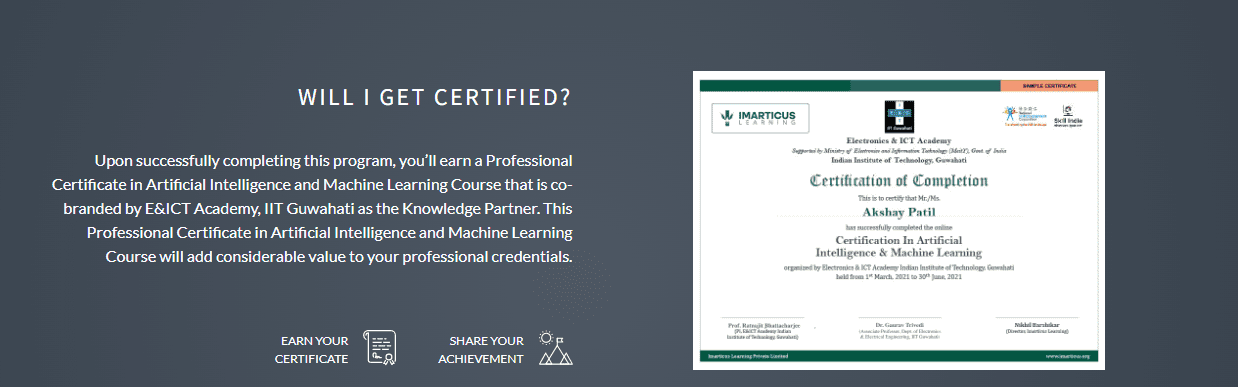
This Artificial Intelligence and Machine Learning certification combine the E & ICT Academy, IIT Guwahati, and the best industry leaders. This 9-month course will help students prepare for data scientists, data analysts, machine learning engineers, and AI engineers.

This course will help students strengthen their fundamental AI competencies. Students can now use the Expert Mentorship service to build a practical understanding of artificial intelligence and machine learning. Take advantage of real-world projects from a variety of sectors. This course has a long way to go towards assisting you in seizing lucrative job possibilities in the hot fields of artificial intelligence and machine learning.

Course Benefits for Learners:

  • Prepare for a fascinating data science profession by acquiring in-demand data science and AI abilities with 25 real-world projects that give employers diverse industry exposure.

  • Impress employers and display your AI skills with an E & ICT Academy, IIT Guwahati, and an Imarticus Learning-endorsed certificate.

  • Students can now participate in live online seminars and discussions with one of the finest instructors in India.

Using machine learning to scale data analytics at Airbnb

Airbnb was a revolution in the hospitality industry. It allowed their hosts associated with them to set their prices for the rent from their customers.

With the help of large data resources, Airbnb uses Artificial intelligence and Machine Learning to improve its online services. The company is one of the top targets for those pursuing their Machine Learning course with placement opportunities. 

One of the major improvements made by the company is in its price settings. Earlier it was the host who set the price and now, it is still the host who decides but AI directs them towards the price that will be beneficial for both sides.

Airbnb uses the vast amount of data they gather and analytics to come up with this guidance. What changes did they do to achieve this progress? Let’s find out!

  • Price tips

Price tips are the primary feature that ‘nudges’ the host towards the desired price. This AI-powered feature constantly updates the various price ranges for each day of every month of the year. At a glance, the hosts will be able to see if their set price is suitable to garner any profits if it is enough to get the attention of the customers, or which range is most likely to get bookings, etc. If the price is shown in green, then they are good to go.

If it shows in red, then the host needs to make some changes to make it green. Prices in green will be the most suitable for clicks.

This price range depends on the days of the week, time of the year, specific neighborhood, locality, etc. Even the latitude and longitude matter. This is a result of the algorithms set by Airbnb through the available data.  

  • Aerosolve

The machine learning package that helps with the pricing is the other analytical feature of Airbnb. It handles the behind-the-scenes factors and patterns that lead to the pricing shown in the Price Tips. It helps the user to interpret the words having entirely two meanings in two localities in the right context. 

Such developments are a result of a bunch of data analysts and scientists having such a useful model. It is such usage of data analytics that people are looking for a quality Data analytics course with placement offers. 

  • big data analytics certification coursesIn-app message intent

The third important feature of Airbnb analytics is their in-app message system. Here, the queries of customers will be automatically answered appropriately by classifying the message intent. The machine ‘learns’ to understand what the customer is looking for and respond to them as needed.

It is useful for hosts and customers in different time zones. This way, there is no delay in getting the answers and the customers feel valued. The AI system can identify the queries and even give suggestions such as a link, map, or picture, to the various queries. 

Bottom Line

Airbnb achieves all of these with a few data analysts. They are also empowering their hosts so that they can make their own decisions with the help of the already set analytics. The existing hosts can find effective bookings and the company will be able to find more listings and hosts. 

If you are fascinated with these developments in technology, enroll for the Post Graduate Program in Data Analytics here at Imarticus to understand more about data analysis.

The classes are conducted by industry experts. There will be proper mentorship throughout and beyond the period of the course. You will be prepared for interviews and get assistance with placements as well. 

5 traits for a successful career as a supply chain analyst

supply chain Analytics certification through the SCM program at Imarticus helps you become an efficient Supply Chain Specialist responsible for ensuring that the company’s supply matches client demand. They are in charge of its supply networks and guarantee timely delivery and staying within budget.

Duties of A Supply Chain Analyst

Supply Chain Analysts use data gathering and analysis to increase the efficiency of supply chain operations. The job of a supply chain analyst requires meticulous attention to detail, a thorough understanding of the delivery process, and strong analytical abilities. They collect data from various departments and offer methods to improve the supply chain using interpersonal and problem-solving skills.

The duties of a supply chain analyst are:

  • Gather information about supply chain operations.
  • Analyze data to pinpoint weak areas of supply chain operations.
  • Develop and implement programmes that will improve supply chain operations.
  • Develop and maintain working connections with shippers and vendors.
  • Examine vendor operations and ensure meeting of the quality criteria.
  • Measure and report supply chain performance to management.
  • Improve service delivery by collaborating with the procurement, logistics, and IT departments.

5 Traits of An Efficient Supply Chain Manager

Your company’s supply chain is at the centre of everything the company does. Your supply chain manager is in control of the whole route of your product, from acquiring ingredients to making sure it meets client demand.

The role of the supply chain manager has progressed from being the company’s buyer or buying manager in the backroom to being an integral element of the company’s backbone. 

The manager should possess diverse skills, such as effective use of available data, planning, financial management and contract management, building strong relationships, and a good understanding of the manufacturing process, transportation system, and warehousing.

A successful supply chain manager possesses a variety of qualities and skills. It requires a good mix of hard and soft talents, which might be challenging to come by.

With the supply chain analytics course training at Imarticus, we emphasize the following five qualities of a supply chain manager:

  • Math skills and strong analytical and statistical capabilities are required to grasp supply and demand concerns with the available data.

  • The manager should have the ability to analyze orders and shipments, sales patterns, demand, and any flaws and inefficiencies using data.

  • Another trait of a supply chain manager is the technical knowledge of artificial intelligence, machine learning, the Internet of Things, analytics software and apps.

  • A supply chain manager requires soft skills for negotiating and building connections with suppliers, customers, and team members.

  •  Attention to detail for understanding the business and its environment.

Supply Chain Analytics Course 

By generating the SCM program at Imarticus, we help you train in an exciting area in high demand. This course at Imarticus takes you on a fascinating journey where supply chain analytics meets data analytics. 

At Imarticus with SCM program, our motive is to know the real-life examples of the application of supply chain onto various domains: selling, logistics, production, sourcing, and generating a powerful and significant social and economic impact. 

Create a Facebook Bot using NLP

Chatbot, the computer program made using artificial intelligence, mimics human conversation and can reply automatically to queries. The key player inside this program is Natural Language Processing (NLP) which helps with the ‘translation’ of the human queries into a form that the machine can understand. 

It involves data analysis and giving the right input to make the machine capable of doing what it is expected to. When you have the resources, it is now easier to build a bot with the right NLP tools and platforms.

When do you need a Facebook bot?

The Facebook bot is used for the FB pages to improve customer service, to make communication easier for the transactions in e-commerce, etc. It is a way of optimizing the overall customer satisfaction and taking the business forward. 

Facebook has its own user interface called Wit.ai that helps with the creation of intents, agents, and entities. It is completely free, comes with a manual, and integrates well with NLP. Most importantly, it works well with Python, Nodje.js, and Ruby. For those who are familiar with the codes and are willing to spend some time, a Facebook bot building is possible for anyone. 

How to create a Facebook bot?

  • Create a Facebook account and have a page dedicated to your business or brand.
  • Connect the business account or the page with the Bot builder of Facebook. 
  • After going through the manual carefully, start by creating a welcoming reply which will be the default for all customers. 
  • Now comes the most important conversation structure that helps with the navigation of the conversations. It includes pictures, URLs, audio, video, or any kind of media, etc., depending upon the expectations from this chatbot.
  • Once the structure is done, provide the necessary inputs for the dialogues while making sure that they are brief, clear, and relevant. 
  • The next step is creating the ‘brain’ or AI that works with the structure to perform specific tasks according to the commands recognized and received.  
  • Test the new bot for any errors and malfunctions. Go through every aspect and structure of the bot. 
  • The final step is to launch the chatbot by providing the link to your Facebook page. 

Is it as easy as it looks?

In simple terms, yes, it is as easy as it sounds. But the catch here is to have someone who knows about the technology and is familiar with data analysis and machine learning. Those who have completed courses such as the Post Graduate Program in Data Analytics will be a good contender for this task. 

The reason is, the Facebook UI has a steeper learning curve and can take some time to complete. The UI does not offer any visual aspect for the whole programming. So it needs some coding to do and a few other technical nuances to ace the process. So a professional, experienced or a beginner would be requisite. When all these necessities are fulfilled, then yes, creating a Facebook bot will be easy. 

Conclusion

Regardless of the difficulty level of creating one, the Facebook bot has become one of the most efficient ways of connecting with customers. There are several other platforms such as Dialogflow to help with this creation. If you are interested in building such fascinating tools and technologies do enroll in the data analytics course.

The best Data Analytics course with placement will give you the necessary boost to help you land the job, as early as possible. 

Supply Chain Planning: Blockchain to the rescue

New technologies are showing optimistic prospects for advancement across the supply chain planning. Blockchain can improve supply chain traceability and transparency while reducing administrative expenses. Corporates are realizing that blockchain-driven innovations in the supply chain, have the potential to offer immense business value as they reduce risk, increase transparency, and improve the efficiency of the overall supply chain management. 

With the increasing popularity of blockchain, startups, as well as large-scale corporations, are experimenting with this technology in different sectors apart from financial services. Imarticus Learning has come up with a Supply Chain Analytics course that will help young professionals to build a supply chain management career and learn about the operations and supply chain industry from the industry leaders and the experienced faculties of DoMS and E-learning Centre, IIT Roorkee. This article will give you a cursory understanding of blockchain and its benefits in supply chain planning. 

What is blockchain?

Blockchain is a kind of shared database, but it is fundamentally different from a typical database in its method of storing information. While a traditional database usually reserves its data into tables, blockchains store data in blocks and connect them via cryptography. It enters fresh data into a new block and chains it onto the previous block after it gets filled. As a result, the data gets linked together in chronological order with blockchain technology.

You can use blockchain to store various types of information, but its primary use has been a ledger for financial transactions till now. The most famous example of this is Bitcoin, where blockchain has been used in a decentralized manner. As a result, all users collectively keep control instead of any individual or particular group retaining control over it. Also, decentralized blockchains are inflexible, and hence the data entered cannot be reversed in any way. This is why all transactions in Bitcoin are perpetually recorded and can be viewed by everyone. 

Benefits of using blockchain in supply chain planning

Companies can use blockchain to effectively manage the supply chain by recording relevant information, such as time, date, price, quality, location, etc. The availability of these details within the blockchain has the potential to lower losses from the counterfeit and grey market, improve compliance over outsourced contract manufacturing and visibility, increase traceability of the material supply chain, and enhance the user’s prowess in responsible manufacturing.

Some of the main benefits of using blockchain in supply chain planning are:

  • Manage an international business spread across multiple countries
  • Track the day to day working of third-party agents
  • Follow the mechanics of the supply chain through its several stages
  • Execute supply chain contracts by self
  • Organize and enforce any form of agreement
  • Run the regulation of cold chain management without the help of any third party 
  • Ensure the whole process is more secure and transparent
  • Solve auditing problem and information sprawl
  • Track whether there is mishandling or damage to any product
  • Solve customer dissatisfaction swiftly in an organized manner

Conclusion

Multiple corporations are already experimenting with blockchain innovations to accomplish their needs. Monegraph utilizes blockchain to secure the usage and sharing privileges of digital media and to share revenue with distributors, publishers, and media creators. Provenance has recently conducted a six-month pilot using blockchain to track responsible sourcing of tuna in Indonesia.

Skuchain constructs blockchain-based B2B trade and supply chain finance products that target the $18 trillion global trade finance market involving banks, buyers, logistics providers, customs, sellers, and other relevant third parties. Imarticus Learning’s Supply chain management course will help you build a career in this prospective and lucrative field. 

Bring ideas to life, drive economic growth and expand human welfare with AI courses

AI courses are a great way to bring your ideas to life and expand human welfare. With AI, you can create new products or services that improve the quality of people’s lives. You can also use AI to automate processes and tasks that used to be done by humans.

It can help businesses save money and increase efficiency. In addition, AI can help researchers solve complex problems and discover new cures for diseases. By taking an AI course, you will have the skills needed to make a difference in the world! 

What is AI, and how will it change the world economy?

The future of AI is so bright we have to wear shades. That’s because the impact of artificial intelligence on economic growth promises to be enormous and far-reaching. The Mckinsey & Company reports that “by 2030, AI could deliver an additional global output of around $13 trillion – or about 16% higher cumulative GDP compared to today.”

That’s a pretty staggering number, and it underscores the importance of getting up to speed on AI for personal and professional reasons. And that’s where our new AI courses come in! They cover all aspects of AI, from its history and development to the latest applications. 

How can AI courses help people learn new skills and advance their careers?

AI can increase business efficiency by automating menial tasks and improving decision-making. By taking AI courses, businesses can learn how to use these tools to improve their productivity. In addition, as artificial intelligence becomes more widespread, employees who are familiar with its workings will be in high demand.

By teaching them how to use AI in everyday activities, AI courses can also help people improve their lives. For example, an AI course may teach students how to identify and correct errors when they see them or create a chatbot that can intelligently respond to questions.

The benefits of artificial intelligence for human welfare

Artificial intelligence is a new technology that many industries have adopted to increase efficiency and creativity. For example, AI can help us make better financial decisions, improve our health and safety at work, predict the future of weather on Earth, or even what we should do in case of an emergency. Many studies have been done on AI to determine how it can benefit different areas of our lives. 

Discover AI Certification with Imarticus Learning

This Artificial Intelligence certification will provide students with a solid foundation in the practical applications of data science by teaching them how to apply their knowledge to solve real-world issues.

best artificial intelligence courses by E&ICT Academy, IIT GuwahatiThis program is for recent graduates and early-career professionals interested in advancing their careers in Data Science and Analytics, the most in-demand job skill.

Course Benefits for Learners:

  • Participate in 25 in-class real-world projects and case studies from corporate partners to gain machine learning capabilities.
  • This IIT AIML course will teach students the principles of data analytics and machine learning and expose them to several prominent tools used by professionals today.
  • Impress employers and demonstrate talents with an AIML course recognized by India’s most prestigious academic collaborations.

6 beginner-friendly steps to learn machine learning with Python

Programing languages are vital for computer programming, and Python is one such language, but it is a scripting language that is high-level, interactive, easy to interpret, and object-oriented. This language has a built-in data structure that is high level, and it is combined with dynamic typing to make it worthwhile for Rapid Application Development.

Phyton encourages modularity and code as it supports modulus and packages, and today many networking websites are written in Python. You can learn Python online through the PGA program at Imarticus.

Some of the features of Python are:

  • Simple structure and easy to learn
  • It is a beginner’s language
  • Readily available and at zero cost on the official website
  • Easily integrated, interpreted, and object-oriented
  • Portable and can run on different platforms
  • You can develop a graphical users interface using Python

Steps To Learn Machine Learning With Python

In the PGA program at Imarticus, we teach specific basic steps to learn machine learning through Python:

  • The first step is learning Python because you have to know Python basics to implement machine language.
  • To understand machine learning and its algorithm, you should know the basis of specific mathematical topics such as probability, linear algebra, calculus, statistics, and matrix.
  • The third step is to learn the concepts of the machine learning algorithm.
  • In the fourth step, acquire knowledge about data science tools.
  • Become familiar with Python tools such as pandas, Numpy and Matplotlib.
  • Gain deep learning skills and build your machine learning model.

Machine Learning Course With Placement

Machine learning focuses on data and algorithms to imitate the way humans learn. It relates to artificial intelligence and computer science. Machine learning is a crucial part of the rapidly expanding discipline of data science.

Algorithms are trained to generate classifications or predictions using statistical approaches, revealing vital insights in data mining initiatives. These insights drive decision-making within applications and enterprises, intending to influence significant growth KPIs.

Labeled datasets or supervised learning give insight into “deep” machine learning algorithms, but these insights are not always needed. It consumes unstructured data in its raw form and determines the group of features that separates one category of data from another automatically.

The PGA program at Imarticus also helps to understand the difference between various data inputs.

Post Graduate Program in Data Analytics

What is Data Analytics? It is the science of studying raw data, and numerous data analytics approaches and processes have been mechanized into mechanical techniques and algorithms that deal with raw data intended for human consumption.

Data analytics is a broad word that refers to a wide range of data analysis techniques. You can apply Data analytics techniques to any data to obtain insights utilized to improve things. Trends and indicators that might otherwise be lost in a sea of data can be revealed using data analytics techniques. This data can then improve procedures and boost a company’s or system’s overall efficiency.

Further, a few of the elements of the data analytics process can aid a range of endeavors. A good data analytics program will present a clear picture of where you are, where you have been, and where you should go by merging these components.

2021 in review: Principles of successful supply chain planning

2021 in Review: Principles of Successful Supply Chain Planning

The supply chain is one of the most important aspects of any business. Keeping up with the market’s ever-changing demands is quite challenging, but you can stay ahead of the competition with the correct planning principles. 

This blog post will examine the essential principles of successful supply chain planning and discuss how they can help your business succeed in 2022 and beyond!

What are the principles of supply chain planning?

The key to supply chain planning is having a solid knowledge base about your industry and its needs. It includes understanding how products move through different stages from production to consumption, what consumers want or need to purchase goods, and where they will sell those products. 

With this information, you can create strategies to help your business achieve its goals while meeting customer demands regarding quality and cost-effectiveness.

The principles of supply chain planning include:

  • Forecasting – This helps estimate the demand for a product over time based on historical data or current trends within an industry. Forecasts indicate future demand levels and help businesses plan their operations accordingly.
  • Resource Analysis- This determines the resources necessary for production processes and other supply chain-related activities. These may include raw materials, labor costs, or even labor hours per employee per day.
  • Production Planning – This creates a production schedule that meets customer demand while efficiently utilizing resources. It also includes setting up processes and protocols for quality control.
  • Distribution and Transportation Planning – This determines how you will transport products to meet consumer demand, taking into factors such as delivery time, distance, and the availability of resources. It also includes creating a distribution network that will optimize efficiency.


  • Inventory Management – This ensures that the correct inventory level gets maintained without tying up excessive capital in stock. It can also help reduce the cost of merchandise while maximizing customer satisfaction.

 How to apply these principles in your own business?

There are many ways to apply these principles to your own business. For example, by using data from previous years and looking at current trends, companies can make better decisions about future demand for their products or services. By understanding resource availability, businesses can plan production schedules accordingly to avoid running out of stock before consumers need it.

Additionally, by using inventory management techniques, companies can ensure that they are not overstocking or understocking products and lose out on potential sales.

Supply chain principles are essential for any business looking to succeed in the ever-changing marketplace. 

Explore Supply Chain Management Course with Imarticus Learning

This Professional Certification in Supply Chain Management and Analytics equips candidates interested in entering the operations or supply chain analytics course with cutting-edge experience. This supply chain analytics course will prepare students for jobs such as Demand Planner, Data Scientist, Supply Planner, and Supply and Operations Planner, which are in great demand.


Course Benefits For Learners:

  • We immerse students in in-demand technologies and projects, including six real-world projects that will give them a complete grasp of the industry to prepare them for a satisfying future in Supply Chain Management and Analytics.
  • Students who complete a supply chain management online course will prepare for competitive careers such as Demand Planner or Data Scientist, which are in great demand among companies today!
  • This supply chain management and analytics training course will help students become more data-centric and improve Supply Chain decision-making by harnessing the power of Python.
Contact us through chat support, or drive to one of our training centres in Mumbai, Thane, Pune, Chennai, Bengaluru, Delhi, and Gurgaon

Top 5 machine learning skills desired by employers

AIML or Artificial Intelligence and Machine Learning are some of the leading subject matters in the tech industry. ML is a branch of AI and has a wide range of applications in our daily lives, ranging from traffic predictions, face and voice recognition, product recommendations, virtual personal assistant, fraud detection, automatic language translation, and many more.

Therefore, big ventures like Google and Facebook are exclusively employing AIML in their products and services. Machine learning is the process by which computer scientists and engineers attempt to impart intelligent behavior into machines, to make them think and respond like human-mind in real-time situations.

For example, Google Assistant, Cortana, and Siri are entirely powered by machine learning algorithms that recognize speech.

AIML works in a complex way to make predictions and decisions based on past data, eventually refining its accuracy. A machine learning course can definitely help someone study and get training in machine learning data and algorithms.

What are the top Machine Learning Skills?

To get a desirable job related to machine learning – data engineer, machine learning engineer or machine learning scientist – you need to have knowledge and training in both software engineering and data science.

Following are the top 5 machine learning skills desired by employers:

  1. Computer Science Fundamentals and Programming

If you are getting into a technical world, then you need to have knowledge of CS fundamentals like data structures (graphs, stacks, queues, etc), algorithms (optimizing, dynamic programming, etc), computability, and complexity (NP problems, P vs NP, etc).

Having experience in different programming languages, like Python and Java, will make it easy for you to implement these fundamentals for better results.

  1. Applied Mathematics

Within applied mathematics, probability and statistics go hand in hand. Many machine learning algorithms employ probability and its techniques, like Markov Decision Process and Bayes Net, to approach uncertainties and deal with them.

You should also be well-versed in statistics to be able to build algorithms from observed data through the application of various measures, analysis methods, and distributions.

  1. Data Modelling and Evaluation

Data modeling is the process of understanding the underlying structure of a dataset, in order to find complex patterns. Furthermore, you will have to evaluate the data to be able to choose an effective accuracy/error measure like regression, clustering, and classification.

The kind of evaluation strategy that you will apply, whether it’s training-testing split or sequential vs randomized cross-validation, depends on your knowledge of data modeling and its different measures.

  1. Machine Learning Algorithms

ML algorithms are broadly characterized into three categories – supervised, unsupervised and reinforcement machine learning algorithms. You can effectively choose a machine learning algorithm if you are aware of the learning procedures and hyperparameters that affect the learning.

Some of the common algorithms are K Means Clustering, Naïve Bayes Classifier, Support Vector Machine and Linear Regression. Having appropriate knowledge of the advantages and disadvantages of these algorithms is essential to machine learning.

  1. Natural Language Processing (NLP)

NLP is the bedrock of machine learning. It is a learning model through which a computer is made to understand and interpret the human language. Many libraries across the world provide the foundation of NLP and help computers understand human language by decoding the text or speech according to its syntax.

Natural Language Toolkit is one of the most popular libraries to build NLP applications. Without the basic skill of using NLP, it can become fairly difficult to get into machine learning.

 Conclusion

All these skills come under one roof with the Artificial Intelligence and Machine Learning course offered by Imarticus. A PG in Data Analytics and Machine Learning will definitely polish these top skills and help you understand related concepts such as Deep Learning and Artificial Neural networks.