Here’s how you can excel in a data analytics course with placement

Here’s How You Can Excel In A Data Analytics Course With Placement

In the digital age, most companies use advanced technology in their business which, in turn, creates a lot of data in the form of several digital footprints. Now humanly, it is not possible to comb through such digital footprints and find trends or patterns which could benefit the business.

Here, the concept of data analytics comes into play which can dig deep and provide meaningful insights that will not only help to find trends but will also help the business to grow. And, this has made business analytics courses one of the sought-after training courses for students globally.

Types of Data Analytics

There are 4 types of data analytics:

Descriptive Analytics – With the usage of key performance indicators (KPI), it answers particular questions like ‘what happened?’ and ‘what is happening?’ and gauges the success or failures of methods implemented in the business.

Diagnostic Analytics – To easily summarise, it is considered the upgraded version of descriptive analytics. It goes further digging into the raw data and provides information about ‘why it failed?’ or ‘why it succeeded?’

Predictive Analytics – From the name, it can be understood that it predicts the future outcome of any initiative by finding key patterns or trends. It also sheds light on the fact further it will again happen or not.

Prescriptive Analytics – Heavily dependent on machine learning, this process collects data from the predictive analysis and provides insights on ‘how to get the work done?’ and is a great way to avoid rash decisions. 

What advantages would you have with a certification in data analytics?

The processes that are involved in data analytics are data mining, data management, statistical analysis, and data presentation. After learning these processes, your abilities would include: 

Firstly, the omission of guesswork which, in turn, will help to plan proper designs for various business models.

Providing tailor-made customer service is one of the key strategies for a successful business. With its cutting-edge technology, it would analyze the interests and concerns of the customers and would recommend in the same manner creating a trustable customer-company relationship.

With proper information on the table, it would benefit one by cutting the budget and saving valuable time. Both of these precious elements can be invested in other places for further development.

The leads which were once lost in the tons of data now can be easily converted into potential customers, and also, it is one of the most demanding professions in the world according to reports by Forbes.

The sectors that have implemented data analytics are: 

Retail Sector – By using data analytics, retailers understand the trends and the needs of their customers. And then, supply them with their want hence increasing their profit.

Financial Sector – There has been an extreme rise in loan scams and frauds globally. In the financial sector, data analytics has been a blessing that has helped to curb these scams to a great extent.

Logistics – Data analytics helps to provide efficient safe routes which, in turn, helps the companies to deliver desired materials in less time conveniently.

Healthcare – It has had a great impact on the healthcare sector, as it not only helps to develop new methods for preparing drugs but also helps in accurate diagnostics of patients and thus providing them with proper treatment.

Conclusion

With the advancement of technology, a career in data analytics seems to be a smart choice, and for doing so, you can definitely check out data analytics certification courses online designed by Imarticus Learning. The course is implemented with real business projects, case studies and mentorships which will help you excel in the corporate world.


Supervised learning: How its impacting the future

There is a continuous need to stay ahead of the competition in the corporate world. It is especially true in technology, where we have new advances every day. One area where you can see a lot of growth in recent years is supervised learning. 

Supervised learning is a machine learning algorithm that allows computers to learn from data that humans have labeled. This type of learning is becoming increasingly important as businesses strive to automate more and more tasks. This blog will discuss the basics of supervised learning and explore how it impacts the industry’s future!

An overview of Supervised Learning

Supervised learning algorithms are a type of Machine Learning algorithm that is used to learn from labeled training data—supervised learning targets to build models that can generalize from the training data to make predictions on unseen data.

According to recent research, supervised learning will become one of the essential technologies for businesses in the next few years. It is because supervised learning algorithms can automatically learn and improve from experience. 

You can see the benefits of this technology in many industries, including healthcare, finance, and retail. For example, hospitals use supervised learning to develop better treatment plans for patients. 

Banks are using supervised learning in the financial sector to detect fraudulent activity. And in the retail industry, e-commerce companies are using supervised learning to personalize the shopping experience for customers.

You can also use supervised learning algorithms to develop self-driving cars, defeat Go champions, and outperform humans in reading comprehension.

How supervised learning impacts the industry’s future?

With data and computing power increasing, supervised learning will become more widely used and refined. It could lead to supervised learning becoming even more effective and efficient. It is an exciting time for this field of machine learning.

Supervised learning is already having a significant impact on the future. Additionally, it helps develop new technologies, such as driverless cars and personal assistants. As supervised learning becomes more refined and widespread, its impact on the future will only become more significant.

Some potential applications of supervised learning in the future include:

  • More accurate medical diagnoses
  • Improved financial predictions
  • More efficient manufacturing processes
  • Faster development of new technologies
  • Better personal assistants

The future of supervised learning looks very promising. With its many potential applications, it will significantly impact the future. Exciting times lie ahead for this field of machine learning.

Discover AI and Machine Learning courses  by Imarticus Learning

The E & ICT Academy, IIT Guwahati, and the most significant industry experts come together in this Artificial Intelligence and Machine Learning certificate. This artificial intelligence course will assist students in preparing for data scientists, data analysts, machine learning engineers, and AI engineers.

Course Benefits for Learners:

  • Prepare for a fascinating career in data science by completing 25 real-world projects that give you industry expertise.

  •  Impress employers and display your skills with an E & ICT Academy, IIT Guwahati, and an Imarticus Learning-endorsed certificate.

  •  This machine learning course will assist you in seizing lucrative job possibilities in the hot fields of artificial intelligence and machine learning.

Supply chain planning: Learn 6 applications of big data in supply chain management

It is not hidden from anyone that today’s world is very competitive and the marketplace too. In the world of globalization, Higher customer expectations, and constant development of activities in the marketplace, you need to always be a step forward from your competitors. That’s what the whole point of logistics and supply chain management courses and big data is. 

What is big data? 

Big data is explained as a huge set of data that can capitulate or encompass more than an exabyte of data. it makes the traditional systems and applications useless in handling, overseeing, visualizing, and capitulating data in a structured and statistical format. That is why people take up SCM professional certifications so that they can get a better understanding of big data and its relation to the supply chain. How is big data connected with supply chain planning and management is a key feature to understand before you take up any certification for supply chain professionals?

What is the relationship between big data and supply chain planning?

Many organizations try to make changes and upgrade their Big Data Analysis (BDA) capabilities for its obvious benefits. The certification for supply chain professionals gives you that upper hand so that you can be the person the organization needs when they want to manage and handle their data effectively and efficiently.

Currently, the ‘5V’ type of big data is being used by most organizations as it contains 5 key features of big data. These key features can be categorized as:

  • Variety
  • Veracity or verification
  • Velocity
  • Volume
  • Value

The understanding of these 5 V’s is very important whenever you are thinking of taking up any logistics and supply chain management courses. as it has been told already that big data has a very important role to play in the management of the supply chain. 

6 major applications of big data in supply chain management

The applications of big data in supply chain management can be learned by certification for supply chain professionals. Big data performs major applications in supply chain management which can be stated as follows:

  1. Prediction of inventory: it is considered to be one of the most important applications of big data in supply chain management. Big data helps organizations to calculate and credit the inventory required for the upcoming period.

  2. Control of product quality and temperature: industries like food, agriculture, pharmaceuticals, and chemical processing need to sincerely monitor and observe a few distinct features of their supply chain, among which is product quality and temperature, in which they need to be kept. Big data helps organizations to have an idea of the same.

  3. Real-time tracking and fulfillment of order: nowadays free sign your order and effective order full payment is a key feature of any supply chain. The inclusion of big data helps organizations to see the traceability of their orders and the fulfillment of each of them.

  4. Maintenance of machines: machines are a very integral part of industries and supply chains in today’s time. Big data has its role here as well. It helps the industrialist to maintain their machines and know the depreciation, the value of the machines, or when to repair them as per the calculation of machine life.

  5. Keep moving the supply chain: big data has an important role in circulating the movement of the supply chain and that’s what makes it unique for the management of the same.

Conclusion

Although investing in big data can be a tricky option for organizations, the outcomes and the benefits of big data Bend on the heavier side. Therefore, if you are looking for logistics and supply chain management courses, then the course of professional certification in supply chain management and analytics by Imarticus in collaboration with IIT Roorkee is the one for you.

An insight into self-supervised learning

A subtype of machine learning and artificial intelligence is supervised learning. It is characterized by its reliance on labeled datasets to train algorithms capable of reliably classifying data or forecasting events.

An approach known as self-supervised learning uses unlabeled input data to produce a supervised learning method.

There is plenty of unlabelled data to choose from. Self-supervised learning is motivated by the desire to first acquire usable data representations from an unlabelled sea of information, and then tune those representations by labeling them for a supervised learning method.

Principle of Working

Self-supervised learning relies on the structure of the data as a source of supervisory signals. With self-supervised learning, the goal is to make predictions about inputs that are either unobserved or concealed, based on the inputs that are both visible and invisible.

Importance of Self-supervised Learning

To predict the consequences of unknown data, supervised learning needs labeled data. Large datasets, on the other hand, maybe required in order to construct proper models and arrive at accurate predictions. It may be difficult to manually identify huge training datasets. When dealing with large volumes of data, self-supervised learning can manage it all.

Computer vision tasks that use OpenCV and Convolutional Neural Networks are often performed via self-supervised learning. Self-supervised learning may enhance computer vision and voice recognition systems by reducing the need for example instances, which are necessary for building correct models.

Human supervision is required for supervised models to function properly. There are exceptions to this rule, though. Reinforcement learning may then be used to encourage machines to start from scratch in situations where they can get instant feedback without causing any harm. However, this may not apply to all situations in the actual world. 

Prior to making decisions, human beings may consider the repercussions of their actions, and they don’t need to experience every possible outcome to make a decision. Even machines have the ability to function in the same manner. Self-supervised learning takes over now. It creates labels without human participation and allows robots to come up with a resolution on their own.

Applications of Self-supervised Learning

Computer vision and Natural Language Processing (NLP) are the primary areas of application of self-supervised learning systems. There are other areas where self-supervised learning is applied. Most of them are mentioned below:

  • It is used for coloring images in grayscale
  • It is used for filling up missing gaps in pictures, audio clips, or text
  • It is used in surgeries to predict the depth of cut in the healthcare industry. It also provides better vision in medical visualization by colourisation using computer vision
  • It is used in self-driving cars. The self-supervised learning technique allows the car to calculate the terrain on which it is and also the distance between other cars
  • It is used in ChatBots as well

Conclusion:

Using self-supervised learning for voice recognition has shown encouraging results in recent years and is now being employed by companies like Meta and others. Self-supervised learning’s main selling point is that training may be conducted with data of lesser quality while still boosting final results. Using self-supervised learning mimics the way people learn to identify items better. 

Learn machine learning & AI with Imarticus’ AI & machine learning certification. This is an all-inclusive program that covers all the tools widely used in the domain of data analytics and machine learning in just 9 months.

To assist candidates in developing into skilled data scientists, the curriculum includes real-world business projects, case studies, and mentoring from relevant industry leaders. Secure your AI & Machine Learning Certification now by clicking here.

Tech Talks: Use of Data Analytics in improving working Capital Management

What is working capital management?

Working capital is an organization’s utilization of money to cover its daily needs, such as paying for raw materials, supplies, and salaries. The term can also be applied to individuals. Working Capital Management is defined as “managing cash flow so that it fulfills all the business needs”.

For example, if you have $10 in your wallet but need $100 worth of groceries today, your working capital would be negative $90. Working capital management takes care of the flow of funds within the organization. It ensures that funds are available to meet short-term obligations without having to borrow or sell assets. It’s essential for all businesses because it affects the growth and the profits of the company.

Without sufficient working capital, companies will fail before utilizing their full potential. Working capital management is a critical function for every company. Whether you are operating in the manufacturing or service industry, managing your working capital will impact your ability to grow and succeed. 

How does it help the organizations?

Data analytics can help organizations measure how much money they need for their working capital based on their current situation. This way, they can improve their working capital management by minimizing risks such as overinvesting or underinvesting in one area while neglecting others.

There is a need for both MSMEs and large manufacturers to remotely manage their supply chain, cash flows, etc. This has led to a rapid and massive shift away from manual processes. This is where automation comes into play – Accounts Receivable Automation (ARA) was developed as an alternative solution by many companies who needed more control in this area of their business while still managing all aspects with less workforce. These systems allow businesses to deal directly with suppliers and it drastically cuts down processing between payments and delivery. 

Application in the real world 

In the past few years, the use of Data Analytics has been steadily increasing as a way for organizations to understand their customers better and identify trends. 

In today’s world, data analytics is indispensable as it facilitates the efficient working of an organization. The proper recording and analysis of every activity related to the manufacturing cycle of the products help in having visibility of the processes. 

One particular area where Data Analytics can be applied is in examining customer payment patterns, such as when customers pay or don’t pay on time. For example, one company found that because of the customers who paid late, they were losing roughly about $21 million annually due to delayed payments from other clients. It also examined the reasons why people pay late. They came up with several insights like cash crunch during month-ends, etc. that stopped them from making these payments. 

Using a company’s balance sheet and cash flow statement, a financial analyst can determine when the business has excess funds and also the times when they need more money. This analysis can then be used to establish an appropriate financing strategy that balances the company’s needs with its ability to repay the debt over time. Data Analytics makes the entire process smoother and better.

Conclusion

To maintain change, it is imperative to differentiate between noise and signal. This is done by developing measurable, granular  KPIs that are monitored strictly. Carefully analyzing historical data can provide valuable insights into managing networking capital by quickly finding and dealing with emerging issues.

Contact us today if you want to be well equipped when it comes to dealing with such situations. With a digital analytics course, implementing these tactics in your business becomes easier.

With a data science course, you become aware of the techniques that go into it. The course comes along with a placement opportunity so that you’re all set to apply your business analytics knowledge in managing operations.

Supply chain online courses: Probabilistic forecasting and inventory optimization

Online courses are becoming more and more popular in our increasingly digital world. In 2022, the most in-demand supply chain online courses will be probabilistic forecasting and inventory optimization.

These courses will teach students to use modern technology to better predict future demand and stock levels. If you want to stay ahead of the competition, it is crucial to keep up with the latest trends in supply chain management!

What is probabilistic forecasting, and how can it help organizations improve inventory management practices?

Probabilistic forecasting is a method that uses probability to predict future events. You can use this type of forecasting to help organizations make better decisions about inventory levels and stock-outs.

Some benefits of probabilistic forecasting include:

  • Improved accuracy of forecasts
  • The ability to account for uncertainty
  • The ability to account for seasonality
  • The ability to use historical data to make predictions

Organizations looking to improve their inventory management practices can benefit from online supply chain courses that cover probabilistic forecasting. These courses can help organizations learn about the benefits of this type of forecasting and how to implement it in their own business. 

What is inventory optimization?

Inventory optimization ensures that a company’s inventory levels get aligned with its sales and production goals. It can involve anything from setting stocking levels to managing order frequency. In other words, it’s all about ensuring that a company has the right amount of inventory on hand at all times – not too much and not too little.

You can use several different methods to optimize inventory, but probabilistic forecasting is one of the most popular. This approach uses historical data and statistical models to predict future demand, which you can use to inform inventory decisions.

While it may sound complex, probabilistic forecasting is relatively straightforward – and it can be a very effective way to improve inventory management. If you’re looking to learn more about this approach, check out the best online courses in 2022. 

 Get started on your supply chain education today!

Discover Certificate Course in Supply Chain Management with Imarticus Learning

The supply chain management training online gives cutting-edge knowledge to those interested in taking the operations or supply chain analytics course. Students enrolled in this online supply chain management program will learn about Demand Planner, Data Scientist, and Supply Planter job titles.

Course Benefits For Learners:

  • We immerse students in relevant technologies and projects, such as six real-world projects that will give them a solid understanding of the sector to prepare them for a successful future in Supply Chain Management and Analytics.

  • Students who finish a supply chain management online course can prepare for highly sought-after professions such as Demand Planner or Data Scientist, which are in high demand among businesses today!

  • Students will learn to become data-centric and improve Supply Chain decision-making by utilizing the Python programming language.

Contact us through chat support, or drive to one of our training centers in Mumbai, Thane, Pune, Chennai, Bengaluru, Delhi, and Gurgaon

Understanding Natural Language Processing In A Few Minutes

In the last few years, Natural Language Processing (NLP) has become the focus of Artificial Intelligence with the introduction of game-changing new applications and models. This article will also provide a brief on AI certification tests. So, keep reading to know more about the current rage.

Technically, Natural Language Processing (NLP) is the union of Artificial Intelligence (AI), Computer Science, and human language (Generally, English). It is the study through which you can teach computers how human beings inherently write, talk, and speak. 

Now that the technical definition is out there, what do we really mean by NLP, which forms an important part of AI and Machine Learning courses

Real-world Examples of NLP 

Without realizing it, you’ve come across NLP more often than you’d admit. The virtual assistants on your smartphones like Google Assistant and Siri are the most common examples of NLP. They carefully listen to what you say and process that information in a language intelligible to their systems. 

So, generally, NLP can be used for Voice Commands, Text-to-Speech, Chatbots, Search Engines, Language Translation, Sentiment Analysis, and Spelling Checks.

What is Natural Language Processing? 

Humans generally communicate with each other using natural language. Processing refers to the action of converting data into a form that can be easily understood by machines. Combining these two terms, we get Natural Language Processing which helps computers communicate with people in their natural language. 

How does NLP work? 

We use NLP software for pre-processing sentences in a natural language and structure that can be used for interpretation by machines. 

Must-know Terms in NLP 

Let us understand the most important concepts in NLP through the example of this sentence: “She doesn’t sing, but my son is a vocalist.”

  • Tokenization: In this process, a whole text is divided into tokens. A word tokenizer separates words, and the sentence tokenizer separates sentences. 

Example: Word-tokenize: “She”, “does”, “not”, “sing”, “but”, “my”, “son”, “is”, “a”, “vocalist”.

  • Stopwords: These words don’t add any meaning to the given sentence. The library “nltk.corpus” contains a list of stopwords. By importing this library, you can derive a sentence without stopwords. 

Example: Stopwords: “she”, “doesn’t”, “but”, “my”, “but”, “is”, “a”.

  • Part of Speech Tagging (POS Tagging): Here, the words are tagged based on the part of speech they represent. 

Example: 

  • She: Personal pronoun 
  • Does: Verb
  • Not: Negative particle 
  • Sing: Verb  
  • But: Conjunction
  • My: Possessive pronoun
  • Son: Noun
  • Is: Preposition
  • A: Article
  • Vocalist: Noun

  • Bag of Words: Once the sentence is cleaned, it’s converted into vectors (numerical representation) for feeding into the ML model. We do this using predefined python libraries.

  • Stemming: Here, the words are reduced to the root form. 

Example: In this sentence, only “does” is converted to “do.”

  • WordNet: This is the dictionary for English that is made for NLP. You can use it to find synonyms and antonyms.

  • Lemmatizer: It works similarly to stemming except for returning a word that makes sense. 

Example: 

  • Stemming: Vocalist – vocal
  • Lemmatizing: Vocalist – voice

Importance of NLP for AI Certification 

NLP is essential for AI as it makes human language legible for machines. This process helps in creating structured data for software performing text analytics, speech recognition, etc. 

About AI and Machine Learning Courses 

Imarticus Learning offers industry-ready AI Certification courses. To find out more, visit our centers in Mumbai, Pune, Jaipur, Delhi, Noida, Lucknow, Gurgaon, Chandigarh, Dubai, Patna, Bangalore, Chennai, and other places. 

Debate the usefulness of various tools in data analytics

To perform data analysis, professionals use tools & software that ensure the best results. There are many of them in the market, but a few are on the top list for data analysts that need to be chosen wisely to extract the best benefit. 

This article discovers the best data analyst tools and highlights key features of each based on different types of analysis processes. But first, here’s a basic definition & introduction.

What Are Data Analyst Tools?

Data analyst tools are applications & software that data analysts develop & perform analytical processes to make better, informed business decisions while keeping costs low & profits high.

Top Tools Used by Data Analysts?

1.) Business Intelligence Tools

BI tools are the most represented means to perform data analysis. Specialized in business analytics, they prove beneficial for every data analyst to monitor, analyze, and report essential findings. Self-service, advanced SQL modes and predictive analytics make them easily adjustable to every level of knowledge without immense IT involvement. 

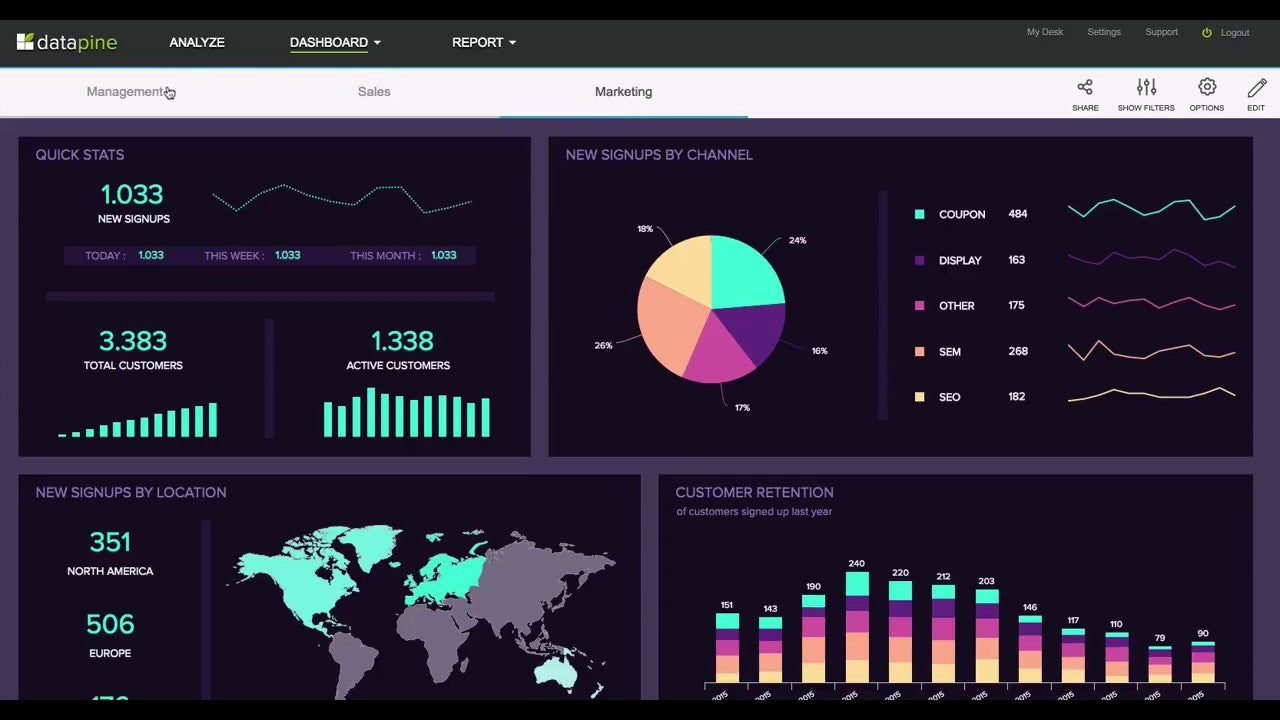
DATAPINE covers most requirements of beginners & advanced users.

Key Features:

Visual drag-&-drop interface

Powerful predictive analytics & interactive charts & dashboards

Intelligent alarms triggered for anomaly

2.) Statistical Analysis Tools

There exist multiple programming languages that make work easier & effective. With the expansion of languages, some rules and scenarios need special attention for statistical data analysis & modeling.

R PROGRAMMING is the most popular tool for data analysts.

Key Features:

An ecosystem of more than 10k packages & extensions for data analysis

Statistical analysis, modeling, & hypothesis testing

The active community of researchers, statisticians, & scientists

3.) General-Purpose Programming Languages

Programming languages help to resolve a variety of data problems. Tools like C#, Java, PHP, Julia, Ruby, and Python are many reliable solutions.

PYTHON is the most trusted tool.

Key Features:

Open-source solution with simple coding processes

Easy integration with other languages

Advanced analysis processes through ML & text mining

4.) SQL Consoles

SQL is a programming language used to manage data held in relational databases, effectively handling structured data for analysts. Highly popular in the data science community, these tools are used in various business cases & data scenarios. 

MYSQL WORKBENCH is the most popular one.

Key Features:

  • Unified visual tool for data modeling, administration, SQL development, backup, etc.
  • Instant access to the database via Object Browser
  • SQL Editor offers color syntax highlighting, reuse of SQL snippets, & execution history

5.) Unique Predictive Analytics Tools

Predictive analytics is an advanced technique to combines data mining, AI/ML, and predictive modeling to predict future events. It is an essential data analysis tool as it simplifies predictive analytics processes. 

SAS FORECASTING is an analysis software helpful for predictive analytics processes & helps analysts to predict future scenarios.

Key Features:

  • Automatic forecasting for entities or products, including hierarchical forecasting
  • Scalability & modeling to create an ensemble
  • An unlimited model repository including time-series & casual methods

Apart from the tools mentioned above, there are industry-specific analytics tools & data science platforms that assist professionals. A business analytics course can help you better understand what data analytics is!

Build a New-Age Career with Imarticus:

Imarticus Learning offers Data Science Courses, the most extensive, industry-approved experiential learning program ideal for Data Analysts. Industry experts have developed the programs to help students learn real-world applications of Data Science from scratch & build robust models to generate valuable business insights and predictions. Take a giant career leap with this analytics program.

For more details, contact us through the Live Chat Support system or visit our training centers in Mumbai, Thane, Pune, Chennai, Bengaluru, Hyderabad, Delhi, and Gurgaon. 

7 reasons why you must technologize supply chain using advanced analytics and AI

The supply channels of the industry are experiencing a crucial moment in their existence and those responsible for this vital area for any business face the greatest challenge of their careers; managing an innumerable list of suppliers, information and communication flows, technologies, procedures, and levels of demand, as never before in the history of the global industry.

These supply networks have grown in complexity appreciably and have suffered the consequences of the global economic crisis with particular virulence. To help you understand the importance of technologizing the supply chain using advanced analytics and AI, we offer an SCM program where you can obtain a certification in supply chain management

Here are 7 reasons why you must consider technologizing the supply chain using advanced analytics and AI: 

  • Agility is key to success, more than ever. Designing supply chain network systems must work like a clock, and take advantage of new technologies, such as IoT, Blockchain, or Artificial Intelligence, to reach new levels of efficiency.

  • Advanced analytics is another alternative high impact in this world, taking into account the permanent state of evolution and change network provision of any business. Evaluating the best options, those that provide the greatest value and margin, and taking advantage of all the data at our disposal has an immediate positive consequence on the results. Thankfully, our professional certification in supply chain management explains how advanced analytics is beneficial for the supply chain management.

  • The information must be analyzed comprehensively and quickly, with the powerful support of the cloud. Large corporations are moving quickly so that their supply chains are aligned more with your customer strategy, and are connected more directly, accurately, and flexibly. But, above all, an “always ON” supply chain is sought that responds to commercial needs at all times.

  • The interconnection of all its links is crucial for the machinery to function and respond to the demanding market conditions. Analyzing that information has profound implications for B2B processes. For this reason, one of the fundamental attributes of this supplier ecosystem is its “resilience”, understood as the ability to anticipate and react immediately to any potential anomaly that could endanger it.

  • Staying safe from the unexpected requires intelligent use of multiple data sources, new, traditional, structured or not, of diverse typology, even in natural language, and easy to find or obscure to the provider. And all of them must be leveraged by certification in supply chain management.

  • You need expert staff and precisely the links in the supply chain have long suffered thinning plans that have reduced their workforce like never before. And when older veterans leave the organization, they will carry with them a lot of knowledge and experiences that have been treasured for decades, with the consequent brake on exhaustive analyzes that require intelligence to interpret the information.

  • Designing a supply chain network with full intelligence is capable of managing in real-time large amounts of structured and unstructured data from internal and external sources, including data sets that may previously have been difficult to reach. Precisely anticipating future demand and managing assets, inventory, and shipments in real-time improve the bottom line for any operator, requiring an optimized, near-automatic supply model.

The new forms of commerce that have fostered the Internet, the cloud or connected objects will only gain shape if they have the most efficient logistics processes, a modern supply chain that meets their high demands with a permanent journey to excellence. Professional certification in supply chain management offered by Imarticus can lead to a truly digital supply chain. 

Machine Learning at work: The future of the workplace in 2022

Automated algorithms that learn from experience and data are known as machine learning (ML) algorithms. In order to generate predictions or judgments without being exclusively coded or overseen by humans, machine learning algorithms generate a model based on training data. The discipline of machine learning gains new techniques, theories, and application fields from mathematical optimization research. 

When it comes to machine learning, input such as training data or knowledge graphs is used in the same way that the human brain develops information and comprehension. Defining entities allows for deep learning. The Edutech industry nowadays is filled with Machine Learning and Artificial Intelligence courses.

There are several ways to start the machine learning process, such as through looking at examples, direct experience, or even teaching. Data is examined for patterns that may be used to draw conclusions from the instances given. With machine learning, computers can learn on their own, with no help from humans, and then modify their behavior as a result. 

Types of Machine Learning Algorithms

Machine Learning algorithms can be mainly distributed into three categories, they are:

  • Supervised Learning: Supervised machine learning systems use labeled samples to predict future occurrences based on what has been learned in the past. The learning technique uses a known training dataset to build an inferred function that predicts output values based on that dataset. After sufficient training, the system is capable of providing objectives for any new input. It is also capable of comparing the model’s output with the planned, proper output in order to identify problems and make modifications as necessary.

  • Unsupervised Learning: To train an unsupervised machine learning algorithm, you don’t need to classify or label the data. It is possible for systems to infer a function from unlabeled data in order to explain a hidden structure. Throughout the whole process, the machine does not know the right answer. Instead, it uses datasets to make predictions about the result.

  • Reinforcement Learning: A Reinforcement learning algorithm is a way of teaching a computer to do something by causing it to do an activity and then looking for faults or rewards. “Trial and error” and “feedback” are two of the most important aspects of this kind of learning. 

Workplaces Where Machine Learning is Being Extensively Used

Businesses across many industries are already using machine learning to boost innovation and improve operational efficiency

  • Cyber-security firms
  • Finance sectors such as banks and FinTech enterprises
  • Healthcare industry
  • Detection of fraud
  • Retail businesses

Why this Course?

Acquire a firm grasp of the fundamentals of data analytics and machine learning, and learn how to master the most used data science tools and methodologies, to position yourself for employment. Post Graduate Program in Data Analytics & Machine learning by Imarticus comes with a guaranteed placement opportunity. 

In this machine learning course, you’ll learn exactly what the world’s leading employers of data scientists are looking for in their employees. As part of the curriculum, you’ll work on Capstone Projects, real-world business cases, and mentoring from industry leaders that matter.

Conclusion:

While many might say that employment is being lost to AI at a far faster rate than in prior industry-changing events, the numbers so far do not stack up. Rather than eliminating employment, artificial intelligence in the workplace is enhancing people’s skillsets, and hence their compensation, across a broad variety of sectors.

So without any delay, get your machine learning certification now and pave your own path to becoming a successful Data Science Professional with Imarticus’ Post Graduate Program in Data Analytics & Machine learning.