The CFO Career Path: Milestones, Skills, and How to Accelerate Your Journey to the Top

In corporate finance, only few positions are more influential, and the Chief Financial Officer is one of those positions. But how is one supposed to ascend the ladder toward this highly coveted role? Seizing this Career Path as a CFO will enable a finance person who is eyeing the next big move or an ambitious executive who has been setting long-term objectives. 

Usually, the CFO Career Path is a twisted one and definitely not about sitting by a desk and crunching numbers. Making really tough managerial decisions with people from all walks of their lives and being taught over and over-again while doing so. In this blog, we’ll take you through the steps to the CFO position, the milestones you’ll need to achieve, the skills you’ll need to acquire, and actionable plans to accelerate your financial leadership process.

Table of Contents

  • Introduction to the CFO Career Path
  • Steps to Become a CFO
  • Key Milestones on the Financial Leadership Journey
  • CFO Roles and Responsibilities Explained
  • Essential Skills for an Executive Finance Career
  • Advancing in Corporate Finance: How to Accelerate Your Journey
  • Enrol in a Global CFO Programme to Fast-Track Success
  • Key Takeaways
  • FAQs
  • Conclusion

The CFO Career Path is usually seen as – the pinnacle of success for finance professionals. However, contrary to popular assumption, there is no one, fixed recipe to be followed. CFOs these days have multiple hats to wear: they’re strategic advisors, financial guardians, risk managers, and even change leaders.

In a world of business powered by ongoing transformation, CFOs are now called upon to provide more than fiscal know-how. They need to provide vision, insight, and the skill to lead organisations through change and development. If you are committed to developing your executive finance career, grasping this changing role is the beginning.

CFO Career Path

Steps to Become a CFO

The CFO career path demands meticulous planning, continued development, and the exposure. Since no two journeys are alike, however, most successful CFOs have somewhat similar career patterns that they follow.

Usually.. many of them begin their careers in accounting, audit or investment banking and consulting. Then, these professionals get into senior finance roles, receiving exposure to financial operations, strategy, and leadership.

Steps to Becoming a CFO:

  • Earn a bachelor’s degree in accounting, finance, economics, or an associated field.
  • Seek professional certifications (e.g., CPA, ACCA, CFA).
  • Gain experience with financial reporting, budgeting, and analysis.
  • Advance to mid-level finance positions like Finance Manager or Financial Controller.
  • Develop strategic capabilities and cross-functional capabilities.
  • Seek advanced leadership education or executive education.
  • Become senior finance leadership positions (e.g., VP of Finance, Director of Finance).
  • Exhibit strategic thinking and sound business acumen.

Educational & Career Milestones

StepDescription
Bachelor’s DegreeFoundation in finance, accounting, economics
Professional CertificationsEnhance credibility (CPA, CFA, ACCA, etc.)
Early Career RolesFinancial Analyst, Auditor, Consultant
Mid-Level RolesFinance Manager, Controller
Senior LeadershipVP of Finance, Head of Finance
CFO AppointmentTop financial strategist and decision-maker

Key Financial Leadership Milestones

Financial leadership is defined by certain milestones that reflect readiness for increased responsibility. It’s not about job levels.. it’s about developing influence, strategic acumen & leadership presence.

Achieving these milestones provides you with the experience and exposure necessary to lead complex financial activities at the executive level.

Critical Milestones on the CFO Career Path:

  • Financial fundamentals mastery: reporting, budgeting, and forecasting.
  • Leading cross-functional teams and projects.
  • Crafting business-wide financial strategies.
  • Attaining international exposure or operating globally.
  • Assembling effective relationships with C-Suite and board members.
  • Implementing organisational change and transformation efforts.
  • Managing investor and stakeholder communications.

Strategic impact and communication abilities are now included among the most sought-after skills among CFO candidates by boards, based on Deloitte’s 2024 CFO Survey.

CFO Job Responsibilities Defined

CFO job responsibilities and roles are crucial for anyone on the CFO Career Path. The days when balancing the books was the only role of the CFO are over.

The modern CFO is a strategic business partner who contributes to long-term vision formulation, financial sustainability, and sustainable growth. The role has expanded from the traditional financial oversight to include the realm of technology along with areas of risk management and corporate governance.

Primary CFO Roles and Responsibilities:

  • Financial planning, budgeting, and forecasting.
  • Management of cash flow, capital structure, and financial risk.
  • Driving M&A activity and investment policies.
  • Driving compliance with regulations and standards.
  • Advising the board and CEO on finances.
  • Leading digital change in finance.
  • Constructing and guiding top-performing finance organizations.

Table: CFO’s Shifting Role

Traditional ResponsibilitiesEmerging Responsibilities
Financial reportingStrategic decision-making
Cost managementTechnology and digital initiatives
Compliance oversightESG and sustainability leadership
Budgeting and forecastingRisk management and crisis preparedness

Key Skills for an Executive Finance Career

To be successful at an executive finance career takes much more than technical knowledge. Although financial sophistication forms the core, potential CFOs also need to develop a wide range of skills that combine leadership, strategic vision, and creativity.

In today’s fast-evolving global economy, businesses want CFOs who can not only read numbers, but can also spin the story behind numbers—and use this story to steer the organisation in the right direction.

Top Skills to Master on the CFO Career Path:

  • Financial literacy and analytical mind.
  • Leadership and team management skills.
  • Strategic thinking and business acumen.
  • Communication and stakeholder engagement.
  • Digital and technological acumen.
  • Change management and resilience.
  • Risk management skills.
  • Emotional intelligence and high-pressure decision-making.

Based on McKinsey & Company’s CFO Insights, CFOs increasingly function as agents of business transformation. 

Moving Up in Corporate Finance: How to Fast Track Your Career

Most finance professionals are curious about how they can differentiate and accelerate their journey along the CFO Career Path. The solution is deliberate career steps, ongoing learning, and assertive leadership.

Waiting for opportunities will not do. You must pursue experiences that create strategic abilities, international experience, and executive presence—three cornerstones that drive advancement within corporate finance.

The Steps to Fast-Track Your Financial Leadership Journey

  • Seek executive education and leadership development programs.
  • Volunteer for significant projects outside the core finance scope.
  • Establish mentorship and senior leadership relationships.
  • Seek international assignments or cross-border experience.
  • Acquire skills in fast-emerging fields such as digital finance and ESG.
  • Stay current on industry trends and thought leadership.
  • Proactively manage your personal brand and executive presence.

Quick Insight: The Harvard Business Review highlights that CFOs with global, cross-functional, and tech-driven experience are in high demand among Fortune 500 companies.

Enrol in a Global CFO Programme to Fast-Track Success

If you want to fast-track your CFO Career Path, invest in a globally recognized executive programme for future CFOs. The Chief Financial Officer Programme at the London Business School, available in partnership with Imarticus Learning, helps you exactly do that.

This top-tier programme provides you with the latest in financial leadership skills, strategic awareness, and the global exposure to succeed at the most demanding echelons of corporate finance.

Enrol Now: Chief Financial Officer Programme by LBS & Imarticus Learning

Key Takeaways

  • The CFO Career Path is -dynamic, requiring strategic, financial, and leadership excellence.
  • The path of becoming a CFO requires education, varied experience & ongoing development.
  • Top-level success depends on mastering CFO jobs and responsibilities.
  • Developing executive finance skills goes beyond technical finance.
  • Advancing in corporate finance proactively relies on -global exposure, mentorship, and strategic opportunity.
  • Formal executive programs such as the LBS CFO Programme can make a huge difference.

FAQs

1. What is a typical CFO Career Path?

A typical CFO career path generally involves roles such as -Financial Analyst, Finance Manager, Financial Controller & Vice President of Finance before entering the role of CFO, supported with further qualifications and leadership development.

2. How long does it take to become a CFO?

It takes between 15-20 years, on average, to reach the position of CFO.. this figure varies on the basis of one’s career choices, industry, and educational background.

3. Do CFOs require professional certifications?

While not a must- certifications such as CPA, CFA, or ACCA are a great way to add credibility and enhance an individual’s competitiveness for the CFO Career Path.

4. Which industries offer the quickest CFO Career Path?

Technology, financial services, and private equity generally offer somewhat faster finance leadership career pathways propped up by rapidly evolving financial landscapes.

5. What’s the most severe challenge confronting new CFOs?

The new CFOs face a huge load of expectations from stakeholders, manage digital transformation, and adjust to global financial volatility.

6. How do I cultivate strategic thinking as a finance professional?

Strategic thought can be cultivated by working on: cross-functional initiatives, engaging in executive education & keeping up to date with business trends.

7. Is global experience essential for CFOs?

 Yes, global exposure is more and more sought after, as CFOs tend to oversee financial operations in more than one region and will have to deal with various markets.

8. Can one be a CFO without an accounting background?

Yes, although most CFOs have an accounting background, some also have an investment banking, consulting, or operational finance background.

9. How significant is digital literacy for CFOs?

 Digital literacy is extremely important since CFOs today drive finance transformation through technology, data analytics, and automation.

10. What is the benefit of joining a CFO leadership programme?

Such programs offer structured education, international views, peer networking, and real-world insights that speed up preparation for the CFO position.

Conclusion

The journey to getting to becoming the CFO must be as intellectually challenging as it is rewarding. However, upon fully appreciating the CFO Career Path, developing the essential skills, and creating and seizing new opportunities for growth on your own, you are almost a guarantee of reaching the top levels of finance leadership. 

With the right mindset, right strategic moves, and a world-class education like the LBS CFO Programme, the way to the top is greatly shortened. So remember, the future will never belong to the ones that do just understand numbers—but rather to those who can lead; inspire, and really affect lasting business change.

How to Become a CFO: Skills, Qualifications, and the Quickest Route to the C-Suite

Reaching the top of the ladder that leads to the much-desired Chief Financial Officer (CFO) position is no simple task, but this is the dream of many finance professionals across India. If you have ever pictured yourself as a senior decision maker at the highest level impacting the future direction of an organisation with control of its finances, this blog will show you how to become a CFO.

The path to the CFO role does not merely involve number crunching in today’s competitive landscape. It involves great leadership & vision, as well as the right balance of technical skills, business skills & soft skills. No matter where you are in the process, whether as an aspiring finance leader, mid-career professional or starting to plan a pathway to CFO.. it is important to understand what skills to be able to develop, what qualifications you may require and what is the quickest route to the C-suite.

How to become a CFO

Table of Contents

  • What Does a CFO Do?
  • CFO Career Path: The Typical Journey
  • Skills Needed to Become a CFO
  • CFO Qualifications and Certifications You Need
  • Financial Leadership Positions Leading to the CFO Role
  • Executive Finance Training: Fast-Track Your Journey
  • Fastest Route to the C-Suite: Practical Advice
  • Key Takeaways
  • FAQs
  • Conclusion

What Does a CFO Do?

Before you strategize on how to become a CFO, it is important to know the extent of this lofty position. The CFO occupies the confluence of finance, strategy, and leadership, serving as the financial guardian and strategic guide to the CEO and board.

Now, CFOs are no longer just confined to crunching numbers. Now, they lead business growth, manage investments, handle risks, and lead digital transformations. Their function stretches far beyond financial reporting to creating company vision and performance.

Chief Responsibilities of a CFO:

  • Managing financial planning, budgeting, and forecasting
  • Managing capital structure and financial risk
  • Guiding M&A and strategic investment decisions
  • Ensuring compliance with regulations
  • Guiding the CEO and board on financial strategy
  • Driving operational efficiency and profitability

Explore global CFO trends from PwC

CFO Career Path: The Generic Journey

It takes time, experience, and wise decision-making to plot your CFO career path. There is no such thing as a one-size-fits-all plan, yet knowledge of the generic journey can facilitate planning.

Not everyone becomes a CFO overnight. Most CFOs gain experience in finance, accounting, operations, and leadership over a period of 15-20 years. Through focused planning and the right executive financial training, talented professionals can expedite this timeframe.

Typical Career Path:

Career StageKey RolesDuration
Entry-LevelFinancial Analyst, Accountant2-4 Years
Mid-LevelFinance Manager, FP&A, Controller4-7 Years
Senior-LevelHead of Finance, Director of Finance5-8 Years
Executive-Level (C-Suite)CFO

A few professionals can switch from audit, advisory, or corporate finance careers. Others might shift from top finance leadership jobs like Finance Director or VP of Finance.

Skills to Become a CFO

Learning how to be a CFO involves acquiring technical skills and leadership skills. Strategic thinkers, technologically savvy, and able communicators are today’s CFOs.

Technical knowledge is not enough. You will need to inspire teams, work with stakeholders, and address complicated business environments.

Key Skills for Future CFOs:

  • Financial Acumen: Strong finance statement, modeling, and forecasting expertise
  • Strategic Thinking: The ability to link finance with business objectives
  • Leadership: Directing teams and impacting at board level
  • Technology Awareness: Knowledge of digital tools, AI, and analytics
  • Risk Management: Finding and addressing financial risks
  • Communication: Communicating complex data to non-finance stakeholders
  • Adaptability: Managing change and uncertainty

It is said that according to Deloitte’s Global CFO Signals, CFOs nowadays are more likely required to lead innovation and organisational transformation.

Qualifications and certifications you require

Your professional and academic qualifications are instrumental in deciding how to become a CFO. Experience is important, yet qualifications reflect credibility and dedication towards your CFO career.

In India, a combination of core degrees, advanced certifications, and international exposure enhances your CFO prospects.

Typical CFO Qualifications and Certifications:

  • CA (Chartered Accountant): Extremely well-respected for finance skills
  • MBA (Finance/Strategy): Best suited for strategic leadership development
  • CFA (Chartered Financial Analyst): Enhances investment and finance knowledge
  • CPA (Certified Public Accountant): Reputed for international finance expertise
  • Executive Finance Training: Short-term programmes for leadership skills

Numerous successful Indian CFOs have augmented their skills through specialized executive finance training, like the Chief Financial Officer Programme by London Business School and Imarticus Learning.

Financial Leadership Positions Leading to CFO

Along the way to becoming a CFO, you will probably move through several financial leadership positions that lead you to the highest position. Each is developing your technical skills, business acumen, and leadership skills.

These jobs provide essential experience in strategic decision-making, managing teams, and communicating with stakeholders—pillars of CFO success.

Financial Leadership Positions:

  • Financial Controller
  • Head of FP&A (Financial Planning & Analysis)
  • Director of Finance
  • VP of Finance
  • Finance Business Partner
  • Head of Treasury or Risk Management

Numerous Indian CFOs also acquire global exposure or cross-functional experience in ops or strategy positions prior to arriving at the C-suite.

Executive Finance Training: Speeding Up Your Career

While a traditional CFO career path can be decades long, the right executive finance education can condense and expedite your career. These programs develops leadership capability, knowledge of global business, and strategic decision-making.

For Indian finance professionals seeking to speed up their career, such training offers:

  • Exposure to global finance trends
  • Access to world-class faculty and industry specialists
  • Leadership development in live business scenarios
  • Networking with senior finance colleagues

One such initiative is the exclusive Chief Financial Officer Programme by London Business School and Imarticus Learning, which helps prepare finance leaders for the C-suite.

Fastest Path to the C-Suite: Practical Tips

Face it—the CFO race is cutthroat. But with intentional decisions, ongoing learning, and conscious career strategies, you can speed your way to the top.

Here’s a pragmatic guide to speed-up becoming a CFO:

Guidelines to Make it to the C-Suite:

  • Secure recognized CFO certifications and qualifications early
  • Develop cross-functional skills (strategy, operations, technology)
  • Establish networks with mentors and senior executives
  • Stay current with new financial technologies
  • Enhance leadership, communication, and negotiation skills
  • Engage in high-impact projects that showcase strategic thinking
  • Consider executive finance training to enhance credibility

For insights on evolving CFO expectations, check out EY’s CFO Imperative Report.

Key Takeaways

  • The path to CFO requires technical expertise, leadership, and vision.
  • Mapping your CFO career path early boosts your chances.
  • Focus on building the skills required to be a CFO, including strategic thinking and technology awareness.
  • Acquiring respected CFO qualifications and certifications enhances credibility.
  • Strategic financial leadership roles build readiness for the C-suite.
  • Executive finance training accelerates your leadership journey.
  • With planning, ambition, and continuous learning, Indian professionals can reach CFO faster.

FAQs

1. How long to become a CFO?

Generally.. it takes 15-20 years of progressive experience, in finance & leadership positions to become a CFO. However -that timeline can move faster with the right qualifications and executive programs.

2. Do I need to be CA, or MBA to become a CFO?

While 99% of CFOs have a CA or MBA, it is possible become a CFO, without a CA or MBA, but with some other finance-related certifications, and extensive leadership experience, as long as global certifications and executive training are obtained.

3. Do I need to be CFA to be a CFO?

A CFA is not required but greatly appreciated for investment strategy, capital markets, and financial leadership positions at multinational corporations.

4. In which industries do CFOs get hired most frequently?

CFOs are recruited in all industries such as -BFSI, technology, manufacturing, healthcare & startups, where strategic growth is fueled by financial leadership.

5. Must I have international experience to be a CFO?

Though not necessary, international exposure greatly enhances your CFO opportunities, particularly in multinational firms or MNCs.

6. How significant is tech savvy for CFOs?

Very significant—today’s CFOs need to be familiar with financial technologies, data analysis, AI, and digitalization to guide successfully.

7. Can Indian professionals indulge in global CFO vacancies?

Yes. With good credentials, international experience and leadership potential, Indian professionals very often are offered CFO roles at multinational corporations.

8. What is the fastest route to becoming a CFO in India? 

The fastest route being through pursuing the best CFO qualifications and investments, accumulating cross functional experience, engaging in strategy projects and studying top executive finance programs.

9. Is CFO a finance-only role? 

No. Finance is a core role but the modern CFO is a strategic business partner who has influence over operations, technology, risk and the performance of the organisation as a whole.

10. What can I do today to start preparing for a CFO position?

Focus on technical knowledge and expertise, develop your leadership skills, develop your network, stay up to date with global finance developments and consider taking special programs such as the Chief Financial Officer Programme by London Business School and Imarticus Learning.

Conclusion

For aspiring finance professionals in India, learning how to become a CFO is the first step to a respected and influential leadership role. Becoming a CFO means not only developing technical skills, but also developing strategic thinking, and a serious commitment to learning. 

By thoughtfully developing the skills to act as a CFO, earning reputable CFO qualifications and certifications, obtaining experience in necessary finance leadership roles along with a commitment to executive finance education, you can accelerate your journey to the C-Suite. 

If you have invested time and effort into creating your CFO career pathway, you should consider applying the Chief Financial Officer Programme by London Business School and Imarticus Learning, an internationally-recognised hiring programme for finance leaders transitioning to the top spot.

The path may be challenging, but if you stay the course, the C-Suite is closer than you think.

Cybersecurity Training: Why Business Leaders Need It

Table of Contents

  • Introduction
  • The Evolving Cyber Threat Landscape
  • Executive Cybersecurity Training: Beyond Technical Teams
  • Cybersecurity Awareness for Business Leaders: A Boardroom Priority
  • Cyber Risk Management: A Shared Responsibility
  • Oxford Cybersecurity Course: Shaping Confident Leaders
  • Leadership in Cybersecurity: Building a Culture of Vigilance
  • Real-World Examples: When Leaders Made the Difference
  • Key Takeaways
  • Conclusion
  • FAQs

Introduction

The era when cybersecurity training existed as a secluded technical activity reserved exclusively for -IT professionals has ended. The current hyper-connected data-centric environment transforms cyber threats from obscure online dangers into boardroom challenges. The responsibility of protecting organisations from cyber threats now rests heavily upon business leaders along with executives and decision-makers. And the stakes? The current levels have reached unprecedented heights. 

Recent high-profile violations have demonstrated a rigorous reality: without strong leadership participation in cyber security strategy, even the most technically stronger organizations are unsafe. This is not about transforming business leaders into hackers or coorsted – it is about making them equipped with the knowledge, awareness and strategic mindset required to navigate the complex world of cyber risk. Where executive-focused cyber security training comes.

The Evolving Cyber Threat Landscape 

The quantity & complexity of cyberattacks continue to expand at a rate -that frequently exceeds the defensive capabilities of organizations. The current threat environment reaches new levels of danger as ransomware attacks disable essential systems while phishing schemes aim at top corporate leaders. 

A newly published IBM report indicates that the worldwide mean expense of data breaches escalated to $4. The population reached 45 million in 2023 representing a 15% growth during the preceding three years. The scope of attacker exploitation has expanded beyond technical vulnerabilities to include human gaps alongside business process flaws and inadequate strategic oversight. 

Type of ThreatImpact on OrganisationsReal-World Example
Phishing AttacksCompromise of executive credentials, financial lossThe Twitter Bitcoin scam of 2020 saw high-profile accounts hacked
RansomwareOperational shutdown, reputational damageColonial Pipeline attack disrupted fuel supply across the US
Insider ThreatsData leakage, intellectual property theftTesla faced a major insider sabotage incident in 2018

Business leaders need to understand this evolving landscape.. not just the technical jargon -but the real-world business implications. That’s exactly why cybersecurity training must extend beyond the IT department.

Executive Cybersecurity Training: Beyond Technical Teams

Many organisations still believe cybersecurity training is best left to IT teams, technical experts, and engineers. But in reality.. executives are prime targets for cybercriminals—often referred to as ‘whale phishing’ or ‘CEO fraud’.

Executive cybersecurity training isn’t about teaching business leaders how to configure firewalls —it’s about enhancing their ability to identify risks, ask the right questions & make informed decisions that protect the organisation.

Why Leaders Need Dedicated Cybersecurity Education:

  • They shape policies that directly impact the company’s security posture.
  • Their decisions influence resource allocation for cybersecurity initiatives.
  • Their credentials and communications are frequent targets for attackers.
  • They must respond effectively to breaches and crisis situations.

A well-informed leadership team, empowered by targeted cybersecurity training, is essential for building organisational resilience in the digital age.

Cybersecurity Awareness for Business Leaders: A Boardroom Priority

Cyber incidents are not only limited to assistive IT tickets but are capable of destroying mergers, spoiling reputations, and even incurring regulatory fines. Therefore, a cybersecurity awareness campaign for business leaders is now absolutely necessary.

Just imagine—according to Gartner’s research, 88% of boards of directors consider cybersecurity a business risk, rather than only a technical risk. However, many senior executives are still unaware

Key Areas of Cyber Awareness for Leaders:

  • Understanding emerging cyber threats relevant to the industry.
  • Recognising social engineering tactics that target executives.
  • Appreciating the legal and reputational fallout of breaches.
  • Supporting a security-first organisational culture.

Without cybersecurity awareness for business leaders, even the most sophisticated security tools can be rendered ineffective.

Cyber Risk Management: A Shared Responsibility

Cyber risk is business risk—plain and simple. While technical teams handle the mechanics.. effective cyber risk management starts at the top.

Cyber risk management isn’t about eliminating risk entirely —that’s impossible.. but about identifying, assessing & mitigating threats in a way that aligns with business objectives and regulatory requirements.

Element of Cyber Risk ManagementLeadership Responsibility
Risk AssessmentEnsure enterprise-wide risk identification processes
Policy DevelopmentApprove and champion cyber policies and frameworks
Incident ResponseLead crisis management efforts during cyber events
Continuous TrainingMandate ongoing cybersecurity training for all staff

Without leadership buy-in and understanding of cyber risk management, organisations remain reactive and exposed.

Oxford Cybersecurity Course: Shaping Confident Leaders

For leaders seeking practical, world class education in this space, the Oxford Cyber ​​Security Course offers a unique opportunity. Especially designed for professional authorities, the program bridges the difference between technical complications and strategic leadership.

Through the Oxford Cybersecurity Course, delivered in collaboration with Imarticus Learning, participants gain:

  • A deep understanding of the global cyber threat landscape.
  • Practical frameworks for effective cyber risk management.
  • Insight into governance, compliance, and regulatory expectations.
  • Confidence to lead cybersecurity conversations at board level.

Ready to Lead with Confidence? Enrol now for the Oxford Cybersecurity for Business Leaders Programme with Imarticus Learning.

Leadership in Cybersecurity: Building a Culture of Vigilance

Technology alone cannot defend against cyber threats – people and culture play an important role. This is why the leadership in cyber security is more than policies – it is about the cultivation of vigilance throughout the organization.

Cybersecurity Training

Cyber ​​security includes effective leadership:

  • Set tone for accountability and safety-conscious behavior.
  • Running cyber security training running at every organizational level.
  • To encourage open dialogues about cyber concerns and events.
  • Recognizing and rewarding employees with safety.

Leaders who prefer cyber security make flexible organizations – where everyone understands his role in defense.

Real-World Examples: When Leaders Made the Difference

History provides countless examples of how strong leadership – or in its absence – can affect the results of cyber phenomena.

In the target data breech (2013), poor executive awareness delayed reaction efforts, resulting in significant financial and prestigious damage.

Conversely, Mercec’s response to notpatya (2017) demonstrated decisive leadership and rapid crisis management, which reduces long -term decline.

Twitter Hack (2020) highlighted how the attackers target high-profile individuals, highlighting the need for cyber security awareness for business leaders.

These cases strengthen the message: Effective cyber security training is not optional for leaders – this is a competitive and risk management mandatory.

Key Takeaways

  • Cybersecurity training is essential for executives, not just IT teams.
  • Business leaders are prime targets for sophisticated cyberattacks.
  • Executive cybersecurity training builds strategic decision-making capacity.
  • Cybersecurity awareness for business leaders fosters proactive risk management.
  • The Oxford Cybersecurity Course equips leaders with vital knowledge.
  • Effective cyber risk management requires leadership involvement.
  • Strong leadership in cybersecurity creates a culture of resilience.

Conclusion

In a world where cyber threats crop daily & attackers grow more clever -it is not enough to fully rely on IT departments to protect an organization. Business leaders should not take steps not as technical experts, but not as an active patron of their company’s digital assets.

Investing in cyber security training is not only about compliance – it is about protecting reputation, protecting stakeholders and ensuring organizational longevity. With programs such as the Oxford Cyber ​​Security Courses, officials can create confidence, awareness and strategic mindset necessary to safely lead their outfits in the future.

FAQs

1. Why do business leaders need cybersecurity training? 

Look, leaders are the big fish—prime targets for cybercriminals. If you’re making the major calls, you’d better understand the risks out there. One misstep, and you’re risking the whole company’s wellbeing. You want resilience? That starts at the top.

2. Is cybersecurity training for non-technical professionals effective? 

Absolutely. Programs like the Oxford Cybersecurity Course are built for executives, not IT pros. They cut through the tech noise and focus on what matters for leadership. Doesn’t matter if you’re not a coder—these insights are practical, actionable, and designed for decision-makers.

3. How does cyber risk management relate to business strategy? 

It’s all connected. Cyber threats hit your operations, your brand, and your bottom line. If you’re not factoring cyber risk into your strategic decisions, you’re basically gambling with your company’s future.

4. What is the role of leadership in cybersecurity? 

Leadership sets the agenda. Where leaders focus resources and attention, the company follows. If execs make security a priority and set a strong example, that attitude spreads. Culture starts in the boardroom.

5. Can cybersecurity awareness for business leaders reduce incidents? 

Definitely. When leaders take cyber threats seriously and model secure behavior, employees notice. That tone from the top can build a culture where everyone is more vigilant—which absolutely makes a difference in reducing incidents.

6. What makes the Oxford Cybersecurity Course unique? 

It’s tailored for executives—strategy, governance, real-world scenarios. Forget getting lost in technical details. It’s about what leaders need to know to keep their organizations secure and resilient.

7. How often should leaders undergo cybersecurity training? 

At least annually. The threat landscape doesn’t stand still, and neither should leadership. Ongoing awareness is a must to stay ahead.

8. What are the business risks of ignoring cybersecurity? 

Neglect it.. & you’re looking at data breaches, hefty fines, lost productivity, and reputation damage that can haunt you for years. The financial fallout isn’t just short-term—these problems linger.

9. Is cybersecurity a shared responsibility within organisations? 

No question. IT handles the nuts and bolts, but leadership has to drive the overall strategy and culture. If it’s not a company-wide priority, you’re leaving gaps—and that’s when problems sneak in.

10. How can I enrol in the Oxford Cybersecurity for Business Leaders Programme?

 You can learn more and enrol in the Oxford Cybersecurity Course via Imarticus Learning’s official website.

What Is Data Science & Why It Is A Smart Career Decision

Introduction

Let me ask you a straightforward question: What if the decision of a new career, could land you right in the heart of a vast, global pool of innovation, high-paying job opportunities, and a game of limitless potentials? Tempting, right? That’s all Data Science in 2025. Regardless of whether you’re a new graduate, a working professional, or somebody looking to pivot your career, being asked what is data science could open doors to pathways previously unimagined.Firstly, in the last five years, Data Science has moved from a buzzword to an integral part of our everyday reality across many industries including: finance, healthcare, retail, and entertainment to name a few. By 2026 there will be over 11 million Data Science Job openings in India alone, therefore, it could be an incredibly smart and transformational career move.

Table of Contents

  • What is Data Science?
  • Careers in Data Science: Scope and Opportunities
  • How to Begin a Career in Data Science in India
  • Best Data Science Course with Placement Opportunities
  • Selecting the Best Data Science and AI Postgraduate Course
  • Why Data Science Is The Smartest Career Choice for 2025
  • Key Takeaways
  • FAQs
  • Conclusion

What is Data Science?

The world creates approximately 328 million terabytes of data on a daily basis. However, raw data itself is not useful unless we can interpret it. That’s precisely where Data Science helps. So, let’s dissect what is data science in easy words.

Data Science

Data Science is an interdisciplinary field that uses -scientific methods, algorithms, and systems to extract knowledge & insights from structured & unstructured data. It uses mathematics, statistics, computer science, and other subject courses to make data actionable to the organization and have them use their intelligence to make better decisions.

Key Components of Data Science

Component Description
Data Collection Gathering raw information from multiple sources.
Data Cleaning Removing errors, duplicates, and inconsistencies from data.
Data Analysis Applying statistical methods to identify patterns and trends.
Machine Learning Building predictive models that improve with more data.
Data Visualisation Presenting findings in understandable formats like graphs.

In simple terms, Data Science is the process of extracting meaning from data to address actual problems.

Data Science Careers: Scope and Opportunities

It’s great to know what data science is, but to know where it can lead is more thrilling. The world has seen a rapid rise in careers related to data science, and hence, it’s one of the most future-proof and fulfilling career options today.

In India, organizations from all industries are hiring data professionals at a fast pace to remain competitive. Startups and mega players such as Infosys, TCS, Amazon, and Google – no one is leaving data teams behind.

Top Careers in Data Science

  • Data Scientist: The most desirable job, whose task is to develop models and draw out insights.
  • Data Analyst: Delivers on interpreting data that already exists to aid business decisions.
  • Machine Learning Engineer: Experts at creating AI-based solutions.
  • Data Engineer: Develops and sustains data infrastructure.
  • Business Intelligence Analyst: Converts data into strategic insights.
  • AI Engineer: Develops artificial intelligence technologies for implementation.
  • Big Data Engineer: Maintains and analyzes large-scale data sets.
  • Statistician: Implements statistical theories to address intricate problems.

With this diverse range of roles- jobs in data science have something for everyone, ranging from technical coders to business professionals.

How to Start a Career in Data Science in India

The question in everyone’s mind is – how to begin a data science career? The good news is, you don’t have to be a technical wizard to begin. But you do need to follow a systematic approach.

Here’s an Indian student and professional’s roadmap:

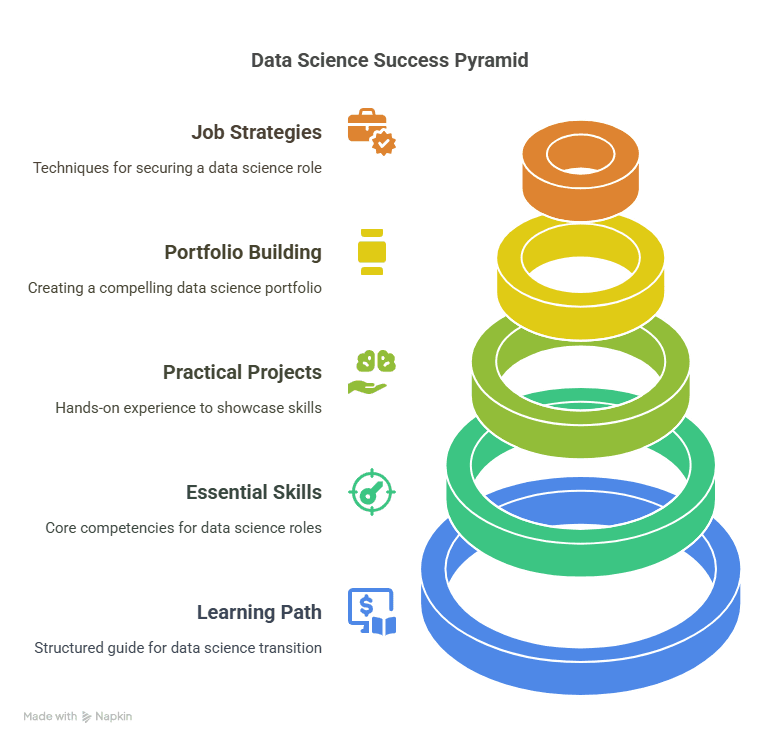
  • Step-by-Step Guide to Begin Your Data Science Career
  • Know the Basics: Learn what Data Science is.
  • Develop Technical Skills: Learn Python, R, SQL, and data visualisation software.
  • Mathematics & Statistics: Refresh probability, linear algebra, and stats.
  • Choose the Right Course: An MBA in Data Science with placement can speed up your career very much.
  • Work on Real Projects: Practical experience is priceless.
  • Build a Portfolio: Display your skills with GitHub, Kaggle, or personal projects.
  • Stay Updated: Be abreast of industry developments and trends.
  • Network and Apply: Go to meetups, LinkedIn networking, and apply for internships.

For those seeking a guided learning process, taking admission in a well-known data science course with placement is usually the best way to begin.

Top Data Science Course with Placement Options

If you’re serious about entering this industry, opting for a placement data science course is a big ticket. It provides you with not only technical skills but also job guarantee and industry exposure.

Best Courses to Make Career-Ready Data Scientists

Program Name Features
Imarticus Learning – PG Program in Data Science and AI Placement support, industry projects, AI integration
IIT Roorkee – Data Science and Machine Learning Certificate Focus on advanced ML tools with placement assistance

For Indian students seeking best-of-breed training with job assurance, the Imarticus Learning Data Science and AI Program is one of the most reliable choices.

Selecting the Top Postgraduate Course in Data Science and AI

After deciding you want to venture into this area, the second step is finding the best postgraduate course in data science and AI. But with all the possibilities, how do you select?

A proper postgraduate course should have – industry-focused curriculum, practical projects, experience with AI technologies & career guidance. Considering how interdependent AI and Data Science are, studying both together maximizes your job opportunities.

Factors to Keep in Mind When Selecting a Program

  • Curriculum crafted by industry professionals.
  • Both Data Science and AI emphasis.
  • Hackathons and real-world projects.
  • Career services and placement assistance dedicated.
  • Flexible online or blended learning possibilities.
  • Good student feedback and sector standing.

The best postgrad program in data science and AI gives you both technical skills and the skills to solve business issues with data-driven solutions.

Why Data Science is the Smartest Career Move for 2025

Let’s be honest – technology is not going to slow down anytime soon, nor will the need for data experts. Adopting Data Science as your career choice in 2025 is equivalent to investing in a future-proof property.

The latest findings from Forbes indicate that Data Science and AI will be the driving forces in global job markets over the next decade. India, with its thriving digital economy, is amongst the prominent markets for this boom.

Why 2025 is the Ideal Time

  • Massive opportunities for data science careers in India and around the world.
  • Competitive pay and high job satisfaction.
  • Opportunity to work on state-of-the-art AI and ML projects.
  • Freedom to work across industries such as healthcare, finance, and e-commerce.
  • High impact and mentally stimulating work.
  • Global mobility and work-from-anywhere options.

The Future of Jobs Report of the World Economic Forum marks Data Science among the most emerging fields.. and therefore it is a wise career choice. 

Key Takeaways

  • Data Science is transforming business decision-making. 
  • Careers in data science are booming in India.
  • You can begin with a placement-oriented data science course. 
  • Picking the right postgraduate course in data science and AI guarantees career-readiness.
  • 2025 is the best time to make the transition into this line of work.

FAQs

1. What is data science and why is it so important?

 Data Science is the process of extracting insights from data to answer real-world questions & that’s why it’s so important for companies to remain competitive.

2. What do data science careers require?

 You require technical skills such as – Python, SQL, statistics, and machine learning, in addition to problem-solving and critical thinking skills.

3. How to begin a career in data science with no technical background?

Start with entry-level courses and build your technical skills step by step, particularly with a data science course with placement.

4. What is the best postgraduate data science and AI program?

Programs like Imarticus Learning’s PG Program are best known for industry focus, AI, and placement support.

5. Are data science careers just for engineers?

 Not at all! There are professionals from mathematics, economics and business to those coming from non tech backgrounds who have transitioned successfully.

6. How much does a Data Scientist earn in India?

— Entry level salaried roles can earn you between 6-10 LPA, and with experience, you can earn 20 LPA or even more.

7. What industries hire Data Scientists?

 IT , finance, healthcare, e-commerce and even government organisations.

8. Does Data Science have a future in India?

 Yes. with India’s digital transformation, the demand for Data professionals, will be exponential.

9. Can I take a data science program online?

 Yes! There are many providers like Imarticus Learning which have platforms that offer extensive programs with flexible learning options and placement support.

10. How long will it take to be job ready?

Working with a structured program, most learners can be job ready in 6-12 months.

Conclusion

There has never been a better time to step into Data Science! With so many people interested in data, it’s possible to dominate industries and even economies based on data. The rigorous the increase in demand, potential salaries, and job satisfaction represents one of the best long-term decisions in your career.

If you are starting from scratch, or simply want to transition to a new career in data, 2025 could represent the beginning of the smartest decision in your career with its leap into Data Science.

Ready to begin your journey? Join the Imarticus Learning PG Program in Data Science and AI today and get your career on track for success.

External References:

  1. Forbes: Data Science Trends for 2024 and Beyond
  2. World Economic Forum: Future of Jobs Report 2023
  3. Harvard Business Review: Why Data Science is the Sexiest Job of the 21st Century

Top In-Demand Data Science Skills Employers Are Looking For

Introduction

Want to land your dream job in data science? You’re not alone. With companies across industries doubling down on data-driven strategies, the demand for data scientists has exploded in India. But here’s the twist—just having a degree isn’t enough anymore. Recruiters are looking for something more: the right data science skills. If you’re asking yourself what differentiates one candidate from the resume ocean, more often than not it boils down to the quality of their skillset and its match with actual business requirements. In this blog, we will guide you through the most in-demand data science skills employers need and how you can learn them to accelerate your data science career advancement.

Data Science Skills

Table of Contents

  • Essential Data Science Skills for 2025
  • Understanding Data Science Job Requirements
  • Most In-Demand Skills for Data Scientists
  • Technical Skills for Data Science Success
  • Programming Languages for Data Scientists
  • Machine Learning Skills for Jobs
  • Boosting Your Data Science Career Growth
  • FAQs
  • Key Takeaways
  • Conclusion

Essential Data Science Skills for 2025

The world of data science continues to change rapidly, as do the skills needed by employers from applicants. While some skills have remained mostly the same, others are becoming mandatory with the introduction of new tools and technologies.

Here are some essential data science skills you should have in 2025:

  • Data wrangling: Cleaning, sorting, and pre-processing raw data. 
  • Exploratory Data Analysis (EDA): Finding trends and outliers in datasets. 
  • Data visualization: Telling a story and presenting findings with tools like Tableau, Power BI. 
  • Model Deployment: Understand how to deploy models into production. 
  • Cloud Computing: Especially AWS, Azure, and Google Cloud. 

These data science skills will not only help you become more technically competent – but will also improve your problem solving mindset, allowing you to think in the style of a data person.

Understanding Data Science Job Requirements

So, what are companies actually asking for in job descriptions? Many freshers and professionals make the mistake of assuming that learning Python or R is enough. But recruiters want a mix of technical prowess, business acumen, and communication skills.

Let’s break down common data science job requirements in a table:

Requirement CategoryExamples
Programming SkillsPython, R, SQL
Machine LearningRegression, Clustering, Decision Trees
Business IntelligenceTableau, Power BI
Cloud PlatformsAWS, GCP, Azure
CommunicationReport writing, stakeholder presentations

Keep an eye on job portals like Naukri, LinkedIn, or global ones like Glassdoor to stay updated on what employers are demanding.

Most In-Demand Skills for Data Scientists

The competition is real—and so is the opportunity. The most successful data scientists are those who develop a combination of domain knowledge and tech stack mastery. From statistical modelling to working on big data platforms, here’s what you should focus on.

Most in-demand skills for data scientists include:

  • Data Engineering: Knowing how to build pipelines using tools like Apache Spark.
  • Model Explainability: Understanding SHAP, LIME, and other interpretation techniques.
  • AI Integration: Merging machine learning models into larger AI workflows.
  • Version Control: Using Git to collaborate and manage code versions.

When these data science skills are part of your toolkit, you position yourself as an asset in any business environment.

Technical Skills for Data Science Success

Beyond theoretical understanding, your technical chops will be scrutinised during interviews and assessments. Technical skills form the backbone of any successful data scientist’s career.

Let’s look at the core technical skills for data science:

  • Statistics & Probability: Hypothesis testing, A/B testing, distributions.
  • Database Management: SQL queries, joins, indexing.
  • Big Data Technologies: Hadoop, Spark, Kafka.
  • APIs: RESTful APIs for model deployment.
  • Scripting: Shell scripting for automation tasks.

Tip: Build projects using real-world datasets to strengthen these skills. Sites like Kaggle are great for practice.

Programming Languages for Data Scientists

You can’t name yourself a data scientist if you don’t know how to use at least – one programming language fluently. But most importantly.. you need to know when & how to use each language for each use case.

The most important programming languages for data scientists:

  • Python: The number one language for machine learning, data cleaning, and data visualization.
  • R: Excellent for statistical analysis and academic research.
  • SQL: Essential for querying relational databases.
  • Scala/Java: Often used in big data environments.

A well-rounded grasp of these tools adds immense weight to your data science skills portfolio.

Machine Learning Skills for Jobs

Machine learning isn’t just a buzzword anymore—it’s a job essential. From fintech to healthcare, every sector is integrating ML models to make smarter decisions. Your understanding of these algorithms can set you apart.

Machine learning skills for jobs include:

  • Supervised Learning: Regression, classification, ensemble methods.
  • Unsupervised Learning: Clustering, dimensionality reduction.
  • Deep Learning: CNNs, RNNs, transformers.
  • Model Evaluation: Precision, recall, F1 score, ROC curves.

The better your grasp on these concepts, the more confident you’ll be in interviews and real-world applications.

Boosting Your Data Science Career Growth

Acquiring skills is just the first step. Strategic learning, mentorship, and networking play a huge role in scaling your data science career growth. The key is to never stop learning and updating your toolkit.

Actionable tips to boost your data science career:

  • Enrol in Certification Programs: Choose ones with real-world projects.
  • Follow Industry Leaders: Stay inspired and updated via LinkedIn or Twitter.
  • Contribute to Open Source: Collaborate on GitHub projects.
  • Attend Webinars and Hackathons: Great for networking and experience.

Remember, growth in data science is exponential when you stay curious and proactive.

FAQs

Q1. What are the most important data science skills to learn first?

 Start with Python programming, statistics, and SQL. These form the foundation of almost every data science role and are universally in demand.

Q2. Are soft skills relevant in a data science job?

 Absolutely, communication, storytelling and managing stakeholders are extremely important for demonstrating data-driven insights effectively.

Q3. Which certification can someone use to reflect their data science skills?

 The certifications available on Coursera, EdX or other platforms like Imarticus Learning will help you be noticed, these certifications will add credibility to your profile. 

Q4. How do I showcase my machine learning skills?

 You can showcase ML projects on GitHub or participate in competitions on Kaggle and write blogs or case studies on Medium.

Q5. How do I become job ready in data science, how long will this take?

 With learning and practice the goal is achievable in 6–9 months, depending on your input and previous experience. 

Q6. Which companies are hiring data scientists in India?

 The top employers are TCS, Infosys, Accenture, Flipkart, and listings include Amazon and fintech companies like Razorpay and Paytm.

Q7. Is it necessary to know both Python and R?

 Not necessarily. Knowing one language well is more valuable than knowing two superficially, though Python is more widely used in the industry.

Q8. Do I need a master’s degree for a data science career?

 It helps but is not mandatory. Skill-based hiring is gaining traction. A strong portfolio can outweigh a formal degree.

Q9. What’s the best way to stay updated on data science trends?

 Follow resources like Towards Data Science, Analytics India Magazine, and DataCamp blogs.

Q10. How important is domain knowledge in data science?

 Very important. Understanding business context enhances the relevance and applicability of your models.

Key Takeaways

  • Mastering data science skills is essential for cracking job interviews & thriving in the industry.
  • Focus on building essential data science skills – from programming to storytelling.
  • Understand data science job requirements thoroughly and tailor your profile accordingly.
  • Learn and apply technical skills for data science through projects and hands-on practice.
  • Boost your data science career growth with the right strategy, certifications, and networking.

Conclusion

The world of work will be driven by data, and businesses want people who not only have the right technical acumen but are also business-aware as well as verbal communicators. It takes the effort and time to acquire those data science skills which are most sought after at that point to make your job future-proof. If you’re a student weighing options or a working individual career-switching, the ideal skillset will stand you apart amidst a noisy marketplace. Get yourself updated, inquisitive, and most crucially, continue building.

How to Future-Proof Your Finance Career with the Right Skills

Introduction

In the fast-changing world of finance today.. standing still is no longer an option. As a student looking to enter the finance industry or a professional already working in this fast-paced environment, here’s one thing that’s certain—future-proofing your career in finance is a must. With automation, fintech revolution, and evolving market needs, your long-term success hinges on ongoing learning and skill acquisition. But what exactly does it take to succeed in the finance landscape of the future?

This blog is your complete guide to future-proofing your finance career with the optimal combination of technical expertise, analytical mindset, and strategic upskilling. Let’s get started.

Finance Career

Table of Contents

  • Understanding the Need to Future-Proof Your Finance Career
  • Future Skills for Finance Professionals
  • Finance Career Growth Strategies
  • In-Demand Skills for Banking Jobs
  • Financial Analyst Skill Development
  • Adapting to Fintech Innovations
  • Career Advancement in Finance
  • Investment Banking Job Skills
  • FAQs
  • Key Takeaways
  • Conclusion

Understanding the Need to Future-Proof Your Finance Career

The finance sector is transforming at an unprecedented pace-technology is reshaping roles, automation is redefining efficiency & new-age skills are replacing traditional expertise. To remain competitive, professionals must adapt proactively.

If you’re eyeing a long-term finance career, this means being agile, updated, and continuously learning. You must anticipate industry shifts and align your skills with future demands.

Key Trends Shaping the Future of Finance

  • Automation & AI are eliminating repetitive tasks
  • ESG and sustainable investing are gaining traction
  • Demand for data-driven decision-making is rising

External Source:  World Economic Forum – Future of Jobs

Future Skills for Finance Professionals

As the industry evolves, certain skills are becoming non-negotiable. The following are must-haves for finance professionals looking to thrive in the future.

Technical expertise alone won’t cut it. You need a balanced portfolio of soft skills and digital acumen. Here’s what’s topping the charts today.

Essential Future Skills for Finance Professionals

Skill CategorySpecific Skills
Analytical ThinkingFinancial modeling, forecasting, data mining
Digital ProficiencyPython, Power BI, Excel, SQL
Strategic CommunicationPresentation skills, stakeholder reporting
AdaptabilityAgile mindset, continuous learning

Finance Career Growth Strategies

Career growth is no longer linear. You need to navigate through a mix of vertical and lateral moves, upskilling opportunities, and network building.

Whether you’re just starting or aiming for the next level, the right strategy can fast-track your finance career.

Practical Growth Strategies

  • Pursue professional certifications like CFA, ACCA, or CPA
  • Enroll in domain-specific online courses
  • Attend industry webinars and workshops
  • Seek mentorship from experienced professionals
  • Keep a pulse on regulatory changes and market dynamics

External Source: Linkedin Learning New Skills in Finance

In-Demand Skills for Banking Jobs

The banking sector is evolving with -digitization, automation, and increased customer-centricity. To stay relevant, banking professionals need to adapt.

This section focuses on in-demand skills that can make or break your career in banking- especially if you’re eyeing private or investment banking roles.

Top In-Demand Skills for Banking Jobs

  • Risk analysis and compliance knowledge
  • Understanding of core banking software
  • Customer relationship management (CRM) tools
  • Digital payment systems expertise
  • AI-based fraud detection systems

How to Develop These Skills

  • Take hands-on CRM system tutorials
  • Attend fintech-focused banking seminars
  • Subscribe to regulatory newsletters

Financial Analyst Skill Development

Financial analysts play a critical role in guiding businesses through complex financial decisions. Their toolkit is becoming increasingly data-driven.

A robust finance career in analysis requires both technical accuracy and strategic insight.

Financial Analyst Skillset Table

Core CompetencyTools & Techniques
Data AnalysisExcel, Tableau, R
Report WritingPowerPoint, dashboard tools
Financial ModellingDCF, LBO models
Sector ResearchSWOT, PESTLE, industry databases

Adapting to Fintech Innovations

Fintech is not a disruption—it’s the new normal. From blockchain to robo-advisors, innovation is everywhere. Staying ahead means staying informed.

You don’t have to be a tech expert, but you do need to understand how technology affects the financial ecosystem.

How to Adapt to Fintech Innovations

  • Understand blockchain fundamentals
  • Explore digital wallets and decentralized finance
  • Stay updated with AI and machine learning trends in finance
  • Experiment with fintech products as a user

Career Advancement in Finance

Climbing the finance ladder requires more than just experience. Strategic positioning, visibility, and smart transitions are key.

This section outlines a structured plan to accelerate your finance career growth in a competitive job market.

Career Advancement Tips

  • Build a strong LinkedIn presence
  • Join finance forums and attend global finance summits
  • Regularly publish financial insights or blogs
  • Upskill every 6–12 months
  • Volunteer for cross-functional finance projects

Investment Banking Job Skills

Investment banking is often seen as the pinnacle of a finance career. However, it’s also the most demanding in terms of skills and stamina.

If you aim to break into or rise within this domain, these are the non-negotiables.

Must-Have Skills for Investment Banking Jobs

  • Financial modeling & valuation expertise
  • Advanced Excel & PowerPoint proficiency
  • Understanding of IPOs, M&A, and LBOs
  • Strong analytical and quantitative skills
  • Excellent written and verbal communication

FAQs

1. Which is the single most critical skill for a career in finance today?

The most important skill is adaptability, which enables one to learn, unlearn, and relearn in response to accelerated industry changes.

2. Am I required to learn coding for a career in finance?

Though not strictly required, learning elementary Python or SQL can provide a major advantage for financial analysis, modelling, and automation.

3. What finance certifications are most sought after in India?

CFA, CPA, and ACCA certifications are well-accepted for international finance positions and can greatly boost career advancement.

4. How do I switch from accounting to a career in financial analysis?

Begin by studying financial modelling, business analytics, and presentation skills. Familiarity with Excel and BI tools is also a must.

5. Is fintech a threat or opportunity for finance careers?

Fintech is rather a chance, bringing new jobs in digital finance, crypto, and AI-driven advisory systems for financial professionals.

6. What are the critical soft skills for finance professionals? 

Communication, problem solving, emotional intelligence, and teamwork are all very useful for relationship management with clients and across different teams.

7. Can I get into finance without an MBA?

Yes, many positions now prioritise skill and/or certification more than they do a degree. What matters most is that you can show that you have the expertise and you are continually learning.

8. What is the impact of AI on finance?

AI is relying on predictive analytics to predict what will happen in the market, fraud detection, and portfolio management. Essentially, it comes down to efficiency and accuracy.

9. How often should I upskill?

You should ideally go back to your skillset every 6–12 month to stay on top of trends and technology in the industry.

10. How do I build a professional finance network?

Get onto LinkedIn, attend conferences specific to finance, join an online community, contribute to finance blogs or webinars, etc.

Key Takeaways

  • Your finance career success depends on continuous skill development.
  • Focus on digital, analytical, and communication skills.
  • Understand and adapt to fintech innovations.
  • Strategic certifications and networking are essential for growth.
  • Roles like financial analyst and investment banker require a unique skill mix.

Conclusion

In time, the financial industry is evolving, and so would you. With an insightful mindset, prudent tools, and sharper strategies, your finance career merely doesn’t survive but thrives in the future. Invest in yourself, keep learning, and stay agile. The finance future is bright, and you have everything it takes to lead the way.

Best Ways to Learn Financial Modelling

Table of Contents

  • Introduction
  • Learn Financial Modeling Online: A Smart Start
  • Best Financial Modeling Tutorials for Beginners
  • Self-Study Financial Modeling: Your Independent Roadmap
  • Investment Banking Modeling Techniques to Master
  • Financial Modelling Certification: Is It Worth It?
  • Excel for Financial Modeling: Tools You Need
  • FAQs
  • Key Takeaways
  • Conclusion

Introduction

If you’ve ever been curious how analysts sift through voluminous amounts of financial data, or how investment bankers come up with future profits it is done through financial modelling. It is the pillar of strategic business decision-making in finance. The ability to learn financial modelling could alter your career goals. Whether you are planning to pursue a career in investment banking, or just want to become a better financial analyst, in this guide, we will help you figure out the best route for exploring the most helpful financial modelling approaches—from the programs to study from to the best forms of self-learning. 

Learn Financial Modeling Online: A Smart Start

Online learning platforms have revolutionised professional upskilling. If you’re planning to learn financial modelling, online courses offer flexibility, real-world case studies, and instructor support. This is ideal for working professionals and students balancing multiple responsibilities.

This course combines foundational theory with industry exposure, ensuring a strong grasp of core concepts.

Best Financial Modeling Tutorials for Beginners

If you’re a motivated learner who prefers autonomy, self-study is a fantastic approach. It allows you to tailor your journey based on your career goals.

Self-study also builds long-term discipline, critical thinking, and problem-solving skills—all of which are invaluable in financial modelling. You’ll gain the flexibility to revisit concepts, experiment with models, and pace your learning according to your grasp. Supplement your efforts with practice cases from actual annual reports and 10-K filings to mimic real-world scenarios. Keep a journal of mistakes and learning reflections to track growth over time.

Self-Study Financial Modeling: Your Independent Roadmap

If you’re a motivated learner who prefers autonomy, self-study is a fantastic approach. It allows you to tailor your journey based on your career goals.

Self-Study Plan Checklist

  • Set Clear Goals: e.g., build a 3-statement model
  • Gather Resources: books, online PDFs, YouTube series
  • Practice Daily: modelling requires repetition
  • Join Forums: Reddit’s r/financialmodeling or AnalystForum
  • Seek Feedback: upload your models for peer review

Some top-rated books for self-study financial modelling include:

  • Investment Banking: Valuation, LBOs, and M&A by Rosenbaum & Pearl
  • Financial Modeling by Simon Benninga
  • The Wall Street MBA by Reuben Advani

Investment Banking Modeling Techniques to Master

A huge part of the financial modelling skillset involves investment banking techniques—especially when it comes to valuations and strategic transactions.

Key Modelling Techniques:

Learn Financial Modeling
  • DCF (Discounted Cash Flow): Forecasting company value based on future cash flows
  • LBO (Leveraged Buyout): Used in private equity to analyze debt-fueled acquisitions
  • M&A Models: Evaluating synergies, accretion/dilution analysis
TechniqueUse CaseTools Required
DCFValuing startups or established firmsExcel, financial reports
LBOPrivate equity investmentsExcel, debt schedules
M&AStrategic mergersExcel, synergy models

Mastering these investment banking modelling techniques prepares you for high-impact roles in IB, PE, and VC firms.

Financial Modelling Certification: Is It Worth It?

While it’s entirely possible to learn financial modelling independently, certifications add credibility. They signal to employers that you’ve been vetted by a recognised body.

Top Certifications:

  • CFI Financial Modeling & Valuation Analyst (FMVA)
  • Wall Street Prep Certification
  • Imarticus Learning Certification in Financial Modeling
CertificationDurationCostRecognition
FMVA4-6 months$500Global, job-oriented
Wall Street Prep1-2 months$399Investment banks
Imarticus Learning3 months₹70,000Placement-supported in India

Financial modelling certification enhances your resume and opens doors to high-paying jobs in finance.

Excel for Financial Modeling: Tools You Need

Spreadsheets are the foundation of all financial models. If you’re going to learn financial modelling, proficiency in Excel isn’t optional—it’s essential.

Excel isn’t just about formulas—it’s about understanding data flow, cleaning messy datasets, and creating intuitive dashboards. When you’re working on large-scale models with interdependent sheets, strong Excel fundamentals can be a game-changer. Get comfortable with keyboard shortcuts to boost speed, and explore macros to automate repetitive tasks. Learning Excel in the context of finance helps you apply logic in ways that mimic how professionals work in investment banks and corporate finance teams.

Must-Know Excel Functions:

  • VLOOKUP/XLOOKUP
  • IF, AND, OR
  • INDEX & MATCH
  • OFFSET
  • Pivot Tables
  • Data Validation

Excel for financial modelling also involves shortcuts, data visualization, and scenario analysis. Many platforms now offer Excel templates with embedded logic for practice.

Check out  Microsoft’s Excel Training Center for guided modules and templates.

FAQs

Q1. What is the best way to learn financial modelling from scratch?

The best way to learn financial modelling from scratch is to- start with foundational courses that teach accounting and Excel basics & then move into more specialised modelling tutorials. Structured programs from reputed providers like CFI or Imarticus Learning can help streamline this journey.

Q2. How long does it take to learn financial modelling?

It usually takes 3-6 months to master financial modelling with regular practice. The duration can be shorter or longer based on your experience with finance and Excel.

Q3. Is financial modelling hard to learn if you don’t have a finance background?

Although a finance background is helpful, most successful students have non-finance backgrounds. With proper guidance and practice, you can master the skills.

Q4. What are the most valuable Excel skills for financial modelling?

The key Excel skills are: logical functions (IF, AND), lookup formulas (VLOOKUP, INDEX MATCH), data validation, pivot tables, and keyboard shortcuts to maximise efficiency.

Q5. Are free courses sufficient to learn financial modelling?

Free courses may be an excellent starting point but lack depth and personalised feedback. Paid programs involve mentorship, assignments, and industry projects that add value to learning.

Q6. What are the career positions that demand financial modelling skills?

Positions in – investment banking, equity research, corporate finance, FP&A, private equity, and management consulting often demand financial modelling skills.

Q7. Do I need to be certified to secure employment in financial modelling?

Certification is not required, but it greatly increases credibility, particularly if you are coming into the profession without work experience.

Q8. Can I learn financial modelling while employed full-time?

Yes, with effective time management, several professionals upskill while on the job. Modular-designed online courses with lifetime validity are ideal for flexible learning.

Q9. What is the distinction between financial modelling and financial analysis?

Financial modelling is developing future-oriented forecasts based on historical information, while financial analysis reads through available financial data to facilitate decision-making.

Q10. What books can be used to study financial modelling independently?

The best books recommended are “Investment Banking” by Rosenbaum & Pearl, “Financial Modelling” by Simon Benninga, and “The Wall Street MBA” by Reuben Advani.

Key Takeaways

  • Learn financial modelling to unlock career opportunities in finance, IB, and consulting
  • Online platforms like Imarticus offer flexible learning
  • Combine self-study financial modelling with structured courses for maximum impact
  • Gain edge with financial modelling certification from reputed bodies
  • Excel mastery is non-negotiable—focus on automation, functions, and logic
  • Start with basics, build real models, and seek continuous feedback

Conclusion

Never has it been easier – or more important – to learn financial modelling, whether you’re new to finance or looking to strengthen your skills for a new opportunity. Now there are so many options: learning through online financial modelling courses and self-study financial modelling resources right at your finger tips. Focus on what aligns best with your learning style, stay consistent, and soon, you’ll be crafting models that drive million-dollar decisions. The finance world awaits—are you ready to build your future?

The Top 3 Financial Analysis Tools Every Analyst Should Master

Introduction

Knowing your numbers is no longer enough in today’s fast-paced finance world. If you are an aspiring financial analyst or even a finance professional looking to advance your career, knowing the right Financial Analysis Tools can give you that winning edge. Financial Analysis Tools allow you to work smarter and not harder, enabling you to make data-driven decisions, develop thoughtful reports, and still allow you to create market-case scenarios. This post dives deep into the top three Financial Analysis Tools that every analyst should be familiar with—and why they are more important than ever.

Table of Contents

  • Excel for Financial Analysis
  • Power BI: Essential Tool for Data Analysis in Finance
  • Tableau: Visualizing Financial Insights
  • Comparison Table: Top Tools for Finance Professionals
  • Why These Tools Matter in Investment Banking
  • FAQs
  • Key Takeaways
  • Conclusion

Excel for Financial Analysis

Excel is the foundation of all financial modelling and analysis. Whether you’re projecting revenue or creating dashboards, this tool remains a non-negotiable in your finance toolkit. For students and professionals starting out in financial roles, learning Excel for financial analysis can set the stage for a solid and scalable career in finance.

Why Excel Stands Out

It is widely accepted and applied in almost every finance job, so it is a core skill that employers in all industries, such as investment banking, corporate finance, and consulting, require.

Provides robust formulas, pivot tables, and financial functions, which can be manipulated to analyse information, execute complicated computations, and create automated procedures for repetitive work.

Simple to audit and review models constructed upon Excel, offering traceability and transparency that is paramount at the time of financial reporting and in the instance where models require validation by teams or clients.

Key Features

  • Financial modeling
  • Scenario and sensitivity analysis
  • Budgeting and forecasting templates

Excel Tips for Financial Analysts

  • Use INDEX-MATCH instead of VLOOKUP for better flexibility and faster lookups, especially when working with large datasets where performance is critical.
  • Master conditional formatting for dynamic dashboards that visually highlight trends, anomalies, or thresholds, making data interpretation quicker and more intuitive.
  • Use Data Tables for quick scenario analysis, enabling you to test multiple assumptions or inputs and instantly see how changes impact your key financial metrics.

External Link:

Power BI: Essential Tool for Data Analysis in Finance

Power BI is more than just a data visualization tool. For finance professionals- it brings large, scattered data into a centralised, easy-to-read format. As one of the most essential tools for financial analysts, Power BI is used extensively in reporting, dashboarding & real-time data analytics.

How Power BI Elevates Analysis

  • Connects to various data sources like SQL, Excel, and cloud-based platforms
  • Interactive dashboards that update in real-time
  • Enables decision-making with advanced analytics

Use Cases in Finance

  • Budget variance analysis
  • Real-time tracking of KPIs
  • Automated report generation

Table: Power BI vs Excel

FeatureExcelPower BI
Real-time DashboardLimitedYes
Data Volume HandlingModerateHigh
Advanced VisualizationBasic ChartsInteractive Visuals

External Link:

Microsoft Case Studies: Power BI in Financial Services 

Tableau: Visualizing Financial Insights

Financial Analysis Tools

Tableau is all about transforming data into appealing stories. With Tableau, finance professionals can demonstrate insight in such a way that stakeholders quickly understand and act upon it. It is one of the best-used tools for finance professionals involved with communicating data to leadership or clients.

Why Use Tableau in Finance

  • Offers intuitive drag-and-drop features for visualization
  • Works well with large datasets
  • Ideal for building dashboards for top management

Use Cases in Finance

  • Revenue trend visualization
  • Profitability analysis by product or segment
  • Risk heatmaps and forecasting

Tableau Skills to Master

  • Building interactive dashboards
  • Creating calculated fields for financial ratios
  • Using storyboards for presenting investment insights

External Link:

Gartner Magic Quadrant: Tableau’s Leadership in Analytics 

Comparison Table: Top Tools for Finance Professionals

ToolBest ForEase of UseCostLearning Curve
ExcelFinancial Modeling, ForecastingHighLow (Free in many cases)Low
Power BIDashboards, ReportingModerateFree to ModerateModerate
TableauVisual AnalyticsHighModerate to HighModerate

These tools are often used in tandem for a complete financial analysis ecosystem. For instance, analysts often start in Excel, move the data to Power BI for dashboarding, and then use Tableau for executive-level visual storytelling.

Why These Tools Matter in Investment Banking

In the high-stakes world of investment banking, precision, clarity, and speed are non-negotiable. The use of investment banking software has evolved, and professionals must now go beyond traditional spreadsheets.

You know well how investment banking relies on precise valuation and strategic reporting for scenario-testing capabilities. The financial analysts who are astute with Financial Analysis Tools like Excel, Power BI, or Tableau can give faster, deeper, and more accurate insights and edge their competition. Mastering these tools has become an unfortunate necessity toward building a career. Today’s analysts are not just number crunchers—they’re storytellers, strategists, and data interpreters.

What Investment Bankers Use These Tools For

  • Equity research modeling
  • IPO valuation
  • Pitch book creation
  • Real-time performance dashboards

FAQs

1. What are Financial Analysis Tools?

 Financial Analysis Tools are software or platforms that help finance professionals- analyze, interpret, and present financial data for decision-making.

2. Why are these tools important for finance professionals?

 They help professionals gain insights quickly, present clear dashboards to leadership, and make decisions based on real-time data.

3. Can beginners learn these tools easily?

 Yes, platforms like Excel and Power BI offer tutorials, and popular edtech platforms like Imarticus Learning provide structured training courses on financial analysis.

4. Is Excel still relevant in modern finance roles?

 Absolutely, Excel remains the base for all financial modelling and is widely used in banks and finance firms.

5. How does Power BI differ from Excel?

 Power BI handles large data sets & creates dynamic, real-time dashboards, unlike Excel, which is best for modelling and static analysis.

6. What’s the cost of using Tableau in finance?

 While Tableau Public is free, enterprise versions can be moderately priced, depending on user count & features required.

7. Which tool is best for investment banking?

 Excel is the foundation, but Power BI and Tableau are excellent for reporting and visualization, respectively.

8. Do companies use these tools?

 Yes, most top finance firms and investment banks use a combination of these tools for robust analysis.

9. Can I get certified in these tools?

 Yes, certifications are available for all three tools and are often valued by employers.

10. How do these tools help in job interviews?

 Proficiency in these tools can help you demonstrate practical skills, especially when given case study-based interview rounds.

Key Takeaways

  • Excel, Power BI, and Tableau are the top 3 Financial Analysis Tools for every analyst.
  • Each tool has unique strengths—from modelling and dashboards to interactive visuals.
  • Mastering these tools opens doors in investment banking, corporate finance, and consulting.
  • Financial Analysis Certification and hands-on practice improve employability for students and finance professionals.

Conclusion

In today’s cut-throat finance industry- mastering Financial Analysis Tools is not just “nice to have” skill but rather a necessity. Be it for an investment banking role, or climbing the corporate finance ladder, the tools: Excel, Power BI and Tableau, offer the insight and edge you need. After all, tools are as effective as the person wielding them. So start learning, start applying, and watch your financial career soar.

CIBOP Course Benefits For Your Investment Banking Career

Table of Contents

  1. Introduction
  2. Investment Banking Certification: Building Credibility Early
  3. CIBOP Program Advantages: A Comprehensive Skill Boost
  4. Career Growth in Investment Banking: Pathways After CIBOP
  5. Financial Analyst Training: Real-World Practical Learning
  6. Banking Job Opportunities: Unlocking High-Demand Roles
  7. Finance Industry Skills: Mastery That Sets You Apart
  8. Professional Banking Courses: How CIBOP Stands Out
  9. Key Takeaways
  10. FAQs
  11. Conclusion

Introduction

If you’ve ever dreamed of steering high-stakes mergers, guiding IPOs, or cracking the codes of global capital markets, you’re not alone. Investment banking is a high-speed, high-reward, and high-intellect profession. But here’s the catch—it’s also extremely competitive. So, how do you get ahead of the pack? The solution may be in a specialised certification that not only prepares you in the nuts and bolts of the profession but also promises job interviews with leading banks. 

Welcome to the CIBOP Course by Imarticus Learning.

The CIBOP Course – which stands for Certified Investment Banking Operations Professional – is a stepping stone for students and early professionals looking to establish a successful career in investment banking. Still, it is much more than a course; it is a structured journey into the industry created with the help of industry experts. Whether you are just graduating or just a professional wanting to explore a new domain, this course represents the direction, skills, and confidence needed to be successful in a high-performance domain.

Investment Banking Certification: Building Credibility Early

The importance of certification in finance, especially when you’re just starting, cannot be overstated. It demonstrates not only your commitment to the field but also that you possess verified industry-relevant knowledge. The CIBOP Course comes with a certification that is widely recognised across the financial services sector, especially among top-tier banks and global financial institutions.

This certification acts as a.. professional seal of approval. For recruiters- it signals that you’re not just interested in finance, you’ve taken the initiative to gain specialised training in investment banking operations. And in today’s hiring environment, that makes all the difference.

Here’s a comparison table of job profiles with and without certification:

Job ProfileWithout CertificationWith CIBOP Certification
Operations Analyst₹2.5–3.5 LPA₹4.5–6 LPA
KYC Analyst₹2–3 LPA₹4–5.5 LPA
Investment Banking AssociateDifficult to break inEasier entry post-CIBOP
Financial Analyst₹3–4 LPA₹5.5–7 LPA

CIBOP Program Advantages: A Comprehensive Skill Boost

When evaluating any program, one must look beyond just the curriculum. The CIBOP Course stands out because of its holistic approach—it doesn’t just teach you theories; it prepares you for the actual challenges faced by professionals in investment banking.

With 180+ hours of live training, hands-on projects, and access to mentors from the industry, the CIBOP journey is designed for transformation. Students walk away not just with knowledge, but with the kind of confidence that only practical exposure can provide.

Major CIBOP program advantages include:

  • Live training by industry veterans with 10+ years of experience
  • 100% interview assurance with global and domestic investment banks
  • Hands-on projects and use of real-world financial tools
  • In-depth modules on trade life cycle, risk management, KYC, AML, and more
  • Mock interviews and soft skills training for better placement outcomes

Career Growth in Investment Banking: Pathways After CIBOP

One of the biggest concerns among finance aspirants is career stagnation. But with the CIBOP Course, learners gain access to a clear roadmap for growth. From entry-level roles to specialist positions, the course creates a strong foundation that fuels vertical movement.

After completing CIBOP, many professionals have transitioned into roles like Investment 

Banking Analyst, Trade Support Executive, and Risk Management Associate. These roles not only offer higher pay but are also stepping stones to leadership positions in the sector.

Growth roadmap post-CIBOP:

  • Investment Banking Analyst → Senior Analyst → Team Lead → Associate → VP → Director
  • KYC Analyst → Compliance Officer → Risk Head

Additionally, the career growth in investment banking is supported by structured interview training and resume-building sessions offered during the course.

Read more about investment banking careers

Financial Analyst Training: Real-World Practical Learning

CIBOP Course

Theory alone doesn’t make a great banker—it’s the ability to apply concepts in real-world scenarios that sets professionals apart. The CIBOP Course focuses heavily on this, offering real-time simulations and assignments that mirror day-to-day banking operations.

The course is built around financial analyst training that ensures students grasp concepts such as:

  • Trade life cycle management
  • Derivatives and fixed-income instruments
  • Operational risk and mitigation
  • Settlement and reconciliation processes

List of practical elements in the course:

  • Daily trade simulation using case-based examples
  • Tools like MS Excel and macros for financial modeling
  • Real-life case studies from global markets
  • Peer discussions and assignments for collaborative learning

Banking Job Opportunities: Unlocking High-Demand Roles

India’s BFSI sector is one of the fastest-growing in the world, and roles in operations and compliance are seeing increasing demand. The CIBOP Course ensures you’re job-ready for these booming segments.

From investment banks to NBFCs and financial KPOs, students of CIBOP have found roles that offer stability, growth, and meaningful work. With over 70 hiring partners, Imarticus opens doors for learners to connect with top recruiters.

Top Banking Job Opportunities after CIBOP:

CompanyJob RoleAverage Salary
JP MorganTrade Support Analyst₹5–6 LPA
BNP ParibasKYC/AML Executive₹4.5–5.5 LPA
Societe GeneraleRisk Management Associate₹5–6.5 LPA
Goldman SachsInvestment Banking Operations₹6–8 LPA

Banking job market stats and outlook

Finance Industry Skills: Mastery That Sets You Apart

To thrive in investment banking, you need a sharp set of technical and soft skills. The CIBOP Course offers a targeted path to mastering these. This includes not just financial theory, but also compliance, communication, and analytical skills that are highly valued.

With modules covering KYC, AML, trade processing, and data accuracy, students develop a comprehensive skill set that aligns perfectly with hiring requirements in the finance industry. These finance industry skills are increasingly critical in the era of automation and digital transformation.

Skills developed during the CIBOP Course:

  • End-to-end understanding of the trade life cycle
  • Regulatory compliance and documentation
  • Data validation and reconciliation
  • MS Excel, MIS reporting, and dashboards
  • Strong business communication and teamwork

Professional Banking Courses: How CIBOP Stands Out

Among the many professional banking courses in the market, CIBOP is in a league of its own. Unlike generic MBA programs or unstructured online certifications, CIBOP is hyper-focused on investment banking operations, which is what makes it so effective.

It bridges the exact gap between academic learning and employer expectations. Designed in collaboration with banking professionals, this program ensures every module is aligned to real-time industry needs.

Why CIBOP stands out:

  • Industry-led curriculum tailored to actual job roles
  • Direct connections with recruiters through placement drives
  • Mentorship support during and after the course
  • Dedicated career services to guide your job hunt
  • Imarticus’ 500,000+ learner community as a support ecosystem

Key Takeaways

  • The CIBOP Course offers a fast-track route into investment banking.
  • It provides practical training, global certification, and job interview assurance.
  • The program builds in-demand finance industry skills and prepares students for roles in operations, risk, and compliance.
  • Alumni enjoy impressive placements with top investment banks and global firms.
  • Ideal for fresh graduates and early professionals seeking banking job opportunities.

FAQs

1. Who is eligible for the CIBOP Course? 

Graduates from commercial, financial, or business background with a maximum of 3 years of professional experience can apply.

2. What roles will I get after completing the CIBOP course? 

Roles you may get are KYC Analyst, Trade Support Analyst, Ops Executive, Investment Banking Associate, etc. 

3. Is CIBOP certification recognised globally? 

It is recognised among most top-tier investment banks in India and other countries.

4. How long is the course? 

The course can be completed in 2–3 months. You have the option of weekday batches, or weekend batches.

5. Does Imarticus offer placement support?

 Yes, Imarticus guarantees interview assurance and extensive placement support with more than 70 hiring partners.

6. Can I do the course online?

 Yes, the course is offered in both live online and classroom modes for flexible learning.

7. What kind of projects will I work on during the course?

 You’ll engage in simulations, real-life case studies, and projects involving trade processing, compliance, and MIS reporting.

8. What is the fee structure of the CIBOP Course?

 You can check the detailed fee structure and EMI options on the official Imarticus CIBOP page.

9. How is CIBOP different from a finance MBA?

 CIBOP focuses solely on operational roles in investment banking and offers much faster ROI with job-ready skills.

10. What support do I get after completing the course?

 Alumni receive continued career support, access to job alerts, webinars, and upskilling options from Imarticus.

Conclusion

While entering the world of investment banking may seem like a challenging ascent, the right education can help you truly stand out. One way to do this is by signing up for Imarticus Learning’s CIBOP Course. They equip you with all the tools needed for an effective start in one of the most richly rewarding careers in finance, expert-led hands-on sessions, and guaranteed interviews. CIBOP is not just a good way of going about things if you’re committed to your future in investment banking but actually the intelligent way to go about it. 

Ready to make your stamp in the world of finance? Start your CIBOP Course journey today.

Essential Qualifications & Degrees for a Career in Investment Banking

Introduction

So, you wish to have a career that is high-flying, intellectually stimulating, and financially rewarding in investment banking? You’re not the only one. It may be the excitement of financial markets, the thrill of executing multi-crore deals, or the pride of working for global companies, but investment banking draws the best brains. But before you get that coveted job, you must know just what it will take to achieve it.

Let’s dissect the vital qualifications, degrees, and skills that pave the way for an electrifying investment banking career.

Table of Contents

  • Investment Banking Qualifications You Need
  • Best Degrees for Finance Careers
  • Educational Requirements for Bankers
  • Finance Certifications for Investment Banking
  • MBA for Investment Banking: Is It Worth It?
  • Top Finance Courses for Banking Jobs
  • Skills Needed for Investment Banking Roles
  • Comparing Qualifications: A Table
  • FAQs
  • Key Takeaways
  • Conclusion

Investment Banking Qualifications You Need

To break into investment banking, especially in the competitive market, you’ll need:

  • A strong academic background (preferably in commerce, economics, or finance)
  • A bachelor’s or master’s degree in finance-related fields
  • Recognised certifications that signal technical expertise
  • Soft skills like communication, negotiation, and problem-solving

Minimum qualification required for bankers in this space is a- bachelor’s degree, while they prefer higher-level certifications and post-graduate degrees. Professionals also get exposure to internships, workshops, and live projects, which increase exposure to real-world realities and networking.

Best Degrees for Finance Careers

Wondering which degrees best support a career in investment banking? Here’s a rundown:

DegreeWhy It’s Useful
B.Com/BBABuilds strong finance and accounting foundation
BA in EconomicsEnhances understanding of markets and policy
Chartered AccountancyDeepens financial reporting and analysis skills
MBA (Finance)Broadens strategic thinking and leadership skills
CFAGlobally recognised and highly valued

Selecting the top degrees for finance jobs can pave the way for your career. Additionally, such careers also usually entail access to solid networking from alumni, finance clubs, and on-campus placements, which may be determinant in securing leading positions.

Educational Requirements for Bankers

The basic educational requirements for bankers interested in investment banking include:

  • Completion of Class 12 with Commerce or Science (Maths preferred)
  • Undergraduate degree in Finance, Economics, or related fields
  • Optional but beneficial: Postgraduate degree or diploma in Finance
  • Relevant internships with finance firms or startups

Early planning and consistent academic performance are key. Students who participate in business case competitions, finance internships, and summer analyst programs significantly improve their chances of entering top-tier investment banks.

Finance Certifications for Investment Banking

Certifications can give you a real edge in a crowded talent pool. Here are the most respected finance certifications for investment banking:

  • CFA (Chartered Financial Analyst)
  • FRM (Financial Risk Manager)
  • CIMA (Chartered Institute of Management Accountants)
  • NISM & NCFM Modules for Indian regulatory knowledge
  • CPA (Certified Public Accountant) for global mobility

These demonstrate expertise and dedication to recruiters worldwide. Completing these certifications also proves your commitment to continuous learning & can significantly boost your salary potential and career trajectory.

MBA for Investment Banking: Is It Worth It?

Absolutely. An MBA for investment banking acts like a career catalyst. Here’s why:

  • It helps transition from mid-level roles to leadership
  • Many top recruiters visit B-schools for campus hiring
  • It offers networking opportunities with alumni and industry experts

Focus on Tier-1 institutes like IIMs, ISB, XLRI, or global names like INSEAD and London Business School. Apart from the degree, the peer learning and case-study approach of MBA programs sharpen decision-making and leadership skills essential for investment bankers.

Top Finance Courses for Banking Jobs

Apart from traditional degrees, consider these top finance courses for banking jobs:

  • Certified programs in Investment Banking (like those from Imarticus Learning)
  • Online courses on platforms like Coursera or edX
  • Executive programs from NSE, BSE Institute, or IIMs

These equip you with both theoretical understanding and hands-on training. Some programs also include placement support, industry mentorship, and access to real-time trading simulations, making them extremely valuable for beginners and professionals alike.

Skills Needed for Investment Banking Roles

career in investment banking

While qualifications matter, your skills determine your success.

  • Top Skills Needed for Investment Banking:
  • Financial modeling and valuation
  • Excel, PowerPoint, and data tools proficiency
  • Analytical and problem-solving ability
  • Communication and interpersonal skills
  • Ability to work long hours under pressure
  • Presentation and storytelling skills

A well-rounded profile is what truly builds a standout career in investment banking. Employers value candidates who show leadership potential, adaptability, and commercial awareness in high-stakes financial environments.

Comparing Qualifications

QualificationEntry-Level RoleAvg. PackageGlobal Recognition
B.Com/BBAAnalyst₹4-6 LPAMedium
CAAnalyst/Associate₹8-12 LPAHigh
CFAAssociate₹8-15 LPAVery High
MBA (Tier-1)Associate/Manager₹12-25 LPAVery High
PGP Investment BankingAnalyst/Associate₹7-10 LPAMedium to High

Frequently Asked Questions (FAQs)

1. What is the minimum qualification for a career in investment banking?

 A bachelor’s degree in finance, economics, or business is typically the minimum, but most firms prefer candidates with additional certifications or post-graduate degrees.

2. Is CA better than MBA for investment banking?

 Both have their strengths. CAs bring deep financial expertise, while MBAs offer strategic and managerial exposure, especially from Tier-1 schools.

3. Can engineers become investment bankers?

 Yes, especially if they pursue an MBA or CFA to gain finance knowledge. Many top IB professionals are engineers with finance specialisations.

4. How important is CFA for investment banking?

 CFA is highly regarded. While it doesn’t guarantee a job, it significantly boosts credibility and global employability.

5. What GPA or academic record is needed?

 A consistently strong academic record (above 75%) is often a requirement, especially when applying to top banks or MBA programs.

6. Are online certifications valid for investment banking?

 Yes, if they are from reputed platforms and cover core skills like valuation, M&A, and financial modelling.

7. Is an MBA mandatory for mid-career shifts to investment banking?

 Not mandatory, but highly recommended. It enhances career switch opportunities and access to IB networks.

8. What are the top institutes for finance courses?

 IIM Ahmedabad, ISB, XLRI, and institutions like Imarticus, BSE Institute, and NSE Academy are popular choices.

9. How long does it take to build a career in investment banking?

 It usually takes 2-5 years post-graduation to land a strong role, depending on qualifications and networking.

10. Do investment banks hire freshers?

 Yes, especially from top colleges or through certification-based programs that offer placement support.

Key Takeaways

  • A career in investment banking requires a mix of education, certifications, and skills.
  • Start with a finance-based degree and build up with CFA, MBA, or specialised PG courses.
  • Hands-on skills and real-world application matter just as much as theoretical knowledge.
  • Aspirants have multiple pathways, from CA and CFA to B-school and online certifications.

Conclusion

Investment banking is more than a job; it is a career racked with high stakes and high rewards. Entry for a fresh graduate or a mid-career changer – the right combination of qualifications, skills, and strategy will divert good fate onto a prosperous road. Start with goal setting, map possible educational courses, earn certifications, and – most importantly – build a personality that radiates competence and confidence in every direction. Once the candidate invests in the adequate preparation, the effulgent financial market awaits.

External Links:

How to get into investment banking

Investment banking careers