Have you ever wondered how to become a financial analyst and build a future-proof career in finance?
Most of the graduates in the field of finance feel confused by the competition and do not know where to start to establish themselves in the financial world. The good news? You don’t need years of experience or an Ivy League degree to succeed.
All you require is the proper skills, certifications, and a clever plan of action, and you can go ahead.
Here, we are going to take you on a distinct path to being a successful financial analyst in India.
What Does a Financial Analyst Do?
A financial analyst carries out financial analysis as a key part of their role, serving either internal teams or external clients.
Their work is to check on their financial reports, trend analysis, and the opportunities to invest in. They also provide reports and other presentations that will enable decision-makers to appreciate financial performance and make intelligent decisions.
Still, there are various kinds of financial analysts, as each focuses on a certain area:
Stocks, bonds, etc., are always reviewed by the investment analysts.
Risk analysts identify potential financial risks.
Portfolio managers deal with investment portfolios to obtain greater returns as well as control the risks.
Equity research analysts give opinions and recommendations on specific shares or market segments.
The financial analysts operate in numerous sectors- the industry, corporate finance, consulting, and investment companies. They apply their skills to the objective of the organisation wherever they are.
The Roadmap: How to Become a Financial Analyst
Financial analysts help businesses and individuals decide how to spend money wisely to achieve profits. You require a strategic course. This roadmap will guide you in acquiring the proper knowledge, tools, and experience to hopefully become one step ahead of the rest as a financial analyst.
Step 1: Know What a Financial Analyst Is Really Like
Have a clear understanding of the job before getting involved in courses or a job search. A capital analyst makes use of the information and dictates future projections and investment/business decisions. You can do equity research, corporate finance, M&A, or portfolio analysis.
In order to have a successful career, you will have to know the technical stuff, think smartly, and present yourself. That’s why identifying and building the right financial analyst skills is the first major step.
Step 2: Build Core Financial Analyst Skills Early
Recruiters no longer hire based only on degrees. They want financial analyst skills that show you can perform under pressure and solve real problems.
These include:
Financial statement analysis
Excel and PowerPoint fluency
Equity and industry research
Business valuation techniques
Forecasting and budgeting
Strong communication skills
Mastering these skills can set you apart from other applicants.
Step 3: Enrol in Financial Modelling Courses
If there’s one skill every analyst must master, it’s financial modelling. Most candidates either skip it or learn it theoretically. Big mistake.
Real-world finance roles rely heavily on modelling for decision-making, whether you’re working on valuations, market research, or investment strategy. A good course doesn’t just explain models, it lets you build them.
Step 4: Choose the Right Finance Certifications
Certifications will give you credibility and demonstrate to potential employers that you are really committed to finance.
If you’re just starting out, the Imarticus Learning programme offers one of the most industry-aligned financial modelling courses with 100% job assurance and 7 guaranteed interviews.
Step 5: Start Networking in the Finance Industry During Your Course
Many assume networking is only for senior professionals. However, networking in the finance industry should start on Day 1. Here’s how to do it even if you’re a student:
Create a professional LinkedIn profile
Join finance groups and follow industry leaders
Attend webinars and guest lectures
Connect with peers from your training programmes
Step 6: Prepare for Interviews with a Focused Strategy
To land the job, you need to have a skill set and certifications. However, this is the twist: most applicants fail in interviews even when they have attended good courses.
That’s why interview preparation for analysts is crucial. You should be capable of discussing your models, explaining how to value the companies, and their behaviour.
Step 7: Keep Upskilling for Continuous Career Growth in Finance
Finance isn’t static. Regulations change. Tools evolve. New products emerge. To grow in your role and move up the ladder, you must keep upgrading.
Focus on these areas as you grow:
Anti-money laundering (AML) frameworks
Know your customer (KYC) policies
Financial compliance and regulations
Why Interview Preparation for Analysts Matters
Receiving an interview is just halfway there. The only thing that matters is how you manage the follow-up chat. Interview preparation for analysts is often overlooked, but it can make or break your chances, especially in today’s competitive finance job market.
By seeking to become an analyst, you will have to show how you analyse data, describe the valuation models, and answer business scenarios presented in the real world.
Interviewers always demand that you take them step-by-step through your financial modelling work, read and interpret a company statement, or assess the trends in the market. You should demonstrate not only technical aptitude but also good communication.
Even in programmes such as the Postgraduate Financial Analysis Programme offered through Imarticus Learning, there is ample training on interviews, mock tests, and resume-cleaning up, so that when you go into an interview, you are confident rather than nervous.
Why Choose Imarticus Learning to Become a Financial Analyst?
Imarticus Learning has trained over 45,000 professionals and delivered thousands of job transitions across India. ThePostgraduate Financial Analysis Programme is one of the most job-relevant courses available today for freshers and early professionals.
Programme Highlights:
100% job assurance
7 guaranteed interviews
Weekend and weekday batches (classroom + online)
Duration: 4 to 8 months
Real-world simulations
Placement training + personal branding support
Start your journey to becoming a financial analyst with hands-on learning, expert mentoring, and a clear path to placement.
Get hired with 100% job assurance by enrolling in the Imarticus Learning’s PGFAP Course!
FAQ
1. How do you become a financial analyst with no experience?
Get a degree that involves finance, and then enrol in a practical course such as the Imarticus Learning Postgraduate Financial Analysis Programme.
2. What are the top financial analyst skills I need to develop?
Emphasis on financial modelling, Excel, valuation, communications, and problem solving. They are in demand in high-end positions in the field of finance.
3. Do you really need to take up financial modelling courses?
Yes. They know how to construct business models and perform actual analysis, which is essential to any financial analyst. This is something that recruiters expect you to understand.
4. Which finance certifications help in career growth in finance?
Credentials such as CFA, CPA, and the Postgraduate Financial Analysis Programme enhance your profile and give you access to higher positions.
5. What can I do to prepare for financial analyst interviews?
Read case studies, brush up on your verbalisation, and practise describing models.
6. Is it possible to move to the position of a financial analyst instead of accounting?
Absolutely. Many accountants acquire the right skills and certifications to transfer. Knowledge of financial modelling and valuation is essential.
7. What is the role of networking in the finance industry for freshers?
Very. It aids in job referral, learning, and remaining in sight. Start networking while you’re still in your course.
Final Thoughts
There is no luck in becoming a financial analyst, but strategy. With proper skills, certification, and training, you can create a career that will not only be well-paying but also keep growing.
So if you’re still asking how to become a financial analyst, it’s time to stop wondering and start preparing. Select the programme that provides you with practical skills, real interviews, and practice to succeed.
Take the first step towards building your dream finance career today.
Do you ever wonder how fresh graduates land high-paying investment banking jobs straight out of college while you’re still figuring things out? You’re not alone.
The road to investment banking is often misunderstood; some think it’s all about luck or fancy connections. But the truth? It’s a structured journey, and you can follow it too. This post breaks that down, step by step.
How to Become an Investment Banker: Understand the Career Path Before You Start
Let’s get this clear: investment banking isn’t just for Ivy League graduates or financial geniuses. It’s for anyone willing to work hard and upskill.
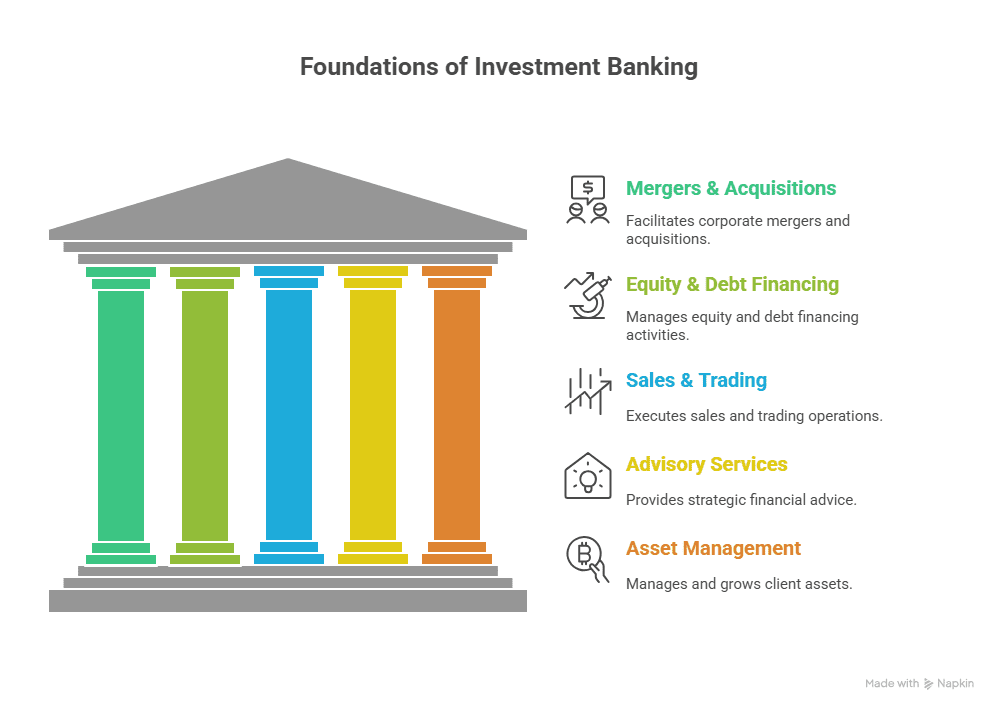
Investment banking provides advisory-based financial services to institutional investors, corporations, governments, and similar clients.
You must build a foundation in:
Financial markets
Securities
Wealth and asset management
Risk handling
Anti-money laundering (AML)
Most aspirants make the mistake of jumping into job applications without understanding what the role requires. Recruiters want skills. You need to know how banking works behind the scenes, especially in operations. That’s why choosing from the top investment banking courses can change everything.
Investment Bank Team Structure: Jobs and Career Path
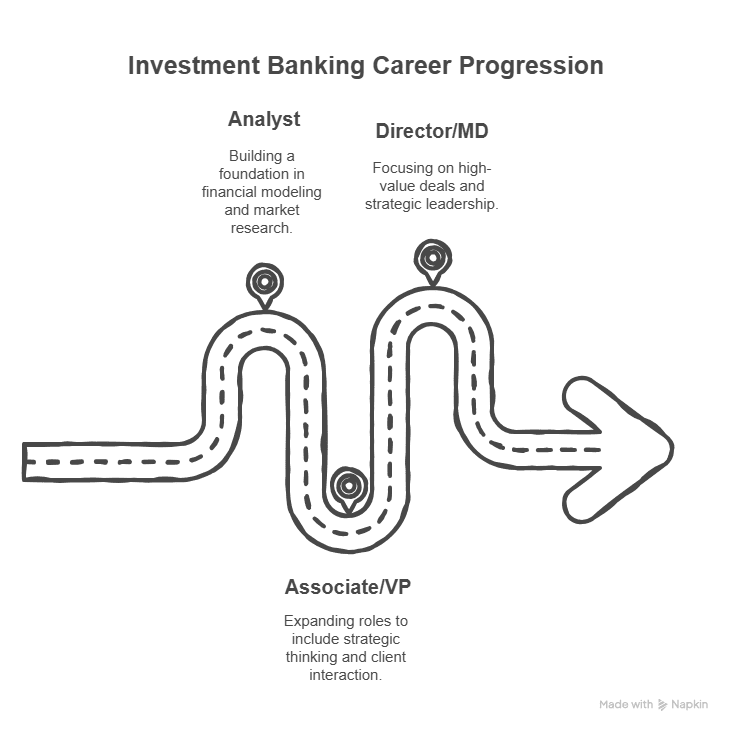
The investment banking career line is hierarchical. Most professionals start as analysts and scale up the ladder to associate, vice president (VP), director, or senior vice president (SVP), and finally, the apex of being a managing director (MD).
Analyst- The Entry Point
Role:
Analysts are the entry-level people on the investment banking ladder. They collaborate directly with associates to create marketing materials to pitch the firm to clients, create financial models that value the firm, and perform intensive industry and product research.
Associate-level Managing Deliverables
Role:
Associates will supervise Analysts and assume the responsibility of providing client-presenting materials. Although they still perform pretty much the same things, like constructing financial models, they also bring with them more responsibility for precision and ownership of work.
Vice President (VP) -Team Leader
Role:
Vice Presidents fill the gap between top-level managers and junior employees. They supervise associate and analyst working groups, develop relationships with clients, and assist in executing deals.
Ex-Senior Vice President (SVP) / Director- Driving Strategy
Role:
The directors (or SVPs) are in a strategic position. They do solicit new offerings, supervise the ongoing transactions, and manage top-level relationships with the clients. They are also important in training junior workers and in generating revenues.
Managing director (MD)
Role:
Managing Directors are in charge of sector or product teams and bear complete responsibility for winning and generating business. They control long-term strategies and are at the top of the decision-making level.
Why Financial Modelling Skills Matter More Than Ever
Every investment banker must work with numbers. But not just basic Excel formulas. We’re talking about:
Profit projections
Company valuation
Mergers and acquisitions modelling
That’s where financial modelling skills come into play. This is your edge in interviews and on the job. Recruiters look for candidates who can analyse complex data and build realistic forecasts. Most freshers ignore this and lose out.
If you want to know how to become an investment banker, mastering financial modelling is non-negotiable. Practice case studies. Take simulations. Learn the logic behind the numbers, not just the formulas.
Interview Tips for Investment Banking Roles (That Actually Work)
You’ve done the course and built your base. Now what? The real test lies in interviews. Most candidates mess up here, not because they lack knowledge, but because they lack structure.
Follow these interview tips for investment banking:
Always have 2–3 finance-related news stories prepared.
Explain your project work like a story, not like a textbook.
Learn basic financial modelling logic.
Practice mock interviews and record yourself.
Research your interviewer if possible.
Remember, confidence comes from practice. The more real-world knowledge you bring, the better you sound. Use your financial modelling skills to talk about real cases.
Start Networking in the Finance Industry While You’re Still Studying
Connections open doors. That’s a fact. Most jobs in investment banking don’t get posted online. They come through referrals.
Here’s how you can start networking in the finance industry now:
Join LinkedIn groups for finance professionals.
Follow CFOs, analysts, and recruiters from investment banks.
Attend webinars from top investment banking courses.
Comment meaningfully on posts.
Ask questions, not favours.
One introduction can lead to your first break. Build that chain before you need it.
What Recruiters Expect: A Realistic Look
India’s venture capital (VC) landscape showed strong recovery in 2024, with funding 1.4 times higher than in 2023.
Many freshers don’t understand what a recruiter in an investment bank wants.
Here’s a simplified breakdown:
Good command of financial modelling skills
Practical knowledge of investment operations
Communication that is sharp but clear
Internship or course with real-time simulations
Smart use of keywords like securities, risk, and reconciliation
That’s why courses like CIBOP™ matter. They give you practice scenarios. You understand how trade life cycles work, what back-office teams do, and how it connects with front-office decisions.
The Modern Investment Banking Career Path
The traditional way of entering investment banking is no longer enough. You need extra efforts and smarter choices.
Step 1: Bachelor’s Degree in finance, economics, or related field
Step 2: Choose from the top investment banking courses
Step 3: Gain financial modelling skills through projects or bootcamps
Step 4: Start networking in the finance industry during your course
Step 5: Apply for internships or entry-level roles
Step 6: Clear interviews with solid interview tips for investment banking
This course has helped thousands who had 0–3 years of work experience find their spot in banking.
Feature
What You Get
Duration
Choose from 3 or 6 months
Placement Rate
85% success rate
Job Assurance
100% job guarantee for eligible learners
Salary Potential
Up to INR 9 LPA
Curriculum Focus
Practical, scenario-based training
Recognition
Best Finance Education Provider 2024
Thousands of learners have switched careers or started new ones with the CIBOP™ course. Some were freshers. Others came from accounting backgrounds. But they all followed one thing: structured upskilling.
Imarticus Learning’s investment banking course doesn’t stop at lessons. It coaches you. Guides you on interviews. Places you in a position to work in the financial world. And, what is above all, it will make you stand out in a crowd.
FAQ
1. What qualifications do I need to become an investment banker in India?
You require a bachelor’s degree in finance, economics, or any related area. Your chances are better with a practical course like CIBOP™, which improves your chances.
2. What are the top investment banking courses in India?
The CIBOP™ by Imarticus Learning is highly regarded for its real-time focus and placement support.
3. How important are financial modelling skills in investment banking?
They are essential. Whether you’re in operations or front-end roles, you must understand numbers deeply.
4. Can a fresher get into investment banking?
Yes. It is possible when you choose the correct career path in investment banking and upgrade with the correct course.
5. How do I build strong networking in the finance industry as a student?
Join professional groups, attend webinars, and stay active on platforms like LinkedIn.
6. How can I prepare for investment banking interviews as a fresher?
Focus on the basics: know your financial modelling skills, stay updated with market news, and practise talking through your projects confidently. Imarticus Learning’s CIBOP™ course also includes mock interviews and real-world case training to get you job-ready.
7. Is job assurance really possible through investment banking courses?
Not all courses offer this, but the CIBOP™ by Imarticus Learning does come with a 100% job assurance for eligible candidates.
Final Thoughts
So, you’ve learned the path. You are aware of the steps to take to become an investment banker. So the question is: Will you take action?
Become serious with your future, visit the Certified Investment Banking Operations Professional (CIBOP™) course offered by Imarticus Learning. It is for people like you because you are one of those who need something more than just a job. Individuals wishing to work in the world of banking.
Take the first step towards your investment banking career today. Enrol in the CIBOP™ programme at Imarticus Learning and secure your future on Wall Street or Dalal Street.
Have you ever felt like your finance degree just isn’t enough?
You’ve got the basics, but when it’s time to actually analyse a company’s value or make investment calls, there’s hesitation.
Why?
Because textbooks won’t teach you how to think like a CFO. What’s missing is real-world skill, the knowledge you get from a Financial Modelling and Valuation Course. If you’re serious about CFO career development, it’s time to level up.
What’s Holding You Back From Becoming a Future CFO?
Financial modelling means creating a simplified version (a model) of a real-life financial situation. Financial models are basically used by businesses to work out budgets, value the businesses, and assess risks. Such models assist the leader in making decisions on the areas to utilise the money, how to expand, or even reduce the need.
Strong models consist of real historical numbers, assumptions, and correct financial statements, such as profit & loss, balance sheet, and cash flow. These are essential, without which the numbers become useless.
The model should be simple, clear, and changeable. Ensure that others will be able to understand it. Do not make mistakes; recheck your formulas. Design it in a good way so that it does not collapse when inputs vary.
Case Examples in the Big Companies
ØActivision Blizzard is a company purchased by Microsoft.
They have adopted a DCF (Discounted Cash Flow) that would help determine whether the $68.7 billion deal made business sense.
ØAirbnb in the time of COVID-19
In order to make ends meet during the pandemic, Airbnb constructed models that demonstrated worst-case scenarios in terms of cash flows. This was to keep them prepared for anything.
ØProduction Planning of Tesla
Tesla also employed models in terms of cash expenditure and supply chain risks. These assisted the company in planning its expansion without a lack of funds.
ØApple Share Buybacks
Apple used financial modelling to determine the amount of money to pass to the shareholders. It assisted the company in striking a balance between reward and risk.
Why Finance Graduates Struggle Without Practical Skills
The academic world often misses what the industry expects, such as practical finance execution. Think about it. When you’re asked to assess a company’s worth or present forecasts to stakeholders, are you just guessing based on formulas?
Or are you relying on solid investment analysis skills backed by business valuation techniques?
This gap isn’t small. Most finance graduates enter the workforce without hands-on skills like Excel financial modelling, market risk evaluation, or cash flow structuring. They know theory, not execution.
Financial Modelling and Valuation Course: Why It’s More Than Just Numbers
According to its World Economic Outlook report, the International Monetary Fund (IMF) thinks that global growth will remain low at 3.2 percent in 2024 and 2025.
You may think it’s just Excel. But financial modelling and valuation courses go beyond spreadsheets.
Understand DCF (Discounted Cash Flow) and LBO (Leveraged Buyout)
If you’re chasing a CFO career development, knowing how to use Excel like a CFO does isn’t optional; it’s essential. You need to break down performance metrics, evaluate risk, and create investor-ready reports.
Corporate Finance Training: Your First Step to the CFO Career
Being a CFO isn’t just about knowing finance. It’s about applying it at a strategic level.
That’s where corporate finance training changes everything. You’ll learn to look beyond balance sheets to judge company performance, make capital structure decisions, and manage profitability. This training sharpens your ability to make financial decisions that impact the business directly.
CFOs don’t just track money. They tell stories with it. For instance, if you’re handed a proposal to acquire a smaller company, can you assess whether the target firm is undervalued or overpriced? That’s where your business valuation techniques come in.
Business Valuation Techniques: How CFOs Make Smart Calls
Valuation isn’t opinion. It’s structured logic.
If you can’t value a business, you can’t lead its financial strategy. With strong business valuation techniques, you’ll be able to:
Value public companies using market comparables
Evaluate startups using revenue multiples
Forecast discounted cash flows under various scenarios
Imagine you’re in a board meeting, and someone asks if the company should expand into a new geography. You can’t rely on instinct. You’ll need numbers. That’s what this training equips you for: data-backed, analytical thinking. CFO career development doesn’t happen overnight. But with the right skills and roadmap, you can fast-track your growth.
Start as a financial analyst. Get hands-on with real-world deals. Master modelling, valuation, and risk. Gain exposure to internal controls, compliance, and budgeting.
From there, you move up to associate, manager, finance lead, and eventually, CFO. Every level requires smarter financial judgment and deeper accountability.
Why Indian Finance Professionals Need This Now
India’s financial services sector is growing fast. But there’s a shortage of finance talent that’s job-ready.
Employers today don’t want just degrees. They want professionals who can:
Evaluate investments confidently
Forecast accurately
Navigate financial operations smoothly
Whether you’re in Mumbai, Bangalore, Delhi, or Hyderabad, a Financial Modelling and Valuation Course bridges the classroom-to-boardroom gap. And if you’re serious about corporate finance training, investment analysis skills, and CFO career development, then this is your next logical step.
How the CIBOP™ Programme from Imarticus Learning Transforms Your Career
You don’t just study, you get placed. A real job. Guaranteed.
85% Placement Success
Strong industry connections mean real results.
3- or 6-Month Format
Choose based on your schedule both are intensive and industry-ready.
Focused on Real Scenarios
Learn what actually happens in investment banks, not textbook fluff.
Recognition in Industry
Named Best Education Provider in Finance at the 30th Elets World Education Summit 2024.
More than just a certificate, this course is your launchpad to high-growth finance roles. Whether you aim to enter an investment bank, a fintech firm, or a consulting company, this programme builds your credibility.
No one becomes a CFO without mastering Excel. Why? Because it’s the language of modern finance.
With Excel financial modelling, you’ll:
Build structured forecasting models
Automate budget tracking
Perform real-time risk calculations
Create dashboards for C-level decision making
The Imarticus Learning programme doesn’t just skim Excel. It deep-dives. You’ll model P&Ls, run sensitivity tests, and even simulate equity research reports. These models speak louder than words when you’re sitting across a boardroom pitching your vision. Imarticus Learning supports this journey with dedicated career services, mock interviews, resume building, LinkedIn branding, and access to top recruiters in finance.
FAQ
1. What does a financial modelling and valuation course consist of?
A financial model and valuation course teaches the use of Excel to create models to analyse companies, plan budgets, and undertake business valuation based on real data.
2. What is the benefit of taking a financial modelling and financial valuation course?
It assists in the development of fundamental finance skills such as Excel financial modelling, investment analysis, and business valuation methodologies, all of which are essential in the development of a CFO career.
3. Who may attend the financial modelling and valuation course?
Anyone interested in training in corporate finance can become a member, and so can graduates of finance or those young professionals who are new to the professional world. It suits workers between 0 and 3 years.
4. What role does this course play in developing CFO careers?
This course will make you learn real-life skillsets of a finance professional, such as investment analysis, prediction, and decision-making, which are also necessary to become a CFO.
5. What do you learn in a course in financial modelling and valuation?
You will study Excel financial modelling, the financial statements, the DCF analysis, forecasting, sensitivity analysis, and business valuation skills.
6. Is Excel financial modelling challenging?
No. Excel financial modelling is something that, with an organised corporate finance training, can be easily mastered by any person. Courses begin with the elementary tools and then get advanced.
7. What is the contribution of this course towards investment analysis?
You will train in analysing company performance, determining risk, and constructing models to make investment decisions, as some of the skills employed by leading finance experts.
8. What are the possible careers people can practice after the course?
You have a possibility of working as a financial analyst, investment banking associate, risk analyst, or even advance to be a CFO.
The Final Words
You don’t need another generic finance course. You need a financial modelling and Valuation Course that turns ambition into action. If you want to rise through the ranks and eventually take the CFO seat, then this is your moment.
Investment banking courses in the current rapidly evolving finance landscape are not only a stepping-stone but a springboard to lucrative career paths in the world of finance. For a future career as an analyst, quality training can accelerate one’s career faster, bridge skill gaps, and offer entry into best-of-breed options in the top finance cities of the world.
A finance analyst introduction program is not only rich in basic knowledge but also endows them with high-level technical knowledge and recent applications. And with the appropriate investment banking curriculum overview, professionals can easily shift to live projects as well as actual banking procedures.
What Do Investment Banking Classes Teach You?
You ought to know what you are getting yourselves into before you become involved. Investment banking training typically entails four broad categories:
Corporate Finance & Valuation: Review company accounts, perform due diligence, and handle M&A and IPO calls.
Financial Modelling: Excel decision and projection models utilised daily by analysts.
Securities & Trade Operations: Acquire knowledge of equity, debt, and derivative markets—settlement cycles and trade monitoring.
Regulations & Compliance: Study international AML regulations, KYC norms, and sound banking practices.
These modules are the cornerstone of any investment banking analyst course, with technical, strategic, and regulatory competence for a career anywhere in the world.
Why Beginners Should Opt for Analyst-Specific Courses?
An investment banking course to become an analyst is quite different from a typical finance course. Here’s why:
Specific Skills: These courses are specially offered for the professional job roles such as Equity Analyst, Trade Associate, or KYC Analyst.
Industry Exposure: Offer live project exposure and mentorship by senior bankers.
Placement Oriented: The majority of the best courses provide interview or placement guarantee.
For all interested to know how to become an investment analyst, the answer is generally starting with enrolling in a professional investment banking analyst training program that incorporates skill development with career guidance.
Key Features of a High-Impact Investment Banking Course
While considering best courses for a finance professional, look at based on the following:
Depth of Curriculum: Coverage of special as well as core modules.
Practical Exposure: Exposure with projects.
Mentor Access: Individual access to masters.
Career Guidance: Resume building workshops, mock interview practice sessions, and placement camps.
One such high-performing program is the Certified Investment Banking Operations Professional (CIBOP) from Imarticus Learning. With 85% placement and job guaranteed, it is a refueling stop for finance passouts keen to accelerate.
How Long Should Your Investment Banking Class Be?
Time is money. While brief bootcamps are nothing but surface exposure, the well-structured 3 to 6 months (as the case may be) program guarantees depth of learning.
The structure of the course in investment banking has to be grounded as much as possible in career aspirations and not just depth of exposure.
CIBOP is offered in two modes—3 months (intensive) and 6 months (weekend)—with working professionals and students both having the leeway.
Imarticus CIBOP: A Deep Dive
About the Program
CIBOP program has developed more than 50,000 careers and conducted 1200+ batches. Project-based and best suited for those who desire sure-shot interview calls and formal mentoring.
What You Learn
Money Laundering Techniques
Ethical Banking
Trade-based Money Laundering
Compliance and Risk Management
Career Support
7 Interview Guarantees
1000+ Recruitment Partners
60% Salary Increment Average
4 LPA Average Salary
Regardless of whether you are about to begin your career or contemplating a career change, the CIBOP gives you a sound edge in a competitive situation.
Real-World Roles After Completing Investment Banking Classes
Upon completing a financial analyst course for beginners, your investment banking career could proceed to:
Investment Banking Associate
Client Onboarding Analyst
Wealth Management Associate
Trade Surveillance Analyst
Regulatory Reporting Executive
Risk Management Consultant
Hedge Fund Associate
Collateral Management Analyst
Every role entails specialized exposure, from client engagement to risk analysis and regulatory reporting.
How Investment Banking Training Aligns with Job Prospects?
Investment banks and global finance firms require professionals who are:
Job-ready from Day 1
Compliance workflow familiar
Trade settlement proficient
Excel-based financial modeling expert
That is why professionally certified high-reputed institute students get the best career in investment banking. A program like CIBOP™ is not offering training—it develops capability. It bridges the knowledge-practice divide and exactly reflects what recruiters look for.
Essential Skills Needed for Investment Banking Success
These are investment banking skills every analyst must gain:
Excel & PowerPoint Mastery
Financial Modeling
Data Reconciliation & MIS Reporting
Regulatory Compliance
Client Communication & Stakeholder Reporting
Problem Solving under Pressure of Time
Global Knowledge of the Market
These are adequately covered in formal training such as CIBOP™ so that the candidate is professionally well-prepared overall.
What Makes a Certification Worth It?
Choosing the best investment banking certification is a significant decision. Ensure that the course has:
Accreditation: Industry- or institution-approved.
Placement Track Record: Success with salary results demonstrated.
Real-World Relevance: Industry projects, evaluation, and instructors.
The Best Education Provider in Finance award for Imarticus at the 30th Elets World Education Summit 2024 solidified its leadership.
Imarticus Learning’s Edge in Career Growth
This is how CIBOP™ course stands out:
100% Job Guarantee
3-6 Month Duration Choices
International Career Opportunities
Professional-Led Live Training
No Limits to Career Guidance
In-depth Certification
From beginners to mid-level working professionals, the course has been structured in a manner that builds capability as well as confidence.
FAQs
1. What is the ideal duration of investment banking classes for beginners? An ideal course duration of 3–6 months is ideal to cover the trade-off between theory learning and practical exposure, especially with placements assured.
2. Do I need a finance background for these courses? Yes, the majority of the analyst-level courses like CIBOP™ are for finance graduates or freshers with experience ranging between 0–3 years.
3. What’s the average salary after completing CIBOP?
The graduates have been placed at jobs with a salary of 9 LPA, average being 4 LPA.
4. Can I shift from a non-banking career to investment banking?
Yes, if you have a basic finance background, a structured certification like CIBOP™ can facilitate the switch.
5. Are these classes available online? Yes, the best investment banking courses like CIBOP are the best classes for finance careers and are online and in the form of hybrid courses as well.
6. What’s the placement process like?
You will get resume preparation, mock interviews, and access to 1000+ placement partners, with 7 interviews assured.
7. Is the certification recognised globally?
Although CIBOP had its inception in India, the course follows global standards and is hence as useful for international positions as well.
Conclusion
Choosing the correct investment banking courses can change the course of life in finance. Whether it is a young analyst wanting to begin a career or an already successful professional seeking a mid-career switch, a recognised course such as CIBOP™ at Imarticus Learning offers it all—talents, exposure, credibility, and most importantly—career guidance.
Since the financial world keeps advancing with technology, regulation, and globalization, there is never a more opportune time than today to invest in yourself. Become a successful investment banker today.
In 2025, with the need for digital competence growing, many students and professionals are planning to upskill themselves. One question that is often asked is: whether the cost of the digital marketing course is worth it for its payback? As digital marketing evolves as an integral business function, understanding the cost of the digital marketing course and its connection to long-term value is more critical than ever. In this comprehensive guide, we explore pricing models, program components, and assessing the return on investment (ROI) of digital marketing courses.
Understanding the Digital Marketing Landscape
Digital marketing is not a buzzword anymore—it’s a requirement for business. From content marketing to pay-per-click advertising, social media, email marketing, and SEO, the practice is varied and dynamic.
The proliferation of online learning platforms allows anyone to learn digital marketing skills at their convenience. Not all courses are alike, however—whereas some provide top-class training from industry professionals, others are just a string of outdated slides.
This is why determining the value of digital marketing certification is as important as learning the price of a digital marketing course.
What Factors Affect Digital Marketing Course Price?
Different variables influence the price of a digital marketing course, from the reputation of the course provider to the depth of the curriculum, live mentoring, value of certification, and post-course support.
Key price influencers include:
Course Type – Online self-paced, live instructor-led, or hybrid.
Certification Credibility – Is the course certified by global digital giants like Google, Meta, or well-known universities
Curriculum Breadth – Bare minimum overview versus comprehensive content such as SEO, SEM, SMM, email marketing, and analytics.
Mentor Access – Courses that include live sessions with practitioners from companies such as Zomato, Deloitte, or MFine will be more expensive.
Placement Assurance – If job support is a part of the program, anticipate a higher cost.
Finally, it is not about inexpensive digital marketing courses, but what you receive in return.
Comparing Digital Marketing Course Fees in India
A detailed online marketing course fee comparison shows a wide range—from ₹5,000 for the bare minimum certification to ₹1.5+ lakhs for premium programs with guaranteed job interviews and career advice.
MyCaptain’s Digital Marketing Program, for instance, provides expert training by professionals at Zomato and Deloitte, 10 assured interviews, and premium modules for extra money, but much better ROI.
What Do You Get for the Price?
So, what are you actually paying for in a digital marketing course?
Expert Mentorship – Gain insights from working professionals of top companies.
Career Services – Resume building, mock interviews, and placement help.
Certifications – Globally accepted certifications add value to your credibility.
Industry Tools – SEMrush, Google Ads, HubSpot, and more at your fingertips.
Courses that offer these features deliver much better digital marketing course ROI than common, lower-priced alternatives.
Is Digital Marketing Course Worth It in 2025?
Now let us come to the point—is digital marketing course worth it in 2025?
Yes, if you choose to enroll in a course that combines sound fundamentals with experiential learning, subject-matter expertise, and career placement. Here’s why:
Marketing Budgets Are Growing: More businesses are putting more dollars into digital, and the need for certified marketers is increasing.
Remote Work Opportunities: Digital marketers can work from anywhere in the world.
Skill Gaps Persist: Not everybody knows SEO, ad bidding, or funnel design—there are few skilled professionals to go around.
Given the worth of digital marketing certification, you’re not merely purchasing knowledge—you’re investing in future income, brand-building experience, and long-term professional development.
The Real ROI of Digital Marketing Courses
Digital marketing course ROI can be calculated based on both tangible and intangible returns. This is how you can determine your return:
Job Offers: Did you get interviews or offers following completion?
Salary Hike: Did the course lead to a noticeable salary increase?
Skill Mastery: Are you now competent to handle marketing strategies independently?
Freelance Gigs: Can you offer your services on platforms like Upwork or Fiverr?
When a course gives you tools, portfolio work, and access to employment, its price is no longer an issue compared to its potential.
Affordable Digital Marketing Courses with High Value
Not all good courses are expensive. Some courses reach the balance point between digital marketing course prices and learning. Look for:
Scholarships or EMI Options
Short-Term Intensive Bootcamps
Live Cohort Learning Models
Workshops and Hackathons
Courses such as the MyCaptain Digital Marketing Program are geared towards freshers and early-career professionals, with a job-ready focus and having mentors from MFine, Zomato, Deloitte, and 10 interview guarantees.
How to Choose the Right Course for You?
Ask the following questions prior to registration:
Does it guarantee employment?
Who are the trainers?
What equipment do I get trained on?
Is placement and mentorship assistance available?
Can I pay the total amount, or are EMI facilities offered?
Smart comparison enables you to pay the minimum and yet derive maximum career mileage.
FAQs
Q1. What is the average digital marketing course price in India?
The fee ranges from ₹30,000 to ₹1.5 lakhs, depending on course intensity, guidance, and placement.
Q2. Is digital marketing certification worth the money?
Yes, if it involves live projects, industry-experienced instructors, and job placement.
Q3. Can I find affordable digital marketing courses online?
Yes, they are cheap yet still offer a balance between learning and affordability.
Q4. Does a higher course price guarantee better job opportunities?
Not necessarily—but expensive courses have employment guarantee, industry professionals as mentors, and career guidance.
Q5. Which is better: self-paced or mentor-led digital marketing course?
Mentor-led courses deliver better outcomes, especially for career switchers and freshers.
Q6. Do all digital marketing courses include placement?
No. Only some courses, like MyCaptain, offer 10+ job interview guarantees.
Q7. How long is a typical online marketing course?
It does—most formal courses are 12 to 20 weeks long.
Q8. What tools should a good course cover?
Search for courses that teach Google Ads, Facebook Ads, SEO tools, HubSpot, and Analytics.
Q9. Is job support available for career transitions?
Yes. Resume building, mock interviews, and career mentorship are included in many courses.
Q10. Will a digital marketing course help me freelance?
Absolutely. You’ll gain client-facing and campaign management skills to offer freelance services.
Conclusion
Determining the cost of a digital marketing course is not as simple as comparing numbers. It’s a matter of knowing what you get in exchange—skills, qualifications, real-world exposure, and career direction. The best course in 2025 will give you everything from technical skill to employability, and that’s the ultimate test of value.
Having knowledge of the external business environment at the time of decision-making in a business is extremely critical. PESTLE analysis is one of the finest ways to do this. What is PESTLE analysis? It is an instrument which facilitates analysis of external macro-environmental influences on businesses. Political, Economic, Social, Technological, Legal, and Environmental forces are the letters used by the acronym. All of these are extremely crucial while decision-making in a business.
Full PESTLE analysis is applied on a daily basis by business planners, financial analysts, and marketers for market conditions analysis, trend prediction, and risk avoidance. Companies use instances of PESTLE analysis for foreign expansion analysis, policy changes, and technological trends along the way. The information gained from such an analysis may even prove useful to professionals seeking an ACCA course because it provides them with risk assessment and strategic planning capabilities.
In a fast-moving global economy, organisations need to respond fast to external factors. Digitalisation, climate policies, regulatory climate, and shifting consumer trends make organisations keep themselves equipped with a scientific approach to analyse such factors. The PESTLE analysis provides a scientific way of analysing opportunities without threats and finding an equilibrium between business objectives and external factors.
In this article, PESTLE analysis will be explained in full detail, supported by examples and applications, including a step-by-step process in conducting it.
What is PESTLE Analysis?
PESTLE analysis is a strategic management tool by which businesses are able to study external macro-environmental factors. Every element of the PESTLE analysis full form gives a different insight into different segments of the market. Monitoring these factors helps businesses to be well-equipped to make future-proof, timely decisions.
Components of PESTLE Analysis
Political Factors:
Government policy and regulation
Trade barriers and tariffs
Taxation policies and political stability
Changes in leadership impacting business
Policies regarding foreign trade and diplomatic relations
Economic Factors:
Interest rates and inflation
Exchange rates and economic growth
Consumers’ spending power
Business cycle and market directions
Financial investment prospects and credit facilities
Social Factors:
Consumer behavior and demographic trends
Culture and lifestyle influences
Education and labor availability
Attitudes towards sustainability and corporate ethics
Population growth and migration
Technological Factors:
Innovation and R&D
Digitalization and automation
Cybersecurity and data protection
New blockchain and AI technologies
Disruptive industry technologies
Legal Issues:
Labour and employment law
Intellectual property
Industry regulation and compliance
Data protection law and GDPR compliance
Tax policy evolution
Environmental Forces:
Climate change impact
Green policies and sustainability
Waste management and resource scarcity
Environmental activism impact on business reputation
Green energy incentives and carbon footprint regulation
PESTLE Analysis Example
To observe PESTLE analysis in action, let’s take the example of a global automobile giant expanding into a new market:
Political: Import/export tariffs compelling the entry of car sales and new automobile emission policies.
Economic: Rising inflation decreasing the purchasing power of consumers, interest rate-sensitive automobile finance, and raw material price volatility.
Social: Increased trend among electric vehicle consumers, green product switching consumer behavior, and urbanization growth affecting car ownership.
Technological: Autonomous technology research and development, the effectiveness of electric vehicle batteries, and automotive safety features spurred by artificial intelligence.
Legal: Environmental safety regulation adherence, the effect of labor legislation on the workforce, and stringent emissions standards.
Environmental: Government incentives towards environment-friendly cars, in view of global warming to motivate production, and environmentally friendly practices on an industrial level.
By the above reasons, the company is capable of taking strategic decisions regarding their subsequent entry into the market in the long run.
Why is PESTLE Analysis Important?
1. Strategic Decision-Making
PESTLE analysis helps business firms to anticipate threats and possibilities within the environment.
2. Risk Management
Environmental risks can be anticipated ahead of time and mitigation response plans previously declared by firms.
3. Market Expansion Insights
Macro-environmental variables being understood allow companies to grow internationally with fewer risks.
4. Competitive Advantage
Firms monitoring external drivers will be in a position to remain at the forefront since they can respond promptly to transformation.
5. Innovation and Future Planning
Because of technology advancements and social changes, businesses can innovate and stay competitive in fast-paced industries.
How to Conduct a PESTLE Analysis?
Step 1: Identify Relevant Factors
Explain each of the six PESTLE drivers that affect your business or industry.
Step 2: Gather Data
Use market reports, government policy, industry trends, and competitor analysis to provide factual data.
Step 3: Assess Impact
Assess how each driver affects business operations, profitability, and market position.
Step 4: Develop Strategic Actions
Formulate action plans to leverage opportunities and eliminate potential threats.
Step 5: Review and Update
As business contexts do change, sharpen the analysis to accommodate altering external environments on a regular basis.
PESTLE Analysis and ACCA Course Relevance
ACCA course equips finance professionals with a competence of macroeconomic forces affecting business choices. ACCA candidates would understand how is PESTLE analysis beneficial as it helps in:
Financial risk analysis
Developing business strategies
Compliance with regulation understanding
Analysis of corporate governance
Investment banking and consulting decision-making improvement
Accurate PESTLE analysis competencies of ACCA professionals place them in a strong position in auditing, taxation, and corporate financial planning.
Conclusion
What is PESTEL analysis? This question is to be answered by businesses, investors, and finance professionals who examine political, economic, social, technological, legan and environmental factors to make informed choices. Such choices reduce risks, make informed decisions and increase tremendous opportunities for expansion.
As observed from PESTLE analysis example, firms making use of this model during strategic planning are likely to overwhelm their competitors by conforming changing market situations in a timely manner. In addition, experts pursuing an ACCA course are able to apply PESTLE analysis towards facilitating improved financial risk analysis as well as business strategy formulation.
Organisations adapt to the fast-paced global economy very quickly with the help of PESTLE analysis to their decision making. Be it an entrepreneur, investor, or ACCA student, understanding how to conduct PESTLE analysis is crucial to stay active in the current business era.
When uncertainties in the market are the order of the day, it is having a process of external scrutiny that is well organized which gives companies the knowledge and confidence. Companies that utilize the application of PESTLE analysis in strategic process on a continuous basis have it in a better position to manage unforeseen troubles, innovate at the best speed, and have long-term nourishment.
Know how to prepare for ACCA course in this video
FAQs
1. Why do business perform PESTLE analysis?
PESTLE analysis assists business in weeding out external macro-environmental variables—political, economic, social, technological, legal, and environmental—most likely to have impact on decision-making, strategy, and long-term planning.
2. How frequently should business perform a PESTLE analysis?
Business enterprises should perform PESTLE analysis at least annually or in the event of a radical change in the state of the market, government policy, or technology trend.
3. Where is PESTLE analysis most appropriately used?
Any sector may be vulnerable to this but some sectors such as finance, healthcare, automobile, retail, and technology are big consumers of PESTLE analysis to study risk, compliance, and market opportunity for growth.
4. Is PESTLE analysis different from SWOT analysis?
SWOT examines internal weaknesses and strengths as well as external threats and opportunities but PESTLE only examines external macro-environmental factors that affect business operations.
5. Can PESTLE analysis identify business risks?
Yes. Companies can anticipate threats in the guise of regulatory change, inflation, or green levies by monitoring political, economic, legal, and environmental developments and create risk avoidance mechanisms.
6. Why is it beneficial for ACCA professionals to use PESTLE analysis?
PESTLE analysis is beneficial for ACCA professionals while undertaking financial risk analysis, strategic planning, and governance data for audit, consultancy, and corporate finance careers.
7. What are some pitfalls to avoid while conducting PESTLE analysis?
A few of these limitations include analysis from old facts, not taking into account interrelationships among the factors, and use of the analysis as a static planner rather than a dynamic one.
Tired of just running reports? Ready to be the one guiding decisions when markets shift and uncertainty hits? That’s exactly where the Financial Risk Manager (FRM) course steps in.
Offered by the GARP and recognised worldwide, the FRM program equips you to analyse, manage, and mitigate complex financial risks. Its curriculum spans quantitative methods, market and credit risk, liquidity and operational challenges, and emerging industry practices – preparing you to build risk frameworks that support real business strategy.
For professionals aiming to move beyond routine finance tasks and step into impactful, leadership-oriented roles in banks, consulting firms, and multinational organisations, FRM acts as a true career accelerator.
In this guide, we’ll break down everything you need to know about the FRM course – from eligibility and fees to career benefits and job opportunities – so you can decide if it’s the right next step for your finance career.
What is the FRM Course?
The FRM course is offered by the Global Association of Risk Professionals (GARP). It’s globally recognised. That means whether you’re in Mumbai, New York, or Singapore, your credential signals expertise in financial risk management – a language that every top-tier firm understands.
In today’s unpredictable financial landscape, FRM gives you the expertise to make smarter, more confident decisions, the kind that help organisations stay steady even when markets get volatile.
If you might be wondering what is FRM, think of the FRM Course as your toolkit for risk leadership. While traditional finance roles focus on reporting or compliance, FRM trains you to identify, assess, and mitigate risks before they turn into problems.
🎥 Before we dive in, here’s a video that breaks down everything you need to know about the FRM course – from fees and eligibility to duration and career scope.
The FRM Course Structure
The FRM isn’t just a credential; it’s a signal to employers that you’re prepared for strategic leadership. The FRM program is broken down into two parts, designed to build your knowledge from the ground up.
Part I builds foundations in quantitative methods and financial market instruments, while Part II delves into market, credit, operational and liquidity risks, as well as contemporary risk management challenges.
Part I: The Core Foundations
This is where you lay the groundwork. Imagine trying to explore a new city without a map – you’d get lost. Part I gives you the map. It focuses on quantitative methods, financial instruments, and the core concepts of risk.
Topic
Focus
Foundations
Ethics, Corporate Governance, and Core Risk Concepts
Quantitative Analysis
Statistical methods and modelling for risk
Financial Markets & Products
Understanding Derivatives, Fixed Income, and more
Valuation & Risk Models
Measuring risk with tools like VaR and stress testing
If you were equipped with Part I knowledge back during the 2008 financial crisis, you could have quantified subprime mortgage risk, understood derivatives exposure, and anticipated the ripple effects across global banks. That’s the kind of foresight FRM equips you with.
Part II: Strategic Application
Part II is where you move from theory to strategy. It’s like being fresh out of an architecture degree; the first project hits hard. It isn’t just designing – suddenly, you are juggling market swings, credit, operations, cash flow, and new challenges like ESG and cyber risks. Real-world projects are way more complex than any classroom could prepare you for.
Topic
Focus
Market Risk
Managing fluctuations in market prices
Credit Risk
Dealing with potential borrower defaults
Operational Risk
Mitigating losses from internal failures (people, processes, systems)
Liquidity & Investment Risk
Managing cash flow and investment portfolio risks
Current Industry Issues
Emerging topics like ESG, climate risk, and cyber risk
Passing the exams and documenting two years of relevant professional experience signals your readiness to lead risk initiatives rather than simply react to them. To understand how the FRM program builds your knowledge step-by-step, explore our detailed FRM Course Structure section.
Pro Tip: Specialising in emerging areas like ESG risk, climate modelling, regulatory technology, and sustainable finance further enhances your market edge. As firms prioritise these domains, FRM holders find themselves at the forefront of transformational finance roles.
Important Note: To officially get your FRM Charter, you must document two years of relevant work experience after passing both exams and within a 10-year window.
FRM Exam Details & Preparation
You can’t ace this by just skimming. The FRM exams are rigorous, but the structure is straightforward. With disciplined preparation, you can confidently clear them.
Aspect
Part I
Part II
Format
100 multiple-choice questions
80 multiple-choice questions
Duration
4 hours
4 hours
Study Time
275-300 hours recommended
Smart Tip: If you schedule 2 hours daily for quantitative practice and another hour for reading GARP core texts. By four months, complex probability models that initially seemed daunting become intuitive.
FRM Course Cost Breakdown
Here’s a quick overview of the FRM course fees to help you understand how the total cost is distributed across different components.
Component
Cost (USD)
Notes
Enrolment Fee
$400
One-time fee
Part I Exam Fee
$600-$800
Based on early vs. standard registration
Part II Exam Fee
$600-$800
Based on early vs. standard registration
Estimated Total
$1,600-$2,000
A small investment for a big return!
Think about it – spending $2,000 to unlock global career opportunities and leadership roles is a small price for financial freedom and professional growth.
FRM Course Pass Rates
The FRM Certification remains one of the most demanding credentials in financial risk management – official data from GARP shows that exam pass rates for Part I typically range between 40% and 50%, while for Part II they trend higher, at about 50% to 60%.
These moderate pass rates reflect the rigorous nature of the exams and why holding the FRM credential is viewed as a mark of serious competence in risk management skills.
How to Prepare for the FRM Course?
Using the right techniques can make a huge difference when it comes to acing your exams. Here are a few practical tips to help you prepare effectively for the FRM exams:
Structured Study Plan: Break the syllabus into weekly milestones with a reputable provider. Consistency beats cramming.
Mock Exams: Build stamina and timing. FRM isn’t just about knowledge – it’s about applying it under pressure.
GARP Core Readings: Don’t skip them. They’re the backbone of exam success. Supplement with trusted third-party question banks.
Real-World Application: Whenever possible, link theory to your current work. For example, use Part II frameworks to evaluate your company’s operational risks.
Why is the FRM a game-changer?
Let’s be real – the FRM isn’t just another finance certification you add to your résumé. It’s a powerful launchpad that can completely change the direction of your career. Let’s break it down:
Massive Paycheck: According to the U.S. Bureau of Labour Statistics, risk management roles and FRM holders enjoy median salaries soaring around USD 156,100 globally. For Indian finance professionals, this translates to career paths that not only elevate your earning potential but position you as a coveted expert in a field that’s gaining unprecedented strategic importance.
Job Security & Growth: Roles in financial management are expected to grow by a strong 16% through 2032. Plus, 40% of risk-management jobs require or prefer the FRM credential.
Global Elite: Join a network of 90,000+ FRM professionals operating in over 190 countries. Talk about a serious networking edge!
In-Depth Expertise: You won’t just learn buzzwords. You’ll master cutting-edge quantitative models, stress testing, and frameworks for complex risks like climate and cybersecurity.
Future is Bright: A staggering 73% of professionals expect risk management roles to increase over the next 18 months, and 85% would recommend a risk career to a peer. Optimism is high. And you need to be ready to step up!
Why Choose the FRM Course?
Let me be honest: the FRM is not for everyone. This certification is purpose-built for finance professionals who are ready to seize the leadership seat. If you’re in a finance role and feel limited by repetitive tasks, FRM can change your trajectory.
You should pursue the FRM if you are a:
Risk Analyst ready to lead projects and transition into management.
Credit & Market Risk Manager seeking the deepest, most authoritative insights.
Operational Risk Specialist looking to streamline firm-wide processes and influence enterprise strategy.
Consultant advising clients on macro-level risk and corporate resilience.
Finance Leader committed to steering a firm through market volatility and regulatory change.
Stop settling for a career of calculations. The FRM course is the definitive step to becoming an indispensable, high-earning financial strategist.
💡 Did You Know?
According to the 2025 FRM Global Practice Analysis Report, 40% of financial risk managers have responsibilities related to climate risk. 42% of financial risk managers view AI/machine learning as a key area for continuing education. 55% of financial risk managers spend at least half of their time performing risk management tasks.
Insights from the 2024 GARP Risk Careers Survey
GARP‑certified professionals are in high demand. More than 40% of survey respondents said the FRM Certification is listed as preferred or required in job postings.
Nearly 79% of survey respondents globally reported a high degree of satisfaction in their work. 73% anticipate opportunities in risk management will increase slightly or significantly over the next 18 months. 54% plan to hire more risk professionals, and 85% would recommend a risk management career to peers.
This underscores why FRM holders are in demand worldwide.
FRM Course Benefits
Imagine being the person in the room who can spot a financial storm before it hits – a professional everyone turns to for guidance when markets shift unexpectedly. That’s the kind of edge the FRM certification gives you.
Earning your FRM isn’t just about learning risk – it’s about becoming the go-to expert in a fast-moving financial world.
Top banks, investment firms, consultancies, and regulators look for professionals who can spot, analyse, and manage complex risks that others might miss.
It also opens doors to better pay – FRMs often earn 15-30% more than their peers and career paths that can take you from risk analyst all the way to chief risk officer.
With a global network of over 90,000 risk professionals across 190 countries, your opportunities aren’t limited by geography.
And with emerging areas like ESG, climate, and cyber risks shaping the future of finance, FRM helps you stay ahead, think strategically, influence decisions, and turn your expertise into real impact, reputation, and career growth.
FRM Career Path
When I first looked into the FRM course, what really grabbed my attention was how practical and career-focused it is. Unlike generic finance certifications, FRM is built to give you skills you can actually use in high-impact roles.
Here’s what you stand to gain from pursuing the FRM:
Strategic Risk Expertise: You’ll learn how to spot, measure, and manage financial risks before they become big problems. Think of it as having a financial radar for every decision your company makes.
Global Recognition: FRM is recognised in over 190 countries. Your skills aren’t just for local roles—they make you a global asset.
Leadership Readiness: FRM doesn’t just teach technical stuff. It trains you to make smarter decisions under uncertainty – a skill that sets you apart for managerial and executive roles.
Future-Proof Skills: From ESG and climate risk to AI in finance, FRM ensures your knowledge stays relevant as the industry evolves.
Networking Opportunities: You join a community of over 90,000 professionals worldwide, opening doors to mentorship, collaboration, and career growth.
Real-World Impact: Imagine being a Risk Analyst, and your bank is eyeing a new investment portfolio. FRM equips you to quantify market and credit risks, spot operational weak spots, and make recommendations that protect the firm’s bottom line – turning you into a trusted decision-maker.
But the opportunities don’t stop there. The rise of fintech and digital banking has created new roles in model risk, compliance analytics, and stress testing, where FRM knowledge gives you a powerful edge. Even consulting and tech-driven financial companies now rely on FRM-certified professionals to design robust, data-backed risk frameworks.
Whether your goal is to work with global banks or lead risk strategy for an emerging fintech, the FRM badge signals that you’re equipped to guide decisions – not just report on them.
Emerging Specialisations: ESG, AI, and Sustainable Finance
Risk management isn’t just about markets anymore. With global shifts in ESG (Environmental, Social & Governance) standards, climate risk, and AI-driven analytics, FRMs are at the forefront of defining what financial sustainability looks like.
These evolving domains are opening new, high-impact roles in green finance, climate risk assessment, and digital risk strategy – all areas where FRM knowledge gives you a clear edge.
FRM Salary in India
More than just a pay bump, the certification opens doors to leadership. Many professionals transition from routine finance roles to strategic positions like Risk Manager or even Head of Risk within a few years of completing their FRM journey.
Let’s talk numbers. One of the biggest motivators for taking any certification is the career upside – and FRM salary delivers.
Senior Risk Manager, Head of Risk, Chief Risk Officer (CRO)
₹30-50 LPA+
Fresh FRM-certified professionals start in analytical or junior management roles across banks, NBFCs, and consulting firms.
With experience, FRMs move into risk management and treasury functions, handling complex portfolios and regulatory reporting.
At senior positions, FRMs lead enterprise-wide risk frameworks, policy compliance, and strategic decision-making across financial institutions.
You can transition from an Analyst role at a mid-sized bank to a Senior Risk Manager position at a multinational after completing FRM. Within three years, your salary can nearly double, and you can lead a team that directly advises on strategic investments.
Globally, salaries are even more attractive than the FRM salary in India: FRM holders in the US, Singapore, and the Middle East often earn USD 100,000-180,000+, depending on experience and industry.
Why Choose Imarticus for the FRM Course?
The FRM is the smartest move for ambitious finance pros who want to lead, not just calculate. It’s in high demand, offers great pay, and equips you with future-proof expertise in a rapidly evolving financial world.
Thinking of studying FRM on your own? That’s possible – but here’s why Imarticus Learning makes it easier and more effective:
Why Choose Imarticus FRM:
Learn from Experts: Mentorship from industry pros who’ve managed risk at global banks.
Complete FRM Coverage: Structured, GARP-aligned guidance for Part I & II.
Interactive Classes: Real-time problem-solving, case studies, and doubt-clearing sessions.
Smart Progress Tracking: AI tools highlight your strengths and areas to improve.
Trusted Study Material: Kaplan resources and mock exams included.
Flexible Learning: Full-time, part-time, or hybrid options for working professionals.
Career Support: Assistance with placements at top banks and firms.
Pass & Career Guarantee: Structured coaching to get you exam-ready and job-ready.
Real-World Learning: Cases drawn from actual boardrooms, trading floors, and advisory work.
Success in FRM isn’t about cramming formulas; it’s about connecting those numbers to real situations – like understanding how a shift in interest rates ripples through bond portfolios or liquidity positions. With a clear plan, discipline, and the right training support like Imarticus’ GARP-aligned modules, most committed candidates manage to clear both parts confidently.
🎥Curious about how the FRM stacks up against other big finance certifications like ACCA, CMA, CFA, or CPA? Check out this video:
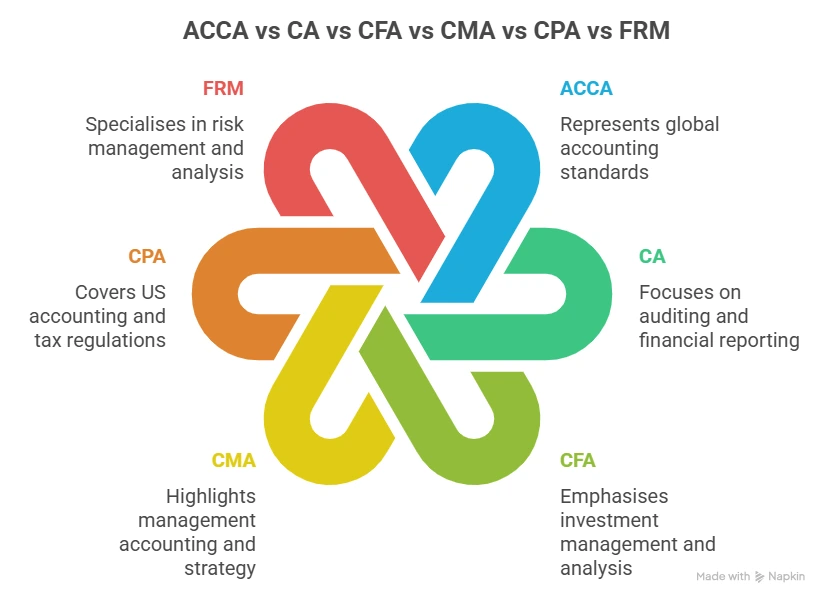
FRM Course vs CA vs CPA vs CFA vs CMA vs ACCA: Which Finance Qualification Wins?
The FRM is specialised in risk management, whereas general finance certifications like CFA or CPA focus on investments, accounting, or auditing. For professionals aiming to lead strategic decision-making in uncertain markets, FRM offers unmatched expertise and credibility.
Credential
Focus
Global Reach
Senior Salary (India)
Top Role Target
FRM
Risk Management (ESG, Credit)
Global
₹30 LPA+
Chief Risk Officer
CFA
Investment Analysis
Global
₹28 LPA+
Fund Manager
CPA
Accounting (US GAAP)
Global
₹25 LPA+
CFO
CA (India)
Accounting & Tax
India
₹20 LPA+
Domestic CFO
CMA (USA)
Management Accounting
Global
₹22 LPA+
Corporate CFO
ACCA
Global Accounting
Global
₹22 LPA+
Audit Specialist
Why FRM is the Preferred Choice?
Directly prepares you for leadership roles in risk management.
Global recognition in 190+ countries ensures career mobility.
Hands-on skills in quantitative modelling, ESG risk, climate, and AI.
High earning potential with strategic career growth.
Networking edge with 90,000+ FRM professionals worldwide.
For finance professionals looking to step into roles where decisions shape business outcomes, FRM is not just another certification – it’s a career accelerator.
FAQs About the FRM Course
If you’re considering the FRM course, you probably have a few questions. Here are a few frequently asked questions covering topics such as eligibility, exam difficulty, salaries and career opportunities related to the FRM course.
What is the FRM Course?
The FRM course, offered by the Global Association of Risk Professionals (GARP), is one of the most respected and in-demand qualifications in the finance world. It’s designed to help you truly understand how risks affect businesses and how to manage them effectively. Whether it’s market, credit, operational, or liquidity risk, FRM gives you the real-world tools to handle them confidently. In simple terms, it trains you to think like a risk expert – the kind of professional companies rely on when the markets get unpredictable.
Is FRM better than CFA?
Honestly, it depends on what you want to do in your career. The CFA is great if you’re drawn to investment analysis, portfolio management, or research. On the other hand, the FRM is all about understanding and managing financial risks – perfect if you’re interested in banking, treasury, or enterprise risk roles. They’re both valuable in their own ways. In fact, many professionals choose to pursue both, as the combination provides them a strong balance of investment knowledge and risk expertise – a real advantage in today’s financial world.
Who is eligible for the FRM course?
Anyone interested in finance or risk can register for FRM Part I. There aren’t strict eligibility rules. To actually earn the FRM Charter, though, you need to pass both Part I and II and have at least two years of relevant work experience in finance, investments, or risk management.
What are the FRM course fees?
The total cost of the FRM course typically ranges between ₹1,41,800 and 1,80,000. This covers a one-time enrollment fee plus the exam fees for both Part I and Part II. The exact cost depends on when you register – those who sign up early usually pay less. So, if you plan and register during the early window, you can save quite a bit compared to the standard registration fee set by GARP.
Is FRM tougher than an MBA?
They’re different. An MBA gives you a broad understanding of business, while FRM is highly specialised and technical. Many people find FRM more quantitative, especially in areas such as probability, statistics, and valuation models. That said, pairing an MBA with an FRM can give you an edge in strategic and technical skills.
Is the FRM Course Very Difficult?
Let’s be honest – yes, it’s challenging. GARP designed the exam to test real-world understanding, not just theory or rote learning. You’ll be diving deep into quantitative methods, risk models, and decision frameworks that push you to think like a strategist. Pass rates usually range between 40% and 60%, which tells you it’s rigorous but absolutely doable with the right approach.
Can I complete the FRM course in 1 year?
Yes! With the right plan, it’s doable. Many candidates take Part I in May and Part II in November. With consistent study and guidance from institutes like Imarticus Learning, you can complete both parts in just one year.
What is the FRM Salary?
FRM-certified professionals generally start around ₹12-15 LPA in entry-level roles, often as Risk Analysts or Associates. Once you gain a few years of experience, the numbers rise quickly – mid-level professionals earn between ₹18-25 LPA, while senior roles, especially in risk leadership or treasury, cross ₹30 LPA and beyond.
Who Hires FRMs in India?
FRM professionals in India land roles at some of the biggest names in finance – HDFC, ICICI, SBI, and the Big Four consulting giants like Deloitte and KPMG. You’ll also find them steering risk at global banks like Morgan Stanley, Citi, and HSBC. But it’s not just the traditional players – fintech startups, asset managers, rating agencies, and even regulatory bodies are now actively hunting for FRM-certified talent. If you want to be the go-to person who helps firms navigate risks and make smarter decisions, getting your FRM opens doors everywhere.
Take Charge of Tomorrow’s Financial Challenges with FRM
The FRM course is your ticket to stepping out of routine finance tasks and into strategic risk leadership. The FRM isn’t just about clearing exams – it’s about truly mastering the skills to navigate real-world challenges like market volatility, credit risks, operational hiccups, and even newer threats such as ESG and cybersecurity.
It’s a globally recognised credential that earns you respect and opens doors to top banks, consulting firms, fintechs, and regulatory bodies. More than anything, it gives you the confidence and credibility to make an impact where it matters most – in key financial decisions.
Ready to lead, not just calculate? Start your FRM Course journey with Imarticus Learning, where expert mentors, GARP-aligned curriculum, smart progress tracking, and real-world case studies come together to make your success achievable. Take that decisive step towards becoming the financial strategist tomorrow’s market needs.
FRM Certification is the pinnacle of risk management qualifications, which enables finance experts to analyse and manage complex financial risks.
With increasing regulatory pressures and market volatility, international employers seek experts who know how to map credit, market and operational risk.
By obtaining an FRM Certification, you sharpen your analytical ability and signal to international employers that you possess the math and ethics capabilities necessary to manage assets and drive strategic decision-making.
Foundations of risk management and quantitative analysis
Valuation methods, derivatives and issues in today’s markets
Credit risk measurement and credit risk management
Operational risk frameworks and risk modelling
Part I consists of 100 multiple‑choice questions to be completed in four hours, and Part II consists of 80 multiple‑choice questions to be completed in another four-hour exam.
The candidates should pass both exams and acquire two years of relevant professional experience to be deemed eligible.
Until now, over 90,000 professionals have obtained the FRM charter, demonstrating its popularity and global reach.
Why a Financial Risk Manager Course in India
Enrolling in a Financial Risk Manager program in India ensures you will learn in a setting that combines local market forces with GARP’s global syllabus.
Leaders in the industry, like Imarticus Learning, offer:
Live, interactive classes from industry experts
Detailed mock exams with analytics-based feedback
Active peer forums and mentorship support
These topics enable you to develop a deeper understanding of key concepts, such as Basel III capital requirements and stress testing, and to hone the skills applicable to real-world risk situations.
FRM Career Development Prospects
FRM career development prospects include some high-impact roles:
Climate Risk Analyst (Sustainability and environmental risks analysis)
FinTech Risk Consultant (Cryptocurrency and cybersecurity risks analysis)
Role
Average Salary (INR LPA)
Key Responsibilities
Risk Analyst
6–10
Quantitative models and stress-testing
Credit Risk Manager
10–15
Loan portfolio monitoring and credit scoring
Operational Risk Specialist
8–12
Control evaluations and loss analysis
Regulatory Compliance Officer
12–18
Compliance audits and regulatory reporting
Chief Risk Officer
25+
Strategic risk governance and leadership
Advantages of FRM Certification
The benefits of FRM certification far outweigh a line on your resume:
Global Acceptance: FRM-holders are accepted in 190+ countries.
Compensation Boost: ₹9–12 LPA base pay for Indian FRM professionals
Excellent Network: GARP alumni conference, webinars and thought-leadership access.
Skill Enhancement: Proficiency in complex risk models, stress-testing techniques and regimes.
Continuous Learning: GARP’s Risk Intelligence platform is updated monthly on new risks and best practices.
Global Risk Management Career
A Global risk management profession is concentrated in major financial centres like London, Singapore, and New York, where risk professionals with professional credentials hold key positions.
Financial managers’ occupations are forecasted to grow 17% between 2023 and 2033, contrasted with a 4% increase for all occupations over the same timeframe (Bureau of Labor Statistics).
Key trends driving demand are:
More regulation, management, and capital levels
Increasing demand for cryptocurrency and digital asset risk management
Greater emphasis on reducing climate risk and sustainability
Increased application of AI and data-driven risk analytics
FRM Course Eligibility and Scope
Understanding FRM course eligibility and scope makes your preparation easy:
Eligibility: Bachelor’s degree (any stream) or equivalent; final-year students can enrol.
Exam Schedule: Part I and Part II are both available every May, August, and November.
Curriculum Coverage: Areas covered in teaching are market risk, credit risk, operational risk, derivatives, quantitative analysis and new issues.
Fees: Standard Fee of USD 800 for Part I and Part II; USD 600 for Part I and Part II for early registration, and also one-time registration fee of USD 400 is to be paid.
FRM versus Other Risk Credentials
FRM is solely focused on risk management, while other credentials are broader or of a differing focus:
Role
Average Salary (INR LPA)
Key Responsibilities
Risk Analyst
6–10
Quantitative models and stress-testing
Credit Risk Manager
10–15
Loan portfolio monitoring and credit scoring
Operational Risk Specialist
8–12
Control evaluations and loss analysis
Regulatory Compliance Officer
12–18
Compliance audits and regulatory reporting
Chief Risk Officer
25+
Strategic risk governance and leadership
How to Effectively Prepare for FRM Certification
A thoughtful study calendar is the key:
Plot the Syllabus: Allocate topics for each part and assign studying hours (200–250 hours per Part).
Choose the Right Material: Utilise GARP’s authentic study materials, including Schweser Notes, AnalystPrep, and Imarticus Learning study packs.
Peer Groups: Studying in groups enhances memory and introduces you to various problem-solving approaches.
Mock Exams: Simulate practice tests to build exam stamina and improve time management.
Weak Spots: Analyse study performance reports to reveal quantitative or conceptual knowledge deficiencies.
Up-to-Date: Study GARP’s monthly Risk Intelligence bulletins for trends and exam question insights.
Industry Insight & Fresh Perspective
Updated GARP data indicate that 40% of job specifications for risk jobs now include FRM Certification as desired or needed, again solidifying its central role in hiring.
Banks and financial institutions are trying to keep up with emerging risks—like AI-tailed trading irregularities and climate-borne credit risk exposure—so demand for certified risk managers keeps increasing.
Watch the below video to know more
FRM Certification Explained
Frequently Asked Questions
What is the pass rate for the FRM?
Part I is around 55%; Part II is roughly 52%.
How much preparation time do I need?
Allow 200–250 study hours per exam.
Can I sign up before graduation?
Yes, final-year students are also eligible.
Is prior work experience necessary before exams?
No, two years’ work experience in the relevant field following the clearing of both parts.
What study material is recommended?
GARP study material, Kaplan Schweser, AnalystPrep and Imarticus study material.
Are there online and classroom classes?
Yes; Imarticus Learning and Kaplan offer both classroom and live-online classes.
How is FRM distinguished from CFA?
FRM deals with risk, whereas CFA focuses on broader portfolio management.
Conclusion
Apart from enhancing your quantitative and ethical abilities, FRM Certification provides the best career opportunities worldwide in the field of risk management, a skill deemed necessary in today’s modern age.
Key Takeaways:
Highest Demand: 54% of companies plan to expand risk teams within the next 18 months.
Competitive Compensation: From ₹9 LPA to ₹33 LPA maximum with experience.
Global Mobility: Valid in over 190 countries, leading to opportunities in London, Singapore, New York, and other professional destinations.
In the hectic era of data science, statistical concepts are the pillars of wise decision-making, precise model forecasts, and wise data stories. Machine learning model construction or riding business metrics, sound knowledge of statistics is essential. Having an ability to grasp basics of statistics for data science, in this hectic competitive data-driven enterprise era, is an absolute requirement for anyone in this profession.
In this blog, we’ll explore the important statistical concepts for data scientists, and basics of statistics for data scientists from foundational ideas to the more nuanced statistical methods in data science. We’ll also discuss how these concepts apply practically and why every aspiring professional must-know stats for data science to thrive in their career.
Why are Statistical Concepts Important in Data Science?
Statistics is not merely something in your school background. It’s the foundation of data science. Any algorithm, any prediction, any correlation – they’re all built on statistical theory. From machine learning statistics to running data experiments, data scientists use stats to decode and validate results.
Statistical Concepts Provide:
Order of Data Interpretation
Validation
Inventive Summaries of Trends
Platform for Hypothesis Testing
Predictive and Probabilistic Tools
Now, let’s talk about the key statistics for data science that any professional needs to know.
Descriptive Statistics: The Foundation
There is descriptive statistics in every single dataset – they’re measures that aptly summarize data.
Key Measures Include:
Mean, Median, Mode: Simple measures of central tendency.
Standard Deviation & Variance: Dispersion measures that reflect data spread.
Skewness & Kurtosis: Distribution shape measures.
These factors enable analysts to immediately understand the data structure prior to getting to dig deeper.
Probability: Measuring Uncertainty
No discussion of statistical concepts would be complete without a discussion of probability. It is the foundation of decision-making and predictive models.
Key Ideas:
Probability Distributions such as Binomial, Normal, and Poisson
Conditional Probability & Bayes’ Theorem
Monte Carlo Simulations
Statistics and data science’s probability enables data scientists to put numbers on uncertainty and provide more informed estimates.
Inferential Statistics: Drawing Conclusions from Samples
While descriptive stats enable you to summarize your dataset, inferential stats enable you to make conclusions beyond your dataset.
Core Methods:
Confidence Intervals
Hypothesis Testing (Z-test, T-test)
Chi-square Tests
ANOVA (Analysis of Variance)
These are the fundamentals of running A/B testing, customer testing, and model testing on real-world data science pipelines.
Regression Analysis: Building Predictive Models
Perhaps the most ubiquitous statistical technique of data science, regression assists in assessing association and predicting future trends.
Types of Regression:
Linear Regression: most suitable for continuous prediction
Logistic Regression: applied to classification problems
Ridge/Lasso Regression: regularized forms for greater accuracy
Regression is one of the data science stats staples because it yields insights into feature significance and the ability to forecast.
Bayesian Thinking: A Modern Approach to Inference
Bayesian statistics are increasingly applied due to its inherent handling of uncertainty.
Concepts Include:
Prior and Posterior Probability
Bayesian Inference
Bayesian Networks
The majority of statistics and data science work, particularly in recommendation systems and NLP, is based on this paradigm.
Sampling Techniques: Working With Real-World Data
Sampling allows for effective handling of big data in the form of representative samples.
Important Techniques:
Random Sampling
Stratified Sampling
Systematic Sampling
Bootstrap Sampling
Sampling is crucial to prevent biases and keep the model pure.
Central Limit Theorem (CLT): Statistical Bedrock
CLT tells us why most statistical methods perform so well. CLT tells us that with the population size being large enough, the sampling distribution of the mean will be very close to a normal distribution.
It’s used in most statistical concepts and is the fundamental thought process of hypothesis testing.
Feature Selection and Correlation
It is absolutely critical to recognize the behavior of correlation and its limitations while selecting features for a model.
Pearson Correlation Coefficient
Spearman’s Rank Correlation
Multicollinearity Analysis (VIF)
Variable selection is essential to design effective and efficient ML models.
Time Series Analysis: Tracking Data Over Time
Applied in financial forecasting, trends in sales patterns, and predicting stock prices.
Techniques:
Moving Averages
ARIMA Models
Exponential Smoothing
These statistical values enable one to understand the pattern of variable change over time.
Imarticus Learning’s Data Science Course: Practical Stats in Action
If you want to apply all these key statistical concepts to data scientists in live projects, the Postgraduate Program in Data Science and Analytics by Imarticus Learning simply does that.
This 6-month program includes:
Job-oriented Curriculum: Python, SQL, Tableau, and statistics
10 Interview Guarantees: With 2000+ hiring partners
Projects Based on Real-world Applications: 25+ projects with statistical applications
Live Learning & Career Services: Resume development, hackathons, mentorship
22.5 LPA top salary and 52% mean raise, this is the best way to study statistics for data science with job assurance.
Real-world Applications of Statistical Concepts
In Machine Learning:
Control by regression, classification, and probability supervise learning
Statistical distances are utilized in clustering and density estimation
In Business:
A/B marketing campaign testing
Forecasting sales trend analysis
In Healthcare:
Biostatistics in clinical trials
Risk prediction models
These machine learning ideas equip professionals across domains of life.
Challenges in Learning Statistics
Statistics are strong, but students are afflicted by:
Too complicated mathematical notation
Scary jargon
Lack of ability to connect practice and theory
That is why a structured course like Imarticus’ Data Science Course is necessary.
Tips to Learn Statistics for Data Science
Begin with Descriptive Stats and Visualisations
Python Packages such as Statsmodels & Scipy
Apply principles to actual datasets
Mentor-guided courses
Hackathons and competition
FAQs
1. Why are statistical concepts important in data science?
They form the basis of all analysis models and methods and are employed to retrieve conclusions and test predictions.
2. What are the most important statistical methods for data scientists?
Descriptive statistics, probability, regression, and hypothesis testing are the stars of the show.
3. Is it necessary to be a math expert to learn data science? No, but you do have to know elementary statistics.
4. How can I apply statistics in real-world projects? Use them for A/B tests, machine learning model validations, and business analytics projects.
5. Are there tools that make learning statistics easier?
Yes, Python (Scipy, Statsmodels), Excel, and R make statistical analysis easier.
6. Can I learn statistics without coding?
You can learn theory, but in today’s life, you have to know basic programming.
7. How does the Imarticus course cover statistics?
It involves practical exposure of Python, SQL, and introductory statistical theory through case studies and projects.
Conclusion
Statistics principles aren’t something that you decide to learn – it’s a necessity. If you’re looking for trends within patterns or creating machine learning models, core statistics for machine learning, statistics in data science helps you take numbers and turn them into findings. Bayesian inference to hypothesis testing, every principle gets you one step nearer to becoming an excellent data scientist.
Ready to start your odyssey? With Imarticus Learning Postgraduate Programme in Data Science and Analytics, not only do you learn all this, but get to implement it on real-time projects, with 100% job guarantee and unparalleled career advice.
Python is now the undisputed data science king—and, not surprisingly, so. Its simplicity, malleability, and size of library ecosystem are some of the reasons that it remains the perfect tool for data manipulation, visualization, and analysis. For either the new entrant newcomer entering the picture or the experienced analyst scaling up high-end models, mastery of the leading Python libraries for data science is the thing.
If you’re studying data science, or at least considering it, then you’ve probably already heard the names Pandas, NumPy, Matplotlib, etc. This tutorial is all about the Python packages for data analysis that will bring you up to the next level. They’re not just a timesaver— they’re a must to anyone serious about getting this done.
In this article, we will talk about the most popular Python libraries utilized in data analysis, best Python tools for data analysis, and how they are used in production pipelines, and their usage.
What Makes Python Ideal for Data Science?
Let us take a look at why Python is the favored language for data science.
Readability and Simplicity
Python has clean and readable syntax. It is easy for new developers to learn, and it removes the complexity that most programming languages contain.
Community and Support
There are wildly enormous numbers of developers who support and take care of data analysis with Python libraries with day and night support and very descriptive documentation.
Compatibility with Tools
Python is highly compatible with tools like SQL, Hadoop, Spark, Tableau, and Power BI.
Pandas: The Backbone of Data Analysis
Query any data scientist his workhorse tool for his day-to-day operations and Pandas will more than likely be the answer. Pandas offers smooth data analysis with clean data and offers high-level data manipulation capabilities.
Key Features:
Tabular data in DataFrames
Smooth CSV, Excel, SQL imports
Grouping, filtering, joining, reshaping data
Use Case: Cleaning and preparing ginormous data sets to feed machine learning algorithms.
NumPy: Powerful Numerical Computing
NumPy (Numerical Python) forms the foundation of all Python data pipelines. NumPy offers n-dimensional array and high-level numerical functions.
Key Features:
Support for large datasets
Fourier transform, linear algebra, and random numbers
Construction blocks for libraries such as TensorFlow and SciPy
Matplotlib is the old grandfather of Python graphics libraries. It is capable of taking raw data and converting it into meaningful visualizations with small amounts of code.
Key Features:
Has support for bar chart, line chart, scatter plot, histogram
Very configurable and horrifyingly flexible
It is capable of embedding itself in applications
Use case: Plotting customer trends in exploratory data analysis.
Seaborn: Statistical Graphics on Steroids
Along with Matplotlib, Seaborn is equally good as an info-visualiser and as a prettifier. Also works exceedingly well with Pandas DataFrames.
Key Features:
Themes and in-built color palettes
Violin plots, regression plots, box plots, etc.
Statistical libraries integration
Use Case: Plotting heatmaps of correlation in your data science course capstone project.
SciPy: Advanced Scientific Computing
SciPy is built on top of NumPy and is a library to facilitate scientific and technical computing. It is generally used to calculate optimisation, statistics, and linear algebra issues.
Key Features:
Interpolation and integration
Signal and image handling
Multidimensional image operations
Use Case: Executing high-level simulations in research work data.
Scikit-learn: Machine Learning Simplifiedg
Due to being one of the most effective Python modules for machine learning and data processing, Scikit-learn facilitates clustering, regression, classification, etc.
Key Features:
Preprocessing techniques like MinMaxScaler, OneHotEncoder
Classification, regression models like SVM, Logistic Regression, etc.
Tools for model performance
Use Case: Loan approval prediction in a banking case study for data science training.
Statsmodels: Statistical Modelling the Right Way
Statistical modelling at heart, and hypothesis testing too, if that’s what you want, then Statsmodels is the place for you. It provides you with an insight which can’t be obtained using machine learning models.
Key Features:
Linear regression, logistic regression
Time-series analysis
ANOVA, chi-square tests
Use Case: Time-series forecasting model designing to predict stock prices.
TensorFlow and PyTorch: Deep Learning Giants
Even though both such libraries are technically used to perform deep learning, both these libraries get proper utilization in Python data manipulation and data analysis at the abstraction level through the use of Python.
Key Features:
Building neural networks and training them
GPU acceleration
Scaling on CPUs and clusters
Use Case: Building image classification models in sophisticated AI modules.
Plotly and Bokeh: Interactive Visualisation
Matplotlib and Seaborn are awesome, yes, but Plotly and Bokeh offer something more—interactivity.
Key Features:
Hover tools and click events in dashboards
Integration with web apps
Zoomable, pannable plots
Use Case: Real-time dashboard generation for a business analytics project.
Jupyter Notebook: The Ultimate Playground
Originally a standard library, Jupyter Notebook is now just a bare necessity of every data analysis practitioner. It has code, images, and documentation all under one roof.
Use case: Interactive presentation and report generation for portfolio creation.
Real-World Application: From Learning to Earning
Imarticus Learning 6-month job-assured Postgraduate Programme in Data Science and Analytics covers all these best Python libraries as a part of the course. Students are guided from Pandas to TensorFlow via 25+ real-time live projects.
Online and classroom course advantages:
100% Job Guarantee
10 Sure Shot Interviews
52% Average salary increase
Access to 2000+ Hiring Partners
Course curriculum allows you to collaborate with Python data manipulation libraries, such as Power BI, SQL, and live hackathon case studies.
Benefits of Mastering Top Python Libraries
Career Edge
Knowledge of top Python libraries makes you employment-ready to implement in any industry—fintech or healthcare, for example.
Practical Exposure
Imarticus’ courses don’t just make you “learn” but develop your skills through Python coding for data analysis.
Portfolio Building
You may upload all of your actual projects that you are working on at present to your GitHub, and you are competent enough to be recruited by the recruitment managers.
FAQs
1. What are the top Python libraries for data analysis?
The most important ones are Pandas, NumPy, Matplotlib, Seaborn, Scikit-learn, Statsmodels, and TensorFlow.
2. Do I need to know all libraries to start a data science career?
No, start with Pandas and NumPy for data science. Once you’re familiar with those, you’ll need to learn the others like Scikit-learn and Matplotlib.
3. Are these Python libraries used in actual companies?
Yes. Start-ups and Fortune 500s alike, these libraries make up the foundation of data teams globally.
4. Is it better to learn Python or Excel for data analysis?
Excel can be okay for small businesses but Python can be scaled up and automated and therefore is used by professionals.
5. Can I master these libraries through an online course?
Yes. Imarticus’s Postgraduate Program in Data Science and Analytics imparts comprehensive training in all the large scale Python libraries.
6. How long will it take to learn these libraries?
If you invest the time, 3–4 months will be sufficient to learn basics with projects and training from experts.
7. Are these libraries free to use?
Yes. All the aforementioned large Python libraries are open-source and free.
Conclusion
The data science world is big and breathtaking—but gated by the incorrect tools, inaccessible to you. Beginner or upgrade, discovering the best Python libraries is your path to smarter data.
If you are looking for a structured method to know about all these tools, then Imarticus Learning’s Postgraduate Program in Data Science and Analytics is your doorway to an exciting high-salary and future-proof career.