


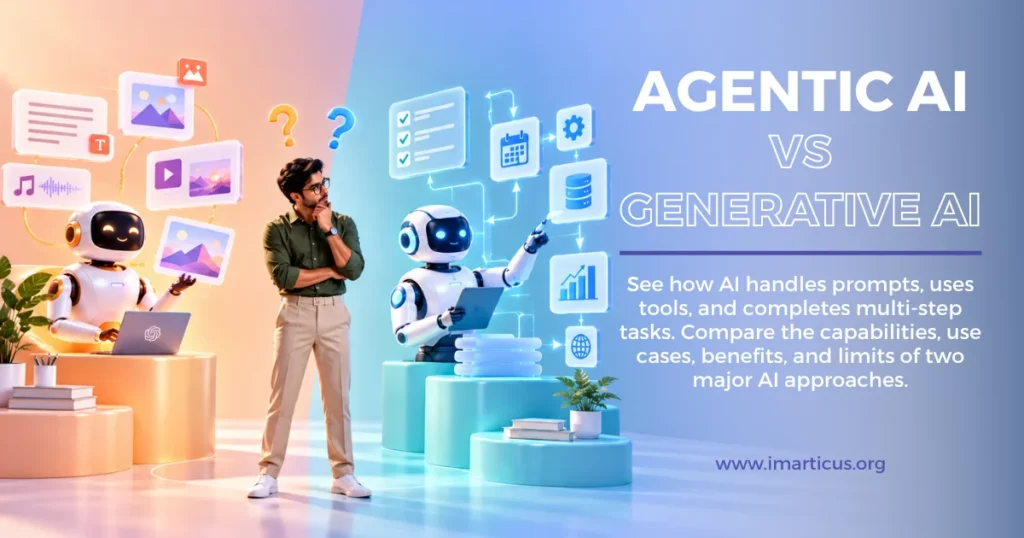
Generative AI is software that creates content, such as text, images, audio or code, when you give it a prompt. Agentic AI is a system that works toward a goal: it plans the steps, uses tools, takes action and changes course when something fails.
With generative AI that’s you. With agentic AI it’s the system. Most agents run on a generative model anyway, so they don’t compete. ChatGPT is a good example, since plain chat is generative and its tool features are agentic. Pick generative for drafts you’ll review and agentic for repeat jobs with many steps.
Picture a meeting at pretty much any company right now. Somebody says, “We don’t need generative AI, we need agentic AI.” Heads nod around the table. Nobody asks what the difference actually is, because asking feels like admitting you haven’t kept up. The people who do know it cold mostly got there by building something small, like a no-code workflow in a weekend course such as Imarticus Learning’s Generative AI for Professionals Course.
So let me be the one who asks. Agentic AI vs generative AI is mostly a vocabulary mix-up, and you can sort it out in about ten minutes. Below you’ll find plain definitions, a table that puts the two side by side, some real examples, and a straight answer on ChatGPT. I also break down agentic AI vs AI agents vs generative AI, since those three get tangled up constantly, and show where agentic AI vs generative AI vs predictive AI fits in the same picture. Short on time? Read ahead for the quick version.
What is Agentic AI vs Generative AI?
Generative AI makes things: text, images, code, whatever you ask for, whenever you ask. Agentic AI chases a goal. Give it one and it plans the steps, uses tools, takes action and changes course when something breaks. Generative AI produces. Agentic AI acts.
Don’t Let Our Best Advice Get Buried
Add Imarticus as a Preferred Source — see more of what we publish, every time you search.

Agentic AI vs generative AI at a glance
| Generative AI | Agentic AI | |
| Core job | Create content | Complete a goal |
| Starts when | You send a prompt | You set a goal |
| Output | Text, images, code, audio | Finished tasks, changed systems |
| Autonomy | Low | Medium to high |
| Example | Writing a refund email | Spotting a damaged-order claim, checking policy, paying out, logging it in the CRM |
The short version
- Generative AI is a model that makes content when you ask. Agentic AI is a system that gets a goal done using tools.
- My shortcut is the next-step rule: once the first output exists, who decides what happens next, you or the system?
- Most agentic systems run on a generative model underneath. So these two aren’t competing. One sits on top of the other.
What is the difference between generative and agentic AI?
Generative AI creates content, like text, images or code, in response to a prompt, and a person decides what happens with it. Agentic AI pursues a goal across several steps, using tools and making decisions along the way. In short, generative AI delivers outputs and agentic AI delivers outcomes.
Did You Know?
In June 2025, Gartner predicted that over 40% of agentic AI projects will be cancelled by the end of 2027, pointing to escalating costs, unclear business value and inadequate risk controls. (Source)
What Is Generative AI?
Generative AI is software that makes new content (text, images, audio, code) by predicting what should come next, using patterns it picked up from huge amounts of training data.
That’s really all there is to it. The rest is marketing. A language model guesses the next word. An image model starts from static and sharpens it into a picture. The machinery differs, but the interaction looks the same every time: you type a prompt, you get an output, and then it waits. Quietly. Like a dog holding a ball.
What generative AI is good at?
- First drafts
- Summaries.
- Translations
- Brainstorming
- Code suggestions
Mostly it saves you from the blank page, and if you’ve ever stared at an empty doc at 11 p.m., you know that’s worth a lot.
Where generative AI stops
It doesn’t want anything. Between your messages, it does nothing at all. Tidy list, I know. But the loop is where an agent either earns your trust or loses it. Every pass is a chance to get it right or wrong, and the system is the one making the call, not you.
What sits inside an agentic system
- A reasoning model, usually an LLM, that decides the next move
- Memory, so it remembers what it already tried
- Tools: search, code execution, APIs, databases
- An orchestration layer that keeps the steps in order
- Guardrails, meaning permissions, approval points and spending limits
Take any of these out, and you’re back to a chatbot or a plain script.
Single-agent and multi-agent systems
A single agent can own a narrow job, like triaging IT tickets. Multi-agent setups split the work among specialists, say a researcher, a writer and a reviewer, with a manager agent keeping them in line. People build these with frameworks such as LangGraph, CrewAI and the OpenAI Agents SDK.
Interesting Insight → Open protocols like Anthropic’s Model Context Protocol (MCP) and Google’s Agent2Agent (A2A) are attempts to standardise how agents plug into tools and talk to each other.
What Is Agentic AI vs Generative AI? The Core Difference
If you asked me what is agentic AI vs generative AI in a single line, I’d say: generative AI answers, agentic AI acts. The question I’d actually use in a meeting, though, is who owns the next step?
With generative AI, you do. You read what came back, decide what’s next and type the next prompt. With agentic AI, the system does. You name the destination, and it works out the route. I call this the next-step rule, and it clears things up faster than a page of definitions.
Think of a good writer next to a project manager. The writer hands you the draft you asked for, then waits for notes. The project manager takes the brief, hands out the work, chases the stragglers and comes back when it’s finished. Both are useful. They’re just different jobs, and the generative vs agentic AI argument mostly comes down to which one you need on a given Tuesday morning.
Agentic AI vs Generative AI: Key Differences
| Parameter | Generative AI | Agentic AI |
| Primary goal | Create content | Achieve an outcome |
| Trigger | A prompt | A goal |
| Autonomy | Low, since a human steers each step | High, since a human sets the goal and limits |
| Actions | Produces text, images, code | Calls tools and APIs, changes systems |
| Memory | Mostly within one session | Carries across a task, sometimes longer |
| Planning | Minimal | Multi-step planning, with re-planning when things fail |
| Main risk | Confident wrong answers | Wrong actions with real consequences |
| How you judge it | Output quality | Task success, reliability, safety |
| Example | Drafting a refund email | Spotting the issue, checking policy, issuing the refund, updating the CRM |
Reading that table, you’d think the two are opposites. They’re not, and most articles bury this part. Almost every agentic system uses a generative model as its brain, so agentic vs generative AI isn’t a fork in the road. Think engine versus car. An engine by itself won’t get you to the airport. A car with no engine is an expensive couch. Any honest generative AI vs agentic AI comparison ends up here sooner or later, so I’d rather open with it.
The Autonomy Ladder: Where Does Your AI Tool Actually Sit?
Most agentic AI vs generative AI comparisons treat this as an on-off switch. It isn’t one. It’s a dial, and this is the ladder I use to find where a tool sits on it.
| Level | What it does | Who decides the next step | Example |
| L0: Prompt and response | Answers when asked | Human | Asking a chatbot to rewrite a paragraph |
| L1: Tool-assisted | Uses a tool like search or code inside a reply | Human | A chatbot that browses to answer a question |
| L2: Fixed workflow | Runs the same steps every time | The script | Summarise an email, draft a reply, save it to the CRM |
| L3: Supervised agent | Plans its own steps, pauses for approval | Agent, with human sign-off | A research agent that proposes actions and waits |
| L4: Guarded autonomous agent | Acts within set permissions | Agent | A support agent that issues refunds up to a limit |
| L5: Multi-agent system | Several agents coordinate | The agents | A team of agents running a lead-to-quote process |
The Autonomy Ladder in one sentence: the higher you go, the more steps the system handles and the less often a person touches the work.
My honest read? Most products sold as agentic today sit at L2 or L3. That’s fine, because those are the levels where reliability is best. The trouble starts when a vendor sells an L2 workflow as an L5 autonomous agent. You end up paying for a rung you’re not standing on.
How Generative AI and Agentic AI Work Together?
Agents don’t replace generative models. They’re built on top of them. The language model reads the goal, reasons about it and picks which tool to call. What agentic design adds is the stuff around it: memory, tools, a loop, and rules for what the system may and may not do.
Picture the stack. The model sits in the middle. Memory keeps track of progress. Tools reach the outside world. An orchestrator decides what comes next, and guardrails stop it from doing anything costly or irreversible.
That’s why I see these as layers, not rivals, and why the agentic AI vs generative AI debate is less dramatic than the headlines make it sound. If you can write a good prompt, you already have the skill at the bottom of the stack. Want to see the rest by building a small no-code agent yourself? Module 5 of this Generative AI course for professionals covers it with tools like Zapier and CrewAI.
Agentic AI vs Generative AI Examples
Generative AI creates content such as text, images, code, and videos in response to prompts. Agentic AI goes a step further by using AI models and tools to work towards a goal, make decisions, and carry out multi-step tasks with limited human intervention.
For example, Generative AI can draft a marketing email, while Agentic AI can research the target audience, draft the email, schedule its delivery, and track responses, subject to the tools and permissions available.
Generative AI examples
Generative AI can create a wide range of content based on user prompts, including text, images, videos, music, and code. For example, it can draft blog posts, generate product images, summarise reports, create marketing copy, or write code snippets. These examples show how Generative AI helps produce new content quickly, while the quality of the output depends on the prompt, the model, and the information provided.
- Marketing copy and ad variations
- Images for campaigns and presentations
- Code completion and boilerplate in an editor
- Meeting summaries and email drafts
All of these work the same way. A person asks, a person decides.
Agentic AI examples
Agentic AI examples include support agents that resolve refunds end to end, coding agents that edit files and open pull requests, research agents that put together cited briefs, IT agents that triage tickets, supply-chain agents that reroute delayed shipments, and sales agents that research a lead and follow up. Here’s how a few of those look in practice:
- Customer support: reads the request, checks order history and policy, issues the refund, logs the case
- Software engineering: reads an issue, edits files, runs tests, opens a pull request for review
- IT operations: sorts, assigns and resolves routine tickets like password resets
- Sales: researches a lead, writes the message, sends it, follows up
These are the agentic AI examples I’d point to when someone asks what the technology does all day.
Examples by industry
Here are a few more agentic AI vs generative AI examples, grouped by industry, so you can see the gap in familiar settings.
| Industry | Generative AI | Agentic AI |
| Banking | Drafts a customer reply about a failed UPI transaction | Pulls the transaction record, checks its status, and prepares the dispute resolution for human review |
| Healthcare | Summarises a doctor’s visit notes | Handles appointment scheduling, reminders and insurance pre-checks across systems |
| E-commerce | Writes product descriptions | Handles a return end to end: checks eligibility, books the pickup, triggers the refund |
| IT and DevOps | Explains an error log | Detects the incident, runs diagnostics, restarts a service, escalates if that fails |
| HR | Drafts a job description | Screens resumes, schedules interviews, updates the applicant tracking system |
One task, two approaches: a refund request
This is the simplest of all the agentic AI vs generative AI examples I know. Say a customer writes: “My order arrived damaged. I want my money back.”
The generative approach:
- A model reads the message
- Drafts a polite reply for a support executive.
- Then the executive checks the order, confirms the policy, issues the refund, updates the system and sends the reply.
- The AI saved a few minutes of typing. The person still did the work.
The agentic approach:
- The agent reads the message.
- Pulls up the order, checks the damage claim against policy, issues the refund within its approved limit, updates the CRM and replies.
- If the amount is over its limit, or the photos look off, it passes the case to a human with a short summary.
Same customer, same result. The only thing that changed is how many steps a person had to handle.
Agentic AI vs AI Agents vs Generative AI
People swap these three terms around all the time, and some vendors don’t mind, because vague language is easier to sell. Here’s how they really relate.
- Generative AI is the capability: models that create content.
- AI agents are individual software entities that use a model and a few tools to finish one specific task.
- Agentic AI is the bigger approach: systems that pursue goals on their own, often by coordinating several agents.
The analogy I like: generative AI is a skill, an AI agent is an employee who has that skill plus a job description, and agentic AI is a whole department running a process with several employees.
Agentic AI vs AI agents vs generative AI compared
| Generative AI | AI agent | Agentic AI | |
| Scope | Model capability | Single, task-focused system | Goal-driven system, often multi-agent |
| Autonomy | Low | Medium | Medium to high |
| Example | A model drafting a report | A bot that books meeting rooms from chat requests | Coordinated agents that research, draft, check and publish a report |
| Typical tools | LLMs, image models | An LLM plus a few APIs | Orchestrators, memory, multiple agents, guardrails |
The terminology isn’t settled. In casual conversation, using “agent” and “agentic AI” interchangeably is fine. When you’re buying or building, it isn’t. So the label depends on the mode, not the product name.
That’s the answer. The why is more interesting. ChatGPT is one of the best agentic AI vs generative AI examples to keep in mind, because one product lands on several rungs of the ladder. Plain chat sits around L0 or L1. Agent features push it toward L3, where it plans and acts but still stops for your approval on sensitive steps.
Same story with Claude, Gemini and Microsoft Copilot. Each has a plain chat mode and modes that use tools. The brand name tells you very little. What the product actually does tells you everything.
If you’ve never used an AI tool before, the jargon in this space can feel like a lot. ChatGPT and DeepSeek are free to try, and getting comfortable with them is the easiest way to understand what generative AI actually does. A few prompts in, the difference between a tool that answers and one that acts starts to make sense.
Agentic AI vs Generative AI vs Predictive AI (and Traditional AI, Machine Learning)
Throw predictive AI into the mix, and most articles give up and draw a Venn diagram that helps nobody. Try this instead.
- Artificial intelligence is the umbrella.
- Machine learning is the part of AI where systems learn patterns from data.
- Predictive AI is machine learning used to forecast outcomes from historical data.
- Deep learning is machine learning built on neural networks, and it powers generative models.
- Generative AI is deep learning used to create content.
- Agentic AI is a system design that uses models, often generative ones, to pursue goals and take actions.
Notice that agentic AI isn’t a technique like machine learning. It’s an architecture built on top of the others.
| Type | What it does | Data needed | Output | Example |
| Traditional (rule-based) AI | Follows hand-written rules | Rules from experts | Fixed decisions | A rule that flags transactions above a set amount |
| Predictive AI / ML | Forecasts from patterns | Historical, often labelled data | A score or forecast | Fraud scoring, demand forecasting, churn prediction |
| Generative AI | Creates content | Massive training data | Text, images, code | A drafted email |
| Agentic AI | Pursues goals using models and tools | A model plus access to tools and data | Completed tasks | A support agent that resolves a ticket |
Seeing agentic AI vs generative AI vs predictive AI in one table matters because real systems use them as a team. A predictive model flags a customer who’s likely to churn. A generative model drafts the retention offer. An agent decides when to send it and to whom, then logs what happened.
Where conversational AI fits
Conversational AI is about the interface: systems that talk with people by text or voice. What’s underneath can be rule-based, generative or agentic. A basic FAQ bot is conversational but neither generative nor agentic. A modern support assistant that chats with the customer and actually resolves the issue is all three.
Interesting Insight → An agentic system can change its next step based on what happens. Google’s machine learning glossary describes an agentic loop through four stages: observe, reason, act and receive feedback.
Agentic AI vs Generative AI: Which Is Better?
Neither, and I’ll stand by that. Asking which is better is like asking whether a spreadsheet beats an analyst. They do different jobs. The agentic vs generative AI decision should start with the job, not the technology. And if you’re still stuck on generative AI vs agentic AI, the checks below should settle it.
Choose generative AI when:
- The output is content, a draft, an idea or a summary
- A human will review it before it goes anywhere
- A mistake wouldn’t cost much
- The work is one-off or varied
Choose agentic AI when:
- The job has many steps across several systems
- The process is repetitive and well defined
- Mistakes can be caught or reversed
- You can limit what the system is allowed to do
The agent-washing test
Gartner has a name for this: “agent washing.” It means rebranding existing products, like AI assistants, RPA and chatbots, as agentic without real agentic capability. Its June 2025 analysis estimated that only about 130 of the thousands of agentic AI vendors are real. So before you buy anything called an agent, ask three things:
- Does it plan its own steps, or follow fixed ones?
- Does it call tools and change something outside the chat window?
- Does it adapt when a step fails?
If the answer is no to two of them, you’ve got a workflow or a chatbot. Nothing wrong with that. Just price it like one.
A five-question decision checklist:
- Is the end result a piece of content or a completed action?
- How many systems does the task touch?
- What’s the worst that could happen if a step goes wrong, and can it be undone?
- Is a person available to approve key steps?
- Have you defined the data access and permissions the system needs?
Mostly content, few systems, high stakes? Stay with generative AI and a human reviewer. Mostly actions, many systems, reversible steps? Consider an agent, start at L3 on the Autonomy Ladder, and move up only once it has earned trust. Budget for running costs too. An agent may trigger several model calls per task, and it needs more oversight than a chatbot.
Future Scope of Agentic AI
Gartner predicts that at least 15% of day-to-day work decisions will be made autonomously through agentic AI by 2028, up from 0% in 2024. That’s a forecast, not a fact, and the same analysis warns about plenty of project cancellations. I read it as a direction, not a destination.
Three shifts stand out:
- Interoperability. Protocols like MCP and A2A make it easier for agents to share tools and talk to one another.
- Multi-agent collaboration. Specialist agents under a coordinator will take on more complex workflows.
- Changing job content. Routine coordination work shifts to agents. People spend more time setting goals, reviewing results and handling exceptions.
Risks and Governance For Agentic AI Vs Generative AI
Both carry risk, but they break in different ways. Generative AI goes wrong in text. Agentic AI goes wrong in action.
The math below is why I stay sceptical of long autonomous chains. As an illustration, say an agent gets each step right 95% of the time. Over ten steps, the whole task succeeds only about 60% of the time (0.95 to the power of ten is roughly 0.60). Real systems vary, but in the agentic AI vs generative AI risk comparison, compounding errors are the biggest single difference. Two more risks deserve a mention.
- Prompt injection is when hidden instructions in a web page or document hijack the agent.
- Excessive permissions mean the agent can do far more than its task needs.
None of the fixes are exotic:
- Give the agent the least access it needs
- Require human approval for irreversible actions
- Log every step
- Set spending and rate limits
- Test on messy, real edge cases before launch
And someone in your organisation has to own what the agent does. You can’t hand accountability to software.
How Does Imarticus Learning’s Generative AI Course for Working Professionals Help?
Plenty of consultants stall on pay because the week only has so many hours. Imarticus Learning’s Generative AI for Professionals Course, run with PwC Academy, goes straight at that problem, and consulting is one of the fields it’s open to.
- Joint certification from PwC Academy and Imarticus Learning, so there’s a PwC name on your profile
- Weekend classes only, about 3 hours on Saturday and Sunday, so client work doesn’t take a hit
- No coding needed, and you can start from zero
- Live sessions led by AI practitioners from PwC Academy
- 18 AI tools you’d use at work, including ChatGPT, Claude, Gemini, Perplexity AI and Gamma
- Real business case studies, with a portfolio to show for them
- Reports, analysis and documentation automated, which the programme says can free up 5 to 8 hours a week
- 6-month no-cost EMI
FAQs About Agentic AI Vs Generative AI
Still weighing agentic AI vs generative AI, or got a doubt the sections above didn’t quite settle? These are the most frequently asked questions by readers, answered in plain terms so you can get back to your decision.
What is the main difference between AI and agentic AI?
AI is the broad field of getting machines to do things that normally take human intelligence. Agentic AI is one kind: it sets sub-goals, plans, uses tools and acts with little supervision. Every agentic system is AI, but most AI isn’t agentic.
Is ChatGPT agentic AI or generative AI?
Standard ChatGPT chat is generative AI, since it responds to prompts. Once ChatGPT uses tools, browses or completes multi-step tasks in agent mode, it behaves agentically. The label depends on the mode, not the product name.
What are examples of agentic AI?
Common examples: support agents that resolve refunds end to end, coding agents that edit files, run tests and open pull requests, research agents that compile cited briefs, IT agents that triage tickets, and sales agents that research leads and follow up.
Agentic AI vs generative AI: which one is better?
Neither one wins. Generative AI suits content, drafts and summaries that a person reviews. Agentic AI suits repeatable, multi-step work across systems where mistakes can be caught. Most real solutions use both, with the generative model running inside the agent.
What is agentic AI vs generative AI?
Generative AI creates content in response to a prompt. Agentic AI pursues a goal by planning steps, using tools and acting on the results. One gives you outputs, the other gives you outcomes, and agentic systems usually run on top of generative models.
What is the scope of agentic AI in the future?
Agentic AI is likely to spread across customer service, IT, finance operations and software development, helped by shared protocols and multi-agent designs. Gartner predicts at least 15% of day-to-day work decisions will be autonomous by 2028. Expect supervised, narrow deployments first.
What is the difference between Gen AI, conversational AI and agentic AI?
Gen AI creates content. Conversational AI is about talking with people by text or voice, and it can be rule-based, generative or agentic underneath. Agentic AI pursues goals by acting through tools. One assistant can be all three at once.
Is agentic AI the same as an AI agent?
Not quite. An AI agent is a single task-focused system. Agentic AI is the wider approach of goal-driven, autonomous behaviour, often with several agents working together. In a generative AI vs agentic AI vs AI agents comparison, the agent is the component and agentic AI is the system.
Where to Start With Agentic AI vs Generative AI
Most of the confusion goes away if you ask who owns the next step in the agentic AI vs generative AI question. If you read the output and decide what happens next, you’re using generative AI. If the system works that out itself, it’s agentic. Both run on the same engine, so you’re really choosing a job to hand over, not a side to take.
A few things are worth carrying out of this blog. Check where a tool sits on the ladder before you pay for it. Ask whether it plans its own steps, changes something outside the chat and recovers when a step fails. A lot of what’s sold as an agent is a workflow, which is fine as long as it’s priced like one.
Whether you’re weighing generative vs agentic AI for your team, or generative AI vs agentic AI vs AI agents for a project, the quickest way to get it is to build something small and see where it breaks. If you’d like to do that with guidance, Imarticus Learning’s Generative AI for Professionals Course is a 90-day weekend programme with no coding, where you work through 18 tools, no-code agents included. Or open a free tool tonight and automate one boring task. Either way, build one thing this month.
Liked This? Follow Us Where You Already Search.
Preferred Sources is Google’s built-in follow button — no app, no login, just more Imarticus in your results.