


Last updated on December 3rd, 2025 at 03:46 pm
Last Updated on 4 months ago by Imarticus Learning
The road to qualifying as a global accountant feels exciting when you know exactly what lies ahead. Students often hear that the ACCA Papers are simple to understand on the surface, yet layered with depth once you begin preparing for them. This guide is meant to give you a clearer picture of each stage, why the structure exists the way it does, and how the papers build the instincts required for a modern finance career.
The ACCA Papers have been explained here in the way an experienced mentor would guide a student who wants clarity, confidence, and a real map for the next two or three years.
Considering ACCA?
Get personalized guidance on your ACCA journey—eligibility, exam roadmap, and career outcomes in a 15-minute call with our expert counsellor.
No commitment required • 200+ students counselled this month
The papers are grouped into Knowledge, Skills, and Strategic levels. Together, they shape how you think, analyse, and solve problems in dynamic business environments. Every level adds a different lens, much like switching from reading glasses to binoculars and eventually to a panoramic view of financial decision-making.
What Is ACCA? What are the ACCA Papers?
Before you see any syllabus or list, it is important to understand why the qualification is organised the way it is. The ACCA Course prepares you for global roles, and each stage simulates the maturity expected from someone handling complex business situations.
The early papers sharpen your foundations. The mid-level papers drill in discipline, structure, and accuracy. The final level trains you to think like someone who owns the consequences of their decisions.
That is why employers around the world trust the qualification. ACCA Papers mirror the real world, not just the academic world.
Students beginning their finance careers often start by asking what is ACCA.The Association of Chartered Certified Accountants (ACCA) is a global qualification that trains you to understand, analyse, and interpret financial information in a modern business environment. The syllabus prepares you for global accounting roles, and its structure helps you grow step by step.
Here is a video that explains the ACCA course in-depth:
A Quick Breakdown Of What ACCA Covers
The table below summarises the main idea behind ACCA and the skills it aims to build.
| Area of Learning | What ACCA Trains You To Do |
| Business Understanding | Understand how organisations operate and make decisions |
| Accounting & Reporting | Prepare and interpret financial statements |
| Tax & Law | Apply regulatory rules to business situations |
| Audit & Assurance | Evaluate reliability and consistency in information |
| Strategy & Leadership | Make decisions that influence long-term business outcomes |
These areas become easier to master because the ACCA Papers follow a level-wise learning path.
How The ACCA Papers Are Structured To Support Student Growth
The qualification recognises that students learn best when concepts build on each other. That is why the ACCA Subjects List moves from foundational to advanced decision-making topics.
The table below shows how each stage supports your preparation.
| ACCA Level | Focus of That Level | How It Helps Students |
| Knowledge Level | Basics of business, accounting, and technology | Builds conceptual clarity |
| Skills Level | Applied accounting, reporting, audit, and finance | Sharpens analysis and problem-solving |
| Strategic Level | High-level judgement and leadership reasoning | Prepares you for real business decisions |
This progression turns unfamiliar topics into manageable blocks. The following visual shows the aspects these ACCA papers cover:
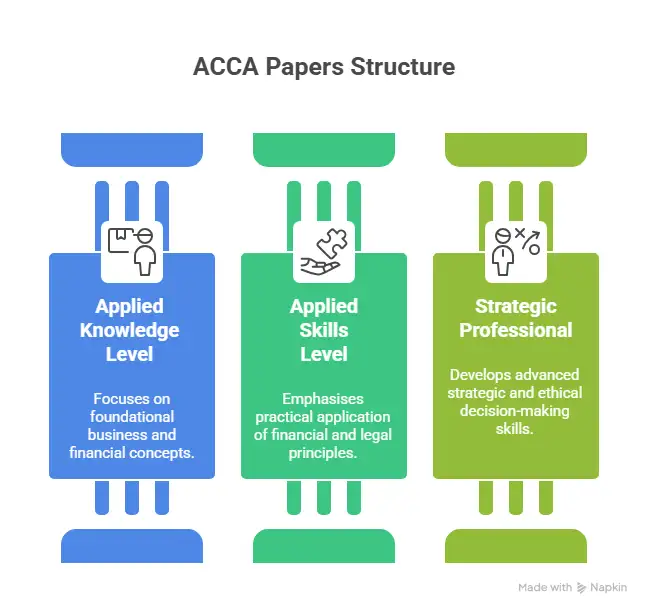
The Three-Level ACCA Papers Structure Explained
Every ACCA student starts with the same question: how many ACCA Papers truly shape your journey? There are 13 in total, though exemptions can change the number you personally take. But each paper has a personality of its own.
1. ACCA Knowledge Level Papers
These are the entry points for the qualification. They build the raw mental toolkit needed for analysis.
The table lists the ACCA knowledge level papers, the core thinking each one builds, and one relatable example to connect theory with reality.
| Paper Code | Paper Name | What It Really Builds | Everyday Example |
| BT | Business and Technology | Understanding how companies run | Why a bakery fails during festivals, even with high demand |
| MA | Management Accounting | Cost control instincts | How airlines price seats differently on the same flight |
| FA | Financial Accounting | Recording and reporting reliability | How a retail store tracks a single damaged product in inventory |
These ACCA knowledge level papers act as the base of a tall tower. Students who are strong here find the higher levels far more manageable.
Why these papers matter more than students realise
A common mistake is underestimating these early papers because they look familiar. Many learners feel they resemble school-level accounting or BCom subjects. The truth is that these papers train your pattern recognition skills. Every time you identify why a company lost money despite good sales, you are using BT and MA concepts without even noticing.
Did you know? According to the official ACCA report on pass rates, students with strong Knowledge level foundations have significantly higher chances of clearing mid-level papers within fewer attempts.
ACCA Skills Level Papers
Once you complete the foundational stage, the ACCA skill level papers push your thinking into applied territory. This stage has six papers, each one designed to refine accuracy, discipline, and professional behaviour.
These papers are the point where many students say they begin to feel like actual accountants and analysts. The list below outlines the ACCA skills and clarifies the professional instincts each builds in a learner.
| Paper Code | Paper Name | Practical Skill Developed |
| LW | Corporate and Business Law | How decisions get bound legally |
| PM | Performance Management | Measuring success in numbers |
| TX | Taxation | Understanding national financial systems |
| FR | Financial Reporting | Presenting a company’s story through numbers |
| AA | Audit and Assurance | Detecting inconsistency and assessing reliability |
| FM | Financial Management | Understanding the pulse of money inside a company |
Key Insight
Think of these papers the way athletes think of training drills. They do not exist to stress the student; they exist to shape mental discipline. For example:
- TX trains you to think within rules rather than assumptions.
- PM strengthens your ability to turn chaos into measurable performance indicators.
- AA builds the inner auditor in you who questions what others overlook.
The ACCA skill level papers are designed to shift your thinking from student to professional.
Most employers suggest that the ACCA skill level papers mirror the complexity of real junior analyst roles.
Strategic Professional Level Papers
This level represents your transition into executive-level thinking. These ACCA Papers train you to see the entire organisation instead of isolated transactions.
They teach the mindset of someone who makes decisions, not just documents them. The strategic level has two compulsory papers plus two optional specialisations. The table explains this in clear terms.
| Category | Paper Code | Paper Name | What It Shapes In You |
| Essentials | SBL | Strategic Business Leader | Leadership instincts and cross-functional reasoning |
| SBR | Strategic Business Reporting | Ability to narrate impact through reporting | |
| Options | AFM | Advanced Financial Management | Modern investment and risk judgment |
| APM | Advanced Performance Management | Designing high-performance business frameworks | |
| ATX | Advanced Taxation | Tax structuring decisions | |
| AAA | Advanced Audit and Assurance | High-level audit logic and stakeholder persuasion |
Strategic-level ACCA exam papers are where students learn to think like future CFOs. These papers challenge your ability to balance numbers with people, logic with intuition, and compliance with long-term thinking.
Real-Life Scenario
Imagine being asked whether a company should enter Vietnam as a new market. Strategic-level papers train you to weigh regulations, taxation, performance measures, leadership alignment, financial risk, and audit implications. This is the point where your ACCA training begins to feel like real navigation, not an academic exercise.
Summary Of The 13 ACCA Papers
Before you move to deeper planning, here is a clean overview of the total ACCA papers for clarity. This table offers a complete ACCA papers list in one place.
| Level | Papers Count | Paper Codes |
| Knowledge | 3 | BT, MA, FA |
| Skills | 6 | LW, PM, TX, FR, AA, FM |
| Strategic | 4 | SBL, SBR, plus two optional papers |
| Total | 13 | Complete ACCA structure |
Students often ask how many papers in ACCA they must appear for if they hold prior degrees. The number varies because exemptions are possible. Exemptions will be discussed in detail later, but for now, keep in mind that the ACCA total papers remain 13 in structure.
Understanding Exam Mindset Across ACCA Papers
Students preparing for ACCA Papers usually underestimate the role of temperament. While knowledge is essential, temperament often decides the outcome. ACCA exam papers are structured to test not just the accuracy of answers but also how you handle pressure.
Here are typical behavioural patterns that benefit students during ACCA exams.
- A calm approach to unexpected questions.
- A steady reading speed during long-case scenarios.
- The ability to allocate time with discipline.
- The intuition to move on when stuck.
- The habit of revisiting flagged questions without emotional bias.
Exam mindset is a skill that grows through exposure. Mocks, timed quizzes, and self-reviews sharpen it.
This video discusses free resources available to support your ACCA journey with top-class study material, updated insights, and study tips:
Sequencing Strategy For ACCA Papers
A thoughtful sequence can reduce stress and enhance understanding. The order in which you attempt papers shapes your mental load and knowledge transfer.
Below is a sequencing framework used by many effective candidates. This table suggests a commonly successful sequencing pattern while maintaining flexibility. It connects cognitive load, real-world applicability, and learning curvature.
| Stage | Suggested Papers | Reason It Works |
| Foundation | BT, MA, FA | Light cognitive load, strengthens raw fundamentals |
| Skill Consolidation | PM, FR, FM | High concept transfer between these papers |
| Law and Tax | LW, TX | Keeps regulation-heavy topics together |
| Assurance Stage | AA | Best handled after FR for contextual clarity |
| Strategic Start | SBR | Helps before SBL due to reporting alignment |
| Leadership Stage | SBL | Integrates all previous learning |
| Specialisation | Optional Papers | Choose based on career interest, not fear |
This approach acknowledges that each student studies with evolving confidence. Moving from known to unknown reduces cognitive fatigue and keeps morale high.
The sequencing also reduces duplication of effort. For example, FR learned before AA avoids the need to relearn reporting logic during audit preparation.
Skill Transfer Across ACCA Papers
Every ACCA student must understand that papers do not exist in isolation. They reinforce each other. This skill transfer helps students reduce effort and improve retention. Below are examples of skill transfer across the ACCA Papers.
- MA helps PM because costing behaviours influence performance analytics.
- FR supports SBR because high-level reporting requires clarity of fundamentals.
- PM strengthens APM because decision frameworks scale from mid-level to strategic-level analysis.
- FM enhances AFM because investment management at the strategic level is built on financial management blocks.
- TX supports ATX because advanced tax structuring builds upon introductory tax behaviour.
Students who study with awareness of these links tend to feel less overwhelmed and more aligned with the ACCA curriculum’s internal logic.
Designing Revision Cycles That Support All ACCA Papers
Revision cycles define how information behaves in your memory. ACCA Papers require agility because questions can move between conceptual, analytical, and narrative styles.
Below is a revision cycle that supports long-term clarity.
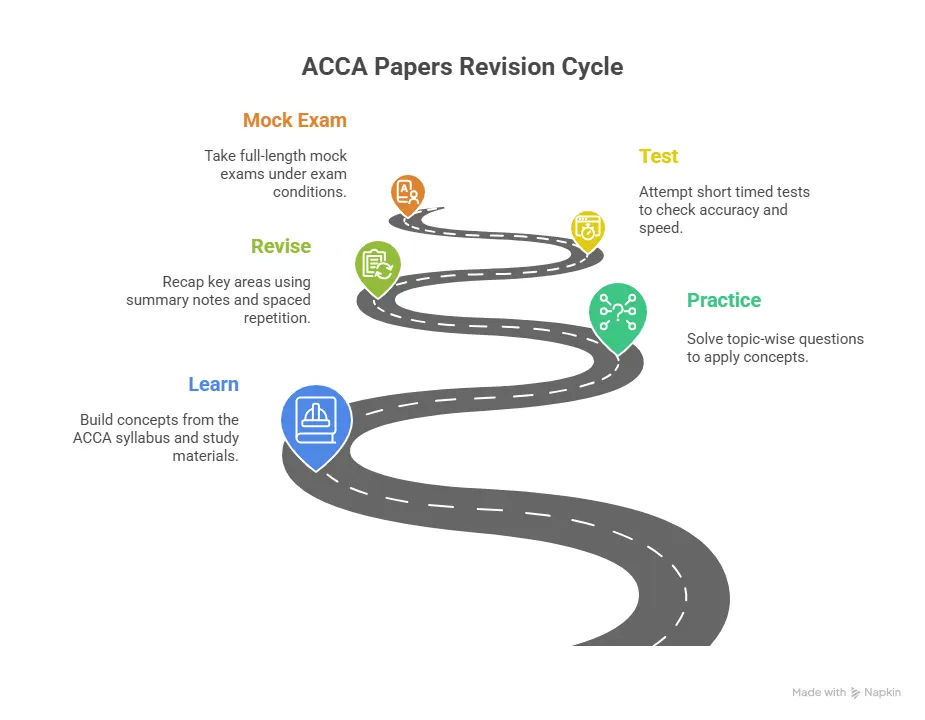
- First cycle: Short, daily recaps of 20 minutes per paper.
- Second cycle: Weekly consolidation, focusing on weak topics.
- Third cycle: Past questions arranged topically.
- Fourth cycle: Mixed and timed questions that bring unpredictability.
- Fifth cycle: Full mocks with self-review.
This layered approach helps students switch context quickly, which is useful during real ACCA exam papers.
Memory Techniques That Help In ACCA Papers
ACCA Papers cover a wide and varied concepts. To remember them with clarity, use techniques that strengthen neural pathways instead of relying on passive reading.
Here are cognitive tools that many high performers use.
- Concrete examples: Relate topics to real companies, products, or events.
- Story chains: Build small narratives around technical topics.
- Visual notes: Mind maps and flowcharts help reduce revision density.
- Teaching technique: Explain topics to a friend. Teaching strengthens confidence.
- Pattern spotting: Identify recurring question types in each paper.
These techniques train your mind to recall information as structured packets.
Mental Preparation For Strategic-Level ACCA Papers
Strategic papers like SBL and SBR require a different approach from the earlier ones. They demand not just knowledge but judgement.
- Students preparing for ACCA Papers at the strategic level should build the following mindset:
- The ability to see relationships between departments.
- Confidence to suggest solutions instead of searching for perfect answers.
- Emotional clarity when handling long case studies.
- The habit of summarising complex ideas.
- The patience to break down multi-layered scenarios.
This mindset prepares students for senior roles later in life. Many CFOs attribute their approach to decision-making to training received during SBR and SBL.
Here is a visual that explains the revision cycle needed for students to optimally prepare for the ACCA Papers:
Understanding Job Roles After Completing ACCA Papers
Students often ask what type of work they will handle and what the ACCA career potential is. The roles vary widely because ACCA is recognised across industries, including banking, consulting, FMCG, manufacturing, fintech, and even newer areas like sustainability reporting.
Below is a table that connects the ACCA Papers with job roles that commonly emerge after qualifying. This helps students visualise the practical transition from exams to employment.
| ACCA Area Strengthened | Typical Job Roles |
| Financial Reporting | Financial Analyst, Reporting Associate, Group Accounting Officer |
| Audit and Assurance | Internal Auditor, Statutory Audit Associate, Risk Analyst |
| Performance Measurement | Business Analyst, Management Accountant, FP&A Analyst |
| Corporate Law and Taxation | Tax Associate, Compliance Officer |
| Strategic Thinking | Consultant, Strategy Analyst, Senior Finance Executive |
These roles evolve as you grow professionally. What begins as audit exposure can progress into advisory. What begins as financial reporting can convert into senior controllership roles. The ACCA Papers lay the groundwork for these paths by training your analytical mindset and decision instincts.
Where The ACCA Qualification Fits In The Indian Job Market
The Indian market has changed significantly over the past decade. Hiring managers across Big Four firms, mid-tier firms, shared service centres, and MNCs increasingly prefer candidates with globally oriented training. The ACCA Papers give you that advantage because they build worldwide standards rather than country-specific viewpoints.
India now hosts many global capability centres. These centres require professionals who understand international reporting norms, cross-border tax behaviour, and strategic insight. Students who finish the ACCA Papers often find opportunities in financial planning roles, global audit teams, and international reporting units.
Salary Expectations After Completing ACCA Papers
Salary ranges differ widely depending on your number of attempts, communication skills, software literacy, and job location. Employers also consider how deeply you understood the ACCA Papers, not just whether you passed them.Below is an illustrative ACCA salary spread based on publicly available surveys from platforms like Glassdoor, AmbitionBox, and Payscale.
| Experience Level | Approximate Salary Range (India) |
| Fresher after ACCA | 4.5 to 8 LPA |
| 2 to 4 years of experience | 7 to 12 LPA |
| 5 to 7 years of experience | 12 to 20 LPA |
| Senior roles (8+ years) | 20 to 45 LPA, depending on the domain |
Sources:
Glassdoor India
AmbitionBox
Payscale
These ranges improve substantially for professionals working in investment roles, multinational treasury teams, or strategic finance units. Students who complete all ACCA Papers early in their careers often unlock faster salary jumps.
FAQs About ACCA Papers
Below are the most frequently asked questions designed to respond to the most searched ACCA-related queries.
What are the 13 papers in ACCA?
The 13 ACCA Papers form the core structure of the qualification and cover the Knowledge, Skills, and Strategic levels. These papers include BT, MA, FA, LW, PM, TX, FR, AA, FM, SBL, SBR, and two optional papers. Together, these papers help you grow from basic financial understanding to complex strategic judgement, which is why the qualification is highly respected. Students who train with institutes like Imarticus Learning often receive structured mentoring that supports their progress across all 13 papers.
What are the 9 papers of ACCA?
Students sometimes hear people refer to nine papers because older versions of the qualification had a slightly different structure. Currently, there are a total of 13 papers, but the Skills and Strategic levels together contain nine papers. These include LW, PM, TX, FR, AA, FM, SBL, SBR, and one optional specialisation. Each of these nine ACCA Papers develops professional behaviour and analytical sharpness, and many students prepare for them with structured programs at institutes such as Imarticus Learning.
Is ACCA difficult than CA?
Difficulty varies with learning styles, but the ACCA Papers follow a concept-driven approach that emphasises reasoning rather than memorisation. This makes the difficulty manageable when you study consistently. Many students who take coaching at Imarticus Learning feel confident with the papers because the training focuses on structured thinking, exam temperament, and practical application.
Can ACCA earn 1 crore?
Many professionals who complete all papers eventually reach compensation levels above 1 crore per year, especially in senior roles such as CFO, finance director, investment manager, or global reporting head. International postings, consulting roles, and specialised finance positions tend to offer such packages. Salary growth depends on experience, stability, results, and leadership skills built over time.
What is the 7-year rule in ACCA?
The 7-year rule applies to the Strategic Professional level. Once you pass your first Strategic paper, you must complete the remaining Strategic papers within seven years. This rule ensures that students maintain up-to-date knowledge and demonstrate consistent professional development. Planning your attempt sequence is essential to comfortably remain within the timeline.
Is the ACCA salary more than CA?
Salary depends on the role, location, employer, and experience. Some global finance roles, IFRS-focused positions, and multinational audit teams offer higher salaries to ACCA-qualified professionals because the ACCA Papers develop international reporting skills. In many Indian organisations, CA and ACCA professionals receive comparable roles when they demonstrate clarity, skill, and strong results.
Is ACCA closing in 2026?
There is no official indication that ACCA will close in 2026. Students sometimes hear rumours due to changes in accounting regulations or updates in exam formats. ACCA continues to publish updates regularly on its website for transparency. If you feel uncertain about evolving exam formats or future changes, guided programs at Imarticus Learning can help you stay updated with accurate information and prepare with clarity.
Does Big 4 hire ACCA in India?
Yes, all Big Four firms hire ACCA students and members in India. It prepares students with IFRS, audit logic, tax concepts, and analytical frameworks that align closely with Big Four workflows. Many teams in statutory audit, internal audit, advisory, and consulting actively recruit ACCA learners and affiliates.
Is ICAI better than ACCA?
Each qualification serves different types of career goals, but the ACCA Papers provide global mobility and international reporting exposure that suits candidates aiming for MNCs or global finance roles. Indian students who have cross-border or international aspirations find ACCA particularly valuable. Many professionals pursue both qualifications at different stages to complement their expertise.
Is ACCA good for girls?
Yes, the ACCA Papers create strong opportunities for girls because the qualification offers flexibility, remote exam options in many regions, and access to global industries that value skill over geography. Many women in finance choose ACCA because it supports long-term career growth without rigid restrictions and opens pathways across audit, taxation, advisory, and corporate finance.
Can I convert CA to ACCA?
Yes, CA professionals often receive several exemptions in the ACCA Papers because ICAI training aligns with key areas of accounting and audit. Many CA candidates pursue ACCA to broaden their global opportunities. Institutes like Imarticus Learning help CA professionals understand their exemption eligibility and create a preparation plan for the remaining ACCA exam papers.
Do Big 4 accept ACCA?
Yes, Big Four firms accept ACCA students, affiliates, and members for various departments, including assurance, taxation, consulting, and advisory. The papers build strong foundational and strategic thinking skills, which align with the work Big Four firms expect from their analysts and consultants.
Bringing Your ACCA Journey Together
Reaching this point means you now have a clearer picture of the ACCA path. You understand how the ACCA Papers grow from simple fundamentals to strategic thinking, how each level trains a different part of your professional mindset, and how your preparation rhythm can shape the way you perform in real exams.
This guide brought together the structure, preparation flow, study logic, and real-world relevance behind the qualification. When these pieces align, the learning becomes smoother and your confidence rises. The next steps depend on how consistently you create your study habits and how intentionally you move from one level to the next.
If you feel the need for structured mentoring, guided study plans, or academic support that keeps you on track, Imarticus Learning offers ACCA course prep that supports students at every stage. Many learners appreciate having a steady framework while preparing, especially when balancing work or academics.
