


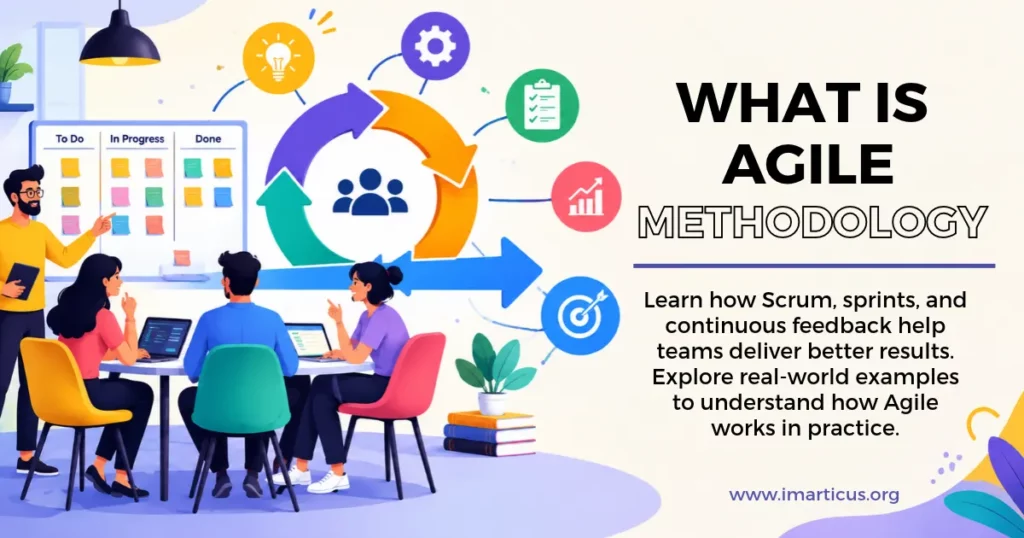
Wondering what is agile methodology? The simple answer: You divide a large project into smaller chunks and complete them, typically in 1-4 week intervals, as a series of smaller tasks. Once you have played each round, present the work to the customer, take his/her feedback, and incorporate it into the next round’s work. The origins of Agile are a short document, the Agile Manifesto, written in 2001, and Scrum is the most popular method of adhering to the principles of the Agile Manifesto. It started with software teams, but now testers, project managers, bankers, and marketers use it too. People like it because there is less waste, the product reaches users sooner, and a change in plan doesn’t cause a crisis. Further down, I’ve covered Scrum, how a sprint works, agile versus Scrum, and the jobs you can get by learning it.
You’ve surely heard the word agile in the workplace, a meeting, or on LinkedIn. If a person asked you right now about what agile methodology is, could you tell them in 2 sentences? Most of the people can’t and that’s fine. Needless to say, I was not able to either when I began to write about project management. I constantly heard sprint, backlog, stand-up, and it all seemed like a secret club to me.
After I had some people who do agile teams on a daily basis, I could understand it all, and it was a piece of cake. It really is simple. So in this blog, I’ll go step by step. First, the meaning, then Scrum, then how it works in software development, testing, and project management. At the end, we’ll talk about jobs. If you want to learn it properly with mentors and a live project, the Project Management Pro Degree is worth a look.
Agile Methodology Meaning
Before any framework or fancy word, let me explain the basic idea. I’ll do it the way I’d do it over a cup of tea, and then we’ll look at the proper definition.
Don’t Let Our Best Advice Get Buried
Add Imarticus as a Preferred Source — see more of what we publish, every time you search.

In simple words, what is Agile Methodology?
Consider your home as the location of a wedding. One Caterer prepares the entire menu, serves it at the conclusion, and then discovers that customers didn’t want as much spice as they had been given. There’s not much to be done now. The other one sends out a few samples to find out people’s reactions, and makes adjustments to the rest of the menu on the fly. The second caterer is working the agile way.
Work projects are no different. If you plan everything first and deliver on the last day, you’re hoping you guessed right. If you do a little, show it, and listen, you don’t have to guess. When you look at an agile team, these are the things you’ll notice:
- The work is done in short rounds, mostly one to four weeks, called sprints
- Every round ends with something that really works
- The customer sees it early, so mistakes get caught while they’re small
- The team decides how to do the work
- A change in requirements is just part of the job
Agile Methodology Definition
So, if you need to have it in a sentence, here’s the definition. Agile methodology is a planning and work delivery approach that is done in small cycles. One cycle completes one aspect of the project, is evaluated by users, and contributes to the next cycle of the project. The plan stays flexible, and the product improves a bit at a time.
You’ll also come across the agile development methodology. It’s the same thing used for building software. People mostly say just “agile” now, because teams outside IT use it as well.
A Brief History of the Agile Development Methodology
In the past, most software teams adhered to Waterfall. First, you wrote all your requirements, then designed the whole product, built it, and tested it at the end. It’s OK for a bridge. For software it causes trouble, since customers switch their minds, and the market moves while you’re working on the software.
In February 2001, seventeen software people met at a ski lodge in Snowbird, Utah. They were tired of late projects and not-so-happy customers, and they wrote the Agile Manifesto. It is one page. I will admit, as a first-time reader, I thought it was too brief to be of any consequence. I was wrong. It was that one page that changed the industry, and today, most tech teams start off their development process with agile.
What Is Agile and Scrum Methodology
Once you start reading about agile, Scrum turns up within minutes. Many beginners think they’re the same. They’re not, but they go together, so I want to explain Scrum right here before we move ahead.
Scrum Meaning
Scrum is a framework. That just means a ready-made way of running agile work, with rules you can follow. The name comes from rugby. In a scrum, the players huddle and push together to restart the game. A Scrum team does something like that. Everyone pushes toward one goal, in short rounds called sprints.
So agile is the thinking, and Scrum is one way of putting that thinking to use. The combination of the words agile and Scrum methodology equates to this.
Scrum Roles, Events and Tools
The nice thing about Scrum is that it has very few parts. Here are the main ones.
| Part | What it is |
| Product Owner | Decides what to build and what comes first |
| Scrum Master | Helps the team work well and clears blocks |
| Developers | The people who build, test, and deliver |
| Sprint | A fixed period, one to four weeks |
| Daily Scrum | A 15-minute catch-up every day |
| Sprint Review | Team shows the working product to stakeholders |
| Sprint Retrospective | Team talks about what worked and what didn’t |
| Product Backlog | The list of everything that may be built, in order |
A new team can learn this in a few days. Getting good at it takes longer, of course. But now you know what Scrum is, and the rest of the blog will be much easier to follow.
Agile Manifesto Values Behind Agile Methodology
The Manifesto has four values and twelve principles. Scrum, Kanban, and every other agile framework are built on top of them. Here are the four values in everyday words.
| Agile value | What it means in practice |
| People and conversations over processes and tools | Talking to each other beats any tool |
| Working software over heavy documents | Build what works, write only what you need |
| Customer collaboration over contract haggling | Keep the customer with you till the end |
| Responding to change over following a plan | A plan is only a guide |
One more thing. The items on the right side are not thrown out. You still need tools, documents, contracts, and plans. The Manifesto only says that when the two sides clash, the left side should get more weight.
There are twelve principles as well. I won’t go through all of them. These are the ones I see teams actually using:
- give users something that works every few weeks
- enjoy change, even late change, as some of these are the best ideas
- let business people and developers talk daily
- trust motivated people to get the job done
- keep a pace that doesn’t burn anyone out
- stop every now and then and ask how to do better
To me, the values are what is important and the principles are how to act on a busy Tuesday afternoon.
Also Read: Scrum Master Course
How Agile Methodology Works Step by Step
People think an agile project must be messy. It’s the opposite. There’s a rhythm to it, and after two or three sprints it starts feeling quite calm. Most teams go through the steps below and then loop back for the next sprint. If you wanted to know the phases of agile in the software development life cycle, here they are.
- Plan. The team and the product owner agree on the goal. Anything that could possibly be required is put on a backlog.
- Gather requirements. The top items are written as small user stories, like “As a customer, I want to reset my password so that I can log in again.”
- Design. The team does some sketching of how the feature will operate. Nothing heavy.
- Develop. The planned work for this sprint is developed.
- Test. Testers test each piece as soon as it is finished.
- Deploy. The working piece is released or presented to stakeholders.
- Review and feedback. Everyone sees and discusses what has been constructed and carries the learning forward to the next sprint.
A team typically becomes comfortable with their sprint after 4 or 5 sprints. The customer has seen real progress a few times, and surprises are smaller, because problems come up early. A two-week sprint normally looks like this.
| Day | What usually happens |
| Day 1 | Sprint planning, team picks what it can finish |
| Days 2 to 9 | 15-minute stand-up each morning, then building and testing |
| Day 10 | Review with stakeholders and then do a sprint retrospective. |
The typical duration is 2 weeks. The pattern is the same in the event your team goes for one week or four.
How Agile Methodology Works Step by Step
People think an agile project must be messy. It’s the opposite. There’s a rhythm to it, and after two or three sprints it starts feeling quite calm. Most teams go through the steps below and then loop back for the next sprint. If you wanted to know the phases of agile in the software development life cycle, here they are.
- Plan. The team and the product owner agree on the goal. Anything that could possibly be required is put on a backlog.
- Gather requirements. The top items are written as small user stories, like “As a customer, I want to reset my password so that I can log in again.”
- Design. The team does some sketching of how the feature will operate. Nothing heavy.
- Develop. The planned work for this sprint is developed.
- Test. Testers test each piece as soon as it is finished.
- Deploy. The working piece is released or presented to stakeholders.
- Review and feedback. Everyone sees and discusses what has been constructed and carries the learning forward to the next sprint.
A team typically becomes comfortable with their sprint after 4 or 5 sprints. The customer has seen real progress a few times, and surprises are smaller, because problems come up early. A two-week sprint normally looks like this.
| Day | What usually happens |
| Day 1 | Sprint planning, team picks what it can finish |
| Days 2 to 9 | 15-minute stand-up each morning, then building and testing |
| Day 10 | Review with stakeholders and then do a sprint retrospective. |
Agile Methodology in Software Development
This is where agile began, and it’s still the best fit. Nobody can describe a software product perfectly on day one. So building a little, showing users, and learning from them is just common sense.
Take a team building a food ordering app. The product owner keeps a list: login, menu, cart, payment. In sprint one, the team builds only login and the menu, and shows it to a few users. If the menu confuses people, the team finds out in week two. In the old way, they’d find out in month eight, after spending all the money. That’s the whole point.
Some habits you’ll see on agile software teams:
- features written as user stories, from the user’s side, in a line or two
- everyone’s code joined and checked every day, so nothing piles up
- two developers sitting together on one piece of code, called pair programming
- regular clean-up of the code so it doesn’t become a mess
- a shared definition of done, so everyone agrees what finished means
Agile Methodology in Software Engineering
Software engineering is wider than coding. It covers requirements, design, testing, maintenance, and quality. So what is agile methodology in software engineering? It means all of these happen inside each sprint, and not as separate long phases. Engineers like this because decisions stay small. If one goes wrong, you fix it next sprint, and you don’t find out after launch.
Many teams also use automated builds and version control. Once those are in place, releasing every week, or even every day, stops being scary.
Did You Know?
The Agile Manifesto was created in one meeting in a ski lodge in Utah in 2001. (Source)
Agile Methodology in Software Testing
Earlier, testers came in at the end, after the developers had finished. Agile changed that. Now testing begins on day one and goes on in every sprint.
Now, what is agile methodology in Software Testing? The tester works with the developers to test each little thing as soon as it is written, and gives them feedback during the same sprint. Quality becomes everyone’s job. It’s not a gate at the end anymore.
If you’re a tester, a few things change for you:
- You join the planning and help decide when a story is really done
- Each user story is tested as soon as it’s ready
- Repeat checks are automated, so regression testing takes minutes and not days
- You talk to developers daily, so bugs get fixed fast
- You also explore the product on your own and find what scripts miss
Agile Methodology in Testing
Teams that have adopted agile in testing tell me they experience fewer last-minute surprises. A bug found a day after it was written is cheap to fix. The same bug found after three months can mean redoing a whole feature. Quick feedback also builds trust. The talk stays on the product, and not on whose mistake it was.
Also Read: QA Automation Testing Certification
Agile Methodology in Project Management
Agile is not just for Software. It is used as the basis of banking, marketing, design, healthcare, and consulting project managers’ work, where things constantly evolve.
The agile approach is to plan the first two weeks, then wait and see what people like and click on, and make the next two weeks after that. Reduced guesswork and higher results.
In the agile project management methodology, the manager doesn’t oversee each of the tasks anymore. This role cblocker-removerming a team’s block-clearing and a stakeholder’s informational agent. Planning is layered – Year Plan, Quarter Plan and Next Sprint Plan. The chart below illustrates the differences between the two styles in the workplace.
| Area | Traditional project management | Agile project management |
| Planning | One detailed plan at the start | Plans updated every sprint |
| Scope | Fixed early | Flexible, ordered by priority |
| Delivery | One big release at the end | Small releases all along |
| Customer role | Involved at start and end | Involved throughout |
| Risk | Found late | Found early, sprint by sprint |
Hybrid is the term that is used to describe a combination of both in real life. It is up to the project, and a good project manager will know how to select. Progress is also visible to all, with boards, burndown charts, and velocity reports, which senior folks appreciate.
Agile Methodology vs Scrum
It is the question I get asked by the newbies the most. My brief answer is: Agile is the mindset, and Scrum is a method that adheres to this mindset. Scrum isn’t a requirement for being agile.
| Point | Agile | Scrum |
| What it is | A set of values and principles | A framework with defined roles and events |
| Scope | Broad, covers many methods | Narrow, with clear rules |
| Flexibility | Very high, no fixed practices | Structured, with set meetings |
| Time boxes | Not compulsory | Sprints are a must |
| Examples | Scrum, Kanban, XP, Lean | Product owner, sprint, backlog |
Once again, examine the table, and you will see that they are not competing. Agile thinking prioritises events; Scrum is routine, and Scrum provides agile with some structure.
Agile Methodology vs Waterfall
Another name you will continue to hear is waterfall. It proceeds in a linear fashion: Requirements, Design, Build, Test, Release. Agile goes in loops. Waterfall suits work where requirements are fixed, and changes cost a lot, like some construction jobs or heavily regulated work. With the trade-off being the trade, Agile suits are a match for that. Many professionals learn both, as a lot of real projects will require a bit of both.
Also Read: Impact of Agile Methodology
Popular Agile Methodology Frameworks
Agile is an umbrella, and a number of frameworks are under it. Expected based on the team, based on people, product and how they like to work.
| Framework | Best known for |
| Scrum | Sprints, set roles, and regular meetings |
| Kanban | A visual board and limits on work in progress |
| Extreme Programming (XP) | Strong coding habits like pair programming |
| Lean | Cutting waste and focusing on value |
| Crystal | Light methods that change with team size |
| Feature Driven Development (FDD) | Building feature by feature in short blocks |
| DSDM | Fixed time, larger, flexible scope |
In larger companies, multiple teams may be involved, and you need a scaling framework such as SAFe. My first tip for the newbies is to learn Scrum and Kanban. Of the two, you’ll encounter most of the things you’ll see at work.
Benefits of Agile Methodology
Agile didn’t get popular by chance. Teams see real gains once they get used to it. These are the benefits I hear about most.
- Products reach users much sooner than with one huge launch
- Testing all along catches problems while they’re still small
- Customers see progress and can shape the product as it grows
- Trouble shows up in weeks, not at the end of a long project
- The team can react to the market without throwing the whole plan away
- Teams that make their own decisions usually care more about the result
- Boards and reviews show exactly where things stand
Put together, you waste less effort and build more of the right thing. For a business, that means money and time are used better.
Challenges in Agile Methodology
No method is perfect, and agile teams do face problems. The good part is that each one has a known fix.
| Common challenge | How good teams handle it |
| Unclear goals at the start | Spend time on a clear product vision and a ranked backlog |
| Scope creep | Let the product owner say no, and keep new ideas for later sprints |
| Too little documentation | Keep short, useful notes agreed in the definition of done |
| Busy customers | Fix review slots in advance and keep them short |
| Teams new to agile | Start with training, a coach and one small pilot project |
Most of these get sorted in the first few sprints. By the third or fourth sprint, teams usually settle down, and the benefits begin to show.
Agile Methodology Skills, Roles and Careers
Agile skills are wanted in almost every industry. Recruiters look for people who can plan in short rounds, talk to stakeholders, and keep a team moving. Some roles you can grow into:
- Scrum Master
- Product Owner
- Agile Project Manager
- Business Analyst
- Programme Manager
- PMO Analyst
- Agile Coach
And these are the skills that help the most:
- writing user stories and ordering them by value
- running clear stand-ups, reviews and retrospectives
- reading burndown charts, velocity and cycle time
- using the boards and trackers agile teams work with daily
- setting expectations with stakeholders and taking feedback calmly
- knowing when to mix agile with traditional methods
It doesn’t matter if you come from software, operations, or a non-technical background. You can learn all of this step by step. And a structured programme with practice projects gives you something real to show employers.
Imarticus For Project Management Pro Degree
Reading about agile helps. Doing it is what makes it stick. The Project Management Pro Degree from Imarticus Learning, in knowledge partnership with PwC India, is built for that hands-on practice. Here is what it offers.
| USP | What you get |
| Knowledge partnership with PwC India | Masterclasses by industry professionals from PwC Academy |
| Full methodology coverage | Agile, Waterfall, Hybrid and Lean Six Sigma in one programme |
| Deep Agile module | Scrum, Kanban and SAFe, backlogs, user stories, sprint planning, stand-ups, burndown and velocity, reviews and retrospectives |
| Hands-on tools | Practice on JIRA, Microsoft Project, Trello, Asana and Power BI |
| AI in project management | Forecast timelines, predict risks, and automate reports |
| PMP exam preparation | 35 PDUs towards PMP eligibility, plus certification guidance |
| Real project mentorship | Build a project from start to finish with expert guidance |
| Case studyreal-world | Six real-world case studies across industries |
| Joint certificate | Awarded by Imarticus Learning and PwC Academy |
| Flexible format | 4 months and 100 hours of live online classes, with recordings to revise |
The programme is open to recent graduates, career switchers, aspiring project managers, and senior professionals. If you want to turn what you’ve read here into a career skill, it’s a good place to begin.
FAQs About What Is Agile Methodology
These are the questions learners ask me the most. The answers are short, so you can find what you need and get back to the part of the blog you came for.
What’s agile vs Scrum?
Agile is a way of thinking, made of values and principles. Scrum is one framework that uses that thinking, with sprints, roles, and regular meetings.
What are the 5 C’s of agile?
The 5 C’s of agile, which are most often used, are, but not by every trainer, communication, collaboration, commitment, courage, and continuous improvement.
What are the 7 phases of SDLC agile?
The phases of SDLC agile are planning, requirements, design, development, testing, deployment, and review. In agile, these repeat in every sprint and don’t happen just once.
What are the 7 most popular agile methodologies?
The most popular 7 agile methodologies are Scrum, Kanban, Extreme Programming, Feature-Driven Development, Crystal, and DSDM. Most workplaces use Scrum or Kanban.
What are the four pillars of agile?
The four values of the Agile Manifesto are: individuals and interactions, working software, customer collaboration, and responding to change.
Why is agile called Scrum?
It isn’t really. Scrum is just one framework under agile. The name comes from rugby, where players push together as one group, just like a Scrum team does.
Is Scrum like Six Sigma?
No, Scrum is not like Six Sigma. Scrum is for delivering products in short cycles, while Six Sigma uses data to reduce defects in processes. They can work together, and the Project Management Pro Degree covers both Agile and Lean Six Sigma.
What is agile vs Scrum vs Kanban?
Agile is the overall mindset. Scrum works in fixed-length sprints with set roles. Kanban is continuous, with a visual board where a team takes up a new task only when it has room.
Make Agile Methodology Work for You
Think back to the friend who booked just the first two nights in Goa and let the rest of the trip unfold. That’s agile in a nutshell. You plan a little, try it out, listen to what you learn, and shape the next step. It’s a simple idea, and it has changed how software is built, how testing is done, and how projects of every kind are run.
What makes agile so rewarding is that you can start small. One short sprint, a quick chat with your customer, and an honest look at what worked are enough to begin. Every round teaches you something new, and your team grows more confident, more connected, and more creative along the way. Learn Scrum and Kanban first, and you’ll feel at home with most agile teams you meet.
Ready to turn what you’ve learned into a career skill? Agile is valued across industries, and every sprint you practise builds your confidence. With guidance from mentors and hands-on work on a live project, the Project Management Pro Degree can take you from the basics to leading real projects. Your agile journey can start today.
Liked This? Follow Us Where You Already Search.
Preferred Sources is Google’s built-in follow button — no app, no login, just more Imarticus in your results.